The Silent Hum of Retribution: How a Quiet Neighborhood Generator Broke a Tyrant’s Empire
CHAPTER 1: THE FIRST NOTICE
The generator sat on its freshly poured concrete pad like a crouching beast, silent save for the faint, internal pulse of its diagnostic lights. It was a monument to preparedness, engineered to run at a whisper—quieter than a normal conversation, quieter even than the sputtering lawn mower idling three houses down. Yet to Karen, it was an open declaration of war.
Mark did not blink. He kept his weight balanced evenly on the balls of his feet, his posture rigid in the way the infantry had beaten into him years ago. In combat, you scanned the horizon for muzzle flashes; in the pristine cul-de-sacs of suburbia, you looked for the twitch of a curtain or the calculated stroke of a pen.
“Mr. Riley,” Karen said, her voice a grating mix of feigned politeness and unadulterated power trip. “That generator is a class 3 violation of the community aesthetic and acoustic statutes. You have forty-eight hours to have it professionally removed, or the daily fines will begin at two hundred dollars. Compounding.”
She tapped a manicured nail against the clipboard. The plastic clip clicked like a cocking hammer.
Mark looked past her shoulder, tracking the peeling green paint on her own front trim and the silent, glaring army of plastic garden gnomes marching across her neglected lawn. Section G, paragraph 4. A clear, blatant infraction of the bylaws she claimed to safeguard. A dark, bitter humor rose in his throat, cold and sharp as iron, but he kept his expression carved from stone. He knew the weight of rules. He knew the heavier weight of breaking them for survival.
“Karen,” Mark began, his voice dropping into that dangerously flat register that used to make junior officers check their map coordinates. “I can assure you the unit is in full compliance with all city and county ordinances. Its operational decibel level is lower than your husband’s lawn mower. I sent the board the courtesy pre-installation paperwork two months ago.”
A micro-twitch crossed her left eye—a flash of annoyance at being checked, instantly smothered beneath layers of righteous self-importance.
“The board,” she said, savoring the word as if tasting an expensive wine, “deems it an unacceptable modification. The concrete pad is not an approved shade of gray. The unit is not concealed by an approved landscaping buffer. It’s all right here. Section C, paragraph 12. Section F, paragraph 4. The rules are the rules, Mr. Riley. They exist to protect our property values.”
She smiled then, a thin, triumphant slash across her face, and turned on her heel, her floral fabric fluttering behind her like a captured banner.
Mark stood motionless on the pristine concrete of his porch, watching her march back toward her regulated corner of the world. He didn’t shout. He didn’t argue. He only reached down slowly, feeling the slight vibration of the machine humming beneath the earth, and calculated the distance to the horizon where the real storm was already beginning to gather.
CHAPTER 2: THE COMMAND CENTER
Mark did not turn around until the heavy oak front door was latched shut behind him. Inside, the air conditioning hummed a low, cool counterpoint to the heat outside. The contrast was immediate, a sharp transition from the humid theater of war on the porch to the sterile, quiet sanctuary of his home. Sarah was waiting by the kitchen island, her hands wrapped tightly around a cold ceramic mug, her eyes flicking toward the entrance before locking onto his face.
“She’s escalating,” Sarah said, her voice dropping into that quiet, strained register that meant she was holding the family’s collective panic at bay. “Mark, two hundred dollars a day… We can’t just absorb that. If this compounds for even a week—”
“We’re not paying a dime,” Mark interrupted. His voice was level, stripped of anger, shaped entirely by discipline. He walked past her toward the dining room table, his boots clicking softly on the hardwood floor.
He didn’t rush. Rushing led to mistakes, and mistakes were what Karen banked on. She was a guerrilla fighter operating under the false flag of a homeowner association charter, weaponizing administrative friction to break his resolve before he could even mount a defense. But she didn’t know who she was dealing with. In another life, across a very different kind of dust-choked landscape, Mark had mapped out insurgent supply lines and logistics networks with far less paperwork than this.
The dining room table had been transformed into an operational command center. Neatly organized stacks of paper covered the mahogany surface, weighted down by a brass paperweight and a heavy Maglite flashlight.
He pulled out the mahogany chair and sat down, leaning over the documentation. To his left lay the certified mail receipt, its green card bearing Karen’s looping, hurried signature from two months prior. To his right rested a freshly printed copy of the neighborhood Covenants, Conditions, and Restrictions—the massive, phone-book-thick legal document that governed every blade of grass and shade of paint in the development.
“Look at this, Sarah,” Mark said, gesturing to a highlighted section.
Sarah stepped closer, leaning over his shoulder. Her hand brushed against his back, a brief, grounding anchor of warmth.
“The thirty-day rule,” Mark murmured, his finger tapping the paper. “Under the HOA’s own bylaws—specifically Section A, item four—any architectural or property modification submitted in writing via certified mail is deemed automatically approved if the board fails to respond within thirty business days. I sent this package on May twelfth. The green card proves delivery on May fourteenth. Her window closed in mid-June. She didn’t deny it then because she never even opened the envelope. She’s acting retroactively, trying to enforce rules she missed her own deadline to contest.”
“Can she do that?” Sarah asked, her brow furrowing as she looked down at the dense legal text. “Legally?”
“Legally? No,” Mark said, his jaw tightening slightly. “Administratively, within the insulated bubble of a suburban board? She thinks she can. She’s counting on the fact that most people don’t want to spend thousands of dollars on legal fees or endure months of social isolation to fight a petty tyrant. They fold because it’s easier.”
“We’re not folding,” Sarah said, her tone hardening, the initial panic giving way to a cold, shared resolve. She reached out and picked up the pediatric rheumatologist’s letter—the crisp, official hospital stationery detailing Lily’s rare autoimmune disorder, the biological medication, and the absolute, non-negotiable requirement for a stable temperature-controlled environment between thirty-six and forty-six degrees Fahrenheit. “If the power drops for even an hour during a summer storm, that medication denatures. Every vial is worth more than our first car. This generator isn’t a luxury, Mark. It’s an extension of her prescription.”
“Exactly,” Mark said. He pulled a yellow legal pad toward him and uncapped a black ink pen.
He began to draft the formal written appeal. He didn’t use emotional language. He didn’t complain about the unfairness of the fines or the absurdity of arguing over the natural hue of concrete versus an approved shade of gray. Emotion was a vulnerability; it gave the enemy a target to aim at. Instead, he approached the document with the cold, clinical precision of an after-action report.
He cited the exact section numbers. He attached copies of the certified mail receipt. He cross-referenced the county decibel ordinances with the manufacturer’s specification sheet, highlighting the exact sonic output: fifty-eight decibels at twenty feet, well below the municipal residential threshold. Finally, he included a certified copy of the medical necessity letter, making it explicitly clear that any interference with the unit’s operation or placement constituted a direct hazard to a minor’s health.
As he wrote, the afternoon sun shifted through the plantation shutters, casting long, sharp parallel shadows across the table.
Every stroke of the pen was a calculation. He knew Karen wouldn’t back down simply because he handed her facts. Bureaucrats of her caliber didn’t yield to logic; they doubled down to protect their authority. Which meant this appeal wasn’t actually meant to convince her. It was step one of a much larger containment strategy. It was the paper trail. Every baseless rejection she hurled back would become another brick in the legal wall he was quietly erecting around her.
“What’s our next move after we mail this?” Sarah asked, watching him sign his name with firm, deliberate strokes.
“We wait for her to overreach,” Mark said, capping the pen with a sharp click that echoed in the quiet room. “She’s going to deny it. She can’t help herself. When she does, we escalate from an internal appeal to external legal counsel. I’m going to call Frank.”
“Major Frank?” Sarah asked, a faint, rare ghost of a smile touching the corners of her mouth.
“Major Frank,” Mark confirmed. “If Karen wants to play bureaucratic warfare, we’re going to introduce her to someone who writes the rulebook.”
He pushed the legal pad to the center of the desk, squaring up the edges of the papers with methodical care. Outside, the cicadas buzzed in the heavy afternoon heat, a low, persistent static drone that filled the quiet spaces between them. The first shot had been fired from her clipboard, but the battlefield was now set on his terms.
CHAPTER 3: THE ESCALATION OF PAPERWORK
The sun dipped lower behind the plantation shutters, bleeding a dull, bruised orange across the suburban horizon. Mark did not leave the dining room table. He gathered the freshly printed appeal, the certified hospital stationery detailing Lily’s medical requirements, and the original delivery receipts, sliding them neatly into a heavy manila envelope. Every movement was deliberate, stripped of wasted motion.
Sarah stood by the kitchen pass-through, her arms folded across her chest, watching him with a gaze that balanced anxiety with growing resolve.
“You’re mailing it certified today,” she stated, not as a question, but as a confirmation of the tactical layout.
“Immediately,” Mark replied, rising from the chair. The sudden shift in posture brought a phantom weight to his shoulders—the old muscle memory of checking tactical gear before stepping outside the wire. Except there was no wire here, only manicured lawns, identical mailboxes, and an invisible war line drawn across the asphalt. “If we leave it until tomorrow morning, she claims another twenty-four hours of non-compliance. Bureaucracy moves at the speed of paper, Sarah. We have to keep pace with her or get buried under her filings.”
He stepped out of the air-conditioned sanctuary of the house and onto the front porch. The heavy, stagnant humidity hit him like a physical blow, thick with the metallic scent of distant rain and parched earth. The generator sat a few feet away, its enclosure panel locked tight, emitting that low, steady, reassuring hum. As he walked down the driveway toward the sidewalk, a sharp, intrusive memory flickered behind his eyes—the green wash of a thermal scope scanning a perimeter in Fallujah, searching for heat signatures and hidden threats. He shook the thought away, anchoring himself firmly in the present. The threat here wasn’t hidden behind a mud wall; it was sitting three doors down behind a fortress of floral curtains and passive-aggressive notes.
The local post office was a ten-minute drive, but Mark walked. He needed the friction of the pavement under his boots, the steady rhythm of his stride to clear the static from his mind. When he returned twenty minutes later clutching the bright green customer receipt stamped with the official postal seal, the first official fine notice was already waiting in his physical mailbox.
It hadn’t come via standard mail delivery. It was tucked securely beneath the heavy brass clip of the box, as if hand-delivered by a ghost eager to remind him of its presence.
Mark pulled the crisp business-size envelope free. The HOA’s logo was embossed in a regal, pretentious gold foil at the top. He walked back up the driveway, his thumb tracing the heavy paper texture before he even stepped inside.
He didn’t open it in secret. He brought it straight back to the dining room table, laying it down beside the manila envelope stub like a card laid out on a poker table. Sarah came over, her fingers brushing the edge of the gold foil as she leaned down to read the text over his shoulder.
“Two hundred dollars,” she whispered, her breath catching slightly. “For uncurred violation: prohibited mechanical installation. Mark, look at the bottom. It says it assesses daily.”
Mark didn’t answer right away. He slid his pocketknife from his belt, flipped the small blade out with a single practiced flick, and sliced the top edge of the envelope clean. He unfolded the heavy paper inside. There was no personalized greeting, no human touch—just sterile, typed legalese demanding immediate rectification or mounting financial ruin.
“She’s pressing the attack,” Mark said, his voice flat, steady, and devoid of fear. “She thinks the mounting numbers will break our nerve before the week is out.”
“And if they don’t?” Sarah asked, her eyes searching his face, looking for any sign of the strain she was desperately trying to mask.
“Then she has to escalate to keep the pressure up,” Mark said, leaning back into his chair, his eyes fixed on the empty space across the room. “And every time she escalates, she has to put it in writing. She has to invent new rules to justify the old ones. That’s her weakness. She’s so used to ruling by intimidation that she’s leaving a paper trail a mile wide.”
He reached out and picked up the phone. The screen was dark, but the contact was already saved, memorized from years of shared hardship and institutional friction long before they ever traded the desert for suburban cul-de-sacs. He pressed call, waiting through the heavy, muffled ringtones until a crisp, familiar voice answered on the other end.
“Peterson,” the voice barked, sharp and professional.
“Frank,” Mark said, leaning forward, resting his forearms on the mahogany table right over Karen’s freshly minted fine notice. “I need you to look at a paper trail. I think our adversary just handed us the first piece of ammunition we need.”
There was a brief pause on the other end, the sound of rustling paper, and then a low, dark chuckle that carried decades of shared operational understanding.
“Send it over, Mark,” Frank said. “Let’s see what the clipboard queen stepped in.”
Mark hung up the phone. Outside, the first heavy drops of rain began to strike the roof tiles, a steady, rhythmic drumbeat marking the approach of something much larger than a afternoon storm.
CHAPTER 4: THE WHISPERING FENCES
The rain did not clear the heavy, stagnant air; it only trapped it closer to the asphalt, turning the cul-de-sac into a humid bowl of grey mist and dripping eaves. Mark did not sit in the quiet of the house for long. A commander does not win a sector by staring at a map inside a command tent; he walks the perimeter, checks the wire, and looks for where the defenses are bowing.
He stepped back out onto the front porch, pulling the hood of his weather-resistant jacket over his head. The generator was still purring its low, mechanical note, completely undisturbed by the downpour.
As he walked down the driveway toward the community sidewalk, the immediate neighborhood felt strangely hollow. The silence was not the peaceful quiet of a resting suburb; it was the tense, guarded hush of a front-line zone where civilians had learned to keep their heads down. Across the street, the window blinds of a split-level house twitched—a fleeting shadow behind cheap plastic slats—before snapping shut with deliberate finality.
Mark kept his pace steady, neither hurrying nor slowing. He was tracking the social topography of the block.
At the community mailbox kiosk near the corner, two neighbors were wrestling with a stubborn parcel locker door. As Mark approached, the man—a stocky accountant from four houses down whose name Mark vaguely recalled as Brenda’s husband—stiffened. He muttered something low to his companion, grabbed his mail with a sharp, jerky motion, and turned away before Mark could even offer a nod.
The isolation was working. Karen’s whisper campaign had planted its roots deep. To the rest of the street, Mark was no longer just a neighbor dealing with a property upgrade; he had been successfully painted as the disruptive outsider, the rogue element threatening the fragile, manufactured peace of the community code.
Mark didn’t let the cold shoulder touch his pulse. He altered his route, looping past the communal green space toward the eastern edge of the property line.
As he passed the house with the peeling green trim and the regimented array of plastic garden gnomes—Karen’s domain—he slowed his stride. The house looked pristine from a distance, but up close, the cracks in the facade were obvious. The paint was flaking off the window sills in dry, white scabs; a commercial-grade delivery box sat half-concealed behind an overgrown boxwood hedge. It was a subtle detail, but significant. The woman who demanded absolute conformity from every other resident allowed her own property to decay at the margins, shielded by the authority of her office.
He paused near the property line, pretending to tie his bootlace on the damp curb. Through the grey veil of rain, he caught the faint, rhythmic sound of heavy machinery running inside Karen’s closed garage—a low, industrial hum that didn’t belong to a standard household appliance.
Non-residential equipment, Mark noted silently, filing the discrepancy away. The rules she enforced so ruthlessly against others were apparently elastic when applied to her own convenience.
He stood up, shaking the rainwater from his jacket sleeve, and turned back toward his own house. The friction on the street was tangible, but it wasn’t a threat—it was proof of pressure. And pressure always exposed structural weaknesses.
When he reached his front door, Sarah was standing just inside the threshold, holding a dry towel. She didn’t hand it to him immediately; she just looked at his face, reading the lines around his eyes.
“How was the walk?” she asked quietly.
“Quiet,” Mark said, stepping inside and letting the heavy oak door click shut against the damp air. “Too quiet. People are keeping their distance. Karen’s got them convinced we’re the ones bringing the storm.”
“Let them look,” Sarah said, her voice dropping into a firm, grounding register as she finally handed him the towel. “We’re holding the line. That’s all that matters.”
Mark wiped the rain from his face, his gaze shifting back toward the dining room table where the manila envelope and the growing dossier rested. The perimeter was drawn, the alliances were strained, but the foundation was holding.
CHAPTER 5: THE MARINES INCURSION
The garage door was propped open a foot to let in the cool draft following the downpour, framing a wet slice of asphalt and the gray-green hood of a parked pickup truck across the street. Mark stood at his workbench, wiping down a set of socket wrenches with an oily rag, his movements unhurried and rhythmic. The workspace was orderly, every tool locked into its designated shadow-board slot—a habit left over from motor pools and combat engineering bays where misplaced gear could cost more than time.
A shadow fell across the concrete threshold, cutting off the pale light from the street.
Mark didn’t look up immediately. He finished wiping the flange of the wrench, set it down with a soft metallic clink, and then raised his eyes.
A man about his age stood in the open bay, wearing a faded canvas jacket with a high-and-tight haircut that hadn’t surrendered to civilian drift. A Marine Corps decal was stuck to the rear window of the silver pickup idling quietly behind him in the driveway. The man’s posture was balanced, his weight centered, hands hooked casually into his belt loops.
“Mark, right?” the man said, stepping past the threshold without waiting for an invitation. “I’m Dave.”
Mark kept his expression neutral, his hands resting lightly on the edge of the wooden bench. “Dave. Come on in out of the damp.”
Dave walked further into the garage, his boots leaving faint, wet impressions on the concrete. He glanced over at the house door, then back toward the street before his eyes settled on Mark. There was no hesitation in his gaze, none of the tight, nervous avoidance Mark had seen from the accountant at the mail kiosk earlier that day. This was a man looking to check another man’s alignment.
“Listen, man,” Dave said, his voice dropping into a low, gravelly register. “I need to talk to you. What Karen is doing with those fines… it’s garbage. Complete garbage.”
The tension in Mark’s shoulders eased by a fraction of an inch—not enough to look casual, but enough to acknowledge the arrival of solid ground. Relief washed over him, cool and steady. An ally.
“Take a weight off,” Mark said, gesturing to a folding chair near the corner of the workbench.
Dave pulled the chair over and sat down backward, resting his forearms across the plastic backrest. “I watched her try this exact playbook a year ago,” Dave continued, shaking his head. “She came at me because I put up a portable basketball hoop in the driveway for my boys. Claimed it violated structural aesthetic integrity. Tried to hit me with two grand in cumulative fines, citing codes that didn’t even exist in the printed booklet.”
“How’d you handle it?” Mark asked, keeping his tone measured.
“I didn’t fold,” Dave said, a thin, hard smile cutting across his face. “I dug up the municipal zoning laws, walked straight into a public board meeting with three county printouts under my arm, and read them out loud until she turned the color of a bruised plum. She counts on people not wanting the hassle. She counts on the quiet ones writing a check to make the noise go away.”
Mark picked up a small screwdriver, turning it slowly between his fingers. “She picked the wrong asset this time. The generator isn’t about property values. It’s about medical necessity.”
“Oh, I know,” Dave said, leaning forward, his eyes narrowing slightly. “Word gets around the block, even if people are too scared to say it to your face. But here’s the thing you need to know about Karen, Mark. She doesn’t just make up rules for the fun of it. There’s a machine behind her.”
Mark stopped turning the screwdriver. The metallic shaft caught the light from the overhead fluorescent strip. “What kind of machine?”
“The financial kind,” Dave said, lowering his voice further, as if the damp air outside might carry the words back across the asphalt. “She’s been president of that architectural review committee for four years. No open elections, no transparent audits. Every time someone pays a fine or the board hires a ‘legal consultant,’ the money flows through a private ledger that nobody outside her inner circle gets to look at. I’ve talked to Mrs. Gable two doors down. Karen tried to hit them over a wheelchair ramp last year, same intimidation tactics. But when her son—the lawyer—started asking to look at the community’s general ledger balance sheets, Karen dropped the ramp issue inside twenty-four hours.”
Mark processed the data point, integrating it instantly into the tactical map of the neighborhood. The aesthetic violations weren’t just a petty tyrant’s personal hobby; they were a revenue stream, or worse, a smoke screen.
“She’s protecting something in the books,” Mark said softly.
“Buried deep,” Dave confirmed, standing up and clapping a hand onto Mark’s shoulder—a firm, grounding impact of solid muscle and shared understanding. “She thinks she’s isolated you with those fine letters. But she’s just given us a target. You keep building your paper trail, Mark. I’ll start checking who else she’s squeezed over the last three years. We’re going to map her entire supply line.”
The garage door rattled slightly as a fresh gust of wind swept across the driveway, carrying the scent of wet pine and distant asphalt. The alliance was forged. The defense was no longer holding a single line; it was preparing to counter.
CHAPTER 6: THE DOSSIER DEEPENS
The workbench lamp cast a sharp, circular cone of yellow light over the wooden surface, isolating the tools and papers from the gloomy shadows of the rest of the garage. Mark didn’t waste time unpacking Dave’s warning verbally. Actions required documentation; intelligence required verification. He pulled a fresh sheet of grid paper toward him and picked up his pen.
The pieces were aligning with the cold, geometric precision of a grid layout under fire. For weeks, the conflict had looked like a straightforward dispute over a concrete pad and decibel levels—a localized skirmish driven entirely by Karen’s personal taste for micro-management. But Dave’s drop regarding the private ledger changed the operational geometry.
Mark systematically mapped out what he knew. Fact one: Karen had spent four consecutive terms as president of the architectural review committee without an open floor vote. Fact two: fines levied against residents like Dave and Mrs. Gable weren’t standard community assessments logged with the treasurer; they were funneled through specialized consulting fees. Fact three: the recent wave of fines directed at his own property was climbing past the four-thousand-dollar mark, an inflated figure designed to force compliance or accumulate a manufactured lien.
It wasn’t just aesthetic tyranny. It was a closed loop.
He opened a secure encrypted folder on his laptop, transferring the timeline of receipts, certified mail green cards, and notes from his conversation with Dave into a single comprehensive digital file. A brief, cold flash of caution hit him—a paranoid calculation that if the board’s administrative network was compromised, digital files could be scrubbed or locked out remotely. He immediately backed up the critical data onto a physical thumb drive, ejecting it with a sharp click and slipping it into his pocket. Redundancy was the only defense against institutional collapse.
A soft tap sounded at the interior garage door, breaking the quiet hum of his concentration. The door creaked open an inch, framing Sarah’s face in the gap. The harsh light caught the lines of fatigue etched around her eyes, though her expression remained steely.
“Dinner’s ready, Mark,” she said softly. Then, noticing the grid paper covered in tactical notes and financial flowcharts, her voice dropped a notch. “More intelligence coming in?”
“Dave filled in some missing terrain,” Mark said, leaning back in his chair and rubbing the back of his neck where old tension from long patrols always settled. “The fines aren’t just about the generator or concrete colors. They’re part of a closed financial circuit. She’s been steering community legal funds through unauthorized channels for years.”
Sarah stepped fully into the garage, closing the door quietly behind her. She walked over to the bench, her gaze scanning the handwritten flowcharts mapping out the HOA board’s revenue streams. There was no hesitation in her posture, no plea to back down or drop the fight. She understood the stakes as clearly as he did.
“If the ledger is a closed circuit, how do we crack it open?” she asked, her voice steady.
“We don’t break it from the inside,” Mark replied, tapping the tip of his pen against the paper. “We bring in someone who knows how to subpoena the bank records legally. I’m already in touch with Frank. Once he sees the pattern Dave uncovered—selective enforcement paired with unaccounted-for legal fees—he won’t just file an appeal. He’ll hit them with a full compliance audit.”
Sarah nodded slowly, reaching out to rest her hand briefly over his knuckles. The contact was warm, steadying, cutting through the sterile cold of the paperwork. “Do it,” she said. “Let’s finish building the case.”
Mark pocketed the thumb drive and stood up, closing the laptop lid with a soft, final snap. The perimeter was mapped. The trap was nearly set. All that remained was to let the adversary make the final, fatal miscalculation.
CHAPTER 7: THE LEGAL ARTILLERY
The transition from the cool gloom of the garage back into the brightly lit interior of the house felt abrupt. Mark walked straight to the study, his boots making a steady, measured sound on the hardwood floor. Major Frank Peterson did not operate on suburban timetables; when a brief was assembled, it required immediate transmission to the tip of the spear.
Mark seated himself at the desk, sliding the encrypted thumb drive back into the USB port of his workstation. The screen flared to life, illuminating the dark room with a cool blue hue. He opened a secure communication channel, attaching the comprehensive dossier Dave had helped compile: the selective enforcement records, the unrecorded consulting fees, the timeline of fabricated violations, and the digital scans of Karen’s previous rejection letters.
Within minutes, his phone buzzed against the polished wood surface. The caller ID displayed Major Frank’s direct line. Mark picked up on the second ring, keeping his voice flat, tactical, and clear.
“I’ve got the package,” Frank said, his voice carrying that familiar, dark amusement of a litigator who had just spotted an opponent stepping onto a landmine. “Mark, look at what she attached to your second appeal notice. She didn’t just reject your compliance request; she signed off on an explicit denial of medical necessity under the banner of preserving community aesthetics.”
“She thinks the board’s authority supersedes municipal and federal protections,” Mark said, leaning back in his leather chair, his eyes fixed on the glowing monitor.
“She didn’t just think it—she codified it,” Frank replied, papers rustling sharply on the other end of the line as he flipped through the printed exhibits. “This is better than good. This is a gift-wrapped federal violation. Under the Fair Housing Act and the Americans with Disabilities Act, treating a medically necessary installation as a cosmetic infraction isn’t just an administrative overreach; it’s systemic discrimination. And because Karen spearheaded the drafting of that response on official board letterhead, she’s anchored her personal liability directly to the HOA’s corporate structure.”
Mark felt a cold, sharp satisfaction settle into his chest. “What’s the play?”
“We don’t file a standard defensive appeal,” Frank said, his tone dropping into crisp, clinical precision. “We deploy a three-pronged legal assault. Prong one: a civil complaint filed in district court naming Karen and the board members individually for breach of fiduciary duty, selective enforcement, and discrimination. Prong two: an official inquiry submitted to the state attorney general’s office regarding the unrecorded financial flows Dave uncovered. Prong three—and this is the poison pill—we notify the board’s Directors and Officers insurance carrier.”
Mark nodded slowly, tracking the strategic architecture of the counter-offensive. “The D&O policy.”
“Exactly,” Frank said. “Board members rely on that insurance to protect their personal assets from lawsuits. But standard D&O policies contain strict exclusions for willful misconduct, fraud, and intentional discrimination. If we demonstrate that Karen’s aesthetic crusade was a malicious, retaliatory pattern masking financial irregularities, the insurance carrier will void their coverage faster than you can blink. That means every single board member who rubber-stamped her fines is suddenly looking at personal liability. Their homes, their savings, their retirement accounts—all on the line.”
“They’ll fold the moment the insurance company sends the warning letter,” Mark noted.
“Within forty-eight hours,” Frank confirmed. “People like Stan the accountant or Brenda aren’t ideological crusaders; they’re rubber stamps who trusted the wrong tyrant. When their own equity is threatened by Karen’s ego, they’ll turn on her like wolves.”
“Execute,” Mark said simply.
“Consider it done,” Frank replied. “Stand by for the formal filings. All you need to do now is hold the perimeter.”
Mark hung up the phone and stared at the blue light of the monitor. The legal artillery was locked onto target. Outside, the night sky continued to churn, heavy and bruised, waiting for the atmospheric pressure to break.
CHAPTER 8: THE SKY TURNS PURPLE
The atmosphere inside the study felt like the interior of a pressurized drum. Mark walked over to the tall window overlooking the front lawn, his boots clicking evenly on the floorboards. Outside, the midday sky had shifted from a bruised violet to an opaque, heavy charcoal. The local weather reports had long since ceased issuing cautious advisories; they were now broadcasting near-hysterical warnings for a category-three monster named Melissa, tracking directly toward the coast with its eyewall poised to rake across the county.
A sudden, sharp memory flared behind Mark’s eyes—the sticky, suffocating heat of a monsoon briefing room years ago, where every man knew the mission was a gamble against the elements. He blinked the phantom image away, keeping his breathing measured and shallow. In a storm like this, panic was an operational hazard.
Sarah walked into the study, carrying a stack of heavy-duty flashlights and spare lithium batteries. Her face was taut, but her movements lacked any trace of hesitation.
“Schools are shuttered, and the county just issued a mandatory evacuation order for the coastal sectors,” Sarah said, setting the gear down on the edge of the bookshelf. “Voluntary for our inland district, but they’re warning about widespread grid failure. The power company’s automated systems are already reporting pre-emptive overloads.”
“We’re staying,” Mark said without turning around. He watched a violent gust of wind tear through the upper branches of the oak tree near the driveway, sending a shower of loose leaves spinning across the asphalt. “Our house is built on high ground, reinforced frame, and we have our own power source.”
“I know,” Sarah replied, stepping up beside him and resting her shoulder lightly against his arm. “And so does Karen. Which is why she couldn’t resist sending out one last administrative broadside before the grid goes down.”
Mark frowned slightly. “Another notice?”
“Check your email,” Sarah said, stepping back to let him turn toward the desk.
Mark sat back down, waking the monitor with a sharp tap of the spacebar. At the top of his inbox sat a fresh message bearing the official seal of the HOA emergency communication portal. The subject line was highlighted in bold, aggressive red lettering: URGENT: Hurricane Preparedness and Acoustic Compliance Reminders.
He opened the message. Beneath the standard, boilerplate instructions regarding securing trash cans and trimming loose limbs, Karen had inserted a bespoke, highly targeted postscript. It explicitly reminded all residents that community acoustic statutes remained in full effect during emergency grid outages. It singled out “loud, non-compliant machinery, including unapproved power generators,” warning that maximum daily fines and immediate legal impoundment would be enforced the moment municipal conditions allowed.
It was a public, retaliatory decree dressed up as community safety. She was drawing a line in the mud, daring him to defy her authority while the rest of the neighborhood plunged into vulnerability.
Mark didn’t slam his hand on the desk, nor did he swear. A slow, cold, deliberate smile touched the corners of his mouth.
He highlighted the email text, copied it into a new draft, and added Major Frank’s secure address in the recipient field. In the subject line, he typed a single, unembellished classification: Exhibit Q-I.
He hit send.
“She just signed her own eviction notice,” Mark murmured, standing up from the desk. “Let’s finish the pre-storm check. The system needs to be at one hundred percent before the first feeder band hits.”
They moved through the house with synchronized efficiency, shutting storm shutters, securing patio furniture in the garage, and verifying the emergency water reserves in the bathrooms. Every action was grounded in physics, discipline, and absolute preparation.
When Mark stepped out onto the back porch to run a final diagnostic on the generator, the wind hit him with a heavy, wet roar. The generator sat on its concrete pad, silent for the moment, its heavy enclosure locked against the rising gale. As he lifted the inspection panel to check the oil levels and indicator lights, a flash of movement caught his peripheral vision across the property line.
Three houses down, Karen was standing on her own porch, her arms crossed tightly over a patterned tunic, staring directly toward Mark’s yard. Even through the gathering gloom and the driving mist, he could see the rigid, unyielding line of her jaw. She looked like a general surveying a battlefield she was entirely unprepared to lose, completely unaware that the ground beneath her fortifications had already been undermined.
Mark closed the inspection panel with a firm, solid click, locked it, and turned back toward the safety of the house. The storm was coming, and with it, the absolute test of everything they had built.
CHAPTER 9: THE EYE OF THE STORM
The kinetic impact of Hurricane Melissa struck just past dusk. The first feeder bands did not arrive as a gradual accumulation of rain; they slammed into the coast like a wall of water and gravel, hurling handfuls of debris against the reinforced glass of the living room windows. The wind rose from a low, threatening moan into a shrieking, metallic roar that shook the very framing of the house.
Mark stood near the kitchen island, his eyes fixed on the analog wall clock. Sarah was seated at the counter, her fingers laced tightly together, while eight-year-old Lily sat cross-legged on the rug nearby, playing quietly with a set of plastic blocks, comforted by the familiar hum of the refrigerator.
On the third flicker of the overhead recessed lighting, the system died.
The kitchen plunged into absolute, pitch-black silence. For three full seconds, the only sound inside the house was the brutal, deafening howl of the wind tearing across the roof tiles outside. Then, with a soft, mechanical click from the utility room, the automatic transfer switch engaged.
The soft, steady purr of the generator cut through the gloom. The overhead lights flickered back on to a warm, unyielding glow. The refrigerator resumed its low hum, and the air conditioning unit kicked in, blowing a steady breath of cool air across the kitchen floor.
Lily looked up from her blocks, her eyes wide with a mixture of wonder and relief. “The magic box is working, Daddy.”
Mark knelt beside her, placing a heavy, reassuring hand on her small shoulder. “It sure is, sweetie,” he said, his voice steady. “And it’s going to keep working until the outside world catches up.”
He walked over to the front window, peering out through the reinforced glass. Up and down the street, every house was a dark, lifeless monolith swallowed by the storm. The streetlights were dead, the transformers down the block had blown in a shower of blue-green sparks moments earlier, and the entire cul-de-sac was submerged in a sea of windswept blackness. His house alone stood as an island of bright, functional calm amidst the chaos.
The storm raged through the midnight hours, a relentless assault of driving rain and punishing gusts. Inside the perimeter, however, the atmosphere remained controlled, anchored by the rhythmic, heartbeat-like thrum of the generator outside. Mark monitored the diagnostic panel every hour, checking fuel pressures, oil levels, and operational temperatures. Everything was in the green. The machine was doing its job, exactly as engineered.
When the first pale, bruised gray of dawn finally bled through the storm-shattered clouds, the wind had dropped to a sullen, weeping drizzle. The neighborhood outside was a landscape of minor devastation—shredded branches, scattered patio furniture, and tangled lines of dead black power cables draped across the wet asphalt like snakes.
Mark pulled on his weather-resistant jacket, checked his side pocket for the secure thumb drive, and stepped out onto the porch to survey the sector. The air was thick with the scent of crushed leaves, wet earth, and ozone.
As he walked down the driveway, he could already hear the distant, grating mechanical whine of cheap portable generators coughing to life up and down the avenue—the noisy, gas-guzzling units that Karen would have had every theoretical right to complain about, if she weren’t currently sitting in a dark, sweltering house of her own making. The stage was set. The grid was dead, the power dynamic had inverted, and the final sequence of the operation was about to unfold.
CHAPTER 10: THE KNOCK ON THE DOOR
The morning sun struggled to punch through the lingering layers of bruised gray cloud cover, casting a flat, washed-out light across the debris-strewn street. Mark was standing in the kitchen, pouring a cup of black coffee from the fresh pot brewed by the generator’s steady current, when the sound cut through the quiet hum.
A sharp, hesitant knock rapped against the front door.
Mark didn’t flinch. He set the ceramic mug down on the counter with a soft clink, his eyes narrowing slightly as he mapped the coordinates. Sarah paused by the living room entrance, her gaze locking onto his face with quiet inquiry.
“Stay here,” Mark said quietly.
He walked down the short hallway, his boots clicking evenly on the hardwood floor, and reached the heavy oak door. He didn’t rush to fling it open; instead, he peered through the narrow reinforced glass pane of the sidelight.
Standing on the threshold was Karen.
The transformation was absolute. The pristine, arrogant authority of the laminated ID badge and the floral mumu had vanished entirely. She wore a stained, oversized silk tunic, her hair matted and tangled by the storm winds, her face slick with a sheen of nervous sweat. The usual mask of absolute, unyielding control had cracked wide open, replaced by a raw, haggard desperation. For a moment, she just blinked against the bright light spilling from Mark’s clean, air-conditioned hallway, her eyes darting past him toward the brightly lit interior where the television murmured softly in the background.
Mark unlatched the deadbolt with a solid, metallic thud and pulled the door open a foot, keeping his body positioned squarely in the threshold like a bulkhead door sealing a compartment.
“Karen,” Mark said, his voice completely level, stripped of both mockery and warmth. “Can I help you?”
She licked her dry lips, her chest rising and falling in shallow, ragged breaths. The power dynamic had been so utterly inverted that the operational logic in her mind seemed to have seized entirely.
“Mr. Riley,” she began, her voice a reedy, unfamiliar croak. “Mark… it’s—it’s awfully dark out here.”
It was a pathetic, understated opening. The sheer contrast between her previous threats of daily two-hundred-dollar fines and her current posture of supplication hung heavily in the damp air.
“Yes, it is,” Mark agreed, leaning slightly against the doorframe, his posture immovable. “Main transformer down at the end of the block. Looks like a major grid failure.”
“Right,” she stammered, nodding quickly, trying and failing to summon some remnant of her old executive command. “Well, I was just wondering… my phone is dead. All our phones are. I need to… I need to be able to coordinate the community response.”
The transparent excuse didn’t even register as clever. Mark didn’t blink.
“And my freezer,” she blurted out, the thin veneer completely shattering as panic broke through. “I just had a delivery from Omaha Stakes delivered right before the storm hit, and my special ice cream… it’s all going to be ruined. The whole garage is getting warm.”
Omaha stakes and specialty ice cream, while elderly neighbors two doors down relied on oxygen concentrators. The sheer, unadulterated weight of her entitlement was staggering.
She finally dropped her gaze to the welcome mat, her voice dropping into a desperate plea. “I was wondering if I could perhaps plug a few things in just for a little while. A power strip, maybe, to charge our phones. And I have a small cooler for the… the important items.”
There it was. The exact apex of the curve. The petty tyrant who had tried to legislate his safety out of existence was now standing on his porch, begging for a scrap of the very power she had condemned.
Mark didn’t smile. He didn’t gloat, and he didn’t offer a stinging rebuke. He simply maintained the cold, professional mask of an engineer evaluating a structural load.
“I’m sorry, Karen,” Mark said, his voice soft, firm, and absolute. “I can’t do that.”
Her head snapped up, her eyes wide with a mixture of rage and sheer disbelief. “What? Why not? It’s just a couple of cords!”
“It’s a liability issue,” Mark said, tasting the clean, cold justice of his own phrasing. “My system is calibrated for my home’s specific electrical load. Running extension cords to external properties, especially across wet ground in these conditions, could overload the inverter or create a serious fire hazard. It’s strictly against the manufacturer’s recommendations, and of course, it would violate several municipal electrical codes.”
He paused, letting the silence stretch, before driving the final nail home with surgical precision.
“The rules are the rules, after all,” Mark concluded, echoing her own favorite decree. “They exist to protect the community.”
The color drained entirely from her face, replaced by a mottled, furious red. She opened her mouth to argue, to command, to threaten, but no words came out. The machinery of her authority had ground to a complete halt against the unyielding wall of his compliance.
“Good night, Karen,” Mark said softly.
He closed the heavy oak door with a solid, deliberate click, sliding the deadbolt home. He stood in the quiet hallway for a second, listening to the silence on the other side, before turning back toward the light.
CHAPTER 11: THE EXTENSION CORDS OF RESISTANCE
The interior of the house remained an island of steady light and quiet order, but outside, the neighborhood was struggling to breathe beneath the oppressive humidity of the post-storm aftermath. Mark didn’t linger in the hallway after turning Karen away. He moved directly to the utility room, retrieved two heavy-gauge, weather-resistant extension cords from their wall mounts, and coiled them over his shoulder.
If the state-level legal artillery was closing the trap from the outside, the localized logistics had to anchor the community from within.
He stepped back out through the side door, walking carefully across the damp grass toward the edge of his property line. The generator hummed its steady, reliable note, a low mechanical heartbeat that drowned out the sputtering whine of the neighbors’ gas generators down the block.
His first vector was Mrs. Gable’s house two doors down. The frail, elderly woman had spent the last forty-eight hours trapped in a dark, sweltering box while her husband, George, depended entirely on an electric oxygen concentrator. Mark walked up their wooden steps, untangled the heavy yellow cord, and plugged it directly into the generator’s external weather-proof outlet.
A moment later, through the front window, Mark saw the steady amber light of George’s oxygen machine flash green and resume its quiet, rhythmic hiss.
The front door opened a fraction, and Mrs. Gable stood in the gap, her frail hands trembling as she clutched a knitted shawl around her shoulders. Tears welled in her clouded eyes, bright and unhidden. “Mr. Riley,” she whispered, her voice cracking. “I… we don’t know how to thank you. Karen said—”
“Don’t worry about what Karen said, Mrs. Gable,” Mark interrupted softly, keeping his tone steady and reassuring. “That machine stays on until the grid comes back up. You’re safe.”
Before she could offer money or canned goods, Mark stepped back, nodded, and picked up the second extension cord. His next target was Dave’s house across the street. When Mark crossed the wet asphalt and looped the line toward Dave’s side porch to keep his refrigerator running, Dave stepped out into the open air, a heavy wrench in his hand and a fierce grin cutting across his face.
Dave’s two young boys were already sitting on the steps, eating melted ice pops with wide, victorious grins.
“You’re a better man than I am, Mark,” Dave said, clapping a heavy hand onto Mark’s shoulder as he inspected the secured cable connection. “If she’d come knocking on my door begging for power after everything she pulled, I would have laughed her right off the porch.”
“Laughing gives her ammunition,” Mark replied, his eyes scanning the street. “This isn’t about her anymore. It’s about who actually holds the line when the pressure drops.”
As if summoned by the words, a sudden commotion broke out near the corner of Karen’s yard.
Karen had marched out of her house, her face flushed a furious, mottled red, screaming at the sight of the heavy yellow cord crossing the corner of her unblemished lawn on its way to Mrs. Gable’s porch.
“This is a direct violation!” Karen shrieked, her voice cracking with hysteria as she pointed a shaking finger at the cable. “Unauthorized utility lines crossing property boundaries! It’s a trip hazard! It violates the bylaws!”
Before Mark could even step forward, Mrs. Gable pushed her front door open wide, stepping onto her porch with a spine-straight courage that defied her fragile frame.
“You leave him alone, Karen!” Mrs. Gable shouted across the yard, her voice carrying an unexpected, ringing strength. “That cord is keeping my husband alive! If you touch it, so help me God, I will call the sheriff and have you arrested for reckless endangerment!”
Dave didn’t hesitate. He pulled his smartphone from his pocket, holding it up with the camera lens pointed squarely at Karen. “Yeah, Karen,” Dave called out, his voice dangerously low and resonant. “Tell us more about the bylaws while George tries to breathe inside. This video is going straight to the community network board.”
Up and down the street, front doors opened. Neighbors who had stayed hidden behind drawn blinds for weeks stepped out onto their porches, murmuring in agreement, their collective silence finally breaking under the weight of accumulated truth.
Karen looked wildly around the cul-de-sac, realizing with a sudden, crushing jolt that her authority had evaporated into thin air. She had no clipboard, no compliant board, and no fear left to trade on. She was just a furious, sweaty woman yelling at a yellow extension cord while the community watched her unravel.
Defeated, she choked back a sob of pure venom, spun on her heel, and stalked back into her dark house, slamming the door behind her with a hollow bang.
Dave lowered his phone and grinned. “I think the reign of terror is officially over.”
CHAPTER 12: THE FALL OF THE THRONE
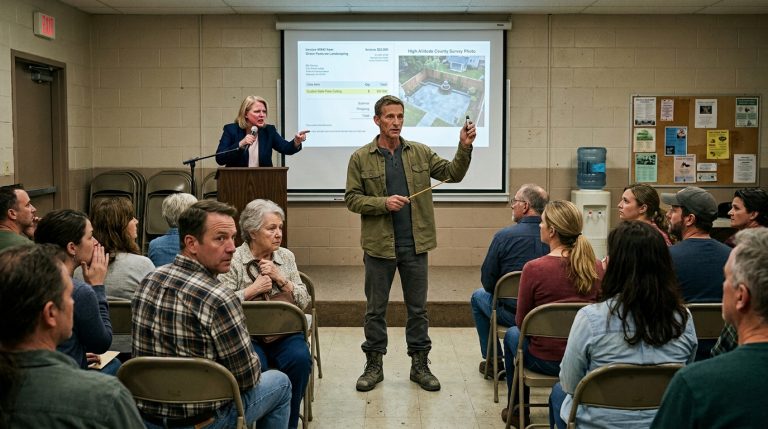
The community clubhouse usually stood as a sterile, quiet monument to suburban bureaucracy, but on the evening of the emergency meeting, the air inside was thick and electric with a long-suppressed collective rage. It was standing room only. Every folding chair was occupied by residents who had spent years biting their tongues, now buzzing with a sharp, awakened sense of empowerment.
Mark sat in the front row between Sarah and Dave, his posture calm and balanced. To his left, Mrs. Gable and her son shared a quiet nod, while Major Frank Peterson stood silently near the double doors at the back, an imposing, motionless observer holding a leather briefcase packed with the final legal surrender.
At the long mahogany table at the front of the room, Karen sat flanked by her remaining board members. They looked pale, rigid, and cornered. Karen tried to strike her usual pose of absolute command, reaching out to tap a wooden gavel against the tabletop to call the room to order, but her hand shook. The sharp crack of the gavel fell flat against an unyielding wall of silence.
The room did not obey.
Dave stood up immediately, his frame blocking the view of the podium. “We’re not here to read the minutes of the last meeting, Karen,” Dave announced, his voice booming effortlessly through the room. “We’re here to discuss the federal lawsuit that’s about to bankrupt this community’s insurance pool, and the president whose personal crusade caused it.”
A low murmur of agreement rippled through the packed rows.
Dave didn’t rely on legal jargon; he spoke in plain, hard truths. He laid out the history of arbitrary fines, the manufactured violations, and the selective intimidation tactics. Then, stepping aside, he tapped a remote linked to the wall-mounted projector.
The screen flickered to life, projecting the video Dave had captured during the storm—the exact frame where Karen stood over the extension cord, screaming about bylaws and trip hazards while a neighbor’s life support hung in the balance. The harsh, unflattering light of the projector exposed every twitch of her panicked expression to the entire neighborhood.
An angry, collective wave of disbelief swept through the crowd.
Before Karen could stammer a defense, Mrs. Gable’s son stood up, laying out the financial devastation. He detailed the D&O insurance policy exclusions, explaining how the board’s malicious, intentional discrimination had legally voided their coverage, leaving every single board member personally liable for the four-thousand-dollar legal fees and damages.
The accountant, Stan, sitting two seats down from Karen, turned deathly pale. His hands gripped the edge of the table as the realization hit him: his personal savings, his home equity, and his retirement account were being held hostage by Karen’s ego.
Finally, Mark stood. He didn’t raise his voice; he let the absolute weight of quiet facts carry across the room. He spoke of Lily, of the rare autoimmune condition, of the biological medication that required a stable temperature, and of the formal notification letter sent months prior that Karen had willfully ignored. He held up the board’s signed rejection letter, reading the damning sentence aloud for everyone to hear: The board is not bound by individual medical requests that compromise the visual integrity of the community.
A heavy, suffocating silence fell over the room. The last vestige of sympathy for Karen evaporated into the air.
Stan stood up abruptly, his chair scraping loudly against the linoleum floor. “I move for an immediate vote of no confidence in President Karen Smith,” he said, his voice shaking but clearly audible. “And a motion for her permanent removal from the board.”
The board member seated to Karen’s right immediately seconded it.
The vote wasn’t close. It was a landslide, a near-unanimous roar of hands raised across the entire room. Karen was stripped of her title, her gavel, and her authority in a single, brutal public spectacle. She sat frozen at the front table, her face locked in a mask of bitter disbelief as the kingdom she had ruled through fear dissolved around her.
The aftermath was swift. With Karen deposed, the remaining board members capitulated completely to Frank’s terms within twenty-four hours. All fines against Mark were permanently rescinded, accompanied by a formal written apology published in the community newsletter. The legal fees were shifted entirely to the personal responsibility of the board members who had enabled the crusade, sparing the community treasury. Most importantly, the bylaws were rewritten from the ground up, permanently embedding protections for medical equipment, transparent architectural reviews, and strict limits on administrative overreach.
A few months later, the house with the peeling paint and the army of plastic garden gnomes quietly went on the market. The last Mark saw of Karen was through the front window—she stood in her driveway, directing a crew of moving men with a tired, broken wave of her hand, before climbing into her car and driving away from the neighborhood forever.
The transition back to normalcy was marked not by silence, but by renewal.
On a bright, sun-drenched Saturday afternoon, the community hosted a barbecue in the central park. The newly elected president, a soft-spoken retired teacher, called Mark and Sarah up to the front and presented them with an oversized check for five thousand dollars, made out in Lily’s honor to the National Foundation for Autoimmune Research. The applause from the surrounding neighbors was genuine, warm, and deeply felt.
Later that evening, the celebration faded into the quiet stillness of twilight. Mark sat alone on his back porch, a cool ceramic mug of coffee resting on the wooden railing. The air felt lighter, cleared of tension and friction. Out in the yard, Lily chased a cluster of glowing fireflies, her carefree laughter echoing softly against the darkening sky.
Beside the patio, the generator sat in its recessed concrete pad—a low, quiet sentinel. It no longer represented a battle line or a point of conflict. It was simply a testament to endurance, a physical reminder that sometimes a man’s duty is not just to protect his own roof, but to hold the line until the entire neighborhood is safe again.
Mark reached out, running his hand along the smooth, polished wood of the porch railing he had repaired that morning, feeling the solid, grain-worn texture beneath his fingers. Justice had not been won in a distant courtroom; it had been settled right here, in the quiet earth of their own backyard.