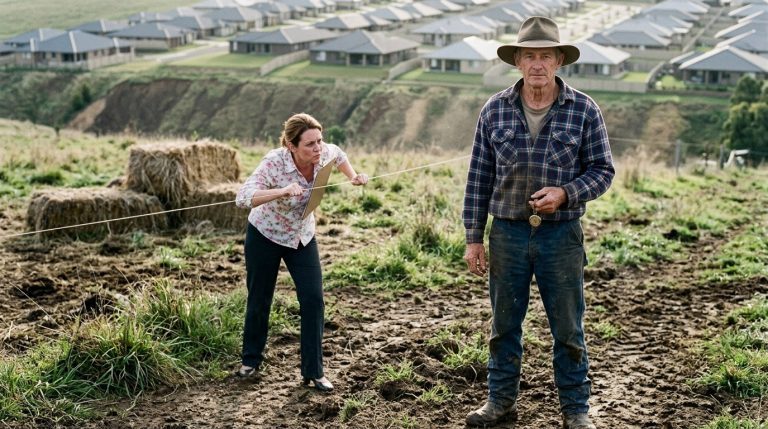
The Concrete Kingdom Met the Iron Will of an 1824 Homestead, and the Price of Entitlement Was Exacted in Full
CHAPTER 1: The Driveway Ultimatum
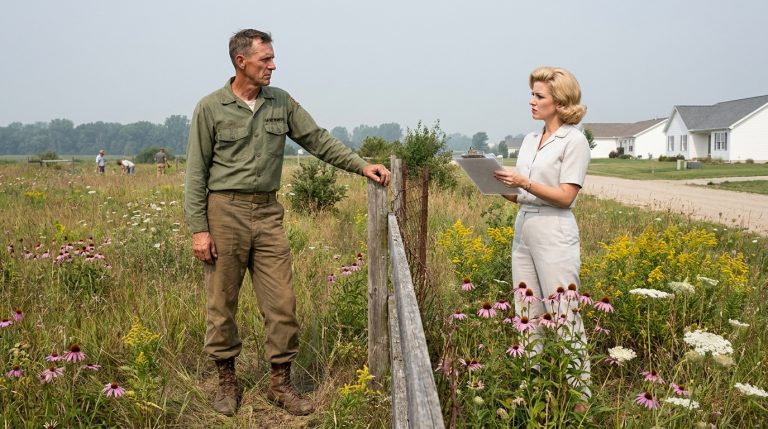
The cold iron of the fence post bit into my palm, rusted and familiar, a texture carved by two centuries of stubborn weather.
I didn’t look up right away from the staple I was hammering.
The white SUV sat idling twenty yards off, its pristine paint job looking entirely out of place against the peeling red wood of my grandfather’s barn.
The driver’s side window slid down with a faint mechanical whisper, revealing a pair of oversized designer sunglasses and an expression carved entirely out of grievance.
“The HOA’s annual summer gala will be held on your property this Saturday,” she called out, her voice carrying that sharp, practiced inflection of someone accustomed to speaking into a microphone.
Not asked. Told.
I kept my eyes on the wood, tapping the rusted staple another half-inch into the oak post with three measured strikes.
“We’ve hired caterers, tents, one hundred and twenty-five guests,” she continued, gesturing broadly toward my back meadow—the stretch of high grass and wildflowers she had spent eighteen months calling an eyesore and a weed patch. “Be ready by noon.”
She didn’t wait for an acknowledgment, tapping the accelerator and kicking up a spray of limestone gravel before I could even straighten my back.
I wiped a smear of sweat and red dirt from my forehead with the back of my wrist, letting out a slow, heavy breath that tasted faintly of dust and dry grass.
The silence that rushed back in after her engine faded wasn’t peaceful; it was the heavy, loaded quiet of a fuse that had just been deliberately lit.
CHAPTER 2: The Paper Trail
The kitchen table was buried under county ordinance books and heavy binders that smelled like old paper and municipal coffee.
I didn’t turn on the television.
The silence inside the house was dense, broken only by the steady tick of the wall clock and the distant, muffled crow of a red rooster out in the coop.
My grandfather always kept the zoning records locked in a tin box behind the pantry, right next to the original 1824 land patent.
I flipped open the county code manual to Section 408, running a calloused thumb down the margin where public assembly rules were underlined in red ink.
Holding a commercial event for more than one hundred people on agricultural land requires four distinct sign-offs: a health department permit, a fire marshal safety inspection, verified liability insurance, and explicit written consent from the deed holder.
She had zero out of four.
Tucked underneath a stack of feed store receipts sat a crumpled piece of paper I’d picked up off the property line yesterday—a catering deposit slip bearing a corporate logo and a timestamp that didn’t match any local vendor.
The numbers didn’t add up.
A standard catering drop for a private party doesn’t require a commercial site fee breakdown unless money is changing hands under the table.
She wasn’t just planning a neighborhood get-together; she was running an unpermitted commercial ticket sale on land she didn’t own.
I tossed the receipt onto the wood table, reaching for my coffee mug only to find it stone cold and dark as ditch water.
The sheriff’s office phone number was already written on a yellow notepad by the landline, but I didn’t pick up the receiver.
Calling the deputies now would only get her slapped with a minor trespass warning, and she would simply pack up her tents, cry victim, and find another way to chip away at my boundary line next month.
No, a warning wouldn’t stick.
I needed to let the machinery of her own arrogance spin fast enough to throw a rod.
I closed the ordinance book with a heavy thud that rattled the sugar bowl, my eyes drifting toward the window facing the back meadow.
Let her print the flyers.
Let her sell the tickets.
When the tents went up on Saturday, I’d be ready to show her exactly what happens when you build a kingdom on someone else’s foundation.
CHAPTER 3: The Gathering Storm
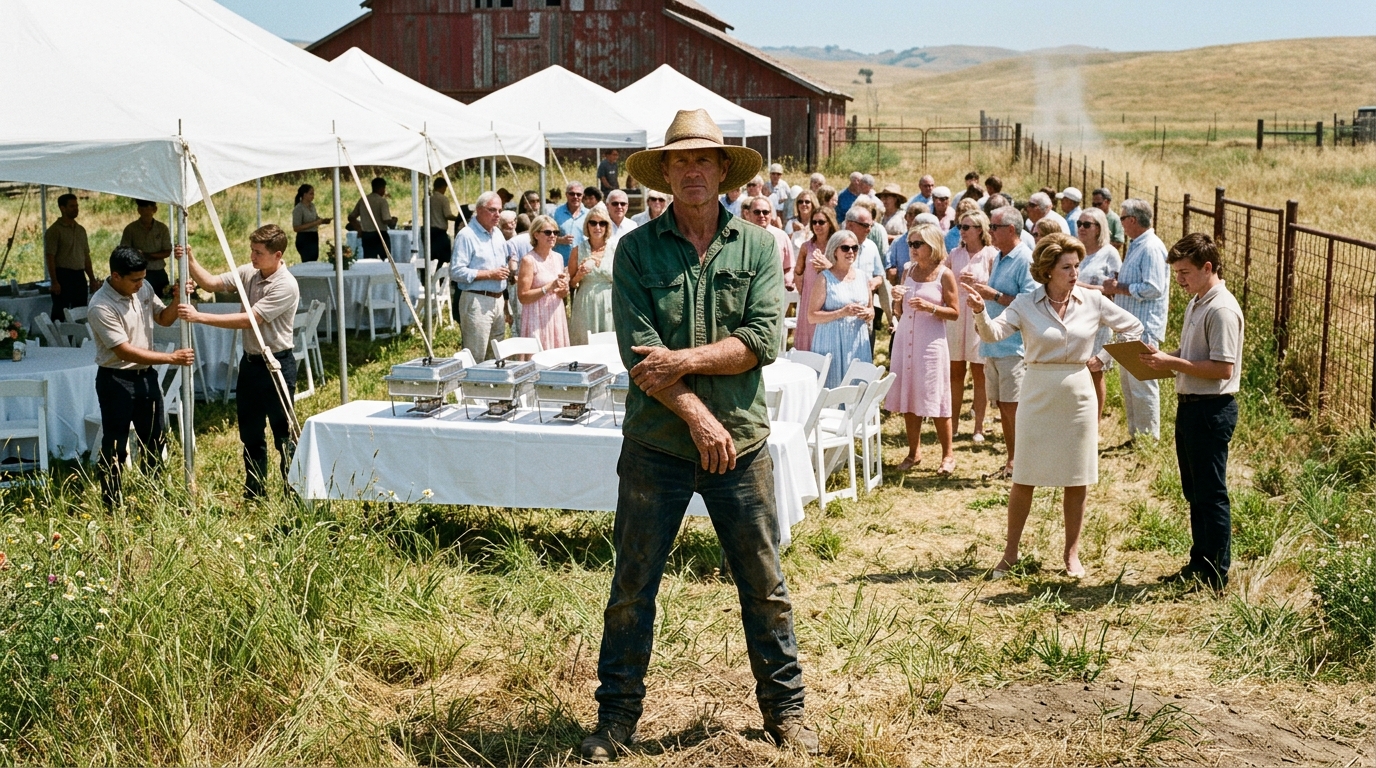
The midday sun beat down hard on the dry soil, raising a thin haze of limestone dust as vehicles began stacking up along the property line.
I stood by the old tractor shed, watching a sleek catering van idle near my back meadow while drivers unloaded folding tables and polished silver chafing dishes.
People in pastel sun hats and designer footwear spilled out across the high grass, stepping over clover and wild chicory as if they were checking into a resort lobby.
The HOA president stepped out of her white SUV, smoothing down a cream-colored skirt and barking instructions at a bewildered teenager holding a clipboard.
“Make sure the VIP seating faces the sunset,” she commanded, her voice cutting sharp across the quiet farmyard.
Not a single person in that crowd looked down at the mud caked on their shoes or questioned why there were no public utility hookups in sight.
They had bought the story hook, line, and sinker—believing this historic pasture belonged to their neighborhood association.
I reached into my pocket, my fingers brushing against the cold steel staple puller as I watched them hammer white canvas tent stakes directly into my granddad’s sod.
The air grew heavy with the sweet, synthetic scent of high-end floral perfume mingling with the dry heat of high noon.
It was almost time.
CHAPTER 4: The Irrigation Roar
The engine caught with a deafening cough, roaring like a freight train across the quiet afternoon air.
I shoved the throttle forward, locking the metal arm into place as water surged through the rusted aluminum pipes with a violent shudder.
Out in the back meadow, the elegant murmur of the summer gala instantly evaporated beneath the mechanical howl.
The oscillating sprinklers bolted near the property line jerked violently upward, spitting a heavy, pressurized arc of pond water straight over the pristine white canvas tents.
High-priced sun hats jerked back in unison as a fine, misting spray carrying the unmistakable, rich aroma of bottom-land sediment drifted directly across the catered dining tables.
I watched through the dirty screen of the barn window as guests leaped out of folding chairs, frantically clutching porcelain plates and swatting at the drifting moisture.
The HOA president bolted upright from the head table, her face flushing a deep, mottled crimson as a drop of nutrient-rich water landed squarely on her cream-colored skirt.
She opened her mouth to scream commands, but the roar of the pump drowned out every word before it could cross her lips.
CHAPTER 5: The Sirens Echo
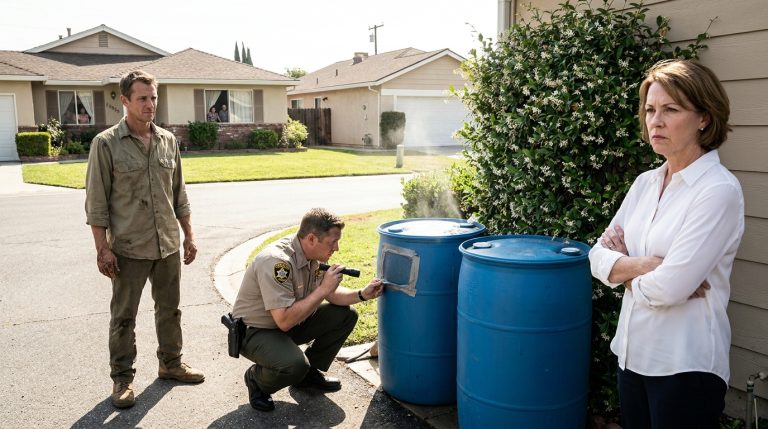
The deputy cut the engine, stepping out onto the crushed stone with a heavy duty belt creaking under the weight of his gear.
Beside him, the fire marshal strode briskly toward the meadow, clipboard raised high against the swirling mist of the pump’s discharge.
Out under the ruined white tents, panic had already taken root among the guests.
Porcelain plates hit the grass with muffled thuds as people scrambled backward, abandoning folding tables and expensive sun hats to escape the drifting agricultural spray.
The HOA president marched down the center aisle, her heels sinking deep into the mud, eyes blazing with fury as she intercepted the authorities.
—You have no right to be here!— she shrieked, pointing an acrylic fingernail directly at the deputy’s chest. —This is a private community function! Arrest that farmer right now!—
The deputy didn’t flinch, holding up a hand to halt her advance while the fire marshal scanned the unpermitted commercial rigging with a grim expression.
—Ma’am, step aside,— the deputy commanded, his voice flat and unyielding. —We’ve received complaints of an illegal mass assembly, unpermitted commercial vending, and unauthorized land usage.—
She spun around, her face twisting in desperate defiance as she pointed a shaking hand straight at me where I stood leaning against the barn door.
—He gave us permission! It’s community property! He said we could use it!—
I didn’t rush.
I walked slowly down the gravel path, pulling a clear plastic folder from my canvas jacket and sliding the 1824 deed, the unreturned emails, and the printed ticket sales ledger right into the deputy’s open hands.
—Never agreed. Never got paid. And she charged every single person here fifty bucks a head for the privilege,— I said plainly, letting the paper speak for itself.
The deputy flipped through the pages, his eyes hardening as he compared the signatures against the commercial receipts fluttering in the wind.
He turned back to the pale, stammering woman whose empire of entitlement had just completely run out of road.
—Step over to the cruiser, ma’am. We’re going to have a long conversation about fraud and trespassing.—
CHAPTER 6: The Final Crow
The legal collapse didn’t happen overnight, but when it hit, it arrived with the weight of an iron anvil.
County courts upheld every citation, slapping the ex-president with heavy fines for unpermitted commercial operations and false advertising.
The catering companies and tent rentals didn’t wait for the state; they filed civil suits to recover their losses, dragging her through depositions where her grand defense crumbled into excuses.
Residents from the subdivision flooded the neighborhood forums with refund demands and angry questions, realizing they had been played for fools by a woman who treated their trust like a balance sheet.
By the end of the week, her resignation letter was pinned to the HOA bulletin board like a tattered flag of surrender.
The new board president mailed a formal apology to my box, accompanied by a written acknowledgement that my family’s 1824 acreage held zero connection to their community rules.
Judges ordered her to pay thousands in restitution, covering site fees and civil damages that stripped away her polished suburban leverage down to the bare studs.
She retreated behind her white SUV, sitting parked at the edge of the subdivision with her phone glued to her ear, watching her manufactured kingdom turn to dust.
I didn’t gloat, and I didn’t chase her down.
I took the settlement funds and invested them right back into the homestead, purchasing a brand new rooster—a magnificent, high-strung bird with a voice like a foghorn.
Now, every morning at 4:30 sharp, that bird lets out a piercing cry that echoes straight across the property line.
I sit right here on the porch, sipping dark coffee from a chipped ceramic mug, listening to the morning breeze carry the scent of damp earth and clean rain.
The new board members wave when they drive past, respecting the boundary lines and keeping their distance.
Entitlement is a loud thing, but it has a short shelf life when it crashes headfirst into common sense and hard ground.
Some folks learn their lessons quietly, and some learn them while listening to a rooster crow at dawn.