The Silent Heiress Reclaims Her Empire from the Family That Erased Her
CHAPTER 1: THE NAMELESS SEAT
The cream-colored cardstock sat on my kitchen counter, heavy enough to feel important. The gold script requested my presence at the Quinland estate for a “strategic planning session,” but the text my mother sent ten minutes later delivered the real instruction: Be calm. Let your sister lead. Don’t cause trouble this time.
I set my coffee mug down on the hardwood counter, watching the steam curl into the morning light. Eight years of building a multi-million-dollar logistics operation out of a rented apartment, and to them, I was still the difficult middle child who needed to be managed.
I arrived five minutes early. The iron gates at the estate squeaked with that familiar, dry screech as I pulled my sedan onto the gravel driveway. I parked well clear of the main entrance, leaving an open path to ensure my car wouldn’t be blocked in when the time came to leave.
Inside, the formal dining room had been gutted and rebuilt into a corporate boardroom. Thick oak tables lined the rug, set with brass nameplates, leather-bound folders, and glass carafes of water.
I walked the length of the table, scanning the engraved names. My father sat at the head. Next to him was my sister, Valora, then her husband, then the family estate attorney, Mr. Rudd.
“Your seat is over here, Ms. Quinnland,” an estate assistant muttered, barely looking up from her clipboard.
She pointed toward the far wall, right next to the heavy double doors leading to the service kitchen.
The chair was made of lightweight pine, noticeably smaller than the leather armchairs surrounding the primary table. In front of it lay a blank index card—no title, no name, no folder. Just a plain black ballpoint pen resting beside it.
I didn’t sit immediately. I stood behind the pine chair, adjusting the cuffs of my navy suit jacket. I picked up a titanium pen from my pocket, slowly turning the metal barrel between my thumb and forefinger, feeling the cool weight of the metal against my palm.
Across the room, Valora was laughing with Mr. Rudd, her cream blazer immaculate, her posture effortless. She didn’t look up when I entered. She didn’t need to. The seating arrangement was her message, mapped out long before the doors opened.
“Theres?” A small voice chirped from near the sideboard.
My seven-year-old niece stood there holding a juice box, staring up at me. “Who is she?” she asked her mother.
My cousin didn’t hesitate. She grabbed the girl’s shoulder and pulled her backward toward the buffet line. “Oh, that’s just your aunt. She used to live in Austin. She’s just visiting.”
Just visiting. As if the coats in the hall hadn’t been bought with my money, and the birthday gifts in her room hadn’t come from my office.
My uncle Douglas sat down two chairs down from my pine post, grunting as he settled his weight. He didn’t look at my face. He kept his eyes fixed on his iPad.
“Didn’t know you were coming,” he said, his voice flat.
“Neither did the person making the nameplates,” I replied quietly.
He gave a dry, dismissive chuckle, tapping his screen. “Well. At least you came to observe. Some roles don’t require speaking.”
I aligned my titanium pen perfectly parallel to the edge of the blank index card. I didn’t raise my voice. I didn’t pull back my shoulders to make a point. I just watched Valora stand up at the head of the table, tap her microphone twice, and open the binder that contained my life’s work.
CHAPTER 2: THE ERASED LEDGER
Valora cleared her throat, her voice projection crisp from years of local networking luncheons. “As you’ll see in your agenda packets, the family office is streamlining our operational branches for the upcoming fiscal quarter.”
I reached down and lifted the thin manila folder resting on the corner of my pine chair. It came without a staple. I flipped open the cover.
Page after page outlined the portfolio: Lucas’s real estate venture, Douglas’s logistics equipment lease, Valora’s strategic advisory branch. Every single project I had single-handedly restructured over the last four years had been quietly rebranded under “Quinland Strategic Core.” My name didn’t appear in the margins. It didn’t appear in the historical footers. It didn’t exist.
“If everyone turns to tab three,” Mr. Rudd instructed, his dry voice echoing off the hardwood floor, “you’ll see the proposed legal allocations.”
I didn’t turn to tab three. I pushed my chair back—the unweighted pine legs scraping loudly against the tile—and stood up.
Valora’s speech didn’t stumble, but her eyes flicked toward me, narrowing just a fraction of a millimeter. “Theres, we’re in the middle of the presentation. Restrooms are down the hall on the left.”
“I know where the rooms are, Valora,” I said smoothly. “I grew up here.”
I stepped away from the table, leaving my agenda packet open on the blank chair. I walked out of the dining room, my heels making a deliberate, measured click against the parquet floor of the main hallway.
Instead of turning toward the powder room, I slipped sideways into my father’s former study. The room smelled of old paper, stagnant cedar, and unventilated dust. The heavy mahogany desk sat in the center, its surface cluttered with unfiled mail and legal binders bearing Mr. Rudd’s corporate stamp.
I didn’t have a master security key or a digital bypass. I had five minutes before someone realized I wasn’t in the bathroom.
I pulled open the bottom right drawer. It snagged on a loose folder. I reached in, feeling along the wooden track until my fingers caught the edge of a thick, green hanging file marked Wills & Allocations.
Inside were two separate drafts. The first was dated eight months ago. My name was listed clearly as co-trustee of the technology infrastructure assets.
The second document was stamped six weeks ago.
I flipped to the signature page. My name had been completely scrubbed, the line reallocated directly to Valora’s private holding company. But as I shifted the pages, a folded piece of paper slipped from between the legal stock and fell to the floor.
It was an unredacted bank transfer receipt from four years ago. It bore my mother’s fluid cursive signature at the bottom, authorizing a six-figure wire out of the primary trust account into a defaulted commercial loan held under Lucas’s name. Attached to it was a revoked corporate account statement, showing the primary family trust was operating on a paper-thin margin, entirely dependent on secret liquidity injections.
They hadn’t just omitted me to keep me in my place. They were hiding the fact that the family empire was already hollow, and they needed my unencumbered assets to cover the floor before it caved in.
The study door handle turned with a sharp, metallic latch-click.
CHAPTER 3: THE STOLEN BLUEPRINT
Mr. Rudd stood in the doorway, a thick stack of fresh blue-bound folders tucked under his arm. He blinked twice, his eyes darting from my hands to the cracked drawer.
“Ms. Quinnland,” he said, his voice flat, professional, and slightly strained. “Your sister requested your return to the main room. We are moving into the execution phase.”
“Execution phase,” I repeated softly, slipping my phone into my pocket. “Appropriate term.”
I walked past him into the hallway without another word. The dining room air was humid now, heavy with the smell of catered roast chicken and stale coffee.
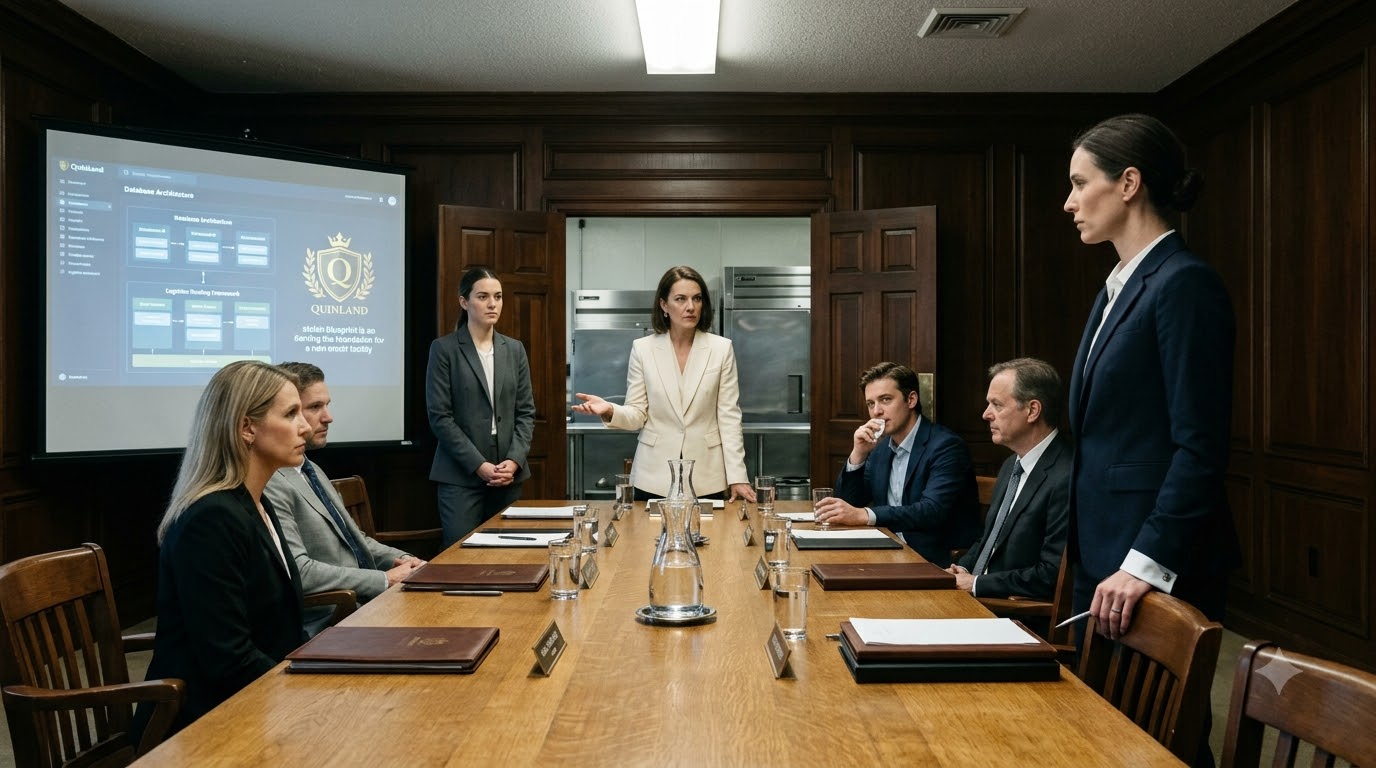
Valora stood at the head of the long oak table, gesturing toward a woman in a sharp charcoal pantsuit standing beside the projector screen. It was Kayla—my former operations lead from three years ago, whom I had personally trained before she quietly resigned to “pursue independent ventures.”
“As part of our digital modernization,” Valora announced, her voice booming with practiced authority, “Kayla will be presenting the central pillar of Quinland Strategic Core: our proprietary logistics routing framework.”
Kayla clicked a handheld remote. The projector hummed, casting a glowing slide onto the white wall.
I sat down in my nameless pine chair near the double doors. On the screen was the exact user interface, database architecture, and load-balancing algorithm I had spent four years developing in my Denver apartment. Every color scheme, every data flow node, every efficiency formula was identical—except my company logo had been scrubbed and replaced with a gold Quinland crest.
“Efficiency isn’t about speed,” Kayla recited smoothly, using the exact phrase I had written in her performance review two years prior. “It’s about total invisibility.”
Across the table, my brother Lucas tapped his water glass, offering a proud, theatrical nod. My mother dabbed the corner of her lip with a cloth napkin, smiling at Valora like a proud matriarch at a coronation.
“This platform,” Valora continued, stepping toward my end of the table, “will serve as the collateral foundation for our new credit facility.”
She slid a thick blue folder across the wood. It skidded past the mahogany armchairs and came to a stop right against the edge of my bare pine seat.
“We just need your signature on section four,” Valora said, her voice dripping with artificial sweetness. “It acknowledges that you were involved in the initial ‘family brainstorming sessions’ and waives any external IP claims. A pure formality so the bank can finalize the line.”
I opened the blue folder. Section four was three paragraphs long, explicit in its language: I hereby assign all rights, title, and interest in any logistics software developed during my tenure with or adjacent to Quinland entities.
They weren’t just erasing me. They were using my stolen intellectual property as the financial life raft to bail out Lucas’s debts and cover the insolvent trust.
Valora extended a sleek gold fountain pen toward me. “Initial the bottom right, Theres. Let’s not drag this out into the afternoon.”
I pulled my titanium pen from my pocket, unscrewed the heavy metal cap with a sharp, deliberate click, and laid it directly across the signature line.
“I won’t be signing that, Valora,” I said.
CHAPTER 4: THE ESCORT OUT
Valora’s hand froze mid-air, the gold fountain pen hovering between us. A tight, white line formed around her lips—the only crack in her carefully rehearsed composure.
“Don’t be ridiculous, Theres,” she said, her voice dropping an octave into that low, dangerous tone she used when staff made mistakes. “This isn’t a negotiation. It’s an administrative update.”
“It’s intellectual property theft,” I said, my voice steady enough to cut through the hum of the projector. “And section four asks me to certify a lie.”
Across the table, my father slammed his palm against the wood. The water glasses rattled. “That is enough! You come into this house, you take up space, and you immediately start throwing accusations around. Valora has spent six months putting this package together!”
“Valora spent six months copying code my engineers wrote in Denver,” I replied, looking directly at Kayla.
Kayla’s throat swallowed hard. She shifted her weight, suddenly very interested in the carpet near the presentation screen.
Mr. Rudd stood up, smoothing his tie with a trembling thumb. He leaned toward my father, whispering just loud enough for the head of the table to hear: “If she doesn’t sign the waiver, the bank’s legal team won’t release the second tranche on Monday.”
Valora didn’t panic. Instead, her posture hardened into pure, cold arrogance. She raised her hand toward the double doors behind my chair.
“We tried to include you, Theres,” she said smoothly, addressing the room rather than me. “We offered you a seat at the table. But if you’re going to actively sabotage the family’s legacy, you are no longer a permitted party to these proceedings.”
The double doors opened behind me. A man in an unbadged navy windbreaker stepped into the room—a private security handler Valora had hired for the event.
“Please escort Ms. Quinnland off the estate grounds,” Valora said without looking back at me. “She’s trespassing.”
A quiet gasp rippled through the cousins at the far end of the room. My mother didn’t look up; she kept her eyes fixed on her manicured nails. Lucas smirked into his water glass.
The guard stepped forward, reaching for my elbow. I didn’t flinch. I didn’t scream. I stood up before his fingers could touch my jacket, sliding my titanium pen back into my inner pocket alongside the bank transfer receipt.
“Touch me,” I said softly to the guard, “and your agency receives a formal notice of liability before I reach the gate.”
He hesitated, stepping back two inches to give me space.
I picked up my bag, adjusted my shoulder strap, and looked down the long oak table at my family.
“You think kicking me out of this room protects your deal,” I said, holding Valora’s gaze until her eyes flickered. “You have no idea what you just started.”
I turned and walked through the double doors, my heels clicking clean against the tile, leaving them alone in their hollow kingdom.
CHAPTER 5: THE MANUAL STRIKE
I didn’t have an automated master button on a laptop screen to freeze their world in three seconds. I had to do this line by line, phone call by phone call, invoice by invoice.
I leaned against the hot frame of my car door and dialed my lead corporate attorney directly.
“Rachel,” I said, my voice steady over the rush of distant highway traffic. “Execute the IP freeze on all module licenses registered under my personal tax ID. Issue formal cease-and-desist notices to the bank’s underwriting council before four o’clock.”
“They’ve already submitted the preliminary application,” Rachel warned, her keyboard clicking rapidly in the background. “If we hit the underwriters directly, their loan facility freezes immediately.”
“Hit them directly,” I said. “And attach the wire receipt from four years ago. Show them the primary trust is already running a default deficit.”
I ended the call and opened my banking application manually. Without my custom automated interface, I spent twenty minutes inputting manual overrides: pulling the corporate guarantee off Lucas’s equipment leases, removing my secondary credit backing from the family’s fleet fuel accounts, and revoking my personal guaranty on the estate’s primary utility line.
My phone buzzed in my hand before I could even turn the key in the ignition.
It was Valora. I let it ring until it cut to voicemail. Three seconds later, another call hit the screen—my mother. Then Lucas.
My screen lit up with a barrage of text messages:
Theres, what did you do? The fuel cards at the regional depot just got declined.
Call Dad right now. Mr. Rudd says the bank halted the audit.
You are ruining this family over a petty dispute!
I didn’t type a word back. I tapped the power button, set the phone on the passenger seat, and started the engine.
They had built an entire house of cards on the assumption that I would keep funding the foundation out of habit, guilt, and a desperate desire to be invited to Thanksgiving. They thought my silence was weakness, and my presence was an option.
As I pulled out through the iron gates, I saw Valora burst out through the front doors of the estate, her phone pressed furiously against her ear, her face pale as she waved frantically at my retreating car.
I didn’t slow down.
CHAPTER 6: THE UNBROKEN FOUNDATION
The gold foil trim on the envelope caught the afternoon sun. Inside was a handwritten note from Valora on heavy stock paper, asking for a “restorative brunch” to navigate our “shared path forward.”
There was no apology in the script. No acknowledgment of the bank’s formal denial of their credit line, or the cease-and-desist orders Rachel had hand-delivered to Mr. Rudd’s office. Just a sudden, desperate urge to reconnect now that the bank had frozen their accounts and local business journals were sniffing around Quinland Holdings’ insolvency.
My phone screen flickered on the desk beside me. A voicemail notification popped up from my father.
I played it on speaker. His voice was raspy, stripped of the booming authority he had used in the dining room. “Theres… Valora says the bank won’t talk to us without your release. We’re your family. You can’t just leave us stranded like this after everything we gave you.”
Everything they gave me. An armless pine chair by the service door, an un-stapled packet, and a blank index card.
I picked up the cream invitation, slid it into the electric shredder on the side of my desk, and watched the gold script turn into neat, thin strips of gray dust.
I opened my laptop. Rachel had already uploaded the finalized paperwork for my new independent venture—a logistics incubator built specifically to fund and support young, female-led startups who had been squeezed out by corporate gatekeepers.
I signed the registration documents electronically using my finger on the trackpad. No automated backend tricks, no hidden shell accounts. Just clean, verifiable ownership tied directly to my name.
An email notification dropped into my inbox from my father’s personal address. The subject line was five words long: You were right. I’m sorry.
I stared at the screen for a long moment. It was the sentence I had spent twenty years waiting to hear. But looking at it now, rendered in plain black font against a white background, it didn’t change the foundation beneath my feet.
I closed the laptop screen slowly until the latch clicked shut.
I picked up my ceramic coffee mug, walked out onto the sunlit back patio, and set it down on the small iron table. I took a slow sip, feeling the quiet warmth of the Austin breeze, completely untethered.