The Architect of Silence: A Fragile Restoration of the Empty Halls and Reclaimed Heart
CHAPTER 1: The Arrival of the Unremarkable
The silence in the Cole estate was not an absence of sound; it was a physical weight. It hung in the air like a heavy, velvet curtain, deadening the tick of the grandfather clock and the rustle of Ethan’s papers.
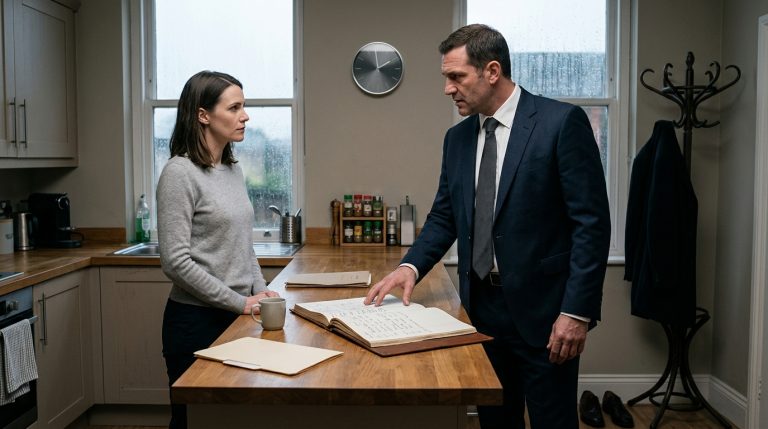
Naomi Carter stepped over the threshold with nothing but a canvas bag. She was twenty-eight, her coat damp from the autumn drizzle, and she possessed a face that betrayed no practiced polish. She didn’t look up at the vaulted ceiling or track the path of the expensive, impersonal artwork lining the foyer. Instead, she paused, her head tilting slightly to the left, as if listening to the house’s breathing.
Ethan watched from the doorway of his study, his fingers drumming a silent, jagged rhythm against his thigh. He held his breath. He had seen three others leave—one with tears, one with a text message, one with a lingering, terrified glance at the stairwell—and he had already composed the rejection note for this one in his mind.
“Gerald,” she said, her voice dropping into the hallway without a ripple. “Where do you want the focus to start? The dust, or the light?”
Gerald, whose composure was usually as immovable as granite, hesitated. “The library, I suppose.”
Naomi nodded, a movement so simple it felt foreign in the calculated stillness of the house. She didn’t ask about the master of the house, nor did she inquire about the son who had occupied the second-floor window for three years. She simply placed her bag on the stone floor, her movements fluid and unhurried.
Ethan gripped the doorframe, his nails digging into the wood. He had spent his entire life building empires on the premise that everything had a price and every problem had a technical solution. But as he watched Naomi pull a pair of gloves from her pocket and walk toward the library without casting a single glance toward his study, he felt a flicker of something he hadn’t prepared for.
She didn’t know she was being watched. Or, if she did, she didn’t care enough to perform for him.
The air in the hallway seemed to vibrate with a sudden, sharp tension. Ethan stepped back, intending to retreat into his solitude, but his foot caught the edge of a heavy, brass-bound ledger on his desk. It tipped, the spine hitting the floor with a resonant, thunderous crack that shook the room.
He waited for the echo to die, his pulse hammering against his throat.
Down the hall, Naomi stopped. She didn’t jump. She didn’t turn around in a panic. She stood perfectly still for three seconds—a long, agonizing count—before she continued walking toward the library.
But as she passed the archway, her hand briefly brushed the wall, the tips of her fingers lingering for a fraction of a second on the cold, smooth plaster, as if she were testing the pulse of the building itself. Then, she vanished into the library, and Ethan found himself staring at the spot where she had stood, gripped by the sudden, chilling realization that for the first time in three years, the house had moved.
CHAPTER 2: The Geometry of Distance
Ethan didn’t move for a long time. The ledger lay open on the carpet, its pages splayed like the wings of a grounded bird. Outside the study, the house was aggressively silent, the kind of quiet that felt polished and maintained. He stared at the brass-bound corners of the book, his heart hammering against his ribs in a syncopated, erratic rhythm that he didn’t recognize.
He was a man who lived by the clock, by the fiscal quarter, by the predictable trajectory of market trends. He did not lose his grip on objects. He did not stand in doorways, paralyzed by the sound of a housekeeper’s footsteps.
He bent down, his joints stiff, and retrieved the ledger. The paper felt brittle under his fingertips, a texture he had never truly noticed until now. He placed it back on the mahogany desk, aligning its edges with the edge of the blotter, ensuring that everything was back in its rightful, rigid geometry. But the air in the room felt altered. It wasn’t the sterile, temperature-controlled atmosphere he had paid for; it held the faint, metallic scent of damp wool and autumn rain—the scent of someone who walked outside.
He walked to the study door and cracked it open just enough to see the gallery. Naomi was moving toward the East Wing, her movements precise. She wasn’t rushing, nor was she lingering to admire the high-priced, emotionless oil paintings. She was working.
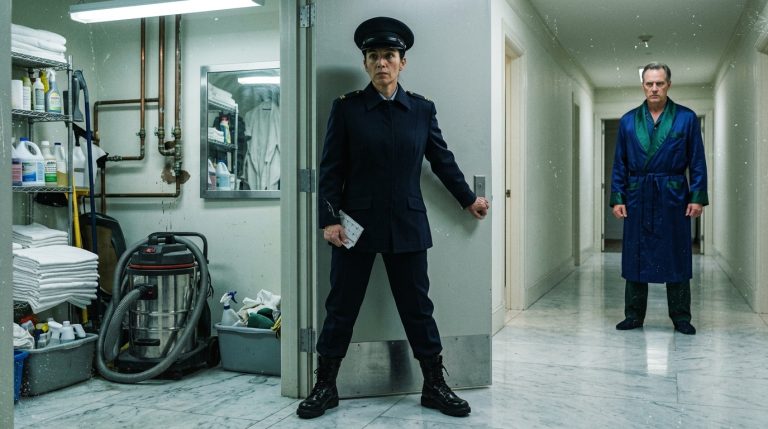
Ethan felt the familiar, clawing urge to know exactly what she was doing. He retreated to the staff locker room, his movements efficient, almost mechanical. He pulled on the guard’s uniform, the fabric heavy and abrasive against his skin. It smelled of someone else’s aftershave—a cloying, cheap scent that made his stomach turn—but it was a necessity. It was the skin he wore to navigate his own home without being acknowledged as the owner.
In the uniform, he felt invisible. That was the point.
He began his rounds, his footsteps muffled by the thick, expensive runner that stretched through the hallways. He kept a precise distance: thirty paces behind, always turning a corner just as she vanished around the next. He wasn’t just observing her; he was mapping her. He noted the way she never checked her phone, how her eyes didn’t dart toward the security cameras, and how she seemed to move as if she were waiting for the house to tell her something.
When she reached the second-floor gallery, Ethan slowed, ducking behind the shadow of a marble bust of a Roman senator. He had forgotten how long the gallery was, how the morning light sliced through the tall, narrow windows to create bars of illumination across the floor. Naomi stopped. She wasn’t looking at the paintings. She was staring at the doorway of the music room, her head tilted, the same listening posture she had held in the foyer.
Ethan realized with a jolt of anxiety that she was listening for Liam.
He watched, breathless, as she didn’t approach the room. Instead, she adjusted her grip on her cleaning cloth and turned, walking toward the stairs. She hadn’t looked for his son. She hadn’t tried to force a connection. She was simply letting the house exist, letting the silence be a space rather than a weapon.
A cold, sharp phantom of a thought flickered through Ethan’s mind: She is doing exactly what you cannot.
He leaned against the cold marble base of the bust, feeling the grit of it against his shoulder. He had spent three years throwing every resource at Liam—therapists, tutors, specialists, weighted blankets that cost more than a mid-sized sedan—and he had achieved nothing but the deepening of the boy’s retreat. And here was a woman who didn’t even have a title, simply existing in the space, doing more in ten minutes than an army of professionals had done in thirty-six months.
The shame was a sudden, physical weight, heavy and suffocating. He realized then that his observation was no longer about security or control. It was a mirror. He was watching her to see what he had failed to be, and the sight of her competence felt like a serrated edge against his pride.
He saw her pause at the base of the stairs. She didn’t look back, but she stood still, her silhouette framed by the silver, morning light, and for a terrifying second, Ethan was convinced she knew. He was certain she could feel the weight of his gaze, the frantic, desperate energy radiating from his position in the shadows. He checked his reflection in the glass of a nearby display case: the uniform was too large at the shoulders, the cap sat too low on his forehead. He looked like an intruder in his own life.
She moved up the stairs, one, two, three steps at a time, her rhythm steady and unhurried.
Ethan didn’t follow immediately. He waited until she was out of sight, until the house settled back into its customary, suffocating stillness. He walked to the window and looked out at the valley, where the fog was finally beginning to lift, revealing the sprawling, lonely expanse of his own property. He was the master of all this, a man who built global networks, yet he felt like a ghost, haunting a structure that was rapidly becoming unrecognizable.
He had meant to observe her character, to verify her trustworthiness before he allowed her to stay. Now, he wondered if he was the one being observed. He adjusted the collar of the oversized uniform, the coarse fabric scratching at his neck, and turned back toward the hallway. He would follow her again. He had to know if she was a savior or simply another temporary fixture in a house that seemed determined to swallow everyone who entered it whole.
He took a step, his shoes silent on the rug, and started down the hall, his pulse settling into a cold, focused rhythm. He was tracking her, but the map was shifting beneath his feet, and he was no longer certain where he was going.
CHAPTER 3: The Book on the Floor
The gallery felt larger than it had seconds ago. Ethan stood near the marble bust, his breath catching in his throat. He had watched the scene unfold with the detached, clinical focus he usually reserved for board reports, but the aftermath felt different. It was intimate. The book—a worn edition of poetry with a cracked, faded blue spine—lay on the carpet where Naomi had retrieved it. It was a mundane object, yet to Ethan, it represented a breach in the walls of the estate.
He walked over, his boots making no sound on the runner, and knelt. He didn’t pick it up. He simply looked at it. The dust motes in the air seemed to settle around the book, highlighting the scuffs on its cover. This was what Liam had been holding when he drifted through the house. This was the companion he carried through the hallways, a physical barrier between himself and the reality of the estate.
A soft sound from the direction of the sitting room—a sharp intake of breath—caused Ethan to freeze. He ducked behind the heavy velvet curtain covering the eastern window, his heart hammering against his ribs.
Naomi emerged from the sitting room, a duster in one hand and a cloth in the other. She paused at the gallery’s entrance, her eyes scanning the floor. She wasn’t looking for him, he realized. She was looking for Liam.
She walked over to the spot where the book had fallen. Her movements were deliberate, devoid of the frantic, performative energy that Ethan had grown accustomed to in the house. She looked down at the empty space on the floor, her expression shifting from calm to something softer, more observant. She seemed to be reading the history of the room, tracking the path of the boy who had just been there.
She turned and looked toward the stairs, then toward the library, her head tilted at that same listening angle.
Ethan watched from behind the curtain, his hands gripping the velvet fabric so tightly that his knuckles turned white. He saw the way her shoulders relaxed, the way she didn’t look for a manager or a security log to report the incident. She simply wiped the dust from the base of a nearby pedestal, her work continuing as if the dropped book were a natural part of the estate’s rhythm—a pause, not a disruption.
The internal pressure in Ethan’s chest was mounting. He wanted to emerge, to ask her why she hadn’t made a fuss, why she didn’t treat the boy like a problem to be solved. But the uniform held him back. It was a barrier of his own making, a shell of anonymity that both protected and isolated him.
He waited until she moved into the adjacent corridor, her footsteps fading into a rhythmic, steady cadence. Once she was gone, Ethan stepped out from the curtain. He approached the spot where the book had lain. The imprint on the carpet was still visible, a faint indentation in the fibers.
He didn’t return to his study. Instead, he found himself walking the same path Liam had taken—the length of the eastern bookshelf. He dragged his hand across the spines, his fingers tracing the texture of buckram and leather. He was searching for the same thing Liam had been searching for: a reason to stop, a reason to exist in the house without the crushing weight of his own expectations.
He reached the end of the gallery and stopped. He stood perfectly still, just as he had watched his son do. He counted the seconds—ten, twenty, thirty—his eyes fixed on the blank, expensive wallpaper. The silence didn’t feel like a punishment in this moment; it felt like a mirror. For the first time in three years, he wasn’t thinking about the business, about the board, or about the next quarter’s growth. He was thinking about the fact that his son was lonely, and that he, the man who had built an empire of connectivity, was the loneliest person of all.
He heard the distant, muffled sound of a vacuum cleaner in the library. Naomi. She was still here, still working, still present.
Ethan turned away from the wall and started back toward the East Wing. He was supposed to be doing rounds, to be assessing the risk, to be the security guard who observed and reported. But he realized that the risk wasn’t Naomi. The risk was the silence itself, and he was beginning to suspect that if he wanted to save what remained of his family, he would have to stop watching from the shadows and start participating in the quiet, mundane work of being present.
He reached the staircase and hesitated. He looked up toward the second floor, where Liam’s room sat behind a closed door, and toward the kitchen, where Naomi would soon be starting lunch. The structure of his life—his house, his company, his carefully guarded control—felt like it was thinning, wearing away at the edges like an old coat.
He walked down the hall, his footsteps falling in time with the distant hum of the cleaning equipment. He was no longer just the owner, nor was he merely the observer. He was becoming something else—a man waiting for the right moment to set down the weight he had been carrying for three years, and to see if, in the silence, there was finally enough room for him to breathe.
CHAPTER 4: The Hymn in the Kitchen
Ethan moved through the service corridor with a hesitation he hadn’t felt in years. Usually, his stride was predatory, purposeful, designed to convey the authority of a man who owned the very air he breathed. Now, he kept his shoulders hunched, his hands deep in the pockets of the oversized guard’s jacket. He had spent the last hour in the gallery trying to reconcile the man he was—the architect of a global empire—with the man he had become: a ghost haunting his own halls, watching a stranger perform the intimacy he had failed to provide for his own son.
As he reached the service door, he heard it.
It was faint, barely more than a ripple in the ambient noise of the house. A hum. A low, melodic phrase, repeated and slightly varied, lacking the artifice of a practiced song. It was the sound of someone completely, unapologetically alone. Ethan leaned against the doorframe, the wood cold and unyielding against his spine. He recognized the tune, or at least the cadence of it—a hymn his grandmother used to sing during the long, grey winters of his childhood. It was a sound that tasted like rosemary and old paper, a memory he had tucked away behind years of mergers, acquisitions, and the cold, sterile efficiency of his current life.
He didn’t move. He stood in the shadows, listening. The kitchen was usually the most clinical room in the house, a testament to the latest technology and the strict, silent efficiency of his staff. But now, it sounded alive. The hum stopped, replaced by the soft, rhythmic scrape of a knife against a cutting board.
Then, a sudden, sharp clatter—the sound of a metal bowl hitting the floor.
Ethan’s training took over. His hand went to the door handle before he could stop himself, his posture shifting into the defensive readiness of the security persona. He pushed the door open, ready to confront an intruder, a mishap, or a failure.
Naomi was kneeling by the pantry, her face flushed from the heat of the stove. A bowl of soup sat slightly off-center on the counter, and a spill of broth pooled on the tiles. She didn’t look up immediately. She stayed on her knees for a second, her hands flat against the cool stone, taking a slow, steadying breath. It wasn’t the reaction of someone who had caused a catastrophe; it was the reaction of someone who had simply reached a limit.
“I have it,” she said, her voice steady but laced with a sudden, weary tremor. She didn’t turn to see who had entered. She simply reached for a cloth.
Ethan froze. He was standing in the doorway, the oversized uniform hanging off his frame, his heart hammering against his ribs in a way that had nothing to do with security. He had intended to watch, to monitor, to maintain the distance. But the sight of her—vulnerable, human, and entirely unguarded—made the uniform feel like a suit of lead.
“Let me,” Ethan said. His voice came out raspy, thinner than he intended.
Naomi turned then. She looked at him, her eyes searching his face, tracking the way he stood, the way he hesitated, the way he didn’t look like any security guard she had ever worked with. She didn’t seem surprised to see him. She just looked at him, her gaze lingering on his eyes with a terrifying, piercing clarity.
“You’re always nearby,” she remarked. It wasn’t an accusation; it was an observation, spoken with the calm, quiet weight she applied to everything. “It must be tiring, doing rounds that never seem to end.”
Ethan walked to the pantry and picked up the cloth. He felt the heat radiating from the stove, the thick, comforting aroma of vegetables and herbs filling the room—a scent so domestic, so profoundly normal, that it made his throat ache. He knelt to wipe the spill, his movements clumsy. He was a man who commanded thousands, yet he struggled with a simple cloth and a pool of broth.
“I’m paid to be thorough,” he said, focusing on the tiles.
“Are you?” Naomi asked. She didn’t move to help him. She stayed on the floor, watching him. “You look like someone who is looking for something that isn’t on the schedule, Mr…?”
She let the sentence hang, unfinished. She knew. Or she suspected, and the suspicion was even worse.
Ethan stood up, the cloth dripping in his hand. He looked at her—really looked at her. Her face was open, her deep-set eyes focused on his with a level of attention he had never received from his board, his lawyers, or his therapists. In that moment, the uniform felt irrelevant, a thin, paper-thin disguise that she had already seen through.
“I’m just doing my job,” he repeated, though the words felt hollower with every passing second.
“And what is that job, exactly?” she asked.
He didn’t have an answer. He turned toward the sink to rinse the cloth, his back to her. The silence in the kitchen wasn’t heavy anymore; it was expectant. It was the silence of a truth that was waiting to be spoken, of a wall that was beginning to show its cracks. He stood there, watching the water swirl down the drain, feeling the weight of the last three years pressing against his chest. He had come here to watch, but as he stood in the warmth of the kitchen, surrounded by the smell of home, he realized he wasn’t observing the house anymore. He was waiting for the house to tell him who he was.
CHAPTER 5: The StormTorn Night
The drain gurgled, a hollow, guttural sound that seemed to mock the silence in the kitchen. Ethan didn’t turn around. He kept his back to Naomi, his grip on the damp cloth so tight his knuckles ached. The heat from the stove felt suffocating now, a physical manifestation of the walls closing in. He had come here with the intent to observe, to maintain the fiction of the guard, but the truth was beginning to leak out, staining the carefully curated surface of his life.
“You’re not a security guard, Ethan.”
She hadn’t raised her voice. It was a simple statement of fact, stripped of accusation or drama. She was still sitting on the floor, her hands folded in her lap, looking at him with that same unnerving, quiet intensity.
Ethan finally turned, dropping the cloth into the sink. He leaned against the counter, feeling the cool, hard surface bite into his lower back. He wanted to maintain the lie—to retreat into the defensive, armored logic of his status—but the sight of her sitting on the floor, amidst the mundane chaos of spilled broth, made the lie feel heavy and absurd.
“Does it matter?” he asked, his voice rough.
“It matters,” Naomi said, rising slowly to her feet. She didn’t move toward him; she kept a careful, deliberate space between them. “It matters because you’ve spent weeks pretending to be a man you aren’t, watching a boy who is trying to survive in a house that feels like a mausoleum. You aren’t observing a household operation, Ethan. You’re trying to find a way to live inside your own grief, and you’re using everyone in this house as a prop to see if it’s possible.”
The words struck him with the force of a physical blow. He opened his mouth to deny it, to launch into the practiced justifications of the wealthy—the need for order, the complexity of his obligations—but the words died in his throat. Everything she said was true. Every hour he had spent in that uniform, every moment he had spent hovering in the shadows, had been an act of cowardice. He wasn’t guarding the house; he was shielding himself from the necessity of feeling anything at all.
Outside, the first thunderclap rolled across the hills, low and ominous, shaking the very foundation of the kitchen. The light in the room shifted, turning a bruised, stormy purple.
“I was afraid,” Ethan said. The confession felt like a stone being pulled from his throat. He looked at his hands—the hands of a man who had built empires—and realized they were shaking. “I was afraid that if I stopped, if I actually looked at what happened three years ago, I wouldn’t survive the wreckage.”
Naomi stepped closer. The air between them was thick with the scent of ozone and the damp, earthy smell of the coming deluge. She didn’t offer comfort; she offered presence. She stood in front of him, her gaze unwavering.
“You think you’re the only one who has ever been afraid to look at the wreckage,” she said. “You think your money, your influence, your status—they buy you a seat apart from the rest of the world. But you’re just a man, Ethan. And your son is just a boy who lost his mother.”
A massive crash echoed from the upper floor—a window pane shattering under the pressure of the wind.
Ethan recoiled, his instincts for protection screaming. He turned toward the door, his mind automatically calculating the structural damage, the cost of the repair, the risk to the property. He stopped himself, his hand hovering over the doorframe. He looked at Naomi, his chest heaving.
“Liam,” he whispered.
“He’s upstairs,” Naomi said, her voice cutting through his panic. “He’s terrified of the storm. He’s been terrified of it for three years because that’s when it happened—on a night just like this.”
The realization hit Ethan with a sickening, visceral clarity. He had been so obsessed with the “experiment,” with the data, with the observation of his own house, that he had ignored the living, breathing agony that his son lived with every single day. The storm wasn’t just a weather event; it was a recurring trauma. And he had been watching it unfold from the shadows, recording the results like a scientist observing a specimen.
He lunged for the kitchen door, his movements frantic. He didn’t care about the uniform, the disguise, or the observation. He cared about the boy on the second floor, the son he had left to sit in the dark while he played the role of the invisible sentinel.
“Ethan!” Naomi called out, but he was already in the service corridor, his footsteps thundering against the floor.
He didn’t look back. He sprinted toward the stairs, his breath coming in ragged, painful gasps. The storm threw itself against the house, the wind howling through the eaves like a living thing, and with every step, the structure of his carefully maintained reality was dissolving. He wasn’t the master of this house. He was a father, and for the first time in three years, he was actually going to show up.
He hit the staircase, the wood groaning under his weight, and for the first time, he didn’t care about the image he projected or the silence he maintained. He ran, the storm outside and the storm within merging into a single, terrifying, and necessary collision. He was heading toward the second floor, toward his son, and toward the wreckage he had finally, finally decided to face.
CHAPTER 6: The Mask Slips
Ethan reached the second-floor landing, his breath tearing at his lungs like glass. The hallway was plunged into shadow, save for the erratic, flickering glare of lightning that bled through the arched windows, painting the walls in strobe-light bursts of stark, clinical white and deep, cavernous grey. He didn’t pause. He didn’t check the empty rooms. He made straight for Liam’s door, his hand trembling as he reached for the brass handle.
He expected it to be locked. He expected resistance. Instead, the door yielded with a soft, mournful creak, swinging open into a room that smelled of stale air and forgotten childhood.
Liam was there, tucked into the far corner near the window seat—the same window seat he had occupied for years. He was crouched low, his head buried in his knees, his hands locked behind his neck. The storm outside was a physical assault, the glass rattling in its frame as if trying to tear itself from the mortar. Every time a bolt of lightning illuminated the room, Ethan could see his son flinch, a sharp, involuntary tremor that traveled through his entire body.
“Liam!” Ethan cried, the name sounding foreign, a jagged piece of steel in the quiet air.
Liam didn’t move. He didn’t acknowledge the intrusion. He was entirely submerged, buried beneath the surface of his own terror. Ethan took a step forward, his boot scuffing against the polished floor, and the sound seemed to draw the lightning toward them. A flash lit the room with blinding intensity, and in that split second, Ethan saw the walls.
They were covered in notes—hundreds of them. Bits of paper, scraps of receipts, the backs of envelopes. They were pinned or taped haphazardly, layer upon layer, creating a frantic, paper-thin mosaic of observations. He stepped closer, his heart seizing. These weren’t ramblings. They were logs. Dates, times, observations of the household staff—the comings and goings, the tone of Gerald’s voice, the specific ways the previous housekeepers had quit.
He was looking at his own life, reflected through the eyes of a boy who had been watching, just as Ethan had been watching him.
The realization was a crushing, physical weight. He had thought he was the observer, the scientist, the man in control of the experiment. All the while, Liam had been the one recording the data. He had been documenting the slow, silent disintegration of his own world.
Ethan reached the corner and sank to his knees, his movements uncoordinated and frantic. He didn’t touch his son; he didn’t dare. He simply sat in the shadow, his hands resting on his thighs, his head bowed. The storm continued to howl, a relentless, roaring beast, but here in the corner, the world seemed to shrink down to the frantic, labored breathing of two men who had spent three years trapped in the same house, staring at each other through a glass that neither had known how to break.
“I see them, Liam,” Ethan whispered, the words barely audible over the wind. “I see what you’ve been recording.”
Liam shifted, a microscopic movement of his shoulder. He didn’t look up, but his grip on his own head tightened.
“I was watching, too,” Ethan confessed, the words tasting like ash. “I was watching the staff. I was watching the house. I was watching you. I thought I was keeping things together. I thought if I gathered enough information, I could predict the future, I could keep the world from breaking again.”
He looked up at the wall again, at the frantic, obsessive record of their collective isolation. He saw a note pinned to the center—a small, yellowed slip of paper. He squinted in the dim light and recognized the handwriting. It was Margaret’s. Don’t forget to watch the light, Ethan.
He had forgotten. He had stopped watching the light and started guarding the shadows.
“I’m not the guard,” Ethan said, his voice cracking. He reached up and slowly, carefully, began to peel the uniform jacket from his shoulders. He let it drop to the floor, a heap of discarded, abrasive fabric. Beneath it, he was just a man in a rumpled white shirt, his skin pale and his eyes haunted by the same storm that was raging outside.
He moved closer to his son, his movements deliberate, honoring the fragile, razor-thin space between them. He didn’t expect a reaction. He didn’t expect to be forgiven. He only expected to be present, to exist in the same room, to bear the weight of the storm that he had allowed to fester for three years.
He sat there as the clock struck midnight, the thunder rolling through the bones of the house. He waited, his gaze fixed on the floorboards, while the walls covered in his own life seemed to lean in, judging him, holding him, and finally, for the first time, acknowledging that he was there. He wasn’t a billionaire, he wasn’t a protector, he wasn’t a cold architect of fate. He was just a father sitting in the dark, waiting for his son to realize that the person he had been waiting for—the person who would finally, truly look at him—had been there all along, hidden behind the mask of a man who was too afraid to see.
CHAPTER 7: The Foundation of Presence
Ethan remained on his knees, his eyes tracing the frantic, jagged lines of Liam’s wall. The storm hammered against the house with renewed ferocity, and the room grew colder, the air thick with the smell of wet earth and shattered glass. He hadn’t moved since he shed the uniform jacket. He felt exposed, stripped of the professional armor that had defined his existence for three years. Every note on the wall was a testament to his own failure—a map of the distance he had allowed to grow between himself and the only person he had left.
A silhouette appeared in the doorway. It was Naomi. She didn’t enter the room. She stood in the threshold, her presence as quiet and steady as the anchor of a ship. She had seen the discarded jacket on the floor, the man kneeling in the dark, and the frantic, chaotic wall of data. She didn’t say a word. She didn’t need to.
“I didn’t know,” Ethan whispered, his voice catching on the jagged edges of the silence. He didn’t look at her. “I thought I was keeping things stable. I thought if I provided everything, if I stayed out of the way, I was doing the right thing.”
Naomi stepped into the room, her boots clicking softly on the hardwood. She stopped behind him, her gaze traveling over the mosaic of notes. “You weren’t keeping things stable, Ethan. You were keeping them frozen. There’s a difference between creating a safe space and creating a museum of your own fear.”
Ethan stood up, his legs trembling. He turned to face her, his reflection caught in the dark, rain-streaked window—a pale, diminished version of the man who walked into this house three years ago. “I need to fix this. I need to take this down. I need to make it right.”
“You can’t ‘fix’ this with money or policy or even a foundation,” Naomi said, her voice soft but absolute. “You fix it by staying in the room, even when it’s uncomfortable. Even when it’s scary. Even when you have no idea what to do next.”
She walked toward the desk in the corner, where a small, leather-bound folder lay open. She picked it up. Ethan recognized it instantly—the initial prospectus for the foundation he had been planning, the one he had spent months documenting and auditing. It was a project born of his desire to “save” children like Liam, a project he had kept in the office, under lock and key.
“I found this in the office,” she said, holding the folder out. “You weren’t just observing me, Ethan. You were observing the very idea of care, as if it were a metric you could calculate, a project you could manage. You wanted to build a world where you could never be hurt again, and you tried to hire me to be the architect.”
Ethan stared at the folder. It felt like an indictment. He hadn’t realized how deeply his transactional mindset had permeated his attempt at redemption. He had been so obsessed with the structure of the healing that he had completely neglected the human cost. He reached out and took the folder, his fingers brushing the cold, smooth leather. It felt like holding a weight that was far heavier than its contents.
“I don’t want to be an architect anymore,” he said, his voice quiet. He looked at Liam, who was still huddled in the corner, his breathing finally beginning to steady in the rhythmic pulse of the storm. “I just want to be a father.”
“Then start by being one,” Naomi said.
She turned and left the room, her footsteps fading into the muffled, storm-dampened hallways of the estate. Ethan didn’t follow. He stood in the center of the room, the folder in one hand and the reality of his failure in the other. He looked around—at the notes, at the shadows, at the boy who had been watching his father play a game he didn’t understand.
The storm seemed to be reaching its peak, the wind screaming through the shattered window, but inside the room, for the first time in three years, the pressure was beginning to dissipate. He took a deep, steadying breath. He wouldn’t take the notes down—not yet. He would sit with them. He would read them. He would acknowledge every single detail of the life he had ignored while he was busy “protecting” it.
He moved to the window seat, the wood cool and hard beneath him. He sat down, not as the owner of the estate, but as a man who was finally, painfully, awake. He watched the rain lashing against the glass, the dark, roiling landscape of the valley below, and he felt the slow, agonizing, and beautiful process of coming back to life. He was here. He was staying. And for the first time, he realized that was enough.
CHAPTER 8: The Lavender Path
The transition was not sudden, nor was it complete, but the house felt different under the morning sun. Ethan stood on the terrace, his hand resting on the low stone wall where the lavender and rosemary had been meticulously tended. The air was soft, filled with the scent of crushed herbs and the promise of a day that carried no weight other than the one they chose to give it.
Beside him, Naomi stood looking out over the valley. The fog had lifted, revealing the expanse of the estate—the fields, the garden, the wild, overgrown corners that had once been ignored in favor of architectural precision. She was holding a small pair of pruning shears, the metal glinting in the morning light.
“The garden is ready,” she said simply.
Ethan looked at her. He didn’t see a housekeeper, nor did he see a program director or a strategic asset. He saw the woman who had walked into the coldest, saddest place he had ever known and, by the sheer, stubborn grace of her presence, forced the doors open. He reached into his pocket. The ring had been there for weeks—a symbol he had carried like a secret burden, waiting for a clarity he hadn’t yet earned. He realized now that the clarity wasn’t about the ring; it was about the path he was standing on.
“I spent three years,” he began, his voice steadying as the morning sun warmed his skin, “trying to solve for a grief that didn’t have a solution. I treated it like a problem to be debugged, a market force to be managed. I thought the only way to protect what I had left was to build walls, to control the variables, to make sure nothing could ever hurt me—or Liam—again.”
He pulled the ring from his pocket. It was small, elegant, and devoid of the heavy, opulent vanity of his former life. He didn’t kneel. He stood beside her, his stature balanced, his gaze level with hers.
“I was the one who was lost,” he continued. “I wasn’t guarding the house; I was hiding from the person I had become. You didn’t just save Liam. You saved me from the prison of my own design.”
He held the ring out, the metal catching the light. “I don’t have a plan for this. I don’t have a roadmap. I don’t know what the next year looks like, let alone the next decade. But I know that I want to be here, with you, in this house, working in this garden, facing whatever comes next—together. Will you marry me?”
The silence that followed was not the suffocating, deadening quiet that had plagued the estate for years. It was a breathing, living thing, filled with the sound of birds in the garden and the distant, rhythmic ticking of the house coming back to life.
Naomi didn’t look at the ring immediately. She looked at him, her deep-set eyes searching his face, looking for the man who had knelt in the dark of his son’s room, for the man who had finally stopped watching and started living. Then, she smiled—an actual, full, radiant smile that changed the geometry of her face—and her eyes filled with a quiet, hard-won light.
“Finally,” a voice called out from the terrace.
Liam was leaning against the stone archway, his hands deep in his pockets. He looked older, more grounded, his posture stripped of the slumped, submerged defensive nature he had carried for three years. He was grinning—not the polite, performative grin he had used to appease his father, but a genuine, boyish expression of delight.
Naomi laughed, a startled, joyful sound that echoed across the garden. “Yes,” she said to Ethan, and as he slid the ring onto her finger, the weight that had sat in his chest for three years—the weight of the accident, the silence, the fear, and the sterile, lonely emptiness of the mansion—seemed to dissolve into the warm, morning air.
They sat on the terrace steps as the day grew long and gold, the three of them—Ethan, Naomi, Liam—a trio held together by the quiet, mundane work of being present. There was no need for grand declarations, no need for the artifice of a billionaire’s life. There was only the garden they had planted, the life they were beginning to tend, and the profound, simple, and inescapable truth that the person who heals a broken heart is rarely the one with the cure; it is simply the one who walks in quietly, pays attention, and chooses to stay.