The Weight of a Stuffed Rabbit: A Story of Healing, Echoes, and the Grace of Small Beginnings
CHAPTER 1: THE UNLATCHED DOOR
The wood of the study door felt cool and unyielding beneath Laura’s fingertips. It was 6:04 AM. The house was usually a tomb at this hour, held in a state of suspended animation by the thirty-seven rules taped to the hallway walls. But this morning, the rules felt like paper confetti in a storm. The door was open—not the customary three-inch gap, but a wide, inviting expanse that revealed the mahogany depths of the study.
Ashford sat at his desk, his silhouette framed by the pale, gray light of a pre-dawn March morning. He wasn’t looking at the roses. He wasn’t looking at the cold coffee mug that sat discarded on the side table. He was looking at a small, silver-framed photograph of a woman in a white dress, his thumb tracing the jagged edge of the frame with a rhythmic, hypnotic motion.
Laura stood frozen at the threshold, her mop bucket handle biting into her palm. She didn’t belong in this space. She belonged in the shadows of the hallways, the invisible orchestrator of cleanliness. But the sight of him—not as a broken monument, but as a man anchored to a memory—pulled at the fraying edges of her own exhaustion.
She took a half-step back, the rubber sole of her sneaker squeaking faintly against the hardwood. The sound was like a gunshot in the vacuum of the room. Ashford turned. His eyes, usually clouded with a distant, clinical detachment, were sharp, vibrating with a raw, exposed grief that made Laura feel as though she were standing on the edge of a precipice.
“The roses,” he said. His voice was raspy, unused to the friction of speech. “They’re blooming.”
Laura didn’t correct him; it was barely mid-March, and the garden was still dreaming under a layer of frost. She simply nodded, feeling the weight of the air change, pressing into her lungs.
“I found your spare keys, Mr. Crane,” she lied, the words spilling out because the silence was suddenly too heavy to inhabit. “Near the kitchen vent. They must have slipped.”
She stepped inside, not to clean, but to be present. As she moved toward the desk, she noticed a detail that hadn’t been there the day before: a singular, yellowed envelope resting on top of his stack of business files. It was addressed in a delicate, flowing script, the ink faded to the color of dried tea. The seal was embossed with a wax rose, a faint, lingering scent of lavender rising from the paper.
Ashford’s gaze flickered to the envelope, then back to her. A muscle in his jaw jumped. He reached out, his hand hovering over the paper as if it were made of light, before retracting it completely. He was afraid of it.
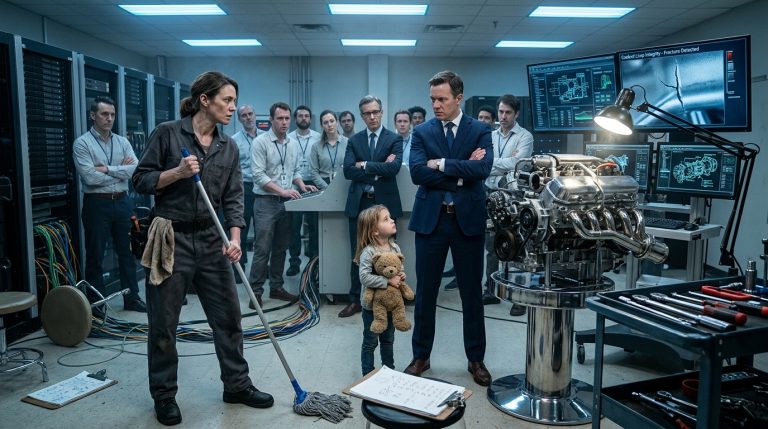
“Leave them on the tray,” he whispered, his eyes sliding past her to the doorway, where a pair of small, mismatched socks appeared, followed by a stuffed rabbit being dragged with purpose across the threshold.
Lena marched into the room, her presence a sudden, jarring shift in the atmosphere. She didn’t notice the tension. She didn’t notice the photograph. She walked straight to the side of the wheelchair, climbed onto the ottoman, and looked up at Ashford with an expectation so pure it seemed to demand the world shift to accommodate it.
“Ash,” she said, holding up a small, smooth stone she’d found in the driveway. “For the dragon.”
The tension in the room snapped, replaced by the terrifying, beautiful vulnerability of a man being forced to play. Ashford looked at the stone, then at the child, and for the first time, he didn’t pull away. He reached out to take the stone, but his fingers brushed against the edge of that lavender-scented letter, knocking it off the desk.
As the envelope drifted to the floor, it landed face up. The return address was clear—a hospital wing in the city, dated three days before Claire’s funeral.
Ashford’s face went white. He didn’t look at the stone. He looked at the letter, and the mask of the billionaire, the cold, unreachable man, disintegrated entirely, revealing the terrified, grieving husband underneath.
CHAPTER 2: THE UNBROKEN SEAL
The envelope lay on the dark hardwood like a jagged white scar. Ashford’s hands remained frozen, suspended in the air where they had reached for the desk, his fingers trembling with a frantic, uncoordinated energy. The cartoon star on the bandage on his hand looked obscenely bright against his pale, bloodless skin.
Laura didn’t move. She couldn’t. The air in the study felt pressurized, the scent of lavender from the letter mingling with the stale, metallic tang of the cold coffee. She watched the way Ashford’s breath hitched—a sharp, ragged sound—and she realized, with a sinking sensation in her gut, that this wasn’t just a letter. It was an anchor. One he had been dragging behind him, submerged and unseen, for two years.
“Mr. Crane?” she said, her voice barely a whisper.
He didn’t hear her. He was staring at the return address. His gaze was fixed, dilated, as if he were looking through the floorboards at something far beneath the foundation of the house. He didn’t look like a man who had lost his ability to walk; he looked like a man who had forgotten how to breathe.
Lena, sensing the sudden seismic shift in the room’s temperature, didn’t press for the dragon stone. She pulled her hand back, clutching Rabbit tightly against her chest. Her big, dark eyes darted from Ashford’s frozen face to the letter on the floor, and for the first time since Laura had been bringing her here, the little girl went completely silent. She stood on the ottoman, a tiny, observant sentry, her presence the only warm thing in the room.
Ashford’s eyes finally moved. They tracked slowly, agonizingly, toward Laura. There was no anger in them—only a desperate, naked shame. It was a look that stripped away the veneer of the billionaire, the estate owner, the untouchable man in the wheelchair. He looked small.
“Pick it up,” he said. It wasn’t an order. It was a plea.
Laura stepped forward, the wood groaning softly under her weight. She knelt, her knees hitting the floor with a dull thud. Up close, the paper felt brittle, the edges slightly frayed. The lavender scent was stronger here, a ghost of a life that had ended before she had even stepped foot in this house. She didn’t open it. She simply lifted the envelope and held it out to him, her own pulse hammering in her wrists.
He took it, but he didn’t look at the contents. He pressed his hand against the center of the envelope, his knuckles turning white, as if trying to shield the contents from existence itself.
“I didn’t open it,” he whispered, mostly to himself. “I told myself I didn’t need to. I told myself it was just paperwork. A condolence. An administrative detail.”
“Maybe it’s not,” Laura said, her voice steadying. She glanced at the door, ensuring it was still wide open, a sliver of the hallway’s morning light cutting across the desk. The outside world—the cleaners, the estate staff, the lawyers waiting for their Thursday phone calls—felt like a million miles away. Here, in this room, there was only the three of them, bound by a secret that was beginning to bleed into the air.
Ashford let out a long, shuddering exhale. “It’s from three days before,” he said, his voice dropping to a low, gravelly monotone. “She knew. She knew the end was coming, and she sent me this. And I… I was so busy fighting the truck, fighting the doctors, fighting the reality of the chair, that I let it sit in the drawer. I didn’t want to know what she had to say after she was gone.”
He finally looked at her—really looked at her—and Laura felt a strange, electric chill crawl up her spine. He wasn’t seeing the maid. He was seeing a witness.
“Why are you still here, Laura?” he asked. The question caught her off guard. “The agency sent the notice. You know the house is failing. You know everyone else has run for the exits.”
Laura looked at Lena, who was now staring at Ashford with an expression of profound, uncomplicated empathy. She looked back at the man who had spent two years building a wall of silence around his grief.
“My babysitter canceled again,” Laura said, her voice gaining a slight, stubborn edge. “And I don’t quit jobs. It’s a bad habit.”
Ashford stared at her for a long moment. Then, he did something that caused the air in the room to shift again. He slid his hand across the desk, pushing the photograph of Claire closer to the letter, aligning them with the precision of a man who suddenly felt the need to organize his own destruction.
“If you’re going to stay,” he said, his voice barely audible over the hum of the electronic wheelchair, “then you might as well see what I’ve been running from.”
He didn’t tear the envelope. He used his letter opener—a heavy, silver instrument that had been sitting untouched on his desk for months—and sliced through the wax seal. The sound of the paper tearing was like a final curtain being pulled back.
He unfolded the letter, his hands shaking so violently that the parchment rattled. He started to read, his eyes scanning the lines, but halfway through, he stopped. He looked up at the ceiling, his lips moving soundlessly, as if reciting a prayer or a curse.
“It’s not what I thought,” he whispered, his eyes widening. “It’s not about the end at all.”
He turned the letter toward Laura, his hand trembling so hard that she had to reach out and steady his wrist. She saw the first line, written in that delicate, flowing script: Ashford, if you are reading this, then you have finally stopped looking at the roses and started looking at the foundation.
Laura felt the room tilt. Beneath the words, there were names—not just names, but bank routing numbers, lists of staff members she recognized, and dates that stretched back to years before the accident.
“What is this?” she asked.
Ashford didn’t answer. He turned the page, and there, stapled to the back, was a document that made the hair on her arms stand up. It was a legal transition agreement, signed by Claire, naming someone as the primary executor of the estate’s care—not a lawyer, not a bank, but a person Laura recognized instantly.
The name was Mrs. Patton.
The room seemed to shrink. The silence that followed was no longer empty; it was heavy with the weight of a truth that had been waiting to be discovered for two years. Ashford looked at the document, his breath catching in his throat, and the realization dawned on him with a clarity that seemed to physically wound him.
“She didn’t just leave,” Ashford whispered, his voice cracking. “She orchestrated everything. Even me.”
CHAPTER 3: THE GARDENS MEMORY
The letter hung in the space between them, a bridge made of brittle paper and ink that had been waiting two years to be crossed. Ashford’s grip on the document had loosened, his fingers hovering over the typed clauses of the transition agreement. The name “Mrs. Patton” seemed to burn on the page, casting a long, strange shadow over the reality Laura thought she knew.
Outside, the March wind rattled the tall windows, a sharp, intermittent sound that made the room feel even more insulated. Laura reached out, her fingers trembling slightly, and picked up the second page. Her eyes traced the lines. It wasn’t just a legal document; it was an instruction manual for a life. It detailed specific dietary adjustments for Ashford, the rotation of his care staff, and a subtle, tiered system of triggers designed to keep his mind engaged with the business he had built.
“He didn’t fire them,” Laura whispered, her voice barely audible. She looked up at Ashford, whose face was etched with a mixture of awe and profound, hollow grief. “He was being nudged. Every caregiver that left—it was part of a sequence, wasn’t it?”
Ashford didn’t answer. He turned his chair toward the window, the soft electric hum of the motor sounding like a heartbeat in the quiet. He stared out at the garden, at the stone bench near the fountain where he had sat with Lena only days ago. “Claire always said I lived in the future,” he said, his voice reflecting the cold, clear light of the morning. “She said I was too busy looking at the next floor of the building to notice the ground I was standing on. I thought she was speaking metaphorically. I thought she was just… teasing me.”
He gestured vaguely toward the documents. “But she wasn’t. She was designing a fail-safe. She knew. She knew exactly what would happen to me when she was gone, and she built a map.”
The realization hit Laura with the weight of cold water. Mrs. Patton, the cook who had remained invisible for nearly two decades, hadn’t just been keeping house. She had been the executor of a shadow estate, a steward of a process that Ashford had been trying to fight for two years.
“I need to speak to her,” Ashford said, his tone sharpening.
“Mr. Crane, wait,” Laura started, but he was already moving, his hands working the controls of his chair with a new, frantic efficiency.
Laura followed him out into the hallway. The house, usually so predictable in its morning routine, felt different now. The walls didn’t seem as solid. The shadows in the corners felt like hiding places for secrets that had been breathing down their necks for years. They reached the kitchen, the heart of the estate, where the air was thick with the scent of toasted bread and the sharp, clean smell of lemon polish.
Mrs. Patton was standing at the cutting board, her back to them. She was slicing mushrooms with a rhythmic, steady motion that didn’t falter even as Ashford’s wheelchair crossed the threshold. She didn’t turn around. She didn’t jump. She simply continued her work.
“Mrs. Patton,” Ashford said, his voice tight.
The cook stopped, the blade of the knife resting against the wooden surface. She wiped her hands on her apron and turned slowly. Her expression wasn’t one of surprise or guilt. It was the calm, settled face of a woman who had been waiting for a very long time for a delayed train to arrive.
“The letter was in the safe, wasn’t it, sir?” she asked. Her voice was steady, utterly devoid of the deference she usually showed.
Ashford gripped the armrests of his chair. “You knew. You knew about this transition plan. You’ve been managing it all along—the agency, the staff turnover, the ‘red list’ designation.”
Mrs. Patton didn’t deny it. She picked up a dish towel and began to fold it, her movements precise and unhurried. “Mrs. Crane was a very forward-thinking woman. She knew you, Mr. Crane. She knew that if you were given a choice, you would choose to isolate yourself. You would choose to work yourself into the ground until there was nothing left but a shell.”
“You were manipulating my life,” Ashford said, his voice rising, though he remained seated.
“I was keeping a promise,” Mrs. Patton countered, her eyes meeting his with an unwavering, flinty resolve. “There is a difference.”
Laura stood by the door, feeling like an intruder in a dialogue that had been simmering for years. She watched the way the light caught the silver tea service on the counter, the intricate patterns of the tray reflecting the tension in the room. This wasn’t just a house; it was a carefully curated experience, and she had been brought in as the final, accidental piece of the puzzle.
“Why me?” Laura asked, the words slipping out before she could stop them. “Why keep me here?”
Mrs. Patton shifted her gaze to Laura. A flicker of something—softness, perhaps, or a weary recognition—crossed her face. “Because you were the only one who didn’t look at the study door and see a cage. You saw a house. And you saw a child who needed a reason to explore, and you saw a man who needed someone to witness that he was still there.”
The kitchen went silent. The only sound was the faint, rhythmic ticking of the wall clock. Ashford looked down at the letter in his lap, then back at his cook. The rage that had driven him from the study was dissipating, replaced by a profound, hollowed-out understanding. He wasn’t being trapped; he was being rescued by a ghost.
“She’s still running it,” Ashford whispered, his eyes misting over. “Even now.”
“She believed in you, sir,” Mrs. Patton said softly, turning back to the stove. “More than you ever did.”
Ashford sat in the center of the kitchen, his chair gleaming in the morning light. He looked smaller than he had the day before, less like a monument and more like a man stepping out of a long, dark tunnel. He looked at Laura, his gaze lingering on the faded textures of her uniform, the wear and tear of a life lived in service to others.
“Laura,” he said, his voice thick with unstated questions. “Do you have any idea what this means for you? For your daughter?”
Laura looked at her hands, the hands that had cleaned floors and polished silver, and then she looked at Lena, who had followed them in and was currently trying to see if she could balance a spoon on the edge of a chair. She realized that the margin she had lived within—the 4:47 AM starts, the cold apartment, the constant, low-level hum of survival—was no longer the only reality available to them.
“I don’t know,” she said truthfully. “But I think I’m finished cleaning, Mr. Crane.”
Ashford let out a dry, mirthless laugh, his shoulders dropping. “Yes. I suspect we both are.”
CHAPTER 4: THE LEGAL SHADOW
The sound of the rotary phone, a relic of the estate’s original infrastructure, grated against the quiet of the kitchen. It was a harsh, insistent mechanical trill that seemed to vibrate through the marble countertops. Ashford flinched, his hand momentarily gripping his wheelchair armrest, his knuckles white. Mrs. Patton didn’t move; she kept her back to them, her focus entirely on the mushrooms, but her posture had hardened, the set of her shoulders signaling a defensive readiness.
“That will be Marcus,” she said, her voice dropping into a low, flat register. “He doesn’t like it when the routine is disrupted. He’s been calling three times a day since the agency withdrew.”
Ashford looked at Laura. There was a flicker of the old uncertainty in his eyes—the shadow of the man who had spent two years retreating from every external demand. The phone kept ringing, a rhythmic, abrasive sound that seemed to mock the fragile, domestic peace they had just begun to carve out.
“Do you want me to take it?” Laura asked, stepping toward the hallway.
“No,” Ashford said, his voice regaining some of its old, clipped authority. “He’ll only talk to me. Or someone who sounds like they’re reporting on my decline.”
He pushed his chair backward, the motor humming as he navigated the narrow space between the table and the stove. He moved with a new sense of purpose, not the frantic motion of the last few weeks, but a steady, calculated momentum. Laura trailed him, her heart thumping against her ribs. She felt as though she were watching a man walk into a storm, armed only with a piece of paper that had changed his entire understanding of his own tragedy.
When they reached the study, the phone was still ringing. Ashford reached out and pressed the speaker button. The voice that filled the room was crisp, professional, and entirely lacking in warmth—a sound that belonged in a courtroom or a sterile boardroom, not this quiet, sun-drenched house.
“Ashford. Finally. I’ve been trying to reach you since Tuesday. The estate’s liquidation paperwork has been pending for forty-eight hours. If we don’t have your authorization for the secondary holding account by end-of-day, the board will initiate a hostile restructuring.”
Laura stood by the door, observing Ashford’s reaction. He didn’t crumble. He didn’t retreat into the clinical silence that had defined his life for months. He looked at the corkboard above his desk, at the two wobbly circles and lines that Lena had drawn, and then he looked at the transition agreement lying open on his desk.
“Marcus,” Ashford said, his voice calm, steady, and dangerously quiet. “The holding account is no longer up for liquidation. I’m rescinding my authorization.”
There was a long, stunned silence on the other end of the line. The tension in the room was palpable; Laura could almost feel the electricity vibrating in the air.
“Rescinding? Ashford, we discussed this at length. You aren’t in a position to manage the assets. The board is acting in your best interest—the interest of the company, and, frankly, the interest of your own long-term care. If you refuse to cooperate, they will petition the court for a temporary conservatorship. You won’t have a choice.”
“I have a plan, Marcus,” Ashford replied. He glanced at Laura, a subtle, almost imperceptible tilt of his head toward the door. “And it doesn’t involve the board. I’ve discovered a prior directive. One that takes precedence over your current board resolutions.”
“A prior directive?” Marcus’s voice sharpened, becoming aggressive, defensive. “There’s nothing in the files that overrides the current board mandate. Don’t play games with me, Ashford. You’re isolated, you’re unwell, and your decision-making has been erratic for two years. Do not test the court’s patience.”
“I’m not playing, Marcus,” Ashford said. “I’m auditing. And I suspect that when you look at the ledger for the primary holding account, you’ll find that the decisions you’ve been making on my behalf haven’t been as… compliant with the original estate charter as you suggested.”
The silence that followed was different this time. It was a brittle, sharp silence—the kind that followed a direct challenge. Laura felt a chill touch her skin. She had spent months cleaning these floors, dusting these shelves, and assuming the house was just a vessel for a broken man’s grief. Now, she realized the walls were lined with ledgers, the garden was a map, and every piece of furniture held a stake in a war she was only beginning to understand.
“I’ll have my assistant pull the files,” Marcus said, his voice icy. “But understand this: you are walking into a fire. If you think you can manage this estate while living in that house, in your condition, you’re delusional.”
“We’ll see,” Ashford said, and he clicked the phone off.
The silence that returned to the study was suffocating. Ashford leaned back in his chair, his hands resting on his knees. He looked at the window, at the garden that had been so carefully tended by a ghost. He seemed exhausted, but the exhaustion was different—it was the weariness of a man who had finally put down a heavy, invisible burden.
“He’ll come here,” Ashford said, not to Laura, but to the room. “He’ll be here by tomorrow morning to try and force my hand.”
Laura looked at the stack of documents on the desk. She thought of Lena, of the apartment with the spring in the mattress, and of the way Ashford had held the small girl’s hand in the garden. She wasn’t just a housekeeper anymore. She was a witness.
“Then we’d better make sure the house is ready for a visitor,” Laura said, her voice firm.
Ashford turned his chair, a small, genuine smile finally touching his lips. “Yes. I believe we have a lot of cleaning up to do.”
He reached for the desk, his movements confident and sure. He didn’t just look like a man in a wheelchair; he looked like a man preparing for a fight—and for the first time in years, he didn’t look like he was going to lose.
CHAPTER 5: THE HIDDEN CORRESPONDENCE
The transition from the study to the rest of the house felt like stepping through a threshold into a different dimension. As Ashford maneuvered his wheelchair across the threshold, the very architecture of the estate seemed to shift. Laura followed, her eyes scanning the familiar hallways with a newfound, piercing scrutiny. She had spent two years cleaning these baseboards, dusting these cornices, and polishing these floorboards, yet she had never actually seen the house.
“Mrs. Patton didn’t just maintain the routine,” Ashford muttered, his voice echoing against the vaulted ceiling of the foyer. “She was the curator.”
He steered toward the hallway shelf, the long one near the east staircase—the place where Laura had discovered the wedding photo months ago. He stopped his chair, his hands hovering over the wood. He didn’t reach for the bowl. Instead, he pressed his hand against a specific panel in the wainscoting—a subtle, almost invisible seam in the oak that Laura had wiped clean a thousand times without ever noticing.
There was a soft, mechanical click, and a narrow section of the panel popped forward.
Laura caught her breath. Behind the panel lay a small, metal-bound box, its surface dull with the accumulation of years. She knelt, her heart hammering against her ribs, and carefully withdrew the box. It was cold to the touch, heavy with the weight of hidden intentions. She set it on the nearby runner rug and flipped the latch.
Inside were not treasures of gold or high-stakes business documents, but something far more intimate: a stack of journals, bound in worn, faded leather, and a series of architectural floor plans, each marked with red ink and handwritten notes.
“These are the renovation logs,” Ashford said, his voice dropping to a whisper as he scanned the dates. “From five years ago. From the time we started planning the west wing expansion.”
Laura looked at the floor plans. They weren’t just blueprints; they were annotated with psychological observations. ‘Ashford finds comfort in the symmetry of the sunroom during periods of stress,’ one note read in Claire’s unmistakable hand. ‘Ensure the lighting in the study remains constant, even in the event of power fluctuations. He fears the dark more than he admits.’
The sense of being observed, even from beyond, was overwhelming. Laura felt a shiver trace its way down her spine. Claire hadn’t just been a wife; she had been an architect of Ashford’s peace of mind, anticipating his fractures years before the accident ever occurred.
“She knew,” Laura said, her gaze fixed on the red ink. “She knew you were prone to this, Ashford. She built the house as a support system for your temperament.”
Ashford didn’t respond immediately. He took one of the journals, his fingers tracing the embossed cover. “I thought my success was my own doing. I thought my temperament was something I had mastered. But this… this is a ledger of my own vulnerabilities, mapped out by the woman I thought I was protecting.”
He opened the journal. The pages were dense with observations, but on the final leaf, a slip of paper was tucked into the binding. It was a note, recent—dated only a month after the accident.
If you are reading this, the accident was the final catalyst. You are now at the center of the labyrinth. Follow the Rose Path. The truth of the accident is not in the truck, but in the manifest.
Laura looked up, her expression tightening. “The manifest? What manifest?”
Ashford looked at her, his face pale. “The manifest from the company board meeting that Tuesday evening. The meeting I never arrived at. The meeting I told the investigators I was driving home from when the truck hit me.”
The air in the hall seemed to grow thinner. The “decoy” secret—the idea that Ashford had been distracted—suddenly felt like a child’s story compared to the looming implication of the manifest.
“You said you were driving home from the meeting,” Laura repeated, her voice rising. “Are you saying you weren’t?”
Ashford’s hands trembled on his knees. “I was driving to it. I was late, I was frustrated, and I had received a call from Marcus just before I entered the intersection. He told me the board was voting on the restructuring that night—the very restructuring he’s threatening me with now.”
He stared at the journals, his eyes wide and unseeing. The psychological phantom of that Tuesday, the memory of the light changing, the roar of the truck, suddenly re-emerged with sensory brutality—the smell of burnt rubber, the screech of metal, the sudden, final silence of his legs.
“I wasn’t just distracted, Laura,” he whispered, his voice trembling. “I was being coerced.”
Suddenly, the front door of the estate groaned open. The sound was sharp, authoritative, and entirely out of place for a house that was supposed to be in lockdown. A pair of heavy, polished shoes clicked against the marble of the foyer. Marcus Webb stood in the doorway, his briefcase in his hand, his eyes scanning the grand hall with the cold, predatory gaze of someone who had already decided the outcome of the visit.
He looked at Ashford, then at the box of journals on the floor, and a thin, satisfied smile touched his lips.
“I see you’ve been doing some housekeeping, Ashford,” Marcus said, his voice echoing in the hall. “I think it’s time we talk about what really happened on that Tuesday. Because the board has been waiting a long time to correct the record.”
The labyrinth had opened, and they were no longer alone.
CHAPTER 6: THE CONFRONTATION WITH THE PAST
Marcus Webb didn’t wait for an invitation. He stepped further into the foyer, his movements fluid and practiced, his gaze tracking the open box of journals on the floor with a mix of disdain and calculation. Behind him, the front door clicked shut—a final, definitive sound that sealed the house’s perimeter. He stopped a few feet from Ashford, the silence stretching taut between them like a wire pulled to the breaking point.
“You look well, Ashford,” Marcus said, his voice a smooth, polished instrument. “The seclusion clearly has its benefits. Though, I see you’ve decided to exhume some rather tedious history.”
Ashford didn’t look at him. His eyes were fixed on the floor—on the red ink annotations in the journals that Laura had been holding only moments before. His heart was a drum in his chest, erratic and loud. He felt the weight of Laura standing silently behind him, a tether to the current reality that Marcus couldn’t touch.
“The manifest, Marcus,” Ashford said, his voice quiet but lacking the tremor of the previous weeks. “I remember the call now. You weren’t calling to discuss board restructuring. You were calling to confirm my route.”
The smile remained on Marcus’s face, but his eyes grew cold. He took another step, his polished shoes scuffing the marble. “Memory is a dangerous, subjective thing, especially after trauma. You were driving a two-ton vehicle at sixty miles per hour when you lost control. The report is categorical, Ashford. The truck driver, the red light, the mechanical failure—it’s all there. Are you truly suggesting we litigate your own incompetence?”
Laura felt the urge to step in, to shout, to point out the journals, but she sensed the shift in the room. This was a chess match played in silence. She stayed back, her breath hitched, watching the subtle interplay of power.
“I’m suggesting,” Ashford continued, turning his chair to face his attorney, “that the truck wasn’t a failure. It was an intercept.”
Marcus let out a short, sharp laugh. “And your wife? Did she plan this too? Perhaps the cancer was just part of the grand, orchestrated design to ruin your life? You’re clutching at shadows, Ashford. You’re desperate to find a villain because the alternative—that you ruined everything yourself—is too painful to accept.”
Ashford flinched. The words hit their mark with surgical precision. For a second, Laura saw the flicker of doubt in Ashford’s eyes, the deep-seated fear that Marcus was right. But then, Ashford looked at the journal cover, at the handwriting of the woman who had known him better than he knew himself. He didn’t look broken. He looked, for the first time, like he was seeing the truth underneath the decoy.
“She didn’t plan for the accident,” Ashford whispered. “She planned for the man I would become after it. She knew you would be the one to push me into the wall.”
Marcus froze. The veneer of calm, professional condescension faltered. He reached into his coat pocket—a slow, deliberate movement—and pulled out a thin, leather-bound folder. He didn’t open it. He tapped it against his palm.
“You think you have the high ground,” Marcus said, his voice dropping into a dangerous, gravelly register. “But you’re living in a museum, Ashford. You’re playing with old papers while the board is already in the process of dissolving your legal identity. If you continue this, there will be no estate to save. There will be no legacy. There will only be a bankrupt man in a wheelchair, surrounded by memories that are already rotting.”
“Then let it burn,” Ashford said, his voice startlingly clear.
Laura moved then, stepping forward until she stood beside Ashford’s chair. She felt the warmth of his presence, the steadiness of his resolve. She looked at Marcus, seeing him not as the all-powerful attorney, but as a man who was terrified that his leverage was failing.
“You’re here because you’re afraid, aren’t you?” Laura said. Her voice was steady, surprising even herself. “You thought you had him locked in this house, kept in the dark by his own grief. You didn’t expect him to wake up.”
Marcus shifted his gaze to Laura, his eyes narrow, dismissive. “And who is this? The help? I suggest you keep your distance, unless you want to see exactly how quickly an estate can be liquidated.”
Ashford leaned forward. The change in his posture was dramatic—the hunch of his shoulders vanished, replaced by the rigid, commanding frame of a CEO who had once built an empire. “She’s not the help, Marcus. She’s the witness to the fact that I’m no longer alone. And she’s the one who is going to help me audit the very accounts you think you’ve buried.”
The tension in the foyer was a physical weight, cold and heavy. Marcus looked from Ashford to Laura, and for a fleeting moment, he looked like a man who had lost his way in a familiar house. The control he had held over the estate, over the information flow, over the very walls of the mansion, was slipping.
“You’re making a mistake,” Marcus said, his voice tight. “A terminal mistake.”
“The only mistake I made,” Ashford said, gesturing to the hallway, “was thinking I could mourn without understanding why I was left behind.”
Marcus turned, his face flushed with a dark, suppressed fury, and walked back toward the door. He didn’t look back as he pulled it open. The gust of cold air that flooded the foyer was sharp, biting, and smelled of the coming rain.
“I’ll be back with the court orders, Ashford,” he said, his voice hard as iron. “And then we’ll see how well your wife’s journals hold up against a judge.”
He stepped out, and the door slammed shut with a finality that seemed to rattle the very foundations of the house. Ashford sat in the quiet foyer, his hands still clenched on his armrests. He looked at the floor, then at the box of journals, and finally at Laura. His hands were still trembling, but he didn’t try to hide them.
“He’s going to move faster now,” Ashford said. “He knows the truth is in those pages.”
Laura knelt, picked up the journals, and held them to her chest. “Then we don’t have a minute to lose.”
CHAPTER 7: THE ARCHITECTURE OF GRACE
The silence that followed Marcus’s departure was not the heavy, suffocating stillness of the past; it was a pressurized, expectant quiet, like the air right before a thunderstorm breaks. Ashford remained in the center of the foyer, his hands resting on his knees, his knuckles still white from the tension of the confrontation. Laura stood beside him, the leather-bound journals pressed firmly to her chest, their rough texture grounding her in the present.
“He’ll go to the board now,” Ashford said, his voice quiet. He didn’t look at her; he was looking at the grand, sweeping staircase that led to the upper floors—the floors he hadn’t climbed in two years. “He’ll use every legal mechanism he has to freeze the accounts and declare me incompetent. He won’t stop until he’s dismantled everything Claire left behind.”
“Then we have to get to the truth before he does,” Laura said, stepping closer to his chair. “The manifest. You said it was the key. Where is it?”
Ashford finally looked at her. His eyes were clear, the fog of the past two years finally beginning to lift, leaving behind a sharp, focused intensity. “It’s not a physical document in a safe. It’s part of the estate’s original digital ledger, which is housed in the secure terminal in the west wing library. A library I haven’t entered since the day of the accident.”
He hesitated, a shadow of the old fear crossing his face—the fear of the accident, of the road, of the life that had been severed on a Tuesday in November. But then he looked at the journals, at the meticulous notes written in Claire’s hand, and the fear was eclipsed by a quiet, steely determination.
“If Claire planned this,” he continued, “she would have known that Marcus would eventually try to seize the company. She would have anticipated the board’s hostility. The manifest isn’t just a list of items; it’s an account of who was actually on that road that night.”
The realization hit Laura with a cold, sharp clarity. If the manifest showed that Marcus or the board had been monitoring his route—had perhaps even been the ones to trigger the “mechanical failure”—then the entire legal foundation of Marcus’s leverage against him was built on a crime.
“Let’s go,” Laura said.
She walked behind his chair, her hands gripping the handles, and began the slow, rhythmic push toward the west wing. The transition between the hallways felt like moving through a history of the estate. They passed the sunroom, where the morning light now hit the rose bushes in a way that made the colors seem almost painful in their intensity; they passed the dining room, where Mrs. Patton was already clearing the breakfast dishes with a serene, knowing smile.
As they reached the heavy oak doors of the west wing library, the air grew cooler, smelling of old paper and the faint, dry scent of wood polish. Ashford opened the doors. The room was vast, lined with thousands of volumes that had been left untouched for years. At the far end, bathed in a single, pale shaft of light, sat a desk with a sleek, outdated terminal.
“I haven’t turned that on since the day I drove away,” Ashford said, his voice low.
Laura maneuvered his chair up to the desk. He reached out, his hand hovering over the power button. He paused, his finger trembling, and Laura placed her hand gently over his. She felt the warmth of his skin, the rhythmic beat of his pulse—a man alive, and, for the first time, present.
He pressed the button.
The terminal hummed to life, the monitor flickering with a soft, green glow that cast long, dancing shadows across the mahogany desk. It took a moment for the files to load, but when they did, the screen revealed a simple, elegant file directory, all labeled in the same precise, flowing script that was on the letter.
Ashford’s Lessons, one folder was titled. The Foundation, another. And there, at the bottom, marked in red: The Tuesday Manifest.
Ashford’s hand hovered over the keyboard. He looked at the screen, and then at the journals in Laura’s lap. He seemed to understand, for the first time, the true extent of Claire’s orchestration. She hadn’t just saved his life; she had given him the keys to his own redemption.
“She didn’t just plan for my recovery,” he whispered, his eyes filling with an expression of profound, aching love. “She planned for the moment I would finally see what she had been trying to show me all along: that I was never the one in control. I was just the one who needed to learn how to let go.”
He clicked the folder open.
The screen filled with data—a log of phone calls, GPS coordinates, and maintenance reports. As Laura looked over his shoulder, she saw the reality of that Tuesday night. It wasn’t a mechanical failure. It was a planned, deliberate intervention, recorded in real-time, by someone who had been watching his every move from a remote terminal just like this one.
And the name on the override authorization wasn’t the board. It wasn’t Marcus.
It was Claire.
Ashford stared at the screen, his face drained of all color. The truth didn’t shatter him; it seemed to settle over him, heavy and absolute. The labyrinth was not a trap; it was a revelation. Claire had seen the corruption coming, and she had decided that the only way to save the company—and perhaps, in her own way, to save the man she loved—was to orchestrate a controlled, catastrophic reset.
“She did it,” Ashford whispered, his voice a ghost of a sound. “She caused the accident to stop me from going to that meeting.”
The silence in the library was absolute, save for the hum of the terminal. Laura felt the weight of the moment—the sheer, staggering scale of the love that had orchestrated such a violent salvation. They weren’t just fighting a board or an attorney; they were finally meeting the architect.
CHAPTER 8: THE NEW FOUNDATION
Ashford’s hands remained frozen on the keyboard, his eyes fixed on the final log entry on the terminal screen. The reality of the accident—the coordinates, the timing, the clear, unambiguous signature of Claire’s authorization—unspooled before him, stripping away the narrative of “bad luck” and “wrong place, wrong time” he had been clinging to for two years. He had spent his recovery grieving the loss of his legs and his agency, never realizing that he had been forced into a pause by the only person who knew him better than he knew himself.
Laura watched him, her hand still resting lightly on his shoulder. She could feel the vibration of his shallow breathing. The library, once a place of stagnant history, now felt like the scene of a profound, radical metamorphosis. Ashford wasn’t just a man who had lost everything; he was a man who had been handed his life back by someone who had already left it.
“She knew you wouldn’t stop,” Laura said softly, breaking the thick, heavy silence. “She knew that if you stayed on that path, you would have destroyed everything you built, including yourself. She didn’t want you to be a casualty of that company, Ashford. She wanted you to be something else.”
Ashford turned his chair slowly, the motor’s hum sounding distant. “I was a machine, Laura. I was a machine that only knew how to run until it broke. She didn’t just stop the machine. She dismantled it. She took my ability to run so that I would have to learn how to live.”
He looked around the library—at the thousands of books, the quiet corners, the space that had been waiting for him to finally inhabit it. He realized that the mansion, the garden, the silence—it wasn’t a tomb. It was a garden in the winter, waiting for the spring. He reached out and closed the terminal, the screen fading to black.
The silence that followed was different—it wasn’t the absence of sound, but a state of profound, peaceful presence.
He didn’t wait for Marcus to return. He didn’t wait for the court orders or the legal threats. Instead, he reached for the small, silver-framed photograph of Claire that he had placed on the desk. He took a heavy, ornate paperweight—a gift from his first board meeting—and set it down on the desk with a solid, final thud. It was a small, symbolic act of transition; the paperweight that had once held down his business documents now sat atop a stack of blank, unwritten pages.
“I need to make a call,” Ashford said. His voice was steady, lacking the sharp edges of his previous tone. “Not to a lawyer, and not to the board. I’m calling the chief financial officer. I’m instructing him to dissolve the primary holding accounts and move the assets into a trust managed by Mrs. Patton and an independent board of directors.”
Laura watched as he picked up the receiver. He sounded like a different man—the command was there, but the arrogance had been replaced by a quiet, grounded authority. As he spoke, detailing the transition, Laura slipped out of the room, leaving him to the conversation.
She walked out into the garden. The mid-morning sun was warm on her face, and the roses were beginning to show the first, faint buds of the season. She found Lena sitting by the stone bench, carefully patting the stone where Claire’s name was carved. The little girl looked up as Laura approached, a wide, easy grin spreading across her face.
“Ash is coming?” Lena asked.
Laura looked toward the house. The library doors opened, and Ashford’s wheelchair emerged, moving not with the frantic pace of a man running from a ghost, but with the measured, steady speed of a man returning to the living. He stopped beside the bench, his hand reaching out to touch the stone—not with the tentative, fearful motion of the past, but with a lingering, gentle stroke.
He looked at Lena, then at Laura. His eyes were bright, and for the first time, he smiled—not the polite, forced gesture of a man hiding behind a mask, but a genuine, light-filled expression that seemed to reach every corner of his face.
“The garden is beautiful today,” he said.
Laura walked to the bench and sat down. She felt the cool stone beneath her, the weight of the journals in her lap, and the deep, abiding sense of peace that had finally settled over the estate. They were no longer running from the accident, or the board, or the cold, silent history of the house. They were finally, truly, present.
“It’s a good place to start,” Laura said.
Ashford reached out, his hand covering Lena’s, and for a long moment, the three of them sat in the sunlight—the architect of the past, the guardian of the present, and the future, all sitting together in a garden that had finally been allowed to bloom again. The cycle of the house had been reset, and in the quiet of the morning, they didn’t need any more words. The truth was out, the ghost was at peace, and for the first time in a very long time, there was nothing left to do but wait for the spring.