When Her Entitled Family Stole Her Home, She Traded Tears for Cold Tactical Reckoning
CHAPTER 1: THE CASSEROLE AMBUSH
The casserole had barely cooled on the stove when my mother set a green college suitcase right beside my front door.
I wiped my hands on the tea towel—the one smelling faintly of last summer’s lavender—and kept my back to the hallway. Five minutes ago, I was adjusting the faded blue-rimmed tea saucers from Grandma’s old china set. I had laminated the name cards at my office desk on Friday, making sure Dad sat at the head and Mom to his right, like this was a diplomatic dinner instead of a Sunday night meal in my first home.
“You’ve always been overly sensitive about space, Jolene,” Dad said, not looking at me.
He folded his cloth napkin into a neat, rigid square, placing it precisely to the left of his untouched salad plate. His eyes swept the living room mantle, appraising the crown molding like a bank inspector calculating foreclosure value.
“A house this size is a lot of overhead for a single girl,” he added.
Isolda didn’t even put her phone down. Her suede boots left faint gray dust trails across the hardwood floor I’d spent six hours mopping on my hands and knees.
“Ryan already looked at the floor plan,” Isolda said, her thumb flicking rhythmically across her screen. “We can knock out the office wall by Tuesday.”
My fingers tightened around the blue-rimmed saucer in my hands. The glaze felt cold against my knuckles.
“I bought this house,” I said. My voice came out flat, stripped of the cheerful hosting tone I’d practiced in the mirror all morning. “The deed is in my safe deposit box.”
Mom finally moved, her manicured fingers grazing the mantle to flip down a framed photo of my college graduation.
“We’ve discussed it as a family, honey,” she said softly, her voice dripping with the fake pity she used whenever I didn’t hand over my savings. “It’s time you refocus. Your old bedroom at our house is still set up.”
“I’m thirty-two years old, Mom.”
“And you’re acting like an child,” Dad interrupted, his jaw tightening into that hard, square line I’d feared since I was ten. “We aren’t asking. We’re managing the family assets.”
Isolda reached into her purse, pulled out a small set of brass keys, and set them on the wooden table with a sharp clack.
“We had the locksmith swing by while you were at the grocery store this morning,” she said, leaning back in her chair. “Your things are in the trunk of your sedan. Just the essentials.”
I stared at the brass keys sitting next to my untouched glass of Pinot Noir.
No one yelled. No one raised a fist. They just sat there, eating the cobbler I’d spent three hours baking, waiting for me to do what I had always done whenever Dad locked his jaw: fold up, shut down, and apologize for taking up room.
I didn’t scream. I didn’t shed a single tear in front of them.
Instead, I set Grandma’s blue-rimmed saucer down on the table, picked up my purse and car keys, and walked out into the biting October air.
CHAPTER 2: LOCKED OUT IN THE COLD
The trunk lid slammed shut under the buzzing yellow light of the edge-of-town gas station, the sound reverberating through my teeth like a crack of broken bone.
I sat behind the wheel with the engine killed, listening to the fluorescent ballast hum against the damp night air. My phone vibrated against my thigh—an unknown ten-digit number flashing on the cracked screen.
“This is Jolene,” I said, my voice unnaturally level.
“Ms. Shipman, this is Alexis from Midwestern Bank’s mortgage department,” a polite, practiced voice replied. “I’m calling to confirm the account adjustments requested on your residential property.”
A cold wire tightened around my ribs. “What adjustments?”
“A request came through to add Vernon and Mara Shipman as joint title holders and update the primary billing address,” she said. “It was flagged because the paper application showed multiple inconsistencies with your original closing file. Did you sign a power of attorney transfer?”
I gripped the steering wheel, my fingernails digging into the worn leather until the plastic frame groaned.
“I signed nothing,” I said. “Lock the account. Flag every attempt. I am the sole owner on that deed.”
“Understood, Ms. Shipman. We are freezing portal access immediately.”
I disconnected the call, staring through the bug-splattered windshield at the empty highway. No tears came. The panic had burned off, leaving behind a cold, hard stone in the center of my chest.
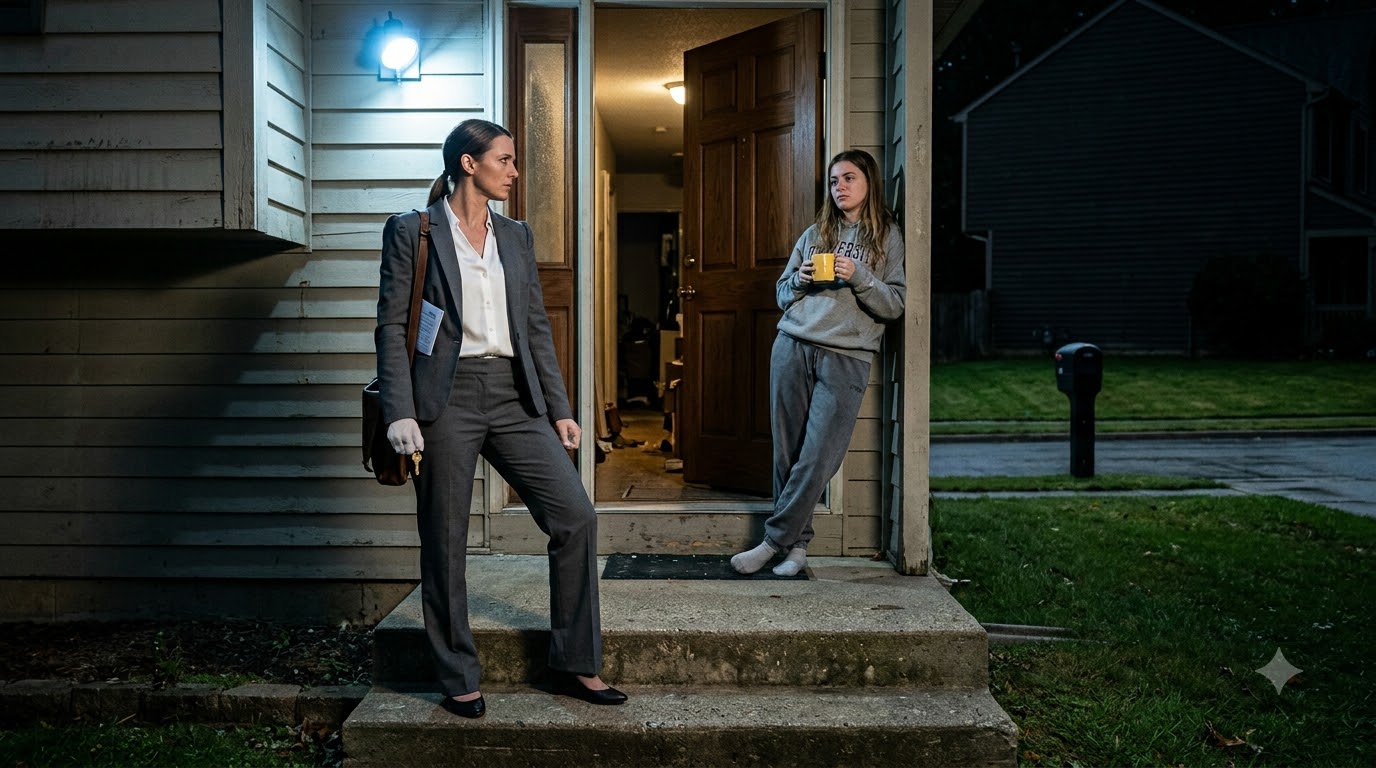
Twenty minutes later, the tires of my sedan crunched over the gravel driveway of my house. The porch light was on, but the soft amber bulb I’d chosen had been swapped for a blinding, blue-white floodlight that cast harsh, industrial shadows across the lawn.
I stepped up to the front door and jammed my brass house key into the lock.
It didn’t slide in. I pushed harder, the metal binding against raw, brass pins. They had changed the deadbolt.
The heavy oak door swung open six inches before I could knock. A young woman in oversized gray joggers and a faded university hoodie stepped into the gap, holding a half-empty mug of coffee—my mug, the yellow ceramic one with the chipped handle.
“Can I help you?” she asked, her voice flat, unimpressed.
“You’re in my house,” I said smoothly, keeping my feet planted on the welcome mat.
“Mara and Vernon said you’d probably swing by,” she replied, taking a slow sip from my mug. “They told me you were having a severe mental breakdown and abandoned the lease. I’m subletting the main floor until the family court date.”
Behind her shoulder, I saw my entry hallway. The hand-woven rug my grandmother made was gone, replaced by a cheap runner. The wall where my framed landscape prints used to hang was completely bare, leaving gray square outlines on the eggshell paint.
“I am the deed holder,” I said, my voice dropping an octave. “You are trespassing.”
“Call the police then,” she said, pulling the door back. “Vernon left a signed lease agreement on the counter. The deputy said it’s a civil matter until a judge signs an eviction.”
The door slammed in my face, the new deadbolt clicking into place with a heavy, final thud.
I turned around and walked back down the concrete steps. Mrs. Kavanaugh from next door was standing by her mailbox in a thick padded robe, watching me through the porch shadows. She didn’t wave. She just pulled her robe tighter and stepped back inside, her door shutting in total silence.
I got back into my car, threw the transmission into drive, and pulled out onto the main road before my hands could start shaking.
CHAPTER 3: THE PAPERWORK SIEGE
Sitting at Norah’s kitchen table under a single overhead light, tracing the chipped rim of a cold coffee mug while papers lay scattered across the Formica, I felt the sheer absurdity of the night settle like dust in my lungs.
Norah dropped a thick manila folder onto the table next to my arm, the slap of paper echoing in the small kitchen.
“Barbara Herrera’s paralegal sent over the preliminary title search,” Norah said, pulling out a vinyl-backed chair. “Your deed is clean, Jolene. Sole ownership, paid-in-full closing statement from six months ago.”
I pulled the deed toward me. Without security cameras or cloud footage to prove they broke in, this paper was my only weapon. My fingers left faint smudges on the crisp white sheet.
“They have a stranger living on my ground floor,” I said. “And the bank flagged a fraudulent power-of-attorney filing signed with Dad’s handwriting.”
Norah frowned, leaning over my shoulder. “How did Vernon even get your personal data?”
“Two years ago,” I muttered, the memory dragging itself up like silt from a riverbed. “Mara asked for my W-2 to ‘help with an accountant review.’ I was twenty-nine and naive enough to think she was being maternal.”
My phone buzzed against the table leg—a text alert from my credit monitoring app.
New Inquiry: Department Store Credit Line. Status: Pending Approval.
New Application: Visa Signature. Requested Address: Vernon & Mara Shipman.
I set the phone face-down on the Formica. They weren’t just taking the physical porch; they were attempting to hollow out my entire financial standing so I couldn’t afford the legal fees to fight back.
“Call Clayton,” Norah suggested, her voice cautious. “He still does property mediation work. He knows your family.”
Ten minutes later, Clayton met me at the 24-hour diner three blocks away. He sat in the booth across from me, his hands wrapped around a cup of black coffee, looking visibly uncomfortable to be dragged into the middle of a domestic storm.
“Look, Jolene,” Clayton began, shifting his weight on the cracked red vinyl. “I spoke to your dad briefly yesterday. He’s just worried about Isolda’s situation. Families do weird things under stress. Can’t you just talk to them without bringing attorneys into it?”
“They changed my locks, Clayton,” I said, my voice deadpan. “They filed fake bank papers. They put a squatter in my living room.”
“It sounds like a giant misunderstanding—”
—”A misunderstanding takes an apology,” I cut him off, sliding a copy of the fraudulent mortgage transfer request across the Formed laminate table. “A forged signature takes a notary and premeditation.”
Clayton stared at the document, his thumb nervously rubbing the edge of his coffee cup. He didn’t want to see it. It was easier to view me as unreasonable than to accept that people he knew were capable of theft.
“I’m not asking you to take a side,” I said, gathering my papers into my leather bag. “I’m telling you what is happening.”
I walked out of the diner before he could offer another sanitized excuse for them.
Back at Norah’s, I spread my original file folders across the floor, organizing every tax document, closing paper, and bank statement by date. Near the bottom of an old folder Mara had handed me during my initial move-in, my hand caught on a thick cream envelope.
It was an unopened tax assessment letter from three years ago, postmarked from a county two hours south—a district where I had never lived, worked, or owned property.
My name was listed as the primary obligor, but the handwriting on the return label belonged entirely to my mother.
Layer 1 was breaking wide open. Vernon wasn’t just trying to move Isolda into my spare rooms; he was actively milking my equity to cover her debts, using a paper trail he’d laid long before I ever signed my mortgage.
CHAPTER 4: THE CORNERED RATS ESCALATION
Standing on the damp sidewalk outside my home, watching the county sheriff’s deputy step up to the front porch to deliver a formal cease-and-desist packet, I felt the sharp bite of the morning air against my face.
The heavy front door opened. Vernon stood in the threshold, wearing his slate-gray cardigan—the one he always wore to look like a reasonable, harmless patriarch.
“Mr. Shipman?” the deputy asked, handing over the thick manila envelope. “You are being formally served with notice of unlawful detainer and an emergency injunction regarding this property.”
Vernon didn’t look at the papers. His eyes scanned right past the officer’s shoulder, locking onto me where I stood by the passenger side of my car.
“She’s unstable, Officer,” Vernon said smoothly, his voice carrying clearly across the quiet front lawn. “Our daughter has had severe financial issues for years. We stepped in to secure her debts before she ruined herself.”
“The court will handle disputes, sir,” the deputy replied, stepping back down the porch stairs. “You have five business days to respond to the county clerk.”
Vernon’s mask slipped the moment the deputy’s cruiser pulled away from the curb. He tossed the envelope onto the porch floorboards and took two long steps toward the gate.
“You think you can play courtroom games with me, Jolene?” he snapped, his fists clenching at his sides. “I built the foundation you stand on! You wouldn’t even have a credit score if I hadn’t managed your name!”
“I saw the tax assessments, Dad,” I called back, my hands shoved deep into my coat pockets. “The ones from the southern county. The ones you put in my name when I was nineteen.”
His jaw went rigid. A twitch flared in the muscle beneath his left eye—a tiny, involuntary admission that I’d struck bone.
“You don’t know what you’re talking about,” he growled.
“Then explain it to Barbara Herrera on Thursday,” I said. “Because every document is attached to the affidavit.”
By late afternoon, the pushback hit from another angle. Isolda sent a frantic mass email to forty-five extended family members and colleagues from her local civic board, claiming I was suing my own elderly parents to force them onto the street.
I didn’t waste time typing a long, emotional defense.
Instead, I replied directly to the thread, attaching three scanned documents: my original title deed, the bank’s fraud investigation receipt, and the county clerk’s filing stamp. I added a single line at the top: The paperwork speaks for itself.
Within an hour, Isolda’s name was quietly pulled from the speaker panel of her upcoming regional leadership summit.
That evening, as I sat in Norah’s living room reviewing court exhibits, my phone vibrated with a voicemail notification from a blocked number.
I hit play and set the speaker on the coffee table.
“You think you’ve won something?” Vernon’s low, rasping voice filled the quiet room. “You haven’t even seen what we’re capable of when we’re backed into a corner.”
Norah looked up from her legal pad, her expression turning hard as iron. “Save that file,” she said. “That goes straight into Exhibit C.”
CHAPTER 5: THE LEGAL CHECKMATE
Standing inside Courtroom 3B behind the oak plaintiff’s table, smoothing the front of my black blazer as the magistrate takes the bench, I could hear Vernon’s heavy, rhythmic footfalls echoing off the hard marble floor.
Mara sat at the defense table beside him, clutching her leather handbag to her chest. Isolda took a seat directly behind them, her jaw set, staring fixedly at the brass railing dividing the gallery.
“Case 24-CV-8802,” the clerk announced, her voice dull and clipped in the air-conditioned room. “Shipman versus Shipman. Emergency motion for quiet title and preliminary injunction.”
Barbara Herrera stood up first. She didn’t offer a dramatic speech. She simply laid three stacked manila folders onto the podium before the judge.
“Your Honor,” Barbara said smoothly, “we have submitted the certified deed recorded six months ago, the payoff confirmation from Midwestern Bank, and sworn bank affidavits flagging unauthorized power-of-attorney forms submitted under my client’s social security number.”
The judge, a gray-haired woman with sharp wire-rimmed glasses, flipped through the top file without expression.
Vernon pushed himself to his feet. He didn’t look like a man facing a property dispute; he carried himself like a CEO addressing an unruly board meeting.
“Your Honor, if I may,” Vernon began, leaning his palms against the wooden table. “This is a private family matter that has gotten entirely out of hand. Jolene is our daughter. We financed her early career, and this property was acquired as part of a joint family estate planning effort. She is currently undergoing emotional instability and—”
—”Mr. Shipman,” the judge cut in, her pen hovering over a yellow notepad. “Are you listed on the deed recorded with the county clerk?”
Vernon paused, his throat tightening as he straightened his posture. “We submitted the proper adjustment forms to the lender—”
—”Is your name on the recorded title, sir? Yes or no?”
“No,” Vernon muttered, his fingers twitching against the polished oak edge of the table. “Not currently.”
“And do you have a signed, notarized lease agreement from Jolene Shipman authorizing you or third-party subtenants to occupy the premises?”
Vernon shifted his weight, glancing sideways at Mara, whose face had gone completely pale.
“We have a verbal agreement spanning years regarding family assets,” he said, doubling down, his voice rising with defensive edge. “She took advantage of our guidance, and now she is attempting to dispossess her own mother and sister!”
Barbara stepped forward, sliding a final paper across to the bailiff—a certified copy of the unopened southern county tax assessment I had found tucked away in Mara’s binder.
“We also draw the court’s attention to Exhibit D,” Barbara noted calmly. “An ongoing municipal inquiry regarding unauthorized tax exemptions filed in my client’s name without her consent.”
The judge skimmed the document. Her eyes narrowed over the rims of her glasses, shifting slowly from the paper to Vernon’s rigid stance.
“The court finds that plaintiff Jolene Shipman has established sole legal title,” the magistrate declared, the sharp strike of her gavel echoing off the high ceilings. “An emergency order of eviction is granted immediately. Defendant has forty-eight hours to remove all personal property under sheriff supervision. Further, this file is being forwarded to the state’s financial oversight unit for formal review.”
Isolda let out a sharp, audible gasp behind the railing. Vernon remained frozen, his knuckles white against the desk, his eyes burning into mine with unyielding, furious defiance.
CHAPTER 6: THE CLEAN BREAK
Standing on the hardwood floor of my living room, watching the final cardboard box labeled “THEIRS” get carried out the front door, the silence in the house finally felt like mine again.
The deputy stood on the porch, handing me a small yellow receipt confirming the completion of the court-ordered eviction.
“Property is clear, Ms. Shipman,” he said with a brief nod. “They’ve been advised that stepping foot back on this lot constitutes criminal trespass.”
Vernon didn’t offer a final speech from the driveway. He sat in the passenger seat of his sedan, eyes fixed straight ahead, refusing to look at the porch while Mara shoved the last plastic bin into their trunk. They had tried one final, desperate move that morning—filing an emergency motion to claim “family contribution equity”—but the magistrate had thrown it out before noon, citing the fraudulent bank filings and the open municipal tax investigation.
I closed the front door and locked it with my new deadbolt. The brass key turned smoothly in the cylinder, smooth and crisp without a single hitch.
In the kitchen, tucked behind the microwave, I found a single sheet of paper Mara had left behind. It was written in her neat, looping cursive: You’ll understand when you’re older. Family comes before pride.
I carried the note out to the back porch, dropped it into the small iron fire pit, and struck a single wooden match.
The flame caught the edge of the paper, curling the ink into gray ash until nothing was left but smoke drifting up into the cool afternoon sky.
The full truth was out now. Layer 1 and Layer 2 were completely dismantled. The bank had permanently locked my file against unauthorized transfers, the municipal board had cleared my credit of the fraudulent southern county tax liabilities, and Vernon’s business partners had quietly distanced themselves after the state financial oversight unit opened its inquiry.
A quiet knock sounded at the kitchen door. Norah stepped inside carrying two cardboard coffee cups and a paper bag from the bakery down the road.
“They’re gone,” I said, setting the iron cover back over the fire pit.
“They never owned this place, Jolene,” Norah replied, setting a cup on the granite counter. “You just let them borrow the delusion for a little while.”
I picked up Grandma’s old faded blue-rimmed tea saucer from the dish rack, washed the last fleck of dust from its edge, and set it carefully in the center of my dining table.
I sat down, pulled my mug close, and took a slow sip while the afternoon sun filtered through the spotless front window.