The Cold Weight of Common Sense: How One Forgotten Sister Reclaimed Her Foundation
CHAPTER 1: THE NAMELESS SEAT
The iron gate at the Quinland driveway squeaked twice, a thin metallic screech that cut through the humid afternoon air. I parked my eight-year-old sedan along the gravel shoulder, far enough from the polished SUVs near the front porch so I wouldn’t get blocked in when things went sideways.
My palm pressed against the small metallic USB drive tucked into my blazer pocket, its sharp square corners biting into my thumb. It was a grounding habit. Inside the main foyer, the air smelled of floor wax and stale air conditioning. A maid carrying a tray of ice water passed me without a glance, her soft-soled shoes tapping double-time on the flagstone.
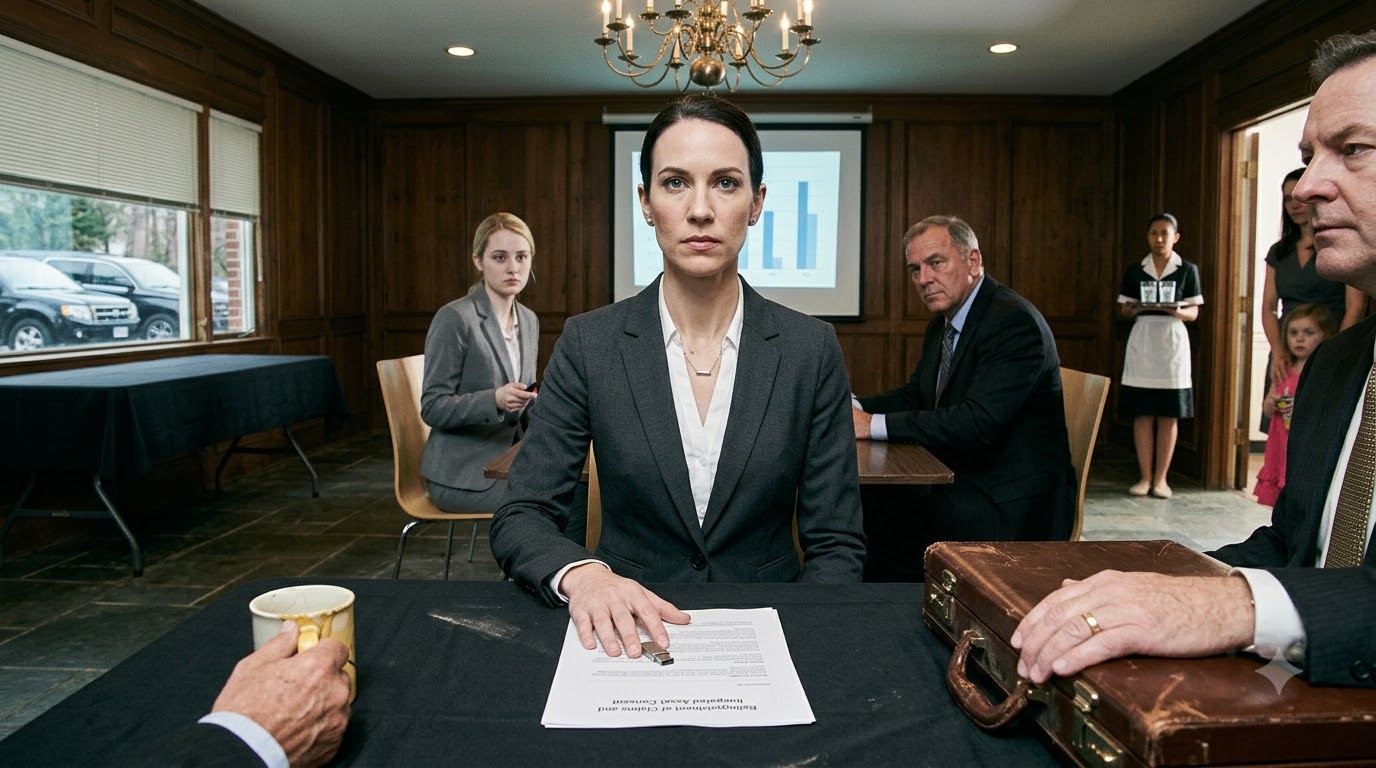
The dining room had been stripped down into something pretending to be a boardroom. Fold-out tables sat end-to-end under the chandelier, covered in dark tablecloths with printed paper agendas at every station. I walked the length of the carpet, looking for my name among the heavy brass place-card holders.
“Yours is over by the pantry doors, Ms. Quinnland,” an assistant said, her voice dropping as she set down a stack of un-stapled folders.
I stopped at the far corner. The chair was cheap birch wood, unpadded, set three feet back from the main line of sight. In front of it lay a blank rectangle of cardstock, paper-clipped to a cheap plastic ballpoint pen with no ink label. No title. No name. Just a white space waiting for an intruder.
Across the room, my sister Valora leaned over the head of the table, her beige silk blouse crisp under the recessed lighting. She was laughing with Mr. Rudd, the family lawyer, whose leather briefcase sat open like an open jaw on the mahogany surface. Neither of them looked up.
“Theres?” A small voice chirped from the doorway.
A six-year-old girl in a pink ruffled dress squinted at me while clutching a juice box. Behind her, my cousin Martha reached down and yanked the child’s shoulder back hard enough to spill purple liquid onto the floorboards.
“Don’t stare, Chloe,” Martha muttered, her eyes scanning the ceiling as if I were a structural beam that needed painting over. “She used to live down in Austin. She’s just here to watch.”
I didn’t answer. I pulled out the light wooden chair, the legs scraping against the heart-pine floor with a dry, hollow vibration. I sat down, folded my hands over the blank cardstock, and waited for the show to start.
CHAPTER 2: THE SILENT AUDIT
The assistant set the agenda packet on my blank cardstock with a dry clack. No staple held it together. Loose sheets slid across the polished wood, the top page askew.
I picked up the stack, my thumb leaving a faint smudge of oil on the top corner. Page one listed the executive board. Valora Quinnland, Managing Director. Douglas Quinnland, Senior Advisor. Lucas Quinnland, Regional Operations.
My name was nowhere on the page. Not as a director, not as a consultant, not even as a shareholder. I flipped to page three, where the asset breakdown listed the regional logistics platform I’d written from scratch on my kitchen table four years ago. They had rebranded it “Quinnland Core Systems.”
“As you can see on slide four,” Valora’s voice cut through the hum of the overhead air conditioner, smooth and practiced, “we’ve streamlined our technical overhead by consolidating our proprietary software assets under the primary family holding.”
Across the table, Uncle Douglas took a slow sip from a chipped ceramic mug, the white glaze crossed by a hairline fracture held together by yellowing epoxy. He set it down on a napkin, not looking at me.
“Is there a historical credit line attached to that module, Valora?” I asked.
My voice didn’t rise. It didn’t need to. The room went dead quiet, the kind of sudden drop in volume that makes people check their phones.
Valora didn’t turn around immediately. She clicked her remote, advancing to a slide filled with blue bar charts. “We’re holding questions until the end of the strategic overview, Theres. Let’s keep this clean for Mr. Rudd.”
Mr. Rudd shifted in his chair, his leather briefcase creaking as he leaned back. He cleared his throat, adjusting a thick gold ring on his left hand. “The documentation is fully compliant with current estate guidelines, Theres. You were provided the summary packet for observational purposes.”
I looked down at the un-stapled pages. On page seven, buried in the fine print of the operational budget, a recurring line item stood out: Vehicle Fleet Maintenance Line 04. $1,400 a month.
That was the fuel and servicing fund for my father’s SUV—an account I’d personally authorized and funded through a local commercial account two years ago when his pension took a hit. They hadn’t just omitted my name from the business; they were still running their daily errands on my personal ledger while telling the room I was just a guest.
“Observational purposes,” I repeated quietly, sliding the loose pages back into a neat stack.
“Let’s not make a scene, honey,” my father muttered from three seats down. He didn’t look up from his tablet screen. “Valora’s got a tight schedule today.”
I pulled the metallic USB drive out of my pocket, setting it squarely in the middle of the blank cardstock where my name should have been. The brushed steel caught the glare of the recessed ceiling lights. Nobody in the room knew the local server keys were stored on that drive, or that the utility accounts keeping the estate’s air conditioning running were tied directly to the same local commercial line.
I didn’t yell. I didn’t push back my chair. I simply pulled a black ballpoint pen from my pocket, uncapped it, and drew a single, heavy black line through the blank space on my cardstock.
CHAPTER 3: THE STOLEN BLUEPRINT
Mr. Rudd smoothed down the corner of the blue folder with his thumb, the heavy paper crinkling under the pressure. He slid a crisp, double-spaced document across the dark tablecloth, stopping it right over the black line I had drawn on my blank cardstock.
“This is an acknowledgement form, Theres,” Valora said from the front of the room, her voice carrying that light, cheerful tone she used when ordering coffee. “Just a standard formality for the records. It confirms you’re aware of the restructuring.”
I didn’t reach for the pen. I tilted my head down, reading the bold header near the top paragraph: Relinquishment of Claims and Integrated Asset Consent.
Beneath the legalese lay three clauses referencing the warehouse tracking architecture and local dispatch loops I’d spent three winters developing line by line. They had rebranded the entire suite under “Quinnland Future Holdings.”
“You’ll initial at the bottom of page two,” Mr. Rudd said, tapping a manicured fingernail against the paper. A small gold tie clip glinted on his tie as he leaned back, his eyes darting toward Valora. “It simply streamlines the regional software rights so the family trust can secure the line of credit for the upcoming expansion.”
“And if I don’t sign it?” I asked.
Valora let out a short, quiet laugh that didn’t reach her eyes. “Let’s be practical, Theres. You’ve always been more of an idea person than a manager. We’re actually doing you a favor by taking the administrative burden off your plate.”
Before I could answer, the side door clicked open. Kayla stepped into the room wearing a sharp gray suit—the same assistant who had resigned from my small office six months ago citing a family emergency. She carried a sleek laptop under her arm and didn’t make eye contact with me as she plugged it into the projector cable.
“Kayla will present the third phase of the digital rollout,” Valora announced, waving her hand toward the screen. “She’s taken our regional logistics platform to a level we couldn’t have managed previously.”
The projector hummed, casting a bright blue box onto the wall. The first slide popped up: Quinnland Logistics Automation Framework.
Every flowchart, every metric column, every color-coded inventory trigger was identical to my local source code. Right down to the lower-right margin note that read: Efficiency isn’t about speed, it’s about predictability. A phrase I had written on a notepad in front of Kayla two years ago.
“We’ve optimized the local routing parameters,” Kayla said, her voice tight as she pointed a red laser at the screen. Her hand trembled slightly, the red dot bouncing against the wall. “This reduces fuel costs across the local delivery fleet by fourteen percent.”
My father nodded slowly, giving a quiet, approving clap. Across the table, Uncle Douglas picked up his epoxy-cracked mug, taking a long drink without taking his eyes off the slide deck.
I reached out and picked up the blue document. I didn’t tear it. I didn’t fold it. I simply slid it under my metallic USB drive on the table, letting the steel weight hold it down.
“You’re using my local administrative access key for that server,” I said directly to Kayla.
Kayla froze, her thumb hovering over the laser pointer. She looked over at Valora, her face going pale under the bright overhead lights.
“We are using family assets for a family business, Theres,” Valora interrupted, stepping between me and the screen. She pushed a pen toward me across the table, the plastic rolling until it hit my knuckles. “Initial the form so we can move on.”
CHAPTER 4: THE ESCORT AND THE KEY
He didn’t wear a security uniform, just a heavy canvas jacket with an estate contractor badge clipped to the pocket. He looked over at Mr. Rudd, who gave a single, tight nod.
“Ms. Quinnland,” the man said, his voice level and unhurried. “We’ve been asked to clear the main room for the voting session. Non-voting parties need to wait in the driveway.”
Valora didn’t look at me. She smoothed down the edge of her cream blazer and tapped her stylus against the laptop screen. “Thank you, Mark. Please make sure the side exit stays clear.”
My father kept his head down, tracing a pattern on the wood table with his thumb. Across the room, my mother picked up her cloth napkin and began folding it into precise, tight triangles. Not a single person at that table looked up as I stood.
I picked up the metallic USB drive, its cold steel slipping back into my blazer pocket. I picked up my phone and my keys. I didn’t push my unpadded birch chair back under the table. I left it sitting three feet out, an awkward obstacle right in the middle of the narrow walkway.
“Theres,” my mother called out softly, her voice barely carrying over the hum of the air conditioner. “Don’t make this a scene, sweetheart. It’s just business.”
“It always is,” I said.
The man in the navy jacket walked two paces behind me down the long hallway. My heels clicked clean and hard against the pine floorboards. When we reached the heavy front doors, he reached past me and held the brass handle open.
The Texas heat hit my face like a warm wet towel the second I stepped onto the porch. The iron gate sat closed down at the end of the gravel driveway.
I walked straight to my eight-year-old sedan, unlocked the driver’s side door, and sat down in the heat. The leather seat burned through my trousers. I opened my laptop on the passenger seat, connected it to my phone’s local mobile hotspot, and opened the local administrative panel for the commercial accounts tied to my tax ID.
There were three active service profiles listed: Quinnland Estate Dispatch Loop, Vehicle Fleet Sub-Account 04, and Estate Utility Credit Line.
I didn’t pause. I un-checked the authorization box on all three.
A confirmation prompt popped up in bold gray text: Revoke local credential routing immediately?
I tapped the trackpad. The screen flickered once, then refreshed with three solid red badges: ACCESS REVOKED. ACCOUNT SUSPENDED.
Ten feet away, inside the estate, the heavy central air conditioner compressor gave a loud, choking rattle, then died completely into the afternoon heat.
CHAPTER 5: THE DOMINO EFFECT
Valora marched down the gravel path first, her cream blazer unbuttoned, cheeks flushed red in the thick afternoon humidity. Mr. Rudd followed three steps behind, his leather briefcase swinging wildly as his dress shoes skidded on the loose stone.
“Theres!” Valora yelled, her voice cracking as she hit the edge of the circular driveway. She grabbed my driver’s side door handle and jerked it hard, but the lock mechanism held fast with a sharp, heavy click. “What did you do to the server switch? Kayla’s system just crashed mid-slide!”
I rolled the window down two inches, just enough to let the dust settle between us. “I revoked the local credential routing. You said it was a family business, Valora. I’m not family on your ledger, so my local credentials don’t apply.”
Mr. Rudd pulled a ringing cell phone from his pocket, his hand visibly shaking as he pressed it to his ear. “It’s not just the server, Valora,” he muttered, his eyes wide as he looked over the roof of my car. “The local bank terminal just declined the estate’s monthly vendor retainer. Line twenty-two was tied to that same commercial clearing profile.”
A black SUV rattled down the driveway toward the iron gate—my father behind the wheel, heading out for his church committee meeting. He stopped at the keypad post, reached out his window, and punched in his code.
The digital pad beeped three high-pitched error tones. Red LED lights flashed twice across the box. The heavy iron gate didn’t budge an inch.
“My fuel card didn’t swipe at the pump this morning either!” my father shouted through his open window, his knuckles white on the steering wheel as he glared at my car. “Theres, stop this childish nonsense right now and open the gate!”
“I don’t manage that fund anymore, Dad,” I said, looking him straight in the eye. “Ask Valora. She’s managing the legacy plan.”
Valora slammed her flat palm against my driver’s window, leaving a damp, oily smudge on the glass. “You can’t do this! We have a binding estate agreement drafted!”
“You have a blue folder,” I corrected, resting my arm over the steering wheel. “And a draft that relies on my local authorization signature. Which you didn’t get.”
My phone buzzed on the center console. A text message from my former assistant, Kayla, popped up on the screen: The local database locks are permanent without your key. I’m leaving.
Valora watched my screen light up, her teeth clenched so tight the muscles in her jaw twitched. “You think you’re so smart,” she hissed, her voice dropping into a desperate, razor-thin whisper. “You think you can just walk away and ruin us?”
“I didn’t ruin anything,” I said quietly, put the car in reverse, and backed up two feet. “I just stopped paying for the illusion.”
CHAPTER 6: THE UNBROKEN GROUND
The key felt heavy, cold, and solid against my palm. No gold plating, no family crest, just standard brass from the locksmith around the corner.
Behind me, the door latch clicked shut. I set the key on the smooth maple desk next to my laptop and a small stack of certified mail receipts.
The top slip bore Mr. Rudd’s official signature, confirming receipt of the final audit documentation. When the local commercial clearing lines were frozen, the bank had audited the estate’s underlying ledger, uncovering three years of unauthorized credit transfers routed through my personal tax ID to cover their property taxes and utility arrears. The family estate hadn’t been an expanding empire; it was a sinking ship operating entirely on my silent backing.
Valora had tried one last desperate counter-move two days ago, leaving a tearful, three-minute voicemail claiming I was abandoning our mother in her old age and threatening to file a public petition for family asset conversion.
I didn’t call back. My lawyer sent a single registered letter attaching the bank’s audit report and a formal warning regarding financial fraud.
The voicemail messages stopped instantly. The public demands dissolved into silence. Without my local operational keys and without my credit line disguising their deficit, Valora and Mr. Rudd were forced to list two parcels of the Quinland outer acreage for public sale just to settle the back taxes.
My phone on the desk gave a short, quiet chime. A text message from my father.
The gate contractor fixed the code box today. We had to pay cash.
I looked at the message for three seconds, then locked the screen without typing a reply. No anger, no sharp retort. Just a boundary drawn in plain concrete.
I picked up a ceramic mug from the small counter by the window—new, smooth, uncracked, holding hot coffee that smelled rich and clean in the quiet room.
I sat down at the maple table, opened my notebook to a fresh page, and uncapped my black ballpoint pen. Outside, the afternoon sun moved across the floor, casting steady, warm rectangles over the unpolished wood. I didn’t need their seat at the head of the table. I had built my own.