A Fragile Empire Built on Silence: The High Cost of the Harrington Deception
CHAPTER 1: THE WEIGHT OF THE GLASS
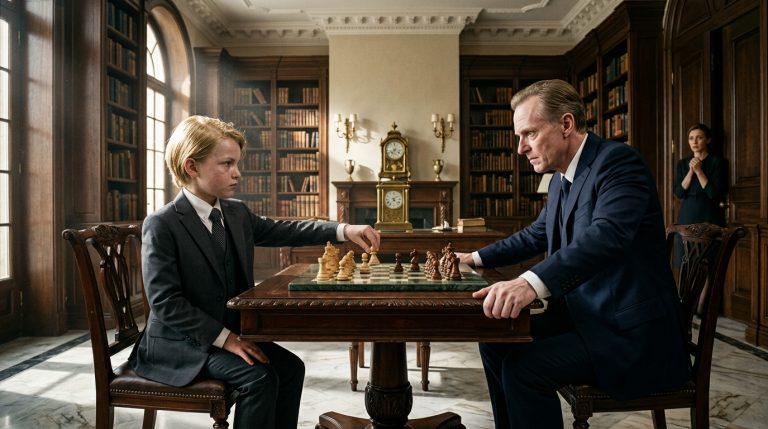
The marble floor of the East Wing foyer was cold enough to seep through the thin soles of Maria’s shoes, a constant, biting reminder of where she stood in the hierarchy of the Harrington estate. She didn’t belong to the marble or the silk curtains; she belonged to the shadows that clung to the edges of the vaulted ceilings. Her eyes tracked the movement of the light as it crawled across the Grand Library, searching for a flaw in the stillness.
There.
John Harrington sat near the east window. His posture was perfect, the kind of stillness that required more effort to maintain than an hour of hard labor. He was reading, or appearing to, his long fingers hovering over the spine of a book he hadn’t turned a page in for twenty minutes. Maria pushed her cart forward, the wheels silent on the plush rug, her gaze locked on the empty space beside his desk.
His physical therapist, Dr. Reigns, had left three minutes ago, cutting the session short. Again.
Maria didn’t look at John. She looked at the floor beneath his chair. The carpet wasn’t compressed in the way it should have been for a man of his size bearing the constant weight of a metal frame. It was barely touched, a subtle discrepancy that whispered of a man who spent more time on his feet than the world was allowed to know.
Her heart hammered against her ribs, a rhythmic, frantic bird trapped in a cage. She knew the consequences of noticing, of cataloging the inconsistencies. If she were caught staring, she would be replaced before the sun hit the horizon. But she was a mother, and she was a woman who had spent years watching people with power break things they didn’t even realize they were holding.
She moved to the side of the desk, her cloth and polish ready, but her mind was calculating the distance between the library and the indoor pool. She had seen the flash of his legs beneath the water last night—the power, the steady, rhythmic kick. That wasn’t the movement of a recovering man. That was the movement of a man in his prime, sharpening his blade in the dark.
A sharp, metallic click echoed through the library. John had closed his book.
“Maria,” he said. His voice was smooth, devoid of any edge, yet it made the hair on her arms stand up.
She turned, her movements practiced, her expression carefully blank. “Yes, Mr. Harrington?”
He turned his chair, the chrome frame catching a sliver of the cold morning light. His eyes were focused on her, not with the distant kindness he usually offered, but with a sharp, probing intensity that felt like a surgical needle. “You’ve been hovering, Maria. Is the library not meeting your standards today?”
“Everything is as it should be, sir,” she replied, her voice steady despite the adrenaline spiking in her veins. She kept her eyes low, focused on the edge of his mahogany desk.
“Is it?” He leaned forward, a movement that felt dangerously fluid. “Because I’ve noticed you’ve been… observant, lately. It’s a dangerous trait, curiosity. In this house, it’s usually fatal to one’s career.”
Maria felt the air in the room thicken. She saw a flicker of movement—a slight tightening of his hands on the armrests—before he forced them to relax. He was holding onto the chair not for support, but to keep himself contained.
She took a breath, the scent of expensive polish and old paper filling her lungs. She chose her words with the precision of a trap being set. “I only notice what I’m required to keep clean, sir. Sometimes, things that are hidden still collect dust.”
John’s expression didn’t change, but the silence between them stretched, tight and humming with unspoken threats. He shifted his weight, and for a fleeting second, his left foot pressed firmly against the carpet, grounding him, preparing him.
“See that you continue to stick to the dust, Maria,” he said, his voice dropping into a register that was chillingly quiet. “Because if you ever start looking for things that aren’t meant to be found, you might find that this house has very few places left for you to hide.”
As Maria walked away, her pulse thrumming in her throat, she realized the chair wasn’t just a prop. It was a barricade. And as she reached the door, a sudden, jarring sound came from the hallway—the distinct, muffled crash of a dropped medical file coming from the East Wing utility closet. The very files she had been trying to access all week were now splayed across the floor, and standing over them was Dr. Reigns, his face pale as he looked directly at her.
CHAPTER 2: THE INTERROGATION OF DUST
The utility closet door didn’t just creak; it seemed to exhale, a sharp, metallic wheeze that echoed off the high-gloss marble of the hallway. Dr. Reigns didn’t move. He stood frozen, his hand still hovering over the scattered white pages, his face drained of color. For a heartbeat, the only sound was the distant hum of the estate’s climate control, a clinical, artificial wind that did nothing to cool the sudden heat rising in Maria’s chest.
“Maria,” he said. His voice was too thin, a brittle reed trying to hold back a flood.
She didn’t retreat. To turn and run would be to signal guilt, a confession written in the frantic pace of her retreat. Instead, she took a deliberate, measured step forward, her eyes fixated on the mess he had made. The pages were technical, full of graphs and clinical annotations that looked suspiciously like standard physical therapy reports, yet the headers were marked with the distinct, crimson insignia of Harrington Global Ventures—the company’s internal legal division, not the medical branch.
“I’m sorry, Doctor,” she said, her voice sounding strangely steady to her own ears. She kept her grip on the handle of her cart, the hard steel digging into her palm until she felt the bone beneath the skin. “I was just… I didn’t mean to intrude. I heard the crash.”
Reigns’ eyes flicked toward the door, checking the corridor for witnesses. The hallway was empty, a long, sterile artery of wealth that offered no salvation. He bent down, his movements jerky, and began scooping the papers into a pile with uncoordinated haste.
“It was an accident,” he snapped, his professionalism splintering. “The floor is… slicker than it looks.”
Maria knelt, a necessary pretense. Her fingers brushed the edge of a document near the doctor’s foot. It was a progress report, dated three days ago. Patient Status: Full Mobility Achieved. Range of Motion: Optimal.
Her breath hitched, a tiny sound she prayed he didn’t catch. The internal phantom hit her then—the sharp, distinct smell of wood shavings and sweat. It was her father’s scent, back when he used to work in the small, cramped shop behind their apartment, his hands always calloused, always moving. He used to say that a man’s hands told the truth even when his mouth was lying. She looked at John Harrington’s therapist, a man who possessed the soft, pampered hands of a high-end concierge, not a healer.
“You’re shaking, Doctor,” she observed, keeping her gaze pinned to the floor. She wasn’t just observing; she was testing the integrity of his composure.
He froze. “I have a flight to catch. The stress of the upcoming party is… considerable.”
“The party isn’t for hours,” Maria countered, and for the first time, she dared to meet his eyes. She didn’t offer a smile. She offered nothing.
The silence that followed was heavy, a suffocating weight that pressed into the gaps between them. Reigns straightened up, the stack of papers clutched to his chest. He looked at Maria not as a member of the staff, but as a potential liability. The realization was as clear as the polished marble beneath her knees. He wasn’t just a therapist; he was a gatekeeper, and she had just walked into the room where the key was kept.
“You should finish your work, Maria,” he said, his voice regaining some of its clinical detachment. “This hallway needs a deep polish. Mr. Harrington prefers his surfaces reflective.”
He turned on his heel and strode toward the staircase, his gait overly careful, almost studied. Maria stood, watching the back of his blazer. She didn’t move until the sound of his footsteps had vanished into the carpeted depths of the second floor. She looked back at the utility closet.
She walked inside.
The air in the small room was stale, smelling of cleaning chemicals and hidden things. She reached into her apron pocket and pulled out her phone, her fingers dancing across the screen to activate the camera. She didn’t have much time; if Reigns returned or if security did a sweep, she would be finished.
She scanned the floor, looking for any stray page the doctor might have missed. There, tucked beneath the base of a chemical shelf, was a small, torn corner of a document. She pulled it free. It wasn’t medical data. It was a calendar, densely packed with names and dates, each entry marked with a dollar sign. The last entry for today was marked: Merger Finalization. Security Clearance: Absolute.
It wasn’t a medical recovery they were hiding. It was a business acquisition. And the wheelchair was the distraction meant to keep the board of directors—and the public—from realizing that Harrington Global was on the verge of a predatory takeover.
Maria tucked the scrap into her waistband, hidden beneath the thick fold of her work smock. The weight of it felt like lead, a cold, sharp-edged anchor that dragged at her resolve. She wasn’t just a cleaning woman anymore. She was a witness.
She stepped out of the closet and stopped dead.
John Harrington was standing at the far end of the hallway. He wasn’t in his chair. He was standing perfectly straight, his frame imposing against the stark white of the wall, his gaze fixed directly on the open door of the utility closet where Maria stood.
He didn’t move. He didn’t speak. He simply watched her, his expression a mask of chilling, calculated neutrality.
Maria gripped the handle of her cart, her knuckles white. She realized then that the decoy had been stripped away, and the game had shifted from a performance to a standoff. She needed to move, but her feet felt rooted to the cold, unforgiving floor. The distance between them wasn’t just physical; it was a chasm of power, and she was currently on the wrong side of the ledge.
He took a step toward her. Then another. The sound of his dress shoes clicking against the marble was the only thing in the world. He was closing the distance, and for the first time in three years, Maria realized he wasn’t looking at her as a servant. He was looking at her as the only thing in the room that stood between him and the total collapse of his empire.
“Maria,” he repeated, his voice low, a vibration that seemed to rattle the very foundations of the estate. “I think it’s time we had a very long, very private conversation.”
CHAPTER 3: THE PRICE OF THE LEVER
John Harrington didn’t rush his approach. He walked with a heavy, deliberate grace, his footsteps hitting the marble with a sound like a gavel strike. Every inch he covered was a piece of Maria’s defensive architecture crumbling away. She stood in the mouth of the utility closet, her back against the cold, metal-backed door, trapped in the narrow space where her secret and his deception were currently bleeding into one another.
“A long conversation, Mr. Harrington?” Maria asked, her voice tight, forced into a steady, flat cadence that betrayed none of the panic blooming beneath her ribs.
He stopped just three feet away. He was taller than he looked from the seat of that chair, his shoulders broad and set in a way that screamed tactical readiness rather than exhaustion. He didn’t look at her face immediately. He looked at the cart, then at the open door of the closet, his eyes scanning the space with the clinical detachment of an appraiser looking at a depreciated asset.
“Dr. Reigns mentioned a minor spill,” John said, his gaze finally snapping back to hers. His eyes were hard, the color of wet flint. “He seemed… agitated. He said you were in the way.”
“I was cleaning, sir,” Maria said. “It is what I do.”
“You do a great deal more than clean, Maria.” He took another step, invading her personal space until the scent of him—sharp, expensive cologne and the faint, lingering ozone of a swimming pool—enveloped her. “You watch. You calculate. You have been building a map of this house for three years, and now, you’ve decided to see what’s behind the walls.”
He reached out, not to touch her, but to brace his hand against the doorframe beside her head. The movement was a cage. He wasn’t violent, but the restraint in his posture was worse; it was the calculated pressure of a man who knew exactly how much force was required to shatter a resistance.
“I don’t know what you mean,” she said, though the lie felt flimsy, a paper-thin barrier against the truth.
“Don’t,” he commanded, the word low and sharp. “We are past the point of performance. I saw you in the closet. I saw you looking at those files.”
The confession hung in the air, electric and dangerous. Maria realized with a jolt of clarity that John wasn’t trying to hide the wheelchair anymore. He was trying to identify what she knew about the rest of it. The wheelchair was the decoy, the obvious lie he had been feeding the world to keep them distracted from the real, deeper rot within Harrington Global. If she only knew about the chair, he could dismiss her. If she knew about the merger, about the legal papers, she was a liability that had to be neutralized.
“The files were on the floor, sir,” Maria said, choosing her words with lethal precision. “I didn’t have to look for them.”
John leaned in, his face inches from hers. The tension in his jaw was a testament to his own internal strain. “Those files represent the future of this company. They represent the livelihoods of five thousand people. If that information were to leak, it wouldn’t just be an inconvenience for me. It would be a catastrophe.”
“Is that why you’re pretending to be broken?” Maria challenged, her own courage surprising her. “To keep the catastrophe at bay?”
He went still. A muscle in his jaw ticked. For a heartbeat, the mask of the billionaire CEO flickered, revealing a raw, jagged edge of panic beneath the veneer. He wasn’t just a man in a chair; he was a man holding up a collapsing ceiling with his bare hands.
“I am doing what is necessary to survive,” he replied, his voice cooling into a dangerous, thin line. “You have a daughter, Maria. Mrs. Guerrero’s home, the preschool applications… you have a life that is small, manageable, and precious. It would be a tragedy if that life were to be upended by an unfortunate misunderstanding.”
The threat was veiled in silk, but it was a blunt force instrument. He was signaling her vulnerability, holding her daughter over the abyss to test her loyalty. Maria felt the scrap of paper in her waistband, the calendar marked with the merger date. It was a weapon, but it was also a death sentence if she revealed it too soon.
“I’m not interested in your business, Mr. Harrington,” Maria said, keeping her gaze locked on his. “I’m interested in the truth. Why would a man who has everything—the estate, the power, the health—need to lie about whether he can walk?”
John looked at her for a long, agonizing moment. He seemed to be weighing the cost of honesty against the cost of silence. Finally, he pulled back, the pressure in the hallway receding as he took a step toward the window, looking out over the manicured expanse of the Rose Garden.
“Because sometimes,” he said, his voice barely a whisper, “the truth is the one thing that will destroy everything you’ve worked to build. You wouldn’t understand. You play for pennies, Maria. I play for the integrity of an empire.”
“If you have to lie to build it,” she said, her voice steadying, “then maybe it isn’t an empire. Maybe it’s just a house of cards.”
John turned back to her, and for a second, she saw something in his expression—not anger, but a profound, weary acknowledgement. He knew she was right. And that, she realized, was what made him truly dangerous. He wasn’t a monster; he was a man who had already accepted the price of his sins and was now just waiting for the bill to come due.
He reached into his pocket, pulled out a small, leather-bound notebook, and tossed it onto the cleaning cart. “There is a meeting tonight with my brother, Daniel. It’s not on the public schedule. If you want to know how the ’empire’ works, Maria, be in the kitchen at 10:00 p.m. Bring the cart. You’ll be serving.”
He didn’t wait for her answer. He turned and walked down the hallway, his steps echoing, a solitary, rhythmic pulse in the vast, hollow space of the estate. Maria stood by the closet, the notebook sitting on her cart like a ticking clock, watching the billionaire retreat into the shadows of his own making.
CHAPTER 4: THE ARCHITECTURE OF SECRETS
Maria retreated into the service corridors, her footsteps muffled by the industrial-grade carpet that lined the backbone of the Harrington estate. The hallway was a stark departure from the grand foyer; here, the walls were stripped of art, replaced by grey steel conduits and the hum of ventilation fans. She held the notebook John had given her as if it were a live wire.
She paused near a service alcove to catch her breath, her heart hammering against her ribs like a trapped bird. She needed to know what was inside before she walked into the kitchen. She ducked into the alcove, the light flicking on with a buzzing, yellow flicker. She opened the book. It wasn’t a diary. It was a ledger. Page after page of names, companies, and numeric values that made her head spin. But it was the recurring pattern in the margins—the word TAKEOVER repeated in John’s jagged, impatient handwriting—that confirmed her worst fears.
As she flipped through the pages, her eye caught something out of place. Tucked into the back binding was a folded slip of paper, a receipt from a local freight company in Vallejo. It was dated for the day after tomorrow. The destination wasn’t the estate. It was a shipping container facility on the outskirts of town. Her pulse quickened. Why would the CEO of Harrington Global be shipping assets to a mid-level industrial yard?
She had no time to ponder it. A door slammed shut at the far end of the corridor.
Maria shoved the ledger into the hidden compartment of her cleaning cart, covering it with a stack of fresh linens. She didn’t have to look up to know who was walking toward her. The rhythmic, heavy thud of footsteps told her everything. It was Daniel, John’s brother. Unlike John, who moved with a calculated, predatory stillness, Daniel moved like a man who was perpetually annoyed by the world.
“Maria,” Daniel said, his voice echoing off the metallic walls. He stopped just short of her cart. He was dressed in a charcoal suit that looked like it had been tailored to fit his sharp, angular frame. “My brother tells me you’ve been… helpful today.”
“I try to do my job, Mr. Harrington,” Maria replied, keeping her gaze neutral, her hands gripping the steel bar of the cart.
Daniel leaned in, his cologne thick and cloying, a stark contrast to the sterile air of the corridor. “John has a penchant for keeping people who see too much. He thinks he can manage them. He thinks he can turn them into assets.” He looked at the cart, his eyes lingering for a second too long on the linens. “Do you feel like an asset, Maria?”
“I’m a cleaner,” she said, her voice devoid of inflection.
“Everyone is a cleaner in this house,” Daniel countered, his tone dripping with thin, razor-edged irony. “Some clean floors, some clean up corporate messes. The problem is that messes have a tendency to stain. And stains, no matter how hard you scrub, always leave a shadow.”
He reached out, his long, thin fingers brushing the edge of the cart’s handle. Maria didn’t pull away, but she felt a cold shiver run down her spine. Daniel was the architect of the family’s pragmatism; if John was the actor in the wheelchair, Daniel was the one writing the script.
“Is there something you need, sir?” she asked.
“Just a reminder,” Daniel said, his voice dropping to a low, intimate register. “This family is currently at a turning point. If you want to keep your job, keep your daughter in school, and keep your life exactly as it is, you will make sure that the ‘truth’ stays inside the library. My brother is playing a high-stakes game. If he loses, we all lose. Including the help.”
He didn’t wait for a response. He walked past her, his coat brushing against her shoulder, a physical brush of cold air. Maria stood frozen in the hallway, the weight of the ledger hidden in her cart feeling like a physical burden. She had been tasked to serve at a meeting that was clearly meant to be a test. John wanted to see if she was a threat or a tool.
She turned and pushed the cart toward the kitchen. The scent of ozone from the pool room seemed to follow her, a constant reminder of the secret lurking beneath the surface of the estate. She reached the kitchen entrance, the massive stainless steel doors looming ahead. She had ten minutes.
She pushed open the doors. The kitchen was empty, the staff having already retreated to the barracks for the night. She moved to the central island and began to set up the coffee service, her movements sharp, efficient, and fueled by a rising, cold resolve. She wouldn’t be an asset. She wouldn’t be a liability. She would be the one to break the cycle.
As she worked, she noticed a small discrepancy—a single, black fountain pen left on the counter, perfectly aligned with the edge of the marble island. She knew that pen. It belonged to the estate manager, a man who never left his belongings behind. It was a signal. She looked around, the kitchen feeling suddenly, claustrophobically small.
She checked her watch. 9:55 p.m. The service door at the back of the kitchen began to click, a slow, methodical unlocking sequence that signaled someone was arriving for the meeting. Maria took a deep breath, adjusted her posture to look as invisible as possible, and waited. She had the ledger, she had the insight, and now she had the stage. It was time to see if John Harrington could handle a truth that wasn’t rehearsed.
CHAPTER 5: THE FRAGILE BRIDGE
The click of the lock was a physical punctuation, a period at the end of the life Maria had known until tonight. She stood by the stainless-steel island, her hands steady only because she forced them to be. John Harrington entered first, his gait smooth and devoid of the performative limp he used for the public eye. He wasn’t wearing his usual sweater; he was in a sharp, charcoal-grey suit that made him look like an executioner. Behind him, Daniel followed, his eyes darting to the service door, then to the coffee service Maria had laid out, and finally to her.
“Leave it,” John said. He didn’t look at her. He walked to the center of the kitchen, his posture radiating a predatory dominance that she had only ever seen in brief, stolen glimpses.
“I have the cleaning to finish, sir,” Maria said, her voice sounding thin in the vaulted acoustics of the kitchen.
“The cleaning can wait,” Daniel snapped, moving toward the edge of the island, his fingers drumming against the cold granite. “We have a problem, John. A liability that just decided to start eavesdropping.”
John stopped. He turned, not toward Daniel, but toward Maria. The intensity of his gaze was a physical weight, pressing into her lungs. He was evaluating her—not as a threat to be removed, but as a potential player in the endgame. He reached out and tapped his fingers on the surface of the island, right next to the ledger he knew was hidden in her cart, shielded by the linens.
“Maria,” John said, his voice dropping into a register that felt like velvet pulled tight over steel. “My brother believes you’re a problem. He thinks you’re a spy for the competition. I, on the other hand, am curious. I want to know why a woman who has everything to lose would gamble it all for a scrap of paper she found in a closet.”
“I’m not a spy,” Maria said. She stood her ground, her chin tilted slightly upward. “I’m a mother. And I don’t like being lied to, especially when it involves the people who work under this roof.”
Suddenly, the overhead lights flickered, a stuttering, violent discharge of energy that plunged the kitchen into brief, pulsating darkness. The hum of the industrial refrigerator died, replaced by an eerie, sudden silence that seemed to swallow the room. In the dark, Maria felt the sharp, electric shift in the air—the smell of ozone from the pool room, and the metallic tang of something being pulled from a holster.
She didn’t move. She couldn’t. When the lights buzzed back to life, the kitchen was bathed in a sickly, yellow glow. John hadn’t moved, but his hand was now resting on the edge of the cart, his fingers mere inches from the hidden ledger.
“The power grid is failing,” John said, his voice eerily calm, almost appreciative. “A symptom of the estate’s age, or perhaps, a sign that the walls are starting to talk.”
“Is that what this meeting is about?” Maria asked, her voice trembling but defiant. “Is this where you decide if I’m an asset or a loose end?”
Daniel laughed, a dry, humorless sound. “John, don’t play with her. We have six hours before the board meeting. The merger is finalized at sunrise. If she has the ledger, she has the leverage. We don’t have time for your empathy.”
“Empathy?” John looked at his brother with a cold, piercing amusement. “This isn’t empathy, Daniel. This is damage control.” He shifted his focus back to Maria. “You have something in that cart, Maria. Something that belongs to the Harrington estate. If you give it to me now, you walk out of here with your life and your daughter’s future intact. If you don’t… well, the estate is large, and there are many places where a ‘cleaner’ could disappear.”
Maria’s mind raced. The power flicker had provided a momentary distraction, but it had also forced their hand. John wasn’t just testing her; he was offering a bribe disguised as a threat. The ledger was the only thing protecting her, and she knew that the moment she handed it over, she would be expendable.
She took a slow, deliberate step back. “I don’t have anything of yours, Mr. Harrington.”
“Don’t lie,” Daniel warned, taking a threatening step forward. “I saw you in the corridor. You were holding the ledger.”
“I was holding a notebook,” Maria said, her pulse thudding a frantic rhythm against her ears. “If you want to search my cart, do it. But you’ll find nothing but linens and cleaning supplies.”
John stood still, his eyes narrowed, searching her face for a tell. She had moved the ledger before entering the kitchen, sliding it into the ventilation shaft behind the service rack while the lights were out. It was a desperate, foolish risk, but it was the only one she had.
“Search it,” John ordered.
Daniel tore through the cart, his movements violent and erratic. He pulled out the linens, flinging them onto the floor, the stack of towels hitting the tile with a damp, heavy thud. He shoved aside the bottles of polish, the brushes, the microfibers. Empty. He stood up, his face flushed with a furious, ugly heat.
“She’s lying, John!”
John watched Maria. He saw the way she stood—not with the cowering posture of a servant, but with the rock-steady focus of a woman who had already anticipated the storm. He walked over to the service rack, his movements slow, his eyes fixed on the gap in the ventilation grate where the ledger was wedged. He didn’t look inside. He simply stared at her.
“You’re a remarkable woman, Maria,” he said, his voice dangerously soft. “But you’ve made a mistake. You think the ledger is the leverage. The ledger is just paper. The real leverage is the fact that you think you’re in control.”
He leaned in close, his voice dropping to a whisper that only she could hear. “The power flicker wasn’t an accident. It was a test. And you just failed.”
He turned to his brother. “Leave her. She’s not the one we need to worry about. We have bigger problems to deal with before sunrise.”
As they walked out of the kitchen, their silhouettes cutting through the dim, flickering light, Maria finally let her breath escape. She had survived the meeting, but the game had fundamentally changed. She was no longer a witness; she was a target. And as the kitchen went dark again, she realized the power wasn’t coming back on. The estate was shutting down, and she was trapped in the center of the architecture she had spent three years cleaning, with no idea what John Harrington had planned for the dawn.
CHAPTER 6: THE MIRROR FRACTURE
The darkness was not merely an absence of light; it was a physical weight, thick with the scent of stagnant air and the metallic tang of the cooling industrial equipment. Maria stayed pressed against the cold, unyielding surface of the marble island, her eyes slowly adjusting to the gloom. The mansion, usually alive with the hum of climate control and the distant, polite murmur of privilege, had become a tomb. She felt the chill of the marble against her palms, a sharp, biting reminder of the risk she had taken.
She needed to reach the ventilation shaft. If John or Daniel returned and found her here, or worse, discovered the ledger missing from the shaft, she wouldn’t just be an “asset”—she would be a loose end. She pushed away from the island, her movements calibrated to absolute silence. Every shift of her weight on the tile floor felt like a thunderclap in the oppressive quiet.
A sudden, sharp rasp of air pulled her gaze toward the service door. Someone was breathing on the other side.
Maria froze, her heart hammering against her ribs with a cadence that threatened to betray her location. She reached into her apron, her fingers brushing the hard plastic of her utility flashlight. She didn’t dare turn it on, not yet. Instead, she crept toward the shadows of the prep tables, her movements fluid and practiced. She had spent three years learning the topography of these kitchens—the squeak of a specific floorboard, the exact resistance of the hinges on the massive, walk-in coolers.
She reached the back of the kitchen, her hands finding the service rack. Her fingers danced over the metal, searching for the grate. She found it—the cool, serrated edge of the ventilation cover—and began to work the latch. It was stubborn, the metal warped by years of heat and neglect. She held her breath, the metallic snick of the latch barely audible over the sound of her own blood rushing in her ears.
As she pulled the ledger from its hiding place, the air in the kitchen shifted. A shadow moved—a deliberate, slow-motion slide across the far wall. John Harrington was in the kitchen. She couldn’t see him, but she could feel the displacement of the air, the cold, calculating presence that always preceded him.
“You think you’re the first person to try and navigate the dark, Maria?” His voice came from the opposite corner, disembodied and smooth. “My grandfather built this house to withstand storms, riots, and revolutions. It knows its secrets better than any of us.”
Maria clutched the ledger to her chest, her knuckles turning white. She didn’t respond. She retreated further into the shadows, her eyes scanning the room for an exit—the service stairs, the side door leading to the gardens, anything that wasn’t a dead end.
“I don’t want to hurt you,” John continued, his voice calm, almost conversational. “But I have a merger to close in seven hours. My brother is currently clearing the security logs. By sunrise, you won’t exist in the company files, and the ledger you’re holding will be nothing more than a piece of evidence that can be destroyed with a single flame.”
She realized then that he wasn’t just stalling; he was forcing her to make a choice. He wanted her to run. He wanted her to lead him to her stash or her contact—if she had one. But she had no one. She was entirely, terrifyingly alone.
She remembered her father’s voice, a ghost from her childhood: Don’t look at the house, Maria. Look at the foundation. If the foundation is cracked, the roof will always fall.
The realization hit her with the force of a physical blow. The ledger wasn’t just a list of takeovers. It was a roadmap of how the estate had been financed—the offshore accounts, the illicit shell companies, the very backbone of the Harrington fortune. If she destroyed it, she destroyed the evidence of his crime, but she also destroyed the power that kept him in the chair.
She lunged.
Not toward the door, but toward the service rack, using her momentum to slam the heavy, steel-topped cart into the center of the kitchen floor. The sound was deafening, a cacophony of screeching metal and clattering dishes that sent John lunging toward the noise.
In the brief, chaotic moment of the impact, Maria sprinted for the back service stairs. Her feet hammered against the wood, her lungs burning, her vision blurring in the absolute darkness. She didn’t look back. She navigated the stairs by touch alone, her hand guiding her along the railing until she felt the heavy, iron bolt of the garden exit.
She threw the bolt back, the metal protesting with a sharp, high-pitched scream, and tumbled out into the cool, damp air of the garden. The night was absolute, the moon hidden behind a dense, suffocating cloud cover. She didn’t know where she was going, only that she had to put as much distance between herself and the library as possible before the dawn broke.
As she sprinted past the rose arch, she felt a sudden, sharp tug on her arm. A hand, strong and unyielding, gripped her sleeve and yanked her down into the darkness behind a thick, overgrown hedge.
“Quiet,” a voice hissed in her ear.
It was Anna.
Her face was pale in the starlight, her eyes wide with a mixture of terror and fierce, unwavering resolve. She held a finger to her lips, her grip on Maria’s sleeve tight enough to bruise.
“I know about the ledger,” Anna whispered, her voice a fragile, trembling line of sound. “And I know about the wheelchair. But you don’t know what they’re planning to do with the company at sunrise. We have to leave, Maria. Now.”
Maria looked at the woman who was supposed to be the prize of the Harrington empire, and for the first time, she realized that John wasn’t the only one keeping secrets. The foundation wasn’t just cracked; it was entirely, irrevocably hollow.
CHAPTER 7: THE FINAL LEVER
Maria remained crouched in the dirt, her breath hitching in her throat as she stared at Anna. The woman she had spent years observing from the shadows was gone, replaced by someone with sharp, frantic eyes and a pulse that hammered against Maria’s arm. The darkness of the hedge provided a temporary, fragile barrier, but the sounds of the estate—the distant, rhythmic clicking of John’s footsteps on the flagstone path—told them that the time for hiding had run out.
“He knows,” Anna whispered, her voice a sharp, jagged instrument. “He knew you would take the ledger. He’s been letting you believe you were playing the game, but John doesn’t play games, Maria. He clears boards.”
Maria didn’t pull away. She looked at Anna, searching for the warmth she had once perceived in her, but finding only a cold, brittle edge. “What do you mean, clearing the board?”
“The merger isn’t just about money,” Anna said, her gaze darting toward the path where the sound of footsteps grew closer. “It’s about the debt. Harrington Global is insolvent. They’ve been leveraging shell companies for three years to cover the losses from the aspen accident. If that ledger reaches the public, the company doesn’t just lose its valuation—it ceases to exist. And John goes to prison.”
The pieces clicked together with the finality of a lock engaging. The wheelchair, the charity gala, the philanthropic facade—it wasn’t just a performance to win Anna’s heart. It was a tactical necessity to maintain the illusion of stability while the core of the empire was hollowed out from within.
“You knew,” Maria said, a cold, sickening realization blooming in her chest. “You weren’t his victim. You were his partner.”
“I was his accomplice,” Anna corrected, her voice losing its tremble. “I provided the social credibility he needed to secure the final, massive liquidity injection from my father’s firm. Without me, he was just a broken man in a chair. With me, he was a billionaire on the mend.”
The footsteps on the path stopped.
The silence that followed was absolute, a crushing pressure that made the air in the garden feel thin. Maria could hear the faint sound of John’s breathing, measured and calm, just on the other side of the hedge. He was waiting. He knew exactly where they were.
“Come out, Anna,” John’s voice drifted through the foliage, smooth and devoid of any emotion. “And bring the cleaner with you. We have a final accounting to finish before the sun rises.”
Maria looked at the ledger still clutched in her hand, then at Anna. She realized the deception she had uncovered—the wheelchair fraud—wasn’t the layer that mattered. It was the skin of the onion, the distraction used to keep eyes away from the deeper, structural rot. John didn’t care about the ledger because it proved he could walk; he cared about it because it documented the fraudulent financial architecture he had built to survive.
“What now?” Maria asked, her voice barely a whisper.
“Now,” Anna said, her eyes turning toward the estate’s main office building, the glass-and-steel monolith that housed the corporate nerve center, “we offer him a trade.”
Anna reached into her coat pocket and pulled out a small, metallic drive. “I’ve been recording our private conversations for six months. I have enough to bring down both brothers. If he wants the ledger, he’ll have to give us everything—the accounts, the records, and a path out of this house.”
Maria stared at the drive. She had walked into the library thinking she was a witness to a simple lie, and she was leaving with the keys to the entire house of cards. But as she looked at Anna, she saw the same calculation she had seen in John’s eyes—the cold, transactional hunger of a person who would burn the entire forest to ensure they remained standing.
“I’m not trading,” Maria said, her voice finding a sudden, unexpected strength. “I’m not your leverage, and I’m not his witness.”
She stood up, the movement fluid and decisive, and stepped out from behind the hedge before Anna could grab her. The garden lights flickered once, twice, and then a blinding, white floodlight illuminated the entire lawn, pinning Maria in a stark, unforgiving beam. John Harrington stood in the center of the light, his posture perfectly relaxed, his hands shoved deep into his pockets. He didn’t look angry. He looked disappointed.
“You were always the hardest variable to calculate, Maria,” he said, walking toward her with a measured, steady gait. “You have the moral clarity of someone who hasn’t yet realized that the world doesn’t reward the honest. It rewards the people who own the ledger.”
“I don’t want the ledger,” Maria said, her voice ringing out across the quiet lawn. “I want to go home.”
“Then do it,” John said, stopping just feet away. “But keep in mind, home is where the consequences live.”
He extended his hand, expecting the ledger. Maria looked at the man, the empire, and the woman who had used them both as pawns. She didn’t hand him the book. She held it over the stone fountain in the center of the garden, the water shimmering black in the floodlight.
“If the foundation is cracked, John,” she said, her voice unwavering, “then it doesn’t matter who owns the ledger. The house is already falling.”
She didn’t wait for his reaction. She dropped the ledger. It hit the water with a dull, wet splash, the pages instantly swelling and soaking up the dark, stagnant liquid of the fountain. John’s expression didn’t change, but for the first time, she saw the shadow of true, uncalculated fear flicker in his eyes. He had been so focused on the leverage that he hadn’t realized the moment the leverage became irrelevant.
CHAPTER 8: THE SETTLEMENT
The fountain water churned, swallowing the ledger in dark, bubbling eddies. John Harrington stood paralyzed, his eyes fixed on the fountain—not with rage, but with the hollow, vacant look of a man watching his reflection shatter. The floodlights cast harsh, elongated shadows across the lawn, making the garden look like a stage set after the play had finished. Anna stood a few paces back, her breathing ragged, her hand still clutched around the drive in her pocket.
“You think that matters?” John asked, his voice devoid of its earlier, tactical precision. It was simply tired. He looked up at Maria, his face etched with the exhaustion of someone who had been running for years and had finally run out of ground. “That ledger was just a record, Maria. It wasn’t the empire. The empire is built on the belief that I am untouchable. You didn’t destroy the truth; you just destroyed the paper.”
“Then let it fall,” Maria said, her voice steady. She took a step toward the garden exit, her body feeling heavy, drained of the adrenaline that had sustained her through the night. “The empire doesn’t belong to me, Mr. Harrington. And the truth is the only thing that doesn’t require maintenance.”
Daniel burst through the garden arch, his hair disheveled, a laptop clutched in his hand. He stopped, seeing the ledger in the fountain, and then seeing the three of them standing in the wash of the floodlights. He looked at John, then at Maria, his face twisting into a mask of pure, unadulterated fury. “You fool,” he hissed, his gaze fixated on his brother. “You let her destroy the only leverage we had against the regulators.”
“It’s gone, Daniel,” John said, his voice flat. “Everything is gone.”
Anna didn’t wait. She walked past the brothers, her movements precise, her eyes cold as ice. She stopped beside Maria, who remained near the fountain. “They’re finished, Maria,” she whispered, the drive held out as if it were a weapon. “I’m going to the press. And I’m going to make sure the board understands exactly what the Harrington brothers built on the back of their ‘charity’.”
Maria looked at Anna—the woman who had chosen to be the final dagger. She realized that the “truth” Anna was bringing to light was just another play, another way to ensure she remained the winner when the dust settled. The Harrington empire would fall, yes, but someone else would rise to take its place. That was the cycle of the house.
“I don’t care,” Maria said. She turned her back on them all—the brothers, the empire, the woman with the drive—and walked toward the service exit.
She didn’t look back at the grand house. She crossed the manicured lawn, the grass damp beneath her feet, and pushed through the heavy iron gate that led to the employee parking lot. The car was right where she had left it. She opened the back door and looked in. Maya was asleep, her small face illuminated by the flickering, weak light of the parking lot lamps. Her shoes were still on the wrong feet.
Maria climbed into the driver’s seat and sat in the silence, the engine cold, the air smelling of dry earth and impending rain. She reached back, her hand brushing Maya’s hair, and felt a profound, settling peace. The billionaire, the secret, the corporate fraud—it all felt small now, distant, like a story she had read in a magazine and then discarded.
She started the engine. The sound was a low, steady thrum against the quiet of the morning.
The Harrington estate was a monument to the weight of lies, but as she drove past the marble columns and the iron fences, the world felt lighter than it had in three years. She drove out onto the winding road of the valley, the first rays of the sun beginning to bleach the sky.
She thought about the ledger, the paper sinking into the fountain, the ink bleeding into the dark water. It didn’t matter who took credit for the fall. It didn’t matter who survived the wreckage. What mattered was the path ahead—the simple, honest road, the preschool application, the small, warm weight of her daughter in the backseat. She adjusted the mirror, catching a glimpse of her own reflection—tired, drawn, but entirely, unequivocally her own.
As she reached the main highway, she felt the last remnants of the tension dissolve. She wasn’t just a maid anymore, and she wasn’t a witness to someone else’s drama. She was a mother heading home, and for the first time in a long time, the only story that mattered was the one she was about to write for herself. The sun climbed higher, casting a warm, golden light over the valley, and Maria accelerated, leaving the house of shadows far behind her in the dust.