The Dimensions of Light: How a Single Proof Rewrote the Future for a Girl from Roxbury
CHAPTER 1: The Weight of Chalk
The lecture hall at East Bridge University held a specific kind of silence. It was a dense, airless quiet that smelled of floor wax and centuries of institutional certainty. Leila Carter stood in the second row, her sneakers feeling dangerously bright against the polished marble floor. Her thrifted blazer was too thin for the drafty hall, and the air around her felt sharpened, narrowed by the presence of Dr. Malcolm Green.
Dr. Green stood at the mahogany lectern, his eyes—pale and fixed—scanning the room until they landed on her. He didn’t see a student. He saw an equation that didn’t balance.
“You’re wasting everyone’s time with these unfounded theories,” Green said. His voice didn’t rise; it didn’t have to. It was a razor, honed by years of cutting away the unnecessary. He looked past her, toward the whiteboards covered in his own perfect, rigid script. “Mathematical progress requires mastery of the established foundation, not the frantic guessing of the underprepared.”
Leila felt the heat climb her neck, a familiar, stinging sensation. Beside her, the other students had already retracted into their notebooks, their bodies angled away from her as if her presence were contagious. She looked down at her desk. Her notebook, filled with scribbled variables and ink-stained fingers, seemed small. The edges of the paper were soft, frayed from being carried through the rain and the subway.
She thought of her father, Jermaine, ironing his security uniform in the dim light of their kitchen, the rhythmic steam a constant, grounding heartbeat. He believed in this space. He believed this hall was a door, not a barricade.
Leila stood. The movement was small, but in the heavy atmosphere, it felt seismic. Her hand remained at her side, but her voice was steady, clearer than she had ever dared to let it be.
“Dr. Green,” she said. The hall seemed to tilt. She could feel the stares—impatient, confused, amused. “The Hamilton-Weston Conjecture isn’t an issue of foundation. It’s an issue of perspective. I’d like to present my solution.”
The silence that followed was different now. It was no longer empty; it was pressurized. Dr. Green leaned forward, his knuckles whitening against the dark wood of the lectern. He seemed to be searching for a way to delete her from the room.
He didn’t notice the way she gripped her bag. He didn’t see the specific, frantic way her fountain pen had leaked onto her thumb during the subway ride here—a dark blue stain that looked like a bruise. He was staring at the doorway behind her, his gaze darting toward the shadows of the exit as if he expected someone else to walk in and contradict her.
He looked, for a fleeting second, not like the master of the hall, but like a man who had lost his keys. He took a breath, his composure slipping just enough to show a flicker of raw, jagged irritation.
“Five minutes, Ms. Carter,” he hissed, the words trembling. “But if you fail to prove your premise in the opening statement, you will vacate this hall for the remainder of the term. Is that clear?”
Leila took a step toward the front, her heart a drum against her ribs. She reached into her bag for her notes, but her hand stopped. The interior of the bag was empty. Her fountain pen, the one she had used to write every single line of the proof, was gone.
She turned to look back at the room, and for the first time, she noticed someone sitting in the shadows near the far wall. A man in a dark coat, holding a notebook that looked exactly like hers, was staring directly at her.
CHAPTER 2: The Apartment Sanctuary
The silence in the lecture hall didn’t just linger; it solidified. It pressed against the drum of Leila’s ears, turning the shuffling of students’ feet into something metallic and abrasive. Her hand remained buried deep in the canvas bag, her fingers tracing the empty space where the cold, silver weight of her fountain pen should have been.
It was gone. The pen, the vessel for her ink and her confidence, had vanished between the subway station and this podium.
Dr. Green hadn’t moved. He stood like a statue carved from disappointment, his eyes tracking her hesitation with a predatory, surgical patience. The man in the shadows near the far wall—the one with the identical notebook—shifted his weight. The floorboard under his heel groaned, a thin, dry sound that seemed to pull all the oxygen out of the room. Leila felt a cold trickle of sweat slide down her spine, but she forced her hand to remain still. She could not search for it now. She could not show them the panic.
“Well, Ms. Carter?” Green’s voice was barely a murmur, yet it echoed with the weight of a gavel. “Does the solution need to be retrieved from your memory, or are you waiting for it to be handed to you?”
Leila pulled her empty hand from the bag, tucking it into the pocket of her blazer. She looked up, meeting his pale, piercing gaze. “The proof is in the logic, Dr. Green. It doesn’t reside in the ink.”
She spoke the words with a composure she didn’t feel, a thin veil over the tremors in her knees. She moved past him to the whiteboard. Without the pen, her hand felt naked, but the chalk was there—a heavy, dry cylinder of white dust. As she touched it to the board, the friction was grounding. It felt like reality.
She wrote. She didn’t look back at the shadow-man or at Green. She focused on the topology, the way the numbers moved in complex, shimmering dances. She began to deconstruct the conjecture, not as an impossible wall, but as a series of cascading dimensions. The math was a language of light, and for a moment, the lecture hall faded.
The lecture eventually ended—a blur of murmurs and the sharp, rhythmic clicking of doors—but the atmosphere remained heavy with the aftermath of her presentation. The journey home felt like a long, slow exhale. The subway rattled beneath her, the city lights outside the window appearing as smeared streaks of neon against the dark. When she finally pushed open the door to their apartment, the familiar, comforting scent of damp wood and floor polish greeted her.
Jermaine was at the small kitchen table, the iron resting on its base, a faint wisp of steam rising into the stagnant air. He looked up, his face etched with the familiar weariness of a twelve-hour shift, but his eyes brightened the moment he saw her.
“How was it?” he asked, his voice low and soft, like a prayer.
Leila dropped her bag on the floor. It landed with a dull thud. She walked over to the table and pressed her forehead against the cool, worn wood. “They didn’t want to hear it, Dad. And someone… someone was watching. They took my pen.”
Jermaine’s expression tightened. He reached out, his calloused hand resting gently on her shoulder. The fabric of his uniform was frayed at the cuffs, a texture she had known her entire life. It was a texture of survival.
“They don’t know who they’re dealing with, Leila,” he said. He didn’t ask about the pen. He didn’t ask why she felt like she was failing. He simply went to the shelf and pulled down a fresh, battered notebook, the kind he found at the thrift store on his way home from work. He placed it in front of her.
The room felt suddenly, intensely small. The radiator knocked, a persistent, rhythmic hammering that echoed the anxiety thumping in her chest. She opened the notebook. The paper was yellowed and rough, but it was empty. It was a space that was entirely hers.
She looked at her father. He was staring at the wall, his gaze unfocused, his mind clearly working through the logistics of the coming week—the rent, the bills, the cost of the next set of textbooks. He was trying to build a fortress out of pennies and late-night prayers.
“They’re going to try to push you out,” Jermaine said, his voice dropping to a whisper. “You need to be ready. Not just for the math, Leila. For the silence they’ll use to bury you.”
Leila looked down at the blank page. She didn’t pick up the pencil yet. She looked at the hardware store sign flickering through the window, its red neon light washing over the table in rhythmic, pulsing waves. Something was wrong. The man in the lecture hall, the missing pen, the way Green had looked at the exit—it wasn’t just about the conjecture. It was about the way the institution held onto its secrets, the way it guarded the door against anyone who didn’t have the right key.
She felt a sudden, sharp ache in her chest, a phantom sensation of the pen still being in her hand. She stood up and walked to the window, the floorboards groaning under her feet. Below, on the street corner, a dark sedan was idling. It hadn’t been there when she arrived. It was parked, its headlights extinguished, but the engine was running. A thin cloud of exhaust drifted up into the night air.
She didn’t tell her father. She just watched, her pulse quickening, as the reality of the academic world collided with the fragile, quiet sanctuary of their home. The conjecture was no longer just a problem on a page; it was a target on her back.
CHAPTER 3: The Hidden Hallway
The morning sun didn’t bring clarity; it only exposed the dust dancing in the air of the East Bridge corridor. Leila walked with her head down, her steps echoing against the polished linoleum. Every shadow that stretched across the floor felt like an extension of the night before, a reminder of the idling engine and the silent watchers. She clutched her new notebook to her chest, the cardboard cover rough against her palms, and moved toward the mathematics department office.
She had to find Dr. Ross. She wasn’t seeking validation anymore—she was seeking context. If she was going to be watched, she needed to know what they were protecting.
The corridor was deserted, the early hour meant for quiet study, but as she reached the heavy oak door of the department office, she heard a muffled, sharp intake of breath from inside. She paused, her fingers hovering inches from the brass handle. It was cold—a biting, metallic chill that seeped into her skin.
She eased the door open just enough to see inside. Dr. Nadine Ross was standing at her desk, her back to the door, her shoulders tight. She was holding a manila folder, but she wasn’t reading it; she was staring at the wall, her expression one of profound, weary disappointment.
“Dr. Ross?” Leila said, her voice barely a whisper.
The professor spun around, a sudden movement that sent a stack of papers cascading off her desk. Her eyes, usually sharp and inquisitive, were clouded. She didn’t look angry; she looked haunted. She quickly moved to cover the folder on her desk with a stack of outdated journals, but Leila had already seen it.
The label on the tab wasn’t a standard student file. It was marked PROJECT H-W: ARCHIVAL FAILURE.
“Leila,” Dr. Ross said, forcing a smile that didn’t reach her eyes. She moved to pick up the fallen papers, her hands trembling slightly. “You’re early. I didn’t expect you for another hour.”
Leila entered the room, her gaze fixed on the corner of the folder peeking out from under the journals. The office smelled of old paper and stale coffee, a scent that felt like the decay of brilliance. “I saw something last night, Dr. Ross. A car. It was waiting outside my building.”
Dr. Ross froze. She stood up straight, the facade of the busy academic melting away, leaving behind a woman who looked suddenly, painfully fragile. She walked to the window and pulled the heavy velvet curtain aside, peering out at the campus quad. The grass was vibrant, untouched by the shadows of the night.
“The institution is a machine, Leila,” Dr. Ross said, her voice low. She didn’t turn around. “It’s designed to process, to refine, and most importantly, to discard anything that disrupts the frequency of its own rhythm. You are a disruption.”
“But the math is sound,” Leila insisted, stepping closer. “The Hamilton-Weston proof isn’t a disruption; it’s a bridge. Why would they want to hide that?”
Dr. Ross turned to face her. She looked at Leila with an intensity that made the girl feel small. “Because if the conjecture can be solved by an ‘unorthodox’ method, it means the last forty years of research—the tenure, the grants, the reputations built upon the assumption that it was ‘impossible’—have been a stalemate. A multi-million dollar, generation-spanning stalemate.”
She gestured toward the desk, toward the hidden folder. “Dr. Green hasn’t been trying to keep you out because you’re unqualified, Leila. He’s been trying to keep you out because he knows you’re right. He’s been standing at the gate for twenty years, convinced that if he couldn’t solve it, no one could. He’s not protecting the standard; he’s protecting his own failure.”
Leila felt the blood drain from her face. It was a dizzying realization—the cold, hard weight of it settling into her gut. The rivalry she had felt, the personal animosity, was all a facade. It was simply a desperate, panicked defense mechanism.
“Then I have to publish,” Leila said. Her voice was firm, stripped of all doubt. “If the proof is real, it doesn’t belong to them.”
Dr. Ross sighed, a long, weary sound that seemed to pull the energy from the room. She walked over to her desk and pulled the manila folder out. She didn’t hand it to Leila, but she opened it, revealing a series of dated, handwritten notes—proofs that ended in abrupt, frustrated slashes of red ink.
“I found these in the archives last week,” Ross said softly. “Green’s own attempts. They’re brilliant, in their way. But they’re stuck. He’s addicted to the complexity, Leila. He can’t see the simplicity because he’s spent his whole life training his mind to ignore it. If you publish, you don’t just solve a math problem. You dismantle the man he has spent forty years becoming.”
Leila looked at the notes—the sharp, erratic strokes of a man desperately trying to claw his way out of a trap of his own making. The textures of the page were frayed, the ink bled into the fibers of the paper as if it had been handled with sweat-dampened palms a thousand times.
“I don’t want to destroy him,” Leila said. “I just want to be heard.”
“Then you have to be faster than him,” Ross said, her voice sharpening. She leaned forward, the shadows in the office deepening, turning the space into a cavern of secrets. “He is already moving to discredit your presentation. He’s reaching out to the department chairs, whispering about ‘procedural errors’ and ‘unverified datasets.’ He has the infrastructure, Leila. You have nothing but your mind.”
Leila looked at her own hands. They were just hands—small, stained with a bit of chalk, trembling slightly. But they held a truth that was capable of shattering the foundation of the entire university.
As she stood there, a soft, deliberate knock sounded at the office door.
Dr. Ross and Leila both froze. The air in the room became brittle, ready to snap. Dr. Ross gestured quickly for Leila to step behind the heavy mahogany bookcase that lined the far wall. Leila slid into the narrow gap, the smell of dust and old binding filling her lungs, and watched through the thin slit between the books.
The door opened.
Dr. Malcolm Green walked in. He wasn’t wearing his usual professorial indifference. He looked disheveled, his tie crooked, his eyes darting around the room with a manic, searching energy. He held a small, silver object in his hand—a pen.
He didn’t wait for a greeting. He walked straight to Dr. Ross’s desk, his movements sharp and uneven, like a machine with a broken gear.
“Nadine,” he said, his voice a gravelly, urgent rasp. “I know she was here. I know you’ve been meeting with her. If you think you’re going to use that girl to bypass the committee, you are gravely mistaken.”
He slammed the pen onto the desk. It was Leila’s fountain pen.
CHAPTER 4: The Dimensional Insight
Leila remained perfectly still in the cramped, airless space behind the bookcase. The wood pressed against her shoulder, biting and rough, smelling of dry rot and abandoned ambition. Through the narrow gap, she watched the scene unfold with a clarity that felt almost painful.
Dr. Green stood over the desk, his frame hunched, his hands resting on the surface. He looked smaller than he had in the lecture hall—less a pillar of academic authority and more a man caught in a long-standing, quiet unraveling.
“I know she was here, Nadine,” Green repeated, his voice devoid of its usual sharp edge. It was hollow. “I’ve checked the logs. I’ve spoken to the dean. This… this obsession with the girl is a lapse in professional judgment that will be audited if you don’t step back.”
Dr. Ross didn’t retreat. She stood her ground, her shadow long and steady against the floorboards. She picked up the fountain pen. She didn’t hold it like a tool; she held it like an artifact. “You’re not protecting the university’s standards, Malcolm. You’re protecting the version of yourself that you were twenty years ago—the one who couldn’t find the answer.”
“I found the answer!” Green snapped, his hand slamming onto the desk again, harder this time. The sound was a jarring, discordant note in the quiet room. “I spent my life narrowing the field, creating a framework so precise that the conjecture had to yield. It didn’t yield. Because it’s flawed. The problem itself is a systemic failure of mathematical logic. She’s not solving it; she’s hallucinating patterns where there is only noise.”
“Then let her present,” Ross countered, her tone dangerously calm. “If the logic is noise, it will collapse under peer review. But you aren’t waiting for the review, are you? You’re trying to purge the noise before it’s even heard.”
Green turned away from her, pacing the small, claustrophobic office. His footsteps were erratic, scuffing against the worn rug. Leila watched the way his hands shook as he reached for a glass of water on the side table. He didn’t drink. He just gripped the glass until his knuckles turned ashen.
Leila felt a sudden, sickening wave of doubt. What if he was right? What if she was simply projecting her own desperate need for a solution onto a complex, impenetrable wall of math? Her mind flashed back to the late nights in the apartment, the way the numbers danced—were they really there, or were they just the frantic scribbles of a girl who had no other way to reach for the stars? She felt the weight of the new notebook in her bag—empty, expectant, potentially a monument to her own delusion.
“She’s twelve,” Green whispered, his voice turning into a ragged plea. “If she does this—if she succeeds—what does that make us, Nadine? It makes the last half-century of our lives… a vanity project.”
The confession hung in the air, heavy and suffocating. It wasn’t malice, she realized. It was grief. A profound, hollowed-out grief for a life spent chasing a ghost.
Dr. Ross stayed silent, the pen still gripped in her hand. The tension in the room was a physical weight, pressing against the bookcase, against Leila’s ribs, against the very fabric of the office.
“I’m going to take the files,” Green said, his voice hardening once more. “I’m going to present the ‘errata’ I’ve found in her methodology to the board. It’s for the best, for her own protection.”
“You’re going to destroy a child’s future to save your own reputation,” Ross said, the words hitting the air like physical blows.
Green didn’t answer. He turned and walked out of the office, the door clicking shut behind him with a final, echoing sound.
Only when the heavy silence returned did Leila dare to exhale. She stepped out from behind the bookcase, her legs feeling like lead. Dr. Ross was still standing at the desk, looking at the pen. She didn’t look up when Leila approached.
“He’s going to use the committee to seal the records,” Ross said, her voice devoid of inflection. “He’s going to categorize your work as ‘unethical data-harvesting’ to disqualify it before the publication window even opens.”
Leila reached out and took the pen from Ross’s hand. The silver casing was cold, smoothed by years of use. It felt alien now—a relic of a conflict she hadn’t known she was part of until this very moment.
“I have to move faster,” Leila said. Her voice didn’t shake. The doubt that had gripped her moments ago had been replaced by a cold, hard resolve—the same resolve her father showed every morning as he tied his laces for another shift. “He thinks the proof is the problem. He’s wrong. The problem is that he’s terrified of being replaced by something simpler.”
“How?” Ross asked.
Leila looked at the desk, at the stacks of journals, the discarded files, the scattered mess of an academic life built on the wrong foundation.
“I need to re-verify the prime decomposition in the quantum sector,” Leila said, her eyes focusing on the empty air as she began to mentally construct the equations. “If I can show that his ‘standard’ framework was actually the cause of the error he spent twenty years chasing, I won’t just publish the solution. I’ll make his entire life’s work a footnote in the correct proof.”
It was a bold move, perhaps even an arrogant one, but as she stood there, the dust motes spinning in the shafts of light, she realized she wasn’t just doing this for the math anymore. She was doing it to strip away the mask.
“Go,” Ross whispered. “Before he locks the server.”
Leila didn’t look back. She pushed through the door and into the hallway, her sneakers silent on the floor, her mind already moving at the speed of light, weaving through the dimensions of a truth that was, at last, coming into view.
CHAPTER 5: The Verification Gauntlet
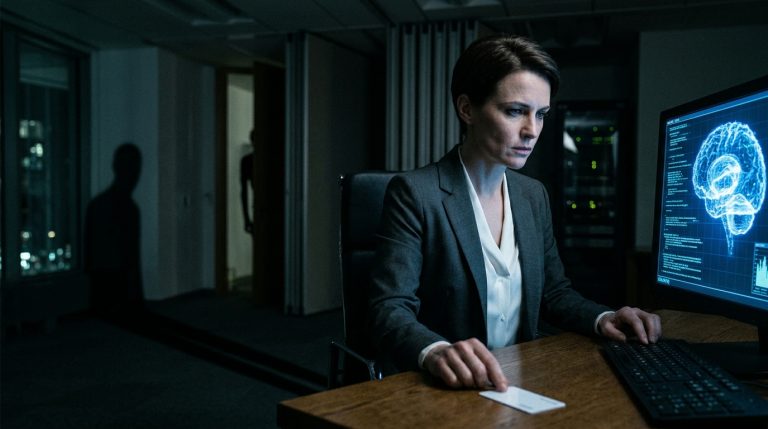
The university computer lab was a cavern of blue-white light and humming hardware. It was past midnight, and the air felt stale, recycled through vents that wheezed like an old man’s lungs. Leila sat at a terminal in the furthest corner, her hands hovering over the keyboard. Her knuckles were pale.
The screen reflected in her glasses, casting a ghostly, translucent grid over her eyes. She was running the final verification on the quantum transformations, the data streaming in a river of green and black. If she could lock this into the university’s archival server before the board met at dawn, it would be a timestamped reality that no amount of ‘errata’ could undo.
She took a breath. The silence of the lab was absolute, save for the rhythmic clicking of the cooling fans. She entered the final command string. The progress bar stuttered—a thin, creeping line of color.
Then, the world went black.
It wasn’t a gradual dimming. It was an instant, violent severance. The hum of the servers died, replaced by a sudden, ringing silence that made her heart leap into her throat. The screen flickered once—a dying gasp of phosphorus—and vanished.
Leila sat in the darkness, the lingering image of the stalled progress bar burned into her retinas. Outside the lab, the hallway lights were dead. She reached out, her fingers finding the edge of the desk. The plastic felt cold, slick with a fine film of dust.
She stood, her movements slow and deliberate. She didn’t know if this was a system failure or an active, calculated intervention. She moved toward the door, her hand outstretched to find the brass knob. It was locked.
The security lock, which should have been deactivated during her research hours, was engaged.
She pressed her ear against the door. There was no sound of footsteps, no murmur of voices. Just the heavy, oppressive stillness of a building that had suddenly decided to hold its breath. She pulled out her phone. The screen was dark. A total signal dampening.
“Smart,” she whispered to the empty room.
She didn’t panic. Panic was a waste of energy she couldn’t afford. Instead, she knelt by the base of the desk, tracing the wires that connected the terminal to the floor ports. She needed an alternate power source, or at least a way to force the local terminal to cache the data before the connection to the main grid was permanently severed.
She found the battery backup under the desk—a bulky, heavy unit. It was humming, a faint, rhythmic vibration against her palms. She pried the casing off, her fingernails digging into the seams. She wasn’t just a mathematician anymore; she was a mechanic of lost causes.
She worked in the dark, her fingers guided by the faint scent of ozone—the smell of trapped energy. She bypassed the main power switch, linking the terminal’s direct feed to the backup cell.
As she worked, the lab door groaned. A shaft of light, thin and piercing, cut through the darkness from the hallway. Someone was there.
She heard the heavy, rhythmic thud of boots—not the frantic pace of a student, but the measured, heavy gait of campus security. Or, perhaps, someone playing that role. She didn’t wait to find out. She shoved the casing back together and pressed the power key.
The terminal sputtered, a burst of static filling the room, and then, the screen flared to life. The data was there, blinking, waiting for the final handshake.
“Ms. Carter?” A voice called out. It was familiar. Dr. Green. He didn’t sound angry anymore; he sounded tired, his voice echoing in the vast, empty space of the lab. “I know you’re in there. You don’t have to do this. You’re trying to prove a theorem, but you’re only proving that you don’t understand how this world works.”
Leila didn’t look up from the screen. She was typing with one hand, her fingers flying across the keys, while her other hand gripped a heavy metal ruler she had snatched from the desk.
“I understand how the math works, Dr. Green,” she called back, her voice steady. “And the math says you’re wrong.”
She hit the ‘Enter’ key. The upload progress bar appeared—ten percent, twenty, forty.
“The math is not the truth,” Green said, his voice closer now. He was inside the lab, his silhouette tall and imposing against the faint light from the hallway. He stopped, his eyes adjusting to the glow of the monitor. He looked at her, and for the first time, she saw no hostility in his face—only a profound, hollow pity.
“You think you’re fighting for the truth,” he said, gesturing to the screen. “You’re fighting for a piece of paper that will be erased by morning. I have already initiated the security override. The data you are uploading is being routed into a dead-end buffer. By the time you think you’ve succeeded, the board will have already voted to terminate your access.”
Leila felt the blood turn to ice in her veins. She checked the packet flow. He was right. The data wasn’t heading to the archive; it was looping back, caught in a ghost-server she couldn’t see.
“But why?” she asked, her voice cracking. “If it’s just a failure, why go this far?”
Green walked to the terminal, his hands clasped behind his back. “Because I cannot allow you to live the rest of your life knowing that you solved what I could not. It is an act of mercy, Leila. A mercy you are too young to appreciate.”
He reached for the power cord at the back of the terminal.
Leila stood up, the ruler gripped tightly in her hand. She didn’t want to fight him, but as she looked at the terminal—at the lines of code that held the weight of her entire identity—she realized that the wall between them wasn’t intellectual. It was a barricade built of pride, and it was too thick to negotiate with.
She stepped between him and the terminal, her shadow casting a long, jagged shape across the lab floor.
“Then I guess I have to be more than just a student, Dr. Green,” she said.
She reached for the keyboard, her fingers dancing across the keys, not to complete the upload, but to break the system entirely. She wasn’t going to win. She was going to burn the house down.
CHAPTER 6: The Verification Gauntlet
Leila’s hand gripped the metal ruler so tightly her knuckles ached. The terminal screen was a mess of jagged white lines and flickering static—a digital scream of defiance. Across the desk, Dr. Malcolm Green stood frozen, the blue light from the dying monitor washing over him, highlighting the deep, weary lines around his eyes.
He wasn’t reaching for the power cable anymore. His hands, which she had always perceived as instruments of cold, surgical precision, were hanging at his sides. And they were shaking.
It wasn’t the tremor of rage. It was a rhythmic, involuntary vibration that started in his fingers and traveled up his wrists, a physical betrayal he clearly lacked the strength to suppress. Leila saw it—the frantic twitching, the way he tried to hide it by curling his fingers into the palms of his hands.
The silence between them shifted. It was no longer the silence of an antagonist waiting to strike, but the heavy, suffocating silence of a man who had reached the end of his tether.
“You’ve been sick,” Leila said. Her voice wasn’t a challenge; it was a realization.
Green didn’t look up. He stared at the distorted screen, his breathing shallow. “I have spent forty years in this chair, Leila. Forty years of trying to map the infinite. Do you know what happens to a mind that refuses to accept the boundaries of its own biology?”
“It breaks,” she said softly.
“It becomes obsessed,” he corrected, his voice raspy. He finally met her eyes. His own were bloodshot, rimmed with the exhaustion of someone who hadn’t slept in weeks—perhaps months. “The Hamilton-Weston Conjecture wasn’t just a puzzle to me. It was the only thing that kept the noise out. If I solved it, I would have had something to hand over. A legacy. Something that didn’t shake, something that didn’t fail.”
Leila looked at the terminal. The upload buffer was still looping, a stagnant pool of corrupted data. She realized then that Green hadn’t just been gatekeeping for the sake of the institution; he had been trying to prevent the world from seeing that the “master” of the department was, in fact, a man losing his grasp on reality.
“You didn’t want to stop me because I was wrong,” Leila said, her heart hammering against her ribs. “You wanted to stop me because you needed the problem to remain ‘unsolvable.’ As long as it was impossible, your failure was just a matter of the problem’s scale, not your own decline.”
Green slumped into the desk chair. The movement was slow, painful. “If you publish this, if you show them that it was solvable all along… then I am just a man who wasted his life.”
Leila looked at the ruler in her hand. The metal felt cold, heavy with a purpose she no longer felt entirely comfortable with. She could walk out. She could leave him there in the dark, let the university find him in the morning, and go to the press herself. But the proof wasn’t just about the numbers anymore. It was about the reality behind them.
“You didn’t waste your life, Dr. Green,” she said, her voice low. “You just spent it in the wrong dimensions. Your frameworks were beautiful, even if they were incomplete.”
She stepped forward and set the ruler down on the desk. The clack of metal on wood was loud, final. “I’m not going to destroy your career. I’m going to co-publish. I’ll reframe your notes on the quantum transformations as the foundation for the proof. We’ll verify it together. You get the credit for the framework, and I get the confirmation for the intuition.”
Green looked up at her, a flicker of something—disbelief, maybe hope—crossing his face. But then the shadow of his own pride returned. “They won’t accept it. They’ll know.”
“They’ll accept it because the math will be undeniable,” Leila said, her voice regaining its steady, unwavering strength. “And because it’s the only way to save the department from this chaos. We do it tonight. We rewrite the upload stream to include your signature.”
Green watched her, his expression a turbulent storm of memories and ego. He knew what she was offering—a path out, a way to maintain the illusion of his brilliance while she quietly took the lead. It was a compromise, a bridge built of pragmatism and empathy, but it was the only way to ensure the proof actually survived.
He reached out, his hand finally steadying as he rested it on the keyboard. “You are an impossible child, Leila Carter.”
“I’m a mathematician, Dr. Green,” she replied. She pulled up a chair beside him. “And it’s time we finish the work.”
As they began to type, the lab around them seemed to expand, the walls fading into the background as the variables aligned, moving in perfect, synchronistic dance. For the first time, she wasn’t alone in the dark. She was working with the man who had tried to bury her, and in the strange, quiet alchemy of the moment, they were creating something that would outlast them both.
But as the progress bar began to move again—green, steady, and certain—Leila noticed a red light blinking on the external firewall monitor. The security override hadn’t been deactivated. It had been moved. Someone else was monitoring the upload from a remote terminal.
The door to the lab swung open. It wasn’t security. It was the department dean, flanked by two figures Leila didn’t recognize—suits, corporate or legal, she couldn’t tell.
“Step away from the terminals,” the dean said, his voice cold, devoid of the usual professorial warmth. “Both of you.”
Leila didn’t move. She kept her finger hovered over the ‘Send’ key. The game had just changed, and the stakes were no longer about ego or legacy. They were about control.
CHAPTER 7: The Podium
The Dean’s voice was stripped of all pretense. “Ms. Carter. Step away. That server is university property, and the data you are attempting to upload is the subject of an ongoing internal inquiry regarding academic integrity.”
Behind him, the two men in suits—legal counsel, clearly—didn’t blink. They stood like statues, their presence radiating a quiet, crushing authority. Leila’s heart was a bird trapped in a cage of ribs, fluttering wildly, but her hand remained steady. She looked past them, toward Dr. Green. He was slumped in his chair, his hands buried in his pockets, his gaze fixed on the floor. He didn’t look up. He didn’t help.
The silence stretched, agonizingly thin. The lab lights flickered, a dying hum vibrating through the floorboards.
“The inquiry is a fabrication,” Leila said, her voice sounding unnaturally loud in the confined space. “And you know it. This isn’t about integrity. It’s about protecting the institution from the truth that its most celebrated researcher failed.”
The Dean stepped forward, his polished oxfords clicking against the tile with surgical precision. “You are a child, Leila. You think this is a math problem to be solved. It is a structure to be maintained. If you press that key, you will never walk onto a campus again. You will be blacklisted, litigated into silence, and your father—whose livelihood relies on the contracts this university awards—will be out on the street by morning.”
The mention of her father felt like a physical blow. Leila’s vision swam, the silhouette of the Dean blurring into the image of Jermaine, his weary smile, the way he ironed his uniform with such meticulous, quiet pride. The dissonance was paralyzing. Do I sacrifice his peace for a proof? The question burned, a wildfire of doubt consuming her composure.
“He wouldn’t want it,” Green whispered from the chair. He finally looked up, his eyes glassy, wet with a resignation that was more terrifying than his earlier anger. “He wants you to have a life, Leila. Not a crusade.”
Leila looked at the screen. The cursor was blinking, a tiny, rhythmic pulse of light. Send.
She felt the weight of the ruler on the desk, the coldness of the metal, and the absolute, crushing gravity of her choice. She wasn’t just a mathematician; she was the architect of her own survival. She realized then that Green’s obsession with “impossibility” was a virus, a way to convince anyone who came after him that they were doomed to fail as well. By holding onto the status quo, the Dean was simply the immune system, reacting to the threat of a truth that could not be categorized, filed, or controlled.
“If the structure is maintained by silence,” Leila said, her voice dropping to a low, dangerous calm, “then the structure is already dead.”
She didn’t press ‘Send.’
Instead, she did something neither the Dean nor the legal counsel expected. She didn’t upload the proof. She hit the ‘Broadcast’ key—a secondary, rarely used internal command that sent the file to every terminal in the department’s local network, including the open-access research portal that the public could see.
“What are you doing?” one of the suits snapped, lunging forward.
“I’m democratizing the failure,” she said.
The progress bar flew. 20%… 50%… 80%…
The Dean’s face turned a mottled shade of red, but the damage was already done. The file packet was fragmented, dispersed across a dozen different nodes, impossible to recall without wiping the entire university’s digital history.
Leila stood up, her legs trembling, and stepped away from the terminal. She felt an unexpected lightness, a sudden, sharp relief that tasted like cold mountain air. She had done it. Not perfectly, not neatly, but the proof was out.
The security team didn’t wait. They moved in, their hands grabbing her arms, their movements practiced and impersonal. She didn’t struggle. She watched as the Dean stared at the monitors, watching the data populate on every screen in the room, the mathematical beauty of her solution finally exposed to the harsh, unforgiving light of the public domain.
As they led her out, she caught Dr. Green’s eye one last time. He wasn’t looking at her. He was looking at the screen, at the equations he had once thought impossible, and for a fleeting, beautiful second, he was smiling.
It was the smile of a man who had finally, truly understood the math.
They walked her through the quiet, echoing halls, the moonlight streaming through the high windows. She didn’t know what tomorrow would bring—lawsuits, expulsion, the end of her life as she knew it—but as they reached the double doors and pushed them open into the cool, dark night, she felt a profound, ringing sense of quiet.
She had made room for others. That had to be enough.
CHAPTER 8: The Echo
The city air was thin and tasted of wet pavement and the impending dawn. Leila stood on the sidewalk, the security guards’ footsteps fading into the distance behind the heavy university doors. She didn’t look back. She could feel the weight of the night in her shoulders, a deep, bone-weary fatigue that threatened to pull her toward the ground. But beneath the exhaustion, there was a steady, humming resonance.
She reached into her blazer pocket. The fountain pen was still there, a cold, reassuring weight. She took it out and traced the familiar grooves in the silver casing. It had survived.
She began the long walk home, her sneakers rhythmic against the asphalt. The streets of Roxbury were beginning to stir. A street sweeper groaned in the distance, and the early-morning delivery trucks rattled through the alleys, their metallic clanging echoing the sounds of the lab—but here, the noise felt less like an obstacle and more like the pulse of a living, breathing world.
She thought of the data streaming across those thousands of screens. She didn’t know the exact outcome—whether the board would scramble to delete the files, whether the press would catch the story, or whether the university would try to bury her reputation under a mountain of legal paperwork. It didn’t matter. The proof was communal now. It belonged to everyone who had ever been told that the door was closed to them.
When she reached their apartment building, she found the front door propped open by a crate of milk. She climbed the stairs, her breath hitching in her chest as she approached their door. She hadn’t called him. She didn’t have a phone, and she hadn’t wanted to drag him into the chaos.
She turned the key and walked inside.
Jermaine was at the kitchen table, his uniform jacket discarded on the back of a chair. He wasn’t ironing; he was sitting in the dark, a single lamp casting a pool of amber light over a stack of newspapers he’d picked up from the lobby. When he heard her, he stood up, his movements stiff.
He didn’t ask what happened. He didn’t ask about the university or the men in suits. He simply opened his arms, and for a moment, Leila was twelve years old again, safe in the only place that had ever been truly hers. She buried her face in his shirt, the smell of laundry detergent and tired, honest work anchoring her.
“They’re talking about you, Leila,” he whispered, his voice thick. “On the radio. A professor from MIT is calling it a ‘seismic shift in mathematical understanding.'”
Leila pulled back and looked at the kitchen table. Her old notebook was there, open to the final page where she’d scribbled the topology of the quantum transformation. Next to it was the letter she had received weeks ago—the one from the fifth-grade girl in Chicago.
She walked over and carefully placed her fountain pen next to the letter. She felt a profound sense of closure, the pieces of her life clicking into place. She hadn’t just proven a theorem; she had repaired the fractured confidence that the world had tried to break in her.
The aftermath wasn’t loud. There were no cameras, no standing ovations, no triumphant return to the lecture hall. There was only the slow, steady cooling of the world as the sun began to crest over the rooftops.
In the weeks that followed, the fallout was exactly as she’d expected. The university launched a public review. Dr. Green stepped down from his position, citing health concerns—a quiet, graceful exit that Leila ensured was preserved. They published the proof together, a collaborative paper that officially acknowledged his early frameworks and her final, intuitive breakthrough. It wasn’t the total destruction of his ego, but it was the end of his shadow. He had been defeated not by an adversary, but by the math itself—the very thing he loved most.
Leila sat at the table one evening, watching the light fade into a soft, bruised purple. She opened a fresh, crisp envelope. It was from the girl in Chicago. She had written again, this time with a diagram—a crude, beautiful attempt at a geometric proof for a much simpler problem.
Dear Leila, the letter began. My teacher saw me drawing shapes in class. She told me to stop, that it was a waste of time. But I remembered what you said. I know now that the math isn’t just in the books. It’s in the way we see the world. Thank you for showing me that.
Leila traced the girl’s handwriting. She felt a deep, resonant peace. She hadn’t just changed the university; she had changed the frequency, and the echo was already coming back to her.
She stood up and went to the window, opening it to let in the cool, evening air. Below, the city was alive, a million stories unfolding in the dark, a million girls looking at the stars and wondering if they belonged. Leila looked down at her hands—steady, calm, and finally, completely her own. She had made room. And that was all she had ever truly wanted.