A Fragile Ledger of Gold and Grit: How One Girl Rebuilt the World’s Broken Foundation
CHAPTER 1: The Glass Fortress
The lobby of the First National Trust was a cathedral of marble and indifference. It soared thirty feet upward, capped by a ceiling that felt less like protection and more like a lid being clamped shut. Jenny stood just inside the heavy, glass-paneled revolving doors, the weight of the plastic folder pressing against her chest like a second heart. Every surface here—from the polished floor that mirrored her own wary face to the mahogany fortress of the teller line—was designed to make the outside world seem small, dirty, and irrelevant.
She took a step, and the click of her scuffed sneakers sounded like a gunshot in a library. Men in charcoal-gray suits drifted past her in tight, purposeful clusters, their voices dropping into a rhythmic hum that she couldn’t parse. They weren’t just talking; they were transacting. Women in coats of heavy wool and fur moved with a buoyancy that suggested they had never known the sting of a bus fare increase or the quiet desperation of a pantry running thin. Jenny felt the familiar itch of the imposter. She tugged at her ponytail, finding the stray strand that had gone crooked during the ride, and squeezed the folder tighter.
“Don’t be scared, Bug.”
Her grandfather’s voice wasn’t just a memory; it was a physical weight in the air, a calloused hand resting on her shoulder, grounding her against the polished marble beneath her feet. He had been a man of simple textures—cedar shavings, dry autumn grass, the rough grain of the wood he whittled on their porch. He had built their world out of things that lasted, and this building, with its cold, imported stone and artificial silence, felt like a mockery of that.
She started walking again, her eyes fixed on the distant mahogany counter. She felt the eyes of the lobby shift toward her—not as a person, but as an anomaly. A stray cat that had wandered into a ballroom. She reached the first of the velvet ropes, her chest tightening until it felt like a bird trapped behind her ribs.
“Lost your parents, kid?”
The security guard loomed above her, a wall of navy-blue fabric and practiced boredom. He didn’t look malicious, just profoundly tired of the inconvenience of her existence. Jenny tilted her head back. The light caught the brass buttons on his uniform, turning them into sharp, unblinking eyes.
“I’m here for business,” she said. Her voice didn’t waver, even though her hands, hidden beneath the plastic folder, were trembling so hard the papers rattled.
The guard’s chuckle was a dry, crackling sound, like leaves shifting in the gutter. He hooked his thumbs into his belt, the fabric of his holster creaking. “Business? Honey, the candy shop is three blocks down. This is a bank. A private bank.”
“I know what it is,” Jenny said, stepping forward. Her heart was a frantic drum, but the memory of her grandfather’s hand—rough, steady, and certain—held her in place. She saw the guard’s posture shift, his boredom hardening into a rigid, protective barrier, and she realized then that the lobby wasn’t just a room. It was a fortress protecting a secret, and she was the only one holding the key. A man in a suit as sharp as a razor blade stepped out from the glass partition behind the guard, his eyes tracking her with the clinical precision of a predator.
CHAPTER 2: The Calculus of Contempt
The guard’s laughter—that dry, crackling sound of dead leaves—didn’t stop when Jenny stepped forward. It simply shifted in tone, becoming the amused, patronizing noise of a man who dealt in the currency of dismissive authority. He loomed over her, his thumbs hooked deep into his belt, the leather of his holster creaking with a dull, heavy friction that seemed to vibrate in the soles of Jenny’s feet.
“This is a bank, kid,” he repeated, his voice dropping into that low, practiced register that was meant to end conversations before they truly began. “And a private one at that. You want the community center? That’s four blocks over, near the bus station. They have all the piggy bank resources you could possibly need.”
The woman in the fur coat, who had been lingering near a Roman-style pillar, let out a sharp, bird-like giggle. It was a textureless sound, thin and brittle, contrasting sharply with the heavy, polished silence of the lobby. Jenny felt the heat bloom in her cheeks, a fierce, stinging embarrassment that threatened to blur her vision. She wanted, with a desperation that tasted like copper in her mouth, to turn around. She wanted to feel the rough, uneven concrete of the bus stop beneath her feet again, to be invisible, to be small, to be anything other than this—a smudge of dirt on the gleaming white-and-gray landscape of the First National Trust.
Then, the scent hit her. It wasn’t just floor wax and old money; it was the sharp, penetrating odor of mahogany oil—the same scent that had clung to the cedar wood her grandfather used to whittle on their porch. The memory flared, unbidden and intrusive: his rough, calloused hands guiding her fingers along the grain of a half-finished bird, his voice a low rumble against the evening crickets. Courage isn’t about not being scared, Bug. It’s about standing tall when the world expects you to bow.
The memory was a sudden, freezing bucket of water. Jenny stopped shaking. She didn’t look at the woman in the fur coat; she didn’t look at the guard’s amused, heavy-lidded eyes. She looked at the mahogany counter, at the brass trim that caught the overhead lights, and she saw the flaws—the tiny scratches in the finish, the dull patches where the polish hadn’t reached. They were not infallible. They were just people sitting behind a wall of expensive wood, hiding behind numbers that were only as real as the screens they were typed on.
“I am not here for a community center,” Jenny said, her voice cutting through the lobby’s hum like a wire. The guard’s smile didn’t fade, but it stopped reaching his eyes. He shifted his weight, his boots squeaking on the marble.
“Look, kid—”
“I am here to access an account,” she interrupted, her volume steady, measured. She didn’t shout, but the clarity of her tone caused the man in the charcoal suit near the pillar to pause his conversation. He looked over his shoulder, his brow furrowing in a flicker of genuine curiosity.
“What did you say?” the guard asked, his voice losing its playful edge.
“I said I am here to access an account,” Jenny repeated. She didn’t wait for his permission. She side-stepped him, her movements fluid and deliberate, the scuffed rubber of her sneakers biting into the polished floor. She ignored the way the guard’s hand reached out, hovering in the air behind her, unsure if he should initiate a physical escort or wait for the branch manager.
She reached the mahogany fortress and placed the transparent plastic folder flat against the wood. The surface felt cold and unyielding, a stark contrast to the warmth of the papers inside. She didn’t look back. She saw the tellers behind the line stop their frantic clicking of pens. One woman, her hair pulled back into a tight, severe bun, stared at Jenny with a look of clinical assessment.
“Is there a problem, Miller?”
The voice was like velvet drawn over gravel—smooth, deep, and utterly devoid of warmth. Jenny turned. A man had emerged from behind a glass-partitioned office. He was tall, his suit tailored to such an exacting degree that it seemed to move with his body like a second skin. His gold watch glinted with a sharp, aggressive light. This was the branch manager, Robert Henderson. He moved with the effortless, predatory grace of someone who had never had to worry about where the next month’s rent was coming from.
He didn’t look at Jenny; he looked at the space she occupied, as if he were trying to calculate the most efficient way to scrub her from his environment.
“Just a bit of confusion, sir,” the guard, Miller, said, his voice dropping into a conciliatory, servile pitch. “The girl was insisting on—”
“I am not confused,” Jenny said, her voice quiet but resonant. She looked up at Henderson, forcing herself to meet those cold, blue, calculating eyes. “I am here to check my balance.”
Henderson’s gaze finally dropped to her. He didn’t lean down; he stood at his full, imposing height, forcing Jenny to crane her neck. The silence in the lobby seemed to condense, thickening with the unspoken agreement of the patrons that this interaction was a tedious, ugly, and entirely unnecessary interruption.
“An account,” Henderson repeated, the word tasting like bile. He didn’t even acknowledge the folder. He looked past her, toward the woman in the fur coat, his lips curling into a smug, performative smirk. “Did you save up your allowance, sweetheart? The piggy bank exchange is across town. We require a minimum deposit here that is, shall we say, significantly beyond your current tax bracket.”
The woman in the fur coat let out another giggle, more confident this time, and a man in a blue suit nearby let out a snort of laughter. The sound was an infectious, grinding weight. It was the sound of a system reinforcing its borders.
Jenny felt the sting again, deeper this time, but the “V-2” phantom—the memory of her grandfather—held her steady. The dirt gets deep, Bug, but you don’t scrub it away. You just find the right tool.
“I have the information here,” she said, her fingers finding the plastic snap of the folder. Her hands were ice cold, but her movements were precise. She wasn’t just a girl with a folder; she was an anomaly in their perfectly calibrated machine, and anomalies had a habit of breaking things. “My grandfather left this to me. He said it’s the law.”
Henderson’s smirk faltered for the briefest of seconds. He saw the wallet—worn, cracked, ancient leather—that she slid onto the counter. He looked at it, then at the birth certificate, then at the small, heavy silver key that seemed to absorb the light around it. His eyes narrowed. The amusement vanished, replaced by a flickering, predatory suspicion. He reached out with two fingers, not picking the wallet up, but prodding it as if it might be contaminated.
“A janitor’s collection?” Henderson sneered, though the volume had dropped, his gaze darting to the lobby to ensure he still had his audience. “Or perhaps you’re looking for a lost and found? This is a bank for significant assets, not a dumpster for historical debris.”
“His name was James Patterson,” Jenny said, her voice ringing with a clarity that silenced the man in the blue suit nearby. “He was a colonel.”
Henderson stopped. He didn’t laugh this time. He froze, his fingers still resting near the edge of the worn wallet. The lobby’s hum grew dangerously thin, the air pressure in the room seeming to drop as if a storm were gathering behind the heavy, sealed glass of the front doors.
“Patterson,” Henderson muttered, the name feeling like grit in his throat. He looked at the screen of his computer terminal, then back at the girl in the scuffed sneakers. He wanted to dismiss her, to have her dragged out by the back of her cheap coat, but the silver key glinted in the light—a small, solid piece of evidence that didn’t belong in a world of digital shadows.
“Fine,” Henderson snapped, his voice tight with an irritation that masked a growing, gnawing unease. “Give me the number. I will punch it in. The system will tell us this is a waste of my time, and then you will leave, or I will have security escort you to the street.”
Jenny took a breath, the air in the bank tasting of ozone and artificial, stale silence. She looked at Henderson, and for a second, she saw past the suit and the watch and the smug, practiced superiority. She saw a man who was terrified of something he couldn’t control.
“4-7-2,” she started, the numbers feeling heavy, like stones she was dropping into a dark, bottomless well.
As she began the sequence, the woman in the fur coat took an involuntary step back. The lobby was silent. The only sound was the rhythmic, aggressive clicking of Henderson’s keys as he entered the numbers, each strike a deliberate, forceful punctuation of his own contempt. He hadn’t yet realized that with every digit he typed, he wasn’t just validating an account; he was opening a door that had been sealed since 1952, and the air behind it was coming for them all.
CHAPTER 3: The Vault of Echoes
The ping was not the sound of a simple transaction. It was the sound of a lock tumbling inside a mechanism that had been dormant for half a century. Robert Henderson’s shoulders, which had been held with the rigid, performative posture of a man ready to dismiss a nuisance, suddenly locked into a much tighter, more unnatural position. He didn’t turn around immediately. He stared at the screen, his face draining of its practiced color until he looked like nothing more than a pale, waxen figure in an expensive suit.
Jenny watched his reflection in the glass of the teller partition. He wasn’t breathing. He tapped a key, then another, his movements becoming erratic, hurried—a frantic, uncoordinated attempt to resolve a discrepancy that shouldn’t have existed.
“Mr. Henderson?” Jenny asked. Her voice was small, swallowed by the vast, cavernous silence of the lobby, but it seemed to trigger something in him. He spun his chair around, his expression caught between total disbelief and a sharp, rising panic. He wiped his forehead with a handkerchief, the fabric trembling in his grip.
“What… what did you say your name was?” he whispered, his voice hoarse, completely stripped of its earlier, velvet-smooth condescension.
Jenny didn’t answer. She didn’t have to. The lobby had shifted. The atmosphere—that crisp, sterile scent of floor wax and wealth—had turned heavy, electric, and oppressive. The patrons who had been smirking a moment ago were now stiff, their conversations dead in their throats. They felt the change in the air, the way the bank’s primary internal clock seemed to have stalled, waiting for the terminal to confirm what Henderson was seeing.
“Miller!” Henderson shouted. It wasn’t a professional command; it was a desperate, jagged bark.
The guard, who had been hovering just a few feet away, jumped as if he’d been struck. He reached for the velvet rope, his eyes wide and scanning the room as if he were suddenly trying to identify a threat that had appeared out of thin air. “Sir?”
“Close the doors,” Henderson commanded, his voice trembling. “Lock them. Put the sign up. No one enters. No one leaves.”
“Mr. Henderson, we’re open until—”
“I said close the doors!” Henderson screamed, the sound ricocheting off the marble, louder and harsher than before. He scrambled to his feet, knocking his expensive ergonomic chair backward, where it hit the mahogany desk with a dull, sickening thud. He didn’t care. He didn’t even look at the equipment. He was staring at Jenny, his blue eyes wide, no longer seeing a girl in scuffed sneakers, but something else entirely. “Get her out of the public eye. Now.”
Before Miller could react, Henderson took Jenny’s arm—not with violence, but with a frantic, gripping urgency—and pulled her toward the heavy, brass-trimmed door behind the teller line. The plaque on the door read Private Client Services, but as they hurried through, Jenny saw that the office was merely a transit point. Beyond it lay a corridor, dim and cool, leading deeper into the building’s reinforced core.
“Where are we going?” Jenny asked, struggling to keep her footing as Henderson practically dragged her through the narrow, carpeted hallway.
“Away from them,” he hissed, glancing back at the lobby entrance where the guard was now frantically turning the heavy brass deadbolt. “You have no idea what you’ve just done. You have no idea what that terminal just showed.”
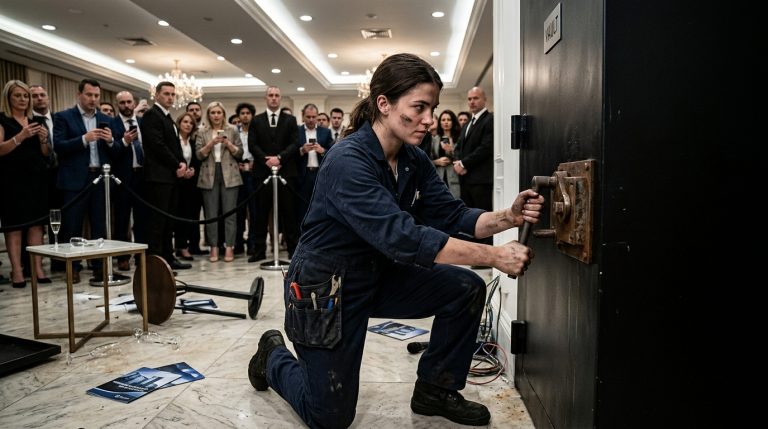
He didn’t wait for a response. He navigated the corridor with a practiced, hurried familiarity, passing locked offices until they reached a heavy, circular door of brushed steel. It was a masterpiece of mechanical engineering, a vault door that looked like it belonged on the hull of a submarine. Henderson punched a code into a keypad, his fingers dancing with a muscle memory that contradicted his current, panicked state.
With a heavy, pressurized hiss, the vault door groaned and began to swing inward. The air that rushed out to meet them was different—older, thinner, and carrying the faint, metallic tang of dust and long-forgotten secrets.
“In,” Henderson said, gesturing for her to step into the darkness of the vault.
Jenny hesitated on the threshold. She looked back toward the lobby, where the glass doors were now obscured by the heavy brass CLOSED sign. She felt a profound, aching sense of isolation. She was no longer just a girl running an errand; she was a variable in an equation that Henderson was clearly failing to balance.
She stepped inside. The lighting in the vault was minimal, provided by a single, flickering strip of fluorescent light that hummed with a low, irritating buzz. The room was a labyrinth of metal drawers, stacking into the gloom of the ceiling. It felt like the inside of a clock—complex, cold, and entirely indifferent to the people who moved within it.
Henderson followed her in and slammed the heavy door shut behind them. The sound was a finality, a ringing boom that shook the very floorboards. He leaned his back against the steel, sliding down until he hit the floor, his breathing coming in ragged, audible gasps.
“We are safe for now,” he wheezed, though his eyes darted toward the door as if he expected it to be breached at any moment. “Not without a thermal lance, anyway. But that won’t hold them forever.”
Jenny stood in the center of the aisle, the plastic folder still clutched to her chest. She looked at Henderson, seeing him for the first time as a man rather than a monolith of the bank. He was disheveled, his silk tie hanging loose, his pristine, tailored jacket rumpled. He looked smaller here, in the cold, mechanical heart of the vault, than he had in his office.
“What was on the screen?” Jenny asked, her voice steadying as she realized he was just as frightened as she was. “Why are you closing the bank?”
Henderson didn’t answer right away. He reached into his pocket, his hand shaking, and pulled out a clean white handkerchief, dabbing at his neck. “That account,” he began, his voice barely a whisper, “isn’t just a balance, Jennifer. It’s an archival record. It’s a list of everything they’ve tried to bury. If the board of directors sees that you’ve accessed it… if Vance finds out…”
He stopped, his gaze snapping toward the far wall of the vault, where the rows of drawers seemed to stretch on into infinity. “We need to find the physical ledger. The system is only the interface. The truth… the truth is down here.”
He stood up, his legs slightly shaky, and began walking down the aisle, his eyes scanning the brass labels on the drawers with a frantic, searching intensity. Jenny followed, her sneakers silent on the cold linoleum, the weight of the plastic folder in her hand suddenly feeling like the only thing keeping her grounded in a world that had gone completely sideways.
“What do you mean, they?” Jenny asked, her voice echoing in the narrow, metallic space.
Henderson stopped and turned to her, his face pale in the flickering light. “The people who own the lobby. The people who think they own everything else. They don’t just own the bank, Jennifer. They own the architecture.” He reached out and touched a drawer labeled 404, his fingers hovering over the lock. “And your grandfather? He wasn’t just a colonel. He was the only man who ever dared to build a trap door into their foundation.”
He looked at her, his expression shifting from panic to a haunting, desperate curiosity. “Open it,” he commanded, his voice barely audible above the hum of the fluorescent light. “Let’s see if he left us a way out.”
Jenny reached out, the silver key in her hand feeling strangely warm against her palm, as if it were responding to the presence of the drawer. She inserted the key. The metal was cold, biting, but as she turned it, the mechanism groaned—a long, protesting sound of rusted metal finally being forced to move. The drawer slid open, revealing not gold or stacks of cash, but a single, leather-bound notebook and a stack of weathered, real-to-reel audio tapes.
She picked up the notebook. The leather was cracked, the binding fraying, and as she flipped it open, she saw the sharp, jagged handwriting of her grandfather, the ink faded to a deep, ghostly sepia. It wasn’t a record of money. It was a record of names, dates, and locations—a map of a system designed to look like order, but built entirely on the debris of families like hers.
“It’s not an account,” Jenny whispered, the realization settling into her bones like a cold draft. “It’s a ledger.”
Henderson leaned in, his shadow stretching long and distorted across the metal drawers, and for the first time, Jenny saw the reflection of the ledger in his eyes. It was a reflection of everything he had spent his life serving, and the sudden, violent recognition that he had been serving a graveyard.
CHAPTER 4: The Radio Bridge
The sound tore through the vault like a jagged blade. It was a rhythmic, scratching static, punctuated by the high-pitched whine of a faulty long-range transmission. Jenny scrambled toward the wall-mounted console, her heart hammering against her ribs with a cadence that mirrored the urgency of the noise. Beside her, Henderson was already moving, his earlier panic replaced by a cold, sharp focus. He slammed his hand against the “Receive” toggle, the metal clinking harshly against the bulkhead.
“Jenny?”
The voice was tiny, fragile, and warped by distance, but it belonged to her mother. It was the sound of a tether pulling tight across an ocean.
“Mom?” Jenny shouted, pressing her face against the cold metal of the speaker grille. “Mom, where are you?”
“I’m—I’m at the perimeter,” Susan’s voice cracked, distorted by the interference of the bank’s external security grid. “The police… they’re holding the barricades, but Vance is here, Jenny. He’s right in front of me. He says—he says he’s trying to negotiate, but I don’t believe him. He’s—he’s looking at the door, baby.”
The static surged, a wave of white noise that swallowed the rest of the sentence. Jenny felt the floor beneath her feet—the cold, industrial linoleum—seemed to tilt. She looked at Henderson, who was hunched over the terminal, his fingers flying across a secondary, hidden array of keys that he hadn’t touched when they first arrived.
“He’s not negotiating,” Henderson muttered, his face drawn tight. “He’s calculating.”
“Mom!” Jenny screamed into the mic. “Listen to me! Don’t go near the glass. Don’t let him near the door!”
“Jenny, baby, just listen,” Susan’s voice pushed through the static again, stronger this time, as if she were shouting over the wind. “Vance has a radio. He’s going to try to talk to you. He’s going to make it sound like there’s a way out, like if you give him the key, everything goes back to normal. He says if you don’t, the police are going to breach the main entrance. You have to be strong, Jenny. You have to stand tall, just like your grandfather taught you.”
The connection buzzed, a deep, resonant vibration that made the vault’s steel door shudder. Jenny gripped the radio cord, her knuckles white. She looked at the notebook in her hand—the worn, cracked leather that held the architecture of a different kind of world. She felt the weight of the silver key in her pocket, a small, heavy anchor in a storm of digital noise.
“I won’t give it to him, Mom,” Jenny whispered, but the radio line had already gone dead.
The sudden silence was even more terrifying than the noise. It felt like the air had been vacuumed out of the room, leaving behind only the cold, recycled oxygen and the smell of dust. Henderson slumped against the console, his hand hovering over a series of toggles.
“She’s right,” he said, his voice flat. “He’s going to use this line. He’s going to try to manipulate the environment. He thinks if he can get you to surrender the key, he can reset the account before the audit triggers.”
“Why does he want it so badly?” Jenny asked, her eyes searching Henderson’s face for a truth he had been avoiding. “If the money is just numbers, why would he burn a building down for it?”
Henderson looked at the ledger, then at the flickering light above them. “Because it’s not just money, Jennifer. Your grandfather didn’t just hide wealth; he hid proof. Every transaction you saw on that terminal wasn’t just a balance—it was a trail. A map of where the money went when it was stolen from people like your mother. If he gets that key, he doesn’t just get the money. He gets to delete the map. He gets to walk away clean.”
Jenny felt a surge of cold, hard resolve. She turned back to the intercom. It was silent, but she could imagine Vance standing on the other side of that glass, watching the building, counting the seconds, waiting for her to break. He thought he was playing a game of chess, but he had forgotten one crucial thing: he was playing against someone who knew how to build a trap.
“He wants the map,” Jenny said, her voice dropping into a register that surprised even her. It sounded like the Colonel. It sounded like the architect. “Then we don’t give him a map. We give him a dead end.”
She reached for the terminal. Henderson’s eyes widened, his hands moving to stop her, but he hesitated. He looked at the ledger, the weight of his own thirty years of compliance crashing down on him. Slowly, he pulled his hands back.
“The protocol,” Henderson whispered, his voice trembling. “The one your grandfather marked… the one that requires a voice command. If we trigger it, there’s no going back. It doesn’t just lock the account. It purges the ledger from the bank’s internal mainframe.”
“Do it,” Jenny said.
Before she could reach for the console, the intercom flared to life again, not with the sound of her mother, but with the smooth, oily, and terrifyingly calm voice of Arthur Vance.
“Jennifer,” the voice purred, filling the vault with a presence that felt like it was standing right behind her. “Let’s have a talk about your future.”
Jenny didn’t flinch. She placed her hand on the microphone, the plastic casing feeling like the handle of a hammer. She looked at Henderson, who was watching her with a mixture of fear and, for the first time, genuine respect. She was no longer just a maid’s daughter. She was the one holding the slate, and she was ready to wipe it clean.
CHAPTER 5: The Floodgates Open
The metal door groaned, a long, agonizing shriek of tortured steel that signaled the end of the vault’s physical resistance. A sliver of blinding white light sliced through the darkness of the inner sanctum, accompanied by a rain of incandescent sparks that showered the linoleum floor like dying stars. Behind the door, the rhythmic, heavy thud of a tactical team echoed through the corridor, each impact a reminder that the world outside was closing in, fast and unforgiving.
“Jennifer,” Vance’s voice continued, drifting from the wall-mounted speaker with the effortless, curated charm of a man who owned the air he breathed. “You have seconds left. Do you truly believe that your grandfather’s notebook holds a future? Or is it just another piece of paper that will burn alongside this building?”
Jenny stood by the terminal, her fingers hovering over the keys. Beside her, Henderson was slumped against the shelving, clutching his bruised ribs, his face pale and slick with sweat. He looked at the buckled steel door, then at the girl who held the trajectory of their lives in her hands.
“Jenny,” he gasped, his voice thin. “If you hit that key, there is no going back. The records will be broadcast. Everything. Every secret, every bribe, every name Vance buried… it will all be exposed. But the system… it’s not designed to handle a purge of that magnitude. It will crash the entire district’s network. You’ll be standing in the center of a black hole.”
Jenny didn’t look at him. She stared at the terminal, the green text pulsing on the screen, waiting for her command. Protocol Tabularasa. She remembered the way her grandfather’s hands had felt—rough, calloused, and absolutely certain. He hadn’t built this to save money; he had built it to be the lever that would topple the whole machine.
A heavy, metallic thud vibrated through the vault. The door was buckling inward, the hinges screaming under the concentrated heat of the torch. Another kick—this one heavier, more deliberate—and the steel plate shifted, the gap widening to reveal the distorted, shadow-streaked figures of three men in tactical gear, their rifles raised, their faces obscured by opaque, obsidian-dark visors.
“Hands in the air!” one of the voices barked, the sound amplified by a tactical modulator that made it feel as though the walls themselves were speaking. “Step away from the console, or we will authorize lethal force.”
Jenny didn’t move. She felt a sudden, strange clarity—the same stillness she felt when she sat on her porch and watched the storm clouds roll over the hills. She was the architect now.
“Mr. Henderson,” she whispered, her eyes never leaving the screen. “You said money doesn’t save you. You said it just buys an expensive coffin.”
Henderson managed a grim, blood-flecked smile. “It does.”
“Well,” Jenny said, “let’s see what happens when the coffin is empty.”
She slammed her hand down on the keyboard. She didn’t trigger the purge yet—she hit the hidden sequence her grandfather had scribbled in the margin: Option C, the flood.
The screen shifted. The green text vanished, replaced by a cascading waterfall of red lines, moving with a speed that made the console hum. A low, vibrating thrum began to fill the vault, a sound of massive data-packets being rerouted, compressed, and broadcast.
The tactical team leader lunged forward, the toe of his heavy boot catching the edge of the console, but it was too late. He raised his rifle, but the weapon seemed to falter, the electronic targeting optic flickering and dying, its connection to the bank’s central grid severed. The entire vault went dark, save for the pulsating, erratic glow of the terminal screen, which was now casting long, frantic shadows against the thousands of safety deposit boxes.
“What did you do?” the leader roared, reaching for her, his movements clumsy in the sudden, jarring loss of his electronic support.
“I turned on the lights,” Jenny said, her voice steady.
In the lobby, the effect was immediate. The bank’s primary communications server, a towering stack of hardware, began to groan under the sheer weight of the data being pushed through it. Every screen in the building—every monitor, every tablet, every smartphone held by the panicked clients in the lobby—flickered to life. The black-and-white ledgers, the hidden offshore accounts, the names of the board members who had been skimming from the public funds—it all erupted onto the screens in a synchronized, unrelenting cascade of truth.
Vance, who was standing on the steps outside, pulled out his phone, his thumb swiping frantically. He looked at the screen, then at the bank’s windows, his composure shattering. For the first time in his life, he didn’t look like a pillar of the community; he looked like a man watching the foundation of his house dissolve into water.
Inside the vault, the tactical team froze. Their comms crackled with the voices of their handlers, screaming in confusion, the encrypted channels collapsing under the flood of public data. They were no longer soldiers in a mission; they were observers in a disaster.
The leader stood over Jenny, his hand hovering over her shoulder, but he hesitated. He looked at the screen, his visor tilted. The information was already everywhere—the sirens of federal transport trucks were already wailing in the distance, no longer just a rumor, but a certainty.
“It’s over,” Jenny said, her gaze meeting the dark, inscrutable glass of his visor. “There’s no one left to pay you.”
The leader pulled his hand back. He didn’t fire. He looked at his comrades, then back at the terminal, the sheer scale of what she had released finally registering. He turned, signaling to his team, and they moved toward the door, retreating not in defeat, but in a sudden, frantic realization of their own irrelevance.
Jenny stood alone in the flickering, dying light of the console. She felt a sudden, overwhelming exhaustion, the adrenaline that had carried her through the long day finally beginning to recede, leaving behind a cold, quiet stillness. She had pulled the lever. The flood was here. She looked at Henderson, who was leaning back against the metal shelving, his eyes closed, a faint, weary smile on his face.
The bank was burning—not with fire, but with the impossible weight of a half-century of hidden truths, and for the first time, the air in the vault didn’t feel like a prison. It felt like space. It felt like the beginning of something that didn’t have to be built out of dirt and cold, hard, unyielding stone.
The sirens grew louder, a chorus of approaching justice, and Jenny walked to the buckled, warped doorway. She stepped over the wreckage of the lock and out into the corridor, leaving the vault behind, knowing that when the dust finally settled, the world would never be able to fit back into the boxes that Vance had built for it.
CHAPTER 6: The Porch at Sunset
The transition from the bank’s pressurized interior to the open air of the city street was like surfacing from a deep, turbulent dive. Outside, the world was a cacophony of sound—the rapid-fire chatter of news reporters, the insistent wail of sirens, and the hum of a city that had been startled into a state of sudden, radical awareness. The black SUVs that had once acted as a menacing wall were now being surrounded by the glare of camera lights, their occupants already being led away in cuffs.
Jenny stood on the sidewalk, her plastic folder still clutched to her chest. Beside her, Susan knelt on the concrete, her hands trembling as she pulled Jenny into an embrace that felt like the only solid thing in the world. Her mother’s uniform, once a symbol of the invisibility she had worn in the houses of men like Vance, now looked like armor—stiff, worn, and deeply earned.
“Jenny,” Susan sobbed, her voice breaking. “I thought… I didn’t know if I’d see you again.”
“I’m okay, Mom,” Jenny whispered, burying her face in her mother’s shoulder. She could smell the faint scent of dish soap and the lingering, metallic sharpness of the bank’s recycled air on her own clothes. She felt the heavy, rhythmic thrum of the city surrounding them, but for the first time, it didn’t feel like it was bearing down on her. The flood—the massive, cascading release of truth—had stripped away the artificial hierarchies of the lobby.
Across the street, Robert Henderson sat on the edge of a paramedic’s stretcher. He was draped in a wool blanket, his chest wrapped in a thick, white bandage, but his eyes were bright, fixed on the chaotic scene with a strange, contemplative peace. As they passed, he signaled to the medic, who helped him stand. He leaned heavily on a borrowed cane, his movements stiff, but he made his way toward them with a deliberate, slow grace.
“You did it,” Henderson said, his voice raspy. He didn’t offer a platitude. He didn’t try to reclaim his authority. He simply looked at the bank, then at the girl who had dismantled his life’s work. “The board is in custody. Vance is being processed. The charity trusts are already being initialized.”
Susan looked at him, her expression a complex mixture of exhaustion and hard-won gratitude. “And what now, Robert?”
Henderson offered a faint, tired smile. “Now? Now, the architecture changes. The Foundation is real, Susan. It’s not just a ghost account anymore. It’s an infrastructure for the people who were supposed to be protected by the very institution I helped run into the ground.” He looked at Jenny, his expression softening. “I’ve been fired, of course. I suspect I’ll be testifying for years. But for the first time in three decades, I don’t have to wake up and wonder if I’m building a prison or a life.”
Two weeks later, the silence of the countryside felt like a long-overdue exhale.
Jenny sat on the top step of their porch, the wood groaning slightly under her weight. The house was still a work in progress—the peeling paint still needed a fresh coat, and the railing remained loose—but the foreclosure notice that had once been a mocking, bureaucratic shadow on their door was gone. The air smelled of drying autumn grass and the faint, sweet scent of cedar chips.
She held a small piece of wood in her hand and a pocketknife her grandfather had left behind. She wasn’t a hero, and she wasn’t a soldier; she was a girl who had finally learned the secret of the architecture. You didn’t need a vault to be secure, and you didn’t need a ledger to be rich. You only needed to know the grain of the wood, and how to carve a shape that would last.
A mid-range hybrid car pulled into the gravel driveway. Henderson—or Bob, as he had asked to be called—stepped out, wearing a simple cardigan. He walked up the path with the slow, careful steps of a man whose ribs were still healing.
“Afternoon, director,” Jenny said, not looking up from her whittling.
“Afternoon, trustee,” Bob replied, taking a seat on the step beside her. He groaned, shifting his weight, then sighed with a deep, settling contentment. “The scholarship applications are in. There’s a kid in South Boston… he’s got an aptitude for systems, but he’s never had a chance to see how they work. I think he’s going to be the first recipient.”
Susan stepped out of the house, carrying a tray with three glasses of lemonade. She looked different—the frantic, shadowed set of her jaw had smoothed into a quiet, enduring strength. She set the glasses down and sat on the step below them, looking out at the sunset. The sky was an impossible blend of bruised purple and burning, molten gold.
“It’s quiet here,” Susan said, her voice barely a whisper.
“It’s the right kind of quiet,” Bob said, taking a sip of the lemonade. He turned to Jenny, watching her work the knife along the cedar. “How’s the carving?”
“It’s hard,” Jenny admitted, her fingers moving with steady, rhythmic precision. “But I’m not trying to make a secret anymore. I’m just making something.”
She held up the piece of wood. It wasn’t perfect, and it didn’t hold the keys to a kingdom, but it was shaped, intentional, and real. She placed it on the railing, right where the loose wood met the solid frame. The sun dipped below the horizon, casting a warm, fading light across the porch, and for the first time, the house felt finished. The foundation was sound. The flood had passed, and what remained was the quiet, steady work of building something that could finally, truly, stand on its own.