The Architecture of Light: A Mother and Daughter’s Journey into the Heart of a Silent Mansion
CHAPTER 1: THE THRESHOLD
The hallway was a tunnel of amber emergency lights and polished marble, a sterile vein running through the heart of the Hale estate. Nadia’s lungs burned, a sharp, cold fire as she sprinted, her bare feet making no sound against the freezing floor. She didn’t calculate the risk of barging into the forbidden wing, nor did she care about the “rules” that Rosa whispered about in the kitchen. The air here was different—stagnant, thick with the smell of old paper and suppressed rain.
She reached the heavy mahogany door at the end of the hall. It was ajar, a sliver of darkness spilling out.
Nadia shoved the wood inward. The movement was primal, a force of nature driven by the singular, devastating possibility that her daughter was in danger. Inside, the room was vast, an expanse of shadows punctuated only by the silver, rhythmic weeping of the rain against the floor-to-ceiling glass.
There, on the floor, was the titan of the city’s industry. Marcus Hale, a man who moved markets with a sentence, was collapsed against the foot of a bed that looked like a fortress. He was a heap of expensive fabric and fractured grace, his face a landscape of sweat and shallow, ragged inhales.
But it was the sight next to him that stopped Nadia’s heart cold.
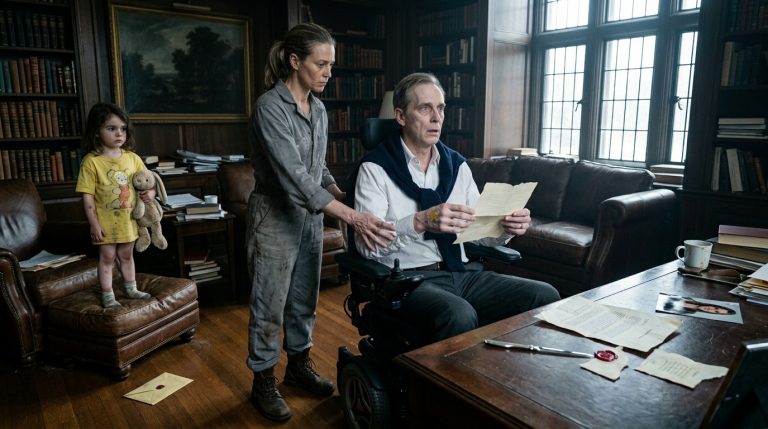
Lily, three years old, her yellow duck pajamas brilliant against the dark, heavy carpet, was knelt beside him. She wasn’t crying. She wasn’t trembling. She was singing—a soft, wordless hum, a lullaby of pure, unadorned presence. Her small, warm hand was pressed firmly against the billionaire’s cheek, tethering him to the earth even as his eyes rolled back, unfocused and drifting.
“Mama,” Lily said, her voice a calm anchor in the room’s dying air. She didn’t look up; she didn’t seem to realize the gravity of the blue tint staining the man’s lips. “The mister is hurting. He says he needs the phone.”
Nadia was at his side in a heartbeat, the floor hard and unforgiving against her knees. She didn’t look at the expensive furniture or the opulence of the room. She looked at the pulse point in his neck, the flutter of his skin, and the terrifying, empty vacancy in his gray eyes.
“Look at me,” Nadia commanded, her voice dropping into the steady, iron-calm rhythm she used when the world fell apart. She grabbed his hand, her own calloused palm scraping against his skin—the friction of a common life meeting a life of unimaginable wealth. “Marcus, look at me. You are here. You are going to stay here.”
His eyes shifted, struggling to find hers through the haze of a failing heart. As he locked onto her gaze, his breath hitched, a jagged, wet sound.
“The phone,” he whispered, a phantom of his usual authority.
Nadia glanced at the table, her mind already navigating the path to the hospital, the timing of the ambulance, and the impossible weight of what this moment meant for their future. As she reached for the phone, she saw it—a yellow silk curtain, half-drawn, fluttering in a draft. It was the only splash of color in the room, and it felt, in that moment, like a scream of life in a graveyard.
She turned back to him, but Marcus wasn’t looking at the phone. He was looking at Lily, his expression shifting from agony to something far more haunting: a sudden, wide-eyed recognition of a kindness he had forgotten how to receive.
CHAPTER 2: THE PULSE OF SILENCE
The ringing on the other end of the line was a jagged, rhythmic heartbeat that seemed to count down the seconds of Marcus Hale’s life. Nadia gripped the phone with such intensity that her knuckles turned white.
“Stay with me,” she repeated, the command soft but absolute. She didn’t look at the opulence of the room—the hand-carved mahogany, the silk drapery, the vastness of a space that felt like a gilded cage—she focused entirely on the gray of his eyes. They were unfocused, drifting toward the window where the rain hammered against the glass with unrelenting mechanical precision.
“Marcus,” she said, her voice cutting through the heavy, stagnant air of the East Wing. “Look at me. Ignore the storm. Ignore the house. Just look at the light.”
She pointed to the emergency wall lamp, its amber glow the only stable point in the room. He blinked, a slow, grueling effort, and finally, his gaze hitched onto hers. The agony in his face was raw, stripped of the polished, untouchable mask that had defined his existence for the last eight months. He was terrified. It was a human truth, sharp and unvarnished, that made the vastness of the mansion feel suddenly, crushingly small.
Lily, still knelt beside him, didn’t pull away. She reached out, her tiny, chubby hand smoothing back a lock of damp hair from his forehead. It was a gesture of such profound, unconscious grace that Nadia felt a lump form in her throat, one she ruthlessly swallowed down. She couldn’t afford to feel. She had to function.
“The ambulance is four minutes out,” Nadia said, her voice remaining steady even as the floor felt like it was tilting. She kept her hand on his chest, feeling the erratic, fluttering cadence of a heart that seemed to be fighting its own rhythm. “They are fast. They are the best. They will know what to do.”
“Elena,” he gasped, the name a broken syllable that seemed to catch in his throat like shrapnel.
Nadia froze. She didn’t know who Elena was, but she knew the weight of a name spoken at the threshold of life and death. She didn’t pry; she didn’t attempt to comfort him with false platitudes. She simply adjusted her stance, keeping her body as a shield between him and the suffocating shadows of the room. She felt the heavy, damp chill of the rain-soaked house creeping into her own bones, a reminder that they were in a place where silence was a currency and secrets were the architecture.
Suddenly, the floor vibrated—a dull, heavy thud from the front of the mansion. The security team, roused by the alarms or perhaps by the sudden disruption in the rhythm of the household, began shouting in the lower corridors. The sound of heavy boots echoed against marble, a jarring, discordant contrast to the fragile, labored breathing in the room.
Nadia didn’t break her connection with Marcus. She couldn’t. If she let go, if she allowed the chaos of the house to penetrate this circle, she felt he might simply slip away into the dark, indifferent expanse of his own estate.
“They’re here,” she said, her voice a calm wire pulling him back. “The team is here. You’re going to be okay, Marcus. You have to be.”
The bedroom door flew open. A phalanx of paramedics, led by a man with graying temples and a look of practiced urgency, burst into the room. The sterile, metallic scent of medical equipment flooded the space, cutting through the stale, dusty perfume of a home long ago stripped of life. The calm, fragile bubble that Nadia had maintained around the man on the floor was instantly punctured by the intrusion of reality.
“Move back,” the lead medic ordered, his voice crisp.
Nadia pulled Lily away, shielding the girl’s eyes as the team swarmed the floor. They worked with a synchronized, mechanical precision that made the room feel like an operating theater. She saw them attach leads to Marcus’s chest, the machine bleeping in a way that signaled a terrifying instability.
She stood in the corner, holding Lily, watching as the man who had been a ghost in his own mansion for eight months was stripped of his status, his suit, and his solitude. He was just a body now, struggling for air, a vessel for a life that seemed to be fraying at the edges.
As they loaded him onto the stretcher, Marcus’s hand suddenly shot out, grasping blindly at the air. His eyes, hazy and searching, found Nadia’s. He didn’t say a word, but the look he gave her—a desperate, fleeting spark of human connection—would burn in her memory for days. He was reaching for the only thing in the room that wasn’t paid for, the only thing that hadn’t been curated.
The paramedics moved with a sudden, jarring speed, the stretcher rolling toward the hallway. The mansion seemed to swallow them, the doors of the East Wing standing open like a mouth that had finally been forced to speak. Nadia stood in the center of the silent bedroom, her hands still trembling with the residual energy of the crisis, the room suddenly feeling even larger, emptier, and colder than it had ever been before.
She looked at the yellow silk curtain, still fluttering in the draft. It was a small, defiant piece of light in a room dedicated to shadows, and for the first time, she wondered what other colors were hidden beneath the dust of the house.
CHAPTER 3: THE MORNING AFTER
The silence of the mansion was no longer the peaceful absence of sound; it had become an active, suffocating entity. Nadia remained in the hallway for a long moment, the back of her neck prickling as if the portraits on the walls were tracking her. In her arms, Lily was finally asleep, her breathing shallow and rhythmic, a fragile counterpoint to the hollow, cavernous stillness of the East Wing.
Nadia didn’t move toward the kitchen or their staff quarters. Instead, she found herself walking back into the room where Marcus had collapsed. It was colder now. The rain had ceased, leaving behind a damp, heavy humidity that clung to the velvet curtains like a shroud. She walked to the spot where he had lain—the exact coordinates of his crisis—and knelt down, tracing the fibers of the thick, dark carpet.
Her mind wandered back to the laundry room, to the monotony of the folding, the way she had convinced herself that visibility was a luxury she couldn’t afford. That life, that carefully constructed prison of survival, felt like a phantom limb. She had spent months cultivating a life of invisibility, of making herself smaller, quieter, less consequential, all to protect the three-year-old pulse of life sleeping against her chest. And yet, in ten minutes, that carefully cultivated invisibility had been stripped away by the raw, unadorned reality of a man dying on his own floor.
She stood up and walked to the window. The gardens were grey, washed out by the night’s deluge, the manicured hedges looking like skeletal fingers reaching toward the overcast sky. She noticed the yellow curtain again. It was frayed at the seam, a tiny, almost imperceptible tear that revealed the underlying white lining. She had never noticed it before. In her drive to be the perfect, invisible housekeeper, she had looked at the room, but she had never truly seen it.
The silence was punctuated by a soft, distant hum—the refrigeration units in the industrial kitchen, perhaps, or the hum of the estate’s security grid. It was the sound of a machine that never slept, a machine that functioned independently of the people it housed. She felt a sudden, sharp pang of loneliness, not for her own life, but for the man who had built this place to house his own solitude.
She turned and began the walk back to the staff quarters. Every step through the long, marble-floored hallway felt like traversing a canyon. The mansion was too large, too hollow, and for the first time, she understood why Rosa and the others walked with their eyes down. It wasn’t just subservience; it was an act of preservation. To look too closely at this place was to acknowledge its vacancy.
Back in their small, warm quarters, Nadia gently laid Lily into her bed, tucking the thin duvet around her daughter’s shoulders. The transition from the high-tension reality of the East Wing to the familiar, worn textures of their room was disorienting. The smell of laundry detergent and fresh crayon wax was comforting, but it felt thin—a temporary bulwark against the vast, cold reality of the main house.
She sat at the small kitchen table, staring at a half-finished cup of tea she had abandoned hours ago. The surface of the tea was cool, a skin forming on the top. She didn’t drink. She just sat, her hands resting on the cool wood, listening to the house settle. She was waiting for a sound, for a call, for some notification that the man she had anchored to this earth was still there.
But the house remained silent.
She thought about the way his eyes had looked when they found hers—the absolute terror of a man who had realized he was alone in a house filled with everything money could buy. It wasn’t the look of a billionaire. It was the look of a child who had woken up in the dark and found that no one was coming.
Nadia reached into her pocket and pulled out a small, lint-covered marble Lily had found in the garden yesterday. She rolled it back and forth between her thumb and forefinger, the clicking sound a sharp, tactile anchor in the silence. She needed to work. She needed the comfort of the routine, the rhythmic, predictable nature of polishing silver or scrubbing tile. But as she stood up to head toward the kitchen, she stopped.
She wouldn’t be able to look at the house the same way again. The hairline crack in the wall, the fraying yellow curtain, the way the light hit the dust motes in the East Wing—everything had shifted. She was no longer just the help. She was a witness. And witnesses, she knew, were rarely allowed to remain invisible. She took a breath, the cool air filling her lungs, and stepped out into the hallway, ready to face the mansion not as a servant, but as someone who had seen the fragile, desperate human heartbeat hidden within the stone.
CHAPTER 4: THE RETURN
The heavy oak doors of the foyer groaned as they swung open. Nadia stood a few paces back, her hands folded neatly in front of her apron. Beside her, Rosa was fussing over the arrangement of lilies in the entryway vase, her movements jerky and anxious. The rest of the staff hovered in the periphery—a gallery of ghosts who had spent their lives being invisible, all of them now waiting for the return of the man who had turned his home into a tomb.
When the car pulled up to the gravel drive, the sound of tires crunching against stone was unnervingly loud. The driver exited first, moving with the practiced efficiency of a bodyguard. He opened the rear door, and Marcus Hale stepped out.
He didn’t look like the titan who had dominated the financial news tickers for years. He was thinner, his movements tempered by a new, jagged caution. He leaned slightly on a cane, his dark overcoat hanging loosely from his shoulders. But it was his face that arrested Nadia’s attention—the sharp, predatory mask she had studied for eight months was gone, replaced by a complexion of bruised vulnerability. He looked at the mansion not with the possessive gaze of an owner, but with the tentative, wary eye of someone who wasn’t sure if he still belonged here.
As he crossed the threshold, the silence of the house seemed to retreat, bowing to his presence. He stopped just inside the foyer, his gaze sweeping the room. It landed on the floral arrangement, then drifted to the high, arched ceilings, and finally, it settled on Nadia.
The others—the maids, the security detail, the cook—seemed to collectively hold their breath. They were waiting for instructions, for the usual curt, dismissive demands that kept the machine running. But Marcus didn’t speak. He simply stood there, absorbing the atmosphere, his eyes uncharacteristically bright, as if he were seeing the textures of the foyer for the first time in years.
“Mr. Hale,” Rosa stammered, stepping forward. “We have the East Wing—”
Marcus raised a hand, a quiet gesture that silenced the foyer. He took a slow, labored step toward Nadia. The sound of his cane hitting the marble was like a gavel strike, punctuating the stillness.
“Nadia,” he said. His voice was a thin, raspy instrument, stripped of the clipped, authoritative tone she had once memorized. He stopped just a few feet from her. The proximity was startling. He smelled of sterile hospital air and something else—a faint, lingering scent of ozone, like the aftermath of a lightning strike. “I am… grateful.”
He didn’t say “thank you.” He said “grateful,” as if the word itself were too heavy to carry. He looked past her then, scanning the entryway as if searching for a familiar figure. “And the little one?”
“She is in the kitchen with her books, sir,” Nadia replied, keeping her voice level, professional, yet mindful of the new, fragile architecture of the moment.
Marcus nodded slowly, his eyes flickering. There was a pause, long and thick with the weight of everything that had transpired over the last three days. Nadia felt the scrutiny of the staff behind her, the collective curiosity and unease, but she didn’t waver. She met his gaze, seeing the fatigue etched into the lines around his eyes.
“This house,” Marcus started, then stopped, his jaw tightening. He looked toward the darkened corridor that led to the East Wing. “It is quieter than I remembered.”
“It is, sir,” Nadia agreed, her voice soft.
He didn’t move toward his office. Instead, he turned his attention to the flowers. He reached out, his long, thin fingers hovering over a lily petal, and then, with a suddenness that made Rosa flinch, he pulled his hand back as if burned. The protective barrier he had spent three years building was still there, but it was no longer solid; it was porous, cracking under the pressure of his own reawakened awareness.
“I need to rest,” he said, the command devoid of its usual sting. He looked at Nadia again, a fleeting, desperate spark of recognition in his eyes—not of the employee, but of the woman who had held his hand while the dark was encroaching. “Would you… would you ensure the kitchen has tea later? Not for the staff. For me.”
“Of course, Marcus,” Nadia said.
He flinched, not at the name, but at the intimacy of it. He stood there for a heartbeat longer, his gaze lingering on her face with a profound, searching intensity, before he turned and began the slow, painful walk toward the staircase. Every step was an act of will, a defiant, rhythmic challenge to the gravity that had pulled him down only days before.
As he disappeared up the grand staircase, the foyer exploded into a soft, nervous chatter. Staff members began to move, their hushed voices a chaotic, discordant murmur. Nadia didn’t join them. She watched the stairs, her mind churning with the implications of his return. He was back, but he was a stranger in his own halls, a man trying to orient himself in a world that had suddenly become very, very sharp.
She turned back to the entryway, the scent of the lilies now overwhelmingly sweet, almost cloying. She had been tasked with a simple request—tea—but she knew it was a test. A test of the new reality, a test of the boundaries that had been dismantled the moment a three-year-old girl pushed open a door. She felt a shiver run down her spine, the coldness of the house seemingly reaching out to pull her back into the routine. But the routine was gone. The invisibility was gone. She was the anchor now, and as she looked toward the kitchen where her daughter was waiting, she felt the first true tremors of a storm that was only just beginning to form in the hollow spaces of this beautiful, broken house.
CHAPTER 5: THE YELLOW THREAD
Nadia moved toward the kitchen, her steps echoing with a hollow, rhythmic cadence against the marble floor. The mansion felt different now, stripped of its protective veneer of order; it was a structure under strain, a vessel holding back a flood of unspoken history. She reached the kitchen, where the staff was operating with a jittery, performative efficiency. Rosa was meticulously lining up copper pots, her back stiff, her eyes darting toward the entryway every time a floorboard creaked.
Nadia set the tray down and began to prepare the tea. It was a grounding ritual, a sequence of movements she had performed for years: the precise measure of loose-leaf, the exact temperature of the water, the quiet placement of the honey pot. But as she reached for the silver tea service, she stopped. Her hand hovered over the hook where the master key ring usually hung—the collection of brass and steel that opened every door in the estate, including the forbidden ones.
The hook was empty.
A cold, sharp sensation, like the prick of a needle, settled in the base of her throat. She glanced at Rosa, who was staring fixedly at the stove, her posture a masterpiece of manufactured distraction.
“Rosa?” Nadia’s voice was barely a whisper, yet it seemed to slice through the kitchen’s tense, rhythmic clatter. “The master keys. They aren’t on the hook.”
Rosa’s hand spasmed, causing a wooden spoon to clatter loudly against the counter. She didn’t turn around. “Mr. Hale took them, Nadia. Before he went upstairs. He has his own ways of managing his home. We don’t ask.”
“He went up with a cane and a heavy coat, Rosa,” Nadia said, stepping closer. “He didn’t have his keys. I saw his hands.”
Rosa finally turned, her face drawn, the lines of her age deepened by a profound, desperate exhaustion. “Then he didn’t take them, did he? Maybe they were misplaced. Maybe they’re in the East Wing. Just leave it, Nadia. For your own sake—and for the girl’s—just leave it.”
Nadia felt the weight of the mansion’s silence closing in around her. The keys were more than just metal; they were the conduit to the rooms that remained shuttered, the spaces that Marcus Hale had spent three years sealing away. If he hadn’t taken them, who had? And why did the very mention of them make the seasoned head housekeeper look like she was bracing for a blow?
She left the tray and walked back toward the foyer. She needed to know. The curiosity wasn’t a product of her job; it was an instinct, a primal recognition that something in the house was shifting. She navigated the hallways with a newfound purpose, her eyes scanning the shadows. She reached the hallway that led to the East Wing. It was darker here, the dust motes dancing in a singular, stray beam of light that cut through the gloom.
She walked toward the master bedroom. The door was closed. She reached out, her fingers ghosting over the golden handle, and stopped. A faint sound drifted from behind the heavy wood—a low, rhythmic scratching, like metal against wood, followed by the soft, ragged sound of a human breath.
“Marcus?” she called out, her voice echoing in the vast, empty corridor.
There was no reply. The scratching sound ceased instantly, replaced by a silence so absolute it felt heavy, a physical pressure against her eardrums. She waited, her pulse hammering against her ribs, the scent of something metallic and dry—like old iron—seeping into the corridor.
She didn’t try the door. She knew, with an intuitive certainty, that it was locked from the inside. But as she turned to leave, she noticed something on the floor near the threshold. A small, brass key—one of the set—lay abandoned on the dark carpet. It wasn’t just dropped; it had been placed there, a deliberate, silent invitation or a warning.
She picked it up. The brass was cold, its surface etched with the faint, intricate carvings of the house’s original architecture. As her fingers closed around it, she heard a muffled, pained groan from behind the door, a sound of such profound, isolated grief that it made her own heart ache in sympathy.
She didn’t knock again. She slipped the key into her apron pocket, the sharp edges pressing into her hip, and walked away. She had a tray of tea to deliver, and a man to care for, but the brass key felt like a burning coal against her skin. She had crossed a line, a threshold of knowledge that couldn’t be undone, and as she looked down the hallway, she realized that the house was no longer a place of work; it was a puzzle, and she was the only one left to solve it.