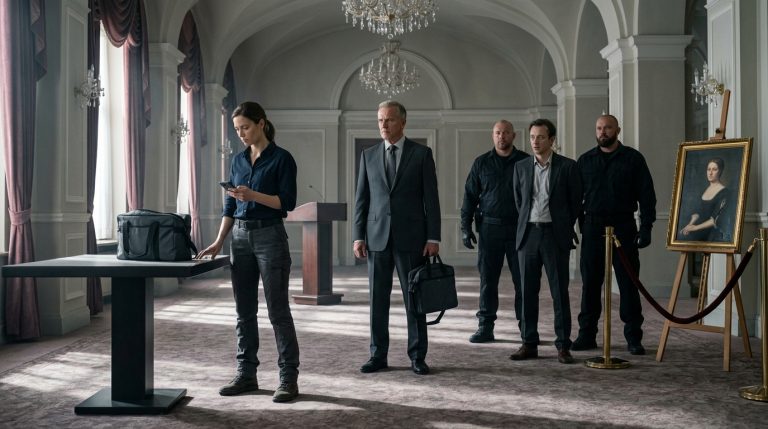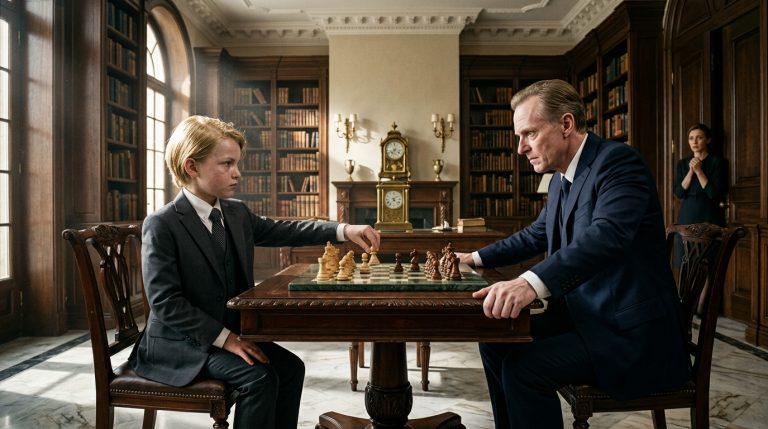
The Resonance of Dust: A Song for the Forgotten in the Halls of Elite Grace
CHAPTER 1: The Ghost in the Velvet
The silence that followed the final note was not empty; it was pressurized, thick with the smell of floor wax and the ghosts of a thousand forgotten performances. Elena’s chest heaved, her lungs burning, not from the exertion, but from the terrifying realization that she had just inhabited a space she was meant to only clean.
She gripped the handle of her mop until the rusted metal bit into her palm. Her uniform—a drab, ill-fitting grey—felt like an armor that had suddenly turned transparent.
“Again,” the boy whispered from the darkness of the aisles.
His voice didn’t carry the bite of his earlier challenge. Julian Thorne stood just within the reach of the moonlight cutting through the high, arched windows. He was dressed in a charcoal suit that cost more than her mother’s monthly dialysis, his posture relaxed, yet his eyes were predatory—not with malice, but with a sudden, sharp hunger.
“I don’t think you heard me,” Elena said, her voice raspy, struggling to regain the composure that kept her invisible. She pushed the mop forward, the wet fibers slapping against the polished hardwood with a sound like a wet bandage hitting a wound. “I’m just the girl who mops, Mr. Thorne. You want a performance, go to the conservatory.”
“The conservatory is full of echoes,” Julian stepped into the light, his movements graceful, detached. He ignored her movement, his gaze tracking her like a navigator following a star. “They sing for the professors. They sing for the grades. You just sang for something that doesn’t have a name.”
Elena didn’t look at him. She looked at the floor, at the way the light glinted off the water spots she had yet to dry. She needed to leave. If she stayed, if she allowed this interaction to stretch into a conversation, she would lose the only thing protecting her: her obscurity. She turned to walk toward the wing, the heavy bucket rattling behind her.
“My mother is waiting for me,” she muttered, her heart hammering against her ribs.
“Wait.” Julian’s voice snapped with a sudden, frantic urgency that made her pause. He reached into his pocket, his fingers fumbling as he pulled out a small, black device. A realization flickered in his eyes—a shadow of greed, or perhaps fear—and he tucked it away before she could fully comprehend the gesture. “If you go now, you’re just the girl with the mop again. If you stay… if you admit what that was… we could both be somewhere else by dawn.”
He stepped closer, the scent of expensive cologne clashing with the sterile, lemony sharpness of her cleaning solution. Elena looked down, and for the first time, she noticed it: a single, crisp piece of sheet music lay on the front row seat, abandoned and marked with a hand-written note that looked identical to her mother’s distinctive, elegant cursive.
It was a piece she had never seen, yet its melody was already burning in the back of her throat.
CHAPTER 2: The Score of Shadows
The sheet music felt impossibly heavy in Elena’s calloused palm, the paper aged to the color of bone, the edges frayed by time. It was a tangible piece of a past she had been told—repeatedly, desperately—was dead. She stared at the staff lines, the notes dancing in the low, dusty light of the auditorium. It was a Nocturne, complex and jagged, not the kind of thing one simply stumbled upon in an elite academy’s trash.
Julian didn’t move. He stood three feet away, his silhouette carved out of the shadows, his breathing steady. He was waiting, watching the way her fingers trembled against the brittle parchment.
“Where did you get this?” Elena whispered, the question feeling like a confession.
“I didn’t ‘get’ it,” Julian said, his voice dropping into that transactional, sharp tone that seemed to define his existence. “I found it tucked behind a radiator in the practice rooms. It’s been there for months, I suspect. But the ink… the ink is fresh, Elena. Or at least, the handwriting is.”
Elena looked up, her eyes narrowing. The transition from the girl who cleaned to the girl who had been caught was agonizingly slow. She pulled her hand back, tucking the music into the waistband of her uniform, beneath the rough fabric of her apron. The cold metal of her bucket handle was nearby, a reminder of her reality. She was not a prodigy; she was a variable in a system that didn’t allow for them.
“You’re mistaken,” she said, her voice regaining the flat, dull cadence of a servant. “It’s just trash. A mistake by a student.”
“Students here don’t write like that,” Julian countered, moving closer. He didn’t invade her personal space with physical touch, but with the sheer gravity of his presence. “That script is old-world. It belongs to a time when people didn’t perform for likes or social standing. It belongs to someone who understood that music isn’t a show—it’s a penance.”
He paused, a flicker of something raw crossing his face—a momentary lapse in his cool, controlled exterior. “My father collects things like that. Not the music, but the people who can make it. He thinks he owns the silence of this building. He thinks he can curate who hears what, and when.”
The air in the room grew stale. Elena remembered her mother, sitting in their small, cramped kitchen, the hum of the oxygen concentrator providing a rhythmic, mechanical backdrop to the rare, haunting melodies she would sometimes hum while cleaning the dishes. The melody on the page was identical to the one her mother hummed when the pain was at its worst. A sudden, sharp memory flared—her mother’s hands, once elegant and long-fingered, now swollen and scarred by years of scrubbing floors—and the phantom weight of a velvet gown she had only ever seen in faded photographs.
She felt the walls of the auditorium closing in, the velvet curtains smelling of dust and ancient, trapped sound. The intrusion of the memory was so vivid she nearly stumbled. She gripped the mop handle again, the friction of the wood against her palm the only thing tethering her to the present.
“You’re fishing for something, Mr. Thorne,” Elena said, her voice steadier now, forged in the heat of a defensive instinct. “Whatever game you’re playing, I’m not a player. I’m the cleanup crew. I leave when the clock strikes seven, and I don’t look at the walls.”
“Look at them now,” Julian urged, gesturing to the expanse of the auditorium.
He didn’t move to stop her, but his eyes were locked onto hers with a desperate, burning intensity. He seemed less like a billionaire’s son and more like a man holding onto a sinking ship. “You think you’re invisible because you wear that grey uniform? You sang, Elena. For a moment, the air didn’t move. You stopped time in a building designed to profit off the passing of it. That’s not ‘cleanup.’ That’s an act of war.”
He didn’t wait for her to respond. He reached into his pocket again, his hand hovering over the device he had tucked away earlier, then seemed to think better of it. He turned on his heel, his expensive leather shoes clicking rhythmically against the floor, a sharp, metallic contrast to the muffled thud of her own worn-out boots.
“The gala is in two days,” he said, not turning back. “My father expects a performance. He expects the usual, hollow, technocratic trash. If you show up with that Nocturne… well, let’s just say it would be a shame if that music stayed buried.”
He disappeared into the dark corridor, leaving Elena alone in the hollow silence. The auditorium felt larger now, more predatory. She reached into her waistband, her fingers brushing the cold, brittle edge of the sheet music. She should burn it. She should drop it in the incinerator and walk away, return to the steady, manageable rhythm of her mother’s medical bills and the quiet dignity of her invisibility.
But as she looked at the rows of empty, velvet-backed seats, she saw the ghost of her mother’s hand—not cleaning, but playing—and the melody began to hum behind her ribs, a sound that refused to be forgotten.
CHAPTER 3: The Sterile Corridor
The walk to the bus stop was a blur of gray concrete and the biting sting of early morning air. Every shadow looked like Julian Thorne; every rustle of the wind sounded like the cadence of that Nocturne. Elena kept her hand pressed firmly over her midsection, her fingers curling around the stiff, brittle paper hidden beneath her apron. She had skipped the usual cleaning supply closet protocol, leaving her mop bucket behind in a panic that she couldn’t quite name. It was the first time in three years she had left the academy before the sun had fully crested the horizon.
She reached the hospital, the automatic doors sliding open with a sigh of pressurized air that smelled of ozone and industrial cleaner. The lobby was a wasteland of fluorescent light and linoleum, a stark, antiseptic contrast to the velvety, dust-choked silence of the academy.
Her heart was a frantic bird against her ribs. She navigated the hallways with a muscle memory born of desperation, past the nurses’ station where the chatter was a low, indistinguishable hum. She pushed through the double doors to her mother’s room, her breath hitching as she saw the familiar sight: her mother, frail and pale, hooked to the steady, rhythmic pulse of the dialysis machine.
The room was bathed in a sickly, pulsating light. Elena froze. For a split second, the flickering overhead bulb seemed to sync perfectly with the tempo of the Nocturne, a haunting, rhythmic strobe that made the room feel like a stage. She rubbed her eyes, blinking away the phantom sensation, but the music remained, a static hum in her mind.
“Elena?”
Her mother’s voice was thin, like wet tissue paper. She turned her head, her eyes milky with fatigue, yet sharp enough to notice the tremor in Elena’s hands. “You’re early. You’re never early.”
“The academy was… finished ahead of schedule,” Elena lied, her voice hollow. She pulled the chair closer to the bed, the plastic screeching against the tile. She sat down, her body instinctively shielding her waist, keeping the sheet music tucked away. “How are you feeling, Ma?”
“The same,” her mother sighed, staring at the ceiling. “The medicine doesn’t touch the ache anymore. It just makes the world go fuzzy.”
Elena reached out to take her mother’s hand. The skin was paper-thin, mapped with a web of veins, cool to the touch. It was a hand that had once held a baton, or so the story went—a myth she had grown up with, a fable of lost glory that she had tried to bury under layers of floor wax and student labor.
“Ma,” Elena began, her voice dropping, “what do you know about… Nocturnes? About music that isn’t written for the masses?”
Her mother’s grip tightened, surprising in its strength. She sat up slightly, the tubing stretching tautly. “Why do you ask?”
“I heard something,” Elena said, her voice barely a whisper. She looked toward the door, paranoid that someone—a nurse, a student, Julian—might be standing in the hall, listening to the secrets she hadn’t even begun to understand. “At the academy. Someone left music behind. It… it sounded like you. When you hum while you’re tired. It was the same melody.”
Her mother’s face shifted. The fatigue didn’t vanish, but a shadow of something else—fear, sharp and jagged—darted across her features. She looked away, toward the sterile window that overlooked the hospital’s bleak parking lot.
“Music is a dangerous thing for people like us, Elena,” she said, her voice flat, devoid of the warmth she usually reserved for her daughter. “It attracts attention. It makes people think they know who you are. We are the ones who clean the stage, not the ones who stand on it. You must understand this. If you don’t, you lose everything.”
“But it was beautiful,” Elena argued, her own voice rising, fueled by the memory of how the sound had felt in her own throat—a sudden, violent blossoming of light. “I didn’t choose to sing it. It just… it came out. Someone heard me, Ma. And now they’re asking questions.”
Her mother turned back, her eyes wide, glistening with a sudden, sharp clarity. She reached for the small, metal locket she wore around her neck, a piece of jewelry that had never been opened, a relic from the life they had abandoned before they ever came to this city.
“Who heard you?”
“Does it matter?” Elena felt the sheet music burn against her skin, a physical weight that threatened to pull her under.
“It matters more than your life,” her mother rasped, leaning forward until their foreheads almost touched. “These people, the ones who run that school, they don’t value art. They value control. If they found a piece of my past, they didn’t find it by accident. They were hunting for it. You aren’t just a cleaning girl to them anymore. You’re a liability.”
The hospital lights flickered again, a rapid, frantic strobe that mirrored the climax of the Nocturne. Elena felt a wave of nausea. The walls of the room seemed to stretch, the white paint peeling away in her mind to reveal the dark, suffocating velvet of the auditorium. She looked at her mother—really looked at her—and saw not just a victim of illness, but a woman hiding from a shadow that had finally caught up to them.
She reached for the sheet music, intending to pull it out, to show her mother the proof, to ask the question that had been haunting her since the auditorium doors had swung open. But before her hand could reach her waist, the door to the room swung open with a harsh, heavy thud.
A hospital administrator stood in the threshold, a clipboard in hand and an expression of practiced, icy indifference.
“Elena,” the administrator said, their voice ringing through the sterile room like a gavel. “You’re wanted in the main office. There’s a matter regarding your scholarship. It seems there’s been a ‘performance issue’ that needs to be addressed.”
Elena sat paralyzed, the sheet music hidden, her mother’s hand trembling in hers, and the heavy, metallic smell of the hospital corridors suddenly reminding her of the cold, iron bucket handle she had left behind.
CHAPTER 4: The Ledger of Silence
The administrator, a woman named Mrs. Gable whose face was a study in sharp, professional dissatisfaction, did not offer Elena a seat. She stood by the heavy oak desk that dominated the small office, a space that smelled faintly of lemon polish and the stale, dry air of an archive. Elena stood in the center of the room, her uniform feeling excessively thin, her skin crawling with the residual heat of the hospital room.
“Scholarship reviews are usually handled in the spring,” Mrs. Gable said, tapping a pen against a manila folder that looked unnervingly thick. She didn’t look up. “But your recent… extracurricular activities have necessitated an earlier inquiry.”
Elena’s hand twitched toward her waistband, checking the security of the hidden Nocturne. She had to stay calm. She had to keep her heartbeat slow, a rhythm she had practiced during the long, monotonous hours of mopping these very halls.
“I don’t know what you’re referring to,” Elena said. Her voice sounded foreign in the small office, steady and quiet.
Mrs. Gable looked up. Her eyes were a pale, washed-out blue, and for a fleeting second, Elena noticed a slight, rhythmic tic in the woman’s left eyelid—a physical discrepancy that spoke of a pressure she was under that had nothing to do with school policies. Mrs. Gable reached out and slid the manila folder across the desk. It wasn’t a disciplinary record. It was a list of medical billing codes, stamped with the same headers Elena saw every month when she helped her mother navigate the insurance bureaucracy.
“We value our scholarship students, Elena,” Mrs. Gable continued, her voice devoid of any warmth. “But we value the integrity of the institution more. You are a cleaner. That is your function. When a cleaner starts acting like a performer, it disrupts the hierarchy. It creates… expectations that we cannot meet.”
She tapped the folder again. “Your mother’s treatment coverage is tied to your continued standing at the academy. If you were to, say, lose your scholarship due to ‘behavioral inconsistency,’ the academy would no longer be able to advocate for the continued funding of her care.”
Elena felt the blood drain from her face. This wasn’t just a threat to her education; it was a threat to her mother’s breath. She gripped her hands behind her back, digging her nails into her palms until she felt the bite of skin. The room seemed to tilt. She saw the dust motes dancing in the light, a stark, quiet beauty that mocked the ugliness of the conversation.
“Is that a threat?” Elena asked.
Mrs. Gable finally smiled—a thin, brittle line that didn’t reach her eyes. “It’s a clarification of terms. We don’t want you to be a martyr for a song, Elena. We want you to be a productive member of our community. That means sticking to the mop, the hallways, and the silence.”
She leaned forward, her voice dropping to a conspiratorial, oily whisper. “Whatever you found—whatever you’re carrying—it’s not yours to keep. You’ll hand it over, you’ll apologize to Mr. Thorne for the interruption, and you’ll continue your service. Do you understand?”
Elena stood there, the silence in the room heavy and suffocating. She thought of the Nocturne. She thought of the way the notes had tasted in her mouth—like cold, clear mountain water after a long drought. If she handed it over, she was safe. Her mother would get the next round of dialysis. She could go back to the gray, manageable existence that had kept them alive this long.
But if she did, the music would be gone. The only piece of her mother’s identity that she had ever truly touched would be fed into a shredder, just another casualty of the elite academy’s cold, calculated efficiency.
“I need to think,” Elena said, the words barely audible.
“You have until tonight,” Mrs. Gable replied, her gaze already shifting back to her computer screen, dismissing her. “The gala preparations begin at dawn. If you aren’t ready to play your part, you’ll find that the world outside these walls is remarkably unaccommodating to people with your background.”
Elena turned and walked out of the office, her legs feeling like lead. She didn’t return to the cleaning closet. She didn’t go to the laundry room. She walked toward the back exit of the school, the weight of the sheet music burning against her stomach. She passed a group of students in the corridor, their laughter echoing against the marble—a sound of privilege that usually made her shrink into the shadows. Today, it sounded like a warning.
She pushed through the back doors and stepped out into the courtyard, where the late afternoon sun was beginning to bleed into the sky in shades of bruised purple. She needed to know what the music really was. She needed to know why her mother was so afraid of it.
She pulled the sheet music out, her fingers trembling as she unfolded it in the fading light. She didn’t see notes anymore. She saw a map—a series of annotations in the margins, tiny, microscopic symbols that looked like coordinate markers. She looked closer, her eyes squinting against the glare. They weren’t musical notations at all. They were a signature—the name of a bank, a date, and a set of instructions that pointed to a vault buried deep beneath the very stage where she had sung.
The realization hit her with the force of a physical blow. The song wasn’t just a song. It was a key.
CHAPTER 5: The Architects Blueprint
The courtyard was cooling rapidly, the air turning crisp and smelling of damp earth and late-autumn decay. Elena stood motionless, the sheet music held out before her as if it were a compass. The handwritten coordinates—scribbled in that same elegant, sloping hand she had known her entire life—seemed to pulse against the page. If these were directions, they led to the heart of the school, a place where the architecture was said to be impenetrable, a fortress of legacy and cold, hard stone.
She tucked the music back into her apron, her fingers slick with sweat. Her mind raced. The administrator’s threat still echoed in the marrow of her bones—the loss of the scholarship, the loss of her mother’s care. But the fear had shifted. It was no longer a cold, stagnant dread; it was a hot, kinetic impulse to find the truth buried beneath the floorboards of her own misery.
She moved not toward the dorms, but toward the service entrance of the North Wing—the oldest part of the academy, where the walls were thick with the grime of a hundred years and the floorboards groaned under the weight of secrets. She navigated the perimeter, her boots making no sound on the gravel. Every shadow seemed to stretch toward her, a jagged reach of iron and darkness. She knew these paths better than the students ever would. She had mopped these tiles until her knees were raw; she had polished these brass fittings until they reflected her own hollow, tired face.
The service stairwell was dark, illuminated only by the thin, vertical sliver of a security light overhead. As she descended, the smell changed—the lemony sterility of the upper floors gave way to the scent of stagnant water and cold, damp iron. This was the sub-basement, a place that didn’t exist on any student map.
A sudden, jarring sound made her freeze: the sharp, metallic snap of a piano key, echoing from somewhere deep within the bowels of the structure. It was an impossible sound. There were no pianos down here. Her heart hammered against her ribs, a frantic, syncopated rhythm. The phantom sound triggered a memory so vivid it stole the air from her lungs—a young woman sitting at a grand piano, the light catching the silver locket she wore, her hands moving with a grace that made the world seem less sharp, less cruel.
Elena shook her head, forcing the image away. Stay focused. She pulled the sheet music out again. She was near the coordinates. She traced the lines of the masonry, her fingers mapping the cold, rough texture of the bricks, until they found a discrepancy. A single brick, slightly recessed, etched with a faint, almost imperceptible symbol—a treble clef, mirrored.
She pressed it.
There was no sound of a vault opening, only the agonizing, slow screech of rusted hinges. A sliver of darkness widened into a passage that smelled of old parchment and trapped, electric ozone. She stepped inside, her breath coming in shallow, ragged bursts.
The room was not a basement. It was an archive. Shelves rose into the gloom, packed not with books, but with thousands of black glass discs, each labeled with a name and a date. And in the center of the room sat a single, pristine desk, and upon it, a recording device—an archaic, mechanical thing, the kind used to capture sound before the world went digital and indifferent.
She approached the desk. Her hand moved toward the device, her skin buzzing with the proximity of it. She saw her mother’s name on a small, yellowed index card pinned to the desk: V. Thorne. Subject 42. Discarded.
The realization was a vacuum, sucking the air out of the room. Her mother wasn’t just a former musician who had lost her way; she was a variable in a massive, systemic experiment, a study in the degradation of human talent for the amusement—or perhaps the profit—of the school’s founders.
Elena reached out, her fingers hovering over the recording device. A movement in the doorway caught her peripheral vision—a shadow, elongated and sharp. She spun around, but the passage was empty. Yet, the air felt disturbed, as if someone—or something—had just been standing there, watching. She wasn’t alone.
She looked back at the recording device, her pulse thundering. If she played it, she would know the final truth of her mother’s life. If she walked away, she kept the fragile, dying peace of their current existence. She placed her hand on the cold, metallic casing of the recorder, the metal biting into her skin, and felt the weight of the entire world pressing down on her shoulders. She was no longer just the cleaner. She was the one who was going to hold the silence accountable.
CHAPTER 6: The Resonance of Ruin
The recorder’s casing was cool, industrial, and unnervingly sturdy. Elena’s thumb hovered over the play button, her skin prickling with a sudden, sharp cold that had nothing to do with the temperature of the sub-basement. Around her, the thousands of black glass discs sat in their slots like eyes, watching her trespass. She felt like an intruder in a graveyard of voices.
The shadow in the doorway hadn’t returned, but the silence had changed. It was no longer empty; it was waiting.
She pressed play.
There was a hiss, like the sound of dry leaves skittering over pavement, followed by the soft, rhythmic click of a mechanical device engaging. Then, a voice. It was unmistakably her mother’s—younger, stronger, and laced with a terrifyingly sharp clarity.
“Subject 42,” the recording began. Her mother’s voice was detached, reciting facts as if they were coordinates on a map. “The Nocturne is complete. The encryption is woven into the phrasing. If anyone outside the lineage attempts to play it, the dissonance will trigger a feedback loop in the academy’s central acoustic architecture. It is a fail-safe, a way to ensure that the music remains only for those who can endure the cost of its truth.”
Elena’s knees buckled, and she sank onto the cold floor, the sound of her mother’s voice filling the cramped, dark archive. The recording continued, detailing a series of transactions—names she recognized from the school’s donor plaques, dates that aligned with the mysterious, sudden expansions of the academy’s prestige. Her mother hadn’t been a victim of a system; she had been the architect of its most dangerous, hidden asset.
The sound of the recording shifted; her mother began to hum that familiar, jagged melody. But as she played, the audio quality degraded into a high-pitched, metallic whine. It sounded like the very building itself was groaning, a structural complaint that made the floor beneath Elena vibrate.
“They think they own the silence,” her mother said on the tape, her voice suddenly intimate, a whisper meant for a secret audience. “But they don’t understand that sound leaves a residue. Every note I’ve played, every lie they’ve forced me to record—it’s all still here, trapped in the stone. They want the music to be a product. I’ve made it a trap.”
Elena reached out to stop the recording, her fingers trembling so violently she nearly dropped the device. The air was thick with the smell of scorched wire—the smell of a machine being pushed beyond its limits. She had her answer. The Nocturne wasn’t just a key; it was a weapon. And she, by simply possessing the sheet music and having the voice to perform it, had become the trigger.
She sat in the dark for a long time, the only sound the hum of the cooling fans in the archive. Her mother had known. All these years, the poverty, the illness, the quiet, fearful life—it wasn’t the result of misfortune. It was a camouflage. A desperate, calculated attempt to keep her daughter as far away from this room as possible.
She carefully rewound the tape, the soft, mechanical whir of the reels sounding like a countdown. She couldn’t leave the recorder here. If Mrs. Gable or Julian found it, the trap would be dismantled, and the leverage they held over her mother would become absolute. She popped the tape out, the small, plastic casing feeling as fragile as a bird’s heart, and slid it into her apron pocket alongside the sheet music.
As she stood up, a sound reached her from the passage—a slow, deliberate footfall.
She retreated into the shadows of the shelves, her breath held tight in her chest. The door to the archive groaned, and a sliver of light from the corridor pierced the gloom. A silhouette stepped through—not a shadow this time, but a figure. The unmistakable, sharp-shouldered frame of Julian Thorne.
He didn’t look at the shelves. He walked straight to the desk, his movements confident, almost possessive. He stopped, his gaze falling on the empty space where the recording device had sat. He froze, his head cocking to the side like a predator sensing a shift in the wind.
“I know you’re here, Elena,” he said, his voice quiet, lacking the bite of their earlier meeting. It was weary, almost resigned. “You’ve heard it, haven’t you? You’ve heard what it costs to be an artist in this place.”
Elena didn’t move. Her heart was a frantic, trapped thing. She kept her hand clamped over the pocket containing the tape, the rough fabric of her apron digging into her skin.
“Don’t,” Julian said, his eyes scanning the darkness, searching for the slightest movement. “Don’t run. You’re already part of the machinery now. The question is whether you’re going to be the lubricant, or the grit that breaks it.”
He took a step toward her hiding spot, his hand reaching into his suit pocket, pulling out a small, silver lighter. He flicked it open, the flame casting a jagged, dancing light across his face. He didn’t look like a student; he looked like a conspirator.
“I’m not here to take it from you,” he whispered, holding the flame steady. “I’m here to tell you that you’re the only one who can actually finish the song.”
CHAPTER 7: The Dissonance of Intent
The flame of the lighter was a small, defiant sun in the oppressive gloom of the sub-basement. Julian held it steady, his eyes tracking Elena’s hand—the one clamped tightly over her pocket. He wasn’t reaching for her, nor was he signaling for help. He was waiting, his posture that of a man who had burned his own bridges and was now standing on the smoking wreckage, watching to see if she would do the same.
“You’re not working for them,” Elena said, her voice sounding raspy, the dust of the archive having coated her throat. She stepped back, putting the corner of a shelf between them.
“I’m working for a version of this place that doesn’t cannibalize its own history,” Julian replied. He snapped the lighter shut, and the sudden plunge back into darkness was absolute, save for the faint, bioluminescent-blue shimmer of the emergency exit signs down the hall. He didn’t move toward her again, respecting the distance. “My father treats this building like a private treasury. He collects talent, stores it in rooms like this, and uses it to insulate his own reputation. He didn’t want you to be a student, Elena. He wanted you to be an asset. When you sang that night, you broke the containment.”
Elena felt the tape in her pocket, the physical weight of her mother’s voice recorded on that small plastic spool. It felt like a stone. “You want me to hand it over? The recording? The music?”
“I want you to be the one to decide where it goes,” Julian said, his voice dropping. “If I take it, I’m just another collector. If you keep it, you’re the one holding the hammer. The gala is tomorrow night. Every major donor, every person who holds the strings to your mother’s hospital funding, will be in that auditorium. They expect a performance. Give it to them. But don’t give them the version they asked for.”
The suggestion hung in the air, a dangerous, jagged idea. Elena’s mind flashed to her mother’s face in the hospital bed—the hollowed-out eyes, the smell of the dialysis chemicals. The academy held them hostage with the illusion of charity. To perform at the gala, to use the very stage they had built to trap her, was a gamble that could erase her entire existence.
“If I do this,” Elena said, her voice sharpening, “they won’t just fire me. They’ll ruin us. You know how they work.”
“I know,” Julian admitted, and for a moment, the icy veneer of his status cracked, revealing a man who was deeply, profoundly tired. “That’s the beauty of the dissonance. They’ve spent so much effort turning this school into a pristine, perfect product that they’ve forgotten how to handle noise. You are the noise, Elena. You aren’t just an applicant; you’re the proof of their corruption.”
A deep, rhythmic thrumming began to vibrate through the floorboards—the academy’s massive ventilation system kicking into its evening cycle. The sound grew, a mechanical growl that made the glass discs on the shelves rattle in their racks. It was a chaotic, discordant symphony, and beneath it, Elena could hear the faint, rhythmic ticking of a clock somewhere deep in the wall.
It was a distraction, a shift in the environment that made the air feel thin and pressurized. Elena looked at Julian. She didn’t trust him—not yet—but she recognized the desperation in his stillness. He was a piece of the architecture, a gilded fixture of the school, but he was currently vibrating with the same intent that had driven her to investigate the archives in the first place.
“Why me?” she asked.
Julian leaned against a shelf, the metal groaning under his weight. “Because you’re the only one who didn’t know the rules. Everyone else here—the students, the staff—they’re all playing a game they’ve already memorized. You? You just walked in and started singing. You’re an error in their system, Elena. And errors are the only things that can cause a system to fail.”
He pushed off the shelf and walked toward the passage door, pausing only for a second to look back. “Mrs. Gable is looking for you. She’ll be in the main hall by now. If you want to keep that tape, you need to be smart. Don’t hide. Be everywhere. If you act like you have nothing to lose, they’ll assume you already found a way out. That’s your armor.”
He disappeared into the corridor, leaving Elena alone in the dark archive. The silence returned, but it felt different now. It was no longer the silence of a grave, but the silence of a room holding its breath before a storm.
She reached into her pocket, her fingers tracing the smooth edge of the tape. She could hear her mother’s voice, the cadence of the Nocturne, playing in her mind like a secret heartbeat. She had been tasked to clean the halls, to scrub away the grime and the mistakes of the elite. Instead, she had found the blueprint of their ruin. She pulled her apron tight, straightened her posture, and walked toward the basement stairs.
She wasn’t going to hide. She was going to return to the halls, and she was going to clean them with a precision that would reveal every crack in their foundation.
CHAPTER 8: The Gala of Glass
The climb back up from the sub-basement felt like ascending from the belly of a leviathan. Elena emerged into the North Wing service corridor, the air here cooler and smelling sharply of the floor wax she had applied only hours before. Her heart was a frantic, steady drum in her ears, each beat counting down the time until the gala.
She walked with a purposeful, practiced stride, keeping her head low. She had to blend into the architecture of the building, to become one of the shadows that lengthened across the polished stone. The academy was beginning to stir—a hum of activity from the main auditorium, the clatter of distant silverware, the muffled instructions of catering staff being barked in hushed, urgent tones. They were preparing a stage for a lie, and she was carrying the truth in her pocket.
As she rounded the corner into the grand atrium, she nearly collided with a group of students in evening attire. They were draped in silk and velvet, their faces masks of carefully curated indifference. She shrunk back, retreating into the shadow of a marble column, her hand instinctively shielding the pocket where the tape and sheet music rested.
A sudden, sharp flash of memory hit her: the sight of the auditorium lights from years ago, during a rare, permitted visit with her mother. The way the chandelier had felt like a constellation of cold, judging stars. It had blinded her then; it was meant to blind her now.
She pressed her forehead against the cold, unyielding surface of the column. She couldn’t afford to be paralyzed by the past. She needed a way to broadcast the truth—or at least, a way to ensure it was heard. The archive had shown her that the building was designed as an acoustic instrument. If the Nocturne was truly a fail-safe, a way to trigger a feedback loop, then the auditorium itself was the weapon.
She began to move, navigating the maze of hallways. She didn’t return to the cleaning closet. She had become an ghost in her own school. She avoided the main traffic, sticking to the peripheral stairwells and the narrow, forgotten passages behind the velvet tapestries. Her goal was the sound booth—the control center that bridged the stage to the exterior world.
It was here that she encountered the first complication. A security guard stood outside the booth, his silhouette blocking the light. He wasn’t one of the usual night staff; he was a private detail, likely hired by Julian’s father to ensure no ‘unauthorized’ sounds disturbed the gala.
Elena stopped, the breath hitching in her chest. She couldn’t fight him, and she couldn’t bribe him. She had only her uniform and the quiet authority of her invisibility.
She waited, watching the rhythm of his patrol. He was bored, his attention fractured, glancing at his watch every few seconds. She realized then that Julian had been right—they didn’t perceive her as a threat because they didn’t perceive her as a person. She was a cleaning implement, a shadow in the periphery.
She stepped out of the darkness, not with a weapon, but with a bucket she had retrieved from a nearby supply bay. She moved with the deliberate, unhurried pace of a worker finishing a late shift. She walked straight toward him, her head bowed, eyes fixed on the floor.
“Excuse me,” she murmured, her voice flat, the tone of a servant that the guard was conditioned to ignore.
The guard didn’t even look at her face. He just stepped aside, his hand moving to his radio as he muttered something about a catering delay. Elena didn’t hesitate. She squeezed past him, her shoulder brushing his heavy jacket, and slipped into the sound booth.
The room was bathed in the soft, green glow of monitors. The smell of ozone was thick here, a mix of electricity and expensive equipment. She reached the main console—a sprawling, complex array of sliders and knobs—and realized with a sinking heart that it was locked. It wasn’t a physical lock, but a digital one, a biometric override that required the credentials of someone who held the master key.
She looked at the monitors. They were displaying the feed from the auditorium, showing the empty stage, the rows of seats waiting for the elite, and the microphones standing like sentinels in the dark.
Then, she noticed it: a small, analog input port, tucked away at the side of the board—an old-fashioned patch point. It was a relic, likely left over from the school’s original construction, meant for manual, direct-to-speaker overrides.
She pulled the tape from her pocket, her fingers trembling. If this didn’t work, if the system rejected the frequency or if the fail-safe triggered before she reached the stage, she would be exposed. She wasn’t just performing anymore. She was rigging the trap. She took a breath, the air in the booth heavy with the smell of scorched circuitry, and inserted the jack. The console lit up, a deep, resonant amber that matched the rhythm of her own, frantic heart.
CHAPTER 9: The Anatomy of a Trap
The console hummed, a low-frequency vibration that traveled up through the soles of Elena’s boots and settled in the center of her chest. She watched the levels on the monitor, the digital needles quivering as they processed the analog input of the tape. She hadn’t hit play yet, but the mere connection felt like a transgression—a digital scarring of a system that prided itself on perfection.
She looked at her reflection in the dark glass of the monitor. She was a smudge of gray in a world of high-definition precision. If they came now—if Julian’s father or Mrs. Gable caught her here, in the heart of the school’s acoustic control—the explanation would be impossible. She wasn’t just a girl with a mop; she was a saboteur.
The room smelled of hot plastic and impending static. Her hand reached toward the playback button, but she hesitated. The trap was laid, but it was incomplete. The tape was only a recording of a secret; to make it a weapon, she needed to amplify it through the auditorium’s resonance chamber, the physical structure that had been calibrated to maximize the academy’s prestige.
Her breath was a thin, ragged thread in the silence. She began to slide the faders, her movements slow and deliberate, mimicking the training she had observed from a distance months ago. She adjusted the equalization, pushing the low-end frequencies to compensate for the auditorium’s cavernous acoustics. She was creating a soundscape that would be impossible to ignore—a low, subsonic drone that would rattle the very bones of the elite, a sound that wouldn’t just be heard, but felt.
A sudden, jarring pop came from the speakers—a spike of white noise that made her flinch. Outside, in the grand atrium, she heard the heavy, rhythmic thud of double doors opening. The gala was starting. The muffled, polite chatter of the wealthy began to bleed into the sound booth, a cacophony of shallow, performative grace.
She checked the time on the console’s clock. She had minutes before the opening keynote.
She turned back to the recording device. She needed to be sure. She pressed play, just for a fraction of a second, to test the signal. Her mother’s voice—hollowed out by the degradation of the tape, but still hauntingly sharp—filled the small, cramped booth.
“The dissonance is the key,” the voice said, clearer than it had been in the archive.
Elena felt a surge of dizziness. The amber light of the console seemed to swirl, the patterns of the digital waveform on the screen looking like the bars of a cage. She was trapped in the frequency. She leaned into the console, her hands bracing against the cool, slick surface, and felt a sudden, sharp jolt of static electricity jump from the board to her fingertips.
It wasn’t just a shock. It was a message.
The console’s display flickered, the waveform shifting from a steady line into a complex, geometric pattern—a mirror image of the coordinate markers she had found on the sheet music. They weren’t just bank coordinates; they were an architectural frequency map. Her mother hadn’t just hidden a secret; she had mapped the structural failure points of the building.
The door to the sound booth creaked open.
Elena didn’t turn. She couldn’t. She was staring at the screen, watching the frequency map pulse in real-time, the academy’s own security system trying to lock onto the intrusion.
“I told you to be smart,” a voice said. It was Julian, his tone tight with a forced, brittle composure. He stepped into the booth, his silhouette blocking the light from the hallway. He glanced at the console, his eyes widening as he saw the waveform on the monitor. “You found it. You actually found the trigger.”
“This isn’t a performance,” Elena whispered, her voice cracking as she realized the true cost of what she was holding. “This is a demolition.”
“Performance is just another form of destruction, Elena,” Julian said, his gaze shifting from the screen to her face. “The question is, are you ready to let the whole place come down?”
The gala music began to play—a light, airy, insipid string quartet that sounded like glass breaking in slow motion. It was the signal. She had to act, or the opportunity would be buried under the weight of the night’s facade. She reached out, her hand trembling, and pushed the master fader to the top. The booth filled with the first, low, subterranean groan of the sound that would change everything.
CHAPTER 10: The Stage of Shattered Glass
The sound booth became a cockpit of chaos. The sub-bass frequency didn’t just play; it occupied the physical space, turning the air into a thick, vibrating medium. Elena felt her teeth ache. She grabbed the edge of the console to steady herself as the floorboards beneath her boots began to shudder, a low-level earthquake induced by the academy’s own acoustic infrastructure.
The monitors flickered, the waveform on the screen tearing itself apart in a jagged, digital seizure. She didn’t look back at the door, didn’t check for security. She sprinted. She burst out of the booth and into the back corridor, the sound now a deafening, throbbing weight that made her vision swim.
She reached the side stage entrance—the heavy, velvet-draped portal that led to the spotlight. The gala was in full swing, though “gala” was no longer the word for it. The guests were frozen. They sat in their plush, velvet chairs, clutching their champagne flutes, their faces masks of mounting, visceral discomfort. The string quartet had stopped playing, their bows hung mid-air, silenced by the encroaching, mechanical roar that vibrated through the foundation.
Elena stepped through the curtain.
The stage lights were blinding, white-hot, and unforgiving. She saw Julian’s father in the front row—a man of stature, silver-haired and impeccably dressed—now leaning forward, his hands gripping the arms of his chair with such intensity his knuckles were white. He wasn’t looking at the stage; he was looking at the ceiling, at the ornate, plaster moldings that were beginning to crack under the strain of the resonating bass.
She reached the center of the stage, her shadow long and distorted under the harsh glare. The microphone stood before her, a silver pillar in a room that was beginning to buckle. She had the tape in her pocket, but the recording was already pouring through the house speakers, filling every corner of the room with her mother’s voice, now distorted by the massive gain into a terrifying, ethereal chorus.
“You built this on silence,” the recording boomed, the sound bouncing off the walls with impossible, crystalline clarity. “But silence is a pressure. And pressure always finds a way to break.”
The auditorium shuddered. A chandelier overhead swayed, its crystals chiming a frantic, discordant alarm. The guests began to rise, a collective, panicked movement, but they were trapped by the sheer physical weight of the sound. It was an acoustic wall, a barrier of noise that turned the elegant hall into a pressure cooker.
Elena grabbed the microphone, her knuckles white. She didn’t need to speak; the music was doing it for her. She saw Julian standing in the wings, his face pale, his eyes wide with a mix of horror and vindication. He had wanted to break the system, but he hadn’t anticipated the violence of the collapse.
“Stop it!” Julian’s father shouted, his voice barely audible over the thrumming, his face turning a bruised, mottled purple. He stood, gesturing to his security detail, but they were stumbling, their hands pressed to their ears, their equilibrium destroyed by the infrasonic frequencies.
Elena felt the floor tilt. A crack raced across the stage, a jagged line of light that split the polished wood beneath her feet. She realized then that her mother hadn’t been bluffing. The building wasn’t just reacting to the sound; it was failing. The academy was built on a series of structural compromises, a shell of prestige covering a hollow, rotting center, and the frequency she had unleashed was systematically unmaking every joint, every beam, every secret seam.
She stood in the eye of the hurricane, the music screaming, the walls weeping plaster dust. She had broken the status quo, but the cost was the building itself—and perhaps, her own life. She looked into the front row, meeting the gaze of the man who had traded her mother’s genius for this cold, gilded cage.
For the first time, he looked small. The power he wielded, the influence he bought—it meant nothing against the physics of what she had triggered. He was looking at her, and in his eyes, she saw the dawning, terrifying realization: she wasn’t just a girl. She was the final note.
The auditorium ceiling gave a sharp, violent groan. A piece of the ornate molding broke free, falling toward the stage like a guillotine blade. Elena didn’t move. She just stared at the wreckage, her fingers still wrapped around the microphone, holding the line as the room finally began to fall.
CHAPTER 11: The Requiem of the Foundation
The roar of the structure failing was not a sound; it was a physical weight, a blast of concussive force that threw Elena backward. The microphone flew from her hand, its cord snapping like a whip against the stage, while the plaster of the ceiling transformed into a suffocating, gray rain of debris. She didn’t scream; she curled into the void, the floor beneath her giving way into the dark, hidden chambers she had only just discovered.
She landed hard, her breath knocked out of her as she slammed against a pile of archival shelves. The world was a chaotic, swirling vortex of dust and darkness. For a heartbeat, there was nothing—no sound, no light, no movement—only the ringing in her ears and the metallic taste of pulverized concrete.
Slowly, the silence returned, heavier and more profound than before. Elena pushed herself up, her limbs aching with a dull, throbbing pain. The auditorium was gone; in its place was a jagged, open mouth of light from above, where moonlight streamed down through the ruin of the stage. The debris had formed a ramp, a messy, unstable bridge from the sub-basement to the level above.
She stood, her legs trembling, and looked around. The archive was shredded. Glass discs lay shattered like fallen stars across the floor, their contents—the voices of the discarded—lost to the ruin.
“Elena?”
The voice was faint, coming from the edge of the collapse. She turned. Julian was there, buried up to his waist in a mound of stage molding and velvet. His face was masked in white plaster dust, his eyes bright with a mixture of shock and a strange, dawning realization. He was holding the recording device—it had survived the fall.
“It’s over,” he coughed, his hand moving to his side. “The structural failure… the acoustic trigger… you didn’t just break the stage. You shattered the school’s entire infrastructure.”
Elena didn’t move toward him. She walked instead toward the center of the archive, where the desk had been. Amidst the rubble, a small, heavy box had been forced open by the impact. It contained not more tapes, but files—meticulous, hand-written records of a different kind. She knelt, her hands shaking, and pulled out a photo.
It was her mother, young and radiant, standing on the very stage that had just collapsed, holding the hand of a man who was clearly a younger, more idealistic version of the school’s current chairman. There was a letter attached, dated twenty years ago. It wasn’t a contract; it was a confession. Her mother hadn’t been an asset—she had been the one who had designed the academy’s foundation to be fragile, knowing that one day, when the greed grew too large, the music would provide the only way to tear it down.
“She wasn’t a victim,” Elena whispered, the truth settling over her like a shroud. “She was the architect of the collapse.”
Julian struggled to free himself, his gaze fixing on the documents in her hands. “She spent twenty years planning for this moment,” he said, his voice a low, gravelly rasp. “She knew that as long as they had the leverage, they would never stop. She chose you as the trigger because you were the only part of her life they couldn’t control.”
The realization was a deep, resonating catharsis. The struggle, the poverty, the constant, grinding labor—it hadn’t been a tragedy. It had been a long, slow-motion strike against an institution that had assumed it could own the truth.
Elena looked up at the moon through the hole in the stage. She felt a quiet, hollow peace. The academy was in ruins, its secrets exposed by the very architecture of its pride. She picked up the photo and the letter, and then, with a quiet, deliberate motion, she reached into her pocket and pulled out the tape. She didn’t need it anymore. She held it out to Julian, who was finally pulling himself free of the debris.
“Give this to whoever is left,” she said. “The world doesn’t need to hear her voice to know the truth. They just need to see what’s left of this place.”
She turned and began the long, slow climb out of the basement, the debris crunching beneath her boots. She didn’t look back at the ruin of the stage. She was moving toward the exit, toward the hospital, toward a life that was finally, for the first time, not composed for anyone else’s ears.
CHAPTER 12: The Quiet After the Chord
The air outside the academy was different. It tasted of rain and wet asphalt, a cold, cleansing draft that washed away the stale scent of ozone and plaster dust that had clung to her hair. Elena walked toward the perimeter fence, her boots crunching against the scattered brick and broken glass. Behind her, the North Wing of the academy sat like a fractured tooth against the night sky, its silhouette jagged and wrong. Emergency lights pulsed in the distance, a swarm of blue and red, but for the moment, she was in the periphery of their attention, a ghost slipping out of a dying dream.
She reached the main road, the streetlights humming with a steady, mundane frequency. She felt light. The crushing weight of the past two days—the terror of exposure, the frantic calculations, the weight of her mother’s secret—had dissipated, leaving behind a profound, hollow clarity. She checked her pocket one last time; the photo of her mother and the letter were still there, her only inheritance.
The walk to the hospital was a pilgrimage. She didn’t hurry, despite the exhaustion that pulled at her limbs. She walked with the steady, rhythmic cadence of someone who was no longer running. Every step was a declaration of ownership. She had spent years mopping the floors of other people’s power, scrubbing away the marks of their existence so that she could remain invisible. Now, she was the one who had left the mark.
When she finally entered the hospital, the lobby was a sanctuary of sterile, predictable peace. She didn’t stop at the desk; she moved straight to the elevator, her reflection in the sliding metal doors a stranger—disheveled, dusty, but possessing a poise she had never worn before.
Her mother’s room was dim, the only light coming from the steady, rhythmic pulse of the monitor. Elena entered slowly. Her mother was awake, staring out the window at the distant city skyline, her hand resting over the spot where her own mother’s locket had once rested. As the door creaked, she turned.
She saw the dust on Elena’s face, the torn hem of her uniform, and the way she held her shoulders. There was no need for words. The silence in the room was not the oppressive, fearful silence of the archive; it was the quiet, settled stillness of a conversation finally concluded.
Elena walked to the bedside and pulled up the chair. She took her mother’s hand, the skin still thin, still cool, but for the first time, she felt a pulse that wasn’t dictated by the machine. It was a human rhythm, steady and strong.
“It’s gone, Ma,” Elena said, her voice soft, the weight of the confession lifting as she spoke it. “The school, the archive, the leverage. It’s all in the past.”
Her mother looked at her, and for the first time, the milky film of exhaustion in her eyes was replaced by a sharp, piercing intelligence. She smiled—a genuine, tired, radiant smile that reminded Elena of the woman in the photograph. “And the music?”
Elena reached into her pocket and pulled out the photo. She placed it on the bedside table, a piece of a life that hadn’t been stolen. “It’s safe. It belongs to us now, not the academy. We don’t have to hide anymore.”
She reached out to the small, plastic basin on the nightstand—a task she had performed a thousand times, a ritual of care that had once felt like a chain. She picked up a damp cloth and began to wipe the dust from her mother’s forehead, her movements slow, meditative, and precise. She was repairing the connection, not with secrets, but with the simple, tactile reality of being present.
Outside, the rain began to fall in earnest, a gentle, rhythmic tapping against the glass. It sounded like the opening notes of a song she had known her entire life—a song that didn’t demand performance or perfection, just the simple, quiet act of existing.
She sat there for a long time, the only sound the soft, rhythmic patter of the rain and the slow, steady hum of the city beginning to wake. The mystery of her mother’s past was no longer a shadow that loomed over their lives; it was just a story, a chapter that had been written in stone and finally, definitively, closed. Elena looked out the window at the distant, shimmering lights of the city. She didn’t know what tomorrow would bring—a new school, a new home, a new way to survive—but for the first time, the melody was hers to write.
She leaned back, closed her eyes, and listened to the rain. The silence was no longer a prison. It was a space. And in that space, finally, she was free.