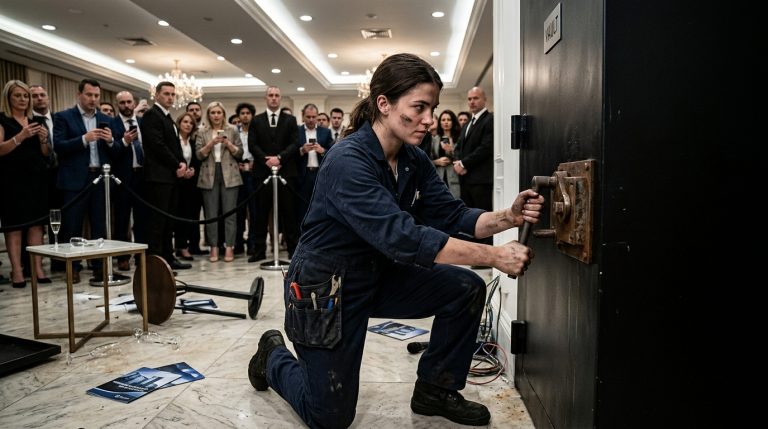
The Weight of Silence: A Mother Navigates the Fragile Boundaries of a Billionaire’s Hidden, Haunted Inheritance
CHAPTER 1: The Weight of Steel
The mop head was heavy, saturated with gray water that smelled faintly of industrial pine and the metallic tang of the building’s plumbing. Maya stood at the edge of the east corridor, the polished hardwood floor reflecting her own silhouette back at her, distorted and thin. The hallway was a vein of silence in the sprawling, cold body of the Harrington estate.
For three months, she had treated this house like a minefield. She knew the pattern of the floorboards that creaked, the exact angle at which the morning light hit the foyer, and the precise, terrifying distance between her and the private rooms. Patricia had been clear: the door at the end of the east corridor was a border.
Today, the border was breached.
The door hung ajar, just three inches. A sliver of shadows beckoned. Maya didn’t mean to look; her curiosity was a reflex she had spent years cauterizing. But the movement—a trick of the light—drew her eyes. Inside, the room wasn’t the library or the study she’d imagined. It was a gallery.
She took a step forward, the soles of her worn sneakers gripping the wood with an unfamiliar friction. The center wall was dominated by a large, ornate frame. Her breath hitched, turning cold in her throat. It was Lily. Her three-year-old daughter, laughing in a faded yellow dress that Maya had mended a dozen times.
The room smelled of old paper and ozone, the scent of a storm trapped behind glass. Maya reached out, her fingers hovering inches from the dark wood frame. There was no dust here, not a single speck. This room was cared for with a reverence that felt like a violation. Her hand shook, and the mop handle slipped from her numb fingers, hitting the floor with a hollow, resounding thud.
The silence that followed was sharp, cutting through the heavy air of the estate. She backed away, the reality of the image searing itself into her retinas. She wasn’t just a cleaner here; she was a variable in an equation she didn’t understand. She pivoted, her boots sliding slightly on the slick floor, and started toward the office. The rules of her survival—the quiet, the invisibility, the head-down labor—had just been dismantled by a single frame. Every step toward the office felt like a climb up a steep, rusted incline, the weight of the coming confrontation pressing against her chest like an iron plate.
CHAPTER 2: The Architecture of Control
The wood of the office door was solid, heavy, and unforgiving. Maya’s knuckles were white, bloodless, as she poised her hand to knock. She had retreated from the east corridor, the images from that room burned into her mind with a clarity that felt like physical trauma. The yellow dress. The laughter. The way the photograph had been placed not just with care, but with ownership.
She took a jagged breath, the air tasting of stale floor wax and old, cold ambition. When she knocked, the sound was thin, swallowed instantly by the vast, quiet expanse of the estate.
“Come in.”
Dominic Harrington’s voice was as steady as the foundation of his house. Maya pushed the door open. The office was dominated by a desk of dark, polished iron and wood, a piece of furniture that looked designed to outlast its occupant. He was sitting there, his attention currently split between a glowing monitor and a stack of physical blueprints. He didn’t look up immediately, a calculated dismissal that grated against Maya’s raw nerves.
“Mr. Harrington,” she began, the name feeling like a curse in her throat. She didn’t wait for him to acknowledge her presence; she crossed the room, the soles of her shoes squeaking on the rug. The sound was abrasive, a reminder of the industrial work she had been performing only minutes before.
He looked up then. His eyes were tired, the skin beneath them bruised with the color of an exhaustion that sleep wouldn’t fix. He pushed the blueprints aside. “I assume you saw the gallery,” he said. It wasn’t a question. It was a statement of fact, as if he had been anticipating this precise trajectory for weeks.
“I saw a room that shouldn’t exist,” Maya countered, her voice vibrating with a dangerous, rusted edge. “I saw my daughter on your wall like she was an exhibit. Explain it. Now.”
Dominic stood up, moving with a deliberate, slow grace. He walked to the window, looking out over the sprawling, manicured lawn. “I didn’t steal her, Maya. I haven’t touched a hair on her head. But I am not a man who accepts the world as it is. When I see something that deserves… protection… I build a perimeter.”
Maya felt a flash of cold fury. She remembered her mother, bent double over laundry tubs, the lights flickering out when the bill was a day late. She remembered the sheer, grinding labor of keeping a three-year-old fed on a budget that consisted of pennies and prayers. “You didn’t build a perimeter,” she snapped, stepping closer, her voice dropping into a low, controlled register. “You violated a life. You talk about protection like you’re doing the world a favor. But you’re just another man who thinks everything is for sale if you have enough zeros in your bank account.”
As she spoke, a memory slammed into her—a sharp, invasive phantom of the laundry mat where she had worked at sixteen. The heat of the steam, the smell of damp wool and ozone, the way she had felt small and disposable. She shook it off, grounding herself in the present friction of the rug beneath her feet.
Dominic turned back to her, his expression unreadable, a stone mask polished to a high sheen. “You think this is just about money? You think I pay for this house because I like the architecture?” He gestured to the office, the estate, the silence. “This house is a cage. And I’ve been looking for someone to help me manage the inventory for a long time.”
He reached into his desk and slid a document toward her. It wasn’t a bank statement. It was a property map of her neighborhood, with several blocks highlighted in a deep, bruised crimson. Maya leaned over the desk, her heart hammering against her ribs. The highlight covered her apartment building. It covered the library. It even covered the small park where she took Lily on weekends.
“What is this?” she whispered.
“The perimeter,” he said, his voice flat. “You think you’ve been cleaning my house because of an ad you found on a board. I’ve been ensuring you were within reach of my resources for months. I needed to know if you were the kind of person who would let your environment define you, or if you were the kind of person who would fight for what was yours.”
The realization hit her with the physical force of a closing door. He wasn’t just a boss; he was an architect of her reality. She felt the sudden, crushing weight of his reach—the way he had infiltrated her life, the way he had orchestrated her employment, all while she had been scrubbing his floors in ignorance.
“You’re not playing God, Mr. Harrington,” Maya said, her voice shaking with the effort to remain standing. “You’re just playing with people’s lives because you’re bored, or because you’re hollow.”
He didn’t flinch. He simply watched her, his gaze intense, as if he were waiting for her to break. But Maya wasn’t breaking. The rust in her life had taught her how to hold on when the structure was failing. She stared back, not as a cleaner, but as a parent whose territory had been invaded. She turned on her heel, the weight of the secret hanging between them like a rusted chain. She didn’t look back as she walked out, the silence of the office pressing in behind her like a physical weight she would have to carry home.
CHAPTER 3: The Paper Trail of Shadows
Maya did not return to the main foyer. Instead, she took the long way around, traversing the service wing that she usually avoided. The air here was cooler, smelling of dry dust and floor polish. Her mind was a frantic machine, dissecting every word Dominic had spoken, every blueprint he had displayed. The red-stained map was still burned into her vision, a cruel topography of her own life.
She needed to understand the scope. If he had been building a “perimeter” around her, she needed to see the physical architecture of that trap.
Her path led her toward the utility closet, a small, windowless space tucked behind the main laundry room. It was where Patricia kept the supply logs. Maya entered, the door latch clicking with a sharp, metallic bite. She flicked on the single, bare bulb. Dust motes danced in the yellow light. She began to shift the heavy cleaning crates, her movements precise and practiced, searching for something she hadn’t known she was looking for until this moment.
She pulled aside a stack of heavy-duty vacuum bags. Tucked behind a shelf-liner that had begun to curl with age was a thin, leather-bound folder. It didn’t belong with the janitorial records. She opened it. Inside, the pages were crisp, smelling of new ink and legal binding.
It was a deed, dated four months ago—a month before she had even applied for the position at the Harrington estate. Her apartment complex wasn’t just in the neighborhood; it had been purchased by a shell corporation. She flipped the page, her fingers trembling against the coarse texture of the paper. The registered agent for the corporation was a law firm she recognized—the same one Dominic Harrington used for his public charitable endeavors.
He hadn’t just watched her. He had become her landlord.
The weight of the realization was nauseating. Every month she paid her rent, she was feeding the very system that was keeping her captive. The rust-colored iron of the utility shelves seemed to vibrate with the sheer scale of the manipulation. She wasn’t an employee; she was an asset under management.
“Looking for something, Maya?”
The voice was cool, detached, and came from the doorway. Maya froze. She didn’t turn around, but she could see Patricia’s reflection in the small, scratched mirror hanging above the sink. The household manager’s posture was stiff, her hands folded in front of her with the precision of a guillotine.
“I was looking for more floor wax,” Maya said, her voice betraying nothing. She slid the deed back into the folder and shoved it beneath a crate of industrial detergents.
Patricia stepped fully into the room, her eyes flicking toward the crate before settling on Maya’s face. “The supply logs are kept in the office, not in the utility closet, Maya. You’ve been here long enough to know the system. Mr. Harrington values efficiency. He also values discretion.”
“I value honesty,” Maya replied, turning to face her. The space was small, the walls closing in. The friction between them was palpable, a static charge that made the hair on Maya’s arms stand up.
“Honesty is a luxury for those who don’t have to manage a kingdom,” Patricia said, her smile not reaching her eyes. “You have no idea what it takes to keep this place running, or why he does what he does. You look at the map and see a trap. He looks at it and sees a wall against the chaos.”
“A wall of his own making,” Maya countered, pushing past her.
She walked out into the corridor, her heart drumming a frantic, irregular rhythm against her ribs. She couldn’t just clean her way out of this. The house was too big, the paper trail too long, and Dominic Harrington was too patient. She needed leverage, but not the kind he used—not money, not real estate, not ownership.
She made her way to the service exit and stepped out into the cool, biting air of the afternoon. The park across the street was empty, the swings motionless. She looked back at the house. It stood against the horizon like a fortress, silent and unyielding. She knew now that he wasn’t just watching her; he was waiting for her to accept the cage.
She reached into her pocket, her fingers brushing against her phone. She didn’t call the police; they wouldn’t understand the geography of this kind of power. Instead, she opened her notes app and began to type, capturing every detail of the deed, the shell corporation, the dates. She needed a map of her own. She was no longer just a mother looking for answers; she was a surveyor of his secrets. And she was determined to find the structural weakness in his design.
She started walking, the city streets turning gray and gritty as she moved further away from the estate. Every step was a calculation, every shadow a potential ally. She didn’t know how she would bring him down, but as she looked at the city skyline, she knew one thing for certain: the perimeter he had built was not as impenetrable as he thought. There was always a way to erode the iron, if you knew how to apply the salt.
CHAPTER 4: The Friction of Truth
The city did not offer sanctuary; it only offered more scale. Maya walked until the soles of her shoes felt thin against the pavement, the metallic tang of the city’s exhaust coating her throat. Every building she passed, every iron-wrought fence, every shuttered shopfront—they all began to look like pieces of the same puzzle. She was no longer just Maya Reyes, the woman who cleaned houses; she was an architect of a counter-strategy, though the blueprint remained alarmingly blank.
She reached her apartment building just as the streetlights began to flicker on, buzzing with the sound of dying insects. The lobby smelled of damp plaster and the lingering, synthetic scent of floor cleaner—a stark, depressing contrast to the clinical, ozone-rich scent of the Harrington estate. She bypassed the elevator, which was perpetually out of service, and climbed the four flights of stairs. Her muscles burned, a dull, aching reminder of the hours she had spent scrubbing surfaces she now knew were part of her own displacement.
Inside her apartment, the air was still, heavy with the scent of lavender and the half-finished drawings Lily had left on the kitchen table. The sight of them—small, colorful, and utterly oblivious to the systemic machine trying to swallow their future—hit Maya like a physical blow. She moved through the small space, not as a resident, but as a soldier securing a perimeter. She checked the window latches, the door locks, even the floorboards in Lily’s room, half-expecting to find some evidence of Harrington’s reach even here.
There was nothing. Just the mundane, rusted reality of their life.
She sat at the kitchen table and pulled out her phone, scrolling through the notes she had made about the shell corporation. The firm, Vantage Holdings, had its main office in the city’s financial district—a glass-and-steel monolith that defied the gravity of the surrounding, decaying brick structures. She needed more than just a name. She needed a link.
A sharp, grinding noise interrupted her thoughts. Down the hall, the neighbor’s cat, Biscuit, let out a startled hiss. The lights in her apartment pulsed, a rhythmic, mechanical stutter that suggested a surge in the grid. Then, total silence. The refrigerator died with a final, shuddering gasp.
Maya stood, moving toward the window. Outside, the streetlights along the entire block had gone dark. It was a blackout, localized and absolute. In the sudden, oppressive darkness, the only thing she could hear was the distant, rhythmic hum of a backup generator—a sound that, in her current state of hyper-vigilance, sounded suspiciously like the machinery at the Harrington estate.
She felt a prickle of alarm at the base of her neck. She grabbed her coat and bundled Lily, who was waking up with a confused, sleepy whimper, into her arms. She couldn’t stay here. If he was testing the limits of his control, if he was trying to see how she reacted to the sudden removal of her basic security, she wouldn’t give him the satisfaction of a panicked retreat.
She exited the building, the cool air of the alleyway bracing and sharp. As she navigated the dark, jagged path toward Mrs. Garza’s unit, she noticed something that stopped her cold: a black sedan idling at the end of the alley, its headlights off, its presence an iron silhouette against the gray brick. It was the same model she saw parked in the Harrington drive every morning.
The friction between her and her reality was reaching a breaking point. She realized then that she had been playing a game with rules she didn’t know, against an opponent who owned the very board they were playing on. She didn’t retreat. Instead, she took out her phone and snapped a photo of the car, her movements steady, her gaze locked on the silhouette.
She had to get out, but not by running. She had to break the machine from the inside. She walked past the sedan, her posture rigid, her heart hammering a rhythm of pure, unadulterated resolve. She wasn’t just a mother protecting her child; she was a variable in his equation, and she was beginning to realize that the most dangerous thing in any system is an unpredictable variable. She felt the heavy, rusted weight of her situation pressing in, but for the first time, she felt the urge to push back, to scrape against the steel until she found the weak point, until the whole structure began to buckle under the strain of its own cold, mechanical design.
CHAPTER 5: The Glass Fracture
The alleyway was a canyon of shadows, the only light filtering from the distant, flickering streetlamps that had miraculously surged back to life. Maya stood perfectly still, Lily’s small, warm weight against her chest a constant, grounding anchor. The sedan’s engine turned over with a low, predatory rumble, but it didn’t move. It sat like a piece of iron slag, silent and heavy, watching her.
She wasn’t just being tracked; she was being corralled.
Every instinct in her body, sharpened by three years of survival, screamed at her to run. But she knew that in this landscape, running was a luxury she couldn’t afford. She had to understand the motive. She reached into her pocket, her fingers brushing against the cold glass of her phone, and initiated a call to the only contact she had for the Harrington estate’s management—the direct line for Patricia.
The phone rang three times before the connection clicked open. There was no greeting, only the heavy, rhythmic sound of breathing on the other end.
“I see the car, Patricia,” Maya said, her voice steady, despite the way her pulse hammered against her ribs. “Tell him to back off. If he wants to talk, he knows where to find me, but he’s not going to keep us under surveillance in the dark.”
“Mr. Harrington isn’t looking to intimidate you, Maya,” Patricia’s voice came back, thin and devoid of its usual briskness. It sounded tired, the weight of the estate’s secrets finally cracking the veneer of efficiency. “He’s trying to keep the structure from collapsing. There are forces at play you don’t understand—legal, financial, things that can tear a life apart faster than a wrecking ball.”
“He’s the wrecking ball,” Maya shot back, her gaze darting to the end of the alley. “He’s been pulling the strings since the day I walked through those doors.”
“He’s been trying to keep the roof from falling on you,” Patricia whispered. The line went dead.
The ambiguity of the statement sent a chill through Maya deeper than the night air. She stared at the sedan, and for the first time, she noticed the subtle details she had missed in her paranoia. The car wasn’t facing her entrance; it was positioned to block the alleyway from the other direction, the direction of the main thoroughfare. It was blocking the path of someone coming in, not watching her go out.
She turned back to her apartment building, her eyes tracing the roofline, the brickwork, the way the shadows gathered around the foundations. The apartment wasn’t just her home; it was a node in a much larger, darker network. She realized then that her perception had been dangerously narrow. She had been so focused on the threat she knew—the billionaire who wanted to control her life—that she had missed the threat she didn’t know—the ones who were coming for the assets he had been shielding.
She moved with a newfound, desperate urgency, navigating the dark stairs of her building. She reached her door and pushed it open, her breath catching in her throat. The apartment had been tossed. Not by a burglary, but by a systematic search. Her drawers were pulled out, her bookshelf gutted, the paper stars she had hung for Lily torn from the ceiling like dead leaves.
In the center of the living room, a single envelope lay on the kitchen table. It was heavy, sealed with a wax crest she recognized from the Harrington estate.
She didn’t open it immediately. She walked to the window, the apartment now feeling like a transparent box, exposed to the eyes of whoever had been watching from the street. The sedan was gone. In its place, a different vehicle—a dark, nondescript van—was parked at the curb, its occupants invisible behind tinted glass.
The realization washed over her with the force of a tidal wave. Dominic wasn’t the enemy; he was the primary target, and she, through her association with him, had become the leverage. She picked up the envelope, her fingers tracing the weight of the parchment. She didn’t need to read the contents to know that the decoy secret of his market manipulation had just been shattered by the reality of a much larger, more violent game.
She looked at Lily, who was fast asleep, and felt the iron-wrought resolve of a mother who would burn the whole city down before she let anyone touch her child. She tucked the envelope into her coat, grabbed the essentials, and slipped out the back of the apartment, the path ahead of her no longer clear, but now, for the first time, entirely hers to forge. She wasn’t playing by his rules anymore. She was changing the board.
CHAPTER 6: The Unfolding Truth
Maya did not run. She walked. Every step down the damp alleyway toward the rear entrance of the Harrington estate was a deliberate act of defiance against the panic that clawed at her throat. She had read the documents in the dim light of a twenty-four-hour laundromat, her eyes burning as the reality of Dominic Harrington’s life—and his death sentence—unspooled across the pages.
He wasn’t an architect of control for power’s sake. He was a man dying of a rare, progressive condition, a man who had watched his own family lineage wither into nothingness, and who had projected his grief and his final, desperate need for legacy onto the only “good” thing he could find in a world he had already written off: Lily. The shell corporations, the real estate maneuvers, the surveillance—it was all a frantic, flawed, and ultimately tragic attempt to build a physical sanctuary for a child he would never live to see grow up. He had tried to buy the future because he knew, with clinical certainty, that he had none.
She reached the back entrance. The security keypad was dark, the power to the estate flickering in sympathy with the rest of the neighborhood. She didn’t use the code; she walked to the service panel she had spent weeks cleaning, stripped the cover, and bridged the connection manually. The gate groaned, a rusted protest of iron against iron, and swung open.
Dominic was in the office. He didn’t look surprised when she entered. He looked small. The sprawling, sterile desk that had once seemed like a throne now felt like a life raft, and he was clinging to it with thin, translucent hands. A glass of water sat beside him, untouched.
“You read it,” he said. His voice was brittle, stripped of the command that had once defined him.
“I read it,” Maya replied. She dropped the envelope onto the polished surface. It landed with a hollow sound. “You’re dying.”
“The money, the buildings, the ‘perimeter’—it was never meant to be a prison, Maya. It was a trust. I wanted to set her life outside the reach of the uncertainty that defined my own. I thought if I could build a wall around you, I could keep her safe from the instability that ruined Daniel.” He looked at her, his eyes clouded with a weary, profound clarity. “I was a fool. I thought I could manage a human life the way I managed an investment portfolio.”
“You weren’t managing,” Maya said, her voice hard, even as her eyes watered. “You were stealing. You stole the right to be her parent, the right to watch her grow, and you tried to trade it for the comfort of watching her from a distance.”
“And now?” Dominic asked, a ghost of a smile touching his lips. “What is your counter-move?”
Maya stepped forward. She didn’t offer comfort; she didn’t offer forgiveness. She offered the only thing that mattered. She reached into her bag and pulled out one of the paper stars, the one Lily had made the night before the power outage—a simple, jagged thing of yellow construction paper and tape. She placed it on the iron desk, right over the blueprints he had been obsessing over.
“You don’t get to buy her future, Dominic. You get to be a part of it, for as long as you have, if you can prove you’re capable of being a human being instead of an architect.”
The silence in the room was absolute, the air thick with the settling of decades of grief. Dominic touched the paper star, his fingers trembling against the cheap, flimsy material. The titan of industry, the man who had bought blocks of the city, was undone by a piece of paper held together with tape.
“I don’t know how to do that,” he confessed, the admission a quiet, terrible sound. “I only know how to build.”
“Then start by tearing down the walls,” Maya said.
In the months that followed, the change was not a violent revolution, but a slow, gritty erosion. The shell corporations were dissolved, the properties handed over to a neighborhood trust that Maya helped oversee. The surveillance stopped. Dominic did not get better; he grew weaker, but the office was no longer a tomb of blueprints. It was a living room, filled with the scattered, chaotic debris of a child’s afternoon.
Lily played in the library, her laughter a bright, piercing sound against the cold marble of the halls. Dominic sat in the sunroom, watching her, no longer trying to control the world. He was learning the rhythm of someone else’s life, a slow, patient labor that lacked the precision of his past, but held the weight of a true, earned peace.
Maya continued to work, but the cleaning was no longer a survival tactic; it was a maintenance of their shared life. She found herself repairing the things that had been broken—the library’s old leather chairs, the garden’s overgrown trellises, the frayed edges of the estate’s history. She felt the heavy, rusted friction of the past slowly smoothing out, replaced by the quiet, steady hum of a day-to-day existence that was no longer an equation, but an experience.
One afternoon, sitting in the garden, she watched Lily draw a picture in the dirt with a stick. Dominic was nearby, resting in a chair, his eyes closed, his breathing labored but calm. Maya picked up a small, weathered stone from the flowerbed and set it back into place, a tiny, permanent correction in a world that was constantly shifting. The air smelled of rain and iron, a gritty, grounded scent that felt like home. She took a deep breath, the weight in her chest finally gone, replaced by the fragile, golden certainty that she had not just survived the storm, but had learned how to live in the rain.