The Silent Reservoir: A Methodical Dismantling of Suburban Tyranny through Precision, Logic, and Calculated Retribution
CHAPTER 1: The First Salvo
The midday heat in Oakmont Creek didn’t just sit; it pressed. It was the kind of heat that made the asphalt shimmer and the neighborhood birds go silent, leaving only the sound of Karen’s voice to scrape against the stillness.
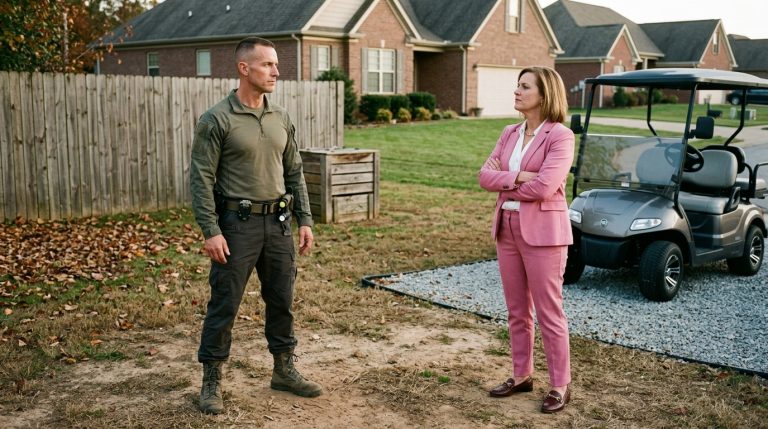
“Those toxic swamp barrels have to go,” she declared. She was a monument to suburban tyranny, arms crossed tightly over a garish floral top that seemed to vibrate with her fury. Her eyes weren’t on me. They were locked onto the two 55-gallon food-grade barrels tucked neatly behind the jasmine trellis at the corner of my house.
I remained in a crouch, my trowel hovering over a stubborn weed. My military training had taught me that in any engagement, the first person to speak clearly controls the tempo. I didn’t look up immediately. I let the silence hang, letting her realize that my garden—my property—was currently outside the radius of her immediate influence.
“They’re a breeding ground,” she continued, her volume climbing to a theatrical pitch. “I’ve filed a complaint with county mosquito control. They’re sending an officer. You’re endangering this entire community, Mr. Davies.”
I slowly straightened, my knees popping in the heavy air. I wiped my soil-caked hands on my jeans, deliberately taking my time. I looked at the barrels. They were sealed, the mesh screens taut and immaculate, catching the sunlight like silver shields. Then I looked at the birdbath ten feet away in her own yard, a patch of murky, green-tinted water where a mosquito landed and took flight without a second thought.
“Karen,” I said, my voice steady, stripped of the fatigue that usually defined my suburban interactions. “The barrels are sealed. They’re an closed system.”
“The bylaws don’t care about your engineering projects,” she snapped, her face turning a blotchy, uneven crimson. “They care about aesthetics. And they care about the law. You’ll be removing them by the end of the week, or the fines will start compounding.”
She didn’t wait for a response. She turned on her heel, her movements sharp, jagged, and entirely performative. She marched back toward her own manicured lawn, her head held with the arrogant tilt of someone who had never lost a skirmish.
I stood in the center of my yard, the silence returning to the cul-de-sac. My heart rate didn’t spike. It leveled out into that familiar, rhythmic thrum I used to feel when surveying a sector in a war zone. I looked down at the rain barrels—the source of her ire—and saw them for what they really were: a catalyst. She thought she was correcting an eyesore. She didn’t realize she had just given me a reason to look beneath the surface of her perfect, suburban order. I walked toward my garage, the workshop door beckoning. The neighborhood was quiet, but as I reached for the handle, I noticed something: a stack of invoices for landscaping services pinned to her bulletin board, and the name on them didn’t match the company working on the street.
CHAPTER 2: The Architects Dossier
The transition from the blinding glare of the cul-de-sac to the dim, dry air of my workshop was like stepping across a tactical threshold. Outside, the world was governed by Karen’s frantic energy and the suffocating pressure of the HOA; inside, the world was governed by weight, measure, and cold, hard logic. I closed the heavy garage door, the pneumatic hiss of the seal sounding like a lung finally catching its breath.
The invoice fragments I had glimpsed on her bulletin board—a mere flicker of paper against the harsh light—now occupied the center of my mind. It was a phantom image, a memory of a document that didn’t belong in a residential trash bin. In my years with the Corps, I had learned that the biggest threats weren’t the ones that exploded, but the ones that eroded the foundation from beneath you. Corruption was exactly like that: slow, persistent, and entirely invisible until the floor gave way.
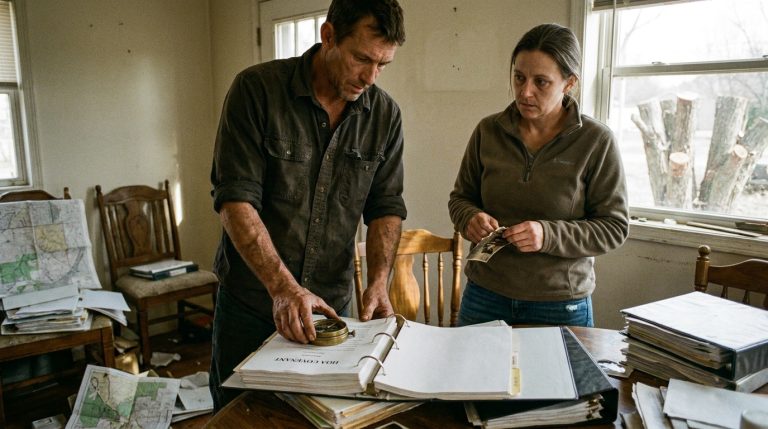
I moved to my workbench. It was an expanse of scarred oak, covered in calipers, levels, and a neatly organized array of hand tools. I pulled out a fresh legal pad. I didn’t write “Garden Plans” at the top. I wrote “Project HOA.”
The shift in perspective was jarring. My brain, once wired to scan for improvised explosive devices or structural integrity in bridge supports, was now calculating the logistics of a neighborhood power structure. It felt ridiculous—until I reminded myself that the stakes were the same. The environment, the stability of the terrain, the objective. I picked up a mechanical pencil, its lead sharp and precise.
I began to map it out. If Karen’s primary weapon was the HOA bylaw book, my primary weapon was the documentation of her inconsistency. I drew a line down the center of the page. On the left, I listed the dates of the “courtesy notices” she had sent. On the right, I listed the physical observations I’d made of the neighborhood—the overgrown hedges, the unapproved color schemes, the rusted lawn ornaments that she conveniently ignored.
As I worked, the silence of the shop became absolute. My internal monologue wasn’t about tomatoes or drought resistance anymore. It was about risk assessment. If I pushed back, how would she retaliate? She had already escalated to a municipal threat—the county mosquito control. That was an aggressive, high-risk maneuver. People who rely on public health officials to win petty disputes are people who feel cornered.
I looked up at the pegboard where I kept my transit level. The memory of a field operation in a humid, dense forest in another lifetime surfaced unbidden. I remembered the way we used to piece together a map from fragmented aerial photos—identifying the enemy’s supply lines by the tread marks in the mud. Karen’s “supply line” was the architectural review committee. If she was controlling the flow of approvals and violations, she was controlling the community’s movement.
I pulled out a small, portable camera from the top drawer of my tool chest. It was a high-resolution piece of hardware, capable of capturing detail in near-dusk conditions. I didn’t need to be aggressive. I just needed to be observant. If her claims about “aesthetics” and “nuisance” were the foundation of her power, I would prove that her foundation was built on an uneven grade.
I spent the next two hours cross-referencing the HOA’s stated rules with the physical reality of the Oakmont Creek subdivision. I identified five separate violations on her own street that hadn’t received a single notice. It was a pattern of selective enforcement so blatant it could only be born of absolute, unchecked arrogance.
But it was the invoices that gnawed at me. The landscaping contract. Why was she so obsessed with the “aesthetic harmony” of the neighborhood? It wasn’t just power. It was protection for a specific vendor. If I could map the relationship between her enforcement patterns and the vendors she authorized, I could trace the logic of her greed.
The heat of the day outside had begun to bleed into the concrete walls, but in here, I was cool, analytical, and ready. I wasn’t just weeding a garden anymore. I was dismantling a machine, gear by gear. I put the legal pad into a manila folder, locked the file cabinet, and stood back. The room felt different now. It was no longer a place of hobbyist construction; it was a command center. I could hear the wind picking up outside, the sound of the jasmine trellis swaying against the house. Tomorrow, I would begin the reconnaissance. The mosquito control officer was coming, and he was the perfect decoy to test the limits of her influence. I had my plan. Now, I just had to wait for the first move.
CHAPTER 3: The Expert Ambush
The rumble of the county mosquito and vector control truck wasn’t just a sound; it was a physical vibration that traveled through the floorboards of my workshop, rattling the calipers and precision drivers I had laid out in anticipation. I stepped out of the garage, the transition from the dim, controlled air of the shop to the humid, unfiltered sunlight of the cul-de-sac acting like a shutter-click.
Karen was already there, hovering on the sidewalk with the predatory posture of a bird of prey. She had dressed for the occasion—a crisp, high-collared blouse that looked far too stiff for the afternoon heat, her expression a mask of practiced righteousness. She caught my eye as I walked toward the barrels, her smirk a sharp, serrated line. She wasn’t just an HOA president; she was a self-appointed general awaiting the arrival of her heavy artillery.
The truck, a nondescript vehicle emblazoned with the official seal of the county, rolled to a stop at the curb. The silence it left in its wake was heavy, punctuated only by the distant, rhythmic chirping of cicadas. A man in a khaki uniform climbed out. He looked to be in his late thirties, his posture efficient and devoid of the performative drama Karen was projecting. He checked a clipboard, his eyes scanning the property with a detachment that made my own professional instincts flare.
“Officer Miller,” Karen swooped in, her voice pitched to ensure the neighbors—already peeking from behind their curtains—would hear every word. “I’m Karen Smith, the HOA president. I called about the public health hazard on this property. These barrels, the standing water… it’s a breeding ground.”
Miller didn’t glance at her. He didn’t offer a smile. He walked toward me, his boots crunching methodically on the gravel driveway. “Mr. Davies?” he asked.
“That’s me,” I said, keeping my hands visible, relaxed but ready. I nodded toward the barrels tucked behind the jasmine trellis. “I’m the one who installed these. I’m happy to walk you through the system. I’m an engineer; I built them to be fully sealed, mesh-filtered, and self-draining. I’d appreciate your professional assessment.”
Karen opened her mouth, a retort ready to launch, but Miller held up a hand—a simple, flat-palmed gesture that silenced her as effectively as a barricade. “I’ll do the inspection, Mrs. Smith,” he said, his voice clipped. “I don’t need a guided tour of the legalities. Just the physics.”
He moved to the first barrel. His movements were clinical. He pulled a flashlight from his belt, the beam cutting through the gloom of the trellis even in the bright daylight. I watched his face—the way his brows furrowed as he checked the marine-grade sealant around the inlet. He wasn’t looking for a “violation”; he was looking for a breach.
He tapped the fine-gauge stainless steel mesh. Clink. Clink. The sound was solid. He knelt to inspect the French drain I had dug, checking for any pooling in the soil. Karen stood three feet away, her arms tightly crossed, her breathing shallow and ragged. The “mosquito hazard” was her decoy, the narrative tool she was using to justify her control. But as Miller moved to the second barrel, he did something I hadn’t anticipated.
He didn’t just check the seal. He stood up and took a long, hard look at the rest of the neighborhood. He walked to the edge of my lawn and looked toward the house across the street—a place with an overflowing, clogged gutter that I knew had been a source of stagnant, mosquito-laden water for months. Then he looked at Karen’s birdbath, just visible over the fence line, where a thin, oily film of water sat undisturbed.
“Officer?” Karen tried again, her voice losing its confidence. “Are you going to issue the citation?”
Miller turned, his face unreadable, but his eyes were sharp. He clicked his pen, the sound amplified by the absolute quiet of the cul-de-sac. “Mrs. Smith,” he said, his tone turning clinical. “I’ve inspected the system. Mr. Davies has installed a model, high-efficiency harvesting setup. It is sealed, vented, and exceeds local health standards for residential moisture control. There is zero evidence of larval maturation here.”
Karen’s face went rigid. “But the HOA—”
“I’m not here to adjudicate your bylaws, ma’am,” Miller interrupted, his voice dropping to a low, dangerous register. “I’m here for vector control. And from where I’m standing, the ‘hazard’ here is a solution. If you want to talk about actual stagnant water breeding mosquitoes, I suggest you look at the unmaintained gutters and birdbaths I’ve seen on my way into this driveway.”
He turned back to me, ignoring the crater of silence forming around the HOA president. “Nice work on the sealant, Mr. Davies. Most people forget to account for the pressure variance. Keep it clear, and you’ll have no issues from my office.”
He turned and walked back to his truck. He didn’t look back. Karen remained on the sidewalk, frozen, her face a canvas of disbelief that rapidly curdled into something much darker. The neighbors’ curtains moved again—a collective shift in the atmosphere of the street. I stood by the barrels, feeling the weight of the moment shift. The mosquito hazard was dead on arrival. Now, I knew, she would have to pivot. She couldn’t afford to lose this fight because this fight was the thin thread holding her authority together. She looked at me, her eyes darting with a frantic, animalistic energy, and I saw it then: the realization that the rules she had used to protect her power were now the very things that were going to force her into a corner. She was already calculating her next violation.
CHAPTER 4: The Paper Siege
The dust raised by the inspector’s truck had barely settled on the pavement when the air in the cul-de-sac curdled. Karen didn’t leave. She didn’t retreat to the safety of her home to lick her wounds or reconsider her tactical position. Instead, she stood at the edge of my driveway, her posture stiffening, her gaze boring into me with a cold, analytical intensity that bypassed anger and went straight to the calculation of damage.
I didn’t turn my back on her. I kept my distance, leaning slightly against the wooden frame of the trellis, my hands shoved deep into my pockets to hide the slight tremor of adrenaline—not from fear, but from the realization that this was no longer a misunderstanding. It was a siege.
The silence between us was heavy, rhythmic, punctuated by the distant sound of a lawnmower from three houses down. Then, she reached into her bag—not for a phone, not for a weapon, but for a cream-colored envelope. She held it out like a summons.
“This,” she said, her voice stripped of the syrupy pleasantries she had used earlier, “is not about mosquitoes. Your little inspector friend can ignore the rules, but the board doesn’t have to.”
I didn’t reach for it immediately. I watched the envelope. It was thick, heavy-stock paper—the kind of stationery that screamed institutional authority. I took it, the surface cool and smooth against my skin. The violation notice. The shift to Section 7.14, the architectural review mandate. She was pivoting. She was abandoning the health-risk decoy because it had been debunked, and she was moving to the structural mandate—the “legal” ground where she held all the cards.
“You’re in violation,” she said, her tone almost satisfied, as if she were reading from a script she’d written long ago. “Section 7.14. Unauthorized permanent structure. The fine is one hundred dollars. Twenty-five dollars a day, starting today, until the tanks are removed.”
I felt the shift in my pulse. The “butterfly detour” of the moment—the sheer, predictable audacity of the legal squeeze—actually simplified things. The tactical complexity vanished, replaced by the stark clarity of an incoming attack. I looked at the letter, then up at her. She wasn’t just a neighbor; she was a variable that needed to be neutralized.
“You’re counting on the money, Karen?” I asked, my voice steady, my tone deliberate. “You’re counting on a financial attrition strategy.”
“I’m counting on the bylaws,” she retorted, turning away before I could see the full extent of her smirk. “The HOA has the right to place a lien on your property if the fines go unpaid. This is a community, Mr. Davies. We don’t have to tolerate people who don’t fit in.”
She walked away, her footsteps echoing on the sidewalk, a sound of measured, rhythmic finality. I looked down at the paper in my hand. It was a weapon, and she had just handed it to me. By moving to Section 7.14, she had effectively opened the door for me to challenge the entire architectural review process. She was so convinced that her authority was absolute that she had ignored the glaring contradiction in the very bylaws she was citing.
I walked back into the garage, the air inside cool and still, a sanctuary of pure, unadulterated reason. I placed the notice on the workbench, right next to the project file. The “consequence loop” was closing. She had attacked me using the law; therefore, I would dismantle her using the law.
I picked up the phone. I didn’t call a neighbor. I didn’t call the city. I called Ben Carter. The phone rang three times before his familiar, gravelly voice broke the silence.
“Mark? I assume something happened?”
“She pivoted, Ben,” I said, staring at the creamy envelope. “She’s not doing the public health angle anymore. She’s going for a structural violation. She’s citing the architectural committee’s mandate. She’s setting up for a lien.”
There was a pause on the other end, followed by the sound of a page turning. “Then she’s walked right into the trap,” Ben said, his voice sharpening. “If she’s invoking the ARC, she’s invoking the entire covenant history. If we challenge that, we force a review of every single enforcement action she’s taken for the last twenty-four months. She thinks she’s boxing you in, Mark, but she’s actually forcing us to open the books. Are you ready for the board meeting?”
“I’m ready,” I said. “And I’m not just going with a lawyer’s letter. I’m going with the neighborhood.”
I hung up and looked at the workshop. It was full of tools—drills, saws, levels—but the most powerful tool I possessed was the truth, currently buried in the thick, dense pages of the bylaws. I had a week before the board meeting. Seven days to collect the evidence, organize the witnesses, and build the case that would collapse the fragile, paper-thin facade of Karen’s suburban kingdom. I sat down at the bench, pulled out the project file, and began to read. Every page, every clause, every tiny, overlooked exception. The war had just moved from the driveway to the boardroom, and this time, the weapon was the system itself.
CHAPTER 5: The Clubhouse Reckoning
The air inside the community clubhouse was thick, recycled, and smelled faintly of floor wax and stale coffee—a sharp, sterile contrast to the humid, organic decay of the garden I had left behind. I stood near the back, my binder tucked under my arm like a ballistic plate. Beside me, George Henderson was a statue of quiet, weathered resolve, his presence a steadying anchor in the rising tension of the room.
The space was packed. There were over fifty residents—more than I had ever seen in the three years we’d lived in Oakmont Creek. They were a cross-section of the neighborhood: the young couples with their strollers, the retirees with their well-tended lawns, and the families who had finally had enough of the creamy-white violation envelopes. When the board members filed in—Karen, Frank, and Mary—the collective silence that followed was sharp enough to cut through the hum of the air conditioner.
Karen walked to the front table with the brisk, performative gait of a high priestess. She didn’t look at the crowd; she scanned the room like a commander assessing a field of fire. Her gaze passed over me, then quickly snapped back, her pupils dilating ever so slightly. She looked ready—armored in the very bylaws she had used to terrorize the neighborhood.
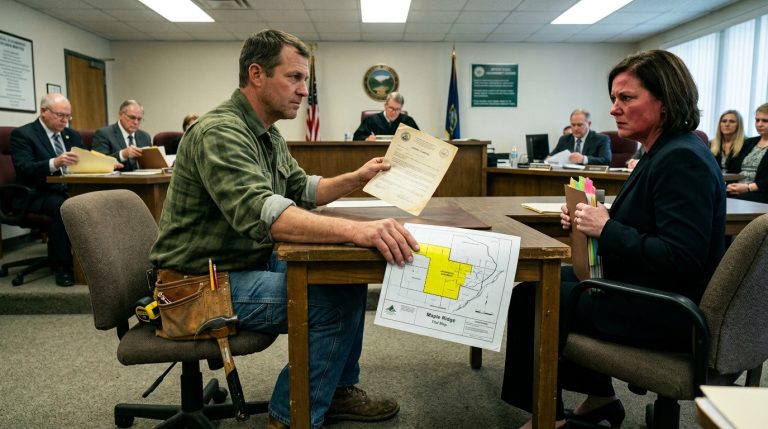
“We will now address the compliance issue at 412 Oak Street,” Karen said. Her voice was thin but carried well, a practiced projection that usually silenced any dissent. “Mr. Davies, the board has determined that you are in violation of section 7.14. The fines currently stand at six hundred and seventy-five dollars. We are here to vote on the initiation of a lien.”
She was baiting me. She wanted the “angry resident” performance, the shouting match that would allow her to call for security or order and remove me from the room, effectively silencing the opposition before the real questions could be asked.
I didn’t give her the theater. I walked to the podium with a measured, rhythmic stride, my boots striking the floorboards with a distinct, deliberate sound. I placed my binder on the surface and opened it to the first tab.
“Good evening, board members,” I said, my voice low and level. “My name is Mark Davies. Karen is correct that this started with me. But tonight, this is not about me.”
I felt the room lean in. I watched Frank, the accountant, out of the corner of my eye. He looked pale, his hands fiddling with a ballpoint pen. Mary, the retired school teacher, kept her head down, staring at the agenda as if it were a student’s failing test. They were the key. They weren’t the architects of this; they were the casualties.
“The board has been told that my rain barrels are an unauthorized structure,” I continued, pacing my words to ensure they hit every corner of the room. “But section 9.02 of our bylaws—the section on water conservation—explicitly encourages the use of rainwater collection systems. It creates an exemption for devices primarily intended for conservation. These barrels are that system.”
Karen started to lean forward, her mouth opening to interrupt, but I held up the binder. “I have the documentation here, signed and recorded in our association’s own founding papers. And that’s not all.”
I didn’t stop for her rebuttal. I pulled out the second tab—the compiled list of thirty other residents who had been harassed, fined, or intimidated by the ARC under similar, arbitrary pretenses.
“This is not a compliance issue,” I said, looking directly at the crowd now. “This is a documented pattern. I have the receipts, the dates, and the witness statements. From the basketball hoop violations to the front-door color palettes. This board hasn’t been enforcing standards; it has been enforcing a personal whim.”
The room was electric. A young woman in the third row raised her hand, her voice trembling but clear. “My son is eight,” she said, standing up. “He was told he couldn’t have a plastic slide on the driveway. We were fined fifty dollars. My house isn’t a museum.”
“I was fined for a gnome,” George added, his voice gravelly and calm.
The dominoes began to fall. Frank looked up, his eyes wide. He wasn’t looking at me; he was looking at the crowd. He was seeing the numbers, the potential liability, and the sheer, overwhelming anger of the people he was supposed to represent. Karen, sensing the ground slipping beneath her, slammed her hand on the table.
“This is out of order!” she shrieked, the facade finally cracking to reveal the raw, panicked insecurity beneath. “We are here to discuss a violation, not to conduct a witch hunt! Security, remove these residents!”
But there was no security. There was just a room full of people who realized their power. The stillness that followed her command was the heaviest silence I had ever experienced—a void where her authority used to be. It was the moment I realized the layer 1 decoy was gone. The mosquito threat, the aesthetic violation—it was all dust. What remained was the raw, unvarnished truth of a neighborhood that had been bled dry by a tyrant who thought they would never talk to each other. I looked at Frank. He was the one who could call for a vote. His hand was resting on the agenda, his knuckles white. The air in the room was stale, but for the first time in years, it felt like oxygen was actually being allowed back in.
CHAPTER 6: The Final Sunset
The silence that followed Karen’s exit was not a vacuum; it was a release. I watched her figure grow smaller through the clubhouse windows—a silhouette retreating into the gathering dusk—and felt the internal tension that had been coiled in my chest for weeks finally start to slacken. The board, stripped of its figurehead, looked diminished, their authority having walked out the door with her. Frank, his face still pale, sat at the head of the table. He didn’t look like a board member; he looked like a man waking up from a long, fevered dream.
“The motion for an independent audit passes,” Frank said, his voice quiet but steadying. “We will be tabling the enforcement actions regarding the property at 412 Oak Street, pending the results of a full financial and procedural review.”
The room erupted. It wasn’t the raucous cheer of a sports game; it was a low, resonant hum of collective relief. Neighbors who had been alienated by years of petty, anonymous violation notices were now standing up, their faces lit by the soft glow of the overhead fluorescent lights. They were talking to one another. Not about aesthetics or property values, but about the neighborhood—what they wanted to do with the shared garden, how they wanted to fix the drainage issues in the park.
I left the clubhouse not as a triumphant hero, but as a man who had successfully finished a project. Outside, the air was cooling, a gentle breeze stirring the leaves of the oak trees that gave our subdivision its name. I walked home alone, the sound of my boots on the asphalt providing a rhythmic, grounding beat.
The next three months were a dismantling, piece by piece. The audit wasn’t a witch hunt; it was a clinical examination of greed. When the auditors released their findings, the evidence was laid out with brutal, bureaucratic clarity: the inflated landscaping contracts, the “administrative fees” siphoned into Karen’s personal accounts, the clear-cut case of self-dealing. It was the “Layer 2” reality we had suspected, but seeing it on paper—neatly typed in bullet points—robbed it of its mythic status. It wasn’t the work of a suburban mastermind; it was the pathetic, small-scale grift of a woman who had mistaken a HOA board for a fiefdom.
She didn’t fight the audit’s findings. She didn’t return to the cul-de-sac. Two weeks after the report was published, a moving truck arrived at her house. I was in my garden, checking the soil moisture levels, when I saw her come out of the front door. She carried a box, her movements slow, the frantic energy of her “reign” gone. She looked older, smaller. She caught sight of me over the fence, and for a second, the old, venomous glare flickered in her eyes—the ghost of the person who had tried to define our lives by her own petty boundaries—but then she just looked away. She got into her car and drove off, and with her departure, the neighborhood’s nervous system finally calmed.
The final resolution wasn’t a dramatic confrontation. It was the quiet, steady restoration of the normal. The HOA board was reorganized. George Henderson was elected to a seat, and he immediately pushed for a rewrite of the covenants. The vague, weaponizable language of “aesthetic harmony” was replaced with specific, objective guidelines that actually prioritized resident autonomy.
One evening, I returned to my backyard. The sun was dipping below the horizon, casting a long, amber glow across the grass. I walked over to the trellis and laid my hand on one of the rain barrels. It was cool, solid, and functioning exactly as I had designed it to. The water inside was clear and clean. I reached out and tightened a slightly loose fitting on the overflow valve—the final, small repair of the project.
Sarah walked out onto the patio, carrying two glasses of iced tea. She watched me for a moment, her smile soft and unburdened. “You know, the garden looks better than it ever has,” she said.
I looked at the rows of tomatoes, the peppers, the climbing jasmine. I thought about the files, the letters, the midnight hours spent studying bylaws, and the quiet satisfaction of seeing a system corrected through its own mechanisms. “It’s about balance,” I said. “You fix the foundation, you get the structure right, and then you just let things grow.”
I took the tea, the condensation cold against my palm. The neighborhood was quiet, really quiet—not the tense, monitored silence Karen had imposed, but the relaxed, easy silence of people who knew their rights and respected their neighbors. The war of the rain barrels was over. I had defended my ground, not by burning the bridge, but by ensuring that the ground itself was built to hold. And in the soft, fading light of the evening, as the first stars appeared over the oak trees, I realized that was the only victory that ever really mattered.