The Ancient Roots and Hard-Earned Peace of Patriot Way: How a Retired Marine Toppled an HOA Tyrant
CHAPTER 1: THE CHAINSAW SILENCE ON THE LAWN
The smell of crushed green sap hung thick in the morning air, heavy and wet like a freshly turned grave.
I stood at the edge of my own lawn, looking up at the brutal, flat-topped stumps where five ancient oaks and maples had anchored the sky for a century.
Karen stood ten feet away, her clipboard clutched to her chest like a riot shield, encased in crisp polyester and an unshakeable belief in her own petty authority.
“Your trees were a violation of section 14, subsection C, paragraph 2, Mr. Thorne,” she said, her voice sharp enough to slice glass.
I didn’t yell. I didn’t rush forward to match the frantic energy humming through her rigid shoulders.
Instead, my thumb simply found the cold metal casing of the brass compass in my pocket, turning it over once against my palm to steady the sudden, heavy heat rising in my chest.
“Compliance with what, Karen?” I asked, my voice dropping an octave into the quiet register that used to make junior enlisted men check their gear twice.
Those trees were standing here before this entire valley was anything more than dirt and scrub brush.
She tapped her laminated ID badge with a perfectly manicured nail, her eyes narrowing as she tried to gauge my stillness.
“The board approved the remediation to protect neighborhood sightlines, and the cost of the cutting will be added to your property levy,” she snapped, stepping back half an inch as the weight of my gaze finally registered.
She thought my silence was hesitation.
She had no idea it was just the first breath before a very long exhale.
CHAPTER 2: THE MASTER ARBORISTS APPRAISAL
The figures staring back up from the bottom of the bound report were clean, cold, and devastatingly specific.
One million two hundred and forty-seven thousand five hundred and fifty dollars.
Sarah stood beside the table, her thumb tracing the torn margin of a county archive photo showing the ancient canopy stretching unbroken across the property line decades ago.
“They won’t even look at this,” she said, her voice tight with the exhaustion of a week spent waiting for a shoe to drop that never did.
“They won’t have a choice once it’s filed,” I said, sliding the heavy brass compass from my pocket and setting it squarely over the total.
The weight of the metal kept the curling paper flat against the wood.
Ben Carter had spent four hours walking our perimeter with a specialized scope, documenting every improper cut and torn vascular ring left behind by Karen’s compliance crew.
He didn’t call it a trimming; he called it a slow execution.
A quiet rap at the front door broke the hum of the refrigerator, sharp and deliberate.
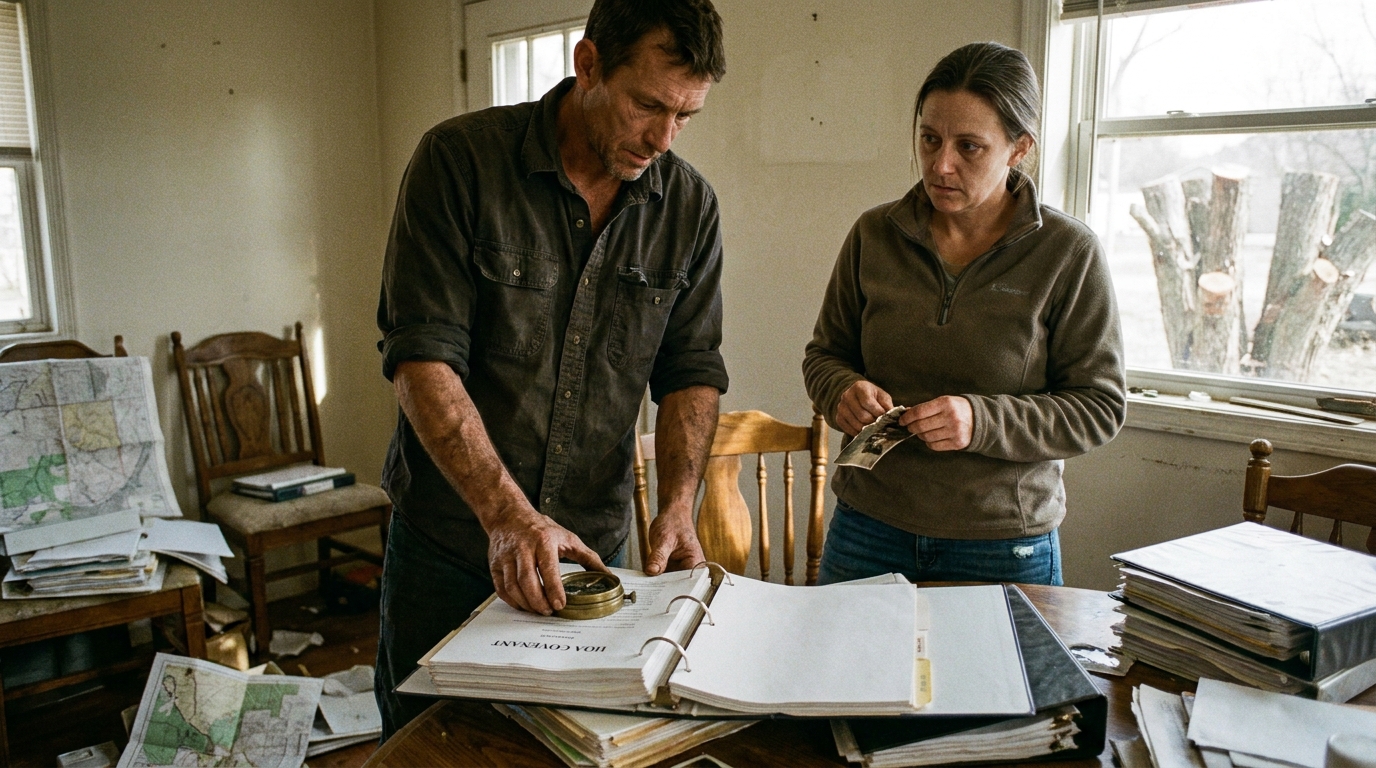
I didn’t answer it with haste, instead stepping past the stack of HOA bylaws spread across the floor like an enemy’s discarded maps.
When I pulled the door back, the afternoon light hit the polished brass nameplate of a certified process server holding a thick, cream-colored envelope.
“Marcus Thorne?” the man asked, holding out the paper without waiting for a nod.
“That’s me,” I said, taking the corner between my thumb and forefinger while the brass compass back in the dining room felt heavy through the fabric of my shirt.
CHAPTER 3: DISSECTING THE ENEMYS BATTLE PLANS
The paper crinkled under my grip, the ink fresh and dripping with the casual condescension of a bureaucrat who thought she held all the cards.
I walked back inside, leaving the door unlatched to let the afternoon breeze cut through the stale smell of coffee and old paper lingering in the dining room.
Sarah looked up from the table, her eyes tracking the envelope as I laid it flat across the center of the HOA covenant binder.
“Another fine?” she asked, her voice dangerously calm.
“Another receipt,” I said, sliding the heavy brass compass from my pocket and setting its sharp point against the margin of the printed threat.
David Miller’s office was downtown, but his legal philosophy was built right here on this table, resting on the contradictions buried deep within article twelve.
We didn’t need to argue with Karen in the driveway anymore.
Every extra penalty she issued, every arbitrary rule she cited without a signed hold-harmless agreement, only widened the fracture in her legal armor.
I picked up a red marker, my thumb brushing the worn metal casing of the compass one last time before pressing the tip hard against the page where her signature sat.
“Let her write all the checks she wants,” I said, looking out the window toward the naked, butchered stumps of the old maples.
“She’s just paying for the ink we’re using to write her exit ticket.”
CHAPTER 4: THE UNFLINCHING QUESTION AT THE CLUBHOUSE
The air in the beige room smelled of stale instant coffee and the low-grade hum of simmering neighborhood resentment.
Karen sat at the head of the folding table, her polyester blouse perfectly pressed and her clipboard held like a shield against the forty residents packed into the folding chairs.
“The board has voted to impose a daily fine of fifty dollars until the remaining stumps at Patriot Way are cleared,” she announced, her voice dripping with the practiced authority of a small-town dictator.
I didn’t storm the table, and I didn’t raise my voice to match Glenn, her burly enforcer, who was already shifting uncomfortably in his seat.
Instead, I stood up slowly in the third row, my thumb finding the familiar weight of the brass compass in my pocket as a grounding anchor.
“Madame President,” I said, cutting straight through the heavy silence that followed her decree.
“Before you issued that removal order, which board members were present for the initial vote?”
Karen’s eyes narrowed into hard, shiny beads as she tried to swat away the procedural nuisance with a flick of her wrist.
“The decision was unanimous among the board members present,” she snapped, her voice carrying across the room with sharp finality.
“The matter is closed.”
“So, for the record,” I pressed, my tone remaining dangerously low and steady against her rising panic, “Karen Peters, Glenn Albright, and Martha Finch all authorized a work crew to trespass on private property without consent.”
Martha’s head snapped up from her laptop, her fingers freezing over the keys as the sheer weight of personal liability hit her face like cold water.
Karen’s face flushed a dark, mottled purple, her hands gripping the edges of the table until her knuckles turned white.
“Your time is up, Mr. Thorne,” she shrieked, banging her gavel down so hard the wooden handle splintered slightly against the laminate.
“Sit down or I’ll have you removed right now.”
CHAPTER 5: THE SEALED ENVELOPES AND PUBLIC EXPOSURE
Rick Valente’s boom mic hovered just above the front row, capturing every sharp intake of breath in the crowded community room.
Karen snatched up the thick legal packet dropped onto the laminate surface, her eyes darting across the bold lettering of the first page.
“What is the meaning of this?” she gasped, her voice cracking as the veneer of administrative power evaporated entirely.
“You’ve been served,” the process server said, turning smoothly toward the exit before she could summon a breath to scream.
David Miller’s name sat right at the top of the complaint, followed immediately by the staggering total of the treble damages claim.
Three million seven hundred and forty-two thousand six hundred and fifty dollars.
The silence that filled the room was absolute, heavy with the realization that the private tyranny was finally crashing down under its own weight.
Karen dropped the papers, her hands clawing blindly at the edge of the table as her husband’s shell company invoices flashed on the monitor behind her via Valente’s broadcast feed.
“This is illegal,” she shrieked, her face twisting into an ugly mask of pure panic as the neighbors she had bullied for years began to murmur in unison.
I didn’t say a word, my thumb resting quietly against the cold brass compass in my pocket while the camera locked onto her complete, unmitigated collapse.
CHAPTER 6: THE QUIET REPLANTING AND FINAL DEPARTURE
A moving truck rumbled slowly down the asphalt, its heavy diesel engine breaking the silence of the morning as it pulled directly into Karen’s former driveway.
Boxes and plastic bins were piled high inside the back of a beaten-down sedan following close behind.
She sat in the passenger seat, staring straight ahead through the windshield with a blank, hollowed-out vacancy where her fierce entitlement used to live.
I stood at the edge of my lawn, my hand resting on the smooth bark of a twenty-foot red oak crane-lifted into place just days before.
Ben Carter stood a few feet away, wiping his leather-worn hands on a rag as the last of the support stakes were driven securely into the rich, dark soil.
Across the street, Mrs. Diaz smiled from behind a fresh border of prize-winning roses, while the faint sound of children laughing drifted over from the Miller family’s new swing set.
The moving truck shifted gears, rolling past our property line and turning the corner out of the neighborhood for good.
I didn’t wave, and I didn’t gloat over the wreckage of her fallen kingdom.
Instead, I turned my attention back to the fresh earth beneath my boots, pressing the soil down firmly around the base of the new tree.
The war was over, and the roots were finally holding fast.