The Frayed Edge of Valor: A Symphony of Broken Threads and Generational Redemptions
CHAPTER 1: THE EDGE OF THE PIT
The chain-link fence vibrated under Bobby Kendrick’s calloused palms, a low, mechanical hum that tasted faintly of salt air and diesel exhaust. The wire was cold despite the midday heat, its galvanized coating long since worn down to gray zinc. Inside the pit, the young Marines moved with a violent, jerky synchronization, their utility blouses stained with dark patches of sweat between the shoulder blades. They looked thin to Bobby. Not weak—never weak—but lean in a way that reminded him of young horses before the first hard winter.
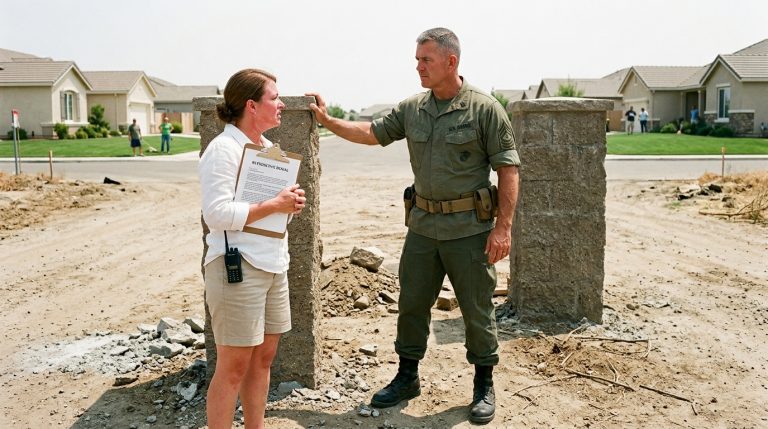
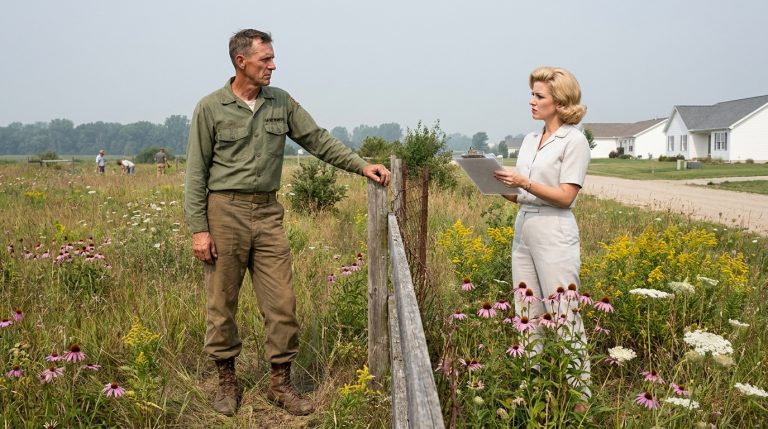
Brennan didn’t look at Bobby’s face. His eyes, sharp and predatory under the stiff brim of his utility cap, dropped immediately to the left shoulder of the denim jacket. The fabric there was pulled taut, the threads of the warp and weft unspooling into a white, fibrous fringe around a dark void the size of a coin. To Brennan, the tear was an insult to the dirt they stood on. It smelled of old trunks, stale tobacco, and the slow, greasy decay of an unwashed collar.
“You’re disrupting the rotation, sir,” Brennan said, the final word clipped so short it sounded like a bone snapping. He took two steps closer, his polished boots sinking an inch into the loose perimeter gravel. “My people are working on reflexive response. They don’t need an audience that looks like it just rolled out from under an overpass.”
Bobby didn’t pull his hands from the fence. His thumb traced the small loop of a rusted wire tie. “The form is good,” he murmured, his voice dry, carrying the flat cadence of the Montana plains. “The boy on the left—he’s favoring his hip. His lead foot is too shallow in the sand. If the other one catches his heel, he’ll go down on his spine.”
A few of the nearby instructors went quiet, the sudden silence rippling through the small crowd of spectators like oil on water. Brennan’s jaw bunched, the muscle shifting beneath the tanned skin of his cheek. He reached out, his thick index finger catching the loose white threads at the edge of Bobby’s shoulder tear, flicking the fabric with a hard, downward snap that made the old denim hiss.
“We don’t worry about spines here, old-timer,” Brennan whispered, his breath hot against the mesh of the fence. “We worry about results. You want to talk about form? Let’s talk about why you’re wearing something that belongs in a grease pit. A man who respects the uniform doesn’t walk around with a hole over his heart.”
The white thread came away in Brennan’s fingernail, a single strand of rotted cotton that smelled suddenly, inexplicably, of ancient mud and scorched copper.
Bobby didn’t blink. The yellow California light seemed to thin out, losing its warmth, turning into the pale, greasy glare of an overcast sky above the Demilitarized Zone. The hum of the fence didn’t stop, but the sound of the grappling Marines grew distant, replaced by the heavy, rhythmic thrum of a field generator struggling against the damp. Beneath his fingers, the galvanized steel didn’t feel like a fence anymore; it felt like the cold, wet rim of an empty ammunition crate.
CHAPTER 2: THE CALCULUS OF CLAY
The single strand of cotton parted with a soft, wet snap, but the sound in Bobby’s ears was the crack of a green bamboo stake splintering under a boot.
The California heat didn’t just fade; it curdled. The dry, dusty gravel beneath his old work shoes lost its sharp grit, turning slick and greasy, sliding into the heavy, unyielding red clay of Hill 861. The air in his throat became thick with the sour stench of damp burlap, diesel smoke, and the unmistakable, metallic tang of unwashed flesh that had lived in a hole for five days without sun. His fingers, still curved around what should have been the chain-link fence of the training pit, were now pressed hard against the splintered, grease-filmed edge of a discarded wooden mortar crate.
“Corporal. Kendrick.”
The voice wasn’t Brennan’s. It was lower, gravelly, worn thin by thirty hours without sleep and the constant, rhythmic thump of incoming 152-millimeter shells that rattled the teeth inside a man’s skull. Captain Marsh stood three feet away inside the command bunker, his utilities so encrusted with red mud they looked like they had been dipped in wet brick dust. The skin around the captain’s eyes was black with charcoal from the stove, an unsuccessful attempt to cut the glare of the white fog that rolled through the trenches every morning at dawn.
Bobby looked down at his own chest. The dark blue denim jacket—the one his father had bought him at the cooperative in Great Falls before he boarded the bus for Seattle—lay folded neatly on top of his field pack. It was the only clean thing left within forty miles of the Laotian border.
The field radio on the low sandbag ledge between them gave a violent, spitting hiss. It was the third time in ten minutes the frequency had drifted, choked by the high iron content of the surrounding ridges and the sheer volume of mortar fragments cutting through the wire antennas strung across the perimeter.
“Redcloud 6, this is Crazy Horse 3,” the handset rasped, the signal modulating wildly as if the speaker were shouting into a metal bucket. “We have… loss of structural… elements on the western slope. Pinned by heavy automatic fire from the draw. Simmons is down. Repeating, Simmons is down through the pelvis. We cannot suppress the bunker on the finger. Requesting… anything. Over.”
The background of the transmission wasn’t silent. Behind the ragged breathing of the operator, Bobby could hear the rhythmic, high-velocity thump-thump-thump of a Chinese-made .50-caliber machine gun firing in three-round bursts from the high grass. It was a methodical sound. A butcher’s sound.
Captain Marsh looked at the radio handset as if it were an adder coiled on the table. His right hand stayed tucked into the front of his flak jacket, his fingers twitching against the heavy nylon seam. He didn’t look at Bobby. He looked at the grease-pencil markings on the acetate-covered map pinned to the timber support behind the radio. The red circles—each one representing an identified NVA mortar pit in the valley below—overlapped until the paper looked like a map of a disease.
“Crazy Horse 3, this is Redcloud 6,” Marsh said. His voice was too quiet, carrying that terrible, artificial flatness that officers used when they were trying to out-think the dead. “We have zero visibility from the tower. The fog has the valley floor locked down. Air support is scrubbed until the ceiling lifts past three hundred feet. Artillery cannot clear the defilade without risking the perimeter wire. Do you copy? Over.”
The radio didn’t answer immediately. Instead, a heavy mortar shell landed somewhere near the western garbage pit, the low whump traveling through the floor logs and vibrating up into the soles of Bobby’s boots. A small stream of dry red clay trickled down from between two sandbags, landing directly across the clean collar of his folded denim jacket.
“We copy, Redcloud,” the radio whispered back. The panic was gone from the operator’s voice now, replaced by a cold, flat indifference that Bobby had seen twice before—once at Con Thien and once in the high grass near the river. It was the sound a man made when he realized the math had already been done, and his name was on the wrong side of the ledger. “We are down to two magazines per weapon. They are digging in on our eastern flank. We will… we will check back in when the sun comes up. Out.”
The static returned, a long, greasy roar that sounded like fat frying in a pan.
Marsh slowly dropped the handset back into its metal cradle. The leather strap of his helmet hung loose, framing a face that had gone completely grey in the light of the single kerosene lamp. He turned his eyes to the map, his thumb still working the seam of his flak jacket.
“Sixty-eight men left in the company, Kendrick,” Marsh whispered to the wall. “If I send thirty out there into that fog to pull six out of a draw, the North Vietnamese will have the eastern gate before the first stretcher gets back to the trench. They’re waiting for us to leave the holes. They’ve been waiting since Tuesday.”
Bobby didn’t answer with text from the manual. He reached down, his hands steady despite the low, rhythmic shaking of the bunker floor, and picked up the dark blue denim jacket. He shook it once, letting the red clay dust slide off the smooth fabric onto the dirt floor, then pulled it over his shoulders. The denim was still stiff, smelling of new dye and the dry timber of his father’s barn. It didn’t belong in the mud. That was why he wore it.
“I know that draw, sir,” Bobby said, his voice dropping into the same flat cadence he used when tracking sheep through the coulees behind the ranch. “I cleared the brush along that creek bed on Monday. The NVA aren’t dug into the rock yet; they’re using the elephant grass for cover because the soil is too loose for trenches. If a man goes out through the wire alone, they won’t waste an eighty-two-millimeter shell on him. They’ll think he’s a deserter or a scout who lost his unit.”
Marsh turned around, his eyes fixing on the small brass buttons of the jacket. “You won’t make fifty yards past the wire, Corporal. The minefield we laid on Wednesday hasn’t been mapped properly since the rain started. The clay is sliding. Half those M16 bouncing mines are sitting two feet lower than they were when the engineers armed them.”
“The water follows the old cattle path, sir,” Bobby said, his hand dropping to the receiver of his M16. “The mines won’t stay in the gravel. They’ll slide down into the swampy patch near the bamboo. If I keep my feet on the white rocks along the ridge, I’ll bypass the drift.”
The captain took a long, slow breath, the air whistling through his nose. He looked at the radio, then at the clean blue sleeve of Bobby’s jacket. For three seconds, the only sound was the grease pencil scratching against the acetate map as the staff sergeant in the corner updated a coordinate.
“There is no fire support, Kendrick,” Marsh said, his voice dropping an octave until it was barely louder than the radio’s hum. “If you get pinned in that draw, I am not turning the mortars toward you. I can’t risk the ammunition. Do you understand what I am telling you?”
“Yes, sir.”
“Then get your gear from the locker,” Marsh said, turning back to the map, his shoulders curving forward as if the sandbags above him had grown heavier. “And Kendrick… don’t leave them out there in the dark.”
Bobby didn’t say goodbye. He stepped out of the command bunker into the grey, greasy light of the trench, the wet fog immediately settling into the wool fibers of his collar like cold grease.
CHAPTER 3: THE HIGH CEILING
The first step outside the trench lip didn’t feel like a departure; it felt like sinking into a heavy, wool blanket that had been soaked in creek water and left to freeze. The grey mist didn’t just hang in the valley; it pressed down against the red clay hills like a physical shutter, shortening the world until the rusted barbs of the concertina wire ten yards ahead were nothing but jagged, charcoal smudges against the white.
Bobby kept his rifle tucked low under his armpit, the black plastic handguard cold and wet against the bare skin of his wrist. His utilities were already blackening around the knees where the moisture gathered from the low elephant grass, but the denim jacket remained dry across his shoulder blades, its stiff weave holding a thin layer of air against his spine.
To his left, the sandbags of the perimeter bunker looked like old lard tins stacked in the mud, their burlap covers rotting away in long, pale strings that waved slightly in the draft. A Marine he didn’t recognize—a kid with a fresh burn scar across his jawline—was sitting behind the sandbag tier, his shoulder pressed against the cold spade grip of an M2 machine gun. The kid didn’t say anything as Bobby passed. He just reached out with an oily rag, wiped a bead of yellow grease from the gun’s top cover, and then turned his eyes back toward the fog. There was no encouragement in the gesture, only the quiet, shared weight of men who knew that any noise louder than a breath belonged to the enemy.
The wire was a double apron, pinned down by iron pickets that had begun to lean into the soft earth under the weight of the rain. Bobby found the narrow gap near the drainage ditch—the single, unrecorded opening where the night scouts slipped through before the clouds came down. The ground here was different from the packed clay of the trenches; it was loose, red gravel that had slid down from the crest during Wednesday’s bombardment, mixed with small pieces of splintered pine and the sharp, chemical smell of burnt sulfur that never really lifted from the soil.
He paused, his boot hovering two inches above a flat, white stone that sat at the edge of the wash. The rock was slick with a thin skin of algae, but it was solid, anchored into the underlying limestone ridge.
“Watch the dip, Corporal,” a voice whispered from the darkness of the bunker behind him. It was the sergeant with the burn scar. He hadn’t moved his body, but his eyes were locked on Bobby’s feet. “The engineers were out there with the tripwire spools before the fog hit. They didn’t finish the rows. Some of the pins are just sitting in the weeds, waiting for a heel to catch the ring.”
Bobby nodded once without turning his head. He lowered his weight onto the stone, feeling the rock settle into the heel-groove of his boot with a tiny, wet crunch. The water in the ditch was running orange, thick with the clay of the upper trenches, carrying small bubbles of white foam that trapped the grease from the kitchen tents half a mile up the slope.
The silence out here was louder than the mortars. On the ridge, inside the holes, you could hear the breath of the next man, the click of a canteen cap, the dry scrape of a shovel against a root. Out past the wire, the only thing left was the sound of the mist hitting the denim of his sleeves—a tiny, thousands-fold pitter-pitter that sounded like sand being thrown against a windowpane.
He began to move along the edge of the limestone shelf, his body bent forward until his chin almost touched the cold steel of his rifle’s carry handle. Every five yards, he stopped, letting his left hand drift down toward the grass, his fingers checking for the greasy feel of a taut wire or the small, metallic nub of a pressure prong. The North Vietnamese were out there—he could taste them in the air, a faint scent of woodsmoke and dried fish that always lingered downwind of the draw—but they were invisible, trapped on the same grid of red clay and stone, waiting for the ceiling to lift.
His father had always told him that when you’re tracking in the brush, you don’t look for the deer; you look for the space the deer leaves behind. You look for the straight line that doesn’t belong in the trees, the grey patch that’s half a shade darker than the rock. Bobby kept his eyes three feet above the grass line, watching the pale fog for the silhouette of an entrenching tool or the specific, unnatural curve of a helmet rim.
A low, whistling grunt came from the draw below—the sound of an eighty-two-millimeter mortar tube being cleared with a swab. It was two hundred yards out, dead ahead, hidden behind the screen of split bamboo. The sound was transactional, ordinary. The crew wasn’t preparing a barrage; they were just cleaning the rust out of the iron before the rain rotted the seals.
Bobby dropped into a low crouch, his hip pressing against the cold, wet flank of a boulder that had been split in two by a previous strike. The stone was covered in a grey, fibrous lichen that came away in his fingernails like wet paper. He didn’t check his watch. The time didn’t matter out here; the only thing that kept the seconds moving was the slow, steady drip of the water from his cap brim onto the receiver of his weapon, each drop hitting the grey parkarized steel with a tiny, metallic ring that felt like a clock ticking inside his ear.
He reached up, his fingers touching the small brass button at the collar of his jacket. The metal was warm from his skin, the only piece of heat left on the mountain. He didn’t think about the six men behind the rocks in the creek bed; he thought about the way the timber smelled in the high barn when the snow was coming through the cracks in the roof—dry, clean, and far away from the mud.
The radio in the command bunker was miles behind him now, but the static seemed to stay in his blood, a low, buzzing hum that vibrated in the soles of his feet every time his boot touched the gravel. He took a long, slow breath through his nose, filtering the copper smell of the dirt, and then stepped off the limestone ledge into the high grass of the valley floor.
CHAPTER 4: THE GRASS AND THE IRON
The razor-sharp stalks of elephant grass closed over Bobby’s head with a dry, rhythmic hiss that sounded like a thousand small knives scraping against canvas. The slate-grey drizzle fell straight down through the green canopy, collecting on the stiff denim of his shoulders until the fabric grew heavy and cold, pinning his uniform shirt against his skin. Every movement was slow, deliberate, and bought with a physical price; the grass didn’t just yield, it dragged at his cartridge belt, caught the barrel tip of his M16, and left thin, white welts across the back of his bare hands.
He stayed on his stomach, his chest plowing through the soft, rotting layer of dead vegetation that carpeted the valley floor. The mud here tasted like copper and old zinc, a sour soup that filled his mouth every time he took a deep breath to quiet the pounding of his heart. He could feel the low, seismic vibration of the mortar pits further up the ridge—not a sound, but a trembling in his ribs that matched the cold trickling of water down his neck.
Five yards into the blind green mass, his left hand struck something solid and metallic buried beneath a layer of wet leaves. Bobby froze, his muscles locking instantly into an unmoving knot. His thumb remained hooked over the safety selector of his rifle, his right eye resting a half-inch above the mud-filmed receiver. He didn’t lift his head. He let his fingers trace the shape through the rotting mulch.
It wasn’t the rusted prong of a bouncing mine. It was a wire—thick, heavy, and insulated with a coarse, grey rubber that had begun to split from the damp. He pulled it gently toward himself, clearing away the wet earth with his fingernails. It was a communications line, but it didn’t belong to the company. The standard field wire running from Redcloud 6 to the forward listening posts was thin, braided copper wrapped in black vinyl. This wire was industrial, heavy-duty, and marked with a faint, repeating yellow stripe.
He tracked the line with his eyes, squinting through the dense, dripping stalks. The grey rubber wound through the roots of a wild banana tree, leading down toward the dried stream bed where Crazy Horse 3 had made their stand. Bobby’s throat went dry. A wire like this required a generator to feed it. It didn’t belong to a light infantry unit running a random ambush; it belonged to a fixed, structural outpost. The implication settled into his stomach with the cold weight of an iron slug: the North Vietnamese weren’t just maneuvering through the draw—they had been sitting here, connected and waiting, long before Captain Marsh ever drew the red circles on his acetate map.
He slid forward another two yards, his elbows digging into the red clay until his knuckles bled into the dirt. The grass began to thin, giving way to a scatter of dark, waterworn limestone boulders that marked the edge of the creek. Through the pale fringe of the stalks, he saw them.
The three walking wounded from Crazy Horse 3 were huddled inside a shallow recess beneath an overhanging rock ledge. Sergeant Kowalski was there, his back pressed against the stone, his left arm bound tightly to his ribs with a shredded green cravat that had gone completely purple with dried blood. His face was the color of skimmed milk, his lips cracked and flecked with white spit. Next to him, a lance corporal whose name Bobby couldn’t remember was trying to force a fresh magazine into his rifle, his hands shaking so violently that the steel box kept clicking against the magazine well without catching the latch.
Bobby crawled out of the grass line, his boots making no sound on the wet stone. He dropped down beside Kowalski, his shoulder touching the sergeant’s uninjured side. The smell under the ledge was terrible—shattered bone, old sweat, and the sharp, vinegar stench of infected flesh.
“Kowalski,” Bobby whispered, his mouth less than an inch from the sergeant’s ear. “The wire is open behind me. You take the two who can walk. Keep your boots on the white limestone shelf along the northern ridge. The mines have drifted down into the hollows. Don’t touch the weeds.”
Kowalski turned his head slowly, his eyes wide and vacant, the pupils dilated until they looked like two pools of black oil. He looked at Bobby’s denim jacket, his hand rising to touch the brass button at the cuff as if verifying that the old man before him was real.
“The radio,” Kowalski rasped, his voice a dry rattle that didn’t carry past the rock face. “They’ve got a line on us, Kendrick. They knew we were coming down the finger before we even hit the draw. Baker’s leg… it’s gone. Simmons is back there by the water. He’s too big to move. You can’t… you can’t carry him through that grass alone.”
“I’m going to try,” Bobby said, his hand coming down firmly over the lance corporal’s trembling fingers, stopping the dry click of the rifle magazine. He pushed the steel box home until the latch snapped with a clean, solid click. “Move now, Sergeant. Before the fog thins out and they look down from the ridge.”
Kowalski didn’t argue. He didn’t have the blood left for it. He used his good arm to drag himself up against the limestone wall, his teeth bared in a silent scream as his broken ribs shifted beneath the cloth. The other two Marines followed him, their movements heavy and mechanical, like men walking through deep water. They disappeared into the grey fringe of the grass without looking back, leaving nothing behind but a small pool of dark red water where Kowalski’s arm had rested.
Bobby waited until the rustle of their departure died out against the steady patter of the drizzle. Then he turned his eyes toward the deeper part of the draw, where the heavy grey wire vanished into the grey fog.
CHAPTER 5: THE RECKONING OF CONVOYS
The heavy grey wire vanishing into the mist didn’t break; it dissolved. The suffocating smell of infected flesh and wet elephant grass thin-filmed away, replaced instantly by the sharp, dry sting of hot rubber and pulverized quartz. The low, subterranean rumble in Bobby’s ribs escalated into a mechanical roar that spit gravel against his shins. The grey ridge of Khe Sanh snapped back into the chain-link perimeter of the Camp Pendleton training pit, the afternoon sun striking the galvanized wire mesh until it burned his retinas with a white-hot glare.
Gunnery Sergeant Tyler Brennan’s finger was still extended, his thick nail catching the loose white fringe of the shoulder tear, but his chest had stopped moving. The arrogant grin on his face had locked into a rigid, frozen mask.
Past the fence, three black Suburbans crested the gravel rise at a speed that forced the heavy chassis to dip violently on their suspensions. Their tires bit into the loose stone, throwing a spray of grey dust across the immaculate paintwork before they slammed to a halt in a synchronized line. The doors flew open with a heavy, metallic thud that sounded precisely like a mortar hatch dropping shut.
A colonel with a face the color of raw beef stepped out first, followed by a sergeant major whose chest was completely obscured by rows of ribbons, but Bobby didn’t look at them. His eyes went straight to the man emerging from the center vehicle.
Lieutenant General Marcus Hayes stepped onto the gravel, his three silver stars catching the direct glare of the noon sun. His face was a landscape of deep, weathered creases—the kind of skin that comes from thirty-five years of chewing desert sand and sleeping on frozen canvas. He didn’t look at the instructors. He didn’t look at the young Marines who had instantly snapped into rigid, breathless attention inside the sand pit. His gaze swept the perimeter until it locked onto the tattered denim jacket standing by the fence.
For two seconds, the training pit was entirely devoid of sound. The dust from the tires hung in the yellow light, drifting slowly between the vehicles and the men. Hayes walked forward, his polished boots making a rhythmic, deliberate crunch on the quartz gravel that echoed in the silence like a clock ticking down an execution. He didn’t stop until he was less than two feet from Bobby, directly in front of Brennan’s frozen hand.
The general didn’t speak. He drew himself up to his full height, his spine locking into an unyielding vertical line. His right arm came up in a salute so sharp, so flawlessly precise, that the starched fabric of his sleeve gave a distinct thwack against his side. It wasn’t the casual, perfunctory salute given to a superior officer in a hallway; it was the heavy, reverent salute reserved for things that couldn’t be bought with a rank or a promotion.
“Mr. Kendrick,” Hayes’s voice boomed across the sand, the volume carrying the flat, unyielding authority of a command bunker. “Sir, it is an honor.”
Bobby felt his shoulder blades tighten against the stiff denim of his jacket. The world seemed to wobble between the two realities—the young general before him and the captain who had sat in the mud fifty-five years ago counting the dead on an acetate map. He raised his right hand slowly, his calloused fingers coming up to the brim of his faded cap in a quiet, loose return of the courtesy.
“Michael,” Bobby murmured, his voice dry and flat, barely lifting above the sound of the wind through the chain-link fence. “You didn’t need to bring the whole county out here for a look.”
Brennan’s hand had dropped to his seam, his fingers trembling against the starched crease of his utilities. Every drop of color had drained from his throat, leaving his skin a pale, greasy grey that matched the zinc coating of the wire he had just used to mock the old man. He stared at the general, then at the frayed hole over Bobby’s heart, his mouth opening slightly as if his lungs had suddenly run out of air.
The general lowered his hand, his eyes shifting from Bobby to the gunnery sergeant. The reverence vanished from Hayes’s face, replaced instantly by a cold, structural fury that made the colonel behind him step back an inch into the dust.
“Gunnery Sergeant Brennan,” Hayes said, his voice dropping into a low, transactional whisper that was far more dangerous than a shout. “You have exactly thirty seconds to explain to me why your hand was on this jacket before I have the military police remove you from this sector.”
CHAPTER 6: THE WEIGHT OF THE GHOST
Gunnery Sergeant Tyler Brennan’s knuckles didn’t just turn white; the skin across his fingers split into tiny, bloodless seams under the pressure of his locked posture. His jaw remained open by a fraction of an inch, a small, silver string of saliva catching the direct midday light before drying in the dry wind that blew off the fire pits. He stared at the third star on General Hayes’s collar—not the man, but the sharp, beveled edge of the metal star itself—as if looking directly into the sun.
“Sir,” Brennan whispered. The word didn’t leave his throat with its usual brassy resonance; it came out like a wet rag being dragged across flat stone. His eyes darted once to the left, toward the sand pit where sixty young Marines had completely ceased their grappling, their bodies frozen in mid-stride like statues left out in the desert to dry. “The… the civilian was standing inside the safety perimeter, sir. I was merely… establishing identity under the protocol.”
“The protocol,” General Hayes repeated. He didn’t raise his voice. He stepped sideways, his heavy leather boot heel crushing a white quartz pebble into grey powder with a sharp, dry pop. His shadow fell directly across Brennan’s face, blocking out the sun and leaving the gunnery sergeant in a cold, blue shade that smelled faintly of starch and old gun oil. “You think you’re enforcing the protocol, Sergeant? You think this base belongs to your rotation schedule?”
The general turned his back on Brennan, his posture shifting until he stood parallel to the wire mesh fence, his shoulder almost touching the white fringe around Bobby Kendrick’s jacket tear.
“Marines,” Hayes’s voice expanded, striking the concrete retaining walls of the pit and bouncing back in a sequence of sharp, flat echoes. He didn’t look at the kids in the sand; he looked through them, his eyes fixed on the pale blue horizon where the mountains met the ocean. “Look at this man. Look at the jacket you’ve been using to test your vocabulary for the last fifteen minutes.”
A collective rustle—the sound of sixty utility blouses shifting against web belts—passed through the training area before settling back into a vacuum.
“You’re looking at Chief Warrant Officer Robert Kendrick,” Hayes said, his words dropping like iron blocks into the dirt. “Retired. But fifty-five years ago, down in the red clay of Kang Tri Province, the men who were dying inside the wire didn’t call him by a rank. They called him the Iron Ghost. And they called him that because every time the mortars cut the signal lines and the sky went completely black with eighty-two-millimeter iron, he was the only thing that kept coming back through the wire.”
Bobby didn’t move his hands from the galvanized tie. His thumb remained nestled against the cold zinc loop, his eyes watching a small black ant crawl along the lowest strand of the apron. His face was entirely devoid of triumph. The name Iron Ghost didn’t sound like a title to him; it sounded like the name of a sickness he’d spent half his life trying to scrub out of his skin with well water and laundry soap.
“January twenty-fourth, nineteen-and-sixty-eight,” Hayes continued, his voice taking on that flat, rhythmic cadence used for reading casualty lists in the rain. “A six-man reconnaissance element from Fifth Marines was boxed into a limestone draw two hundred meters past the wire at Khe Sanh. They had three dead on the gravel. They had three critical under the rocks. Their captain did the math—he had eighty men left to hold a perimeter against two regiments of regulars. He closed the logbook. He said the rescue was scratched.”
The general stopped. He reached out and touched the ragged, coin-sized hole near Bobby’s left shoulder, his calloused thumb tracing the pale white threads where Brennan had just pulled the stitch.
“This man didn’t care about the logbook,” Hayes whispered into the silence. “He went out through the apron alone. He crossed two hundred yards of shifting clay while the NVA were adjusting their brackets by the second. He navigated an unmapped minefield by tracking the white rocks along the limestone ridge. He reached the draw. He sent the walking wounded back through the weeds, and then he stayed behind with the three who couldn’t lift their own flak jackets.”
Brennan’s knees gave a small, horizontal twitch, his boots sliding half an inch into the loose stone of the perimeter walkway. He looked down at his own polished toe caps, his chest heaving with a shallow, panicked rhythm that made the ribbons on his utility blouse click against his brass snaps.
“Three trips,” Hayes said, his voice rising until it hit the high galvanized roof of the kill-house behind them. “Two hundred yards each way. He carried Rodriguez—a hundred and sixty pounds with a sucking chest wound. He came back for Baker, whose leg was sitting in the mud by the creek. On the third trip, he went after Simmons. Simmons was a lineman from Ohio, two hundred and ten pounds of bone and muscle with a shattered pelvis. Halfway through the grass, the third bullet caught Kendrick through the side, exiting his lower back. He didn’t drop the man. He walked him into the medical bunker on his knees.”
The general took his hand off the denim, his eyes returning to Brennan’s face with the weight of a physical blow.
“The captain told him never to sew that hole,” Hayes said, his teeth showing white against his tanned lips. “Because some things aren’t supposed to heal clean, Gunnery Sergeant. Some things are supposed to stay open so you remember what the skin costs. For those six hours, Corporal Kendrick was awarded the Medal of Honor. But he didn’t put it in a case on his wall. He didn’t bring it to the veterans’ breakfast to get his coffee paid for. He went back to Montana, bought a team of horses, and spent forty years clearing stones out of a pasture.”
The silence returned, but it wasn’t the empty quiet of an afternoon; it was the dense, suffocating silence of an old room where someone had just dropped an iron stove through the floor. Brennan looked up slowly, his eyes wet and wide, the skin around his nose twitching as if he were trying to catch a scent that had already gone.
“Sir,” Brennan’s voice broke, the sound high and dry like a dead branch snapping in winter. “I… I have no excuse, sir. I didn’t know the… I didn’t know the architecture of the jacket.”
“You didn’t know anything,” Hayes said, turning his head back to Bobby, his face softening by a fraction of a degree. “Robert, the colonel will clear the car. We’ve got the private briefing in the logistics hangar at thirteen hundred. You don’t need to stand here in the dust with these kids.”
Bobby let go of the fence. The wire gave a tiny, metallic twang as his fingers left the steel, the vibration dying out quickly against the posts. He reached down and pulled the hem of his denim jacket straight, his thumbs settling into the empty pockets of his cargo pants.
“They’re not kids, Marcus,” Bobby said, his voice low and flat, holding the quiet weight of the Montana soil. “They’re just working the sand. Let the sergeant get back to his rotation. He’s got a boy with a shallow heel out there who needs to learn how to stand before the wind changes.”
CHAPTER 7: THE ARCHIVE OF SCARS
The small black ant vanished into the lower seam of the chain-link fence as Bobby turned his back to the wire. The heat rising from the sand pit didn’t drop; it flattened out, turning into a stagnant, grease-scented weight that clung to the stiff cotton of his denim collar. Two yards ahead, Gunnery Sergeant Tyler Brennan remained anchored to the gravel walkway, his ribs expanding in short, ragged jerks beneath his starched utility blouse. The silence of the sixty young Marines inside the pit was absolute, a heavy, unmoving ring of eyes that watched the silver insignia on the general’s shoulders as if waiting for a flare to go up.
“The driver has the rear door open, Robert,” General Hayes said, his voice dropping into a low, conversational rumble that didn’t carry past the front bumper of the leading Suburban. He reached up, his leather-gloved fingers giving the starched brim of his utility cap a sharp, downward tug. “The colonel’s already radioed the logistics hangar. We can bypass the main gate entirely.”
Bobby didn’t look at the black vehicles. His eyes stayed on the white fringe of his left shoulder, where the rotted cotton thread Brennan had yanked was still fluttering in the hot draft from the kill-house generators.
“The hangar can wait five minutes, Marcus,” Bobby said, his cadences falling into that slow, unhurried rhythm he used when checking the water troughs along the northern line of his pasture. He turned his boots toward the concrete ledge where the instructors kept their water cans and clipboards. “The boy here hasn’t finished his lesson. You don’t leave an arm-bar instruction half-set in the dirt. It gives the kids the wrong idea about the leverage.”
Brennan didn’t lift his chin. His eyes stayed fixed on the dry quartz pebbles at his toes, his thumbs tucked so tightly into his trouser seams that the fabric was pulled into white, horizontal wrinkles across his thighs.
Before Hayes could answer, the colonel from the lead vehicle took three rapid steps toward them, his leather clipboard clutched against his ribs like a shield. “General, the staging area just called through the net. The secondary convoy from the division headquarters has a blown hydraulic seal on the main low-boy trailer near the intersection. They’re blocking the narrow part of the perimeter road. It’s going to be twelve to fifteen minutes before the clearing team can skid the chassis off the asphalt.”
Hayes’s jaw bunched into a hard, white knot beneath his tanned skin. He looked at his watch, then turned his gaze slowly back toward Brennan. “Then we wait right here in the shade. Gunnery Sergeant, pick up your clipboard.”
Brennan’s body gave a slight, spasmodic jerk before he moved. He bent at the waist, his movements stiff and mechanical, and retrieved the heavy aluminum board from the wooden bench. His fingers were shaking—not with the loose tremble of fear, but with the dense, structural vibration of a young horse that had been run into a fence. He didn’t look at Bobby; he looked at the blank green margin of the training log sheet pinned to the metal clip.
“Sir,” Brennan whispered, his throat catching on the dry air. “The lesson was… we were completing the third phase of the close-quarters defensive rotation. The next block is the historical perspective. The module requires… it requires an introduction to the doctrine of asymmetric survival.”
Bobby walked over to the bench, his old cargo pants making a soft, scraping sound against the treated timber as he sat down. He didn’t take off his faded cap. He let his hands settle on his knees, his palms flat against the soft, threadbare denim that had gone white at the joints from forty years of grease and lime dust.
“You’ve got the wording wrong on that log, son,” Bobby murmured, his eyes following the white glare of the sun across the metal clipboard. “It isn’t asymmetric survival. It’s just the room you have left when the math stops working. When the captain closes the book and says the helicopter isn’t coming because the fog has the ridges locked, you don’t have a doctrine. You just have the man next to you who’s leaking into the clay.”
The young Marines in the sand pit shifted, their boots making a thousands-fold rustle that sounded like dry grass moving ahead of a fire. One of them—the corporal with the fresh haircut who had called out from the fence earlier—took half a step forward, his chin tucked into the front of his flak jacket, his eyes locked on Bobby’s tattered sleeve.
“The wire I found in the draw,” Bobby continued, his voice dropping into that quiet, flat tone that made even General Hayes stand still in the dust. “The heavy grey line with the yellow stripe. It didn’t belong to a patrol. It was a main trunk line from the regimental headquarters down in the valley. The NVA hadn’t just ambushed Crazy Horse; they’d been sitting under that bamboo with headsets on for three weeks, listening to our command net drift every time the humidity hit ninety percent. They knew the red circles on the captain’s map before the ink was dry.”
Brennan’s chin lifted by an inch. He looked at Bobby’s face—not with the predatory assessment he’d used ten minutes ago, but with a wide, hollow stare that seemed to be trying to find a straight line in a landscape that had gone completely grey.
“The hole here,” Bobby said, lifting his left thumb until it rested just below the frayed edges of the denim tear. “That wasn’t from a sniper. The sniper was three hundred yards back on the finger, using an old Russian piece that spit lead sideways when the barrel got hot. The round that made this hole came from a three-and-a-half-inch rocket fragment that hit the limestone boulder while I was dragging Simmons through the grass. It took the button right off my collar and left a smell of scorched zinc in my hair that didn’t go away until I was back in San Diego.”
He paused, reaching into his pocket and pulling out a small, circular piece of dull grey metal—not a medal, but an old copper ground-nut from a field telephone box, its edges worn smooth from decades of being turned over between his fingers in the dark.
“You teach them how to drop a man on his spine, Gunny,” Bobby said, his eyes meeting Brennan’s with the quiet, unblinking clarity of an old mirror. “That’s fine. That keeps the blood moving while they’re twenty years old and the sun’s out. But you tell them that when the skin starts to cost something real, the uniform doesn’t do the lifting for you. The uniform just holds the mud together while you’re trying to find a reason to take the next step.”
The general didn’t interrupt. He stood by the front fender of the Suburban, his arm resting on the black enamel, his fingers tracing a faint scratch in the clear-coat while the radio inside the cab gave a low, rhythmic hiss of clearing codes.
CHAPTER 8: THE KINTSUGI COWL
The small, circular piece of dull grey metal made no sound as Bobby shifted it from his right thumb to his palm. The coarse, sand-scented air of the Pendleton staging area had long since cleared from his lungs, but the habit of turning the metal over—feeling the specific, microscopic burrs left along the thread line by an entrenching tool fifty-five years ago—remained.
Through the clear pane of the Oceanside coffee shop window, the late afternoon sun was dropping toward the water in a long, desaturated slant of amber. It was the kind of light that didn’t burn; it just picked out the frayed edges of things—the worn wood of the table, the pale rings left by old porcelain mugs, and the fine white fringe surrounding the quarter-sized hole on his left shoulder.
A shadow broke the light across the table.
Gunnery Sergeant Tyler Brennan stood in the aisle, his civilian shirt simple and dark, his posture stripped of the rigid, performing theatricality of the training pit. He wasn’t looking at Bobby with a calculator’s eye anymore. He was holding a thick manila folder under his left arm, his thumb hooked into the cardboard seam to keep it from slipping.
“Mr. Kendrick,” Brennan said. His voice was lower now, holding the quiet, flat tone of a man who spent his mornings in the archives looking at old microfiche under a green lamp. “The girl at the counter said you usually sit by the radiator. Mind if I take the bench?”
Bobby didn’t lift his hand from the grey telephone washer. He nodded once, his fingers sliding the metal piece back into the shallow pocket of his cargo pants. “Sit down, son. The coffee’s still hot enough to taste the tin.”
Brennan sat, his movements deliberate, his heavy shoulders dropping forward as he placed the folder on the scarred wood between them. He didn’t offer a dramatic speech or an engineered apology. Instead, he reached out and turned the folder around so Bobby could see the stenciled lettering on the tab: PROJECT COHORT – THE KENDRICK STANDARD.
“The colonel signed off on the final manual yesterday morning,” Brennan said, his eyes resting on the soft weave of Bobby’s sleeve. He reached down and opened the cover, revealing three thick rings of black-and-white printouts—not lists of combat tactics, but copies of after-action logs, names of linesmen from 1968, and maps of the limestone shelves where the clay used to slide. “We ran the first platoon of instructors through the module on Tuesday. I didn’t teach them the takedown sequence first. I made them sit in the dark for forty minutes with the field radio net recording from the third day of the siege.”
Bobby looked down at the first page. His eyes didn’t track the official text; they caught a small photocopy of a hand-drawn schematic in the margin—the exact layout of the wire apron near the northwestern gate, marked with Captain Marsh’s tiny, crabbed handwriting.
“The boys need to know about the wire, Tyler,” Bobby murmured, his thumb tracing the pale ring left by his coffee mug on the wood. “They think a transmission is just something that happens through the air. They don’t understand that someone had to carry the spool through the grass on their knees to keep the line from grounding out in the mud.”
“I found the logistics logs from the depot,” Brennan said, his finger tapping the bottom of the page. He didn’t look up; his focus was entirely centered on the physical proof of the record. “Layer two wasn’t in the citation, Mr. Kendrick. The general’s personal file had the unedited transcript from the medical bunker. The fragment from the rocket didn’t just take the button off your collar. The reason that hole never closed up—the reason it stays grey—is because when the three-and-a-half-inch shell took out the generator line, you didn’t leave the core line in the dirt. You wrapped the bare copper wire around the brass snap of your collar to hold the circuit together while you were dragging Simmons up the ridge.”
Bobby’s fingers stopped moving against his knee. The pale yellow light from the window seemed to settle into the frayed threads of the denim, turning the white fringe almost silver in the cold draft from the door.
“The copper leaves a green mark in the skin if you don’t scrub it with lye,” Bobby said, his voice flat, carrying the immense, unhurried distance of the Montana hills. “Simmons was heavy. If the net went dead, the captain wouldn’t have known which side of the limestone shelf to work with the mortars. The wire had to stay live.”
Brennan took a slow breath, the folder beneath his hands completely steady. “The antagonist isn’t the mud, sir. I spent six months looking at these coordinates. I thought I knew what an instructor’s job was. I thought if a man looked shabby, it meant he’d let the standard slide. But you didn’t let anything slide. You just kept the wire in your shirt.”
He closed the folder with a soft, clean thwack of cardboard. The confrontation from half a year ago didn’t exist as a weapon between them anymore; it had become a joint between two pieces of timber, held together by the simple friction of the truth.
Bobby reached down, his calloused thumb finally catching the loose edge of the denim tear. He didn’t pull the thread. He smoothed it down against the dark blue fabric, his skin rough against the old cotton. “The fact that you went into the basement to find the names of those linesmen—that’s what matters, son. That takes a different kind of leverage. It’s easy to be strong when the sun’s out and everyone’s watching the sand pit. It’s harder when you’re looking at an old piece of paper in the dark, trying to figure out why a man’s coat is torn.”
He lifted his coffee mug, the cracked ceramic cool against his palm, and held it out toward the center of the table.
Brennan looked at the mug, then reached down and lifted his own thick stoneware cup, bringing the two rims together with a tiny, muted click that didn’t carry past the windowpane. The sun had finally dropped below the line of the pier, leaving the street outside in a deep, atmospheric purple, but inside the booth, the heat from the radiator kept the space between them completely clear.
“To the wire, Gunny,” Bobby whispered.
“To the wire, sir,” Brennan replied.