A Strategist’s Quiet War: The Methodical Dismantling of a Suburban Tyrant Through Law and Measured Precision
CHAPTER 1: The Perimeter Check
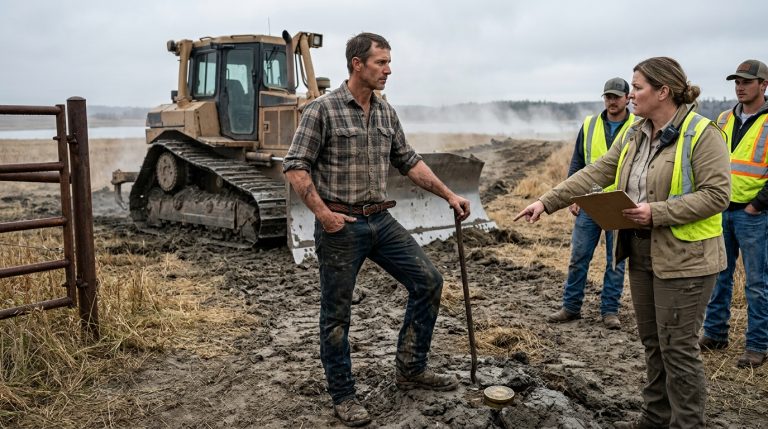
The clipboard hovered in the air between us like a white flag of war, though she clearly mistook it for a scepter. Karen Henderson was a woman built of rigid lines and pressurized air, her floral blouse strained to the point of structural failure as she delivered her ultimatum.
“Article 7, subsection C,” she recited, her voice a sharp, clipped cadence. “Community improvement area alpha. Your use of this parcel is terminated, Mr. Davies.”
I looked past her, toward the two figures standing a few paces back—Bob, with his permanently affronted expression, and Linda, whose silence was a weapon she hadn’t quite learned to aim. The wind pushed against the tall grass of the hilltop, a rhythmic, whispering sound that seemed to mock the stillness of their intrusion.
My mind didn’t jump to anger. It jumped to the math.
I looked at the notice she had thrust toward my chest. The paper was crisp, high-gloss, and entirely irrelevant. It was a bluff designed to solicit a reaction, a frantic need to see me scramble. She wanted the “crazy veteran” narrative; she wanted me to yell, to draw a line in the dirt, to give her the ammunition she needed to claim I was a danger to the aesthetic order of her beige kingdom.
I folded the paper. The sound was microscopic in the vast silence of the hill.
“Noted,” I said. My voice was a flat, level surface, devoid of the jagged edges she was fishing for.
Karen’s smile didn’t reach her eyes. It was a brittle, painted-on thing, faltering as she processed the lack of friction. “That’s all? We are talking about eminent domain, Davies. You don’t get to just ‘note’ this.”
“I am currently noting that you are standing three feet past my property line,” I said, pointing toward the rusted fence post half-hidden by the brambles. “And I am noting that your presence here is an unrequested service.”
Bob puffed his chest, but he didn’t move forward. He looked at the grass, then at me, then at the horizon, his gaze finally skittering away when I held it for a beat too long.
“The surveyors will be here on Monday,” Karen said, her composure snapping back into place like a tightly coiled spring. “Eight hundred hours. Do not interfere, or the sheriff will be involved.”
“Understood,” I said.
She turned on her heel, her acolytes trailing like pilot fish, and marched back toward the pristine asphalt of the development. I watched them until they were mere silhouettes against the groomed lawns.
The battle wasn’t beginning; it had started five years ago, the moment I signed the first page of the project binder in my office. She had marched her army into a killbox she hadn’t even bothered to map. I turned toward the farmhouse, my mind shifting into the cold, methodical hum of an engineer at work.
The hilltop remained silent, save for the breeze. But as I glanced at the oak tree under which Sarah’s ashes rested, I noticed a fresh, jagged tire track cut into the dirt near the entrance—a clear, deliberate encroachment. I pulled out my phone and took a photo, the image timestamped in the low, cooling light.
The first error was documented. The trap was set.
CHAPTER 2: The Command Center
The farmhouse felt different once I stepped inside. It was no longer just the sanctuary I had retreated to after the gray, sterile halls of the Pentagon; it was now a forward operating base. I locked the heavy oak door behind me, the sound of the deadbolt sliding home echoing with a finality that felt like the cocking of a firing pin.
I didn’t turn on the overhead lights. Instead, I navigated the familiar contours of the living room by memory, my boots sounding hollow against the hardwood. The scent of aged paper, floor wax, and the ghost of Sarah’s lavender perfume greeted me—a sharp, sudden spike of grief that usually would have grounded me, but tonight, it served as a catalyst.
I walked into the office. This room was a library of a different kind. Shelves stretched from floor to ceiling, not filled with novels, but with structural manuals, topographical surveys, and the dense, technical histories of the Corps of Engineers. I flicked on the desk lamp, a focused beam of amber light that carved a circle out of the shadows.
I sat down, the leather of my chair creaking—a sound that reminded me of the old Jeep I’d driven in the valley of the Kunar Province. That was twenty years ago. The terrain was vastly different, but the fundamental reality of conflict remained the same: control the high ground, maintain your logistics, and never, ever underestimate the enemy’s capacity for overextension.
I pulled the 1923 deed from the top drawer of the roll-top desk. The paper was brittle, yellowed to the color of dried wheat, and carried the faint, metallic scent of oxidation. I smoothed it out across the mahogany surface, the friction of my palm against the parchment vibrating through my nerves. It was a single, indivisible parcel. Indivisible. A word that held the weight of granite.
The HOA’s notice, the glossy, pretentious document that Karen had thrust at me, lay to the left of the deed, a stark contrast in quality and intent. It was thin, disposable, a piece of performance art masquerading as law.
My gaze shifted to the corner of the room, to the fireproof safe hidden behind a shelf of historical journals. I stood, my knees popping, and crossed the room. I spun the dial—three right, two left, one right. The mechanism clicked, a precise, satisfying sequence. I pulled the heavy door open, revealing the thick three-ring binder labeled Project Sunset VZW.
The memory hit me then, unbidden. It was five years ago, shortly after the funeral. I had been sitting in this exact chair, the silence of the house pressing against my eardrums until it was almost physical. A representative from Verizon had been sitting across from me, his suit too tight, his eyes too bright, pitching the hilltop as a “strategic asset.” I had wanted to throw him out. I had wanted to tell him that no amount of money could turn Sarah’s sanctuary into a conduit for digital noise.
But then, he had laid out the maps. He had shown me how, with proper design, the tower could be hidden—camouflaged, integrated into the treeline, a sentinel rather than a scar. He spoke of the infrastructure, the underground fiber optics, the long-term protection of the acreage. He spoke of legacy. He understood, in his corporate, bottom-line way, that land like this needed a shepherd, or it would inevitably be cannibalized by the creeping gray of development.
I sat back down at the desk and opened the binder. The contents were pristine. It was an ironclad contract, a masterpiece of corporate legal engineering that had been vetted by the sharpest minds in the industry. It didn’t just grant access; it mandated protection. And it included the penalty clauses—the teeth that Karen would never see coming.
I took a fresh legal pad and a smooth-writing fountain pen. I didn’t write as a man who was angry; I wrote as a man who was building a structure. I divided the page into three columns: Intelligence, Fortification, and Counter-Offensive.
Intelligence: Need the HOA’s historical records. Financials, meeting minutes, the trail of the landscaping contracts.
Fortification: Secure the access road, documentation of the property boundaries, and a surveillance log.
Counter-Offensive: Await the first legal misstep. Do not engage. Let the enemy expose their flank.
I checked the timestamp on my phone again—the photo of the tire track on the hill. It was a petty act of vandalism, a small, vindictive scratch on the dirt. Karen thought she was marking her territory. She didn’t realize she was marking the evidence for an attempted grand larceny charge.
My hand moved across the paper, the rhythm of the pen steady and sure. I remembered the feeling of building bridges in places where the ground wanted to swallow everything you placed upon it. It was about patience. It was about waiting for the earth to settle before you laid the foundation.
I looked at the framed photograph of Sarah on the desk. She was smiling, that quick, bright expression she used when she knew I was overthinking a project. I felt a pang of longing, but it was buffered by the cold, clear purpose of the task ahead. This wasn’t about the tower. It wasn’t even about the land. It was about the fact that she had chosen this place, and I was going to ensure that her choice remained undisturbed.
I reached for the phone. It was time to start gathering the data. The HOA’s website was a disaster, a porous, poorly defended relic of the early web. A few months ago, Mrs. Gable, a neighbor who had realized Karen was more of a dictator than a president, had mentioned she couldn’t remember her login to the members-only archive. I had helped her recover it. It was a simple matter to access the archive now, to begin the systematic download of every budget, every board meeting, and every newsletter back to the start of Karen’s tenure.
The computer hummed as the data transfer began—a steady stream of digital evidence pouring into my local drive. Karen had spent years documenting her own ascent to power, and now, that archive would serve as the roadmap for her collapse.
I leaned back, the leather of the chair groaning under the weight. The night was quiet, but the air in the room felt ionized, charged with the latent energy of the coming conflict. I wasn’t fighting for land anymore. I was fighting for the integrity of the truth. And in a world of beige veneers and false authority, truth was the heaviest thing I owned.
CHAPTER 3: The First Probe
The silence of the house was shattered at exactly 08:00 by the low, guttural rumble of a diesel engine. I was already on the porch, a steaming mug of black coffee in my hand, watching the white utility truck pull to a halt at the edge of my drive. The logo on the door, Precision Land Services, caught the morning light. It was a clean, professional design, but it felt like a stain on the landscape.
I didn’t move. I didn’t set the mug down. I simply watched as the two men exited the vehicle. They were draped in safety vests that looked far too bright for the muted, earthy tones of the Virginia hills. They moved with the tentative gait of workers who knew they were in an ambiguous zone—somewhere between public thoroughfare and private domain.
The younger one, the one who looked like he’d been doing this for all of three years, grabbed a tripod and a transit from the truck bed. He glanced toward the farmhouse, his eyes locking onto mine for a fraction of a second before he quickly looked away, feigning sudden interest in a fence post.
I took a slow, measured sip of the coffee. It was hot, bitter, and grounding. I could feel the weight of the phone in my pocket—the repository of Karen’s digital hubris now safely encrypted—but I needed to handle the physical intrusion first.
I set the mug down on the porch railing with a soft, deliberate click. It was a small sound, but in the quiet morning air, it carried the weight of a gavel.
I walked down the steps. My boots crunched against the gravel, the sound rhythmic and steady. I didn’t rush. I didn’t carry a weapon. I simply closed the distance, my posture relaxed but observant, my eyes tracking the subtle shifts in their body language. The younger surveyor stopped, his hand hovering over the tripod. He saw me coming and froze.
“Morning,” I said. My voice was pitched low, calm, lacking the defensive edge they were undoubtedly braced for.
The surveyor cleared his throat, his professional mask sliding into place. “Morning, sir. We’re with Precision Land Services. We have a work order for the hilltop. Utility site survey.”
He held up the clipboard. I didn’t look at it. I looked at the gear—the precise, expensive tools of a trade that was being weaponized against me by someone who couldn’t read a topographical map if her life depended on it.
“Rick, is it?” I asked, recalling the name on the work order I’d glimpsed from the porch.
His eyes widened slightly, surprised by the direct address. “Uh, yes, sir.”
“Rick, before you put that transit on the ground, I need you to ask yourself a question. Did your office run a title search on this parcel, or did they just take a verbal ‘all-clear’ from the HOA president?”
Rick hesitated. It was a short, sharp silence that told me everything I needed to know. He looked back at his partner, who was still by the truck, watching us with a mixture of boredom and growing unease.
“Ms. Henderson said it was community property,” Rick said, his voice losing its professional gloss. He was defensive now, shifting his weight. “We have our orders, sir. If we don’t do the survey, we don’t get paid. It’s not our fight.”
“It becomes your fight the moment you cross that property line,” I said. I kept my voice flat, professional, the same tone I used when briefing a junior officer in a restricted zone. “This is the Davies family land. It was carved out of the original subdivision plat in 1988. It is not part of the Oakidge HOA. If you proceed, you are committing criminal trespass. If you disturb the soil, you are potentially liable for civil damages.”
I wasn’t raising my voice. I was merely laying out the physics of the situation.
“I have the deed here, Rick. I have the county plat maps. I have a direct line to the county sheriff’s dispatch,” I said, gesturing toward the house. “You’re a professional. You know that a work order from a homeowners association doesn’t override a recorded deed. You’re being used as a wedge in a dispute you have no stake in.”
Rick looked at his tripod, then at the access track that wound its way up to the summit—to the stand of pines where the truth was hidden in plain sight. He was calculating the cost of the job versus the cost of a legal headache.
“She told us there wouldn’t be any trouble,” he muttered, his frustration leaking through his mask.
“She told you that because she’s not the one who will be standing in front of a magistrate,” I replied.
I saw the partner walk over from the truck. He looked at me, then at the gear, and then at the long, lonely stretch of the drive. “Rick, we’re not paid enough for a trespassing charge. Let’s just pull it.”
Rick looked at me one last time. There was no hostility in his expression anymore, just the weary resignation of a man who realized he’d been sent to fight a ghost.
“We’re going to head back to the office, sir,” Rick said, his voice formal again. “We’ll let them know there’s a dispute regarding the property status.”
“That would be the prudent course of action,” I said.
I turned and walked back toward the porch, the gravel crunching under my boots. I didn’t look back to see them pack up the tripod. I didn’t need to. I heard the tailgates slam shut, the engines turn over, and the slow, deliberate crunch of tires retreating back toward the asphalt of the subdivision.
I sat on the porch steps, the cold iron of the railing biting into my palm. The first probe had been repelled, but the quiet of the morning had been irrevocably altered. I could sense the ripple effect already—Karen would receive the news within the hour. She would be livid. She would escalate.
My mind returned to the binder in the office. The infrastructure was safe for now, but the battle had shifted from a theoretical threat to a physical engagement. I took a deep breath of the morning air, watching the mist cling to the valleys below. It was time to reach out to David. If she was going to escalate, I needed to make sure that when she finally hit the wall, she’d be moving fast enough to break.
CHAPTER 4: The Intelligence Gatherer
The phone in my pocket continued its steady, insistent pulse, a jarring rhythm that cut through the lingering silence of the morning. I pulled it out. The caller ID showed Mrs. Gable. She was a woman who didn’t call unless the perimeter had been breached.
“Colonel,” she began, bypassing pleasantries. Her voice was thin, brittle as dead leaves, yet possessed of a quiet, razor-sharp intensity. “I hope I’m not interrupting, but I’ve been digging through the digital archive you helped me unlock. There are things here—financials that don’t add up.”
I leaned back against the porch railing, looking out toward the hilltop. The surveyors were gone, but the threat remained, shifted now into a more insidious terrain. “I’m listening, Eleanor.”
“It’s the landscaping contract,” she said, her voice dropping to a conspiratorial whisper. “The one with ‘Lawn and Order’. I cross-referenced the state business filing. The registered agent isn’t a third-party service; it’s Gerald Henderson. Karen’s husband.”
I felt a cold, mechanical satisfaction settle in my chest. It was the missing gear in the clockwork—the confirmation of self-dealing. “Are you certain, Eleanor?”
“I’m looking at the Secretary of State’s printout right now. They formed the LLC two months after Karen was elected president. They didn’t even try to hide it well. They just got arrogant.”
“You’ve done good work,” I said. “Keep that document secure. Do not mention this to anyone else. If Karen finds out someone is tracking the financials, she’ll scrub the site.”
“I’ve already made physical copies,” she replied, a hint of steel in her tone. “I’m not a grandmother, Mark. I’m a neighbor who’s tired of being treated like a tenant in my own home.”
We hung up, and I stared at the phone. The strategy was no longer about defending my hilltop; it was about systematically dismantling the foundation upon which Karen’s authority was built. I went back into the office. The computer monitor was still glowing, the file tree of the HOA’s history waiting like an open wound.
I began to stitch the pieces together. The inflated costs, the lack of competitive bids, the sudden influx of funds into the Henderson household account—it was a pattern of behavior, a blueprint of a small-time criminal enterprise operating under the guise of suburban maintenance.
But I needed more than just the landscaping fraud. I needed the smoking gun that linked the land seizure attempt to the financial impropriety. I dove back into the meeting minutes. Page after page of beige, soul-sucking prose—reminders about lawn ornamentation, warnings about the precise shade of mailbox paint, and then, buried in the minutes from a board meeting three months ago: President Henderson presented an opportunity for a significant new revenue stream through a land use partnership.
It was vague, intentionally so. But then, an attachment. A PDF document that had been overlooked, a draft of an email Karen had clearly intended to send to T-Mobile.
“The parcel in question is HOA common land, and I have the full authority as president to negotiate an exclusive lease. We can offer you a prime location for a fraction of what your competitors are paying for inferior sites.”
I sat frozen, the blue light of the monitor washing over my face. It wasn’t just mismanagement. It was fraud. She was actively shopping my hilltop to a third party, utilizing her position as HOA president to facilitate a deal on property that belonged to me. She was selling a house she didn’t own, and in the process, she was creating a liability that would shatter the HOA’s existence if it ever reached the light of day.
I saved the file, the digital copy a cold, dead weight in my hand. I didn’t need to yell. I didn’t need to engage in a shouting match on the driveway. All I needed was the architecture of her own deception.
I looked at the calendar on the wall. The annual meeting was in three weeks. It was a long time to keep a secret, but a strategist knows that the value of information lies in the timing of its release. I needed to move to the next phase: building the coalition. I needed to know who else she had targeted, who else felt the bite of her iron-fisted rule.
I picked up the phone again, this time calling Marcus Rodriguez. He had been quiet lately, the wooden playset in his yard a silent monument to his own battle against her petty tyranny.
“Marcus,” I said, once he picked up. “We need to talk. I’ve found something that changes the map.”
“I’m at the house,” he said. His voice was guarded, tired.
“I’m coming over,” I replied. “And I’m bringing the proof.”
I grabbed the binder, the physical weight of it reassuring against my side. I walked out to my truck, the engine turning over with a steady, reliable thrum. As I drove down the winding road, passing the rows of perfectly manicured lawns and the uniform, soulless mailboxes, I saw Karen’s SUV at the end of the cul-de-sac. It was idling. She was watching the road, her eyes scanning for any sign of movement, any deviation from her order.
I kept my speed steady, my gaze fixed forward. She didn’t know that the war had moved past the hilltop, that the perimeter she thought she was guarding had already been bypassed. She was playing a game of lawn ornaments and fines, while I was documenting the dissolution of her entire world.
The road ahead was clear. I didn’t need to look back. I had the facts, I had the evidence, and for the first time in years, I had a purpose that resonated with the cold, hard logic of the truth.
CHAPTER 5: The Final Assembly
The truck’s wipers slapped against the windshield in a rhythmic, desperate tempo as the sky over central Virginia opened up. It wasn’t just rain; it was a torrential, blinding deluge that turned the manicured streets of Oakidge Estates into a series of shimmering, grey-tinted channels. I kept my eyes locked on the road, though the sense of being watched persisted. Karen’s influence was a persistent, low-grade fever that seemed to infect the very air of the neighborhood.
By the time I pulled into Marcus’s driveway, the storm had deepened into a near-constant roar of water against metal. I grabbed the binder from the passenger seat, shielding it inside my jacket, and sprinted for the front door. Marcus opened it before I could knock, his face etched with the same grim determination I felt in my own marrow.
“You’re soaking wet,” he said, stepping back to let me in.
“The weather is the least of our concerns,” I replied, setting the binder on his dining room table. I didn’t waste time on pleasantries. I stripped off my damp jacket and flipped the binder open, the plastic sleeves shimmering under the stark overhead lights of his home.
Marcus leaned over the table, his eyes tracing the document-heavy landscape I’d laid out. I pointed to the side-by-side comparison of the landscaping contracts, then to the highlighted email fragments. “This isn’t just a dispute over a hilltop, Marcus. This is a documented, systematic extraction of funds from this community. Every fine levied against you, every ‘violation’ cited against the Millers—it wasn’t about the rules. It was about funding a lifestyle and a business that they built on the back of your HOA dues.”
Marcus traced the lines of the Secretary of State’s printout for Lawn and Order LLC. “I knew it was off. You don’t get a contract like that in a community this size without a formal bidding process. I just couldn’t prove it.”
“Now you can,” I said. “And more importantly, we can show the board exactly what the alternative is.”
I turned to the final, hidden page of the binder—the one I had kept veiled from everyone, including David, until this very moment. I pulled the printout of the Verizon lease from its sleeve. The numbers were staggering in their stark, black-and-white simplicity. $96,000 annually. A 25-year term. Ironclad language that rendered the HOA’s “land seizure” not just illegal, but fundamentally laughable.
Marcus whistled, a low, sharp sound that was swallowed by the thunder outside. “She was trying to trade this for… what? A handful of loose change from T-Mobile?”
“She didn’t know it was occupied,” I said, my voice cold. “She didn’t do the due diligence because she assumed she could bully the ‘old veteran’ out of his land. She thought I was a static target. She never bothered to look at the ground beneath her feet.”
“We need more than just the proof,” Marcus said, looking at me. “The board is in her pocket. Bob and Linda will vote for whatever she dictates. How do we bypass them?”
“We don’t bypass them,” I said, tapping the table. “We overwhelm them. You have the proxies. I have the legal leverage. We don’t just present this as a grievance; we present it as a hostile takeover of the truth. We force a roll-call vote on the motion to recall, and we do it before she even has a chance to frame the narrative around her ‘community improvement’ plan.”
I spent the next three hours in Marcus’s dining room, the storm raging outside like a physical manifestation of the coming collapse. We structured the presentation into a logical, inescapable flow. Every slide in the PowerPoint had a corresponding document in the packet we would hand out to every attendee. We left no room for interpretation, no margin for Karen’s brand of emotive, gaslighting rhetoric.
I could feel the exhaustion pulling at my joints—the legacy of thirty years of project management, of bridge-building, of maneuvering through the halls of the Pentagon. But underneath it, there was a sharpened focus, a clarity that felt like home.
“She’ll try to shut us down,” Marcus said, staring at the screen as we finalized the last slide. “She’ll cite Robert’s Rules, she’ll call the deputy to escort us out. She’s not going to walk away quietly.”
“Let her try,” I said. “Let her make a scene. Every time she speaks, she provides us with more evidence. Every time she tries to shout us down, she shows the entire community exactly what her leadership looks like. We don’t need to win the argument, Marcus. We need to let her lose it.”
I packed the binder back into my jacket, the weight of it now feeling lighter, as if the burden of the secret had already begun to dissipate. I walked to the door, the storm having settled into a steady, persistent drizzle that blurred the outlines of the neighborhood houses.
“See you at the clubhouse,” Marcus said, his hand on the doorframe.
“See you there,” I replied.
I walked out into the rain. The streets of Oakidge were dark, the manicured lawns muted and indistinct in the gloom. I drove the winding road back to the farmhouse, my mind ticking through the final variables. Karen thought she was in a fight over a hilltop. She had no idea she was about to step onto a stage where her performance would be the final act of her reign.
The house was cold when I arrived, but I didn’t turn on the heat. I went straight to the office and sat in the dark, watching the rain streak the windowpane. I didn’t need to sleep. I had the map, I had the resources, and I had the endgame. Tomorrow, the storm would come for her, and it wouldn’t be weather.
CHAPTER 6: The Clubhouse Climax
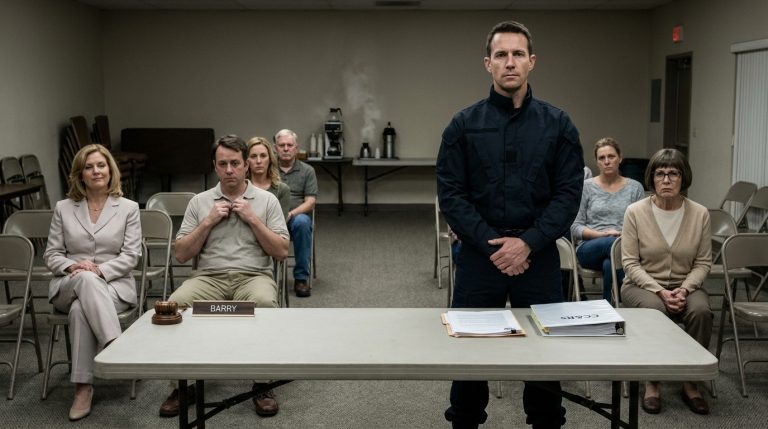
The projector fan hummed, a persistent, mechanical drone that felt like the pulse of the room. I stood by the podium, my hands resting lightly on the cold, laminated surface. My gaze didn’t linger on Karen. It tracked the room. I saw Bob’s face, the color draining away as he processed the financial math in real-time. I saw Linda, who had been the board’s silent enforcer, now looking as if she had suddenly realized the foundation of the clubhouse was shifting under her feet.
Karen’s mouth moved, but the sound was thin, a frantic, high-pitched scratching that didn’t reach the back of the room. She was looking at the screen, at the legal weight of the Verizon lease, as if she could scrub the numbers away with her eyes.
“It’s a lie,” she finally managed, her voice cracking. “It’s a forgery. He’s trying to sabotage the community!”
I didn’t raise my voice. I didn’t need to. “The deed is a matter of public record, Karen. The lease is notarized. You were warned—twice—through formal channels, and you chose to proceed anyway.”
From the back of the room, Sarah Albbright, the Verizon counsel, stepped forward. Her presence was like a sudden, sharp drop in temperature. She didn’t approach the board; she stood in the center aisle, a figure of corporate authority that made the HOA’s bickering look like a child’s game.
“My name is Sarah Albbright,” she said, her voice carrying easily across the hushed clubhouse. “I am senior counsel for Verizon Wireless. I can confirm that the contract displayed on that screen is authentic, binding, and currently in force. Your attempt to interfere with our infrastructure is not merely a civil matter. It is a tortious breach of contract that has now triggered a formal legal response.”
The room exhaled. The tension, which had been building like a static charge for weeks, finally snapped. A murmur began, growing into a low, rumbling tide of voices. People weren’t just shocked; they were angry. They had been lied to, manipulated, and positioned to pay for a legal catastrophe that had no basis in reality.
“Recall!” A voice shouted from the middle of the room. It was Marcus. He stood up, his face set in stone. “We need a motion for a vote of no confidence. Right now.”
“Seconded!” Eleanor Gable called out, her voice clear and resonant.
Karen clawed at her gavel, striking the table. The sound was hollow. She was a captain trying to command a ship that had already been scuttled. She looked at Bob, then at Linda, but they wouldn’t meet her eyes. They were already distancing themselves, their postures slumped in a desperate bid for self-preservation.
The ensuing vote was a formality. The proxy forms Marcus had collected, the quiet rebellion of neighbors who had been fined for the color of their doors or the height of their swing sets—it all converged in a single, crushing demand for change.
I watched the final tally. It wasn’t even close.
Karen sat down, the gavel rolling from her hand to the floor with a clatter. She looked small, suddenly. The armor of her polyester blouse and her lacquered hair seemed to wilt. She hadn’t just lost a dispute; she had lost the illusion of her own importance.
As the interim board—Marcus, Eleanor, and Tom—took their places, I stepped away from the podium. My job was done. I didn’t stay for the procedural motions or the initial shock of the settlement negotiations that would follow. I walked out into the cool, cleansing air of the evening.
The storm had passed. The air was crisp, scented with rain and the iron-rich soil of the Virginia hills. I drove back to the farmhouse in a silence that felt deep and restorative.
A month later, the legal dust had largely settled. The HOA, now under the stewardship of a board that actually listened, had apologized. The fines were scrubbed. The landscaping contract was back in the hands of a local firm that didn’t share a bank account with the president.
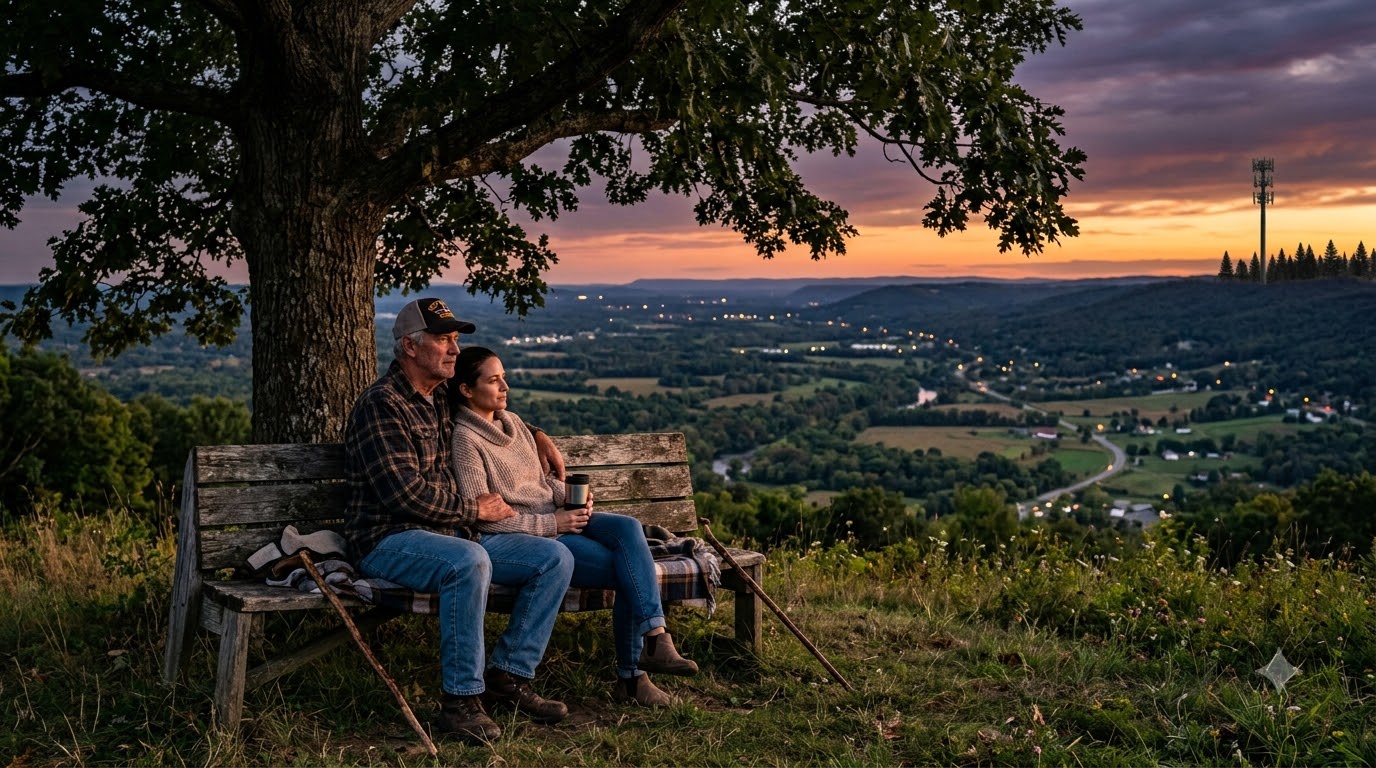
I walked up to the hilltop one evening. The sunset was painting the valley in bruised purples and burnt orange. I sat on the bench I’d built so long ago, my hand tracing the grain of the wood. The monopine tower stood sentinel against the sky, perfectly integrated, a quiet guardian of the space.
My daughter, Jessica, sat beside me. She didn’t speak for a long time. She just watched the valley lights flick on, one by one.
“You did it, Dad,” she finally said.
“I didn’t do anything but document the truth,” I replied. “The rest… the rest was just physics. Gravity eventually catches up to everyone.”
I looked at the bench, then at the sturdy oak tree above us. I pulled a small, weather-resistant wood varnish from my pocket—a simple, deliberate task. I began to touch up a spot where the wood had begun to silver from exposure. It was a small thing, a piece of maintenance, but it felt right.
The house was quiet when we returned. The sense of encroachment was gone, replaced by a settled, atmospheric peace. I wasn’t just a retired colonel in an old house anymore. I was part of the fabric of this place, a neighbor who had reminded everyone that truth is a currency that never loses its value. I leaned back in the porch chair, watching the stars appear, feeling the slow, steady hum of the land, protected, quiet, and finally, entirely my own.