The Iron Ledger: A Soldier’s Calculated Descent into the Beige Kingdom of Summit Creek Estates
CHAPTER 1: The Violation
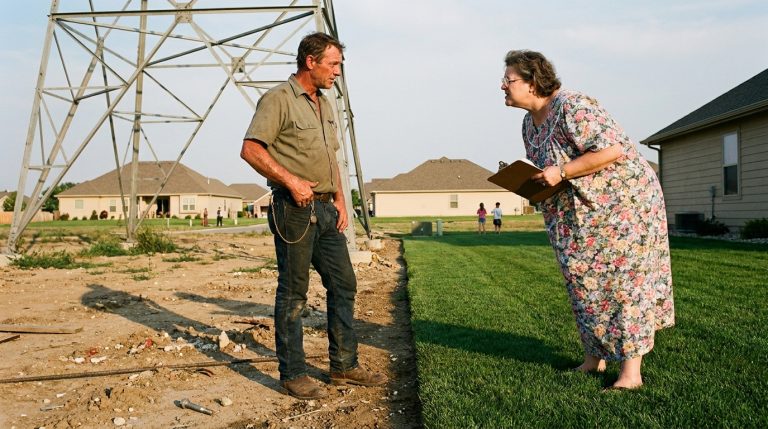
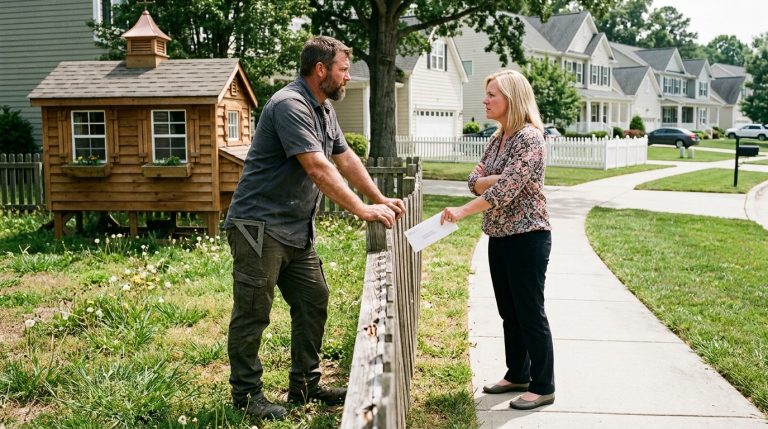
The medieval fire pit, she announced, her voice slicing through the crisp autumn air with the grating authority of a rusty hinge, is not only a class four aesthetic violation, it’s an unapproved commercial enterprise, a noise pollutant, a fire hazard, and a direct affront to the modern, streamlined lifestyle we cultivate here at Summit Creek Estates.
I stood there, the sweat cooling on my brow, the heavy forging hammer still held loosely in my right hand. I didn’t move. I didn’t breathe. I simply stared at the woman who had materialized at the edge of my open workshop, a plus-sized silhouette framed by the blinding afternoon sun, squeezed into a beige pantsuit that looked like armor made of sand. She clutched a clipboard to her chest like a holy shield, her eyes—small, hard, and devoid of light—scanning my forge as if it were a contagion.
The anvil that had been my grandfather’s, the carefully organized racks of cold-rolled steel, the glowing heart of the propane furnace—she looked at them with a disgust usually reserved for roadkill. She tapped a perfectly manicured nail on the clipboard.
The fines start today, Mr. Caldwell, she said, her tone clinical, stripped of any humanity. Two hundred dollars per day for the unauthorized structure, another hundred for the commercial activity, and we are issuing a special assessment of five hundred for the immediate fire risk you pose to the community.
She didn’t wait for a response. She didn’t look for an apology. She was already turning the page of her clipboard, her movements practiced, cold, and entirely devoid of hesitation.
Pay up, or the next letter you receive will be from our attorneys regarding a lien on your property. Shut it down now.
The sheer audacity of the order left a ringing in my ears, a high-pitched frequency that matched the hum of the forge I had spent six months perfecting. My world was defined by the honest conversation between fire, steel, and muscle. It was my peace, my quiet, my life. And this woman, this gatekeeper of beige, was trying to bulldoze it with a piece of plastic and a condescending smirk.
I watched her walk away, her heels crunching against the gravel in a rhythmic, militaristic march that signaled the beginning of a siege. I didn’t call out. I didn’t plead. I watched the way her shoulders shifted, the way she checked her watch, the way she didn’t look back at the trail of threats she’d left behind.
I looked down at my workbench. My eyes locked onto a small, loose bolt near the corner of the anvil, a tiny irregularity in an otherwise perfect system. It was out of place, a flaw in the geometry of the station, and for the first time in years, I felt a strange, cold clarity settle into my marrow. She had made a tactical error. She hadn’t come here to inspect my forge; she had come here to provoke me, to see how the soldier in me would react to a direct, unprovoked assault on my home.
She didn’t know that I had spent fifteen years learning exactly how to neutralize a threat before it had a chance to reach for its own weapon.
As she rounded the corner of the workshop, out of sight, I heard the faint, metallic click of her car door. I remained still, staring at the empty space where she had stood, counting the seconds until the engine turned over. I didn’t need to chase her. I needed to document the perimeter of the field she had just entered.
Beneath the workbench, hidden in a lockbox, sat the original architectural plans. I knew what they said. I knew what the building code demanded. And as I reached for the handle of the box, the realization hit me like a physical blow: she wasn’t here because of an aesthetic violation. The fire pit hadn’t even been lit in a week.
She was here because I was the only person in this development who knew how to build a defense that couldn’t be broken by a bylaw. And that made me the only thing in her way.
CHAPTER 2: The Dossier
The lockbox clicked open with a satisfying, heavy resonance. Inside, resting on the velvet lining, were the original architectural plans for the workshop—blueprints that had been vetted, stamped, and signed by the developer’s own office before the first stone of this house had been laid. They were not merely pieces of paper; they were a shield.
I took the blueprints to the kitchen table, clearing away the remains of dinner. The house was too quiet. Sarah was in the other room with Lily, their voices a muffled, comforting murmur that felt like a frequency from a different life. I didn’t want to bring this darkness into their light, not yet. I needed to understand the shape of the trap before I started prying it open.
I pulled out the thick binder containing the Summit Creek Estates Covenants, Conditions, and Restrictions. It was a dense, suffocating volume of legalese, the kind of book designed to be filed away and ignored until someone needed to weaponize it. I opened it to the section on detached structures.
My eyes scanned the lines, hunting for the specific language that Karen had ignored. Paragraph C, Section 7: Detached hobbyist workshops and art studios are permitted, provided the structural plans are submitted to and approved by the Architectural Review Committee.
I checked the timestamp on my approval letter. It was signed by the developer, the same man who had commissioned the gates, dated three days before our closing. It was airtight.
The memory hit me then—not of the forge, but of a briefing room in Khost. A Major with eyes like polished flint had been explaining the ROE—Rules of Engagement—for a specific sector. He’d leaned over the map, his pointer tracing a jagged line through the valley, and said, The enemy isn’t the guy with the rifle in the cave. The enemy is the guy who writes the rules so he can define you as an insurgent before you even pick up your gear.
I shook the thought away, rubbing the grit from my eyes. The parallel was too clean. I turned the page, my finger tracing the text regarding HOA board authority. This was where Karen had made her mistake. Her power was not absolute; it was delegated. The document explicitly stated that fines and special assessments were subject to board approval by a majority vote at a scheduled meeting.
I leaned back, the chair groaning under my weight. She had acted alone. A queen without a court, issuing decrees that she lacked the legal standing to enforce. It was a blatant power grab, but she had been sloppy. The arrogance of the amateur was her primary weakness; she assumed that no one would ever take the time to read the fine print she used to keep them in line.
I reached for my notepad, the pen poised. I began to map the battlefield. I didn’t need to be louder than her; I needed to be more precise. I needed to document the discrepancies, the lack of a board quorum, and the specific section of the bylaws that rendered her verbal assault in my workshop an unauthorized—and potentially litigious—harassment.
Every word I wrote down was a calculated strike. If she wanted a war of procedure, I would give her a war of attrition.
I looked back at the blueprints. My eyes traveled to the structural bolts, the load-bearing beams I had insisted upon, the ones that had cost me three months of extra labor. She had looked at the forge and seen a threat, but she hadn’t seen the engineering. She hadn’t seen the fire suppression system I’d installed, the one that cost as much as a used car, designed to trigger the moment a specific heat threshold was hit.
I wasn’t just a blacksmith. I was a man who understood the physics of containment. And if she wanted to see the forge dismantled, she would have to prove that the foundation itself was built on sand.
I checked the clock. It was nearly midnight. I hadn’t moved in four hours. My back was stiff, and my hunger had been eclipsed by the cold, persistent rhythm of my own pulse. I closed the binder, the snap of the plastic rings echoing in the empty room like a gunshot. I had the opening move. Tomorrow, I wouldn’t go to the board, and I wouldn’t call the police. I would visit the county office. I needed to see who actually held the title to the common areas, and if there were any secret amendments to the master plan that Karen had pushed through under the cover of darkness.
She was playing a game of intimidation. I was playing a game of chess. And the first piece I had moved was already off the board.
CHAPTER 3: The WellPoisoner
The morning air outside was crisp, carrying the metallic tang of an approaching autumn. I stepped out onto the porch, intending to head straight for the driveway and the sanctuary of the office, but the neighborhood felt wrong. It was a subtle, almost imperceptible shift in the environment—a frequency change that only someone who had spent years listening for the snap of a twig in the dark could truly identify.
Usually, the cul-de-sac was a hive of quiet, suburban motion. Today, it was unnervingly static. I saw Mrs. Gable three houses down, her hand hovering over her mailbox, but when my truck door slammed, she jerked backward as if she’d been burned, ducking back into her garage with a haste that made no sense. She didn’t offer the usual polite, distant nod. She didn’t even glance toward the street.
I leaned against the driver’s side door, my keys biting into my palm. It wasn’t just avoidance. It was fear.
I drove toward the community gate, the path taking me past the pristine row of homes that Karen’s “standards” had supposedly polished to a mirror sheen. Every lawn was a geometric miracle of blades, trimmed to the millimetre. Yet, beneath the veneer of order, there was a palpable tension—the kind of collective held breath one finds in a populace waiting for the next decree.
I slowed down as I reached the intersection where the Patels lived. Their driveway, once a space for their son to practice free throws, was aggressively empty. The asphalt looked sterile, stripped of the child’s chalk drawings and the stray ball that usually sat near the curb. I stopped the truck for a moment, waiting for a signal, a sign, anything. A curtain moved in an upstairs window—a brief, frantic flicker of fabric—and then vanished.
Karen had been busy. She hadn’t just been sending letters; she had been curating a climate. She was framing the “incident” at my forge not as a dispute, but as an infection. If she could make the neighborhood believe that my presence was the catalyst for declining property values, then she didn’t need to win an argument. She just needed to make me a social pariah. A neighbor who can be shunned is a neighbor who can be evicted without a protest.
The thought made my jaw ache. It was a classic counter-insurgency tactic: isolate the node, cut off the supply lines, and wait for the resistance to starve.
I reached the main gate—my gates, the ones I had forged with a sense of pride that now felt like a naive ghost from another life. The iron felt cold under my touch as I paused to inspect the scrollwork, looking for any sign of intentional marring. Nothing yet. But as I pulled back into traffic, I spotted a white sedan idling near the community clubhouse. It was Karen’s. She wasn’t just patrolling; she was holding court.
I didn’t turn my head as I passed. I kept my gaze fixed forward, my hands gripping the wheel with a pressure that turned my knuckles white. Inside the truck, the binder of documents felt like a lead weight on the passenger seat. I was moving toward a confrontation, but the battlefield was shifting from the legal to the psychological.
If I walked into the county office now, I’d be doing it with a target on my back. I was no longer a resident in a dispute; I was a marked man in a political arena. My training urged me to hit the gas, to accelerate away from the visible enemy and reach the safety of the public record, but the soldier in me cautioned against a blind charge.
The fear I had seen in Mrs. Gable’s eyes was the true measure of Karen’s control. To break that hold, I didn’t just need to prove she was wrong; I needed to prove she was irrelevant.
I took the long route to the county building, navigating the backstreets to ensure I wasn’t being followed. The silence in the cabin was broken only by the hum of the tires on the asphalt. My mind, however, was running a recursive loop of the CC&Rs. If she was using the HOA to clear the neighborhood, then the landscaping contracts weren’t the only grift. She had to be incentivizing the turnover.
I parked the truck three blocks away from the municipal center, choosing a spot in the shadows of an industrial warehouse. As I stepped out, the air felt thick, charged with the same static I had felt back on my street. I adjusted my jacket, checking the strap of the binder tucked under my arm, and began to walk. The mission had evolved. I was no longer just protecting my forge; I was starting to realize that the forge was only the first piece of an iron puzzle I hadn’t yet learned how to solve.
Every step toward the clerk’s office was a step further from the life I had hoped to build here, and closer to the life I had thought I left behind in the desert.
CHAPTER 4: The Shadow Ledger
The clerk behind the counter was a woman of indeterminate age, her spectacles reflecting the harsh, buzzing fluorescent lights. She didn’t look up as I approached. Her fingers tapped against a mechanical keyboard with the rhythm of a telegraph operator.
“I need the public records for Summit Creek Estates, specifically the last twenty-four months of board meeting minutes and all financial filings related to vendor contracts,” I said. My voice sounded flat in the vast, echoing room.
She stopped typing and finally looked up. Her eyes were tired, glazed by years of processing the minutiae of other people’s lives. “That’s a lot of paper, Mr. Caldwell. You want copies, or just a digital retrieval?”
“Copies,” I said, sliding my driver’s license across the glass. “Certified.”
While she stepped away to the archives, I leaned against the counter, my pulse thrumming in my ears. The room felt exposed. Every sound—the shuffle of a filing cabinet, the distant slam of a heavy door—seemed aimed at me. It was the same feeling I used to get when I was sitting in a forward operating base, listening to the radio chatter and knowing that something, somewhere, was coming toward us.
When she returned, she placed a thick stack of manila folders on the counter. “The minutes are there, but the vendor financial filings—the actual line-item bids—are in the annex archive. You’ll have to go down to the basement.”
I took the files to a small, isolated table near the back. I didn’t care about the basement. I opened the first folder and began to read. The minutes were a masterpiece of obfuscation. They were written in that specific, dry, administrative language that was designed to sound like consensus while actually recording a series of unilateral commands. Karen wasn’t just directing contracts; she was using the board as a rubber stamp.
Half an hour in, I found it. A series of invoices from Evergreen Solutions that were not just inflated—they were repetitive. They charged the community for “maintenance” on the same three-acre plot four times in a single month. The board had approved them, every single one. I saw Gerald’s signature, the ink shaky, followed by Karen’s—large, sweeping, and aggressively confident.
I needed to see if there was a trail of money going out that wasn’t being reported back to the residents. I dug deeper, ignoring the growing cramp in my hands. That was when I saw the name again: Evergreen Solutions. But this time, it was listed as a sub-contractor for a larger firm called Apex Development Group.
I stopped. My breath hitched. Apex Development Group wasn’t a landscaping firm. It was one of the largest regional real estate aggregators in the state. They were known for buying up mid-sized subdivisions and retrofitting them for commercial or high-density industrial use.
My heart hammered against my ribs. Why would a community of single-family homes be paying a landscaping sub-contractor that was tied to an industrial real estate firm?
I flipped to the back of the file. There, tucked inside a stapled report on “Common Area Long-Term Viability,” was a map. It wasn’t just a map of the neighborhood; it was a surveyor’s overlay of the entire district. My property, my two-acre lot, was highlighted in a distinctive, garish yellow. It sat exactly at the throat of a proposed access road that would connect the highway to a massive industrial park yet to be built.
It wasn’t just about the forge.
Karen wasn’t just a petty tyrant. She was the advance guard. She was systematically driving out residents who didn’t fit the “aesthetic” profile, creating a record of non-compliance and financial strife that would make it easier for Apex to trigger a mass-acquisition clause if the HOA became insolvent. She wasn’t saving the neighborhood; she was liquidating it.
The lights overhead seemed to pulse. Flicker. Buzz. Flicker.
I felt a sudden, sharp coldness in my chest. The forge, the fire pit, the noise—she hadn’t just been targeting my livelihood. She had been targeting the only property on that block that could legally fight the acquisition. If she could make me sell, or force a foreclosure, the access road would have a clear path.
I stood up, the chair scraping loudly against the linoleum. The clerk didn’t even look up. I tucked the map and the invoices into the center of my binder, my movements jerky and uncoordinated. I had to get out of there. The sterile, quiet air of the clerk’s office now felt like a prison.
I walked toward the exit, my eyes scanning the parking lot through the glass doors. A white sedan was parked three rows over, its nose pointed directly at the entrance. I couldn’t see the driver through the tinted windshield, but the presence of the vehicle felt like a physical weight.
I didn’t run. Running would be an admission of panic. I walked to my truck, my hand hovering over the handle of my holster—a habit I’d thought I’d buried years ago. I didn’t have a weapon, but the memory of the weight of one was enough to steady my hand.
I climbed into the driver’s seat, started the engine, and didn’t look back. I had the ledger. I had the proof of the grift. But I also had a target on my property that was far more dangerous than any fine.
Karen wanted a war of attrition. Fine. I had just found the supply lines. And now I knew exactly where to cut them.
CHAPTER 5: The War Room
I didn’t take the direct route home. The white sedan was too persistent, its headlights glowing like predatory eyes in the torrential downpour. I cut through the narrow, unlit service roads behind the commercial district, the truck’s tires spitting gravel and mud. The rain was deafening, a relentless barrage against the roof that muffled the world, but it didn’t dull the sharpening focus of my mind.
I took a sharp right, skidding through a flooded patch of asphalt, and found myself on a logging trail that skirted the northern perimeter of Summit Creek Estates. It wasn’t a road I’d used before, but as I turned, a flash of lightning illuminated the woods to my right. I slammed on the brakes.
There, driven deep into the mud of the tree line, was a yellow-painted stake. It was a surveyor’s marker. A “Phase 3” demarcation.
I sat there, the engine idling, the rain drumming a frantic rhythm. I didn’t need to be a geologist to know that Phase 3 didn’t exist on the original community plan. My mind replayed the map I had seen in the clerk’s office. This stake wasn’t for landscaping. It was a boundary line for the Apex access road. They were already scouting the physical path for the destruction of the neighborhood.
I grabbed my phone, snapped a photo of the stake against the backdrop of the stormy woods, and put the truck back into gear. I had to get home. My house, my wife, my daughter—they were sitting in the middle of a grid they didn’t even know existed.
When I finally pulled into my driveway, the house was dark, save for the porch light flickering in the wind. I didn’t wait to unload the truck properly. I grabbed the binder, tucked it under my jacket to shield it from the rain, and sprinted for the front door.
Inside, the house felt too fragile, a paper-thin shelter against the storm gathering outside. I went straight to my office, locking the door behind me. I didn’t turn on the main lights; the glow of my desk lamp was enough. I dumped the contents of the binder across the desk.
I began to work with a speed that bordered on the manic. I needed a cross-referenced index—a “Master Ledger” that mapped every invoice, every board minute, and every surveyor’s mark I had found. I moved the furniture, pushing my heavy oak desk to create a barricade, a makeshift war room. I pinned the map to the wall, marking the Apex access road in red ink.
Sarah appeared in the doorway, her silhouette framed by the light from the hallway. She didn’t ask questions; she saw the look in my eyes, the way I was pacing the room with a mechanical, restless energy. She saw the documents.
“Jack,” she whispered. “What is all this?”
“It’s a map of how they intend to erase us,” I said, my voice tight. I pulled a chair out for her. “I need you to look at these files. Focus on the signatures. Any board meeting where the quorum was missing, highlight it. I have to call Marcus.”
She sat down, her hands moving with a grace that was the exact opposite of my own jagged movements. Together, we began the assembly. The silence in the room was absolute, save for the rustle of paper and the distant, rolling thunder. We were no longer a family in a suburban home; we were two people in a trench, sorting through the wreckage of our own security to find the one piece of evidence that would blow the enemy’s cover.
I dialed Marcus. His voice was sharp, even at this hour, as if he’d been waiting for the call.
“I found the stake, Marcus,” I said, staring at the map. “They aren’t just buying us out. They’re already surveying the access road. They’re moving into the physical phase of the displacement.”
“That changes the timeline,” Marcus replied, his voice dropping an octave. “If they’ve started physical surveys without a public filing, they’re violating local zoning ordinances. It’s an act of bad faith that voids every single contract they’ve signed with the HOA.”
“How do we use it?”
“We don’t,” he said. “Not yet. We keep it in reserve. We wait for them to double down. If they’re moving this fast, they’re going to make a mistake. They’ll try to push through an emergency maintenance project to hide the survey equipment. That’s when you strike.”
I hung up, my hands hovering over the map. The plan was clear, but the price was escalating. The white sedan hadn’t followed me all the way to the driveway, which meant Karen was confident. She didn’t need to stalk me because she thought she had already won.
I looked at my hands, stained with the ink of the ledger and the mud of the woods. The forge was cold, and the iron was quiet, but for the first time, I realized that I wasn’t just building a defense. I was building a cage. And by the time the hearing started, the bars were going to be set in steel.
CHAPTER 6: The Tribunal
The community clubhouse felt like a funeral parlor for democracy. The air was heavy, scrubbed clean with institutional lemon-scented cleaner that did nothing to mask the underlying scent of stale anxiety and floor wax. I walked through the double doors, the weight of the binder pressed against my ribs, and felt the eyes of the room shift.
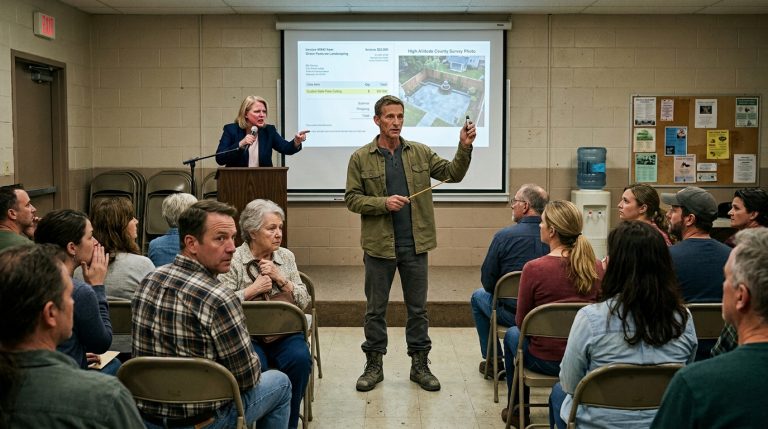
Karen sat behind the long folding table, a gargoyle in a power-red blazer. She held a gavel—a ridiculous, theatrical prop—and tapped it against the laminate surface. Thud. Thud. The sound was an insult to the room’s silence.
“This special hearing of the Summit Creek Estates Homeowners Association is now in session,” she announced. Her voice didn’t waver. It was the voice of a woman who had never known the sensation of being wrong. “The agenda for this evening is the continued and egregious violations of community standards by the resident at 112 Oak Hollow Lane, Mr. Jack Caldwell.”
I took my seat in the front row, Sarah beside me, her hand a firm, grounding presence on my knee. Marcus sat to my left, his face a neutral mask, his briefcase resting on the floor like a dormant explosive. Karen began. She was a torrent of practiced malice. She projected images onto the wall—grainy, zoomed-in photos of my workshop, the angles carefully chosen to make a clean, organized studio look like an illicit, hazardous factory.
“This is not what Summit Creek is about,” she declared, gesturing to the photo of my anvil. “We are a community of harmony. We are a community of beauty. Mr. Caldwell’s refusal to respect these values is a choice. A choice to prioritize his personal gain over the peace of his neighbors.”
She spent twenty minutes detailing the “fines”—the cumulative total now reaching four thousand dollars—and the legal necessity of foreclosure. She spoke of “community safety” and “property values” with the sincerity of a sociopath reading a script. The board members—Gerald, Brenda, and the others—sat with their heads bowed, avoiding my gaze, their postures stiff with the weight of their own cowardice.
I waited. I didn’t interrupt. I let her finish her climb. I watched her ego inflate with every lie, until she was standing at the very precipice of her own imagined authority.
“The board has been left with no choice,” Karen concluded, locking eyes with me. Her smile was thin, triumphant, and utterly hollow. “We are here tonight to vote on levying the most serious penalty our bylaws allow: a lien on your property and the initiation of foreclosure proceedings. To remove this blight from our community, once and for all.”
The room was breathless. A few of the residents shifted, some looking down, some looking at me with a mixture of pity and terror. The trap was set. She had laid her cards on the table, expecting me to fight back with shouts, with emotion, with the “angry veteran” reaction she had clearly banked on.
I stood up slowly. I didn’t raise my voice. I didn’t reach for the binder yet.
“Thank you, Madam President,” I said, the words smooth, practiced, and devoid of the rage she wanted to provoke. “I do have a few things to say. And I think the board might want to listen very closely to the evidence I have gathered.”
Karen’s smirk didn’t falter, but her posture shifted, a minute realignment of her shoulders. She was still in the hunt. She still thought this was a debate I intended to lose. She didn’t realize that in the war room, beneath the red ink of the Apex road map, I hadn’t been building a defense. I had been building a case file.
I walked toward the folding table, the floorboards groaning under my boots. I placed the binder in front of Gerald, the timid treasurer. The thud of the paper hitting the table was louder than her gavel.
“I’d like to begin,” I said, looking straight at Karen, “not with my forge, but with the landscaping contracts. Specifically, the ones awarded to Evergreen Solutions.”
Karen’s eyes narrowed. The first crack in the facade appeared—not in her voice, but in the slight, rhythmic drumming of her fingers against the table. I had initiated the sequence. The rules of her game had been discarded, replaced by the cold, hard procedural reality of the documents now resting under Gerald’s shaking hands.
“I have the invoices here,” I continued, opening the binder to the first page. “And I think the board deserves to know exactly how much they’ve been paying for… selective maintenance.”
The silence in the room changed. It was no longer the silence of fear; it was the silence of people watching a structure begin to lean. I didn’t need to shout. The truth, once documented and presented, had a weight of its own. Karen started to speak, a sharp, dismissive retort forming on her lips, but I kept talking, my voice steady, my gaze never leaving her, ensuring that every word I spoke was recorded in the minutes she so desperately wanted to control.
The stage was set, and the first domino was already in motion.
CHAPTER 7: The Iron Injunction
“Madame President,” Marcus said, his voice cutting through the thick, stagnant air like a scalpel. He stood up, his presence suddenly filling the void where her authority had been. “My client has presented evidence that directly refutes the factual basis for every fine you have levied. But the question remains: why go to such lengths to fabricate these violations?”
Karen’s fingers stopped drumming. She leaned back, her face a mask of calculated indifference, but her skin had turned an ashen, waxy white. “This is irrelevant,” she snapped, though the steel in her voice had rusted. “The bylaws are clear. Mr. Caldwell is in violation, regardless of—”
“Regardless of the fact that the work was approved?” Marcus interrupted. He walked toward the table, his movements slow, deliberate. “Or is it irrelevant because the workshop stands in the way of a much larger, much more profitable venture?”
I felt the shift in the room. The residents were leaning forward, their faces illuminated by the harsh, unflattering light of the projectors. I opened the binder to the map I had retrieved from the county annex. I turned it around, sliding it across the laminate until it sat directly under Karen’s nose. The yellow highlighter I had used on the access road stood out like a warning beacon.
“The Apex Development Group,” I said, my voice quiet, letting the name hang in the room. “I’m sure the board is familiar with the name. They’ve been very aggressive in their acquisitions lately. It’s interesting, isn’t it, that the exact path of their proposed industrial access road cuts through the center of this neighborhood?”
I watched Karen’s eyes flicker to the map. She didn’t look at me. She looked at the road. It was the look of a gambler who had just realized the deck was stacked against them.
“The landscaping contracts,” I continued, pacing the perimeter of the room, keeping my eyes locked on the board members. “Evergreen Solutions wasn’t just overcharging for bad work. They were intentionally neglecting the common areas. They were letting the cherry trees die. They were letting the irrigation fail. They were systematically lowering the property values of this entire development to make it easier for Apex to trigger their master acquisition clause.”
A woman in the third row let out a jagged, startled breath. “They killed my garden,” she whispered.
“They weren’t just killing gardens,” I said, my voice hardening. “They were clearing the ground.”
The room erupted. It wasn’t the laughter from before; it was the roar of realization. Gerald stood up, his chair clattering backward. “Karen? What is he talking about? Apex? We don’t have a contract with Apex.”
“We don’t,” Karen shrieked, her voice finally cracking, losing its rehearsed, imperious edge. “He’s making this up! This is—this is a desperate, pathetic attempt to avoid his own violations!”
“Is it?” Marcus pulled a document from his own folder—a copy of a shell company registration I hadn’t even known he’d secured. “Because this is the corporate filing for the firm that’s been ‘advising’ your landscaping decisions. It’s registered to the same address as the local Apex branch office.”
The finality of it hit her like a physical blow. Her shoulders slumped. The power-red blazer, which had been her armor, now looked like a costume—a hollow, brittle shell. She tried to reach for the gavel, but her hands were trembling too violently. She let it drop. It clattered onto the table, a lonely, pathetic sound that signaled the end of her reign.
I stood there, the silence in the room now deafening, and watched the monster of this beige kingdom dissolve. It wasn’t a sudden explosion; it was a slow, agonizing unraveling. The board members weren’t looking at her anymore. They were looking at each other, the weight of their own complicity dawning on them, the fear turning into a cold, hard resolve to distance themselves from her sinking ship.
I looked down at the binder. The truth wasn’t a weapon; it was a key. I hadn’t been fighting a battle of property lines or aesthetic codes. I had been fighting a war of survival against a machine that didn’t know how to see people—only assets.
I didn’t smile. I didn’t gloat. I simply looked at the board, then at the map, and then at Karen, who was staring at the table as if waiting for the floor to open up and swallow her whole.
“The hearing is over,” I said, my voice steady, the final hammer blow.
Marcus began to pack his files, the click-clack of his briefcase latches punctuating the room’s descent into chaos. The board members were already huddled, the talk of “investigation” and “resignation” floating through the air like smoke. Karen didn’t move. She just stared at the red road on the map, the architect of a future that would never exist.
CHAPTER 8: The Settlement
She didn’t bolt. She stood at the edge of the dais, the red blazer now a garish, misplaced reminder of an authority that had evaporated in the span of an hour. The other board members had retreated to the far side of the room, their whispered arguments a background hum of panic and shifting blame. Karen looked at me, and for the first time, I saw the true weight of her ambition: it wasn’t just greed. It was a frantic, terrifying need to stay relevant in a world that she viewed as a series of obstacles to be paved over.
“You think this is a victory,” she said, her voice a low, grating rasp. It wasn’t a question. “You think by exposing the invoices and the road plan, you’ve saved something. But you haven’t. You’ve just delayed the inevitable. Apex doesn’t walk away because of a binder of papers, Caldwell. They don’t walk away because you found a stake in the woods.”
She took a step toward me, her heels clicking against the hard floor. Her face was pale, the makeup caked into the fine lines of her age, making her look not like a queen, but like a ghost. “They will just replace me. And the next person won’t be as sentimental about the bylaws. They’ll just bulldoze the lot, forge and all, and they won’t even send you a letter to warn you.”
I didn’t move. I kept my hands at my sides, my posture relaxed, the “soldier’s stillness” that had always unsettled her. “They won’t get the chance,” I replied, my voice steady, lacking the heat of anger. “The investigation into the landscaping contracts has already triggered an audit of all the Apex-tied vendor filings. The county is freezing the HOA’s master account until the forensic audit is complete. That means no new contracts, no new land-transfer clauses, and absolutely no movement on that access road. You aren’t just out of a job, Karen. You’re the centerpiece of a criminal discovery process.”
Her resolve flickered. I watched the realization wash over her—not the fear of losing the presidency, but the clinical, inevitable terror of legal exposure. She had relied on the system’s complicity to protect her, and now that the system was being forced to look, it would consume her to save itself.
She opened her mouth to speak, but the words failed her. The two men who had been tasked with the clubhouse security, usually a formality, stood a few paces behind her. They didn’t need to touch her; the weight of the room’s collective scorn was enough. She looked at me one last time, her expression shifting from hatred to a hollow, haunting confusion, as if she were trying to remember why the forge had ever mattered so much.
She turned and walked out the double doors. She didn’t look back. She left the gavel, the clipboard, and the entire edifice of her beige kingdom on the table, abandoned like debris in the wake of a flood.
The days that followed were a blur of quiet, rhythmic restoration. With the HOA account frozen and the board finally finding its collective spine, the community began to breathe again. I returned to the forge, not as a defiant act, but as a return to the natural order of my days. The air felt cleaner, the silence of the neighborhood no longer a sign of fear, but of peace.
I spent the final afternoon of the week at the front of the development. The cherry trees were already showing signs of life, their branches pruned and watered by a new, transparent landscaping service—a company owned by the Patels’ neighbor, a man who actually knew how to keep a plant alive.
I focused on the gates. I had stripped the rust, sanded the iron down to the raw, humming metal, and applied a protective, multi-layered finish that would endure long after the memory of the “aesthetic committee” had faded into the dust of forgotten bureaucratic history. My hands worked with a mechanical grace, each stroke of the cloth a meditation.
Sarah and Lily arrived as the sun was beginning to dip behind the horizon, the sky turning a deep, bruised purple. Lily ran to the gates, reaching out to touch the scrollwork.
“They look new, Daddy,” she said, her voice bright.
“They look the way they were meant to look,” I replied, standing up and wiping my hands on a rag. I looked back at the house, then across the neighborhood, where neighbors were finally stepping out onto their lawns to greet one another, the sound of a basketball bouncing on a driveway replacing the heavy, oppressive quiet.
I walked to the forge one last time before dark. The furnace roared to life, a steady, controlled flame that didn’t threaten the neighborhood, but served it. I picked up the hammer. The first strike against the anvil rang out—clear, resonant, and unapologetic. It wasn’t the sound of a struggle anymore. It was the sound of a foundation that had been tested, held, and made stronger for the trial.
I wasn’t a soldier anymore, and I wasn’t an insurgent. I was a craftsman, building a life in the one place where I had finally learned how to stand my ground. The road ahead was long, but it was mine, and for the first time in fifteen years, the noise of the world had finally settled into a peace that I had made with my own two hands.