The Hive on Arbor Lane: A Veteran’s Stand Against Suburban Tyranny
CHAPTER 1: THE FORTYEIGHT HOUR LINE
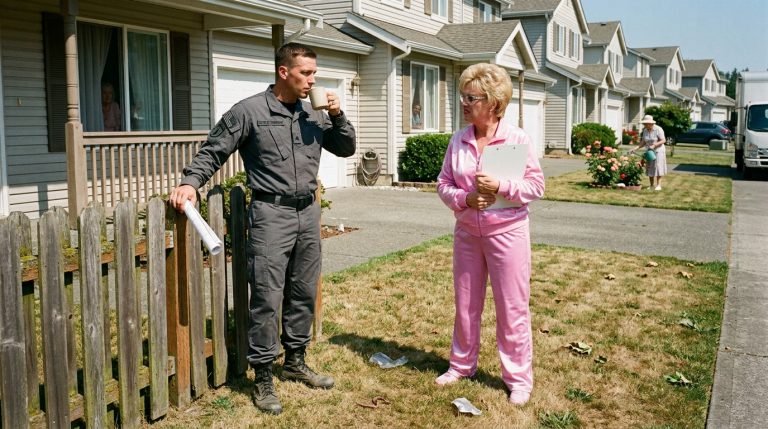
The steam from my mug drifted into the cool morning air, disappearing before it hit the manicured edge of my lawn.
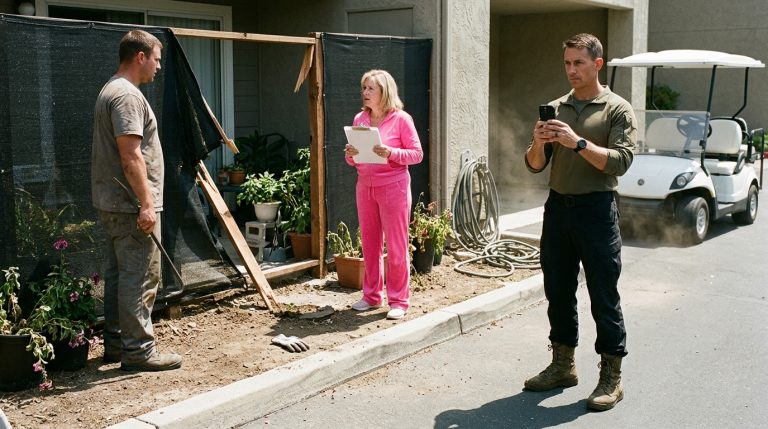
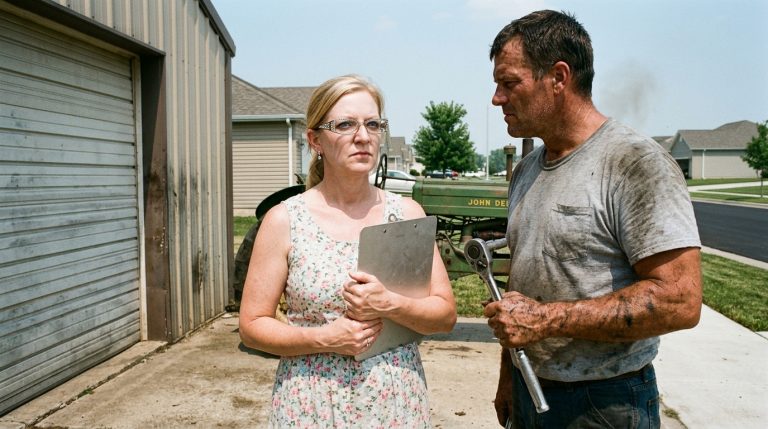
Karen Shipman stood three feet inside my property line, her floral-print muumuu catching the breeze like a signal flag. In her hand, she held a wooden clipboard tightly enough to turn her knuckles white. Behind her, parked at the curb, a rusty pickup truck rattled in idle. A heavy-set man in grease-stained canvas pants leaned against the tailgate, his arms crossed over a steel sledgehammer resting in the truck bed.
“Forty-eight hours, Mr. Thorne,” Karen said. Her voice had the sharp, practiced screech of someone used to shouting over grocery store clerks. “You dismantle that insect-infested monstrosity yourself, or my contractor does it for you. And the bill for demolition, disposal, pesticide application, and the ten-thousand-dollar non-compliance fee goes straight to your mortgage lender.”
I didn’t answer right away. I took a slow sip of the black coffee, feeling the heat roll down my throat, and looked past her shoulder at the cedar post set deep in the turf.
It stood five feet high. The structure mounted on top was untreated red cedar, fitted with hand-mitered copper flashing along the roof pitch. Hundreds of smooth, precision-drilled nesting channels aligned across the front block. No hives, no honey, no swarms. Just a clean, quiet habitat for solitary native pollinators. I’d spent forty hours in my shop turning that cedar, using a brass digital caliper to measure every drill depth down to the millimeter so the wings of mason bees wouldn’t catch on rough grain.
“It’s a solitary bee habitat, Karen,” I said, keeping my tone flat and low. “No queens, no defensive swarming. It’s part of a state research project.”
“I don’t care if it’s a sanctuary for bald eagles,” she snapped, taking a step closer. The tip of her orthopedic shoe dug into my freshly edged grass. “Section 7, paragraph B. No unapproved freestanding structures, outbuildings, or unauthorized animal harborages. The Architectural Review Committee did not approve it. And I am the committee.”
“I sent the ARC notice six weeks ago,” I said. “Along with the scientific spec sheet.”
“And it was denied,” she said, a small, tight smile breaking across her face. “In writing. Which you chose to ignore.”
“I received the denial letter yesterday,” I said. “Signed only by you. The bylaws require a three-member quorum for an ARC ruling.”
The man by the truck shifted his weight, the bed of the pickup squeaking under his boots. Karen didn’t look back at him. She adjusted the clipboard under her arm, her eyes scanning my porch, my driveway, and the small wooden sign hanging near the garage door that read Semper Fi Woodworks.
“You think because you spent twenty years in the military you get to ignore the rules the rest of us live by?” she asked, her voice dropping into a tight whisper meant only for me. “This isn’t a base, Mr. Thorne. This is Oak Creek Meadows. We have standards. You bring down the property values, you bring down everyone’s equity. You have until Monday morning. If that monstrosity is still standing when the sun comes up, Mr. Miller here starts swingin’.”
I reached into my pocket, my fingers wrapping around the cold, heavy frame of my brass digital caliper. I thumbed the smooth depth gauge back and forth inside my pocket, feeling the tiny click of the thumb wheel against my palm. Five years in the Corps as a combat engineer taught me two things about structural integrity: anything built quickly breaks easily, and people who wave big sticks usually rely on you being too tired to measure the length of the wood.
“The structure stays,” I said softly.
Karen stared at me for three seconds, waiting for my hand to shake or my voice to rise. When neither happened, she turned on her heel, her muumuu snapping around her ankles, and marched down the driveway toward her electric golf cart.
“Monday morning, Thorne!” she called over her shoulder. “Eight o’clock sharp!”
The pickup truck slammed into gear, puffing a cloud of blue exhaust into the clean air before following her down the cul-de-sac. I stood on the grass until the sound of the engine faded out completely, the coffee in my mug turning stone cold against my fingers.
CHAPTER 2: PAPER TRAIL AND COLD BRASS
Sarah set a fresh mug of instant coffee near my elbow, her thumb lingering on the handle. “You’ve been at this since midnight, Mark. The sun’s coming up.”
“The clock’s running,” I said without looking up from the page. “She gave me forty-eight hours. That means I have thirty-six left to find out where the grease is coming from.”
Gunner lifted his head from the rug, his tail giving a single, heavy thud against the hardwood before he settled back down with a deep sigh.
In the Corps, when an enemy compound looked too simple from the outside, you didn’t kick the front door down. You looked at their supply lines. You tracked where the water went, where the fuel trucks parked, and who was getting paid to look the other way.
I had no legal team coming to bail me out. The university’s general counsel had sent a polite, automated reply six hours ago stating that off-campus residential disputes fell outside their institutional scope. I was on my own, relying on a three-inch binder of bylaws, two years of buried financial PDFs from the community portal, and my wife’s eye for numbers.
Sarah pulled up a chair, her red pen already uncapped. “Show me what you found.”
“Look at the community events line item,” I said, tapping a yellow-highlighted column. “Fourteen thousand last year. Four thousand five hundred went to ‘Auntie Kay’s Catering’ for a Fourth of July barbecue.”
Sarah frowned, pulling the sheet closer to her face. “There wasn’t a Fourth of July barbecue last year. It was canceled because of ‘budgetary shortfalls.’ Karen put it in the July newsletter.”
“Right. But the check cleared,” I said. “And a quick state business search shows Auntie Kay’s Catering is registered to a P.O. Box downtown under the name Kathleen Shipman. Her sister-in-law.”
“That’s petty theft,” Sarah whispered. “It’s bad, Mark, but it’s small. It won’t stop a sledgehammer on Monday morning.”
“It’s not what stops her,” I agreed, sliding the heavy stack of landscaping invoices toward the center of the table. “It just proves she’s comfortable stealing small. When people get comfortable stealing small, they start thinking big.”
I turned the page to the ledger from eight months ago. The routine payments to Green Pastures Landscaping—a steady eleven hundred dollars a month for mowing common grounds and trimming oak trees—had suddenly spiked.
A single invoice, dated October 14th, read: Special Project: Community Entrance Retaining Wall and Water Feature Installation — $22,000.
Sarah looked at me, her eyes widening slightly. “The entrance? The entrance has the same brick sign it’s had since we moved here two years ago.”
“I walked past it this morning while the sky was still gray,” I said. “Not a single brick has been moved. No digging, no fresh mortar, no stone work.”
I reached for the brass caliper on the table, turning the depth gauge against my palm until it clicked into place. My eyes caught a scanned attachment tucked behind the main receipt—a detailed material breakdown from the subcontractor.
Halfway down the page, typed in fine print, was a line item for materials: Custom Slate Patio Cutting — 24ft x 16ft, interlocking stone layout.
“Entrances don’t need slate patios,” I said softly.
“What?” Sarah asked.
“An entrance retaining wall is vertical brick,” I said, tracing the measurement with my fingernail. “Twenty-four by sixteen is a residential backyard footprint.”
I pulled up the county tax map on my tablet, zooming in on the high-resolution satellite view of our cul-de-sac. I scrolled past my own home, past Dave’s lot, straight to the corner parcel on Arbor Lane.
In Karen Shipman’s backyard, tucked neatly between her flower beds and her covered porch, was a brand-new, multi-tiered stone retaining wall, a wide slate patio, and a three-tiered stone fountain running right in the middle of it.
“She didn’t build a community fountain,” Sarah breathed, her hand going to her mouth. “She paved her own yard with our assessment fees.”
“She billed the HOA for her private resort,” I said, setting the caliper down on top of the invoice with a dull metallic clink. “And she used Green Pastures as the front to sign off on the work.”
Outside, a car door slammed. I moved to the front window, pulling the blinds back a quarter-inch with two fingers.
Across the street, Dave was standing near his driveway, holding a rake. Karen’s electric golf cart was idling on the pavement beside him. She was leaning out of the seat, pointing a finger at his front lawn, her voice carrying faintly through the glass. Dave kept his head down, nodding weakly, his shoulders hunched.
When she drove off, Dave didn’t go back to his leaves. He looked over at my house, saw me behind the glass, and immediately turned his back, walking quickly toward his front door.
“She’s already spread the word,” Sarah said, standing behind me. “Mrs. Henderson wouldn’t look at me when I brought the trash cans in this morning. People are scared, Mark.”
“They’re not scared of bees,” I said, letting the blind drop back into place. “They’re scared of being next on her list. They think she holds all the cards.”
I picked up the printed satellite photo, the $22,000 invoice, and my yellow notepad, sliding them all neatly into a manila folder.
“Where are you going?” Sarah asked.
“To see a man about a flagpole,” I said.
CHAPTER 3: THE AMBUSH AT THE CLUBHOUSE
“That’s slate,” Bill said, his gravelly voice dropping an octave as he squinted at the paper. “I spent thirty years in combat support. I know custom quarry cuts when I see ’em. That ain’t entrance brick.”
“It’s her backyard,” I said. “And the meeting starts in twenty minutes.”
“She thinks she’s running a court-martial,” Bill grunted, tossing the rag onto a workbench and grabbing a clean flannel shirt off a wall peg. “She doesn’t know you brought the topo maps.”
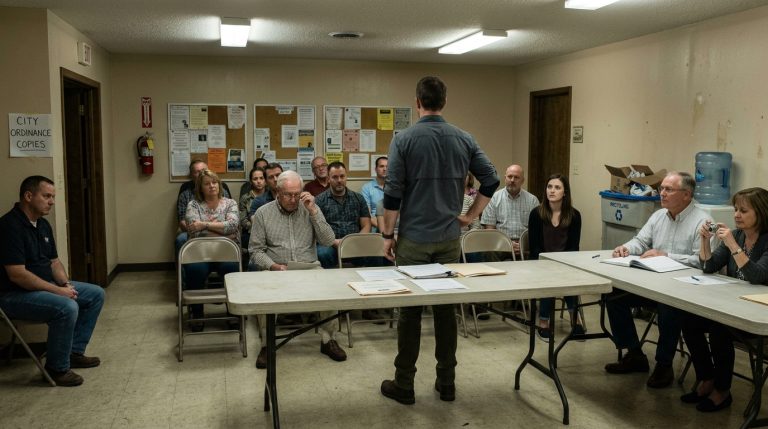
The Oak Creek Meadows clubhouse smelled of stale floor wax and industrial coffee. Eighty metal folding chairs were set up in tight, uneven rows facing a raised podium. Karen stood behind the wooden lectern, wearing a sharp navy blazer, her fingers tapping a rhythm on her clipboard. Beside her sat Gerald, the HOA treasurer, sweating through his collared shirt while shuffling a thin stack of papers.
The room was packed. Neighbors who usually kept their heads down were sitting shoulder-to-shoulder—Dave in the third row, his eyes darting toward the door, and Mrs. Henderson near the back, holding her purse tightly in her lap.
When Sarah and I walked in with Bill, Karen didn’t waste time. She slammed a wooden gavel against the lectern.
“This emergency session of the Oak Creek Meadows Homeowners Association will come to order,” Karen announced, her voice booming through the small PA speaker. “We have one item on tonight’s agenda: the immediate abatement of a non-compliant, hazardous structure at 112 Arbor Lane, and the approval of a ten-thousand-dollar compliance fine.”
A quiet murmur rippled through the seats.
“The bylaws are absolute,” Karen continued, leaning forward over the microphone. “Section 7, paragraph B gives this board full authority to remove unauthorized harborages that threaten community standards and property values. The resident was given forty-eight hours. The deadline expires tomorrow at dawn.”
She looked straight at me, her eyes narrow and satisfied. “In accordance with standard procedure, the floor is open for five minutes of resident response before we proceed to the formal vote of authorization.”
I didn’t walk up to the lectern. I stood right in the center aisle, pulling a USB drive from my jacket pocket and holding it up toward Gerald.
“We don’t need five minutes for my yard,” I said, my voice cutting cleanly through the hum of the air conditioner. “We need ten minutes for the treasurer’s portal.”
Karen’s knuckles tightened on the edges of the podium—
“You are out of order, Mr. Thorne,” she snapped. “This meeting is strictly regarding your code violation.”
“The bylaws state any general meeting may be opened to financial review upon motion from two property owners,” Bill called out from the back row, stepping into the aisle. “I second the motion.”
“Motion denied,” Karen said instantly, her gavel coming down again with a crack. “As ARC chair, I retain agenda control—”
“Gerald,” I said, stepping closer to the front table and placing the flash drive on top of the treasurer’s ledger. “Plug it in. Or we can have the police department’s financial crimes unit pull the drive from the server tomorrow morning.”
Gerald looked up, his jaw slack, a single bead of sweat rolling down the side of his nose. He didn’t look at Karen. His hand shook as he reached for the small metal drive and slotted it into the laptop connected to the wall projector.
“Gerald, don’t you dare—” Karen started, taking a step toward him.
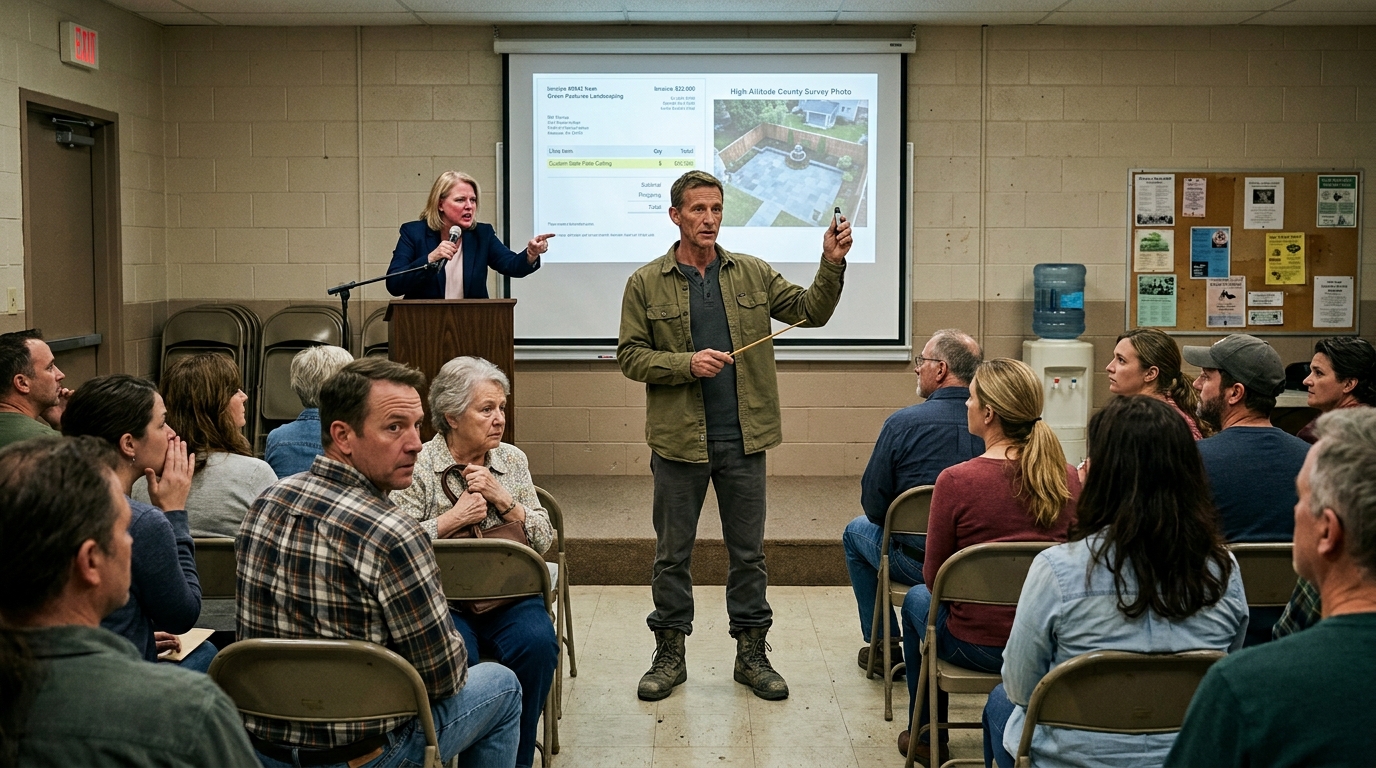
The projector hummed, flashing bright white against the folding screen behind her before settling on a high-resolution image.
The entire room went dead silent.
It wasn’t a diagram of a bee habitat. It was an enlarged PDF of Invoice #8842 from Green Pastures Landscaping for twenty-two thousand dollars, side-by-side with the high-altitude county survey photo of Karen’s backyard.
“That’s the entrance project from last October,” Dave shouted from the third row, standing up to point at the screen. “The one you said got delayed due to supply chain issues!”
“Look at the cutting specs,” I said, using a wooden pointer to tap the highlighted line item. “Twenty-four by sixteen feet of custom slate. That isn’t a retaining wall for the neighborhood sign, folks. That’s the patio sitting behind Miss Shipman’s house right now.”
Karen’s face turned from pale white to a deep, blotchy red. She grabbed the microphone stand, her thumb dragging across the grill with a harsh screech of feedback.
“This is a fraudulent edit!” she yelled, her voice straining against the PA system. “This man is projecting altered documents to deflect from his illegal construction! He’s attempting to harass the board!”
“Auntie Kay’s Catering,” Sarah called out calmly from her seat, holding up a stack of printed receipts. “Four thousand five hundred dollars paid out of the social fund for a Fourth of July event that was canceled. Kathleen Shipman is your sister-in-law, Karen.”
The clubhouse exploded.
Neighbors stood up from their chairs, shouting over one another. Mrs. Henderson was on her feet, waving her hand toward the screen, while two men in the back row began crowding toward the front table.
Karen didn’t back down. She slammed the gavel three times in violent succession, the wood cracking against the particle-board lectern.
“Silence!” she shrieked, her body trembling with rage as she pointed a finger directly at my chest. “You think a few distorted receipts change anything? The ARC violation stands! The sledgehammer will be on your lawn at eight o’clock tomorrow morning, Thorne! You don’t run this neighborhood, and you never will!”
“You’re right,” I said, stepping back as Bill moved up beside me. “I don’t run it. But the interim board does.”
CHAPTER 4: THE UNRAVELING AND THE FLAGPOLE
Gerald didn’t follow her. He sat frozen on his folding chair, his trembling hands sliding the thick black ledger binder across the table until it rested against Bill’s forearm.
“I didn’t sign off on the slate,” Gerald whispered, his voice cracking as he wiped his damp forehead with a sleeve. “She told me it was a contingency bond for county drainage compliance.”
“You signed the checks, Gerald,” Bill said, his rough hand settling heavily over the cover of the ledger. “That makes you a witness. The interim board takes over at midnight.”
Karen didn’t wait for midnight to fight back.
At seven-thirty the next morning, fifty minutes before her demolition ultimatum was set to expire, a white municipal code enforcement sedan pulled up to my curb. Karen stepped out of the passenger side, her navy blazer replaced by a bright neon safety vest. Beside her walked a township inspector holding an electronic tablet and a tape measure.
“Right there, Officer,” Karen said, her voice strained and raspy, pointing a rigid finger at my side yard. “Unpermitted structural hazard, non-standard timber, and unverified biological infestation posing an immediate public health risk.”
I walked down the porch steps with my mug in one hand and my brass digital caliper in the other. I didn’t yell. I didn’t raise my voice.
The inspector looked at the structure, then at his tablet, then at Karen. “Ma’am, this is an untreated cedar post set on a four-inch concrete footing. It’s smaller than a standard birdhouse array. Township code doesn’t regulate non-enclosed garden fixtures under six feet.”
“It’s an unauthorized outbuilding!” Karen shouted, stepping into the inspector’s path. “The HOA bylaws—”
“The township doesn’t enforce private HOA bylaws,” the inspector interrupted, turning back toward his sedan. “And if you called in an emergency hazard report for a three-foot wooden box on a Saturday morning, I’m logging this as an improper use of municipal dispatch.”
Karen stood on the asphalt as the sedan drove off, her jaw working silently as she glared at me across the lawn.
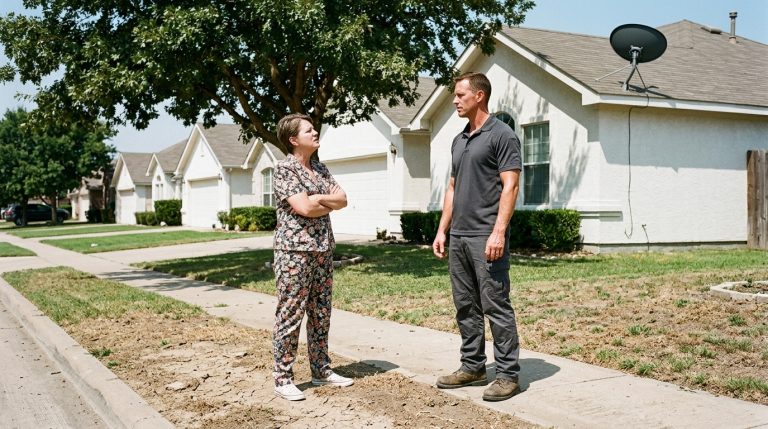
“You think you won?” she spat, her fingers digging into the vinyl edges of her clipboard until the plastic bent. “I built this community! You’re just a tenant with a mortgage! I will lien this house until you’re forced to sell!”
“The interim board froze the account two hours ago, Karen,” I said, taking a quiet sip of coffee. “Bill and Dave are at the main bank branch right now with the police department’s fraud unit. They brought the receipts.”
Her face went completely rigid. For three seconds, she didn’t breathe. Then, without another word, she turned and walked down the street, her heels clicking hard and uneven against the concrete.
Four weeks later, the morning air was crisp and completely still.
The yellow ‘For Sale’ sign on Karen’s lawn had been taken down three days after the sheriff’s deputy served the formal audit summons. A young couple was moving in across the street, their kids running through the front yard with a golden retriever mix.
I sat on my porch steps with a sheet of fine-grit sandpaper, smoothing down the corner of a replacement cedar block for the solitary habitat.
A shadow fell over the wood, and I looked up. Bill was standing on the walkway wearing a clean work shirt, carrying an aluminum flagpole assembly under his arm and a set of stainless steel mounting bolts in his pocket.
“ARC Chair Thorne,” Bill said, his jaw setting into a dry, practical line. “Submitting application 001 for structural modification.”
I set the sandpaper down and took the paper from his hand. It was a single page, filled out in neat, block military handwriting: Installation of one 25-foot telescoping aluminum flagpole. Approved location: Front lawn center.
I pulled my pen from my pocket, laid the form across my knee, and signed my name on the approval line.
“No committee quorum required?” Bill asked, a faint trace of a grin breaking through his gray mustache.
“Common sense doesn’t need a quorum, Sergeant Major,” I said, handing the sheet back. “Set the concrete deep.”
Behind us, near the rose garden, a tiny metallic-blue mason bee hovered over the cedar entrance, dropped its wings, and backed cleanly into one of the smooth, hand-drilled channels.
I picked up my cup, the coffee hot and fresh, and watched Bill walk across the grass to set his post.