The Concrete Ledger: A Surgical Dissection of Power and the High Price of Retribution
CHAPTER 1: THE TORN FABRIC
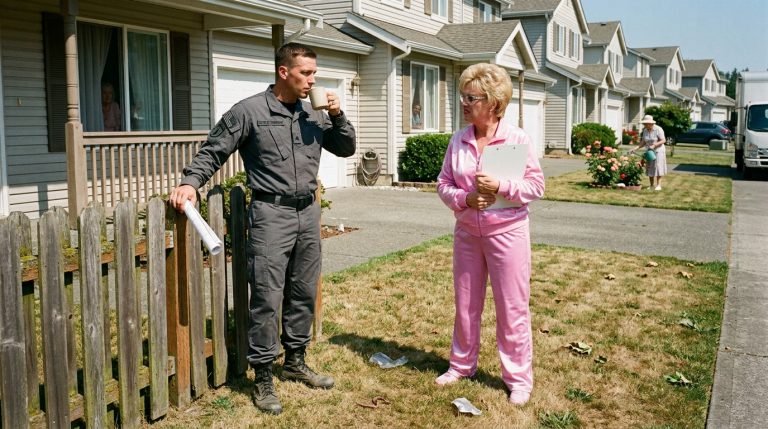
The fabric shrieked—a high, unnatural sound of synthetic fibers surrendering to steel. Karen stood there, her pink tracksuit vibrating with the adrenaline of her petty triumph, her face a mask of smug, porcelain satisfaction. The sun, unfiltered and predatory, slammed into the sheltered space behind the screen, turning my carefully controlled microclimate into a furnace.
I didn’t move. My hands were still hovering near the temperature sensor, my fingers stiff, my pulse a metronomic beat against the silence of the cul-de-sac.
“Section seven, paragraph four,” Karen announced, her voice a grating, artificial symphony. “Temporary structures are a blight on the aesthetic integrity of Oakmont. Consider this your final notice, Mr. Evans.”
She didn’t see me. She saw a problem to be solved with a clipboard. She didn’t see the sergeant who had spent twelve years stabilizing infrastructure in places where the ground itself was trying to kill you. She saw a homeowner with an ugly screen.
Beside her, the man—a monolith of unthinking muscle—prepared to yank another section of the mesh from its wooden frame. The crowbar glinted, a cold, sharp line of light in the harsh morning.
My training bypassed my anger. It didn’t care about the injustice. It cared about the data. I shifted my weight, feeling the familiar, grinding protest of my knee, and my mind began to calculate. The frame was pine. Cheap, brittle. The structure was failing at the joints. The exposure was instantaneous.
“Karen,” I said. My voice was a void. It pulled the air out of the space between us.
She paused, her smugness faltering for a micro-second, then hardening again. “Don’t ‘Karen’ me. You had your chance to comply. This is community standards.”
The man jerked his arm. The wood splintered with a sound like a small-caliber gunshot. A segment of the mesh tore free, flapping in the breeze like a wounded wing. I saw the verbena beneath it—the delicate, sky-blue petals beginning to curl, the leaves turning a sickly, translucent yellow under the sudden, brutal weight of the light.
I reached into my pocket, my movements precise, economical. My phone felt like a weapon. I didn’t look at her; I framed her. I framed the man. I framed the splintered 2x4s and the desiccated soil. Every movement was a recorded piece of evidence, a future weight to be added to the scales of her undoing.
“State your name,” I said, the words landing like lead.
She blinked, the authority slipping for the first time, replaced by a sudden, jagged confusion. “What?”
“Your name. State it for the record.”
The man paused, the crowbar suspended in mid-air. He looked at me, his eyes empty, but for the first time, he hesitated. He felt the shift in the air—the change in atmospheric pressure that precedes a storm. He felt that I wasn’t just standing there; I was waiting for the perfect moment to close the trap.
I looked at the torn mesh, then back at her. The silence stretched, cold and heavy, pregnant with the realization that she had just ripped more than fabric. She had torn into a reality she was entirely unprepared to inhabit.
CHAPTER 2: THE DIGITAL SIEGE
The man with the crowbar didn’t move. He stood caught in the sudden, brutal glare of the morning, looking down at the shredded green mesh as if he expected it to fight back. Karen was still holding her clipboard, her knuckles white against the black plastic. She looked past me, into the heart of the nursery, her gaze landing on the wilting verbena. She wasn’t seeing botany. She was seeing a win.
I didn’t let the heat of the Helman Province—the memory of scorched earth and dry, desperate air—blind me. I channeled that phantom heat into a single, focused point of cold. I kept my phone steady. I kept the recording active.
“You’re done, Mr. Evans,” Karen said, her voice reclaiming its usual register of imperious, suburban authority. “The structure is removed. If you attempt to rebuild, I will have the police escort you from the property for violating the peace.”
“I am recording this, Karen,” I said, my voice as flat and non-negotiable as a concrete foundation. I panned the camera from the torn fabric to the man—the vending-machine-shaped contractor. “And I am recording the individual you hired to destroy it.”
The man shifted his weight. The metal of the crowbar scraped against the wooden frame, a screech that made my teeth ache. He didn’t look at me. He looked at Karen. A flicker of something—hesitation—crossed his face. He wasn’t a professional contractor. Professionals knew about permits. They knew about liability. This man was a tool, and tools only worked as long as the hand holding them was steady.
“Don’t listen to him,” Karen snapped at the man, though she didn’t meet my eyes. She was staring at the exposed verbena, watching the leaves begin to droop under the direct UV radiation. “You’re done here. Let’s go.”
“I have the county ordinance logged,” I continued, pacing my words. I took a slow, deliberate step toward them. The man reflexively took a step back, the crowbar swinging slightly. “Section 1138-B. Destruction of environmental stabilization property. You aren’t just breaking a bylaw, Karen. You’re violating state-level protection. The damage to these seedlings is being documented in real-time.”
She laughed, but it sounded thin, brittle—the sound of glass about to shatter. “Your little weeds? No one cares about your weeds. This is Oakmont. We have standards.”
She turned, her pink tracksuit rustling like dry leaves, and marched toward her golf cart parked at the curb. The contractor hesitated for one more second, his eyes meeting mine. In that micro-second, I saw the truth. He wasn’t just a hired hand. He was terrified. Not of me, but of the woman walking away from him. He knew exactly what she was capable of, and he knew exactly how much she didn’t care about his own liability.
I didn’t say anything. I just let the silence settle. He turned and followed her, his boots heavy on the manicured grass.
I stood in the center of the ruins of my privacy screen. The shade was gone, and the heat was rising. I didn’t rush to fix the plants. I didn’t mourn the destruction. I walked to the edge of the property, my knee clicking in a familiar rhythm, and watched them reach the golf cart. Karen didn’t look back. She climbed in, her movements jagged with self-righteous adrenaline, and drove off.
I waited until they were out of sight before I exhaled. The adrenaline was a dull thrum in my ears, but I suppressed it. I walked back to the nursery. I knelt by the nearest bed of verbena. The leaves were already losing their turgidity. Sunscald was a silent, efficient killer.
I pulled out my tablet from where I’d left it secured under the staging, its rugged case still cool to the touch. I opened the encrypted cloud folder labeled ARCHIVE. I uploaded the video file. I tagged it: DATE: MAY 17. INCIDENT: VANDALISM/TRESPASS. SUBJECTS: MILLER, K. / UNKNOWN MALE.
This wasn’t just a grievance. This was a schematic.
I sat there for a long time, the shadow of my house creeping across the dirt. My training told me that a defensive position, once compromised, had to be either abandoned or reinforced. I wasn’t going to abandon David’s promise.
I picked up my phone and dialed the number for the county conservation office. Dr. Thorne answered on the second ring.
“Thorne,” he said, his voice clipped.
“It’s Mark Evans, Doctor,” I said. My pulse was back to its resting rate. “The screen is down. The seedlings are compromised.”
There was a silence on the other end, then the sound of a chair shifting. “Are you injured?”
“No. I have them on video. Karen Miller and a contractor. She’s claiming HOA enforcement.”
“Stay where you are, Mark,” Thorne said. The tone was professional, but underneath, I heard the steel. “And don’t touch anything else. If she’s crossed the line into government interference, the game changes. You have the documentation?”
“Everything is uploaded.”
“Good. Don’t engage her again. This is no longer a civil matter. It’s an investigation.”
I hung up and sat on the wooden frame of the nursery bed. I looked at the sky-blue flowers, their delicate stems bowing under the oppressive light. I wasn’t angry. Anger was a waste of resources. I was an engineer. I understood forces, loads, and stress points.
Karen had just pushed the structure of her authority past the point of elastic deformation. She was in the plastic range now—the state where the metal stays bent. She didn’t know it yet, but she was already failing.
I stood up and began to dismantle the remnants of the wooden frame. I didn’t need it anymore. I needed something stronger. I needed a foundation that couldn’t be torn down by a woman with a clipboard and a hired goon. I would rebuild, and this time, the structure would be as immovable as the law itself.
I worked until the sun began to dip below the fence line, my movements mechanical and precise. Every splinter I pulled, every screw I removed, was a calculation. I was clearing the ground for the siege.
The neighborhood was quiet. It always was in Oakmont. But to me, the silence felt different now. It was the silence of a minefield before the pressure was applied. I knew the geometry of this war. I knew the weak points. And I knew that Karen, in her infinite, arrogant wisdom, had just given me the only weapon I would ever need to dismantle her world: a perfectly documented paper trail leading directly to her front door.
I went inside, the kitchen cool and dim, and opened my laptop. I didn’t check the news. I didn’t check my email. I opened a fresh document and started building the master ledger.
Row one: The Incident.
Column A: Date/Time.
Column B: Evidence.
Column C: Legal Statute.
I began to type. The keys clicked with a rhythmic, satisfying finality. The war hadn’t started today—it had started months ago, with every tiny, petty violation notice she’d shoved into my door frame. Today was just the day I finally decided to acknowledge it.
CHAPTER 3: THE ALLY IN THE SHADOWS
The blue light of the monitor cast long, angular shadows across the dining room table, turning my schematics into a map of a battlefield. My back ached. It was a familiar, dull throb—a souvenir from years of hauling crates in the desert, now exacerbated by the hours hunched over this machine. Outside, the cul-de-sac was silent, save for the occasional, distant rumble of a car. Oakmont Estates was asleep, but I was wide awake, the adrenaline replaced by a thin, bitter clarity.
I saved the document. The file size was still small, but the weight of it felt substantial. I wasn’t just compiling a list; I was building a case that would withstand the scrutiny of a judge. But I needed more than data. Data was static. To win, I needed a lever, and every lever needed a fulcrum.
I stood up and walked to the window. The privacy screen, or what was left of it, hung in jagged, tattered strips against the night. It looked like the skin of a snake, shed and discarded. My house was dark, but two doors down, a light was burning in a study—the house where George lived. He was a retired litigator, a man who had spent decades navigating the murky, high-stakes waters of civil court. He was the one piece of intelligence I couldn’t verify on my own.
I stepped out onto the porch. The air was cool, smelling of damp earth and late-night irrigation. I walked the short distance to his house, my gait steady. I didn’t knock with a fist; I used the heel of my palm, a soft, rhythmic tap.
George opened the door after a moment. He was wearing a cardigan that looked older than the neighborhood itself and holding a glass of something amber and deep. He looked at me, not with surprise, but with the weary recognition of someone who had seen this look on too many faces before.
“Evans,” he said, his voice a low rumble. “I saw the commotion this morning. I assume that’s why you’re here.”
“I have the video,” I said. “And I have the county ordinance.”
“Come in.”
His study was an island of paper and mahogany in a sea of modern suburban minimalism. Books lined the walls from floor to ceiling, their spines cracked and faded. He set his drink down and gestured to a leather chair. I didn’t sit. I stayed standing, my presence calibrated to his pace.
“Karen thinks she owns the place because she holds the gavel,” George said, sitting behind his desk. He looked at me over the rims of his glasses. “But she’s sloppy. People who think they’re above the law usually are. The question isn’t whether she’s in the wrong, Mark. The question is whether you have the stomach for the follow-through. Civil suits are long, expensive, and they turn your home into a courthouse. You sure you want to go down that road?”
“I’m not looking for a civil suit,” I said. “I’m looking for a systemic failure. She’s using the HOA as a personal extension of her will. She’s falsifying records.”
George smiled, a slow, predatory expression that didn’t reach his tired eyes. “Now, that is a strategy. You aren’t just hitting back; you’re looking to decapitate.”
He stood up and pulled a thick, leather-bound volume from a shelf behind him. He flipped through it with an ease that spoke of decades of muscle memory. “If she’s falsifying minutes, she’s violating the corporate code of the association. That’s not a fine, Mark. That’s grounds for removal, and potentially, criminal investigation if you can prove fraud.”
“I have the video of the contractor,” I said. “He’s her brother-in-law. If I can link the payment of that contractor to HOA funds, I have the nexus for embezzlement.”
George leaned back, his eyes narrowing. “You’re an engineer, aren’t you? Everything is a structure to you. You see the stress points.”
“I see a structure that’s failing because of a central defect,” I replied.
“And you want me to help you apply the pressure.” He didn’t wait for an answer. “I’ve been waiting for someone to come along with the backbone to do this. I’ve lived in Oakmont for fifteen years. I’ve watched her dismantle the character of this community one fine at a time. She’s a cancer, Mark. But to remove a cancer, you have to be precise. You cut too deep, you kill the patient. You don’t cut deep enough, it grows back.”
I felt the weight of his words. This wasn’t just about my garden anymore. It was about the slow, agonizing erosion of peace in a place that had promised exactly that.
“I need the minutes,” I said. “The official ones, and whatever Maria has in her digital archive.”
“Maria,” George said, his voice softening. “She’s the digital intelligence. She’s been tracking the website logs. If Karen’s been altering the minutes, Maria has the version history. She’s been sitting on a powder keg.”
“Then let’s light the fuse.”
George picked up his glass again, his gaze fixed on a distant point on the wall. “She’ll fight, you know. She’ll use the HOA’s legal fund to drown you. She’ll try to paint you as the aggressor. She’s a professional victim when it suits her, and a tyrant when it doesn’t.”
“Let her,” I said. “I’m not a civilian in this. I know how to manage a campaign.”
He looked at me, a hint of genuine respect in his gaze. “I believe you do, Sergeant. Tell me, what’s your first move?”
“Transparency,” I said. “She relies on the fact that no one knows how the association is run. If we make the bylaws and the financial records as public as the violation notices she sticks on our doors, she loses her primary weapon: ignorance.”
“And when she retaliates?”
“Then we make sure the retaliation is documented. Every notice, every fine, every threat. We build a pattern. Courts hate patterns of harassment. It makes it look like policy, not a singular conflict.”
George stood up and walked to the door, opening it for me. The night air had turned colder, biting at my skin. “You have the resolve, Evans. I’ll provide the strategy. Tomorrow, we gather the others. It’s time to move out of the shadows.”
I walked back to my house, the moonlight casting sharp, elongated shadows on the pavement. I felt the change in the atmosphere. The cul-de-sac was still dark, still quiet, but the air felt different. It was charged with a hidden friction. I wasn’t alone anymore. I had an ally who knew the terrain, and more importantly, who knew exactly where the bodies were buried.
As I reached my porch, I saw a flicker of movement across the street. A silhouette in a window—one of the neighbors, watching me. I didn’t look directly at them. I just kept walking, my pace measured. They weren’t just watching me; they were watching the conflict. They were waiting to see who would break first.
I went inside and locked the door, the click of the deadbolt echoing in the hallway. I didn’t turn on the lights. I walked to the kitchen and looked at the nursery through the sliding glass door. The verbena was wilting, a graveyard of blue in the moonlight. But I wasn’t looking at the damage anymore. I was looking at the ground beneath it—the foundation I had to rebuild.
The siege had begun. I had my intelligence, I had my strategist, and I had my objective. Karen Miller thought she was the queen of Oakmont. She had no idea that she was just a target, and the crosshairs were closing in.
CHAPTER 4: THE INSPECTION GAMBIT
The morning light hit the clubhouse exterior with an unforgiving brightness that exposed the peeling paint on the door frame—a small, fitting crack in the armor of Oakmont’s aesthetic perfection. I stood on the porch, waiting for George. My bag felt heavy, weighted down by the tablet and a printout of the bylaws I’d annotated with red ink.
George arrived a moment later, his expression grim. He didn’t look like a retiree on a stroll; he looked like a litigator arriving for a deposition. Maria joined us from across the lot, her laptop bag slung over her shoulder. She was quiet, her focus entirely on the device in her hand.
“The logs are open,” Maria whispered as she stepped up onto the porch. “Karen hasn’t bothered to secure the clubhouse admin portal since the last update. She thinks we’re too stupid to look past the front page.”
I nodded. We had the inspection window, and for the next two hours, the clubhouse was theoretically ours. But Karen wouldn’t leave us unattended. She treated that room like a throne room, and we were the usurpers.
The door opened. Karen stood there, wearing a beige blazer that looked like a suit of armor, her hair sprayed into a stiff, impenetrable helmet. She didn’t move aside. She simply stood in the threshold, forcing us to acknowledge her position as the gatekeeper.
“The records are in the back office,” she said, her voice tight, vibrating with the effort to remain civil. “I have two hours. Then the room is booked for a committee planning session.”
“We’ll be efficient,” George said, stepping past her with a nod that was more of a dismissal than a greeting.
The interior of the clubhouse was stale, smelling of floor wax and old coffee. We moved to the back office, a cramped space dominated by filing cabinets and a desk that looked like it hadn’t been cleared since the turn of the century. Karen followed us, standing by the door, arms crossed, her eyes tracking every movement we made.
Stan was already there, his green visor catching the light. He didn’t look up as we entered. He was already buried in a pile of invoices, his calculator humming.
“It’s a mess,” Stan muttered, not breaking his rhythm. “Disorganized, incomplete, and fundamentally contradictory.”
“Show me,” I said, pulling up a chair.
Maria set her laptop down and plugged it into the desk’s docking station. She began syncing her archive with the physical files Stan was pulling from the cabinets. The screen filled with rows of data—dates, vendor names, transaction IDs.
“Look at this,” Maria said, pointing to a line item for landscaping services. “They paid a company called ‘Green Scape Solutions’ three thousand dollars last month.”
“I’ve never heard of them,” Karen interjected from the door. “They were vetted by the board.”
“Funny,” George said, his voice smooth as silk. “Because the state business registry lists ‘Green Scape Solutions’ as a dissolved entity as of three years ago.”
Karen didn’t blink, but her posture shifted, a subtle tightening of her shoulders. “Perhaps the records haven’t been updated. It’s a clerical oversight.”
“A clerical oversight that involves three thousand dollars of homeowner dues?” Stan asked, finally looking up. His glasses sat low on his nose. “And here, in the meeting minutes from last July, the board ‘approved’ the hiring of this firm. But there’s no quorum listed. No signature from the secretary.”
“The secretary was on vacation,” Karen snapped. “I handled the emergency authorization.”
“Emergency landscaping?” I asked, turning to look at her. “For a planned contract?”
She didn’t answer. She just tightened her grip on her own elbows.
I turned back to the screen. Maria was cross-referencing the meeting dates against the digital version of the minutes she had archived. Her brow furrowed.
“Mark,” she said, her voice dropping. “Look at the time stamps on these documents.”
I looked. The files on the clubhouse computer had been modified on a Sunday afternoon—a day when no board meetings were scheduled. And they were modified by an account labeled ‘K_Miller_Admin’.
“The minutes were altered after the meetings occurred,” Maria said, a small, triumphant smile playing on her lips. “She didn’t just authorize things on her own; she went back and rewrote history to make it look like the board voted for it.”
The air in the room grew heavy. It was the physical weight of evidence hitting the floor. Karen was silent now, her face a mask of hardening rage. She knew she had been caught, not just in a lie, but in a systematic pattern of fraud.
“I think we have enough to start with,” George said, standing up. He looked at Karen, his gaze calm and steady. “You might want to call your lawyer, Karen. This isn’t about paint colors anymore.”
“You’re making a mistake,” Karen said, her voice trembling. “I’ve done everything for this community. You’re trying to destroy my reputation because you have a grudge over a few plants.”
“No,” I said, standing up to meet her. “We’re not destroying your reputation. We’re just revealing the one you’ve already built.”
She didn’t move. She stood in the doorway, a blockade that was rapidly becoming irrelevant. I picked up my bag, the tablet inside heavy with the truth. We walked out of the office, past her, and out into the clubhouse foyer.
“We’ll be filing a formal request for an audit with the county by the end of the week,” George said over his shoulder as we reached the exit. “I suggest you have your explanation ready. And I don’t mean a story about clerical oversights.”
We stepped out into the daylight. The sun was still high, the neighborhood still quiet. But as we crossed the parking lot, I felt a strange sensation. The feeling of being watched. Not by a neighbor, but by the weight of the system itself. We were committed now. There was no going back, no compromise. The structure of her reign was shaking, and we were the ones holding the crowbar.
I looked back at the clubhouse. Karen was standing in the window, a small, dark shape against the glare of the glass. She was still holding the clipboard, but it looked different now. It wasn’t a scepter; it was just a piece of plastic. And the foundation beneath her feet was finally starting to crumble.
CHAPTER 5: THE FINANCIAL AUTOPSY
The sky didn’t just darken; it bruised, a deep, sickly violet that promised the kind of violent, short-lived storm that hits the county once or twice a year. I was already halfway back to my property when the first heavy, wind-driven drops hit the pavement, turning the dust of the cul-de-sac into slick, dark mud.
I didn’t head for my front door. I turned toward the greenhouse. My knees ached with the rapid, uncoordinated stride, but the engineer in me overrode the physical protest. I had invested too much—the galvanized steel, the commercial-grade cloth, the documentation—to let a simple atmospheric event undo the work of weeks.
“Mark!” Maria’s voice cut through the rising wind. She was running toward me from across the street, her laptop bag clutched tightly against her chest. She had followed us out of the clubhouse, her face pale, eyes wide. “The server… I just pulled the full financial dump from the clubhouse drive. If we don’t back it up, she’s going to wipe it.”
“Inside!” I yelled over the gathering roar of the wind.
We reached the greenhouse just as the sky opened up. The rain was a physical weight, hammering against the polycarbonate panels with a sound like small gravel. I grabbed the handles of the heavy, reinforced door, my fingers slipping on the cold metal. Inside, the air was warm, smelling of damp potting soil and the sweet, herbaceous scent of the sky leaf verbena.
I immediately checked the ventilation sensors. The internal humidity was spiking. The automated misting system was trying to compensate, creating a chaotic cycle of moisture.
“The wind,” I said, pointing to the northern wall. The fabric was ballooning, the steel supports bowing under the pressure. “If the supports fail, the whole structure turns into a sail.”
“I have the files,” Maria said, crouching in the center of the greenhouse, her laptop open on a waterproof bench. She was typing with frantic speed. “But I need to get them to the cloud. The connection here is fluctuating.”
I ignored her for a second, grabbing a roll of high-tensile strapping I kept by the door. I scrambled up the ladder, my movements deliberate despite the shivering of the frame. The wind was a living thing, pushing against my chest, trying to peel me off the steel. I started lashing the support beams to the secondary anchoring stakes I’d installed after the initial vandalism.
Every pull of the strap was an act of defiance. This was Karen’s world—the world where rules were weapons, where storms were nuisances, where control was the only currency. But I was building something real. Something that fought back.
“Mark, look!” Maria shouted.
She wasn’t looking at the storm. She was pointing at the screen. “Stan found something in the audit. It’s not just the landscaping. Look at the insurance premiums.”
I scrambled down the ladder, my hands raw from the cold steel. I hovered over her screen. The rows of numbers were a blur, but the discrepancies were jagged, sharp-edged realities.
“She’s been paying for the community clubhouse’s insurance through a policy that covers a commercial warehouse,” I said, my voice barely audible over the roar of the rain.
“It’s a pass-through,” Maria realized, her eyes darting across the code. “She’s inflating the premium, taking the kickback from the agency, and writing it off as a ‘risk assessment’ fee. She’s stealing from the insurance fund, not just the maintenance account.”
It was a brilliant, simple, and utterly corrupt mechanism. And it was all there in black and white.
Suddenly, the roof above us groaned—a deep, metallic scream. A gust of wind caught the main vent, ripping the hydraulic actuator from its mount. The panel slammed open, letting the storm pour into the greenhouse. Rain began to mist over the trays of seedlings.
“No!” I yelled. I scrambled up the ladder again, but the wind was stronger this time. It slammed the panel against the frame, the polycarbonate glass cracking.
I grabbed a heavy-duty tarp from the equipment pile and threw it over the opening. It was a chaotic, desperate act of manual labor. I was fighting the physics of the storm, my muscles burning, my lungs screaming for air. I couldn’t lose these plants. They were the evidence. They were the promise.
For ten minutes, I fought the structure. I clamped, I braced, I tied. I became part of the frame, my own body providing the resistance against the wind.
And then, just as quickly as it had arrived, the storm broke. The wind died down to a low moan, leaving the greenhouse dripping, the air heavy with the smell of wet earth.
I slumped on the ladder, exhausted, my clothes soaked through. I looked down at Maria. She was staring at me, not with pity, but with a look of stunned realization.
“We have it,” she whispered. “The insurance fraud, the landscaping kickbacks, the minutes… it’s all connected. It’s not just a pattern. It’s a closed-loop system of theft.”
I climbed down, my legs trembling. I looked at the trays of verbena. They were wet, battered, but they were still standing. I knelt in the mud and checked the nearest one. It was alive.
“She’ll come for the clubhouse files tomorrow,” I said, my voice cold, devoid of the exhaustion I felt. “She’ll try to wipe the system.”
“She can’t,” Maria said, closing her laptop. “I’ve already mirrored the drive to three different secure servers. Even if she burns the building down, the data exists elsewhere.”
I nodded, standing up. I looked out through the translucent walls of the greenhouse toward the clubhouse. The lights were out, but I knew she was there, somewhere, probably already planning her next move. She had no idea the trap had already closed.
“Let her try,” I said. “Tomorrow, we stop asking for records. Tomorrow, we start calling the police.”
I walked to the door and looked out at the neighborhood. It was quiet again. But it was a different kind of quiet. It was the silence before an indictment. I felt the sharp edges of the conflict cutting through the exhaustion. We were moving into the escalation phase, and for the first time, I felt the thrill of a mission finally coming together. I wasn’t just defending my home anymore. I was dismantling an empire.
CHAPTER 6: THE PINSIR MOVEMENT
The morning after the storm, the cul-de-sac looked deceptively pristine. The rain had washed away the dust, leaving the lawns a vibrant, unnatural green. But for me, the world felt altered. Every time I stepped out onto my porch, I felt the phantom weight of eyes on my back. Was it the woman in the house opposite? The man three doors down who had always waved but now stayed behind his curtains? Karen’s reach had been long, and though her power was fracturing, the climate of fear she had cultivated was still very much alive.
I finished my coffee, the ceramic mug cold against my palms. I wasn’t just waiting for the county conservation officer; I was waiting for the final piece of the strategy to drop into place. Dr. Thorne had called me at dawn. The county council had reviewed the data Maria had compiled. They were ready.
I watched a black sedan roll slowly down the street, its tires crunching softly on the asphalt. It slowed, then stopped in front of the clubhouse. Two men in windbreakers stepped out. I didn’t recognize them, but their posture—the tactical scan of the area, the efficient, purposeful movement—was unmistakable. They were enforcers.
I grabbed my bag and walked out to my truck. As I pulled out of the driveway, I noticed a curtain twitch in Karen’s living room window. She was watching. She had to be. She was waiting for the next violation notice, the next attempt to curb my ‘insurrection,’ but she was about to be met with a force that didn’t care about HOA bylaws.
The clubhouse parking lot was already filling up. George and Maria were standing near the entrance, their presence calm. As I approached, George nodded toward the sedan.
“The county has arrived,” he said, his voice a low, steady rumble. “They’re not here for a discussion. They’re here to serve the official assessment.”
“And the board?” I asked.
“They’ve been notified,” Maria added, her fingers working over her phone. “The interim board members are inside. They’ve seen the evidence website. They’re terrified of being linked to the financial fraud, so they’ve already agreed to cooperate with the county enforcers.”
I looked at the clubhouse entrance. It was a simple, beige building, the kind of place where neighborhood potlucks and committee meetings were meant to happen. To Karen, it was a fortress. To me, it was a crime scene.
We walked inside together. The hallway was empty, the fluorescent lights humming with an aggressive, antiseptic buzz. We reached the main hall, where the two county officers were already talking to Susan—one of the board members who had been quietly backing our movement. She looked pale, her hands trembling as she held a folder of documents.
When she saw us, her expression softened, a look of profound relief. “The sheriff’s office is on their way, Mark,” she whispered. “We’ve given the officers the minutes she falsified. They have everything they need.”
“Where is she?” I asked.
“In the back office,” Susan said. “She’s been in there for an hour. She won’t come out.”
I didn’t wait for an invitation. I walked down the hall, my footsteps sharp on the linoleum. I reached the office door, the same room where we had conducted the inspection audit just days before. I didn’t knock. I pushed the handle and stepped inside.
Karen was sitting at the desk, the clipboard in her lap. She was staring at a blank wall. She looked smaller today—the beige blazer hung off her shoulders, her hair slightly disheveled. She didn’t look up when I entered.
“It’s over, Karen,” I said.
She turned her head slowly, her eyes unfocused. For a moment, I didn’t see the tyrant. I saw a person who had spent years building a house of cards, only to be surprised when the wind finally caught it. “You don’t understand,” she whispered. “This is my home. This is my neighborhood.”
“No,” I corrected her, my voice hard, devoid of malice but absolute in its truth. “This is a collection of homes. And you stopped being a neighbor the second you started treating us like subordinates.”
I could hear the footsteps of the county officers in the hallway. They were close now.
“The county is here,” I continued. “They’ve seen the records of the embezzlement. They’ve seen the falsified minutes. And they’ve calculated the damage to the conservation area. The bill is coming, Karen. It’s not a fine from the HOA. It’s a liability from the state.”
She stood up then, the clipboard sliding off her lap and hitting the floor with a hollow, plastic clatter. The sound seemed to break the spell of the room. She grabbed her handbag, her knuckles white, her face twisting back into the familiar mask of defensive, entitled rage.
“You’re a monster,” she spat, taking a step toward me. “You’ve turned everyone against me. You’ve ruined everything I built!”
“I didn’t do anything but document the truth,” I said, not moving, not blinking. “You built this house of cards yourself, Karen. I just pointed out the holes in the foundation.”
The door opened behind me. The two county officers stepped into the room, their presence filling the small space. They didn’t look at me. They looked at her.
“Karen Miller?” the taller one said, his voice professional, devoid of any emotional engagement.
She looked at him, then at the envelope he held in his hand—the heavy, official-looking document that would begin the process of her undoing. The color drained from her face, leaving her skin a sallow, unhealthy gray. She looked at the door, then back at me. She was looking for a way out, a loophole, a rule, a bylaw that would save her.
But there were no rules for this.
I turned and walked out, leaving the enforcers to do their work. I didn’t need to stay for the serving of the notice. I had already seen the end of this particular sequence. As I walked out of the clubhouse and into the bright, sharp sunlight of the morning, I heard the sound of a door closing—a heavy, final sound.
George and Maria were waiting in the parking lot. They looked at me, their faces expectant.
“It’s done,” I said.
George took a deep breath, the tension in his shoulders finally dropping. “Then the war is officially over, Mark.”
“Not quite,” I said, looking out at the neighborhood. The houses were silent, the lawns pristine. “The war is over. Now, we start the restoration.”
I walked to my truck, the feeling of the panopticon—the watchful eyes—finally beginning to fade. I realized then that the fear had never been about Karen. It had been about the environment she had created. And as I drove away from the clubhouse, I knew that the community wasn’t just going to be free; it was going to be better. We had done the hard work. We had cleared the rot. And now, for the first time in years, the ground was ready for something new to grow.
CHAPTER 7: THE ANNUAL MEETING IMPLOSION
The clubhouse was a furnace. It was 7:00 p.m., the air inside already stifled by the press of bodies—neighbors who, for months, had kept their heads down, their voices quiet, their grievances buried under the weight of Karen’s relentless enforcement. Now, they were a crowd. They were a collective pulse, and I could feel the electricity in the room, a low-frequency hum of anticipation that threatened to override the very air conditioning.
I stood near the entrance, leaning against the cold plaster of the wall, watching the front door. George and Maria were positioned near the podium, looking like sentinels. Susan, the interim president, was already at the table, her hands resting on a thick stack of documents—the autopsy report we had spent the last week refining.
Then, the door opened.
Karen entered. She was wearing a dress that looked too large for her, the fabric hanging off her frame as if she had lost weight in the span of a single weekend. Her hair was still stiff, still maintained, but the armor of it was failing; a few stray strands clung to her forehead, dark with sweat. She walked with a jerky, unnatural rhythm, her eyes scanning the room, searching for an ally, a loophole, an exit.
She didn’t find one. She found only silence.
The room, usually filled with the aggressive chatter of people who felt they were being watched, was dead. It was a vacuum. She walked to the podium, her heels clicking on the linoleum like rifle shots. She didn’t look at Susan. She didn’t look at the crowd. She stared straight ahead at a fixed point on the wall, her lips moving in a silent, frantic prayer or a rehearsal of a defense she knew wouldn’t work.
“Welcome,” she began. Her voice was thin, a reedy vibration that barely carried to the back of the room. She tapped the gavel, but it hit the wood with a dull thud, lacking the authority of a ruler. “We have the annual report. I would like to move directly to the budget review.”
“Point of order,” George said. His voice was a calm, resonant anchor in the silence. He didn’t stand up immediately; he let the words hang there, waiting for the weight of them to be felt.
Karen froze. She gripped the edges of the podium until her knuckles turned the color of bone. “Mr. Gable, the agenda is fixed. We do not take points of order during the opening statement.”
“The agenda is a fiction,” I said, my voice cutting through the tension, clear and steady. I walked down the center aisle, the crowd parting around me as if I were a physical force. I reached the front of the room and placed a folder on the table—the county’s notice of violation, the $50,000 fine, the itemized ledger of the insurance fraud.
“The treasurer’s report is not just a fiction, Karen,” I continued, looking her directly in the eyes. “It’s a criminal document.”
The room erupted. It wasn’t a roar; it was a confused, overlapping cacophony of questions, shouts, and demands. People were standing up. The back-row neighbors were leaning forward, their faces illuminated by the harsh overhead light.
Karen’s control shattered. She didn’t try to gavel them into submission. She didn’t try to restore order. She pulled a stack of papers from beneath her podium and tried to hold them up, to show them something—a chart, a graph, a defense—but her hands were shaking so violently that the pages fluttered like a flock of birds, scattering across the floor.
“You don’t understand!” she screamed, the sound echoing off the rafters. “I did this for you! Every fine, every regulation—it was to keep this place from falling apart! You owe me!”
“We owe you nothing,” a voice shouted from the back. It was Maria. “We have the bank records, Karen. We know about the ‘Green Scape’ company. We know about the cat litter.”
The laughter that followed was dark, sharp, and unforgiving. It was the sound of a community finally finding its voice, and it stripped away the last veneer of her authority. She looked at me, her eyes pleading, searching for the man who had been the architect of this resistance. She wanted to see a monster, someone who had planned this for revenge, someone she could fight.
But I gave her nothing. I just stood there, grounded in the reality of the promise I had made to David. I wasn’t here for her. I was here for the sky leaf verbena, for the butterflies, for the ground beneath our feet. I was here to ensure that nothing like her would ever be allowed to sprout here again.
“You’re done, Karen,” I said, my voice quiet, barely audible over the shouting, yet it carried the finality of a closing door.
She stared at me, and in that moment, she seemed to realize the scope of it. She hadn’t been defeated by a revolution; she had been dismantled by her own choices, her own greed, her own arrogance. She reached for the gavel to try one last time, but Susan stepped forward and pulled the wooden block from the table.
Karen’s hands clutched at the empty air. She turned, stumbled back from the podium, and for the first time, she looked at the room. She saw the faces of the people she had bullied for years—the young couple she had targeted, the man whose paint she had questioned, the neighbors who had been too afraid to speak. They weren’t looking at her with hatred. They were looking at her with the cold, absolute clarity of justice.
She didn’t wait for the vote. She didn’t wait for the sheriff’s deputy who was already standing at the clubhouse door. She simply turned and ran. She pushed past the crowd, her heels breaking on the threshold, and sprinted out into the dark.
I watched her go, my chest tight. The mission was complete. The structure of her reign had been subjected to more stress than it could carry, and it had finally, irrevocably, failed. The room felt lighter, the very air changing as the pressure dropped. I looked at George, who nodded once, a look of profound, quiet satisfaction in his eyes.
“The meeting is adjourned,” Susan announced, her voice strong, clear, and steady.
I turned toward the door. Outside, the night was still, the air sweet with the scent of damp garden earth. The war was over, but the work—the real work of building something worth keeping—was just beginning. I could feel the ghosts in my head finally going quiet, the heavy burden of the past lifting, replaced by the cool, hard reality of the present. I stepped out into the night, the weight of the promise kept, and walked toward home.
CHAPTER 8: THE DENOUEMENT
The cul-de-sac was silent. It was a silence different from the one that had preceded the meeting—this one was earned. As I walked toward my house, the moonlight glinted off the dew-slicked lawns, revealing the neighborhood in a state of strange, motionless pause. My boots crunched against the asphalt, the sound far too loud in the stillness.
I reached my porch and sat on the top step, the wood cool against my back. I didn’t go inside. My house was dark, a structure I had painstakingly rebuilt, but for the first time in months, it didn’t feel like a fortress. It felt like a home.
George was already there, sitting on his own porch, his glass catching the light of the streetlamp. He didn’t speak. He just raised his glass in a slow, silent salute. I mirrored the gesture. We were the victors, but there was no rush to celebrate. Victory in a suburban conflict feels less like a parade and more like the sobering quiet after a demolition crew finishes their work.
I looked over at Karen’s house. The For Sale sign had already been erected, a dark, spindly finger pointing at the sky. She wasn’t there. She was somewhere out in the dark, stripped of her titles, her finances shattered by the very bureaucracy she had once wielded like a broadsword. She had been defeated by her own methods, outmaneuvered by the cold, hard math of the evidence I had meticulously aggregated.
The payoff had been swift. The county had moved in with an efficiency that felt almost clinical. The liens against her assets were already being processed. The civil suits—led by the HOA—were moving forward with the unstoppable momentum of a landslide. She would lose the house. She would lose the lifestyle. She would lose the authority that had been the only thing giving her life shape. It was poetic justice in its most raw, unvarnished form: she was being evicted from the kingdom she had built on the wreckage of her neighbors’ peace.
I stood up and walked to my backyard. The greenhouse glowed faintly under the moon, a translucent lantern of resilience. I pushed the door open and stepped into the warm, damp air. My hands brushed against the trellis where the sky leaf verbena grew. I pulled out a small, metal clippers and began to prune back a few straggling stems—the ones that had suffered the most during the storm.
It was a quiet, domestic labor, a sharp contrast to the tactical exhaustion of the past few weeks. This was the symbolic closure. Repairing the damage, ensuring the plants had the space to recover. David’s promise hadn’t just been to grow these herbs; it had been to create something that could survive the intrusion of a hostile world. And looking at the healthy, vibrant leaves, I knew I had succeeded.
I sat down on the potting bench, the weight of the last year finally beginning to settle into my bones. The ghosts were quiet. The hyper-vigilance that had governed every breath since I left Helman Province had begun to recede. I realized then that my war hadn’t been with Karen. Karen had just been the external manifestation of the chaos I had been fighting internally—a chaotic, uncontained force that needed order, definition, and firm boundaries. By imposing that order on the HOA, I had inadvertently imposed it on myself.
Maria walked into the greenhouse a moment later. She didn’t look at the plants. She looked at me. “The audit report is public,” she said, her voice soft. “The county council published the findings an hour ago. It’s all there. The fraud, the embezzlement, the records manipulation. There’s no coming back from this.”
“Good,” I said.
“You look tired,” she observed.
“I am.”
She reached out and placed a hand on the edge of the workbench. “You did more than just save a few plants, Mark. You gave this place its agency back. People aren’t afraid of the mailbox rules anymore. They’re talking to each other. They’re planning a garden committee. They’re actually acting like a community.”
I looked at her. Her face, usually so sharp and analytical, was softened by a genuine, weary warmth. I thought about the committee meetings, the secret emails, the quiet walks at night—the fragile, human architecture we had built to replace Karen’s structure of fear.
“We built it together,” I said.
She smiled and nodded, then turned to leave. I watched her go, a silhouette moving across the lawn toward her own front door.
I stayed in the greenhouse for a long time. I listened to the hum of the ventilation system, the rhythmic, steady pulse of a machine working exactly as designed. I was at peace. The mission was absolute, the payoff complete, and the denouement was settling into the quiet, atmospheric harmony of a world that had finally stopped trying to tear itself apart.
I reached out and touched a leaf of the sky leaf verbena. It was soft, resilient, and thriving. I had built a legacy for David, and in the process, I had found a way to stop fighting the world and start living in it again. The structure was sound. The boundaries were clear. And for the first time, I felt the profound, grounding weight of a future that didn’t depend on the next violation notice. I took one last breath of the damp, green air, turned off the greenhouse lights, and walked back toward the house. The night was open, the path was clear, and I finally had the quiet to enjoy it.