The Dusty Path of Retribution: How One Retired Engineer Stood Firm Against an HOA Tyrant
CHAPTER 1: THE LINE IN THE DIRT
The muddy little ditch of years past was suddenly declared a community walkway by executive decree.
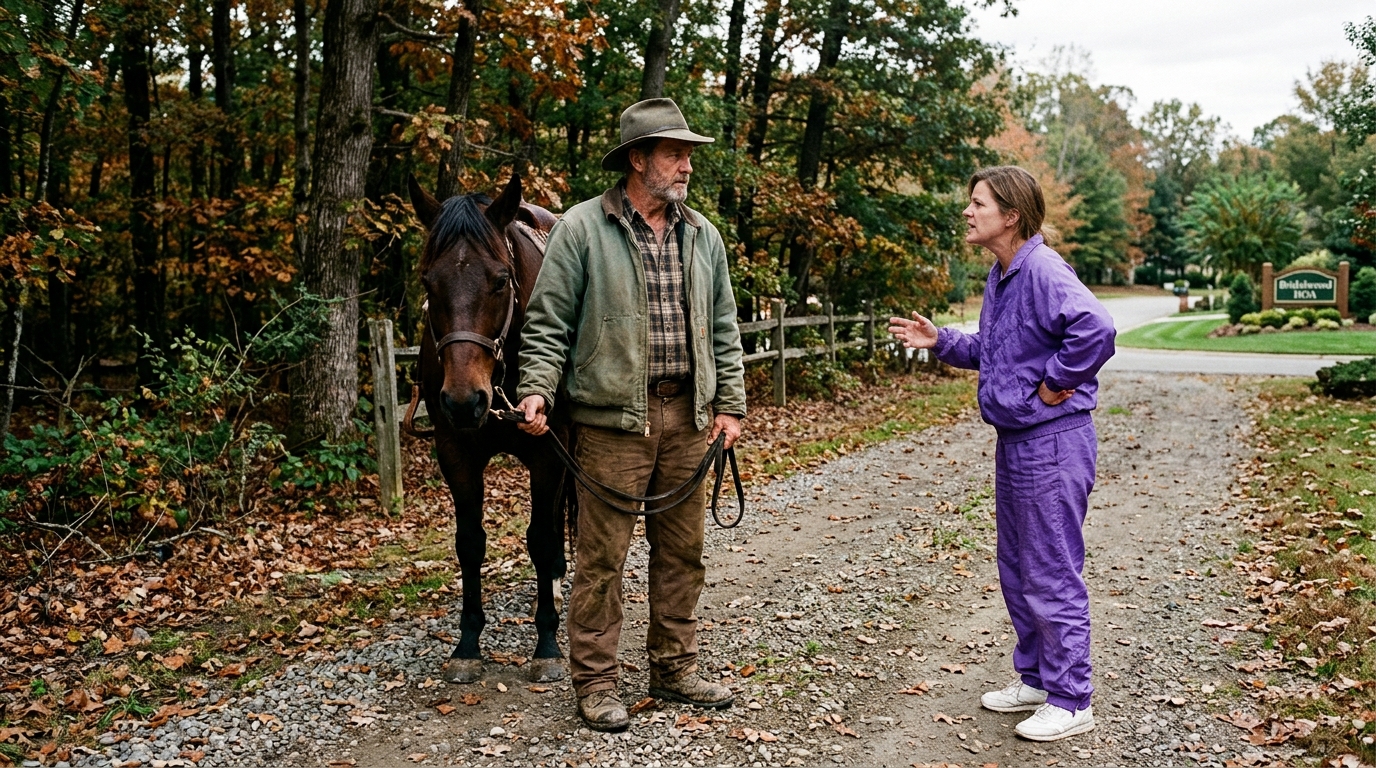
Karen Miller stood with her boots planted wide on the gravel shoulder, her pink tracksuit stretched tight over an aggressive posture.
She held a sheath of papers like a medieval proclamation of war.
I sat easily in the saddle, feeling Valor shift his weight beneath me against the stone embedded in the trail.
The Bridalwood Heritage Path had survived two centuries of history, and it wasn’t going to be flattened by a suburban tyrant with a clipboard.
“The vote was unanimous,” Karen snapped, her voice carrying across the crisp morning air. “We start paving on Monday, Mr. Evans.”
I kept my voice flat and measured, channeling decades of practical command experience rather than rising to her bait.
“This trail is not HOA property, Karen,” I said, adjusting the leather reins in my left hand. “It is private deeded land protected by a state conservation agreement. You cannot pave it.”
She snorted dismissively, waving her papers as if swatting away a fly.
“Our attorney calls it an implied easement, and the community has voted for improvement.”
Her certainty was absolute, built entirely on unearned entitlement and a profound ignorance of property law.
I looked past her manicured expression toward the dense oak forest bordering my fifty-acre parcel.
“Your attorney is either incompetent or lying,” I replied evenly. “If a single piece of machinery crosses that fence line, it is criminal trespass.”
Her face flushed deep magenta as the thin veneer of community spirit slipped entirely.
“You will not threaten me,” she hissed, backing toward her golf cart. “If you interfere on Monday, the sheriff will remove you, and we will place a lien on your property.”
She whipped the cart around and sped off, leaving a plume of righteous dust hanging in the cold autumn atmosphere.
Valor let out a soft, low breath, sensing the sudden shift in my posture from passive observation to cold, methodical readiness.
I turned his head back toward the barn, my mind already calculating the precise documents needed from the flat file cabinet.
Anger was an inefficient luxury; preparation was the only tool that mattered.
CHAPTER 2: THE PAPER SHIELD
The study was bathed in the pale, slanted light of an autumn afternoon, smelling faintly of old paper, floor wax, and dry cedar.
I pulled out the heavy folder labeled deed and easement bridalwood, laying the contents across the massive mahogany surface with deliberate slowness.
There was no room for emotional static when dealing with institutional audacity.
The original survey map from a decade prior lay flat under my palm, its GPS coordinates and boundary stones marked in indelible red ink.
The Bridalwood path ran a full thirty feet inside my northern property line, completely insulated from the jurisdiction of Lakeside Meadows.
Yet Karen Miller’s paper-thin authority relied entirely on the assumption that nobody would bother checking the county archives.
I opened the multi-page state conservation agreement, my finger tracing the exact statutory clause prohibiting any surface alteration without written state consent.
Every word was a brick in a wall I had spent ten years reinforcing.
The phone on the corner of the desk buzzed once against the wood, a short, sharp vibration that broke the silence of the room.
It was an anonymous text message from an unsaved local number, containing only a grainy photograph of survey stakes being dropped near the edge of my treeline.
They weren’t even waiting for Monday morning.
The escalation was moving faster than anticipated, forcing a realignment of the defense long before the sun set.
I closed the folder with a quiet snap, stood up from the leather chair, and walked over to the front window.
Down the gravel drive, the afternoon shadows were stretching long across the grass, hiding the perimeter fence where the trespassers were already testing my boundaries.
CHAPTER 3: THE BROKEN WARNING
The gravel driveway crunched beneath my boots as I walked toward the F-350, the engine block still radiating faint residual heat from the morning chores.
Karen Miller’s subdivision sat just across the tree line, its pristine, winding asphalt streets gleaming under the pale afternoon sun like a monument to artificial order.
I didn’t bother calling ahead or scheduling an appointment.
Formalities were wasted on someone who treated boundary lines as personal suggestions.
The envelope containing the formal cease and desist sat heavy in my pocket, its thick bond paper carrying the weight of recorded law.
When I pulled up to her executive-model house, the faux-Tuscan fountain in the front yard was splashing water over its artificial stone rim with irritating monotony.
I walked up the paved walkway past the oversized American flag and pressed the brass doorbell twice.
The chimes echoed inside before the door cracked open a few inches, revealing Gary’s pale, apologetic face peering through the gap.
“Mr. Evans,” he stammered, his eyes darting anxiously toward the interior hallway as if expecting an invisible reprimand.
“Who is it, Gary?” Karen’s voice boomed from the deep interior of the house, sharp and laden with preemptive contempt. “Is it that man?”
Gary flinched, his shoulders curling inward.
Before he could offer an excuse, Karen shoved past him, filling the doorway in a vibrant purple tracksuit with her hands locked tightly on her hips.
“What do you want now?” she demanded, her chin jutting out.
I pulled the envelope from my pocket and held it out toward her chest without a word.
“This is a formal legal warning outlining the property statutes and your board’s liability,” I said, keeping my tone flat and immovable.
She snatched the paper from my hand with a theatrical swipe, her eyes scanning the first lines with exaggerated disdain.
“More of your worthless paperwork,” she scoffed, though a brief flicker of uncertainty crossed her features before being buried under pure arrogance.
“Our attorney says the implied easement stands, and your little threats mean nothing.”
Before I could remind her of the survey maps sitting back on my desk, she crumpled the legal document into a tight ball in her fist and hurled it at my boots.
“The paving happens on Monday,” she hissed, slamming the heavy wooden door hard enough to rattle the decorative glass panes.
I stood on the porch for a quiet moment, looking down at the crumpled paper resting on her welcome mat, realizing negotiation was entirely off the table.
She had chosen her ground, and it was narrower than she knew.
CHAPTER 4: THE IRON BARRIER
Dawn broke cold and hard on Monday morning, painting the sky the color of slate over the ridge line.
The low, guttural rumble of a diesel engine rolled across the open pasture before the sun had even cleared the top of the oak timber.
I stood by the kitchen window with a mug of black coffee, watching a bright yellow paving machine and a heavy gravel truck idle near the edge of the property line.
Karen’s golf cart buzzed behind them like an angry hornet, its occupant sporting a fluorescent hard hat over her pink tracksuit.
There was no time for hesitation or waiting on outside bureaucracy; the burden of defense rested entirely on the steel parked in my driveway.
I pulled on my field jacket, stepped out into the frosty air, and climbed up into the cab of the F-350.
The heavy diesel fired instantly, filling the quiet morning with a steady, dependable vibration that rattled the floorboards.
I drove the truck slowly down the gravel track, maneuvering the vehicle until it sat squarely across the narrow mouth of the disputed trail.
Cutting the engine plunged the clearing into an immediate, heavy silence broken only by the crunch of gravel as the paving crew’s foreman walked over.
“Got to ask you to move your rig, mister,” the weathered worker said, wiping his palms on a stained rag. “We’ve got a municipal work order to lay asphalt through here.”
From behind him, Karen’s shrill voice cut through the cold air like a siren.
“Don’t waste your breath talking to him—call the sheriff and have that truck towed for trespassing!”
I looked down from the driver’s window at the foreman, keeping my expression entirely neutral.
“That order is written on my private land, friend,” I said, my voice carrying cleanly across the hood. “Cross this line with machinery, and you’re violating property boundaries backed by recorded deeds.”
The foreman hesitated, glancing back at the vibrating asphalt rig and then over at the fuming HOA president.
“Lady, my company isn’t getting dragged into a property title fight,” he muttered, turning his back on her fury. “Shut the machines down; we’re sitting tight until they sort this out.”
Karen let out a choked gasp of absolute disbelief as her paid muscle abandoned the field without laying a single shovel of gravel.
CHAPTER 5: THE FALSE ARREST
Two patrol vehicles cut the engine simultaneously, their doors swinging open to deposit a pair of local deputies onto the gravel shoulder.
Senior Deputy Miller stepped forward first, his belt creaking under the weight of his gear as he sized up the blocked trail and the idle machinery.
Karen skipped past the paving crew like an aggrieved child, her face flushed with vindictive triumph as she intercepted the uniform.
“Officers, thank goodness you’re here—this man has parked illegally to block a public project and threatened my workers,” she shrieked, pointing a trembling acrylic fingernail straight at my truck door.
I killed the diesel, stepped down onto the hard earth, and kept my hands deliberately empty and visible at my sides.
“The vehicle is parked entirely within my private property boundaries, Deputy,” I said, my voice cutting through her manufactured panic with calm precision.
Karen scoffed loudly, tossing her head back.
“He’s lying, he’s unstable, arrest him right now for trespassing on community land!”
Deputy Miller held up a heavy palm, silencing her outburst before turning his attention directly to me.
“Can you back that claim up with property records, sir?”
I reached into my inner jacket pocket and pulled out the crisp, organized binder containing the county tax assessment maps and recorded deeds.
“Every square inch of this trail for twenty feet past that fence is covered under my recorded parcel,” I replied, handing the binder across.
The younger officer, Deputy Chen, flipped through the tabbed pages, his eyes tracing the red boundary lines before nodding slowly to his partner.
“He’s right, Miller,” Chen muttered, pointing to the official stamp from the county clerk. “This land isn’t HOA property at all.”
Karen’s jaw went slack, the color draining instantly from her face as the ground beneath her frantic authority vanished.
“That’s impossible, our attorney said—” she stammered, her voice cracking under the sudden weight of exposure.
“Your attorney gave you garbage advice, ma’am, and calling in a false emergency report over a property dispute is a serious criminal offense,” Deputy Miller said, his tone turning granite-hard as he stepped past her toward his cruiser.
The assembled neighbors murmured amongst themselves, watching the narrative instantly implode upon the unyielding rocks of public record.
CHAPTER 6: THE DUSTY GRAY AFTERMATH
The financial records laid bare across the timber surface told a blunt, unyielding story of greed, fake shell corporations, and systematic neighborhood embezzlement.
Gary Miller’s signature on the unauthorized bank accounts stood out in stark ink, tying the suburban tyrant’s meek husband directly to the theft of over one hundred thousand dollars in community funds.
There was no grand courtroom speech left to give, and no dramatic confession wrung from the antagonist.
Karen had chosen to double down, screaming corruption and staging a final desperate tantrum before county economic crimes investigators placed her in handcuffs outside the community clubhouse.
The weight of her own manufactured crisis collapsed the structure from within, leaving her network of kickbacks and fraudulent paving contracts to dissolve under public scrutiny.
The neighborhood board dissolved its old guard, replacing fear with transparency and clearing away the bogus fines that had terrorized families for years.
I walked out onto the front porch as twilight settled over the valley, the cool autumn air carrying the quiet scent of damp earth and woodsmoke.
Stepping down into the pasture, I whistled softly, and Valor ambled over from the fence line, his warm flank shifting against the dusk.
I settled my boots into the stirrups and gathered the leather reins in my hands, feeling their familiar, unyielding texture.
Guiding him down the Bridalwood path, the earth beneath his hooves remained rugged, natural, and completely untouched by asphalt or artificial design.
The houses of Lakeside Meadows flickered with quiet window lights through the trees, no longer a hostile fortress, but simply neighbors living alongside a quiet border.
Some things didn’t need to be paved over or controlled to have value; they only required the stubborn common sense to let them endure.
I turned Valor back toward the warm lights of the barn, breathing in the quiet stillness of a victory carved out of pure, uncompromising endurance.