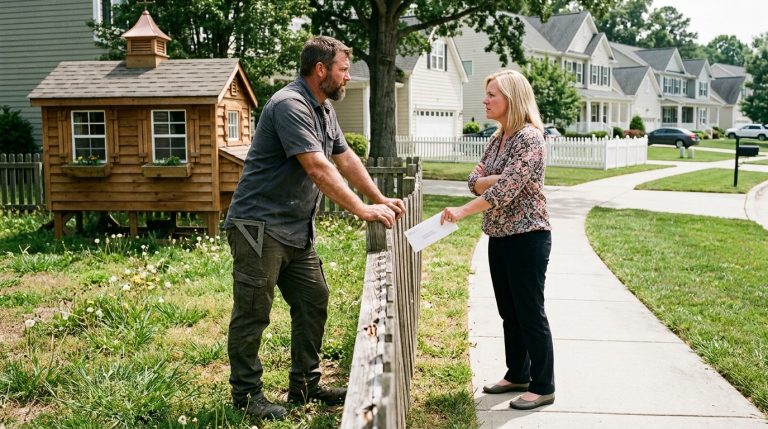
The Survey of Consequences: A Veteran’s Methodical Siege Against a Petty Tyrant’s Fractured Kingdom
CHAPTER 1: The Morning Incursion
The humidity clung to the cedar fence like a damp wool coat. Ten feet, she’d said. The number hung in the air, a geometric absurdity that defied the iron pins buried six inches beneath the soil.
Karen Miller stood on my lawn, her pastel pink tracksuit vibrant against the muted green of the lawn. She held a clipboard like a weapon, her fingers white-knuckled around the plastic. Behind her, the community green belt stretched out—a nondescript patch of grass that she treated with the reverence of a sovereign border.
“Thirty days, Mr. Thompson,” she repeated, her voice dripping with the kind of condescension that only comes from decades of unchallenged authority. “The HOA doesn’t make suggestions. We issue mandates. Move it, or we will remove it at your expense.”
I took a slow sip of my coffee. It was lukewarm, but it grounded me. My mind wasn’t in Oakmont Estates anymore; it was back in the Corps of Engineers. I was analyzing her posture, the tension in her neck, the way her eyes scanned my property not for boundaries, but for weaknesses. She wasn’t looking at the fence. She was looking for a reason to break me.
“Thirty days,” I echoed, my voice steady, stripped of the reflexive anger she was fishing for. I didn’t look at the fence. I looked at her. I watched the way her eyes flickered, disappointed by my lack of a flare-up. She wanted a performance. She wanted me to shout, to wave my arms, to validate her position as the neighborhood’s undisputed arbiter of reality.
“The invoice for the demolition will be attached to your quarterly dues,” she added, her tone softening into a syrupy, patronizing hum. “It’s for the good of the aesthetic consistency of the street, Mike. Surely, you understand.”
“I understand the plat survey,” I said, my voice quiet. “I have it in the office. Every pin accounted for.”
She didn’t blink. She didn’t check her clipboard. She simply smirked, a tight, thin-lipped expression that reached nowhere near her eyes. “Your survey is your opinion, Mr. Thompson. The HOA’s master plat is the law.”
She turned, her movements heavy, and marched toward the sidewalk. Each step she took on my lawn felt like an intentional bruise. I stood on the porch, the coffee mug heavy in my hand, and watched her go. I didn’t feel rage. I felt the familiar, cold clarity of an operation beginning. The threat wasn’t the fence. The threat was her belief that facts were optional.
As she reached the curb, she paused, glancing back at the oak tree in our backyard—the one we’d moved here for—as if she were already measuring it for a fine. I didn’t yell. I didn’t protest. I turned back into the cool, silent dark of my house. The file cabinet in the office hummed with the weight of hard data. My war wasn’t going to be fought on the lawn. It was going to be fought with documentation.
I set the mug down on the counter. The kitchen was quiet, but in the distance, I could hear the faint sound of a neighbor’s lawnmower—a rhythmic, grinding metallic whine. It sounded like an engine warming up. I checked my watch. 8:30 AM. Operation Quiet Fence had officially commenced.
I pulled the manila folder from the top drawer of the military-issue cabinet. The paper felt crisp, substantial, and utterly unyielding. I didn’t need to yell to win this; I just needed to be right. And according to the iron pins beneath the earth, I was.
But as I unfolded the survey, a shadow fell across the desk—not from the window, but from the realization that Karen hadn’t just made a mistake. She had looked at the property line, looked at my house, and chosen to lie. The question was, what was she hiding behind that lie?
CHAPTER 2: The Audit of the Office
The rollers of the gray metal cabinet groaned as I pulled the drawer open, a sound like grinding teeth in the quiet air of the home office. It was a relic of my time in the Corps—a piece of industrial furniture built to withstand the humidity of the tropics and the grit of the desert. It stood in the corner of this room like a sentry, its paint chipped and worn, contrasting sharply with the pristine, suburban comfort of the rest of the house.
I pulled the file labeled 121 Oak Drive from the stack. The paper felt heavy, substantial in my hands. The smell of the room was distinct: a mixture of old paper, the dry, metallic tang of the file cabinet, and the faint, sweet scent of Sarah’s coffee brewing in the kitchen down the hall.
As I laid the survey on the desk, my hands moved with a familiar, mechanical precision. My mind drifted back to a tent in a dusty, sun-bleached valley twenty years ago. I remembered the weight of a transit level in my palm, the way the light shimmered off the scorched earth as we measured out the foundation for a bridge that would outlast the conflict. Everything relied on the base. If the base was wrong, the structure failed. It was the first rule of engineering, and it was a rule Karen Miller had clearly never learned.
My eyes traced the lines on the survey. 121 Oak Drive. The iron pins were marked with clinical accuracy, the coordinates verified by a state-licensed surveyor. The fence was set back, exactly as it should be, a buffer between my private property and the encroaching void of the “green belt.” Karen’s claim wasn’t just a mistake; it was an act of aggressive ignorance.
I pulled out a fresh legal pad. My handwriting was crisp, blocky, and devoid of unnecessary flair. I wasn’t writing a letter; I was writing a report.
Date: May 12th.
Time: 08:30.
Subject: Informal site visit by HOA President K. Miller.
Details: Verbal demand for fence displacement of 10 feet. Stated grounds: Community property encroachment. Assessment: Unsupported by current site survey and recorded plat.
I stopped, the pen hovering over the paper. The memory of her face, the rhinestone-studded glasses catching the morning sun, pushed against my calm. I could feel the ghost of a sergeant’s warning in the back of my mind—don’t let the opposing force dictate the rhythm of your heartbeat. I exhaled, a slow, controlled breath that emptied my lungs and steadied my grip.
Sarah appeared in the doorway, a silhouette against the bright light of the kitchen. She didn’t speak at first. She just watched, her eyes tracking the way I organized the files—the plat map, the closing survey, the deed. She knew that look. It was the look I wore when we were breaking camp, when every screw, every bolt, and every document had to be accounted for before we moved on.
“She’s persistent, Mike,” Sarah said, her voice soft, lacking the sharp edge of the morning’s anxiety. “I saw her talking to the neighbors down the street earlier. She was pointing at our yard. She’s already building her case.”
“Let her build,” I said, not looking up from the notepad. “She’s building on sand. If she wants to play the bureaucracy game, we’ll play it by the manual.”
I reached for the laptop, the screen lighting up the room with a cold, blue glow. I needed to see what the county had on file. If Karen was going to use the “Master Plat” as her sword, I needed to know exactly how dull that blade was. I began to pull up the county archives, the mouse clicking rhythmically against the desk. The office felt like a command center now, the mundane domesticity of our home pushed into the background.
My finger traced the digital boundary lines on the screen, comparing them to the hard copy of my survey. They matched to the millimeter. Karen didn’t have a claim. She had a narrative, and she was weaponizing it. I felt the familiar weight of a project landing in my lap. I didn’t want a war, but if the architecture of my life was being threatened, I would reinforce the foundation until it was immovable.
I saved the document to a folder labeled Operation Quiet Fence. The name felt appropriate. It wasn’t about shouting; it was about the quiet, brutal efficiency of truth. I stood up, the chair scraping against the floor, and looked out the window. Karen’s house sat at the end of the cul-de-sac, quiet and unassuming.
But I knew better. I had the survey. I had the plat. And as I stared at the distance between my property and hers, I felt the first real spark of a cold, calculated hunger. I wasn’t just going to defend the fence. I was going to dismantle the foundation of her authority, one verified line at a time.
CHAPTER 3: The CounterNotice
The heat of the afternoon had baked the asphalt of the driveway, and the air held that heavy, electric stillness that precedes a summer storm. My fingers brushed against the metal handle of the mailbox. It was cold, resistant, with a rusted hinge that complained with a high-pitched metallic shriek as I forced it open. Inside sat the envelope. It was thick, heavier than a single sheet of paper had any right to be, its edges crisp and sharp enough to nick the skin.
I didn’t open it on the porch. I didn’t want the neighborhood to see the reaction. Instead, I walked back toward the house, the envelope feeling dense, weighted with the self-important gravity of Karen Miller’s administration. My boots scuffed against the driveway—a sound that usually signaled the end of a workday, but now felt like the cadence of a march.
Inside the kitchen, the house felt too quiet. The air conditioning hummed a low, monotonous drone, a sharp contrast to the aggressive silence outside. I set the envelope on the island, right next to the legal pad I’d left behind. Sarah wasn’t in the room, but I could hear her in the living room, the muted sound of a book page turning. She was staying out of the way, giving me the space I needed to process the next move.
I reached for a letter opener—a thin, stainless steel blade I kept for opening packages. I slid it under the seal. It didn’t tear; it gave way with a clean, surgical precision. Inside was a formal notice of violation, printed on 24-pound bond paper that felt unnervingly stiff between my thumb and forefinger.
The text was a masterpiece of sterile, bureaucratic aggression. It cited Article 4, Section 2B, a bylaw so vague it could have been interpreted to ban the color of the sky if the board felt like it. It laid out the encroachment claim again, the words “undisputed fact” appearing with a frequency that suggested they were trying to convince themselves as much as me. The fine schedule was listed in a neat, descending table of terror—one hundred dollars for the first week, escalating by fifty for every subsequent seven-day period.
I felt a surge of something cold and sharp in my chest. It wasn’t fear. Fear was for situations where you lacked the tools to respond. This was just logistics. I walked over to the laptop, my shadow stretching long and thin across the hardwood floor.
I began to type. My words were stripped of personality, purged of the indignation I felt. This wasn’t a conversation; it was a deposition. Pursuant to the official property survey conducted by licensed state surveyor L.R. Henderson, license number 582-LS, our fence is situated entirely within the legal boundaries of 121 Oak Drive.
I paused, looking at the screen. The flickering cursor waited for the next move. I was playing a game of chess, but I was the only one in the room who understood the rules of the board. Karen wanted a screaming match. She wanted the “uncooperative veteran” who yelled until his face turned red, giving her the perfect photo opportunity for her next board meeting.
She wasn’t going to get it. I attached a high-resolution scan of my survey, the red boundary lines standing out like a warning sign. I added a delivery and read receipt request—a digital leash that would force her to acknowledge the truth of the document.
As I hovered over the “Send” button, a flicker of doubt crossed my mind—a ghost of paranoia. Did she already have the board? Did she already have the leverage? I looked at the mailbox through the window. The metal lid was still open, a small, dark hole in the side of the house. I could almost picture the next letter, the next fine, the next layer of the trap.
I clicked Send.
The computer pinged—a sharp, digital sound that seemed to shatter the stillness of the room. A delivery receipt pinged back ten seconds later. She was watching her inbox. She was waiting for me.
I closed the laptop and walked back to the kitchen island. I picked up the original letter, crinkling the stiff bond paper in my hand. It was a declaration of war, printed on expensive stationery. I grabbed my pen and took a fresh sheet of paper from the pad, writing down the time of the email response.
14:04. Correspondence sent. Documented.
I felt a strange, detached satisfaction. The escalation was locked in. I had moved my piece, and now, for the first time, I could hear the gears of her bureaucracy grinding in response. The storm outside finally broke, a sudden, violent crack of thunder vibrating through the glass of the window, followed by the hard, rhythmic drumming of rain against the roof. It was the sound of a reset, the world outside washing clean, even if the one inside was just beginning to gather grit.
I went to the garage to find my tools. If the fight was going to be about the fence, I needed to make sure that the fence was ready for anything. I didn’t know what was coming, but I knew that I would be the one to define the boundaries.
CHAPTER 4: The Archive of Discrepancies
The county records building smelled of a peculiar, dried-out time—a mixture of ozone from the servers, the sharp, acidic tang of decaying paper, and the relentless, suffocating absence of natural light. It was a place where history wasn’t lived; it was filed, stamped, and eventually forgotten. I had spent half my life in places like this, pulling schematics for projects that existed only on blueprints, and the familiarity of the environment did more to calm my nerves than any meditation could.
I walked toward the main desk, my boots clicking rhythmically against the polished, grey linoleum. The clerk, a man who looked as though he had been pressed between the pages of a ledger himself, didn’t look up from his screen.
“I need access to the subdivision files for Oakmont Estates,” I said, my voice cutting through the hum of the ventilation. “Specifically, the original development master plats from 1988 and the subsequent building permit history for the 100-block of Oak Drive.”
He grunted, typed a string of characters that looked like a secret code, and pointed toward the back of the room. “Microfilm is in the back left. Hard copies of the plats are in the rolling bins. You have two hours before we close.”
I didn’t waste time. I went straight for the rolling bins, my hands finding the familiar tab systems of the late eighties. I wasn’t looking for a fight; I was looking for the geometry of the lie. I laid the original master plat onto the drafting table. It was a massive, beautiful thing—a complex web of precise measurements, surveyor’s seals, and the kind of architectural certainty that makes a man feel secure in his purchase.
I pulled my copy of my survey from my briefcase and placed it side-by-side with the plat. They were mirror images. My fence was exactly where it was supposed to be. The green belt was a fixed, unchanging quantity. There was no “bulge,” no “encroachment” as Karen had suggested. Her map was a work of fiction, drawn by someone who treated property law as a negotiable suggestion.
But that was the secondary front. I moved to the permit archives, pulling the folders for the properties at the end of the cul-de-sac. I flipped through the pages until I found the 128 Oak Drive folder. My eyes scanned the documents, looking for the specific application from five years ago.
Permit #7721-B. Patio Extension. Miller Construction.
The diagram attached to the permit was crude compared to the master plat. It showed a rectangular footprint extending from the rear of the house. I pulled a ruler from my pocket, an old brass-edged tool I’d kept in my tool belt for years, and measured the dimensions against the scale indicated on the drawing.
According to the permit, the structure ended five feet from the property line. But I knew the house. I’d walked my dog past it every evening for six months. What stood there wasn’t a patio. It was a four-season sunroom—fully enclosed, with a foundation that clearly violated the setback requirements listed in the very document I was holding.
I leaned closer, the smell of the dust rising to meet me. The diagram was stamped with “Approved.” But the signature was hasty, a scrawl that looked like Frank Miller’s. I checked the inspection notes.
No final inspection recorded.
The realization hit me with the force of a physical blow. The sunroom hadn’t just been built without a proper inspection; it had been built on a foundation of misrepresentation. They had filed it as a simple patio to save on fees and avoid the scrutiny that a permanent addition would have triggered.
My heart rate didn’t spike, but my breathing deepened. This wasn’t just a neighborly dispute anymore. This was a structural vulnerability. If I could prove the addition was illegal, the entire weight of the county’s building code would come down on the Miller household. Karen wasn’t just defending her HOA kingdom; she was protecting a house of cards that a single building inspector could knock over with a flick of a finger.
I carefully copied the documents, the light from the overhead lamps glinting off the metal of the copier. Each page that emerged felt like a piece of ammunition. I gathered them into a neat pile, my mind already calculating the timeline. I didn’t need to be loud. I didn’t need to be aggressive. I just needed to file the right paperwork in the right order.
As I walked out of the archives, the late afternoon sun was hitting the pavement, the light sharp and blinding. The air outside was humid, thick with the scent of damp earth, but it felt cleaner than the air inside the records office. I slid the documents into my bag, the weight of them a comforting pressure against my side.
I was going to build a case that even the most stubborn HOA president couldn’t ignore. Karen had tried to drag me into a war of attrition, but she hadn’t realized that I didn’t just want to win. I wanted to verify the truth, and in the end, the truth always had the highest load-bearing capacity.
CHAPTER 5: The Witness in the Garden
The parking lot was a heat sink, radiating waves of shimmering distortion off the asphalt. I adjusted the strap of my messenger bag, the hard edges of the county-certified copies digging into my ribs. I had been planning to head straight home to organize the next phase of the offensive, but Bob Peterson was leaning against the fender of my truck, his posture slouched in that habitual way of a man who has spent forty years mastering the art of patience.
He wore a pair of soil-stained canvas work gloves and a faded baseball cap that shielded his eyes from the glare. As I approached, he didn’t move, though his gaze shifted to the bag over my shoulder.
“Found what you were looking for, Mike?” he asked. His voice was a gravelly rumble, seasoned by decades of neighborhood politics and the kind of quiet observation that only comes with age.
I stopped, my hand resting on the handle of the driver’s side door. The air around us felt charged, the humidity clinging to my skin. “I found enough to know that the map she’s using isn’t just wrong, Bob. It’s a work of fiction. And the foundation of that sunroom? It’s not even on the right side of the line.”
Bob didn’t look surprised. He let out a long, slow sigh, the sound disappearing into the hum of distant traffic. He pushed off the truck and stood straight, his knees popping audibly in the silence.
“She’s been pushing people for a long time, Mike. Ever since Frank got that clubhouse contract, she’s acted like the HOA charter was a private scroll she could rewrite whenever she felt the budget getting thin.” He gestured toward the horizon, where the hazy outline of the neighborhood sat behind a screen of oak trees. “She doesn’t just want the money. She wants the feeling of control. She thinks if she defines the boundaries, she owns the ground.”
“She doesn’t own this ground,” I said, my voice steady. “And she certainly doesn’t own the law.”
“Maybe not,” Bob countered, his expression shifting into something more guarded. “But she knows how to use the fear of the law against people who can’t afford to fight it. Look at Mrs. Gable. She didn’t have the money to challenge a lien, so she paid the fine and moved. Karen counts on that. She counts on people being tired.”
I looked at the older man, seeing the weariness in the lines around his mouth. It was a mirror of the exhaustion I’d seen in the eyes of everyone in the neighborhood. They were tired of the “aesthetic harmony,” tired of the pink notices, tired of the phantom authority that governed their front yards.
“I’m not tired, Bob,” I said.
He looked at me for a long moment, his eyes scanning my face with the intensity of an accountant auditing a ledger. He nodded slowly, pulling one of his gloves off to wipe his hand on his jeans. “I believe you. And if you’re planning to do something about it, I’ve got something you might want to see.”
“What is it?”
“She isn’t just taking money for fines,” he whispered, stepping closer, his voice dropping below the level of the surrounding street noise. “She’s been funneling the surplus into a private account under the guise of ‘neighborhood beautification.’ I tracked the annual reports. They don’t match the bank statements. Frank’s construction firm got the contract for the clubhouse, but look at the actual bank transfers. The money doesn’t stay in the community fund.”
The gravity of his claim hung in the air, heavier than the humidity. If he was right, this wasn’t just a petty tyranny over property lines. It was systematic financial fraud. The “decoy” of the property dispute was already starting to crumble, revealing the rot underneath.
“Do you have proof?” I asked.
“I have copies of the ledger entries,” Bob said, reaching into the bed of his truck to pull out a manila envelope. “I’ve been waiting for someone to come along who wouldn’t just fold when she tapped them on the shoulder. I think you’re that person, Mike.”
He handed me the envelope. It was thick, the edges soft from being folded and refolded. I took it, the texture of the paper telling me everything I needed to know. This was the missing link.
I looked at Bob. His eyes were hard, resolute. We were an unlikely alliance—a retired accountant who’d seen too much and a veteran who knew exactly how to dismantle an obstacle. I felt a surge of cold, calculated purpose. The battlefield had shifted. The fence was no longer the objective; the objective was the total reclamation of the neighborhood from a woman who had built her throne on nothing but intimidation and bad bookkeeping.
“I’ll see that this is used correctly, Bob,” I said.
“See that you do,” he replied, turning toward his own vehicle. “She’s not just a bully, Mike. She’s a desperate woman. And you need to be ready for what she does when the floor starts to give way.”
I watched him drive off, the envelope tucked securely into my bag against the county documents. The storm was coming, but I was ready for it. The foundation was being laid, and the truth was starting to take weight.
CHAPTER 6: The LaserGuided Revelation
The morning sun was already beginning to bleach the color out of the neighborhood, turning the lawns into flat, parched patches of yellow-green. I stood by the edge of my garage, the messenger bag still slung over my shoulder, feeling the presence of the documents against my hip like a sidearm. Across the driveway, the men from Sterling Geomatics were moving with the calm, practiced efficiency of people who dealt in objective reality.
Dave, the lead surveyor, adjusted the tripod, his hands moving over the complex, angular head of the total station. He looked like a man tuning a musical instrument, though the only music here was the hum of servos and the occasional, sharp beep of the laser.
Karen’s front door opened before they’d even finished calibrating.
She stepped onto her porch, arms crossed over the pastel pink fabric of her tracksuit. She was playing the part she had cultivated for years—the aggrieved leader, the victim of resident insolence. She didn’t march down to the fence this time. She stood on the edge of her domain, her eyes narrowed behind those rhinestone-studded glasses, watching the surveyors as if they were a nuisance she could swat away with a stern word.
I didn’t acknowledge her. I kept my attention on Dave.
“Start at the street-side pin,” I said, my voice cutting through the morning stillness.
Dave nodded, signaling to his partner who was holding the prism pole at the edge of my driveway. The laser beam, invisible to the human eye but captured in the steady, calculating logic of the machine, snapped the distance.
“Pins are exactly where the county records placed them,” Dave called out, his voice matter-of-fact.
Karen moved then, stepping off her porch and onto the grass. She walked with a stiff, measured gait, her heels sinking slightly into the soft earth. She looked at me, her face a mask of performative confusion. “Mike, this is an expensive waste of time. I’ve already shown you the plat. The HOA plat is the only one that matters here.”
“The county records don’t seem to agree, Karen,” I replied. I didn’t raise my voice. I didn’t need to. The precision of the survey was doing the talking for me.
Dave and his partner moved deeper into the yard, toward the back of our properties. As they neared the rear corner of the Miller sunroom, Dave paused. He looked at his tablet, frowned, and then moved to a different angle. He stood there for a long moment, staring at the screen, then motioned for his partner to place the prism right up against the edge of the sunroom’s foundation.
“That’s weird,” Dave murmured, but the wind carried it clearly enough.
Karen’s composure wavered. She took a step forward, her eyes darting toward the men. “What’s weird? Are you having trouble with the measurements?”
Dave didn’t answer her. He gestured for me to come over. I walked across the grass, the ground feeling solid and real beneath my feet. When I reached him, he turned the tablet toward me. The screen displayed a digital overlay—a grid of precise lines mapped onto the aerial view of our properties. The red line marking the boundary was straight, uncompromising. The wall of the sunroom, however, crossed over it by a significant margin.
“You see that?” Dave asked, tapping the screen with a gloved finger. “The foundation is over the line by nearly four feet at the rearmost point. It’s a triangular encroachment. It doesn’t even square with the house. It looks like they poured this and just kept going until they hit the limit of their vision.”
My gaze shifted to the wall of the sunroom. Seen from this angle, with the boundary line virtually projected onto it, the error was glaring. The siding was cheap, the windows slightly uneven—the kind of work that screams of a contractor who didn’t want the building inspector to linger too long.
Karen had reached us, her breathing slightly ragged. She leaned in to look at the tablet, and for a second, the mask of the petty tyrant cracked. The fear was raw, unvarnished. She looked at the screen, then at the house, then back at me.
“That’s a glitch,” she whispered, her voice failing to sustain its usual authority. “Your equipment is calibrated wrong. I have a plat that says—”
“You have a drawing, Karen,” I said, my voice cold. “I have a certified survey. And now, I have proof that your structure is a trespass.”
The silence that followed was suffocating. She stood there, trapped between her imaginary kingdom and the hard, iron-bound reality of the land. She looked toward her house, then toward the street, as if hoping for a neighbor to pull up and intervene, but the cul-de-sac was silent.
She turned on her heel and retreated toward her home, her movements no longer ponderous or authoritative. She was scrambling. I watched her go, knowing that the foundation of her entire life—the house, the HOA, the influence—was currently tilting.
I looked back at Dave. “Are you sure about these coordinates?”
“Within half an inch, Mr. Thompson,” he said.
I nodded, the weight of the moment settling over me. The trap wasn’t just set; it had been sprung. She had tried to steal a sliver of my yard, and in the process, she had handed me the deed to her own house’s destruction.
CHAPTER 7: The Tribunal of Oakmont Estates
The clubhouse was a cavernous, poorly ventilated space that always smelled of floor wax and stale coffee. Tonight, it felt smaller, compressed by the weight of a hundred residents who had packed into the folding chairs, their faces illuminated by the eerie, flickering glow of my laptop screen. The projector fan whirred—a steady, rhythmic protest against the heat.
I looked out at the rows of people. There was Mrs. Gable in the third row, her hands knotted in her lap. There was the Rodriguez family, leaning forward with an intensity that bordered on hunger. And there, sitting at the head of the long folding table, was Karen.
She wore black. It wasn’t the pastel pink of a neighborhood leader anymore; it was the severe, defensive armor of a woman who knew the walls were closing in. Her eyes were fixed on the tabletop, though she occasionally flicked a glance toward the back of the room, scanning for an exit that didn’t exist.
“Thank you all for coming,” Tom Albright, the treasurer, said into the microphone. His voice cracked, high and thin. He looked like he’d aged five years in the last week. “We are here to discuss a… sensitive property dispute involving the board and a resident.”
“Let Mike speak!” someone shouted from the back. It was Bob Peterson. His voice carried the authority of a man who had been here since the foundation was poured, and it acted like a starter pistol for the room. The murmur of agreement swelled, a low, tectonic shifting of the crowd’s mood.
I didn’t wait for Tom to grant me permission. I stepped to the podium and clicked the first slide. A high-resolution image of the pink violation notice—the very one she’d taped to my door—filled the wall.
“This is how it started,” I said, my voice steady, amplified by the speakers until it felt like it filled every corner of the room. “Not with a conversation, not with a collaborative solution, but with a threat.”
I moved through the slides with the mechanical efficiency of a briefing. The crude, hand-drawn map. The formal letters filled with legal jargon. The escalating fines that served no purpose other than to drain the bank accounts of residents who were too intimidated to fight back. As I reached the slides detailing the county’s official plat map, the air in the room grew heavy. People were leaning in, their eyes darting between the screen and Karen, who had gone perfectly still, her face a rigid, pale mask.
Then, I hit the final slide. The Sterling Geomatics survey. The red triangle of encroachment—37.5 square feet of illegal construction—lit up the back wall, casting a long, jagged shadow over Karen’s head.
The room erupted. It wasn’t just anger; it was the release of years of built-up pressure. There were shouts, accusations, and a chorus of disbelief that seemed to vibrate the very frames of the building.
“She’s been fining us for paint colors while she built an entire room on someone else’s property?” a voice cried out from the middle of the room.
Karen stood up then, the chair scraping violently against the linoleum. “That is a distortion!” she shrieked, her voice fraying at the edges. “The room is a temporary structure! It was a misunderstanding of the plat! This is a malicious, personal vendetta designed to destroy the aesthetic harmony of our community!”
“It’s not an aesthetic issue, Karen,” I said, my voice dropping, gaining a weight that silenced the room. “It’s a structural fact. You built it on land that wasn’t yours, using a permit you filed under false pretenses. You didn’t just break the rules; you broke the law.”
The board members looked like they were suffering from vertigo. Tom Albright clutched the edge of the table, his knuckles bone-white. The realization of their own liability—of the money they had authorized, the threats they had co-signed—was finally sinking in. They looked at the projector screen, then at the crowd, and finally, at Karen.
The shift was almost instantaneous. The board, once her loyal guard, recognized the sinking ship.
“I move for an immediate vote of no confidence,” Tom said, his voice stronger now, driven by the cold, hard instinct of self-preservation. “And for an immediate audit of all HOA funds managed by the Miller administration.”
The vote was a landslide. A forest of hands rose into the air, a sea of fingers pointing toward the door. Karen looked around the room, her eyes wide, searching for a single person who might stand with her, but she found only the cold, hard stares of the people she had spent years trying to command.
She didn’t wait for the formal vote to conclude. She snatched her purse from the table, the zipper snagging on the edge of the wood, and shoved her way toward the door. She didn’t look at me. She didn’t look at the screen. She fled into the humid night, the door swinging shut behind her with a final, echoing thud.
The room didn’t erupt in cheers. Instead, a heavy, exhausted silence followed—the kind of silence that happens when a fever finally breaks. I looked at the screen one last time, the red triangle still glowing, a perfect, mathematical indictment of the lies that had kept the neighborhood in the dark for so long. The project wasn’t over, but for the first time, the foundation of the community felt solid again.
CHAPTER 8: The Truncation
The sound of the reciprocating saw was a jagged, high-pitched scream that cut through the humid morning air, vibrating against the siding of my own home. I stood on my porch, my coffee mug cooling in my hand, and watched as the crew from the demolition firm began the systematic removal of the Miller addition.
It was a slow, deliberate process. They weren’t just tearing it down; they were performing surgery on a mistake. Piece by piece, the exterior siding—the cheap, pale vinyl Karen had chosen to match the neighborhood aesthetic—was stripped away, revealing the hollowed-out bones of the structure. I watched as they cut through the wooden studs, the sawdust drifting like fine gold in the morning light.
It had been sixty days since the board’s emergency meeting, sixty days of silence from the end of the cul-de-sac. Karen had retreated into her fortress, but the clock of the law was indifferent to her pride. She had tried to fight it with legal motions and empty threats, but Jessica’s team had dismantled every one of them. The truth of the survey was an absolute. It didn’t care about community harmony or aesthetic mandates. It only cared about where the iron pins were buried in the earth.
Frank Miller was standing by his truck, his face a mask of impotent, simmering rage. He didn’t look at me. He kept his eyes fixed on the demolition crew, his hands clenched so tightly in his pockets that the knuckles were white. He was a man watching his financial foundation being jackhammered into rubble. The audit of the HOA had been as thorough as Bob Peterson predicted; every questionable contract, every inflated invoice, and every penny siphoned into Miller Construction’s failing accounts had been laid bare for the residents to see.
The community had moved on, but the scar remained. A four-foot-wide section of the rear wall and a portion of the side were gone, exposing the interior of the sunroom. Through the gaps in the framing, I could see the remnants of her life—a stack of magazines, a dusty chair, the debris of a room that was never meant to exist. It was a bleak, haunting sight, a physical manifestation of a hubris that had eventually cost them everything.
By midday, the concrete slab foundation was being torn up. The jackhammer made a rhythm that thumped in my chest, a relentless, grounding pulse. The earth beneath was damp and dark, finally seeing the light of day after years of being hidden under illegal stone.
Sarah stepped out onto the porch, her hand resting lightly on my arm. She didn’t say anything, but her presence felt like the cooling of the air after a long, intense heatwave. We had weathered the storm. We had held our ground, not because we were looking for a fight, but because we knew that if we let this go, we would never truly be at home here.
“Is it done?” she asked softly.
“It’s being corrected,” I said.
The foreman, a man with a thick neck and dust-caked skin, walked over to the edge of the property line. He wiped his brow with a rag. “We’re going to be done by the end of the week, Mr. Thompson. The city inspector’s coming by on Friday to sign off on the new setback requirements. It’s going to be four feet smaller than the original footprint, but it’ll be legal.”
“Good,” I said. “That’s all I wanted.”
He nodded and walked back to the machine, the noise rising to a fever pitch. I walked down the steps and into the yard, moving toward the cedar fence. I ran my hand along the split rails. The wood was solid, steady. It felt like an extension of my own resolve. I had spent years building bridges in places where the ground shifted underfoot, but here, I had finally found solid earth.
I looked down at the spot where the iron pin was buried, hidden beneath the grass. It was a simple, unobtrusive marker, easily overlooked by anyone who didn’t know what to look for. But it was there, and it was true. It was the anchor for everything.
As the sun began to climb higher, the neighborhood started to wake up in a different way. A neighbor across the street was out washing his car, and he waved—not a curtain-nod of caution, but a genuine, easy gesture of recognition. The air felt lighter, stripped of the manufactured tension that had governed our lives for the past few months.
I walked back toward the house, my pace slow and measured. The conflict was over, but the peace felt different now. It wasn’t the fragile, unexamined silence I had hoped for when we first moved in. It was something more durable, something that had been tempered in the friction of the struggle.
I reached the porch and set my empty mug down. The house was quiet, but it was a warm, living quiet. Sarah was inside, the sound of music drifting through the open window—a soft, melodic tune that felt like the ending of a long, necessary work day. I lingered for a moment, listening to the rhythm of the neighborhood settling in, then turned and followed her inside. The fence held. Everything else could be rebuilt.