A Concrete Foundation of Lies: One Man’s Calculated Dismantling of a Suburban Tyrant’s Empire of Beige
CHAPTER 1: THE GRAY SCAR
The morning sun caught the edges of the slab, highlighting the crude, hurried work of the wooden forms. I didn’t run over there. I didn’t shout. I stood on the threshold of my driveway, the gravel settling beneath my boots, and felt that familiar, icy detachment—the same mental shutter that had locked into place when I was marking coordinates for bridges in a war zone where the ground beneath you was never truly yours.
The concrete was ten feet by ten feet of pure, unadulterated hubris. It was poured exactly over the steel cap of my well, effectively turning a functional, critical piece of industrial equipment into a tombstone.
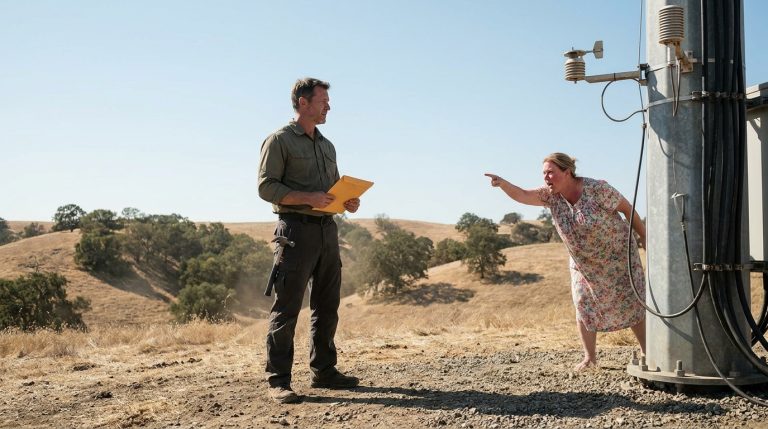
Karen was fifty yards away, watching from the safety of her sidewalk. She wasn’t hiding it. Her floral print blouse was a splash of aggressive color against the neutral, beige aesthetic of her world, and her hands were perched on her hips with the smug, self-satisfied weight of a tyrant who had just executed a coup. She didn’t expect the silence. She wanted the rage. She wanted me to storm over there, to scream, to give her the ammunition to call the police and play the victim of a volatile, unhinged neighbor.
I took a slow breath, the air tasting of wet limestone. My eyes moved past her triumphant expression, scanning the scene. My security camera, which should have been beaming a high-definition view of this exact spot to my server, hung at an awkward, unnatural angle. I shifted my gaze toward the fence post.
There it was. The coaxial cable, thick and black, hadn’t been pulled loose by the wind or an animal. It had been snipped. A clean, surgical cut, precisely measured to blind the lens just before the trucks rolled in.
A ghost of a smile touched my lips. She hadn’t just poured a slab; she had committed a felony, and in her eagerness to bury the well, she had revealed the precise depth of her obsession. She thought she was building a monument to her HOA covenants. She didn’t realize she was handing me the blueprint to her own destruction.
I turned my back on her, refusing to give her the satisfaction of a confrontation. The concrete was just the beginning. I had twenty years of Army engineering in my blood, and I knew a fundamental rule of structural integrity: you don’t fight a load-bearing wall with a sledgehammer. You find the one critical point of failure, the single stress point that, once compromised, brings the whole structure down under its own weight.
I walked back to my truck, my mind already calculating the variables. As I reached for the door, I caught a glimpse of a distinct sneaker print pressed into the damp concrete near the edge of the slab.
I left her there on the sidewalk, admiring her gray square, unaware that she was already standing on a trap.
CHAPTER 2: THE SILENT INVESTIGATION
The sneaker print was not just a mark in the concrete; it was an invitation. I knelt, my knees pressing into the gravel, and pulled a small high-intensity penlight from my pocket. In the low angle of the morning light, the tread was startlingly clear. It wasn’t the footprint of a construction worker. It was the distinct, arch-heavy imprint of a high-end designer walking shoe—a specific, vanity-brand sneaker I’d seen Karen wearing on her power walks a dozen times.
A memory flared: the dry, heat-shimmering silence of a desert outpost, the kind where you hear a pebble slide twenty feet away and know exactly what it means. It was a phantom, an intrusive thought that bypassed logic and went straight to the adrenaline centers. In that silence, I didn’t just see a footprint; I saw the arrogance that produced it. She hadn’t even bothered to wear work boots. She had treated the destruction of my property with the same casual, proprietary dismissiveness one might use to rearrange a patio chair.
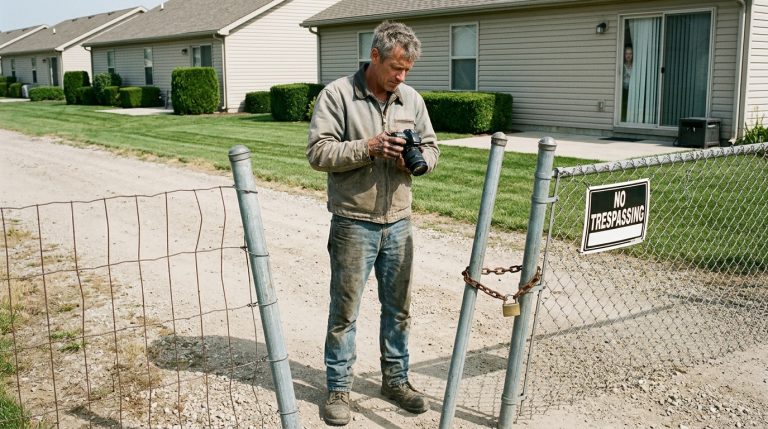
I didn’t move for a long time. I focused on the mechanical act of evidence gathering, channeling that desert-honed compartmentalization. My hand was steady as I pulled my DSLR from the bag. I adjusted the aperture, the lens glass clicking with a soft, precise finality that sounded deafening in the quiet of the morning.
I took the first shot: a wide-angle, capturing the slab in relation to the property line markers. Then, I moved in. I photographed the formwork, the crude, splintered wood still bolted to the concrete, a testament to a rush job done under the cover of darkness. I documented the tire tracks, shallow and indistinct in the dry earth, mapping their path toward the road. Every click of the shutter was a brick in a wall I was building, a wall she would eventually have to stare at.
My thoughts were no longer concerned with the well itself. The well was a static object, an asset; the system was the target. I was mapping the perimeter of her decision-making process. Why had she cut the camera cable? It was an act of premeditation, a tactical admission of guilt. She hadn’t just wanted the slab; she had wanted to hide the act of its birth. She knew the law, or at least she knew enough to fear the record of it. That fear was a vulnerability, a hairline fracture in her facade of absolute authority.
I spent the next hour working the scene with the rigor of a forensic engineer. I didn’t rush. I didn’t allow the anger—which remained a cold, distant hum in the back of my skull—to dictate my movements. Every photo was a piece of leverage. I measured the distance between the center of the slab and the survey pin with a steel tape measure, noting the exact coordinates in my pocket notebook. By the time I stood up, my lower back aching from the sustained crouch, I had a digital ledger that rendered her claim of “community improvement” entirely moot.
I stood and looked toward her house. The curtains remained closed, but I felt the weight of her observation. She was waiting for me to lose control, to tear at the concrete with my bare hands, to give her the theatrics she needed to justify the escalation.
I ignored her. I walked back to the truck, the gravel crunching with a rhythmic, predictable sound. I opened the door and set my gear on the passenger seat, not as a pile of equipment, but as a kit. I had the photographic proof of the trespassing. I had the physical trace of her presence. I had the clear proof of intentional obstruction—the cable.
I pulled out my phone and looked at the call log. I didn’t need a lawyer yet; I needed information. The HOA was a system, and like any system, it relied on a chain of authorization. The slab didn’t appear by magic; it was bought, paid for, and coordinated. Someone had poured it. Someone had sent the invoice.
I started the truck, the engine turning over with a steady, reassuring mechanical hum. I didn’t drive toward the exit of the neighborhood; I drove toward the county line, my route already mapped out in my mind. I was going to find the foundation, the place where this concrete was ordered. I was going to find the paper trail that led directly to her front door, signed in ink, and notarized by her own vanity.
The mission had shifted. It was no longer about a well. It was about exposing the corruption inherent in the authority she wielded. I glanced in the rearview mirror as I pulled away, catching one last look at the gray tumor on my pasture. It looked small now. It looked insignificant. I knew exactly how it would be removed, and I knew exactly who would be footing the bill for the jackhammers.
CHAPTER 3: THE LEVER
The records office was a cavern of fluorescent light and dead air. It smelled of pulverized cellulose, aging adhesive, and the kind of aggressive, institutional cleanliness that suggests time has been suspended. I walked to the counter, my boots sounding unnecessarily loud on the linoleum, and requested the original site plans for Whispering Pines. The clerk, a woman whose face seemed permanently etched with the weariness of a thousand property disputes, didn’t look up as she handed me a stack of requisition slips.
I found a desk in the corner, hidden behind a towering bank of filing cabinets, and began the labor. This was the work I knew best. After twenty years with the Corps of Engineers, I didn’t see paper; I saw systems. I saw utility grids, drainage gradients, and the invisible architecture that allowed a thousand suburban lives to function without a second thought. I wasn’t looking for a mistake; I was looking for an anchor.
For three hours, I waded through the history of the land. I traced the property lines of what used to be the old family farm before the developers moved in and subdivided it into beige perfection. I compared the current survey maps against the master utility blueprints filed in 1978. It was painstaking, eye-straining work—scrolling through microfilm that flickered with a persistent, dizzying hum. My neck cramped, and the bridge of my nose throbbed, but I pushed through, my focus narrowing until the entire world became a grid of ink on polyester film.
The deeper I dug, the more I noticed the oddities. The subdivision wasn’t built on a foundation of pure planning; it was built on a series of compromises. The terrain was challenging, rolling pasture that required complex drainage management. I saw red-lined notes in the margins of the original blueprints—engineers arguing over water pressure, fire hydrant placement, and the limitations of the local aquifer.
Then, I saw it. An appendix tucked behind a structural integrity report for the phase-one water main. It was a formal easement agreement, dated June 1980. The developer had been unable to meet the county’s stringent firefighting requirements for the far edge of the subdivision, where the topography prevented adequate gravity-fed water pressure. To bypass this, they had entered into an emergency contingency agreement with the adjacent landowner—the original farm.
My property.
The agreement granted the county and the fire department permanent, unencumbered access to the agricultural well on my land, designating it as a supplementary booster source for the hydrant network on Magnolia Circle. It was a fail-safe, a hidden plumbing artery that kept the community’s fire suppression system compliant with state codes.
I leaned back, the metal chair groaning under my shift in weight. The irony was cold and sharp. Karen had been waging a war against the very thing that provided the lifeblood of her street’s safety. Her obsession with the well being an “eyesore” had blinded her to the reality that it was a structural necessity. By pouring concrete over the cap, she hadn’t just vandalized my property; she had effectively disabled the fire suppression redundancy for her entire cul-de-sac.
I sat there, staring at the schematic. A strange, metallic taste filled my mouth—the taste of a plan coming together with the inevitability of a collapsing bridge. My initial goal had been simple: force her to pay for the removal of the concrete. Now, the scope had fundamentally changed. I wasn’t just dealing with a vandalism charge. I was dealing with a massive, multi-count public safety violation that reached all the way to the county Fire Marshal’s office.
I didn’t feel rage. The anger had evaporated, replaced by a crystalline clarity. This was the stress point. This was the leverage that didn’t just break her; it would dismantle the entire edifice of her authority. If she wanted a war over “community standards,” I would give her a war defined by the brutal reality of local fire codes.
I spent the next hour documenting the findings. I took photos of the easement agreement and the utility schematics with my phone, ensuring the dates and signatures were legible. I cross-referenced the fire hydrant locations on the site plan with the current map of the subdivision. The well fed directly into the main that serviced the houses on Magnolia Circle—specifically, the houses closest to the clubhouse and Karen’s own residence.
As I packed my bag, the paranoia began to set in. Every rustle of a file in the office sounded like an intrusion. I looked at the clerk, wondering if she knew what was contained in these boxes, wondering how many other homeowners had stumbled upon secrets they were never meant to see. I felt like a man carrying a live charge, the wiring already stripped and twisted, just waiting for the final connection to be made.
I walked out of the records office and into the harsh, humid afternoon heat. The sky was turning a bruised purple, and the air felt heavy, stagnant. I looked at my truck, parked in the lot, and for the first time, the neighborhood felt less like a collection of homes and more like a fragile, pressurized system held together by the very infrastructure Karen had so blindly sabotaged. The leverage was absolute. I had the fire code, I had the easement, and soon, I would have the Fire Marshal’s full, undivided attention. The first stage of the dismantlement was finished. Tomorrow, the pressure would begin to rise.
CHAPTER 4: THE SOFTENING
The phone felt heavy, a cold slab of glass against my palm. I sat in the driver’s seat of my truck, the engine ticked as it cooled, and the stillness of the parking lot pressed against the windows. I pulled the A1 Concrete contact information from my pocket notebook. My fingers moved with the practiced, steady rhythm of a man who had calibrated high-stakes negotiations before. I wasn’t going to be Mr. Davies, the aggrieved neighbor. I was going to be the auditor of a crime.
I dialed the number. Three rings. Four. The receptionist picked up, her voice pleasant, unburdened by the knowledge of the liability she was currently facilitating. I kept my tone breezy, professional, the mask of a potential client looking for a simple residential pour.
“Hi, this is Mr. Peterson,” I said, leaning back against the headrest. “I’m looking to get a slab poured for a generator pad over on the north side, and I was admiring a job your crew did over in the Whispering Pines development last weekend. Thought the work looked professional, specifically the way the forms were braced.”
The receptionist perked up. “Oh, we do quite a bit of work in Whispering Pines, Mr. Peterson. Let me see if I can get you over to Dave, the owner. He handles the scheduling for those custom residential jobs.”
A moment of hold music—generic, upbeat, and entirely out of place—and then the line clicked. A gruff, impatient voice broke through the static. “This is Dave. What can I do for you?”
I dropped the Peterson persona like a shedding skin. My voice lowered, losing the forced cheer. “Dave, this is Mark Davies. I own the property where your crew poured a 10×10 slab this past Saturday.”
There was an immediate, vacuum-like silence on the other end. I could hear him shifting, the sound of a swivel chair creaking, the sudden intake of breath that signaled the realization of a catastrophic mistake.
“I don’t know anything about that,” he said, the defensive tremor in his voice betraying him instantly. “My guys just go where they’re told.”
“Your guys committed felony vandalism and criminal trespass,” I countered, my voice flat, devoid of heat. “They cut a coaxial cable to my security camera, and they poured concrete over a critical, county-registered infrastructure asset. I have high-definition photographs of the entire process, including the truck, the crew, and the footprint of the individual who authorized the job.”
I let the silence hang there, giving the weight of the words time to sink into the drywall of his office. I knew the look on his face—the panicked calculation of profit versus liability.
“Look, Mr. Davies,” he finally said, his voice stripped of its earlier bravado. “I’m a contractor. I get a work order, I do the pour. I don’t ask if it’s on someone else’s land. If there’s an issue with the permit, that’s between you and the customer.”
“The customer is Karen Johnson, the HOA president of Whispering Pines,” I said, my tone clinical. “She signed your work order claiming it was community property. She lied to you, Dave. And now, you’re the one who provided the labor for a felony. I’m not interested in ruining your business, but I need the work order. I need the signed document that confirms who authorized the job and how the payment was handled.”
“I can’t just hand over client paperwork,” he stalled, but the flicker of panic had turned into a desperate, sweating compliance.
“You can hand it over to me,” I replied, “or you can hand it over to the county District Attorney’s office when they serve you with a subpoena. I’ve already spoken to the fire authorities regarding the fire safety easement that slab has compromised. The investigation is already shifting from a civil dispute to a public safety concern. Your signature is on the invoice, Dave. You’re the one who pulled the trigger.”
The threat was surgical, a precise application of pressure on his business’s jugular. He was a small operator; he couldn’t afford the legal fees or the stigma of being the contractor in a high-profile vandalism case.
“I’ll have my admin email it to you,” he whispered.
“Within the hour,” I said. “And Dave? Don’t call Karen. If she knows you’re cooperating, she’ll try to destroy the records at her end, and that will only complicate things for you. Do this right, and you’re just a witness. Do it wrong, and you’re a co-conspirator.”
I hung up before he could respond. The silence that rushed back into the truck cab was different than before. It felt lighter, cleaner. The leverage wasn’t just a theory anymore; I had the paper trail, and with it, I had the confirmation that Karen had not only acted alone but had done so with the hubris of someone who assumed she was untouchable.
I checked my watch. The hour was ticking. I was one step closer to turning her own weapon against her. I put the truck in gear and turned onto the main road, the dashboard lights glowing like the instrument panel of a cockpit. The target was in sight, and I had the coordinates.
CHAPTER 5: THE SIEGE
The clubhouse felt like a pressure cooker. The air was thick with the scent of damp wool and stale coffee, a suffocating humidity that amplified the tension radiating from the hundred or so residents packed into the folding chairs. Karen was at the front, draped in a red power blazer that looked less like a garment and more like a uniform of war. She held the microphone with a practiced, possessive grip, her eyes scanning the room, searching for the validation she fed on.
I walked to the back of the room, my presence a stone dropped into a still pond. People shifted, whispers rippled outward, and Karen’s gaze snapped to me, her lips curling into that thin, triumphant smirk. She was ready. She had spent the last hour painting me as the villain in her narrative of suburban peace, and she expected me to play the role—to shout, to lose my cool, to confirm her version of the “aggressive, litigious outsider.”
She didn’t know I wasn’t here to argue. I was here to present a structural failure.
“Mr. Davies,” she announced, her voice dripping with artificial warmth that didn’t reach her eyes. “I’m so glad you could join us. Perhaps now, in front of your neighbors, you can explain why you feel you’re above the aesthetic covenants of this community.”
The room’s collective gaze swung toward me, heavy and expectant. I didn’t say a word. I didn’t reach for the microphone. I simply walked down the center aisle, my movements deliberate, measured, and calm. I bypassed the podium entirely, moving toward the side wall where a blank, pale stretch of drywall waited. I reached into my bag, pulled out the projector, and set it on a nearby table with a series of efficient, practiced motions.
Karen’s smirk faltered, replaced by a momentary flash of confusion. “Mr. Davies, this is a community meeting, not a cinema,” she said, though her voice wavered slightly, losing its polished edge.
I didn’t answer. I plugged in the projector, the machine’s cooling fan kicking on with a soft, persistent whine that seemed to cut through the room’s agitation. I projected the first slide: the property survey. The red line of the boundary stood out with stark, surgical precision.
“This,” I began, my voice steady, carrying easily in the hushed room, “is a legal document. It is not an opinion, and it is not a suggestion.”
I navigated the slides. Every image was a cold, objective fact. The well cap before the incident. The raw, jagged concrete of the slab after. The signed work order from A1 Concrete, with Karen’s loops and flourishes at the bottom. With every click of the remote, the temperature in the room seemed to drop. The initial murmur of community loyalty began to fracture, replaced by the sharpening edge of curiosity, then the hollow, sickening thud of betrayal.
I watched their faces. I saw the moment the accountant, Arthur, realized he’d been misled. I saw the dentist, Dr. Albright, begin to shrink back into his chair. But I kept my focus on Karen. She stood at the podium, frozen, her red blazer now looking garish and loud in the stark light of the projector beam. She was trying to speak, to interrupt, to spin—but the facts were a closed system. There was no space in them for her performance.
“You told this community you were protecting their property values,” I said, moving to the final slide—the estimate for the removal and the professional well-drilling certification. “You told them you were acting for their safety. But you spent three thousand dollars of their money to commit a felony, and in doing so, you ignored the very infrastructure that keeps this subdivision operational.”
I didn’t need to shout. The projector did the work. The slides were the silent, damning witness to her arrogance. By the time I reached the final image, the room was so quiet that the hum of the projector sounded like a thunderclap.
Karen’s face was a mottled, furious red, her hands gripping the podium so hard her knuckles were white. “This is… this is a total fabrication!” she snapped, but the sound lacked the weight of authority. It was the desperate cry of a system failing to reboot.
I looked out at the room. The betrayal was palpable, a physical weight in the air. People were looking at their neighbors, then back at the podium, their expressions no longer those of loyal followers but of victims realizing they’d been fleeced. The siege had been successful; I hadn’t had to fight her, I had simply let the truth fill the room until there was no air left for her to breathe. I unplugged the projector, the beam of light collapsing into darkness, and left her standing there, exposed, in the sudden, deafening silence.
CHAPTER 6: THE COLLAPSE
The pumper truck dominated Magnolia Circle, its red paint gleaming like a fresh wound against the beige, manicured lawns of the neighborhood. It sat idling in front of the hydrant nearest to Karen’s house, the low, steady rumble of the diesel engine vibrating through the soles of my boots. Neighbors began to spill out of their homes, clutching coffee mugs, their faces etched with a dawning, frantic comprehension. They had watched the community meeting fall apart; now, they were watching the literal failure of their safety net.
I stood on the edge of my property, my weight shifted against the fence post, arms crossed. I didn’t need to say a word. I didn’t need to point.
Karen Johnson emerged from her house a moment later. She was wearing a pink velour tracksuit that seemed to shrink as she marched toward the fire crew, her face a mask of indignant, flustered confusion. “What is the meaning of this?” she shouted, her voice thin and reedy against the backdrop of the truck’s engine. “You can’t just block the street! We have rules here!”
Chief Miller stepped down from his white SUV. He was a man composed of granite and patience, and he didn’t even break his stride to acknowledge her. He gestured to his crew, and they moved with the seamless, robotic precision of men who deal in absolute outcomes. One firefighter opened the hydrant, the sound of rushing water filling the quiet street, while another attached the flow meter and a pressure gauge.
“Pressure’s low, Chief,” the technician shouted, his voice ringing out in the morning silence. “Barely forty PSI. Flow rate is abysmal. It won’t hit five hundred gallons a minute.”
Miller stood still, a tall, dark silhouette against the morning light. He made a note on his clipboard, his expression hardening into something glacial. “That’s a failure. Check the next one.”
Karen followed them, her steps growing more erratic as they moved down the street, testing every hydrant and receiving the same dismal report. Her authority was peeling away with every rejected reading. She tried to interrupt, tried to invoke the HOA board, tried to cite the bylaws, but the Fire Marshal didn’t even look at her. He simply treated her as an obstruction, a minor irritation in a technical process.
When they arrived at the hydrant nearest to my property, Miller finally turned. He walked directly toward me, the neighborhood watching in a sudden, breathless silence. “Mr. Davies,” he said, his voice level and clinical. “You reported a compromise to a critical water source. Can you show me the location?”
I nodded once, my movement minimal, and gestured to the concrete slab still sitting on my grass. “It’s under that, Chief.”
Miller looked at the concrete, then back at Karen, who had reached us, her breath coming in short, panicked gasps. He didn’t raise his voice, but the sudden stillness of his posture was terrifying. “Ma’am,” he said, “are you the president of this homeowners association?”
“I am,” she declared, her chest puffing out, though her eyes were darting around, searching for a defense that wasn’t there.
“That slab you authorized,” Miller said, his voice cutting through the humid air like a razor, “is currently encasing a county-approved emergency fire suppression pump. By obstructing this well, you haven’t just committed a civil nuisance. You have disabled the water pressure for every home on this street. You have made this neighborhood a fire trap.”
The silence that followed was absolute. I looked at the neighbors. They weren’t looking at me anymore; they were looking at Karen. The betrayal wasn’t abstract anymore—it was a tangible, existential threat to their homes, their families, and their bank accounts.
“The fines will be levied against the association,” Miller continued, scribbling in his citation book, his pen scratching with a sound that felt like a gavel coming down. “And a formal notice of risk will be filed with the county and every insurance provider in this zip code. You’ve just increased the liability for every resident on this street.”
Karen’s face, which had been bright red moments before, drained of all color, leaving her looking hollowed out and gray. She opened her mouth to speak, but no sound came out. The neighborhood was done with her. The insurrection began not with a shout, but with the collective, disgusted turning of backs.
I watched as the Fire Marshal finished his report, his demeanor reflecting the total, clinical collapse of Karen’s empire. She was standing in the middle of the street, completely alone. Her house, her title, her neighborhood—they were all still there, but her authority had evaporated, burned away by the simple, undeniable math of a pressure gauge reading forty PSI.
The denouement came in the days that followed. The jackhammers, when they finally arrived, were not a noise of aggression, but a sound of cleansing. I sat on my porch, watching as the concrete was reduced to dust and hauled away, chunk by chunk, revealing the polished steel of the well cap once more. It was a small, quiet victory, a restoration of the earth.
When the well was finally flushed, the pump re-tested, and the water flow restored to the hydrants, Chief Miller returned to give the final sign-off. He shook my hand, his grip firm and dry. “Everything is back to code, Mr. Davies. Thank you.”
The final piece was the quiet settling of the neighborhood. The new board, led by a man named Albright who seemed to vibrate with a perpetual, nervous apology, arrived on my porch with a check and a sincerity that felt like a fresh coat of paint on a weathered structure. I accepted it. I didn’t hold a grudge; I held the facts.
I walked to the end of my driveway and pulled the spray can from my pocket. The red paint was vibrant, a sharp, defiant hue that stood out against the late-summer grass. I touched up the mailbox, the strokes steady and deliberate. My property was quiet, the well was humming, and the road was my own again. The tyranny of beige had been broken, not by force, but by the relentless, cold application of the truth.