The Dusty Gray Border: How One Retired Veteran Outsmarted a Power-Tripping HOA Queen Without Firing a Single Shot
CHAPTER 1: THE ULTIMATUM AT THE FENCE LINE
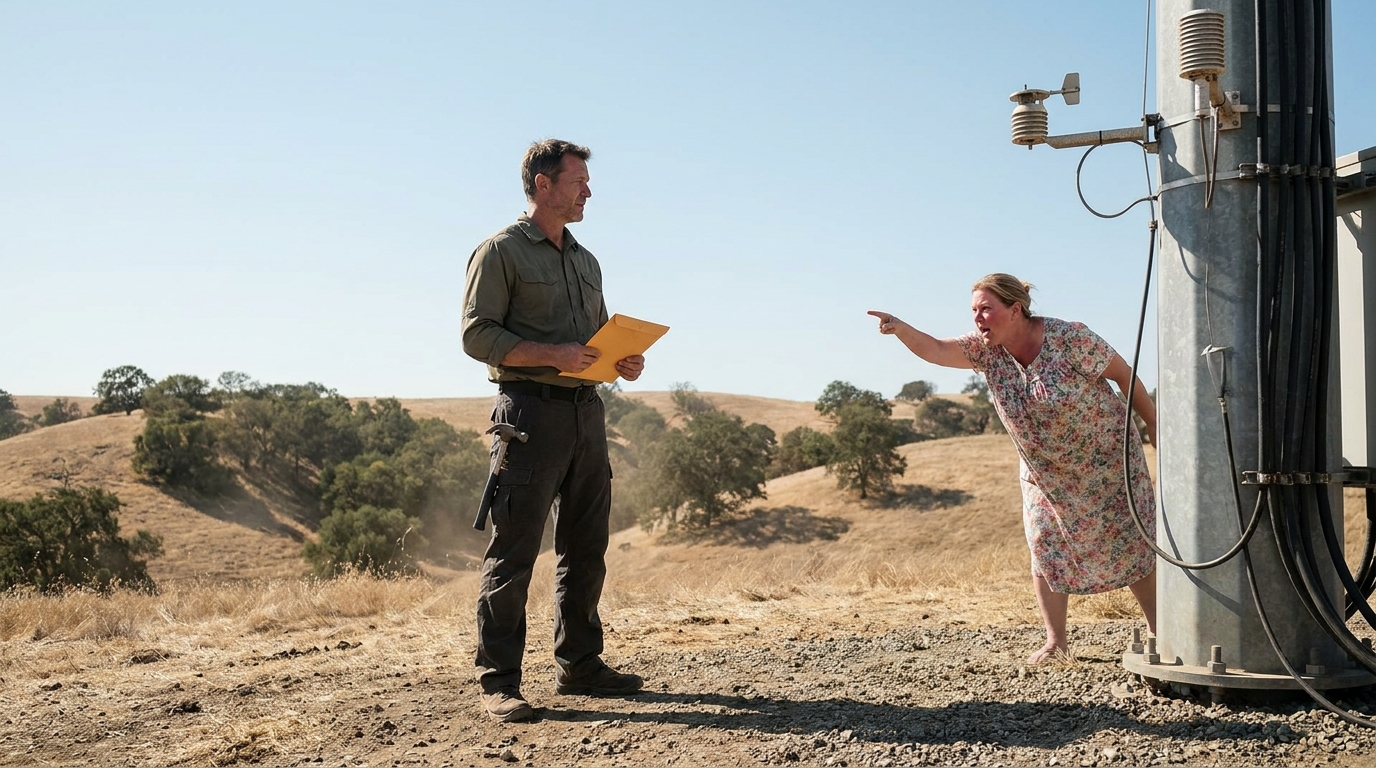
The hammer felt heavy in my palm, cold iron against bruised skin.
I didn’t turn around right away. When you spent twenty years in the Air Force dealing with communications infrastructure, you learned that an angry voice shouting from twenty paces away was just noise waiting for a signal.
“That ugly thing has to come down, Mr. Callahan, immediately.”
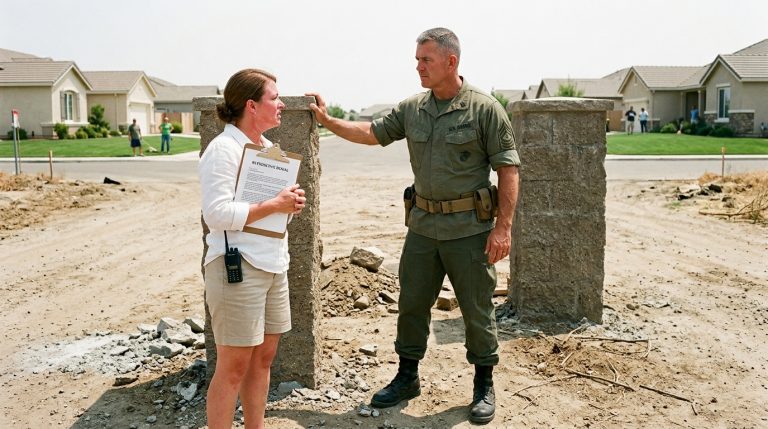
Her name was Karen, and she wore a floral-print mumu that strained against her hips like a cheap tarp in a gale. Her face was flushed the color of a bruised peach, eyes narrowed into thin slits of pure, unadulterated judgment.
She pointed a sausage-like finger past my shoulder toward the far corner of my ten-acre property.
The structure had stood there for fifteen years. It was a sleek, functional silo designed to blend into the rolling oak hills, hiding a high-gain relay tower that kept the entire valley connected.
“This is a planned community with aesthetic standards,” she spat, her voice climbing an octave. “That silo is a rustic eyesore. You have thirty days to remove it, or the fines will begin, and believe me, they will be substantial.”
She jammed a thick manila envelope against my chest.
The cardboard hit my shirt with a heavy, muffled thud, smelling faintly of cheap department store perfume and ozone. I took half a step back, my boots crunching into the dry gravel of the old trail.
“You can’t hide out here in the Wild West anymore,” she barked, turning on her heel toward her beige plastic golf cart.
I didn’t argue. I didn’t raise my voice.
Arguing with someone who believed a binder of bylaws was sacred text was like trying to explain radio frequencies to a fence post. I watched her climb back into her cart, the suspension groaning under her weight, and putter away down the dusty lane.
I looked down at the envelope in my hand.
The paper was stiff, embossed with the gold foil seal of the North Ridge Meadows Homeowners Association. Inside was a neatly printed list of grievances, citations, and an initial penalty designed to induce panic in anyone who didn’t know their rights.
I walked past the paddock toward the quiet shadows of my workshop.
The air inside smelled of pine sawdust, machine oil, and old iron—a clean, grounded contrast to the cloying scent she had left behind. I laid the envelope flat on my wooden workbench next to a half-assembled two-way radio chassis.
Military discipline isn’t about rushing into a firefight; it’s about pausing to assess the perimeter.
Karen had fired an emotional, noisy first volley, assuming I would fold under the weight of her paper threats. She thought she was dealing with a simple property owner who wanted to be left alone.
She had no idea she had just picked a fight with the man who held the master key to her entire digital world.
CHAPTER 2: GATHERING INTELLIGENCE IN THE DUSTY WORKSHOP
I pulled the second letter out from the thick cardstock, my thumb brushing against the embossed seal of the North Ridge Meadows Homeowners Association.
The fine had jumped to fifteen dollars, retroactive and compounded with daily penalties for defiance.
Karen’s words were typed in aggressive boldface, demanding immediate compliance or the threat of a foreclosure lean against the property.
I set the letter down next to a rusted copper wire stripper.
Panic was a luxury built for people who didn’t understand how systems worked.
A heavy fireproof steel cabinet stood against the back wall of the workshop, its green paint chipped from years of hard use.
I pulled the top drawer open, metal rollers sliding with a dry rasp, and drew out a thick file folder labeled with faded marker: Tower Lease & Access.
The original ninety-nine-year agreement with Omniink Telecom was inside, notarized two decades ago when this land was nothing more than open county brush.
My finger traced Section 7, the clause explicitly barring any local governing body or association from interfering with the structural and operational integrity of the relay facility.
Then came the federal preemption clause, citing the Telecommunications Act of 1996 like a steel beam holding up a roof.
Karen was trying to swing a plastic gavel against a federal statute.
My cell phone vibrated against the wooden surface of the workbench, shattering the quiet hum of the room.
I picked it up, seeing David Chen’s direct line flashing across the screen.
“They’re escalating, Jack,” David said before I even had the phone to my ear, his voice tight with corporate caution. “Our legal department just got wind of their intent to file a lien.”
“Let them file it,” I said, leaning back against the edge of the workbench.
“You want to give them more rope?”
“Enough to knit a sweater.”
CHAPTER 3: UNITING THE SILENCED NEIGHBORS
The map showed the dark red scar of the old cellular dead zone, a digital ghost town that existed long before the asphalt and cookie-cutter lawns arrived.
I closed the laptop lid with a soft click and stepped out into the crisp evening air.
If Karen wanted to treat the neighborhood like her private kingdom, she had forgotten that kingdoms built on petty fines always rested on brittle foundations.
Marcus answered my knock within three seconds, his driveway as clean as a military parade ground.
“You got the files?” Marcus asked, stepping back to let me into the garage where an American flag hung folded with crisp precision on a workbench.
“They’re filing a lien,” I said, leaning against a pegboard lined with tools. “Which means it’s time to bring the rest of the street together.”
Marcus crossed his arms, his jaw tightening into a hard line.
“Good. The Hendersons are ready, and so are the GarcAs down the lane. People are tired of walking on eggshells just to water their lawns.”
Two nights later, seven different households sat scattered across my living room.
Eleanor Henderson clutched her teacup with fingers that trembled slightly from suppressed anger, while young Mr. Garcia leaned forward on the sofa with his arms crossed over his chest.
“She came onto my property with a tape measure,” Eleanor whispered, her voice tight with indignation. “Just because my bird bath didn’t match the community palette.”
“She told me my kids’ laughter was a noise violation after eight o’clock,” Mr. Garcia added, shaking his head. “We had to paint their swing set a depressing earth-tone brown just to stop the warning letters.”
I stood by the whiteboard at the front of the room, uncapping a dry-erase marker.
“She isn’t enforcing rules,” I said, drawing a clean line across the board. “She’s enforcing compliance through isolation. But if we pull our records together, we stop being targets and start becoming a coalition.”
CHAPTER 4: THE REDACTED LEDGER DISCOVERY
Marcus leaned over the kitchen table, his finger tapping against the black marker lines obscuring the vendor payments.
“They didn’t just hide a line item,” Marcus said, his voice dropping into a low, flat rumble. “They drowned the whole ledger.”
“Because the trail leads right back to the family,” I replied, sliding the state business registry printout across the wood.
Lush Greenscapes LLC had been registered less than two years ago under the name of Karen’s brother-in-law.
The landscaping contract for the common areas was inflated by nearly forty percent, paid out monthly from the association account without a single competitive bid on record.
It wasn’t just a matter of petty neighborhood bullying anymore; it was an open financial funnel.
The silence in the room grew heavy, weighed down by the realization that the rulebook they used to fine us was a shield for their own illicit cash flow.
“If we take this to Sarah Jenkins,” Marcus muttered, his eyes narrowing on the paperwork, “we aren’t just defending your property line.”
“We’re blowing the top off the whole operation,” I said, picking up my phone to dial our attorney.
CHAPTER 5: THE COMMUNITY MEETING TRAP
Karen stood behind the folding table on the small riser, her magenta pantsuit cutting a sharp, self-important silhouette under the fluorescent hum.
She banged her wooden gavel twice, the sharp crack echoing across a room packed shoulder-to-shoulder with restless residents.
“The board has exhausted its patience with unapproved neighborhood structures,” she announced, her voice dripping with artificial sweet reasonableness. “We are here tonight to authorize formal legal action and ratify the property lien against 141 Oak Ridge Trail.”
Murmurs rippled through the front rows where her loyalists nodded in synchronized agreement.
I didn’t wait for her to call for a vote.
I stood up from the front row, picked up my laptop bag, and walked straight past the front table to plug my cord into the projector’s base unit.
“Before you call that vote, Madame President,” I said, my voice steady enough to carry without a microphone, “the community deserves to see the rest of the paperwork.”
Karen’s face flushed a deep, mottled crimson as my first slide flashed across the wall—the historical cellular dead zone map from twenty years ago.
“That structure you want torn down is a disguised relay tower,” I continued, turning to face the packed rows of neighbors. “It is the exact reason every single person in this room has full cell service today.”
A low wave of chatter broke out among the middle rows as people exchanged puzzled, uneasy glances.
“She has fined me over twenty-five thousand dollars and threatened foreclosure in direct violation of federal telecommunications law,” I said, clicking forward to display the redacted financial statements and the business registry for Lush Greenscapes LLC. “And she has hidden where your money went.”
Todd, sitting beside her as treasurer, turned the color of wet chalk and dropped his gaze to his lap.
“Could the treasurer explain why a no-bid landscaping contract was handed directly to the president’s family?” I asked, letting the silence drop heavy and suffocating over the room.
CHAPTER 6: THE DIGITAL DARK AGE AND THE FALL OF THE QUEEN
I hit the call button and switched the phone to speaker.
“Network Operations, this is Anya,” a crisp, professional voice echoed clearly into the silent room.
“Anya, this is Jack Callahan. Authorization code Delta 7 Alpha,” I said, my voice cutting cleanly through the quiet. “Initiate a five-minute diagnostic shutdown on tower 734.”
“Authorization confirmed,” her voice replied without hesitation. “Shutting down tower 734 in three… two… one.”
A collective gasp rippled through the community center.
One by one, screen lights flickered across the room as people pulled out their phones, staring at zero bars and red warning icons.
“I’ve got no service,” a man near Marcus muttered, holding his device up toward the ceiling.
“Mine’s dead too,” a woman two rows back called out. “What happened to the signal?”
I looked up from my phone straight at Karen.
Her face was a pale, frozen mask of absolute shock, her eyes fixed on her own silent screen sitting on the table like a useless plastic brick.
“That structure isn’t an eyesore,” I said, sweeping my gaze across the crowded room. “It is the only reason your phones work out here. And your president wants to tear it down out of sheer spite.”
“Order! This is not on the agenda!” Karen shrieked, slamming her wooden gavel against the folding table so hard the wood groaned, but her voice cracked under the weight of a hundred angry eyes. “You can’t do this!”
Marcus stood up to his full height, his broad shoulders blocking out the fluorescent light behind him.
“We’re making it the agenda,” Marcus boomed over her tantrums. “I move for an immediate vote of no confidence in President Karen and the entire board.”
“Seconded!” Mr. Garcia shouted from the third row.
A wave of hands shot into the air, an overwhelming majority sweeping through the room before Karen could even pick up her gavel again.
I lifted my phone back to my ear. “Anya, end diagnostic. Restore full power to tower 734.”
Within ten seconds, a cascade of chimes, buzzes, and notifications echoed through the hall as every device reconnected to the grid.
I stepped forward and dropped Sarah Jenkins’s formal cease-and-desist notice directly onto the HOA attorney’s lap, leaving him staring down at allegations of tortious interference and federal preemption violations.
The forensic audit that followed weeks later stripped away every layer of protection they had built, exposing the unbid contracts and the secret debit card charges straight to the district attorney’s desk.
Now, the afternoon sun sits low over the western ridge of my ten acres.
I pull the heavy hammer from my tool belt, line up the iron staple against the cedar fence post, and drive it deep into the wood with two clean, solid strikes.
The dry pine dust settles around my boots as I wipe the sweat from my brow with the back of my sleeve.
Up on the hill, shadowed against the pine trees, the sleek steel structure stands silent and tall, bathing the valley in clear, quiet signal.
I set the hammer on the fence rail, pick up my water canteen, and take a long, cold drink in the quiet air of my own land.