The Iron Ledger of Mirror Lake: Reclaiming an Ancestral Legacy from Bureaucratic Tyranny
CHAPTER 1: The Weight of Iron
The smell of dry earth and crushed shale rises through the floorboards of the old truck, mixing with the sharp scent of pine resin drifting off the timberline. I am standing at the edge of the 1887 dock, my boots flat against oak planks that have weathered a century of freeze and thaw. The water below is dead calm, a dark, reflective mirror holding the shape of the surrounding hills.
Then comes the crunch of expensive rubber on unpaved stone.
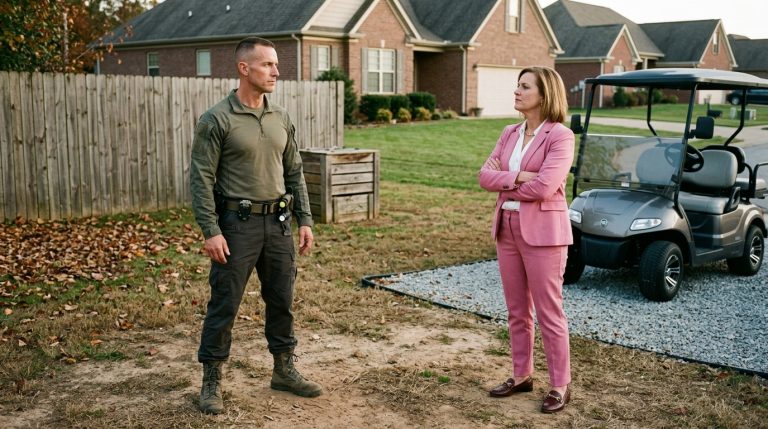
A white Escalade slews to a halt beside my bumper, brakes hissing with a clean, modern efficiency that feels entirely out of place against the timber-and-iron architecture of the property. The door swings open before the dust has even settled. Cordelia Blackwood steps out onto the gravel, her silver hair immaculately pinned, a designer blazer catching the flat afternoon light. She does not look at the water. She looks at the dock like a mechanic eyeing a rusted axle that needs condemning.
She clutches a heavy cream-colored envelope in one hand, the paper thick enough to hold a crease like sheet metal.
“You must be the new arrival,” she says. Her voice carries across the water, clean and leveled by years of courtroom practice. “I am Cordelia Blackwood. President of the Lakeshore Association.”
I don’t move my hands from the pockets of my canvas jacket. The air off the lake carries a sharp bite of iron, the ancient taste of the underground springs that feed the basin. My great-grandfather Silas built this dock with hand-forged spikes and cedar pilings hauled up by mule teams when this county was nothing more than timber claims and surveyor maps.
“Ezra Whitmore,” I say. “And this is private property.”
“Not according to the bylaws filed with the county clerk fifteen years ago,” she replies, stepping past the line of my truck. Her heels grind into the gravel with a dry, rhythmic crunch. She stops three paces short of the timber threshold, raising the envelope like an arrest warrant. “This structure violates baseline safety codes. Immediate removal is required within thirty days, alongside the standard five-hundred-dollar monthly access fee for non-compliant water users.”
She thinks the paper gives her weight. She thinks the printed letterhead creates an absolute boundary, an invisible fence built of ordinances and administrative code.
What she doesn’t know is what is sitting inside the breast pocket of my jacket—a stiff, yellowed piece of vellum signed in iron-gall ink by a county judge who has been in the ground since 1912. The ink has faded to the color of rust, but the words grant absolute riparian rights extending two hundred feet below the lakebed, unencumbered by municipal oversight or corporate boardrooms.
“You’re standing on an easement that doesn’t exist on the original maps, Cordelia,” I say, my voice dropping into the quiet space between the pines.
She holds her ground, her jaw tightening just enough to pull the skin taut across her cheekbones. Her gaze flickers past me toward the timber house behind the trees, calculating, always measuring the square footage, the taxable value, the potential footprint of something bigger.
“The board has ways of dealing with uncooperative anomalies,” she says softly, turning the envelope over in her fingers. “The county inspectors will be here by morning.”
She turns back toward her vehicle, her heels throwing up another spray of gray dust before she pulls away down the drive. I watch the taillights vanish into the timberline, leaving behind the heavy silence of the lake and the faint, unsettling scent of an expensive perfume hanging in the pine-scented air.
CHAPTER 2: The Dust and the Iron Ledger
The basement of the county courthouse smells like wet wool, damp concrete, and forty years of administrative apathy. Fluorescent tubes overhead hum with an angry, oscillating frequency, casting a jaundiced wash over rows of steel shelving that sag under the weight of leather-bound record books. There are no windows down here, only small, wired-glass transom vents near the ceiling that look out onto the asphalt of the employee parking lot at ground level.
I trace a finger along the spine of a ledger from 1887, feeling the dry, cracked hide peel slightly beneath my thumb.
The air is cold enough to make my breath ghost in short, pale puffs, though it is mid-afternoon outside. Across the narrow aisle, the filing clerk—a woman whose posture suggests she was poured into her polyester blouse and left to set—doesn’t look up from her crossword puzzle. Her blue Bic pen taps a steady, irritating rhythm against a stack of yellowed tax assessments.
“You’re still looking at the drainage plats,” she says, her voice dry as parchment. “They haven’t changed since Tuesday.”
“The plats didn’t build the sluice gates, Mrs. Gable,” I reply, pulling down a heavier volume bound in buckram. “The hand-written marginalia did.”
The weight of the book is substantial when I drop it onto the scarred oak table. Dust rises in a pale cloud, catching the thin amber rays of a desk lamp that flickers twice before settling into a steady glow. This is where my great-grandfather Silas kept his account books—not just records of timber sales and cordwood tallies, but the raw engineering notes for the basin management system that keeps Mirror Lake from turning into a mosquito-ridden marsh every August.
In the margins of a survey map dated October 14, 1887, Silas had inked a series of operational formulas using iron-gall ink that never truly fades to black; it ages to the color of dried blood and dark tea. Beside those formulas is something the modern county planners missed entirely: a detailed cross-section of the underground limestone fissures feeding the primary spring, accompanied by a explicit legal reservation of riparian authority.
The water belongs to the ground it travels through, Silas had written in his cramped, precise contractor’s hand. And the ground belongs to those who maintain the channel.
Cordelia Blackwood understands zoning boards, municipal code enforcement, and the slick, intimidating language of modern real estate covenants. She knows how to weaponize a $500 monthly fee against retirees on fixed incomes and how to twist safety regulations until a century-old cedar pier looks like a hazard to public health. But she is looking at the property through the lens of a subdivision map—parcels, lot lines, and projected square-footage valuations. She sees twenty-one hundred acres of water as an aesthetic amenity for luxury buyers, a selling point for upscale lakefront retreats.
She doesn’t understand the plumbing.
I flip the page, my fingers catching on a brittle corner of rag paper. A folded carbon copy falls out, sliding across the grain of the oak table. It is an old easement agreement from 1952, signed by Uncle Morris and the county commissioners of that era, granting perpetual maintenance access to the primary overflow valve located two miles down the shoreline in a choked stand of willow trees.
The valve is the mechanical heart of the entire watershed. If it is closed, the upper coves flood the perimeter roads; if it is opened improperly, the docks along the southern shore dry out, exposing mud flats that would instantly kill any developer’s multi-million-dollar marina plans before a single piling is driven.
My phone vibrates against the wood, a sharp, buzzing rattle that breaks the heavy silence of the archive room.
I pull the device from my jacket pocket. The screen displays an unknown number, accompanied by a calendar reminder set by Tommy Reeves: Township zoning review board hearing at 0800 tomorrow.
I drop the phone back onto the table without answering. The screen goes dark, reflecting the distorted outline of my own face against the yellowed paper of the 1887 deed. Cordelia isn’t just trying to bully an independent property owner out of a dock; she is fighting a clock. If her development corporation can’t secure undisputed control over the watershed’s water rights by the end of the fiscal quarter, their financing collapses under the weight of unfulfilled option contracts.
She needs the water rights cleared, sanitized, and absorbed into the HOA’s master title before the investors realize they are buying shares in a basin controlled by a century-old parchment signed by Silas Whitmore.
I close the ledger with a dull, heavy thud that causes Mrs. Gable’s pen to skip a beat across her puzzle. The dust settles back onto the table, settling into the grain of the wood like fine gray silt.
“Find what you were looking for, Mr. Whitmore?” she asks, still not looking up.
“Just the blueprint, Mrs. Gable,” I say, tucking the photocopied plats and the 1952 maintenance easement into my canvas jacket. “Just the blueprint.”
I carry the weight of the papers out through the swing gate, leaving the chilled archive room behind for the harsh, natural glare of the late afternoon sun bouncing off the courthouse steps. My truck waits by the curb, its rusted fenders coated in a fresh layer of dry limestone dust from the drive over. As I turn the ignition, the engine catches with a low, vibrating growl that shakes the floorboards, matching the steady, unrelenting rhythm of the work waiting back at the lake.
CHAPTER 3: The Assembly Line
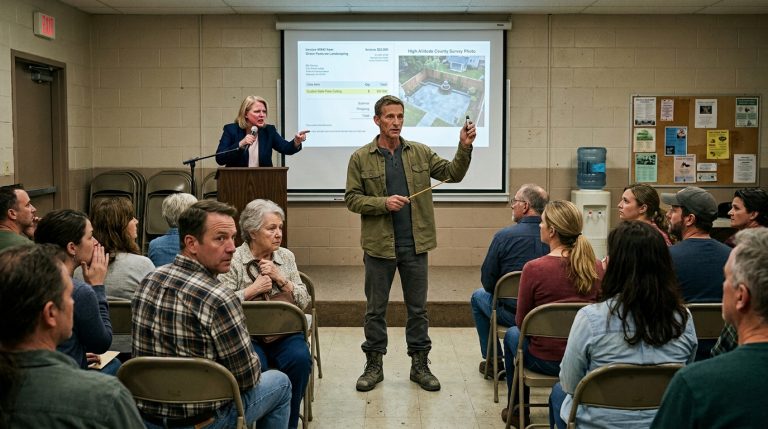
The community center smells of industrial pine cleaner, stale decaf coffee, and the distinct, sour sweat of people who have been summoned by registered mail against their will. The folding chairs are arranged in stiff, hostile rows facing a raised staging platform where a digital projector hums softly, casting a blue, rectangular glow across a pair of laminated poster boards.
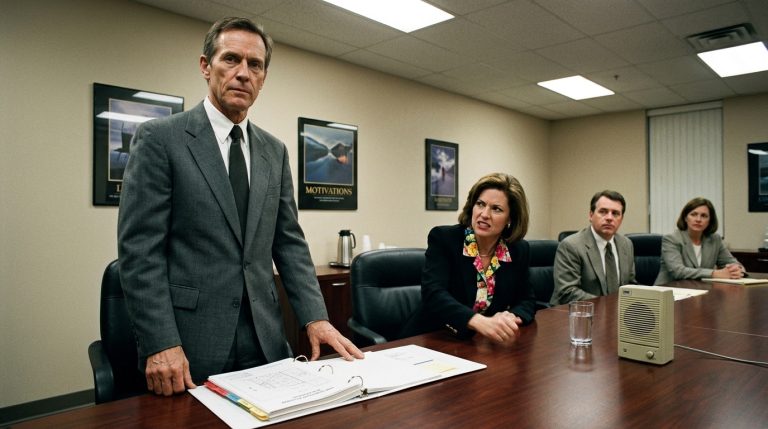
Cordelia Blackwood sits center stage behind a folding table draped in green felt. Her silver hair is drawn back with military precision, and her blazer looks as though it has been ironed with a hot brick. Flanking her are three members of the architectural review committee—local men who look like they would rather be anywhere else on earth than executing a corporate land grab on Tuesday night.
I walk down the center aisle, my boot heels clicking sharply against the linoleum. The low murmur of neighborhood gossip dies out instantly, replaced by a heavy, brittle silence. Heads turn, shoulders stiffen, and eyes dart sideways.
“Mr. Whitmore,” Cordelia says, her voice carrying the practiced crispness of an administrative judge. She doesn’t look at my face; her gaze locks onto the canvas jacket where the bulk of the courthouse photocopies presses against my ribs. “You are late. The agenda began twenty minutes ago.”
“The county archives take as long as they take, Cordelia,” I say, pulling out a folding chair in the third row and sitting down without asking. The metal frame groans under my weight.
Beside me, Mavis Lane leans over, her fingers digging sharply into the sleeve of my jacket. The faint scent of peppermint and old cedar rises from her shawl. “She’s got the zoning board in her pocket, Ezra,” Mavis whispers, her voice a dry rasp that carries over the hum of the projector. “They’re voting on a blanket emergency declaration tonight. Claiming your dock is an active environmental hazard to the entire watershed.”
On the screen behind her, a photograph of my great-grandfather’s 1887 timber pier appears, rendered in blown-up, grainy digital pixels that make the natural weathering look like structural decay. A red circle has been drawn around a rusted iron bolt, annotated with bold red text: Non-Compliant Shoreline Modification.
“As you can see,” Cordelia continues, rising smoothly to her feet and gesturing toward the screen with a laser pointer whose red dot dances across the wood grain of the dock, “the structural integrity of this installation threatens the ecological balance of the entire basin. Furthermore, failure to submit to the mandatory compliance audit and pay the assessed $500 monthly access fee leaves the board no legal alternative.”
She pauses, letting the silence build. This is her theater—the engineered crisis, the manufactured urgency, the quiet terror of administrative penalties designed to exhaust working people until they surrender their deeds for pennies on the dollar.
I cross my arms, letting the cold metal of the 1952 maintenance easement press against my forearm through the paper. The psychological phantom of Uncle Morris sits heavier than the documents in my pocket—the memory of an old man warning me that men who build with concrete and paper will always try to pave over the people who built with stone and gravity.
“The board moves for an immediate emergency vote,” Cordelia says, raising a single sheet of paper stamped with a corporate seal. “To authorize the association to assume temporary administrative custody of all non-registered riparian assets.”
The room holds its breath. A few hands twitch near the edges of the front rows—supporter proxies primed to nod on cue.
I don’t stand up yet. Let her write the motion. Let her enter the fraudulent claim into the official transcript under the harsh light of the recording equipment. Every word she speaks tonight is another brick in a foundation that is hollow underneath.
My fingers trace the edge of the photocopied ledger in my pocket, feeling the rough, fibrous texture of the paper against my thumb. The trap isn’t sprung by shouting back; it is sprung when the weight of their own paperwork finally breaks the axle.
CHAPTER 4: The Inspection and the Iron Stake
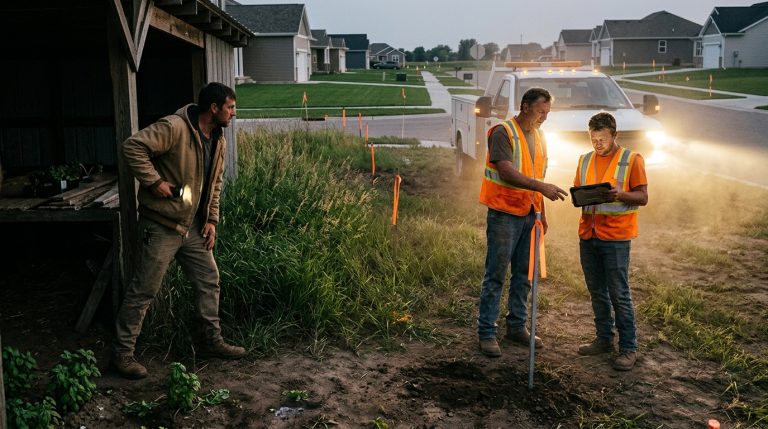
The diesel engines are already idling when I pull my truck up to the edge of the gravel drive, their low, vibrating thrum shaking the early morning frost off the pine needles. Three county vehicles—white utility pickups with government seals on the doors—are parked haphazardly across the apron of my yard like a blockade.
Out step the inspectors, boots crunching on the frozen shale. Pete, the building inspector I recognize from town, leads the group. He looks about as comfortable as a man walking into a brushfire, carrying a heavy metal clipboard and an environmental compliance meter that hums with a faint, steady blip. Behind him, a septic specialist carries a long steel sounding rod, its tip coated in dry red clay.
“Morning, Ezra,” Pete calls out, his breath pluming white in the crisp air. He stops ten feet short of my bumper, eyeing the rusted fender of my truck. “We’ve got a stack of fresh complaints filed with the district office. Unpermitted structural modifications, potential leach field contamination, and an active environmental hazard report regarding the old pier.”
I don’t kill the engine. I let the truck idle, its rhythmic beat matching the cold tension in my chest.
“Filed by who, Pete?” I ask, stepping down onto the frozen gravel. The ground is hard as iron under my boot soles. “Let me guess. A white Escalade with custom plates and a smell like high-end department store perfume?”
Pete winces, looking down at his clipboard as if the answer were printed on the back page. “An official grievance is an official grievance, Ezra. The board triggered the emergency review protocol late last night. We’re required by statute to investigate within twenty-four hours.”
The timing is too clean. Cordelia didn’t wait for the community center chairs to be folded before setting the administrative machinery in motion. She is trying to bury the property in compliance costs and technical violations before Tommy can file the counter-suit at the district court.
“Go ahead,” I say, gesturing toward the shoreline path. “Take your samples. Measure the pilings. But check the easement markers while you’re down there. You’ll find they extend twenty feet past where your map says they stop.”
Pete nods slowly, signaling the other two inspectors down the timber trail toward the water. I follow them step-for-step, refusing to let them out of my sight. The frost crunches beneath our boots as we move through the cedar grove, the air smelling sharply of damp earth, rotting leaves, and the cold iron tang of the lake.
When we reach the 1887 dock, Pete drops to one knee, running a gloved hand along the base of the primary cedar piling where the iron-bolted braces anchor into the stone cribbing. He pulls out a tape measure, stretching it across the beam, then checks the digital readout on his compliance meter.
The silence stretches out over the water, broken only by the distant caw of a crow in the upper pine branches.
After a long minute, Pete stands up, wiping a smear of dark mud from his knee. He looks at the meter display, then up at me, his expression flat. “Well, the timber’s white oak. Hand-hewn. It’s older than the county zoning code, Ezra. Structurally, it’s holding up better than the concrete bulkhead they poured over at the country club last fall. And the water samples? Pristine. The spring flow is clearing out the basin faster than anything we test down-county.”
He clicks his metal clipboard shut, the snap echoing off the water. “There are no violations here, Ezra. None. But…” He lowers his voice, glancing back toward the drive where his truck is idling. “The paperwork that landed on the chief inspector’s desk this morning wasn’t about the dock structure. It was an option agreement notification. Someone’s trying to force a boundary realignment through the county planning commission using an emergency eminent domain rider.”
The butterfly detour of the inspection has served its purpose, exposing the mechanical gears of Cordelia’s broader strategy. She isn’t just harassing an individual property owner; she is laying the paper trail for a forced administrative seizure.
“Let her try to file the rider, Pete,” I say, my voice steady as I look out over the dark, unyielding surface of the lake. “Some properties are anchored a lot deeper than ink can reach.”
Pete shakes his head, turning back toward the trail. “Just watch your blind side, Ezra. When people like that run out of rules, they start rewriting them.”