The Granite Border: A Master Sergeant’s Tactical Dismantling of a Suburban Tyrant’s Carefully Constructed House of Cards
CHAPTER 1: THE TACTICAL ASSESSMENT
The engine cut out, but the silence that followed wasn’t peaceful; it was suffocating. Karen stood there, a powder-blue monument to entitlement, her tracksuit straining against a chest puffed out with enough indignation to power a small city. She didn’t look at the reclaimed barnwood of the farm stand or the rich, dark soil of the beds. She looked only at the violation she had invented in her own head.
I didn’t move. I kept my hands tucked loosely into the pockets of my canvas jacket, feeling the cool weight of my grandfather’s pocket watch. I watched her eyes dart across the heirlooms, the marble-skinned tomatoes, the dew-slicked zucchini. She was searching for a handle, a flaw, an excuse to begin the machinery of her petty kingdom.
“Twenty-four hours, Miller,” she said, her voice a practiced saccharine rot. “Or we start the fines. Bankruptcy is a very efficient way to handle a public nuisance.”
I let the air sit between us, heavy and smelling of basil and damp earth. In the army, I’d learned that silence is a weapon. Most people are so terrified of an information gap that they’ll fill it with their own insecurities. I watched the muscle in her jaw tighten. She wasn’t used to being ignored. She was used to compliance, to the frantic nodding of homeowners terrified of a HOA letterhead.
“My grandfather broke this ground in 1952, Karen,” I said, my voice low. It wasn’t an invitation to debate; it was a statement of fact. “This stand has been here for thirty years. Your charter didn’t exist until 1988. You’re trespassing on a legacy you don’t even understand.”
Her face went a dangerous, mottled crimson. “I am the president of this Association. My jurisdiction is wherever I say it is.”
I picked up an heirloom tomato, its surface a complex map of red and gold. I began to polish it on my sleeve, watching her reflection in the glass of her SUV. She was leaning forward, her knuckles white against the steering wheel. She was already pacing the floor of her office, rehearsing the legal threats, the certified letters, the escalation.
She had no idea she had just declared war on a man who had spent twenty-five years reading the manuals of his enemies. I didn’t feel anger—anger is hot and sloppy—I felt the cold, rhythmic hum of a project initializing.
“Have a nice day, Karen,” I said, turning my back on her to rearrange a crate of lettuce.
She sputtered, a sound like a stalled engine, before jamming the SUV into gear. She tore off, gravel spraying like shrapnel against the side of my barn. I watched the cloud of dust settle, my eyes flicking to the corner of the lot where the boundary marker—a simple, rusted iron stake—was barely visible under the weeds. It was the only thing standing between her and the hillside. And she hadn’t even noticed it.
CHAPTER 2: THE ARCHITECTURE OF A DEFENSE
The gravel dust hung in the air, a fine, gritty mist that tasted like the very foundation of the life I’d built. I didn’t reach for my phone. I didn’t pace. Instead, I walked to the edge of the property line where the rusted iron stake sat half-buried in the tall grass. I knelt, my fingers tracing the cold, jagged metal. This marker was the only thing preventing the Meadowlands subdivision from absorbing this plot into their sterile, manicured kingdom. To Karen, it was a nuisance; to me, it was the border of sanity.
I stood up, brushing the dirt from my knees, and walked back toward the farmhouse. The porch was empty. Inside, the house held the quiet, orderly stillness that had become my reality after Clara passed. My office was in the rear, a space where the air always smelled of old paper, tobacco, and the faint, lingering scent of lavender that had been hers.
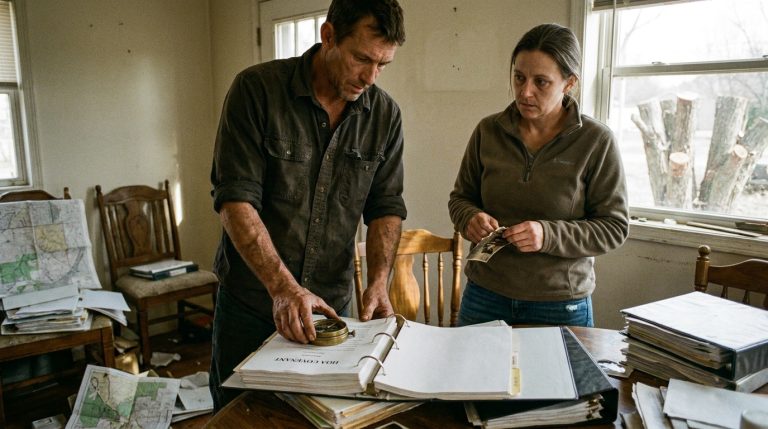
I sat at the heavy oak desk and reached for the hardbound notebook I’d kept since the day Karen first arrived. I didn’t need to write; I needed to deconstruct. I spread the county zoning records out—the documents I’d pulled when we first started the farm renovations. They were yellowed, thick, and held the absolute authority of the county’s original charter.
AG-1 Agricultural.
The ink was permanent. The lines were drawn. The Meadowlands subdivision existed in a separate reality, zoned as R-1 Single Family Residential. I pulled up the HOA’s Covenants, Conditions, and Restrictions on my monitor. The screen glowed, illuminating the dark room. Fifty pages of dense, bureaucratic prose designed to be a cage.
I scrolled to Article 7, Section 3. No trade or business or any activity of a commercial nature shall be conducted on any lot.
“On any lot,” I whispered, the words tasting like victory.
The HOA’s authority stopped at the edge of their grid. My land wasn’t a lot; it was an estate, a distinct parcel that predated their entire existence. Karen was trying to enforce laws on a sovereign entity that didn’t subscribe to her bylaws. She was a general trying to command an army that wasn’t on her payroll.
I opened the folder labeled Project Karen on my desktop. I saved the scan of the zoning map next to the screenshot of Article 7. I then opened the log. I didn’t just record the events; I analyzed them.
Date: July 19. Initial contact. Verbal threat of bankruptcy. Action: Minimal response. Objective: Maintain distance. Maintain legal standing.
I looked at the photos I had taken of her SUV on my property. My eye was drawn to the tires, the mud-splattered powder blue of the paint. She hadn’t even checked for cameras. She was so convinced of her own authority that she didn’t consider she was being watched.
My phone vibrated on the desk. It was Sarah. I answered on the first ring.
“Dad?” her voice was sharp, a professional lawyer’s edge softening into daughterly concern. “I saw the news alerts about the HOA board meeting activity. Is she pushing?”
“She’s making moves, Sarah,” I said, leaning back in the creaking leather chair. “She’s trying to build a case out of thin air. She thinks I’m just a farmer who doesn’t know the difference between a deed and a suggestion.”
“She’s a bully, and she’s out of her depth,” Sarah said, her tone hardening. “I’m looking at the bylaws you sent over. Their ‘nuisance’ clause is vague, but it’s the only hook they have. They can’t prove a vegetable stand is a nuisance unless they can prove it impacts property values or public safety. And since you’re strictly zoned AG-1, they don’t have a leg to stand on.”
“I know,” I replied. “But she’s the president. She can tie me up in litigation for years. She’s counting on me getting tired.”
“Then we make her tired first,” Sarah countered. “Build the paper trail. Every letter they send, every fine they try to levy, every unannounced visit—document it all. We’ll build a wall of evidence so thick they’ll need a court order just to look over it. And Dad? Don’t talk to her. Not one word.”
“I’m already ahead of you,” I said. “I’m not giving her a single syllable.”
We talked for another twenty minutes, mapping out the necessary filings. As I hung up, the sun began to dip below the horizon, casting long, bruised shadows across the fields. The farm was settling in for the night. I stood up and walked to the window.
The stand looked solid, sturdy, and entirely unbothered by the threat looming on the other side of the road. I felt a familiar, cold, and quiet resolve settling into my chest—the same feeling I used to get before a mission, when the target was marked and the plan was set in stone.
I looked at the desk, at the documents that held the truth of my land. Karen was playing a game of intimidation; I was playing a game of chess. She thought she was the one leading the attack, but as I turned off the desk lamp, I realized she was actually walking directly into the trap I had spent years preparing. She wanted a fight? She had no idea what it meant to go to war with a man who had nothing left to lose but his sanctuary.
CHAPTER 3: THE FIRST BREACH
I didn’t turn on the porch light. I stood in the deep shadow of the farmhouse eaves, my pulse steady, my breathing shallow. The darkness was an old friend; it masked my movements and amplified my hearing. Out by the perimeter of the field, a vehicle had pulled off the road, its headlights cutting jagged, white swathes through the tall, uncut grass that bordered the Meadowlands subdivision.
It wasn’t an SUV this time. It was a utilitarian work truck, the kind that didn’t belong in a neighborhood where even the trash cans were color-coded. My eyes locked onto the spot where the rusted iron stake—the boundary marker—should have been. The area was illuminated by the truck’s high beams, and there was nothing but a fresh, dark scar in the soil.
They were moving the goalposts.
I didn’t rush. Rushing led to mistakes, and mistakes were what Karen wanted. I stepped off the porch, my boots making no sound on the packed earth, and moved along the line of the old corn cribs. I had spent twenty-five years learning how to occupy space without being noticed; this was just another tactical patrol, only the terrain was my own front yard.
I reached the cover of a dense row of overgrown hedges that ran parallel to the border. The truck engine was idling with a low, metallic rattle. Two men in high-visibility vests were standing near the scar in the earth, one of them holding a surveyor’s tripod.
“The president said to put the new line six feet further in,” the taller one said, his voice carrying clearly on the night air. “Says the survey she commissioned shows the property line is shifted.”
“It’s not shifted,” the other replied, squinting at a tablet. “This is AG-1, man. It’s been deeded as such for seventy years. You shift this line, you’re putting the fence right through the guy’s shed.”
“I don’t care about his shed. I care about the check. You want to get paid, you hammer in the markers where the lady tells you to hammer them.”
My hand tightened around the handle of the small flashlight in my pocket, but I didn’t reach for it. I was observing. They were hired help, pawns in a game they didn’t fully understand, but they were acting on Karen’s direct instruction. This wasn’t just harassment anymore; this was a deliberate, fraudulent attempt to physically redefine the geography of the conflict.
I waited until they stepped toward the rear of the truck to grab a new metal stake. I moved like a shadow, low and fast, closing the distance to the tripod they had abandoned. I didn’t touch it. I didn’t need to. I pulled out my phone, set the shutter to silent, and captured a series of high-resolution images: the truck’s plates, the two men’s faces, and the GPS coordinates showing exactly where they were pounding the new stakes—well within my deeded, tax-paying property lines.
The evidence was accumulating. Every move she made was a brick for the wall I was building.
“Hey, you hear that?” the shorter worker paused, looking toward the hedge line.
I went statue-still, my back pressed against the rough, splintered bark of an ancient oak. My heart rate didn’t elevate. I knew how to vanish.
“Probably just a deer,” the other guy muttered, grabbing a heavy-duty mallet. “Let’s get this done. I want to be home before the wife starts asking why I’m working midnight shifts on a suburban boundary dispute.”
I stayed there for ten full minutes after they packed up and drove away. The silence of the night rushed back in, but it felt different now. The boundary was marked with false intent. I walked out to the new, freshly driven iron stake. It stood there, bright and silver in the moonlight, a glaring lie in the middle of my fields.
I reached out and grasped the top of the stake. It was solid, driven deep, but it was anchored in fraud. I didn’t pull it up. That would be a reactive move, something she would expect. Instead, I took a small, bright orange ribbon from my pocket—the kind used to mark drainage lines—and tied it securely to the top. I wanted her to know exactly what had been moved, and I wanted her to know that I had seen her do it.
I walked back to the house, my mind already running through the legal implications. This wasn’t just a nuisance; it was property fraud. The moment she submitted any documentation based on this false survey to the county, she was committing a felony.
I entered my office, closing the door softly. I didn’t turn on the main light, just the small, hooded lamp on the desk. I pulled the Project Karen folder back up. I didn’t feel the heat of anger. I felt the cold, hard logic of a trap snapping shut. She was digging a hole for herself, and she was doing it with her own shovel. I just had to make sure the ground was soft enough to let her fall.
I sat down and began to draft an email to Sarah, attaching the photos I had taken. No commentary, just the facts. The enemy is changing the terrain, I typed. Let them continue. It makes the final judgment much easier to secure.
I stared at the screen for a long time, watching the cursor blink in the rhythm of a steady pulse. The farmhouse was quiet, the only sound the faint ticking of the radiator. I knew what would come next. She would wait for me to react, to shout, to pull the stakes. She was waiting for the ‘old farmer’ to lose his temper. But she wasn’t dealing with a farmer. She was dealing with a man who knew exactly how long to let an enemy believe they were winning before he moved to end the engagement.
The stakes were in the ground. The lie was recorded. Everything was exactly as it needed to be.
CHAPTER 4: THE CERTIFIED PAPER TRAIL
The morning air was sharp, smelling of wet clover and the distant, metallic scent of the subdivision’s industrial landscaping equipment. I stood by the false stake for a long moment, my boots sinking slightly into the soft, disturbed earth where the workers had been digging. I didn’t reach for the ribbon. I left it there. It was a silent witness, a marker of the fraud I had caught in the act.
I returned to the house, but I didn’t go back to the office immediately. I walked into the kitchen, the space where Clara used to spend hours experimenting with canning recipes. The silence here was different—it was a heavy, layered quiet that sometimes felt like she was just in the next room, or out in the garden. I stared at the worn wooden table, seeing the faint scratches where she’d hammered down jar lids. For a second, the frustration of the HOA conflict faded, replaced by a phantom ache in my chest—the memory of her laugh over a batch of ruined jam. It was a distraction, a psychological phantom that tried to cloud the clarity I had cultivated. I forced a breath, exhaled slowly, and focused on the physical sensation of the cold kitchen tiles under my feet. Memory was a weapon to be handled with care; I couldn’t let it dull my edge.
I moved to the counter, pulled out the ledger where I kept the records of the farm’s yields and property taxes, and set it beside the new documentation. I was preparing the response Sarah had drafted. The envelope was already sealed, heavy with the weight of legal finality. I just needed to add the final, critical piece: the timestamped photos of the workers moving the stake.
I spent the next two hours at the desk, digitizing the evidence. I created a secondary backup, uploading everything to a secure cloud server that Sarah’s firm managed. If anything happened to my files, if Karen tried to force a ‘clerical error’ that resulted in the destruction of my records, there would be an immutable digital trail.
Around 9:00 a.m., the mail truck crunched up the driveway. Tom, the carrier, stepped out with a heavy stack of envelopes. He looked older, his face etched with a familiar fatigue. He walked up to the porch, his eyes darting toward the road where the Meadowlands development began.
“Anything interesting, Jack?” he asked, dropping the mail into the box.
“Just the usual,” I said, leaning against the porch railing. “You heard anything about the HOA?”
Tom lowered his voice, glancing toward the subdivision. “It’s a pressure cooker, Jack. People are talking. They’re saying the board is trying to push through a new ‘maintenance assessment’ for the nature trails—at five hundred bucks a household. Some are saying it’s to pay for the legal fees. The mood in there? It’s not happy.”
“Five hundred dollars is a steep hike for a nature trail,” I noted.
“It’s a heist,” Tom shook his head. “And everyone knows it. But Karen… she’s got a way of making people feel like if they don’t pay, they’re the ones at fault. It’s like she’s got them under a spell.”
He left, and I took the mail inside. Amidst the junk flyers and electric bills was a thick, cream-colored envelope—the kind that signaled the next wave of intimidation. I didn’t open it. I knew exactly what was inside: a formal ‘notice of violation’ regarding the ‘encroachment’ of my farm stand, citing the new survey that the workers had been building the night before.
It was a beautiful mistake. By citing a survey that they had illegally constructed, they were confirming their participation in the fraud.
I took the envelope and placed it in the Project Karen file. I didn’t need to read it to know that the trap was closing. Every step she took was deeper into the mire of her own making. She was relying on the assumption that I would fight her with volume, with shouting, with impulsive anger. She expected a man who would tear up a survey and end up in the back of a patrol car.
Instead, I was fighting her with the quiet, devastating power of a paper trail.
I walked out to the truck, the certified response in my pocket. As I drove down the long, winding driveway, I passed the spot where the stake had been moved. I looked at the orange ribbon, still snapping in the wind. I didn’t stop. I kept driving, steady and rhythmic, toward the post office.
The engagement was shifting. I wasn’t just defending my land anymore; I was actively documenting the dissolution of her power. She was spending community money on illegal surveys and fabricated violations, and with every signature she scrawled on those letters, she was creating a permanent, indelible record of her abuse of office.
I reached the post office, handed the envelope to the clerk, and watched him stamp it. It was a mundane action—a thud of rubber on paper—but it felt like a tactical strike. The document was now in the system. It was an official, verifiable response that she would have to contend with in a legal arena, one where ‘because I said so’ wouldn’t hold any weight.
I turned and walked back to the truck. My hands were steady. The morning had been productive, and the path forward was clear. She would continue to push, she would continue to escalate, and every time she moved, I would be waiting with a countermove that she wouldn’t even see coming until it was far too late to stop it. The farm was quiet when I returned, the sun climbing higher, warming the rows of tomatoes and the broad, green leaves of the zucchini. It was a good day to grow, and an even better day to watch a tyrant walk the plank.
CHAPTER 5: THE TOWN HALL TRAP
The envelopes were thick, cream-colored, and felt oily between my fingers. I sat at the kitchen table, methodically slitting them open one by one. They were all identical: a final notice, a demand for immediate payment of accrued fines, and a formal declaration that the farm stand was now considered an “unpermitted commercial structure” subject to immediate board-ordered abatement.
Karen had finally tipped her hand. She wasn’t just barking; she was preparing to bite. The sheer arrogance of the language in these letters—demanding I pay thousands in ‘administrative processing fees’ for their own illegal surveys—was almost impressive. It was a frantic, desperate accumulation of power that ignored every legal reality of my property status. She was betting everything on the assumption that I would fold under the sheer volume of paper, that I would be overwhelmed by the threat of liens and the looming, vague promise of ‘abatement.’
I pulled my ledger toward me. The count was up to sixty-two individual notices in the last forty-eight hours.
The phone rang. It was Mr. Henderson. His voice, usually steady, sounded brittle. “Jack, they’re going to force a vote at the Wednesday meeting. They’re calling it an ‘Emergency Bylaw Amendment.’ They want to give the board the power to bypass the standard grievance process for ‘public nuisances.’ It’s a direct move against your farm.”
“They don’t have the authority to amend the bylaws without a full resident vote, George,” I said, my voice calm.
“They don’t care,” he snapped. “They’re going to pack the room with their supporters and force a voice vote. Karen’s been working the phones for days, telling everyone that your farm is the reason their home insurance rates might go up. She’s turned the neighborhood into a pressure cooker.”
“Then we’ll be there,” I said. “Every one of us.”
This was the escalation I had been waiting for. She was trying to force a tactical advantage through a show of brute force. She wanted to overwhelm the process, to replace law with volume. I hung up the phone and looked out the window at the farm stand. It stood there, a simple, sturdy wooden structure of reclaimed barnwood—the same barnwood Clara and I had sourced three years ago. It was an island of sanity in a landscape of bureaucratic madness.
I began the preparations. I didn’t reach for a weapon; I reached for my records. I spent the afternoon organizing the folders—every certified letter, every photo of the illegal stake movement, every witness statement I had gathered from the other non-HOA property owners. I called Sarah.
“She’s moving for a bylaws change to bypass the grievance process,” I told her.
“She’s making a fatal error,” Sarah said, her voice bright with a sharp, professional intensity. “Bylaws are a contract. They can’t unilaterally change the terms of an agreement, especially to target an external party that isn’t even part of their association. If they try that, it’s not just tortious interference anymore. It’s an open-and-shut case of bad-faith governance. If they vote that through, I can get a temporary restraining order against the entire board by Thursday morning.”
“We’ll give them the chance to vote,” I said. “We’ll give them the room to do exactly what they want to do.”
As evening fell, the atmosphere in the air turned heavy, charged with the ozone scent of an approaching storm. I walked out to the farm stand and began to organize the remaining harvest. I didn’t want the stand to look neglected. I wanted it to be pristine. I polished the wooden counter until it gleamed, arranged the last of the heirlooms with a jeweler’s precision, and swept the gravel lot until every stone was perfectly in place.
I felt a strange, surreal detachment, as if the reality of the subdivision was fraying at the edges. The HOA’s authority—the power they held over paint colors, lawn height, and property lines—felt like a fragile veneer that could be stripped away with a single, well-placed truth. They were playing a game of chess, but I had already tilted the board.
I went back inside and made a cup of black coffee, the steam curling into the dim kitchen light. The storm was breaking outside, the first heavy drops of rain hammering against the farmhouse roof with a rhythmic, percussive intensity. I sat in the darkness, listening to the rain, feeling the weight of the coming confrontation.
Karen wanted a spectacle? She would get one. She wanted a showdown? I was going to provide a history lesson. I knew that by the time the sun rose on Wednesday, the board would be convinced of their own invincibility. They would walk into that clubhouse ready to end my legacy in one swift, crushing blow. They had no idea they were walking into a room where every single piece of evidence was already meticulously arranged, waiting for the moment when the truth would finally shatter their thin, fragile world. I closed my eyes, listening to the rain, the sound of the future finally catching up to the past.
CHAPTER 6: THE FRACTURE
The clubhouse air was thick with the scent of damp wool and nervous sweat. I stood at the back of the room, my presence a deliberate, silent weight. Karen was at the front, her face a mask of practiced serenity, though her fingers trembled as she gestured at the dead, black screen of the projector. The power failure had stripped her of her polished slideshow, the one where she likely planned to villainize me with doctored charts and carefully selected snippets of ‘nuisance’ complaints. Without the screen, she was just a woman in a powder-blue suit standing in a room full of people who were beginning to look at each other, not at her.
“The power will be restored momentarily,” Karen said, her voice strained. “In the meantime, we will proceed with the vote on the bylaw amendment.”
“Without the presentation, Karen?” a voice called out from the middle of the room. It was Tom Sterling, the father from Willow Creek Lane. He stood up, his face illuminated by the harsh, flickering emergency light. “You said you had proof that Miller’s farm is costing us thousands. I want to see the numbers. I want to see where that money is going.”
“The numbers are being compiled,” she snapped. “This is an emergency measure for the safety of our property values.”
“It’s an emergency measure for your control,” another voice interjected.
The atmosphere in the room shifted. It wasn’t the tentative, fearful tension of the previous meetings. It was something colder, more dangerous. People were no longer looking for Karen’s approval; they were looking for an exit from her influence. I watched her scan the room, her eyes darting like a trapped bird, seeking the usual suspects—the silent nods of the board members, the compliant silence of the residents. She found none.
I took a slow, deliberate step forward. The floorboards groaned, a sharp sound in the quiet room. All eyes turned to me. I reached into my coat and pulled out a single, thin folder. I didn’t say a word. I just walked toward the front table, my gaze locked on Karen. She stiffened, her posture turning rigid.
“There is no emergency, Karen,” I said, my voice cutting through the silence. “There is only a deficit.”
I laid the folder on the table. It contained the copies of the bank statements I had obtained through the county’s public access portal—records that linked the HOA’s ‘landscaping contract’ to a shell corporation registered in her cousin’s name. It was the Layer 1 secret, the physical decoy that tied her mismanagement to the funds she had been extracting.
She glanced down, and for the first time, her mask didn’t just crack—it shattered. The blood drained from her face, leaving her looking old and unnervingly fragile. She tried to reach for the folder, but I held it down with a single finger.
“The vote isn’t about the farm stand,” I continued, loud enough for the back of the room to hear. “It’s about the fact that this board has been systematically embezzling funds from every household in this room. The ‘nature trail maintenance’ fees? They’re going to a private bank account. The ‘mailbox mandate’? A kickback scheme. Every fine, every assessment, every dollar you’ve been forced to pay—none of it stayed in Meadowlands.”
The room erupted. It wasn’t a roar; it was a confused, chaotic tangle of shouting. People were on their feet, the shock of the revelation vibrating through the floorboards. Karen leaned back, her hands gripping the table so hard her knuckles turned white.
“He’s lying!” she screamed, her voice losing all pretense of control. “This is a vendetta! He’s trying to destroy our community!”
“I’m the one trying to save it,” I said, my voice cold. “And I’m the one who’s going to make sure every cent is accounted for.”
I stepped back, letting the chaos consume the front of the room. I didn’t need to do anything else. The community was turning on her, their voices overlapping in a wave of demands and accusations. I saw the board members at the table exchange terrified glances, their alliances dissolving in real-time. They were looking for a way out, and they realized that Karen was the only one left on the sinking ship.
I looked at Karen. She was staring at me, her mouth working silently, the reality of her total collapse setting in. She had built this house of cards on the assumption that she was the smartest person in the room. She had never considered that someone would simply stop playing by her rules and start checking the math.
I turned and walked toward the door. I didn’t need to see the rest. The fracture was complete. The emergency bylaw amendment would never be voted on; the board would never hold another meeting under her name. The community had found its voice, and it was screaming for accountability. As I stepped out into the night, the rain had stopped, and the air felt clean, sharp, and finally, unequivocally mine. I walked toward the parking lot, the sound of the shouting fading into the night, knowing that the endgame had officially begun. She would try to run, she would try to lie, but she had nowhere left to go. The cage she had built for everyone else had finally locked her inside.
CHAPTER 7: THE RECKONING
I reached the farmhouse in silence, my mind churning through the tactical map of the night’s events. The community was already buzzing; lights flickered on in houses that had been dark for hours, and the sound of neighborly consultation—a low, agitated hum—drifted across the yards. Karen would be back at her house, holed up behind her locked front door, likely already planning her next frantic, self-destructive move. She was a cornered animal, and the most dangerous time was now, when she realized her influence was gone and all that remained was the hard reality of her crimes.
I checked the perimeter of my farm, my boots crunching on the gravel that bordered the subdivision’s encroaching lawn. The stakes the workers had driven in were still there, bright and silver in the dark, but they were now mere curiosities—evidence of an act of desperation rather than a claim to authority. I didn’t pull them. I left them as a testament.
I didn’t have to wait long.
At 3:00 a.m., the silence of the night was shattered by the guttural, heavy-duty growl of a commercial tow truck engine. I was already dressed, sitting in the dark of the porch, the cold night air biting at my cheeks. I watched as the headlights swung around the bend, cutting through the darkness with a harsh, clinical light. The truck was massive, its boom articulated like an insect’s limb, and it was backing toward the farm stand with a mechanical, screeching precision.
And there, standing in the driver’s side door, was Karen. She wasn’t wearing her powder-blue suit. She was wrapped in a long, dark trench coat, her hair a wild, frantic halo in the truck’s work lights. She looked small, stripped of the manicured perfection she had lorded over the Meadowlands, but her eyes—they were burning with a terrifying, singular focus. She had decided that if she couldn’t have her order, she would erase the source of her chaos.
I stood up, my motion fluid and silent. I didn’t reach for a weapon; I reached for my radio. I had already alerted Officer Banks, a regular at the stand who knew exactly what was happening. He was already minutes away.
I walked toward them, my shadow stretching out long and jagged across the grass. I didn’t shout. I didn’t run. I simply walked into the glare of the truck’s work lights, my face a stone mask.
“You’re trespassing, Karen,” I said, my voice cutting through the mechanical rattle of the truck’s lift. “And you are about to commit a felony you cannot talk your way out of.”
Karen stepped off the running board, her face twitching. “This is an unpermitted structure! I have the board’s authorization for immediate abatement! This is a nuisance to the property values of Meadowlands!” Her voice was a shrill, cracking fragment of its former self. She looked at the tow truck driver, a hulking man in a grease-stained jacket who was looking at me with growing hesitation. “Hook it up! Now!”
“Lady, he says he’s the owner,” the driver said, looking at me, then back at her. “You told me you had a court order for the removal. I don’t see no papers.”
“The papers are coming! Do your job!” she shrieked, lunging toward the lever on the side of the truck.
I didn’t stop her. I didn’t even flinch. I just stood there, the weight of the evidence in my pocket a cold, hard reminder of the victory already secured. As she grabbed the lever, the red and blue strobes of a sheriff’s cruiser cut through the darkness, washing the field in frantic, dancing light.
Karen froze. The sound of the patrol car’s tires on the gravel was the final, definitive punctuation mark on her reign. Officer Banks stepped out, his hand resting on the sidearm he would never need to draw.
“Evening, Karen,” Banks said, his voice calm, heavy with a weary disappointment. “You’re a long way from the clubhouse.”
She spun around, the trench coat swirling, her eyes searching for an exit that didn’t exist. She tried to babble about bylaws, about the safety of the neighborhood, but her words fell flat, dissolving into the cool night air. The tow truck driver was already dropping the chains, backing away with his hands raised.
“It’s over, Karen,” I said, my voice not triumphant, just tired. “The math didn’t work out.”
As Banks clicked the steel cuffs into place, the sound was thin and metallic against the backdrop of the insects buzzing in the corn. She went limp, the fight suddenly, utterly drained from her, replaced by a hollow, vacant look. She wasn’t the Queen of Meadowlands anymore. She was just a woman, caught in the wreckage of a life she had tried to force into a shape that wasn’t there.
I watched as they led her to the car. The lights pulsed—blue, red, blue—reflecting off the windows of the farm stand. It was a chaotic, jarring end, but it was absolute. I walked back to the porch as the cruiser pulled away, the taillights fading into the distance. The fields were still, the air quiet, and for the first time in two years, the boundary of my life felt secure, unthreatened, and entirely my own. The storm had passed, leaving behind a silence that was finally, truly, peaceful.
CHAPTER 8: THE TRUTH IN THE DEED
The morning sun didn’t bring warmth; it brought a cold, clarifying light that stripped the shadows from the farmhouse. I sat in my office, the air stagnant and thick with the smell of pipe tobacco and old parchment. The finality of the night’s events felt like a weight lifting from my shoulders, but the broader reality—the reason for Karen’s frantic, desperate obsession—still remained tucked away in the deep, yellowed pages of my father’s original deed.
I unfolded the document, my hands steady. The 1952 records weren’t just a statement of ownership; they were a roadmap of the entire valley’s development. As I cross-referenced the property descriptions with the county’s recent expansion filings, the reason for the HOA’s relentless hostility finally clicked into place. It wasn’t just about the aesthetic harmony of their sterile, beige subdivision.
My ten-acre plot was the literal key to the Meadowlands’ expansion. The original land-trap, signed by my father and the initial developers, contained a restrictive covenant: the HOA could not build or expand into the surrounding acreage unless they held the deed to my parcel, or if the land was legally zoned as part of their commercial district. My stand, my garden, my very presence here as an agricultural entity was the legal bulkhead stopping them from turning this entire hillside into a high-density luxury complex that would have made the board millions.
Karen hadn’t been fighting a vegetable stand. She had been fighting for her own fortune, acting as the front for the developers who had been waiting for the land to become available for years. She had been trying to bankrupt me, to force a foreclosure, so the land could be snatched up for pennies on the dollar.
The realization hit me with the force of a physical blow. The embezzlement, the landscaping kickbacks, the fraudulent surveys—they were all just small-time distractions compared to the windfall they were aiming for. I sat back, the document trembling slightly in my grip. The greed was staggering. It wasn’t just petty spite; it was a cold, calculated dismantling of my family’s history for a corporate payout.
I spent the rest of the day in a state of calm, methodical industry. I called Dave. I didn’t need to explain much; I just read him the specific clauses from the 1952 covenant. There was a long, heavy silence on the other end, followed by a soft, low whistle.
“Jack,” Dave said, his voice stripped of his usual levity. “This is it. You have the leverage of a king. If you go to the district attorney with the fraud evidence alongside this covenant, you aren’t just going to dissolve the HOA—you’re going to open an investigation that will track back to the developers themselves. They are the ones who were pulling Karen’s strings.”
“Do it,” I said. “Every bit of it.”
The denouement happened with the slow, crushing inevitability of a glacier. By the end of the week, the news broke in the local papers. The investigation expanded, dragging the shadow developers into the light of the legal system. The Meadowlands subdivision was put under receivership, the predatory expansion plans scrapped, and the restrictive covenant on my land was reaffirmed in a county-wide public record.
The farm settled back into a rhythm that felt entirely new. The volunteers returned, but now they weren’t just neighbors; they were partners in a restored community. We spent the afternoons harvesting, the laughter and the quiet camaraderie of shared labor replacing the tension that had once hung over the fences.
One evening, as the sun set in a brilliant, fiery display of orange and violet, I walked to the edge of the property. I took the rusted iron stake from the ground—the one the workers had moved—and placed it back in its original, rightful hole. I felt the bite of the metal, the rough, ancient texture of the history I had defended.
I looked at the barnwood stand, solid and quiet. It was more than a structure now; it was a monument to the resilience of a life built on truth. I took a piece of sandpaper from my pocket and knelt by the stand, sanding away a small patch of weathered wood that had been scuffed during the struggle. I polished it until it was smooth, the grain of the barnwood appearing, rich and resilient underneath.
I heard a soft, familiar creak of the porch swing behind me. I didn’t look back; I didn’t need to. I felt the calm of the valley settle over the fields, the scent of fresh earth promising a long, productive harvest. The fight had left scars, yes, but the land remained. It was mine, it was my father’s, and it was hers. And as I stood up, the evening wind ruffling the cornstalks, I knew that for the first time in a very long time, I was finally, truly, home.