The Weight of the Deed: A Calculated Retribution Against the Concrete Encroachment of Modern Tyranny
CHAPTER 1: THE FROSTLINE WARNING
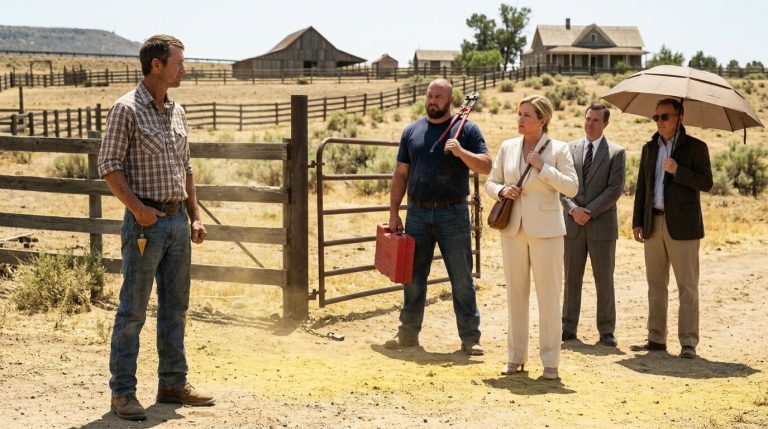
The words hung in the crisp autumn air, colder than the October wind rustling the last of the oak leaves across the driveway. I stood there, hands deep in the canvas pockets of my worn Carhartt jacket, staring down a woman built like a bulldog with a helmet of blonde hair that mocked the gusts. Karen Thorne pointed a meticulously manicured finger not at my chest, but past my shoulder, aiming directly at the sprawling hundred acres of ancestral timber and untamed field behind my house.
“Your grandfather’s legacy is a public nuisance, Mr. Miller,” she said, her voice sharp enough to draw blood, “and I will see it dismantled piece by piece if I have to.”
She stood firmly on the pristine asphalt of her side of the invisible line—the exact boundary separating her sterile, beige kingdom of Oakridge Estates from my family’s soil. To her, my woods were an unkempt scar lowering the property value of her ten-year-old McMansions. To me, that land was a living archive, cleared by my great-grandfather and nurtured by a man whose integrity was measured by the depth of his word, not the square footage of his siding.
Her ambush had been calculated, timed precisely while I was checking the tension on a new stretch of barbwire. Her electric golf cart sat humming on the community road just inches from my grass, a silent harbinger of bureaucratic war. She was furious over my plan to lease a small, remote section of the back acreage to a group of trusted bow hunters—a tradition my grandfather maintained for half a century.
I kept my face entirely still, sliding my expression into the blank, impassive mask my sergeant major had beaten into me during my final tour. I let the silence stretch, refusing to give her the satisfaction of an angry retort. I watched the micro-twitch at the corner of her left eye, the fractional drop of her shoulders as my lack of reaction starved her of the conflict she craved.
Her confidence fractured for a single, fragile second, a flicker of raw uncertainty darting across her eyes before her authoritarian armor slammed back into place.
That flicker was all the intelligence I needed. She had overplayed her hand, treating a sovereign landowner like a delinquent tenant. She thought she was bringing a neighborhood under heel with a binder of petty bylaws. She had no idea she had just declared war on a man who understood topography, logistics, and the art of strategic deconstruction.
“Enjoy your morning, Karen,” I said, my voice low, steady, and utterly devoid of heat. I turned my back on her before she could formulate a counter-strike, leaving her standing alone on the cold asphalt with her unspent fury hanging heavy in the wind.
CHAPTER 2: THE ARCHIVES OF THE PAST
The crunch of gravel beneath my boots replaced the sterile hiss of Karen’s electric cart before the sound of her frustrated breathing had even faded from the wind. I didn’t look back. Walking a perimeter line requires absolute focus, and letting a bureaucrat dictate the rhythm of your stride is the first step toward losing the ground beneath your feet. I climbed into the cab of my truck, the cold vinyl seat biting through my Carhartt canvas, and turned the ignition. The old diesel engine coughed once, caught, and settled into a heavy, rhythmic vibration that matched the pulse in my temples.
The county records office sat thirty miles away in the heart of the valley, a low-slung brick building that smelled permanently of wet wool, floor wax, and the dense, compressed weight of a century’s worth of paper. When I pushed open the heavy glass door, the familiar hum of the microfilm machines hit me like a physical pressure drop.
Marge looked up from behind the high counter, her bifocals sliding an inch down the bridge of her nose. She had been stamping deeds and filing surveys since my grandfather was young enough to haul timber with a mule team.
“Jack Miller,” she said, her voice a dry, friendly rasp that had weathered every political shift in the county. “You look like a man who just found a property stake driven three feet over his north line.”
“Worse, Marge,” I said, leaning my forearms against the scuffed oak counter. “Someone’s trying to build a case out of thin air, and I need to see the original plats before they try to pave over the foundations.”
She didn’t ask questions. In the records office, curiosity was a luxury clerks couldn’t afford, but loyalty to the land ran deep. She reached beneath the counter and slid a heavy, metal-reinforced drawer open with a metallic groan. “You want the Miller homestead partition, or are you chasing the Annexation of Two-Thousand-and-Four?”
“Give me both,” I said. “And pull the development blueprint for Oakridge Estates Phase 1 while you’re at it. I want to see every signature attached to the eastern boundary.”
For the next four hours, the world outside narrowed to the perimeter of a drafting table under the harsh glare of a low-hanging fluorescent tube. I unrolled the massive, crinkling sheets of heavy parchment, weighing the corners down with brass inkwells to keep them from curling. The paper was dry, smelling of old rag and faded linen.
My finger traced the ink lines drawn by surveyors long since dead. There was Parcel 4A—our hundred acres, mapped out in bold, uncompromising ink. And right beside it, cutting into the rolling sweep of oak and pine like a sterile grid stamped onto a living hide, was the geometric perfection of Oakridge Estates.
The variant detail caught my eye almost immediately, a subtle physical discrepancy hidden in the margin notes. A surveyor’s crosshatch indicated an old iron marker that should have sat twenty paces inside the current tree line, but a later pencil notation—initialed in faint, hurried strokes—had shifted the boundary five feet westward to accommodate a drainage easement for the subdivision’s retention pond. It was a minor adjustment on paper, but out in the real world, it meant their utility line was bleeding onto ancestral soil.
I pulled out my phone, framing the section tightly, and snapped a high-resolution digital image. Modern technology serving as an efficient scout in an ancient war of inches.
Marge wheeled a secondary cart over, stacked high with leather-bound volumes of the county’s corporate filings. “You’re digging deep, Jack,” she murmured, resting her hand briefly on the edge of the table. “That subdivision was built by men who didn’t like leaving loose ends. You sure you want to pull that particular thread?”
“The thread’s already pulled, Marge,” I said, staring at the penciled alteration in the margin. “Now I just need to see how tight the knot is.”
I turned my attention to the HOA’s articles of incorporation, flipping past the boilerplate language concerning roof shingles and mailbox paint until I hit the section detailing communal property maintenance. The words blurred slightly under the harsh light, but the structural reality of what they claimed—and what they actually owned—began to separate into sharp, distinct pieces. They were guarding a gate to a yard they didn’t even hold the master key for, treating a public amenity like a private fiefdom.
The physical fatigue began to settle into my shoulders, a dull ache from hours of leaning over the drafting table, but beneath it, the cold resolve hardened. Karen thought she was wielding a legal sword with her cream-colored envelopes and fifty-dollar fines. She didn’t realize she was standing on a foundation built entirely on borrowed paper.
CHAPTER 3: THE RECONNAISSANCE LINE
The heavy, metallic groan of Marge’s filing drawer sliding shut still echoed in the damp air of the county records office as I gathered my copies and stepped back out into the open air. The afternoon sun had dipped behind the western ridge, casting long, sharp shadows across the asphalt and turning the autumn wind into a biting edge that cut straight through the canvas of my Carhartt jacket. I didn’t head straight home. Intelligence without field verification is just a guess written on expensive paper.
My truck bounced lightly over the unpaved transition onto the public access road that skirted the eastern edge of Oakridge Estates. The subdivision looked peaceful enough from a distance—neat rows of beige siding, carefully pruned boxwoods, and asphalt so clean it looked like it had been scrubbed with a toothbrush. But as I slowed the diesel engine down to a crawl, the physical evidence of their administrative overreach came into sharp focus.
There it stood, planted squarely at the edge of the municipal right-of-way: a polished, expensive cedar sign proclaiming Founders Green: A Private Park for the Residents of Oakridge Estates. Below the bold lettering, a neat brass plaque detailed the restrictions: Park Open Dawn to Dusk. No Loud Music. All Guests Must Be Accompanied by a Resident.
I pulled the truck onto the gravel shoulder, left the engine idling, and stepped out. The tires crunched sharply against the loose stone. I walked slowly toward the sign, my gaze sweeping past the polished wood and out across the five-acre expanse of manicured lawn, rolling hills, and a children’s playground that sat just beyond the property line. According to the original parchment and the surveyor’s notes I had just photographed back at the county office, this entire parcel—parcel 5B—was carved directly out of the old Miller homestead. More importantly, it had been deeded over to Madison County two decades ago under a strict public covenant that forbade any private entity from gating it, branding it, or restricting its access.
Karen Thorne’s cedar sign wasn’t just a stylistic choice for her neighborhood; it was a physical confession carved in wood, advertising an ongoing breach of contract.
I pulled my phone from my pocket, framing the sign carefully against the backdrop of the subdivision. I took three distinct shots from the public road, ensuring the asphalt boundary was clearly visible to establish my legal vantage point. Every pixel captured was a coordinate in the grid I was building.
“Something wrong with the landscaping, Mr. Miller?”
The voice was raspy, carrying the dry rattle of age across the open grass. I turned to see Arthur Henderson leaning heavily on a carved walking stick near his fence line about fifty yards down the road. At eighty-five, Arthur’s memory of the valley stretched back further than the deeds in the county vault. He had farmed the adjacent bottomland since before the first modern subdivision was ever dreamed up by a corporate developer.
I walked over, my boots rhythmically sinking slightly into the damp earth of the roadside. “Nothing wrong with the dirt, Arthur. Just checking the boundary markers. Looks like some folks have been putting up fences where there aren’t any property lines.”
Arthur let out a dry, crackling laugh that sounded like dry leaves scraping across concrete. He spat a stream of dark tobacco juice into the grass and shook his head, his weathered face creasing into deep, cynical lines. “That HOA woman, the one with the helmet hair, came down this way last summer. Chased my granddaughter and her kids right off that grass. Said they didn’t live in the zip code, told ’em the swings were for paying members only.” He gripped his walking stick tighter, the knuckles whitening under sun-spotted skin. “My granddaughter was born in the county hospital five miles from here. Her great-grandfather built half the barns in this township. And some woman who moved in from three states over three years ago had the nerve to tell her she’s trespassing.”
“She won’t be saying that much longer,” I said quietly, keeping my eyes fixed on the cedar sign down the road.
“You got a plan for that, Jack?” Arthur asked, his sharp eyes narrowing with a sudden, shrewd glint. “A man don’t usually stare at a sign that hard unless he’s figuring out where to hook the tow strap.”
“Not a tow strap, Arthur. A paper trail,” I replied. “I went down to Marge’s office today. Pulled the original deed of gift for this park. Turns out my grandfather put a very specific condition on the acreage when he handed it over.”
Arthur’s eyebrows shot up, and a slow, wicked grin spread across his face, revealing teeth stained by decades of coffee and tobacco. “Old John put a reversion clause in it, didn’t he? I’ll be damned. The man was always three chess moves ahead of everybody else in the county.”
“He liked clean lines,” I said. “And he didn’t care much for people who break their word.”
We stood there in the fading light for a few more minutes, exchanging names of other local families who had been turned away from the park by Karen’s overzealous patrols. Every name Arthur dropped was another witness, another piece of structural support for the case Sarah Jenkins and I were quietly assembling. I knew Karen would not go quietly. Bureaucrats armed with petty authority rarely surrender until the floor drops out from under them entirely. But as I thanked Arthur and climbed back into the truck, the heavy, metallic smell of diesel exhaust felt like a clean wind. The reconnaissance was complete. The perimeter was mapped, the weaknesses were cataloged, and the trap was slowly tightening its invisible coils around the heart of Oakridge Estates.
CHAPTER 4: THE LEGAL NUKE
The diesel engine’s low rumble vibrated through the floorboards of the truck as I pulled away from Arthur Henderson’s property line, the heavy manila folder resting on the passenger seat like a loaded weapon. The afternoon light had curdled into a bruised, slate-gray sky, dropping a sudden, freezing mist that glazed the windshield with a thin film of moisture. The environment itself seemed to tighten, echoing the cold calculus running through my mind.
I didn’t head back to the homestead yet. Reconnaissance and raw intelligence were only half the equation; a weapon left sitting in the dark rusts into uselessness.
Thirty minutes later, I parked outside a neutral-ground café in the neighboring township—a quiet place out of sight of Oakridge Estates’ watchful eyes. Sarah Jenkins was already sitting at a corner booth near the back, a ceramic mug of black coffee steaming between her hands. As I slid onto the vinyl bench opposite her, I unzipped the manila folder and laid the documents out across the scarred laminate table with deliberate precision.
Sarah didn’t waste time on pleasantries. Her eyes, sharp and analytical behind wire-rimmed glasses, immediately locked onto the top sheet: the county plat map with the surveyor’s notes clearly highlighted. She traced a finger along the boundary line of Parcel 5B—the five-acre park the subdivision called Founders Green.
“You actually pulled the original deed of gift,” she murmured, a faint, appreciative smile touching the corners of her mouth. “Not just a copy. The certified archive record with the reversionary clause intact.”
“My grandfather didn’t leave things half-done,” I said, signaling the waitress for a black coffee. “He gave that land to the county for everyone, not for a committee of suburban authoritarians to gate off behind a cedar sign.”
Sarah pulled the documents closer, turning the pages of the HOA’s covenants and conditions one by one. When she reached the reversionary clause, her finger stopped. She read the text twice, her gaze sharpening into a predatory gleam.
“This isn’t just leverage against a fifty-dollar fine, Jack,” she said, her voice dropping to a low, intense register. “This is a tactical nuke. If they force a fight over your hunting lease, you don’t just win the argument—you reclaim the entire park title. They built their crown jewel on a foundation they don’t even own legally.”
“That’s why we aren’t shouting across the fence line,” I replied, watching the steam rise from the fresh cup of coffee the waitress set down. “We don’t send a cease and desist that looks like a threat. We send an education.”
For the next hour, we mapped out the structure of the letter. Sarah drafted the prose with surgical coldness, ensuring every sentence read like an undeniable statement of physical reality rather than an emotional grievance. It acknowledged Karen Thorne’s notice of violation, dismissed it with the county plat map as absolute proof of zero jurisdiction, and then pivoted sharply to the matter of Parcel 5B. It cited the public access covenant verbatim, outlined the documented breaches—including Arthur Henderson’s testimony about families being chased off the grass—and laid out the reversionary clause like a shadow waiting for light.
We didn’t demand an immediate surrender. We offered them a thirty-day window to perform three precise actions: remove the private sign, issue a written public retraction to the neighborhood, and explicitly restore the park’s status to public property for all Madison County residents.
“And if Karen tears it up?” Sarah asked, her pen hovering over the final signature line.
“Then she finds out what happens when a bureaucrat tries to enforce rules on ground she doesn’t own,” I said evenly. “We let her dig the trench herself.”
Sarah signed her name beneath the legal firm’s letterhead, slipped the papers into a thick, cream-colored envelope bearing certified mail tracking, and slid it across the table toward me. The first salvo was loaded. The only thing left was to watch how the target reacted when the tripwire snapped.
CHAPTER 5: THE PUBLIC EXECUTION
The cream-colored envelope containing Sarah Jenkins’ legal framework had been delivered by certified mail three days prior, and the shockwave it produced had warped the air inside the Oakridge Estates clubhouse long before we even pushed open the glass double doors. The room was a sterile, beige box filled with rows of cheap folding chairs that faced an elevated wooden podium at the far end. It was packed tighter than a storage locker. Every seat was occupied, and homeowners lined the perimeter walls, their faces pinched with the anxious, volatile energy of a mob primed by a panic they didn’t fully understand.
Karen Thorne stood near the front, her blonde hair styled into an immovable helmet that defied the stagnant air, orchestrating the room’s temperature with sharp, performative gestures. When Sarah and I walked through the entrance carrying a slim aluminum case containing the projector, the collective hum of whispered conversations abruptly dropped into a heavy, suffocating silence.
Karen marched down the center aisle, her arms crossed tight over her chest, her face mottled with a blotchy, defensive red. “This is a private HOA assembly,” she snapped, stepping directly into my path as if physical confrontation could block the logic we carried in our pockets. “You have no right to bring outside disruption here.”
“It’s a meeting discussing a public park, Karen,” I said, my voice flat, cold, and entirely unbothered by her proximity. I didn’t break stride; I simply kept moving forward, forcing her to pivot and step back or get brushed aside by the weight of my Carhartt jacket. “And as a party of direct legal interest, we have every right to ensure the record is accurate.”
She sputtered, her mouth opening and closing like a landed fish before she spun on her heel and retreated to the podium, tapping the microphone with a fingernail until the feedback shrieked through the tinny speakers.
“Thank you all for coming on such short notice,” Karen began, her voice dripping with manufactured distress. She launched into a polished performance of victimhood, painting me as a ruthless, aggressive outsider attempting to seize their precious Founders Green for private profit and malicious destruction. She warned them of gunfire, of ruined property values, and of a predatory land grab designed to strip their children of a playground.
The crowd ate it up. Necks craned, heads nodded in harsh synchronization, and murmurs of indignation rippled through the rows of folding chairs. Karen basked in the collective anger, her expression tightening into a triumphant, smug smirk as she reached her theatrical crescendo. “We must stand together and fight this hostile takeover!”
The room erupted into applause. People rose to their feet, shouting their support for her defense of the neighborhood.
Sarah caught my eye from beside the small folding table where we had set up the projector and laptop. She gave a single, microscopic nod.
I stepped forward, pressing the remote control in my palm.
The blank wall behind the podium instantly illuminated. A high-resolution digital image flashed ten feet high across the plaster: the glossy cedar sign reading Founders Green: A Private Park for the Residents of Oakridge Estates.
Karen whipped around, her triumphant smirk instantly shattering into naked panic as the projector light cut across her pale face.
“A question for the board, Madame President,” Sarah’s voice sliced cleanly through the dying applause from the back of the room. “Before this community votes on a war, shouldn’t they be allowed to see the actual title deed?”
“That document is complex—” Karen shrieked into the mic, her voice cracking under the sudden weight of the exposure.
“Let’s simplify it,” I said, advancing the slide.
The screen shifted. The original deed of gift from John Miller to Madison County filled the wall, complete with my grandfather’s bold, unmistakable signature at the bottom. A sharp intake of breath echoed through the packed rows.
I clicked again, highlighting the exact legal text in glaring yellow: in perpetuity as a public park open for the enjoyment of all residents of Madison County without prejudice or exclusion.
“For twenty years,” I said, my voice carrying over the dead silence of the room, “your board has been running a members-only gate on a public library. The sign out front is a fraud. The rules you’ve enforced to chase away local families are illegal.”
Karen tried to cut in, stammering about legal counsel and misinterpretations, but the momentum had already shifted past her control. I advanced to the final slide—the reversionary clause highlighting the exact mechanism of the title reverting directly to my hands if the covenant was breached.
“I don’t want your park,” I said, looking out across the sea of bewildered, betrayed faces in the audience. “I want you to stop lying, take down the illegal sign, and honor the gift my grandfather gave to this entire county.”
The HOA treasurer, a mild-mannered man sitting in the front row, slowly turned around to face Karen, his hands trembling as he gripped his notepad. “Karen… did you know about this clause when you wrote that article attacking him?”
Karen stood frozen at the podium, trapped in the harsh glare of the projector light, entirely stripped of words. And in that heavy, suffocating silence, the entire room realized the truth. The dam had broken, and the foundational lies of her administration collapsed in real time.
CHAPTER 6: THE FALL OF THE BASTION
The suffocating silence in the clubhouse held for three full heartbeats before fracturing into a jagged wave of low, angry murmurs. Karen Thorne stood frozen behind the podium, her fingers gripping the wooden edges so tightly her knuckles had turned completely bloodless under the harsh projector glare. The armor of authority she had worn like a second skin had evaporated, leaving behind the stark, miserable posture of a woman whose world was actively collapsing.
“Karen,” the HOA treasurer said again, his voice cracking with a sharp edge of betrayal as he stepped out from the front row. “Did you know about this deed? Did you know we were risking the entire park over a fabricated boundary dispute?”
She opened her mouth, but no sound came out—only a dry, shallow hitch of breath. The collective realization swept through the rows of folding chairs like a cold draft. The homeowners who had cheered for her aggressive rhetoric moments earlier now glared at her with open hostility. The illusion was shattered.
I didn’t press her further. Piling words onto a beaten opponent is a waste of ammunition; the structural failure was already complete. I clicked the remote once more, blanking the projector wall, and turned away from the podium alongside Sarah Jenkins as the meeting completely dissolved into chaos behind us. Voices clashed, demands for a financial audit erupted from multiple corners of the room, and Karen sank heavily into a chair, completely abandoned by the very committee she had weaponized.
We walked out into the crisp, biting night air, the heavy door sealing shut behind us and cutting off the rising tide of accountability.
The fallout did not take weeks to manifest; it moved with the ruthless efficiency of a system correcting its own balance. Within forty-eight hours, Sarah’s phone was flooded with updates from inside the subdivision. The emergency financial audit demanded by the residents had torn open the HOA’s ledgers, exposing a trail far darker than a simple boundary overreach. The expensive cedar sign, the unplanted landscaping contracts awarded to family members, and the missing reserves weren’t just signs of petty tyranny—they were the paper trail of systemic embezzlement. Karen had been bleeding the community dry to fund her own vanity projects, using the threat of fictitious violations as a smokescreen to keep the neighborhood looking away from the balance sheets.
Faced with irrefutable proof compiled by Sarah and the newly formed board, the district attorney moved swiftly. There was no dramatic courtroom trial; the evidence was a closed box. Karen pleaded guilty to avoid a public spectacle, accepting a sentence of heavy restitution and mandatory community service.
A month later, on a raw, gray Tuesday morning, I drove my truck down the county road and slowed to a stop near the edge of the five-acre park. A county work crew was bolting a brand-new, heavy metal sign onto treated cedar posts. I cut the diesel engine and stepped out, letting the cold wind catch the collar of my Carhartt jacket. The fresh metal read: John A. Miller Memorial Park: A Public Park for the Citizens of Madison County, Donated 2004.
Just fifty yards down the road, clad in a bright orange safety vest, Karen Thorne stood by the asphalt shoulder with a trash picker in her hand, cleaning up the ditch line as part of her court-ordered sentence. She didn’t look up as I watched her. The arrogance that had once defined her posture was entirely gone, replaced by the heavy, bowed slouch of a person crushed under the weight of her own deceptions. There was no triumph in seeing her reduced to clearing litter from the pavement—only the quiet, unyielding satisfaction of a balance restored.
The hunting lease with my veteran friends went into effect the following week. They moved through the back acreage with a practiced, respectful silence, honoring the timber and the terrain in a way the subdivision’s architects could never understand. The invisible line separating my family’s homestead from Oakridge Estates had lost its sharp, hostile edge. Neighbors who had once glared across the property line now waved from their driveways, and children from the subdivision occasionally wandered down to the public park, treating the green space with the open, unhindered joy my grandfather had always intended.
That evening, I stood on the weathered wooden porch of the old hunting cabin, holding a mug of hot coffee as the sun dipped below the western ridge. Bunker lay warm and heavy across my boots, his tail giving a lazy thump against the floorboards at the sound of the evening wind rustling the pine boughs. The paperwork was filed, the boundaries were secure, and the land remained untouched, carrying the enduring weight of a promise kept.