The Land Remembers Every Scar: A Legacy Defended Against the Heavy Hand of Entitlement
CHAPTER 1: THE FIRST CUT
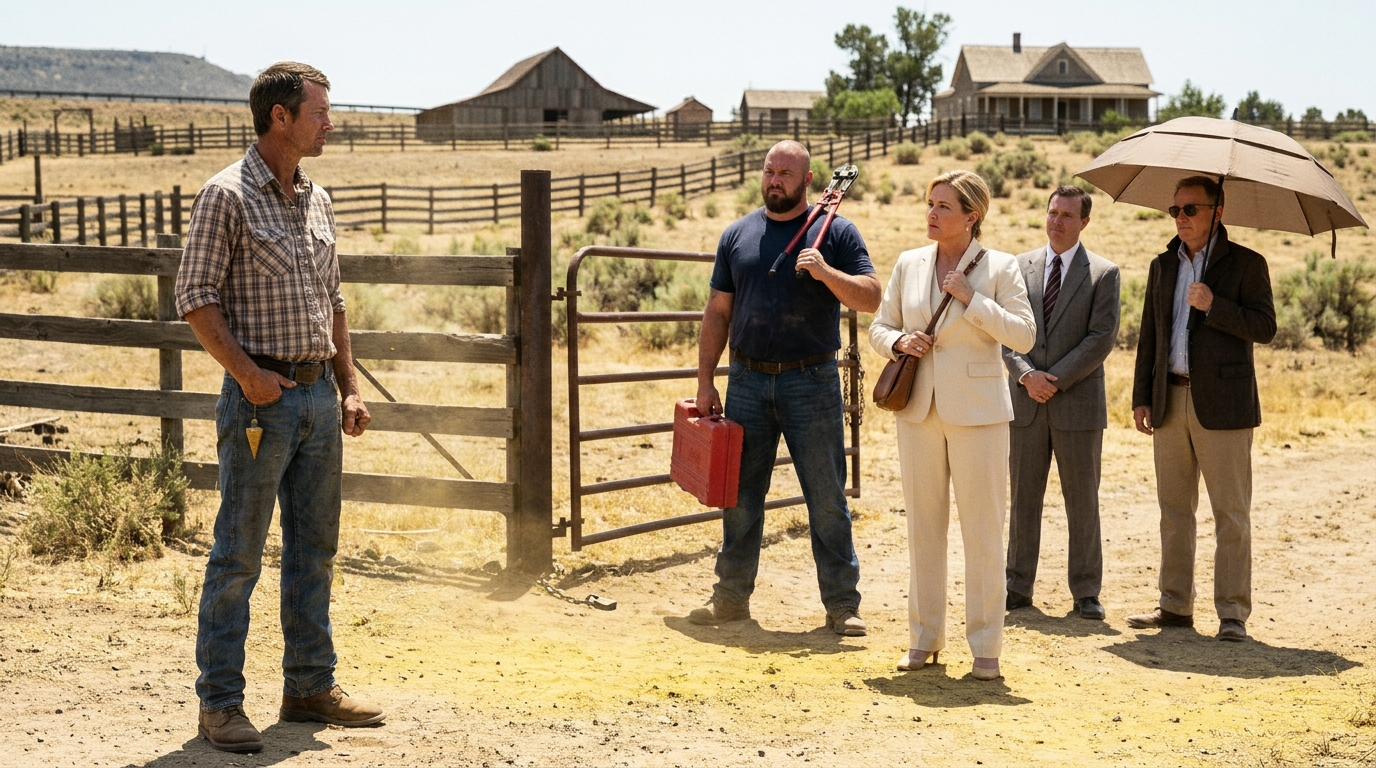
The brass surveyor’s plumb bob felt cold against my palm, a heavy piece of scarred metal that had belonged to my grandfather long before the luxury suburban development across the asphalt ridge was even a sketch on a developer’s napkin. I stood by the window of the old office, watching the white Lexus crunch over the gravel of my driveway, its pristine paint catching the harsh glare of the midday sun. Karen Westfield stepped out of the driver’s seat, her cream-colored pants suit crisp, flanked by two board members who moved with the stiff, self-important posture of volunteer guards. Behind them walked a man carrying a heavy red tool case—a locksmith with bolt cutters slung over his shoulder like a weapon.
They were heading straight for the heavy iron gate that marked the boundary of the Thornton Ranch.
I didn’t rush down the stairs. I let the screen door click quietly behind me, stepping onto the dirt porch just as the locksmith set the heavy jaws of the cutters against the hardened steel padlock my grandfather had put on that chain thirty years ago. The metal gave a sharp, dry crack that echoed across the scrub brush, the severed link dropping into the yellow dust with a soft thud.
“Karen,” I said, my voice flat, grounded in the quiet routine of a man who spent his mornings checking water troughs and clearing rocks from the north pasture. “You’re about ten feet past your playground.”
She didn’t flinch; she adjusted the strap of her leather purse, her face hardening into that familiar expression of weaponized community standards. “This gate is an unapproved structural barrier encroaching on Ridgeline Estates common area, Captain Thornton. We’ve sent three notices regarding the boundary violation. Since you’ve chosen to ignore the community guidelines, the association is taking possession of the access point to restore the easement layout.”
“This dirt has been Thornton dirt since 1952,” I replied, my fingers tightening slightly around the brass plumb bob inside my pocket, letting the sharp point anchor my focus. “My grandfather cleared this brush with an eight-hundred-dollar tractor and a pair of calloused hands. Your development didn’t exist until five years ago.”
“The 1987 plat map states otherwise,” she said, her tone smooth, dripping with the absolute certainty of a regular real estate attorney who knew how to use the weight of official-looking paper to break a common workingman. She didn’t offer a document, didn’t show a deed—she simply gestured to the locksmith, who was already reaching for a new chain inside his red case. “We are placing a formal association lien on the adjoining acreage for non-compliance. If you interfere with the placement of our secure lock, I will have the county sheriff remove you for civil disruption.”
One of the board members behind her shifted his weight nervously, his shiny loafers picking up a layer of gray dust from my driveway. They didn’t have the certified county maps with them, and neither did I—the paperwork was locked away in a town office twenty miles out, caught in a bureaucratic tangle of old town records. All we had out here was the hot wind, the broken iron chain in the dirt, and the unyielding audacity of a woman who believed that if she repeated a lie with enough authority, the land would simply reshape itself to fit her demands.
I stepped off the porch, my boots sinking into the dry earth, closing the distance until the smell of the Lexus’s hot exhaust mixed with the scent of pine and horse manure. “Try to lock it,” I said softly. “See how long the chain holds.”
CHAPTER 2: PAPER SCARS
The numbers on the page didn’t shift, no matter how hard the gray morning light hit the old oak desk. Five hundred dollars a day for an alleged fence violation, backdated four full months. An emergency survey fee of twelve thousand dollars for a crew I had never seen, let alone authorized to cross my cattle guards. Eight thousand in association legal fees, five thousand for community remediation.
The grand total at the bottom of the demand letter from Ridgeline Estates read exactly forty-seven thousand dollars, stamped with a red corporate seal.
Miguel stood by the door frame, his heavy canvas jacket damp from the early mist, his calloused fingers hooked into his belt loops. He didn’t look at the ledger. He looked at the floorboards, his boots leaving a faint trace of damp red clay near the threshold.
“The bank manager called the barn landline ten minutes ago, Captain,” Miguel said, his voice flat with the steady, quiet caution of a man who had worked this valley since the terraces were nothing but scrub brush. “He wouldn’t talk to me. Just said the corporate line of credit is frozen until the title cloud clears.”
I picked up the heavy brass plumb bob from the desk, its cold weight settling into my palm, the metal scarred from decades of real-time use. “We have twenty tons of alfalfa arriving at the north gate by three o’clock, Miguel. The crew’s weekly envelopes are already stuffed.”
“The boys will wait on the cash, Jake,” Miguel muttered, stepping closer, the floorboards groaning under his weight. “But the feed supply store won’t drop the gates without a cleared draft. The old man never missed a Friday payroll in forty years. It ain’t right.”
The phone on the desk buzzed, a sharp, mechanical rattle against the ancient pine wood that cut through the silence of the office. I didn’t answer it. I knew the cadence of the ring—it was the third time the insurance brokerage had dialed since the county recorder logged Karen Westfield’s fictional lien. The institutional machinery was moving exactly the way she had designed it, using the polite, automated cowardice of secondary entities to starve the ranch out from the edges.
I walked to the window, the brass bob swinging slightly from its string between my fingers, a steady pendulum against the view of the ridge. Across the asphalt road, the white fences of Ridgeline Estates gleamed, uniform and sterile, a sharp contrast to the weathered gray timber of my grandfather’s historical barn.
Karen Westfield was standing near the pristine entrance of her development, speaking to a county utility truck driver, her fingers tapping against a clip-board with the absolute authority of a woman who had never dug a posthole in her life. She didn’t look toward the ranch, but the deliberate angle of her shoulders projected the silent weight of her victory.
She didn’t need a court order to break me. She just needed to clog the gears of my daily survival until the friction burned the legacy to the ground.
I shoved the brass metal deep into my pocket, the cold point pressing hard against my thigh as I turned back to the desk. “Load the flatbed, Miguel. We’re driving down to the county seat.”
CHAPTER 3: THE BURIED PIN
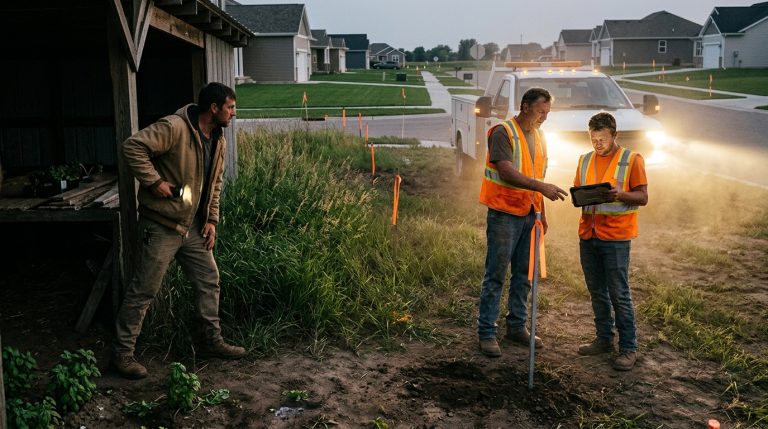
The cold rain from the valley mist seeped into the cuffs of my gloves as I knelt in the gray mud, my fingers scraping away layers of rotted pine needles and wet clay.
Miguel leaned heavily against the handle of his spade, his breathing ragged under the damp sky, his eyes fixed on the narrow trench we had dug along the property line. “That shouldn’t be here, Jake. The community survey lines they showed the town council are supposed to clear the historical barn by fifty yards.”
I pulled the scarred brass plumb bob from my pocket, letting the heavy metal weight dangle right above the rusted iron cap I had just uncovered. The cord hung dead straight, but the rod beneath the dirt wasn’t vertical—it was bent sharply at a forty-five-degree angle, pointing directly toward the foundation of the ranch house itself.
“This pin didn’t rust like this naturally, Miguel,” I said, my thumb tracking a deep, jagged groove gouged into the side of the metal casing. “Something heavy hit it. Something with tracks.”
A shadow fell across the trench before the sound of footsteps even reached us through the thick mist.
Karen Westfield stood on the gravel shoulder of the main access road, an oversized umbrella held aloft by Dennis, her quiet husband, who remained a step behind her with his collar turned up against the cold drizzle. Her gaze locked onto the spade in Miguel’s hands, her lips thinning into a tight, satisfied line that projected the full weight of her administrative authority.
“Altering or excavating association-monitored grid markers is a civil violation, Captain Thornton,” she called out, her voice cutting through the damp air with the cold precision of a foreclosing foreclosure notice. “The engineering firm we retained logged that coordinate layout back during the subdivision platting. Your current residential structure encroaches directly onto the greenbelt zone.”
I stood up slowly, the wet clay sticking to the knees of my denim trousers, the brass bob gripped tightly in my fist to lock down the cold fury tightening my throat. “Your subdivision didn’t lay this iron, Karen. My grandfather set these corners with a sledgehammer when the road out front was still a dirt track.”
“The modern county tax records acknowledge the recorded grid coordinates, not family folklore,” she replied, gesturing slightly with her leather gloved hand toward the ridge behind her. “The association board has already initiated the secondary enforcement phase. Without a clean title clearance, your commercial operations terminate by the end of the month.”
Dennis shifted the umbrella slightly, his eyes tracking the deep ruts left by the excavation equipment that had cleared the Ridgeline Estates perimeter fence two winters ago. He didn’t say a word, but his grip on the handle tightened, his knuckles turning a stark, bloodless white under the gray light.
The bent iron pin stayed locked in the mud between us, a physical contradiction buried in the gray dirt that proved the modern lines had been forced into the landscape with a bulldozer’s blade.
“We’re not moving the fence, Karen,” I said, stepping up to the edge of the ditch until the gray grey dust from the road crunched beneath my soles. “And we’re not moving the house.”
CHAPTER 4: THE MUDDY BASELINE
The smell of old hydraulic fluid and stale tobacco hung heavy inside the cramped garage office.
Old Hank sat on a rusted metal stool, his thick, grease-stained fingers tracing the outline of a cracked porcelain coffee mug as he looked out at the rain slicked gravel lot. “I told that Westfield woman two winters ago that her property stakes were pushed too far west, Jake. My grader hit something solid right where the old boundary pin was supposed to be, and she just told me to keep pushing the blade.”
I set the brass surveyor’s plumb bob onto the cluttered workbench, its heavy base settling with a solid thud among the scattered copper washers and spark plugs. “She wanted the grid coordinates to match her development plat, Hank. She didn’t care about what was already anchored in the dirt.”
“She threatened to pull my excavation contract with the county if I logged the discrepancy,” Hank muttered, his jaw tightening as a heavy drop of sweat ran down his weathered cheek, smudging the gray grime near his temple. “A workingman can’t just throw away six months of steady diesel money because a lawyer wants to play god with a line map.”
The garage door rattled violently as a sudden gust of wind swept through the valley, forcing a cold draft of damp air right across the floorboards.
Miguel stepped inside from the bay, shaking the moisture from his heavy canvas cap, his face set in a grim expression that left no room for small talk. “The feed store owner just posted a notice on our secondary account, Jake. They’re refusing to drop the winter hay allotment unless we settle the outstanding remediation fines Karen logged against the title.”
The institutional chokehold was tightening exactly according to her strategy, using the leverage of local businesses to starve my operation before we could even secure a formal court date.
I picked up the cold metal bob from the bench, my fingers tracing the deep scratches on its brass surface before sliding it back deep into my denim pocket. “We don’t need their corporate grid maps to prove where the original line sits, Miguel. We just need the physical footprint of the equipment that broke it.”
Hank looked up from his mug, his hand trembling slightly from years of heavy lever vibration as he pointed toward a dusty ledger on the shelf. “The daily maintenance logs from that winter are still in the cabinet, Captain. Every yard of dirt shifted along that fence line is written down in plain ink.”
The land didn’t lie, even when the modern records were clouded by administrative malice.
“Load the ledger into the truck,” I said, stepping toward the open bay where the flatbed engine idled with a low, steady rumble. “We’re giving her legal counsel something concrete to look at.”
CHAPTER 5: THE LEGAL SIEGE
The air in the courtroom tasted thin, filtered, and completely detached from the wet clay and scrub brush of the valley.
Roger Simmons stood at the center podium, frantically smoothing down the lapels of his wrinkled suit jacket, his hand trembling slightly as he gestured toward the digital projection screen. “Your Honor, the association acted purely on recorded municipal grid references to protect community architectural integration. The plaintiff has failed to produce any certified state boundary modification files to contest the lien.”
I didn’t reach into my pocket for the grandfather’s plumb bob—the bailiff had taken my pocketknife and keys at the gate—but I kept my eyes locked on the front row of the gallery.
Karen Westfield sat rigidly behind her counsel table, her fingernails dug deep into the leather of her expensive clutch, her posture perfectly stiff as she shot a sharp, warning glare toward the witness stand. She still believed the absence of the official county plat copies left me completely unarmed against her paper trail.
“We don’t need the county’s digital grid lines, Mr. Simmons,” I said, my voice cutting through the wood-paneled room with the slow, deliberate weight of an everyman who had survived a long winter. “We have the original physical anchors.”
Rebecca Brennan stepped forward from our table, lifting Hank’s greasy, oil-stained field ledger with a pair of clean white linen clips, holding it directly beneath the bench for Judge Margaret Harding to see. “The defense relies on modern boundaries that were physically forced into the earth. We have the operator’s log from the winter of the development’s construction, noting the exact position where the original 1952 homestead pin was hit, bent, and buried by thirty tons of steel.”
The opposing counsel fumbled with his notes, his jaw dropping slightly as a bead of nervous sweat broke through his powder-dry skin. “This—this is an unverified logistical log, Your Honor. It has no legal standing over the recorded subdivision covenants.”
“The 1987 residential easement deed signed by Samuel Thornton explicitly states the boundary follows the natural creek alignment and the physical oak baseline, not your mathematical coordinates,” Rebecca stated, her predatory smile tightening the room’s atmosphere until the silence became absolute. “The association didn’t just file a lien. They deliberately altered the landscape to create an artificial encroachment violation.”
Karen leaned forward, her face flushing a deep, angry crimson as she hissed a muffled command to her attorney, her perfect composure completely fracturing under the visibility of the grease-stained field notes.
The weight of the land was finally pushing back against the paper empire she had built.
Judge Harding leaned over her elevated bench, her eyes narrowing behind her reading glasses as she stared down at the fumbling defense team. “Mr. Simmons, I suggest you explain why your client’s subdivision layout matches a displaced iron marker currently sitting forty-five degrees out of alignment in the mud.”
CHAPTER 6: THE DUSTY TRUTH
The metal didn’t budge under the steady pressure of my hand, firmly anchored back into the precise intersection of the creek bed and the old oak roots where it belonged.
Miguel leaned against the newly strung wire fence, the tension tools swinging quietly from his leather work belt, his gaze tracking the empty gravel expanse of the access road. “The new board president signed the formal road maintenance contract an hour ago, Jake. The monthly drafts are already cleared, and they’ve legally retracted every last code complaint from the county ledger.”
I straightened up, wiping the gray loam from my palms onto my canvas trousers, looking across the ridge where the sterile white fences of Ridgeline Estates caught the clean morning sun.
Karen Westfield wasn’t standing at the perimeter gate anymore; her weaponized authority had completely vanished the moment the federal judge issued the criminal fraud referral to the state attorney’s office. The local gossip columns were already detailing the seizure of her personal assets to satisfy the heavy structural damages ordered by the court, leaving her modern grid maps completely worthless against the unrecorded metes-and-bounds deed.
“They’re never crossing this fence line again, Miguel,” I said, my voice steady, grounded in the quiet rhythm of a working property that had outlasted three generations of developers. “The land has a long memory.”
A lone utility truck rolled quietly past the main entrance across the way, its driver offering a brief, respectful nod through the glass—a stark contrast to the cur, frightened isolation that had choked the ranch all through the winter.
Dennis, her quiet husband, had packed his things and crossed the state line weeks ago, leaving the empty white Lexus sitting in the driveway under a bank repossession lock.
The heavy brass plumb bob stayed tucked away inside the top drawer of the old office desk now, no longer needed to anchor my temper or project a hidden line against the unyielding audacity of entitled neighbors.
The cattle moved slowly through the western pasture, their lowing carrying across the scrub brush as the light turned a warm, golden orange over my grandparents’ graves on the hill.
I picked up the empty wooden spade handle, walking back toward the historical barn whose timber frame stood perfectly straight against the wind, completely clear of their modern layouts.
The borders were set in stone.