The Hydraulic Blueprint: How Thirty Years of Civil Engineering Dismantled a Suburban Tyrant’s Reign
CHAPTER 1: THE COLD GRADIENT
The water tasted of iron and rotted lawn clippings, a flat, stagnant flavor that clung to the back of the throat long after Mark turned his back on the property line.
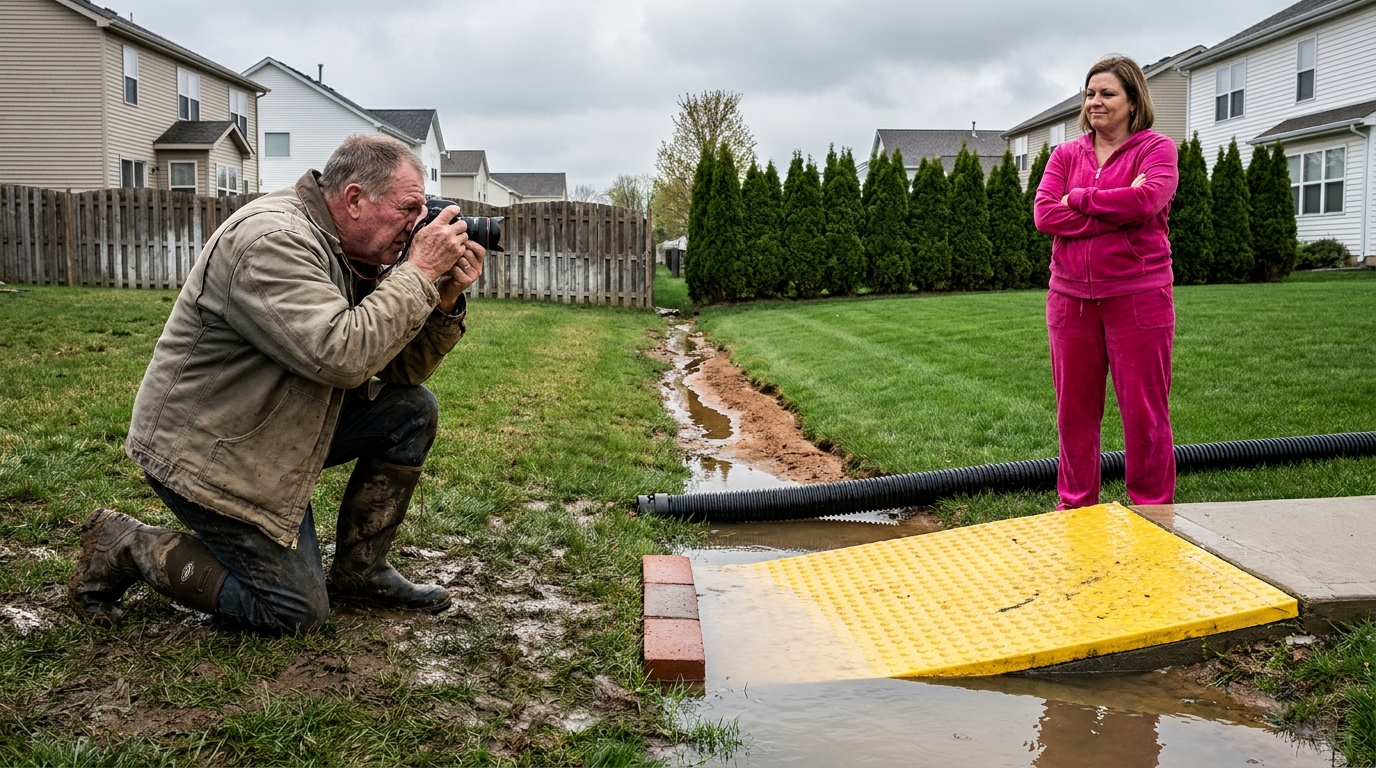
Beside him, the fuchsia velour of Karen’s tracksuit rustled with a smug, rhythmic friction, her arms locked across her chest in an immutable barrier of suburban authority. She spoke of acts of God and poor life choices with the practiced cadence of someone accustomed to undisputed rule, her gaze fixed entirely on the sinking safety-yellow slide. She saw a muddy patch of grass and an aging retiree who could be easily ground down by a binder full of laminated bylaws. She did not see the three decades of military civil engineering coiled like a spring behind Mark’s quiet exterior.
He did not argue. Argument was an admission of weakness, a tactical expenditure of energy where none was required. Instead, his eyes tracked the subtle, unnatural line of erosion cutting across the turf, tracing the vector straight back through the recently planted row of arborvitae to the hidden black corrugated pipe. Four inches in diameter. Gurgling with a steady, calculated discharge. A localized hydraulic weapon aimed directly at his granddaughter’s therapy space.
“Enjoy the weather, Mr. Evans,” Karen said, her voice dropping into a register of condescending pity that felt heavier than the damp air. “The association has rules for a reason.”
She turned on her heel, her footsteps precise on her dry, manicured turf.
Mark remained still, his heavy waterproof field boots sinking a fraction of an inch further into the slurry. His pulse did not race; it slowed, dropping into the rhythmic, measured cadence he had maintained while surveying flood-prone supply lines in the Mississippi Delta. He pulled out his camera, framing the shot with clinical detachment. The water line stained the base of the cedar fence at exactly eighteen inches. The custom ramp he had built with Sarah’s physical therapist—designed with painstaking fractions of a degree to accommodate her muscular dystrophy—was compromised, the specialized shock-absorbing tiles submerged beneath a brown, opaque mirror.
He knelt, ignoring the chill seeping through the knees of his trousers, and ran a gloved hand along the edge of the erosion channel. Something felt wrong beneath the surface. The soil gave way with an unnatural softness, not consistent with a simple overflow of rainwater, but with a channeled, high-pressure subterranean seam.
His fingers brushed against a buried edge of brick near the property line—a corner of hardscaping that had no business being within three feet of the common easement. It was an out-of-place anomaly, a clean, sharp rectangle buried beneath two inches of silt where the natural grade should have been untouched.
The micro-mystery clicked into place beneath his fingertips, shifting the parameters of the conflict from a petty neighborhood grievance to a calculated structural intrusion.
Mark stood up slowly, wiping the dark loam from his glove. He looked from the sunken playground back toward Karen’s shuttered kitchen window, where a reflection of white lace curtains stared down like a blind eye. The first letter to the architectural review committee was already written in his head: precise, factual, and devoid of emotion.
He turned his back on the swamp, stepping carefully across the saturated turf toward the garage, leaving the water to rise behind him in the gathering chill.
CHAPTER 2: THE BLUEPRINT OF DECEPTION
The garage door was closed against the thin, relentless drizzle, sealing in the scent of motor oil, damp cardboard, and old ink. Overhead, a single fluorescent strip hummed with a low, electrical fatigue, casting a harsh, unblinking glare across the massive roll of technical paper pinned down by heavy brass weights at each corner.
Mark did not turn on the radio. He preferred the silence, broken only by the steady tink-tink of condensation dripping from the garage rafters into an aluminum bucket near the workbench. His hands, still smelling faintly of wet earth from the property line, moved methodically across the drafted lines of Oak Creek Meadows Subdivision, Phase 2.
Thirty years of engineering had trained him to look past the visible surface of things—past the manicured lawns, the cheerful painted mailboxes, and the brightly colored plastic play equipment—down to the hidden physics of weight, flow, and displacement. When he had drafted these sheets back in 1998, every contour line had represented a promise of balance. Water, left to its own gravity, would always seek the lowest path. The genius of a proper subdivision wasn’t fighting that gravity; it was anticipating it, channeling the seasonal deluge away from foundations and safely toward the public street grids through an invisible network of French drains, swales, and subterranean culverts.
He reached for a red grease pencil, his movements deliberate and economical, and drew a sharp circle around Lot 42 and Lot 43.
The micro-mystery of the buried brick he had felt beneath his boots earlier that morning was no longer an isolated anomaly. It was a physical coordinate pointing toward a calculated alteration. Karen’s newly expanded stone patio—the one she had boasted about during neighborhood association meetings—extended three feet beyond the original setback line registered on the county plat. More importantly, the subsurface grade beneath her hardscaping had been artificially elevated by at least eight inches of compacted gravel and fill.
By raising her own foundation, she had unknowingly—or perhaps with a reckless disregard for her neighbors—tilted the micro-watershed of her backyard. She had turned her property into a sloping tabletop, and his yard was the basin catching the runoff.
Mark traced the vector of the hidden black corrugated pipe with the tip of his pencil. Four inches of corrugated plastic. It was a coward’s conduit, cheap and flexible, snaking beneath the freshly planted row of arborvitae to bypass the natural percolation of the soil entirely. It didn’t just drain her patio; it concentrated every drop of roof drainage and garden runoff into a high-pressure firehose aimed straight at the retaining border of Sarah’s therapy playground.
The logical next step of engagement required documentation that could withstand not just an HOA arbitration, but a civil court of law.
He pulled a clean legal pad toward him and uncapped a black ballpoint pen. His handwriting remained blocky, precise, and unhurried—the handwriting of a man who had drafted repair orders for bridge spans and floodgates under military deadlines.
Item One: Formal notification of structural encroachment and hydrological diversion, addressed to the Architectural Review Committee, care of the association secretary.
Item Two: Photographic logs with scale measurements, detailing the exact depth of the standing water—eighteen inches at the base of the custom ramp.
Item Three: Soil composition samples harvested from the impact zone, currently sitting in sealed glass mason jars on the back workbench, awaiting density and saturation analysis.
He paused, the pen hovering above the paper as the sharp, metallic crunch of gravel sounded from the driveway outside.
Mark didn’t look up immediately. He allowed his peripheral vision to register the sweep of headlights cutting horizontally across the frosted lower panels of the garage door. A vehicle had slowed down, paused for three beats precisely in front of his property line, and then crept forward. The engine note was quiet—a modern sedan, idling with a faint, smooth purr.
He laid the pen down, the plastic barrel clicking softly against the wood of the drafting table.
Walking to the side service door that led out to the driveway, he didn’t flip the exterior light switch. He kept his silhouette entirely within the deep shadow of the shelving units, his eyes adjusting to the dim, amber glow of the streetlamp filtering through the drizzle outside.
Through the wired glass pane of the service door, a dark sedan sat parked illegally half across his curb. The interior dome light was off, but the silhouette of a driver was unmistakable. Even through the distorted glass, the rigid, angular posture of the head and the unmistakable outline of a fuchsia velour jacket slumped against the passenger headrest were glaringly apparent.
Karen.
She wasn’t just monitoring him; she was conducting her own reconnaissance, staking out his workspace with the nervous, erratic energy of a neighborhood tyrant realizing her control was slipping. She sat motionless in the idling car, staring at the darkened front of his house as if her sheer willpower could dismantle the engineering files sitting on his drafting table.
Mark felt no surge of anger. Anger clouded calculations. Instead, a cold, sharp satisfaction settled into his chest. She was watching him, which meant she felt the pressure. She knew he wasn’t folding under the weight of her arbitrary $100 violation notices. By coming to his curb, she had broken her own unwritten rule of untouchable authority, descending from her manicured lawn into the wet, gray trenches of direct confrontation.
He didn’t tap on the glass. He didn’t turn on the porch light to scare her off. He simply stood in the shadows, watching the exhaust pipe of her sedan plume white clouds into the damp evening air, letting the silence stretch between them until the car finally shifted into gear, tires hissing against the wet asphalt as it sped away into the gloom.
Mark walked back to the drafting table, picked up his red grease pencil, and extended the vector line on the blueprint a fraction of an inch further. The trap was set; now it was only a matter of letting her walk deeper into the geometry of her own making.
CHAPTER 3: THE ALLIANCE OF THE MARGINS
The morning mist clung to the asphalt of Oak Creek Meadows like a wet bandage, dulling the sharp angles of the suburban rooflines. Mark did not take his truck; he walked, his waterproof field boots striking the concrete with a dull, rhythmic cadence that measured the distance between his front door and the Garcias’ driveway two blocks away.
The physical landscape of the subdivision revealed its vulnerabilities under the gray light. Catch basins choked with fallen gum leaves, curb joints showing hairline fractures from seasonal freeze-thaw cycles, and drainage slopes that had settled unevenly over twenty winters. It was a functioning system under normal stress, but entirely intolerant of localized arrogance. Karen’s unpermitted hardscaping was a localized cancer eating away at the margins of that tolerance.
He turned down Maple Crescent, his eyes scanning the houses for the small, familiar markers of quiet neighborhood friction.
At number 24, David Garcia was kneeling beside the rear bumper of a gray station wagon, a socket wrench gripped in his grease-etched hand. The driveway was clean except for the stubborn gray ghost of a painted rectangle near the garage door—the outline of a portable basketball hoop that had been banished two months prior under Karen’s strict aesthetic code.
As Mark stepped onto the apron of the driveway, the metallic clink of the wrench halting against chassis metal broke the silence. David looked up, wiping a streak of dark grease across his forehead with the back of his forearm. His expression was tight, hardened by the lingering resentment of a man who had paid a two-hundred-dollar fine simply to stop the harassment of his family.
“Mark,” David said, his voice flat, carrying the weight of a morning shift already half-started. “Can’t say I expected you out this early. Especially not on this side of the loop.”
“The morning air is honest, David,” Mark replied, stopping three feet short of the oil-stained concrete. He kept his posture relaxed but grounded, his hands resting inside his canvas jacket pockets. “And the paperwork requires witnesses who understand what it means when someone changes the grade of a foundation.”
David set the wrench down with a sharp clink against the concrete slab. He stood up slowly, wiping his hands on a rag that was already stiffened with grime. The memory of the basketball hoop citation flashed in the tight lines around his eyes—the sudden appearance of Karen on the sidewalk, clipboard in hand, declaring that a child’s toy was an unapproved architectural blight.
“She stood right there,” David muttered, pointing a grease-stained thumb toward the edge of the manicured lawn. “Not twenty feet from where we’re standing. Told me my son’s game lowered property values. My boy was nine years old. We paid the fine because my wife didn’t want the letters piling up in the mailbox.” He crossed his arms, his jaw tightening. “You’ve been getting those white envelopes every morning now, haven’t you?”
“Every morning,” Mark said evenly. “One hundred dollars a day for standing water she manufactured herself.”
David let out a harsh, dry laugh that lacked any humor. “She thinks she owns the dirt under our feet. What do you need, Mark? If it’s a signature, tell me where to sign.”
A sudden psychological Phantom drifted across Mark’s focus—the sharp, vivid memory of an engineering battalion briefing in the muddy lowlands outside Da Nang decades ago, where structural integrity depended entirely on the brutal honesty of the weakest joint in a pontoon bridge. You didn’t argue with a failing weld; you exposed it to the commander and replaced it. Here, the weak joint wasn’t concrete or steel; it was the fragile, bought-and-paid-for loyalty of an isolated tyrant’s administrative base.
“Not a signature yet,” Mark said, pulling a folded photocopy of his initial site assessment from his jacket. He smoothed it against the top of the station wagon’s fender. “An affidavit. Just the facts of your citation, the date, and the interaction. We are building a formal record for the architectural committee’s review board. If we present a chorus instead of a solo voice, the board members who are currently hiding behind her stationery will have to choose between their own liability and her theater.”
David leaned over the paper, his eyes scanning the technical headings with the practical appreciation of a man who worked with mechanical tolerances every day. A slow, predatory grin touched the corners of his mouth.
“You’re treating her like a bad engine block,” David murmured, his finger tapping the paper. “You’re tearing her down to the gaskets.”
“I’m just reading the blueprints she chose to ignore,” Mark replied.
Before David could answer, the front door of number 22 down the street clicked open. Mrs. Gable stepped out onto her porch, clutching a light cardigan around her shoulders against the damp chill, her gaze fixed anxiously on the two men standing by the driveway. Her manicured rose garden, bordered by the remaining ceramic gnomes that had survived Karen’s arbitrary purge, looked stark against the gray morning.
Mark met David’s eyes for a single, understanding beat. The perimeter was expanding. The micro-discrepancies in the neighborhood’s peace were aligning into a unified front, and the cold machinery of accountability was finally shifting into gear.
CHAPTER 4: THE POISON PILL BLUEPRINT
The drafting table in the garage was no longer just a workspace; it was a court of inquiry.
Mark sat under the harsh, unblinking glare of the fluorescent tube, his hands steady as he arranged a twenty-page technical application into a crisp, black binder. Beside it sat the lab analysis report for the soil samples and the topographical survey he had completed the previous afternoon. This was not a plea for mercy, nor was it a defensive counter-plea against Karen’s barrage of one-hundred-dollar violation notices. It was a calculated, legally bulletproof explosive device disguised as standard architectural paperwork.
Every drawing, every cross-section of the proposed French drain system, and every flow-rate calculation complied precisely with county residential code. But buried deep within the legal boilerplate and engineering annexes were the three clauses designed to shatter the association’s administrative defense.
The first clause required an independent, certified engineering audit of any external water source entering Lot 43 before a single spade of earth could be turned—legally forcing the HOA to acknowledge the existence of Karen’s black corrugated pipe on record. The second clause transferred financial liability for any downstream infrastructure compromise squarely onto the association’s reserve fund. The third clause indemnified Mark from any existing or pending standing water fines while the application was under review.
He closed the black binder with a dull, satisfying snap.
The trap was fully baited. If Karen and her handpicked review committee approved the application, they would be self-funding a massive infrastructural overhaul on his property while formally admitting culpability for her illegal patio runoff. If they denied it—a perfectly legal, fully certified engineering plan—their rejection would be recorded as an act of absolute bad faith and institutional negligence, providing the definitive exhibits for Dave Riley’s impending civil injunction.
He slid the binder into a heavy manila envelope, sealed the flap with a strip of reinforced packing tape, and pressed a crimson postal stamp onto the corner.
The sound of a heavy diesel engine idling down the street drew his attention toward the open gap above the garage threshold. A slow, heavy rumble vibrated through the concrete floor. Mark stepped out from the dim shelter of the garage into the pale, filtered daylight of the driveway just in time to see a cream-colored sedan ease past his curb. Karen sat behind the steering wheel, her profile rigid, eyes locked straight ahead, refusing to turn her head toward his property. But as the car crept forward, he caught the brief, sharp flash of her expression in her side mirror—a look of frantic, pinched calculation.
She knew the thirty-day review window was closing. She could feel the tightening net of documentation, and her institutional authority was beginning to fray at the edges.
Mark didn’t watch her car turn the corner toward the clubhouse. He turned back into the garage, picked up the sealed manila envelope, and walked out to his truck. The final administrative move had to be delivered in person, recorded with a formal tracking number, and logged into the official register before the afternoon cutoff.
The air felt colder now, carrying the metallic scent of an approaching front over the suburban rooftops. Every step he took on the pavement was measured, unhurried, and absolute. The bureaucracy she had weaponized against him was about to turn inward, weaponized by the very rules she thought she owned.
CHAPTER 5: THE CLUBHOUSE RECKONING
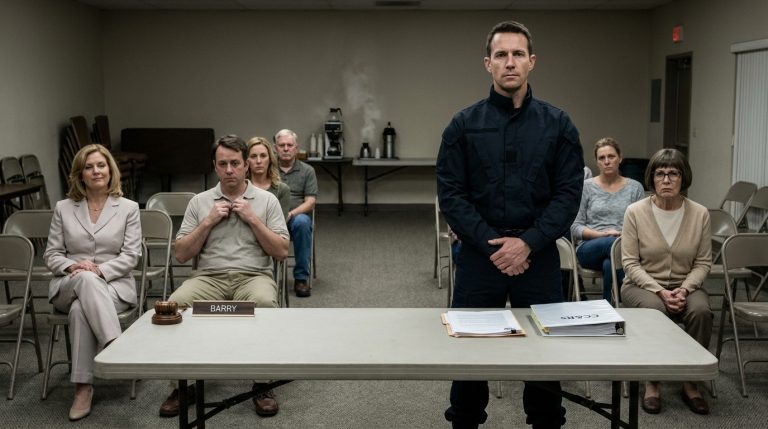
The air inside the sterile beige clubhouse was thick with recycled heat and the collective respiration of fifty anxious homeowners. Rows of folding metal chairs, usually deserted during routine property updates, were packed solid. Near the back stood the Garcis, their expressions tight with quiet vindication, while Mrs. Gable clutched a small leather handbag in her lap a few rows ahead.
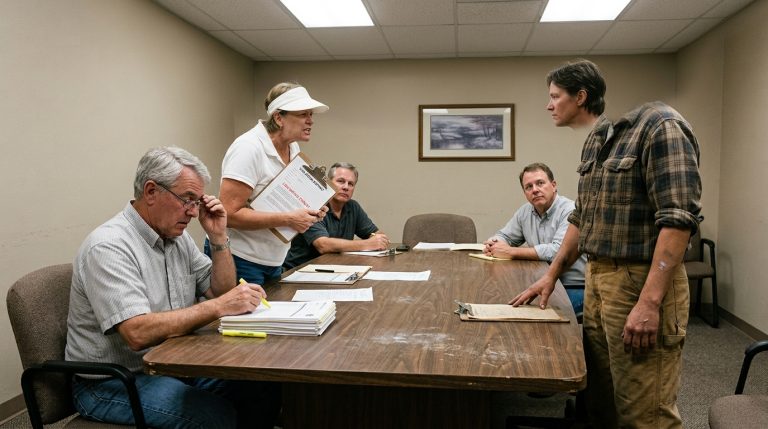
Mark sat in the front row, his posture rigid and unyielding. Beside him, Dave Riley rested a sleek silver laptop on the linoleum-topped table, his fingers tapping a slow, rhythmic tattoo against the aluminum casing. Arthur Henderson occupied the seat to Mark’s left, a silent pillar of the community’s original engineering history whose presence lent an inescapable gravity to their coalition.
At the head table, Karen sat flanked by her four handpicked board members. She wore a power suit the color of dried blood, her fingers gripping her wooden gavel with white-knuckled intensity. Her eyes flicked across the room, registering the unwonted density of the crowd, before locking onto Mark with an expression of sharp, defensive venom. She had expected a quiet administrative dismissal; instead, she found herself facing an assembly primed for exposure.
“We will call the meeting to order,” Karen announced, her voice clipped and strained, cutting through the low murmur of the room. She hurried through the routine opening items—treasurer balances and landscape mulch updates—her pace rushed, desperate to reach the agenda item she believed would permanently silence her critic.
Finally, she reached it.
“New business,” she said, her tone dripping with false formal cadence. “Item A: application from lot 43 for a proposed storm water mitigation system.”
A collective rustle rippled through the rows of folding chairs. Karen held up Mark’s twenty-page black binder, shaking it dismissively toward the crowd.
“The board has reviewed this extensive application,” she continued, her voice rising to regain control of the room. “It proposes a ridiculous, highly costly system of pumps and drains for what is simply a soggy lawn. The architectural review committee has voted unanimously to deny this application. It is frivolous, unnecessary, and a gross misuse of community resources. Therefore, the application is denied. Are there any questions?”
She paused, locking her gaze directly on Mark, a triumphant smirk cutting across her features.
Mark did not shout. He did not rush. He stood up slowly, the legs of his metal chair scraping a sharp, metallic note against the linoleum floor. Beside him, Dave hit a single keystroke on his laptop, and the projector overhead flared to life, casting a massive, high-resolution image onto the white screen directly behind Karen’s head.
The image was unmistakable: the black corrugated pipe hidden behind the row of arborvitae, spewing a steady, unpermitted stream of gray runoff straight toward the boundary line.
Gasps rippled through the front rows.
“On what grounds,” Mark asked, his voice steady, carrying cleanly through the hushed room, “is a professionally engineered mitigation plan, fully compliant with municipal code, considered frivolous?”
Karen scrambled to her feet, her face flushing a dark, mottled red. “That has nothing to do with the application! That is a private matter—”
“It has everything to do with the application,” Dave interrupted, his voice booming as he stood beside Mark. With a tap of the remote, a new document filled the screen—the formal violation notice she had sent Mark, fining him for the exact standing water her pipe had generated. “The application you denied was a formal attempt to fix the damage your illegal actions caused. Your denial in front of these witnesses is an act of profound bad faith and retaliatory abuse.”
The room fell into a heavy, suffocating silence. Karen stammered, her mouth opening and closing as she looked frantically toward her fellow board members for backup. But Gary, the vice president, was staring straight down at his folded hands, refusing to meet her gaze.
Mark took one step forward, anchoring his weight on his heels. “You assumed I was just a retiree you could push through a paper shredder. But you failed to check who designed the infrastructure of this entire subdivision.”
Dave pressed the remote one final time. The original 1998 Oak Creek Meadows master grading plan flashed onto the screen, the crisp technical lines centering cleanly on the signature box at the bottom.
Mark Evans. Lead Civil Engineer.
“I designed every culvert, every grade, and every drainage vector in this neighborhood,” Mark said, his voice dropping into a cold, metallic register that brooked no argument. “Your unpermitted patio and your plastic pipe have compromised the subsurface integrity of the sector. You aren’t just flooding my yard, Karen. You are threatening the structural safety of half the homes on this block.”
Karen stared at the screen, her absolute authority shattering in the harsh glow of the projector light. The silence in the clubhouse was absolute, the weight of the evidence pressing down upon the room like an incoming storm.
CHAPTER 6: THE REDEMPTION OF THE YARD
The air smelled of fresh-cut Kentucky bluegrass and sun-warmed cedar, a clean, atmospheric contrast to the damp iron and rotted mulch that had choked the property weeks prior.
Mark stood near the center of the expansive green lawn, his hand resting on the smooth, polished railing of Sarah’s newly reinstalled playground. The heavy machinery deployed by the city-approved engineering firm had stripped away two feet of super-saturated slurry, replaced it with engineered structural fill, and laid fresh turf that matched the precise grade of his original 1998 blueprints. At the base of the custom wooden ramp, the specialized rubberized tiles absorbed the pressure of his step without a single sign of give.
Order had not been restored by luck or shouting; it had been engineered through thirty years of disciplined patience, meticulous documentation, and unyielding physics.
Karen’s house, sitting just up the gentle incline behind the property line, stood under a quiet, somber shadow. The unpermitted stone patio and the black corrugated pipe were gone, excavated and carted away by county contractors to satisfy a six-figure judgment that had forced her to list the property. A young family with a toddler had already moved in two weeks earlier, planting a simple wooden tree swing from an oak branch instead of erecting hardscape barriers. The drainage system beneath the turf performed exactly as it was mathematically designed to do, routing seasonal rainwater safely toward the street grates without a single drop of pooling compromise.
From the shaded bench near the garden border, Arthur Henderson raised a paper cup in a silent, respectful toast. Nearby, David Garcia tended a portable grill while his wife laughed with Mrs. Gable, whose expanded collection of ceramic gnomes stood proudly along the edge of the patio. Dave Riley sat nearby on a folding lawn chair, a legal binder resting unopened on his knees, surveying the peaceful scene with the quiet satisfaction of a mechanic looking at a freshly tuned engine.
The ultimate reality of Karen’s tyranny had never been about simple neighborhood rules or petty aesthetic control. Beneath her rigid adherence to bylaws lay a frantic, multi-year cover-up of her own unauthorized foundational alterations, executed years prior when she first attempted to level her back slope without permits—alterations that had slowly, systematically shifted water pressures toward neighboring lots until her own drainage failure forced her into open conflict. She had built an administrative fortress of paper to hide a structural lie, and in doing so, had challenged a civil engineer who knew every load-bearing seam of the community’s foundation.
Footsteps crunched softly across the fresh sod behind him.
Mark turned his head slightly as a pair of small, steady hands gripped the lower rung of the playground railing. Sarah stood there, her pink orthopedic walker resting a few inches away. Her face was a mask of intense concentration, her eyes fixed on the gentle incline of the ramp Mark had engineered specifically for her stride.
She took a breath, hoisted herself upward with a fierce, quiet determination, and pulled her weight onto the lower platform. Her small arms strained, but her expression broke into a wide, radiant grin as she reached the top of the slide.
“Look at me, Grandpa!” she called out, her voice clear, bright, and completely unrestrained.
She pushed off, sliding down into the sunlight with a burst of laughter that echoed cleanly across the entire subdivision. It was the sound of absolute freedom—a child unburdened by limits, moving through a space built to support her without apology.
Mark walked over to the shaded bench and sat down next to where his son Michael and daughter-in-law Jessica were watching, their expressions softened by deep, quiet relief. He reached out and brushed a stray blade of grass from the wooden armrest, feeling the solid, unyielding grain beneath his palm. The swamp was gone. The legal battles were settled. The equations had balanced out to zero, leaving behind only the steady warmth of the afternoon sun and the uninterrupted rhythm of a life functioning exactly as it was meant to.
He leaned back, closed his eyes for a brief moment against the glare, and smiled. Water, like truth, always finds its own level.