The Quiet Dissection of Oakwood Estates: A Veterinarian’s Surgical Strike Against Suburban Tyranny and Corruption
CHAPTER 1: THE FIRST NOTICE
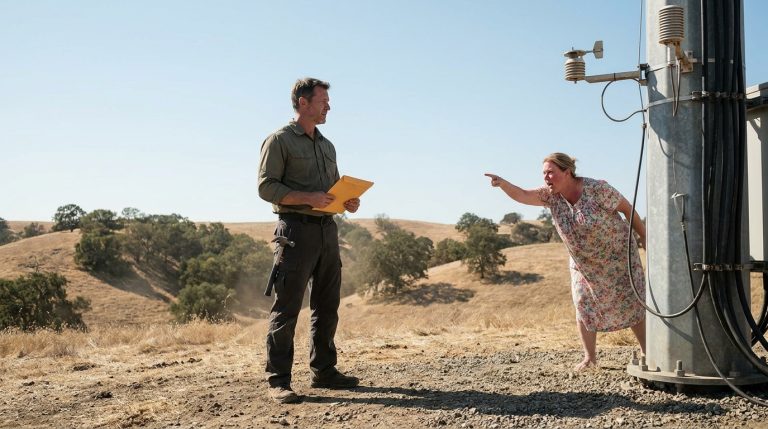
The humid air pressed against my skin like a wet wool blanket, thick with the scent of freshly cut grass and the cloying, perfumed arrogance of the woman standing on my lawn. Karen—the Oakwood Estates HOA president—had positioned herself dead center on the strip of Kentucky bluegrass I’d spent all morning nurturing. She looked less like a neighbor and more like a tactical error that needed to be corrected.
“This unauthorized kennel is a public health hazard, Dr. Hayes,” she said, her voice dripping with that practiced, saccharine authority that usually signaled a desire to extract a tithe. “It’s going to cost you five thousand dollars.”
She held the fluorescent orange violation notice out at arm’s length, as if the paper itself were a scepter conferring some divine right to ruin my life. She was a woman constructed from sharp, angular compromises—too much peroxide, too much polyester, and a smile that never quite reached eyes narrowed into hard, black beads. Behind her, the HOA golf cart sat like an idle tank, the little flag flapping in the stagnant air, mocking the privacy I’d paid a small fortune to secure.
General, my German Shepherd, shifted in the shadows of the run behind me. He didn’t bark. He didn’t growl. He simply watched, his ears pricked, his posture as still as a statue. He was my partner, my anchor in the long, dark nights when the desert memories surged back. I felt the heat rising in my chest, a cold, surgical rage that reminded me of days spent in field hospitals, patching heroes while shells whistled overhead.
I looked at the notice. Five thousand dollars. I’d built the run for a fraction of that, sourcing every bolt and wire with the precision of a field surgeon.
“Foreclosure,” she added, her voice dropping into a register meant for threats. “We can, and we will, Dr. Hayes. Don’t think we won’t.”
I didn’t answer. I didn’t give her the shouting match she was hunting for, the visceral display of weakness she needed to justify her petty dominance. Instead, I stared at her, my expression blank, my heart rate steady. I watched the way her grip tightened on the paper, the slight tremor in her jaw when I failed to crumble. She wanted a target; I was going to be a ghost.
As she climbed back onto her cart, tires carving a fresh, ugly rut into the lawn, the paper in my hand felt heavy, dense with a manufactured purpose. I walked inside, the silence of the house meeting me like an old friend. My wife, Sarah, hovered in the kitchen, her eyes wide, reflecting the fear I refused to acknowledge.
“What are we going to do?” she whispered.
I didn’t look at her. I looked at the orange paper, the specific shade of its ink, the way the cheap, pulpy fiber felt against my thumb. It was a formal accusation, a diagnostic chart of a fabricated disease.
I was going to dissect it. I was going to look at the cellular structure of this bullying, isolate its weaknesses, and then I was going to cut it out. Karen thought she had found a victim; she’d actually tripped over a trigger.
I moved to the dining room table, pulling out the thick, dust-laden binder the title company had given us at closing. I flipped it open, the heavy, legalistic prose of the CC&Rs greeting me like a map. It wasn’t a document of community harmony; it was an arsenal. And for the first time in a long time, I knew exactly what my mission was.
CHAPTER 2: THE TACTICAL BINDER
I spread the Covenants, Conditions, and Restrictions out across the dark wood of the dining room table. It wasn’t a document; it was a weapon. The light from the chandelier caught the edges of the pages, turning the text into a jagged mosaic of legalese. Sarah was still hovering near the kitchen island, her knuckles white as she gripped the granite, but I couldn’t afford to look at her. Not yet. Empathy was a luxury I had stripped away somewhere between the front porch and the office, a necessary casualty of the fight I was about to initiate.
I picked up a highlighter, its tip bright as a warning flare. My hands, once accustomed to the erratic, terrifying rhythm of a battlefield, moved with deliberate, mechanical grace. I started with Article 7: Architectural Modifications.
“Permanent structures,” I whispered to the empty room.
My dog run was freestanding. It sat on a bed of gravel, held in place by its own weight and the integrity of its heavy-gauge steel. It wasn’t bolted to the foundation of the house, nor was it dug into the ground as a permanent fixture. It was a modular system, a tactical advantage disguised as an amenity. The distinction was subtle, the kind of surgical nuance that Karen and her board—people who dealt in aesthetics and neighborhood prestige—would likely overlook. They looked for violations of spirit; I was looking for violations of definition.
As I worked, the smell of old paper and dust filled my senses, and for a fleeting second, the environment shifted. I wasn’t in a suburban dining room anymore. I was back in a makeshift clinic in a forgotten province, the air thick with sand and the metallic tang of blood. The rustle of a page being turned sounded like a bandage being unwound. I closed my eyes, forcing the phantom image of that sun-scorched tent to recede, replacing the heat of the desert with the cold, controlled air of my study. I wasn’t a surgeon here. I was an architect of a different kind of excision.
I moved to the section regarding commercial enterprises. The language was restrictive, designed to keep the suburban aesthetic unblemished by the messy reality of business. But I was a DVM. I knew the difference between a veterinary clinic and a residential accommodation for a service animal. General wasn’t a patient; he was an extension of my own mobility, a piece of living medical equipment.
I took notes on a yellow legal pad, the scratch of my pen sounding deafening in the quiet house. I was cataloging the ammunition. I found a loophole in the bylaw regarding common areas—Karen’s golf cart, which she had parked halfway on my lawn, was technically an unapproved vehicle on a private residential lot. A minor point, perhaps, but a point nonetheless. Everything had to be documented. Everything had to be leveraged.
The doorbell rang. It was a sharp, piercing sound that shattered my focus. Sarah jumped, her gaze darting to the front entrance. I stood up, smoothing my shirt, my face settling into that placid, unreadable mask I had worn for years. I didn’t reach for the door with the curiosity of a resident; I reached for it with the caution of a sentry.
I pulled it open. There was no one there, but a delivery package sat on the porch. I didn’t recognize the sender, and the cold logic in my gut immediately flagged it. I brought the box inside, set it on the kitchen counter, and retrieved a kitchen knife. I slit the tape with precision. It was just a set of specialized security camera components I had ordered months ago for the clinic, meant for monitoring the kennel area.
I stared at the hardware, the black plastic sensors and the tangle of wires, and a secondary plan began to coalesce. If I was going to be accused of maintaining a nuisance, I would prove—with mathematical, forensic certainty—that the nuisance did not exist. I would map the decibel levels of the cul-de-sac. I would capture the ambient noise of the highway and the relative, perfect silence of General’s run.
I looked back at the dining room. The binder was still open, the highlighter bleeding yellow across a passage about due process. Karen believed she was the apex predator of this neighborhood. She had built a kingdom on the assumption that everyone else was a civilian. She was about to find out that she had provoked someone who had spent his life dealing with the consequences of total war.
“Alex?” Sarah’s voice was small, tentative. She had moved closer, her eyes tracing the lines of the documents. “Are we really doing this? Is it worth losing the peace we came here for?”
I turned to her, my expression softening only by degrees, never fully losing the edge of the mission. “Sarah, this isn’t about the peace we have. It’s about the fact that they’ve already destroyed it. If we stop now, the peace is gone anyway. She won’t stop until she finds someone else to devour.”
I walked back to the table, my shadow stretching long and thin across the hardwood. I had a lot of reading to do before morning. Every bylaw, every clause, every tiny, invisible trapdoor in the Oakwood Estates governing documents was about to be laid bare. I sat down and picked up the highlighter again, my focus sharpening to a needle point.
The battle for Oakwood Estates hadn’t just begun; it was already being lost by the side that didn’t know the terrain. I was going to own every square inch of it.
CHAPTER 3: THE TRIBUNAL OF BEIGE
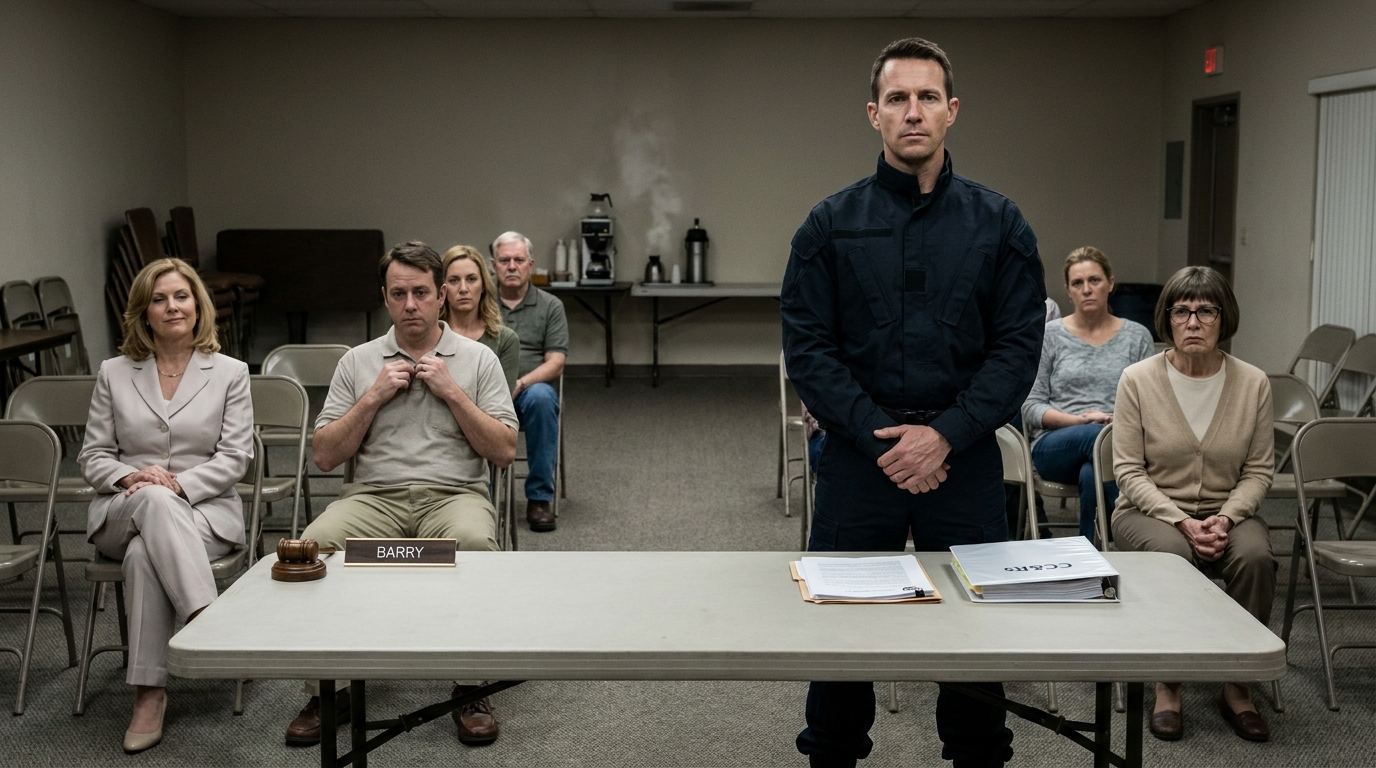
The clubhouse was a cavernous, low-ceilinged room that seemed designed to drain the color from anything it touched. It smelled faintly of industrial carpet cleaner and the kind of stale, lukewarm coffee that is usually brewed to keep people waiting in uncomfortable chairs. I stood near the back, the manila envelope containing my defense tucked under my arm like a shield. My heart didn’t race; it kept a steady, disciplined beat, the rhythm of a man who had already accounted for every variable.
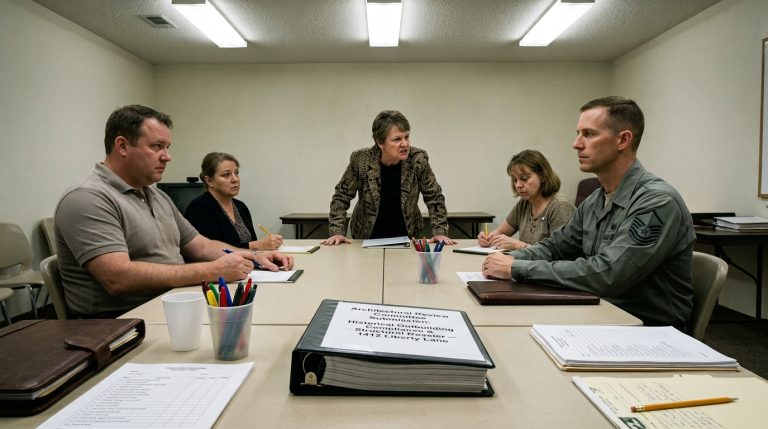
At the front, arranged behind a long, folding table, sat the triumvirate of Oakwood Estates. Karen was the centerpiece, her posture rigid, her face set into a mask of smug satisfaction that she clearly believed was synonymous with authority. To her right, Barry was already leaning forward, his hands twitching as he adjusted a nameplate that was already perfectly aligned. To her left sat Sheila, her severe haircut framing a face that suggested she viewed the entire process as a personal inconvenience.
“Dr. Hayes,” Karen said, her voice projecting across the room with a practiced, shrill cadence. “Please step forward.”
I walked toward the table, the soles of my shoes clicking against the hard surface of the flooring. The room was sparsely populated—a few other residents were scattered in the folding chairs, their expressions a mix of curiosity and, in some cases, barely suppressed fear. They were here for the shakedowns, for the fines regarding lawn height or the wrong shade of porch paint. It was a theater of petty power, and Karen was the lead actress.
I placed my packet on the table in front of her. It was heavy, professional, and dense with evidence. “As per my written correspondence,” I began, my voice steady, “I am here to formally contest the violation notice regarding the structure in my backyard. The notice is based on a fundamental misinterpretation of the HOA covenants and, quite frankly, a disregard for the facts I have already presented.”
Karen didn’t even touch the packet. She didn’t have to; she had already decided the outcome before I’d even parked my truck. She tilted her head, a gesture that was meant to be condescending but just looked rehearsed. “We’ve read your little novel, Doctor. And let me assure you, the board is not persuaded.”
I looked at Barry. He looked back at me, then quickly shifted his gaze to the ceiling, his fingers drumming a frantic, nervous rhythm on the tabletop. He was the weak link. I noted it, logging the micro-reaction into the internal database I was building for this operation.
“Persuasion isn’t the requirement,” I said, keeping my tone clipped. “Compliance with the law is. The bylaws clearly state that permanent structures require a foundation. My dog run is a temporary, non-affixed modular unit. That is not an opinion. That is a geometric and legal fact.”
“We don’t need a lecture on geometry,” Sheila snapped, her eyes narrowing behind her glasses. “We have received a complaint. A credible complaint from a neighbor who finds your backyard to be a public nuisance. Odor, noise, and potential pests. We have the right to regulate the quality of our community.”
As she spoke, the overhead lights flickered, then died, plunging the room into a sudden, grey dimness. A collective murmur rose from the back of the room. It was a minor, inconvenient failure—likely an overloaded circuit or a faulty ballast in the outdated fixtures—but in the silence of the blackout, the tension in the room spiked.
“It seems the facility is as maintained as your arguments,” I said, my voice cutting through the gloom before anyone could react. I didn’t move. I waited for the natural transition.
“Barry,” Karen hissed, “fix the lights.”
Barry scrambled up, his chair clattering loudly against the floor as he stumbled toward the wall switches near the door. He clicked them, pushed them, toggled them, but the room remained bathed in the dull, filtered light coming from the parking lot windows. He was fumbling, sweating, and clearly losing his composure.
I stood there, perfectly still. I wasn’t just observing a board meeting anymore; I was watching a system failing under the weight of its own incompetence. The “nuisance” charge was a fabrication, a phantom constructed to provide a cover for Karen’s agenda. And now, the very setting of their power—this beige, artificial environment—was literally going dark.
“There is no neighbor,” I said into the silence, loud enough for the few residents in the back to hear. “There is no constant barking. There is no biohazard. You are manufacturing a crisis to justify an extortionary fine.”
Karen leaned forward, the shadows catching the harsh angles of her face. She dropped the facade of bureaucratic distance. Her voice went low, conspiratorial, and jagged. “You think you can come into our neighborhood and decide what the rules are? You’re a doctor, not a lawyer. You’re over your head, and by the end of this meeting, your fine will have doubled.”
She wasn’t just enforcing rules. She was angry. I saw it in the way her nostrils flared, in the way her grip on the gavel—a small, absurd piece of wood—white-knuckled the table. She wanted a target. She wanted me to lose my temper, to shout, to provide the scene she needed to mark me as the volatile, aggressive neighbor.
I didn’t give it to her. I kept my face blank, my pulse slow. I watched her, really watched her, the way a vet observes a frightened, cornered animal. She was afraid. Not of the law, and not of the truth. She was afraid that her control was slipping, and in the dark of that room, with the lights refusing to cooperate, she looked small.
Barry finally managed to trip the breaker, and the room surged back to life with a buzzing, clinical white glare. The sudden illumination was jarring. Karen blinked, squinting, her hand still hovering near the gavel.
“The fine stands,” she said, her voice regaining its brittle, high-pitched authority. “And we are assessing a daily penalty, effective immediately. This hearing is concluded.”
I didn’t argue. I didn’t protest. I simply reached forward, picked up my packet, and turned toward the door. I had what I needed. I had seen the crack in the facade. I had watched them scramble in the dark. The game wasn’t lost; it was just moving to the next phase.
As I walked out of the clubhouse, the cool evening air hit my face, smelling of dry earth and pine needles. The battle wasn’t won in the room; it was won by observing the enemy’s movements, by calculating the trajectory of their inevitable collapse. I had the documents. I had the names. And now, I had the target.
CHAPTER 4: THE PERIMETER CHECK
I didn’t head straight home. The adrenaline from the clubhouse, that cold, sharp clarity that had settled into my marrow, demanded movement. I took the long way around the block, my steps measuring the distance between the lives of my neighbors. The Oakwood Estates cul-de-sac was designed for privacy, but in the quiet of the evening, it revealed its true nature: a grid of perfectly aligned windows and manicured patches of soil, each one a potential data point.
I found myself near Mr. Henderson’s property. He was outside, moving with a jerky, unnatural rhythm, pruning his tomato vines under the harsh glare of a single motion-sensor light. He wasn’t working with the rhythmic patience of a gardener; he was hacking at the leaves, his movements hurried, his head constantly snapping toward the street.
I slowed my pace, forcing myself to look like a man simply walking his dog. General stayed perfectly at my heel, his presence a steady, solid anchor of discipline. I stopped at the edge of Henderson’s driveway, the crunch of gravel under my boots sounding like a gunshot in the still air.
“Late night for tomatoes, Mr. Henderson,” I said. My voice was low, conversational, but it held the weight of a professional interrogation.
Henderson jumped, his shears clipping a branch with a sharp snap. He didn’t look at me. He just kept working, his breathing ragged. “Just… maintenance, Doctor. The blight. It’s hard to stay ahead of it.”
“Blight is a persistent enemy,” I agreed, moving a few steps closer. I watched his hands. They were trembling. “But usually, it doesn’t manifest in such a hurry. You look like you’re trying to hide something, rather than prune it.”
He stopped then. He turned, the motion-sensor light casting deep, cavernous shadows across his face. He looked exhausted, the skin beneath his eyes dark and sunken. “The HOA,” he whispered, the words barely audible over the distant hum of the highway. “They’re demanding updates. Karen. She… she gets very specific about how the perimeter should look. If I don’t follow the aesthetic guidelines, the fines start accumulating again.”
“The compost bin,” I said, stating it as a fact.
He nodded once, a quick, jerky motion. “And the fence. And the trim. She holds it over me, Doctor. Every little thing. She says if I keep an eye on the properties near me, if I report the ‘non-compliant’ ones, she can make the financial burden disappear.”
I felt a cold surge of certainty. The spy. He wasn’t a villain; he was a hostage. I stood there for a long moment, the air around us feeling suddenly dense. The physical discrepancy of his uncharacteristic garden maintenance—the way he was effectively clearing the view between his porch and my backyard—was the final piece of the puzzle regarding his role in this, but it also pointed to something much larger. He wasn’t just watching; he was being forced to provide evidence, to catalog, to document.
“She’s not just worried about compost bins, is she?” I asked, keeping my voice neutral. “She’s worried about what you see when you’re not looking at the plants.”
Henderson looked at the house, a shadow of fear crossing his face. “She’s obsessive. She has a notebook. Everything is recorded. Everything is tied to a dollar amount. I don’t know why she cares so much about the money—the HOA fees are already astronomical—but she acts like every cent is coming out of her own pocket.”
I didn’t press him further. I had the confirmation I needed. The coercion was the lever, but the obsession was the drive. I left him there in the dark, the shears still clutched in his hand, and walked the rest of the way to my house.
The walk was therapeutic. I mapped the neighborhood in my mind, identifying the others—the young family with the swing set, the widow with the gnomes. They were all nodes in a network of intimidation. Karen wasn’t just governing a subdivision; she was running an extractive machine.
When I reached my own porch, the house was dark, but the light in the home office was still burning. Sarah was waiting. I stepped inside, the familiar comfort of the interior providing a sharp contrast to the cold calculation of the street. I went straight to the desk, opened my laptop, and pulled up the financial documents I had secured.
I spent the next three hours cross-referencing the fine amounts with the “Consulting Fees” I had uncovered in the budget. It was sloppy, really—a testament to Karen’s arrogance. She assumed no one would ever look behind the curtain. The dates of the fines issued to the Millers, the Hendersons, and the Gables perfectly aligned with the “Consulting” payouts to the shell company. It wasn’t just a pattern; it was a ledger of theft.
I saved the files, encrypted them, and hid them in a directory that looked like nothing more than a collection of old patient records for my veterinary practice. The work was precise, the logic unassailable. I wasn’t just building a case for a hearing anymore. I was building a dossier for an investigation.
I looked at the window, out toward the cul-de-sac. Somewhere out there, Karen was likely planning her next move, the next violation notice, the next turn of the screw. She didn’t know that the ledger she’d created was now the very thing that would ensure her downfall. She was the one being tracked now, and her movements were becoming increasingly predictable, increasingly frantic.
I walked to the kitchen and poured a glass of water, the cool liquid grounding me. I had seeded the network. I had identified the coercion. Now, I needed the final piece—the evidence of the shell corporation’s true reach. And for that, I would have to dig into the administrative side of the HOA, a layer of the operation Karen thought was impenetrable.
I was ready. The fatigue that had threatened to settle in after the clubhouse meeting had vanished, replaced by the relentless, humming energy of a mission in its final stages of preparation. Every step I took was calculated. Every word I spoke to Henderson was a probe. I was tightening the snare, and the beast in the center of the trap had no idea that the hunter had already taken its position.
CHAPTER 5: THE FINANCIAL TRAIL
I didn’t turn around immediately. I sat in the glow of the monitor, my hands flat on the desk, feeling the cool air of the night drift into the room. The street outside was dead silent, but for the first time in years, the stillness didn’t feel like peace. It felt like an invitation. I let my eyes adjust to the darkness, scanning the streetlamp-lit cul-de-sac. Nothing. Just the long, elongated shadows of the oaks stretching across the pavement like fingers.
The paranoia was a new sensation, a sharp, metallic tang at the back of my throat. It was the byproduct of digging, of pulling at the threads of a tapestry that had been woven with such meticulous, cold-blooded intent. I had the ledger, the list of payments, the names of the shell entities—but I was still missing the “Why.” Why risk everything for a few thousand dollars in management fees?
I stood up, walked to the window, and closed it with a solid thud, latching it with a click that sounded overly loud in the quiet house. I wasn’t just tracking a thief; I was tracking an ego. Karen didn’t just want the money; she wanted the validation of the system. She wanted to prove that she was the smartest person in the room, that she could turn a suburban neighborhood into a private fiefdom and get paid to do it.
I turned back to the laptop, the screen reflecting my own face—the eyes narrowed, the jaw tight. My reflection looked like a stranger, someone who had forgotten what it was like to just be a veterinarian. I navigated to the directory I had created, opening the scanned expense reports again.
There it was. A line item I had missed on the first pass. Consulting Fee: Legal Defense Fund.
The amount was absurd—nearly three thousand dollars, paid in the middle of a month where no legal action had been taken against the HOA. I clicked the PDF, a scan of an invoice from a law firm downtown. The address for the firm was a virtual office, a common mask for small, questionable operations. I pulled up the firm’s website on my secondary monitor. It was bare-bones, almost nonexistent.
I grabbed my physical binder, flipping to the section on bylaws. The HOA didn’t have a provision for a “Legal Defense Fund.” The bylaws specifically dictated that all legal expenses had to be voted on by the board and recorded in the minutes of the monthly meeting. I searched the minutes—the ones I had forced them to release—for the month in question.
Nothing. No vote. No record.
The trail wasn’t just messy; it was a glaring, neon-lit sign of a breach of fiduciary duty. My hand moved to the phone. David, my contact from the JAG corps, was the only person who would understand the weight of this. I didn’t call him—too much risk—but I composed an encrypted email, detailing the discrepancy, the lack of record, and the suspicious nature of the “law firm.”
As I hit send, a flash of movement outside caught my eye. My pulse spiked. I leaned into the glass, the cold surface biting against my forehead. Down the street, a car had pulled away from the curb—no headlights, just a slow, creeping roll toward the intersection. It stopped, lingered, and then turned away.
My breath hitched. Was it just a neighbor returning home, or was it a probe? A reminder that in this game, the advantage could shift in a heartbeat? The V-4 variance of my own perception began to play tricks—the swaying branches of the trees looked like silhouettes of people, the rustle of the wind sounded like whispered conversations. I forced myself to step back, to breathe.
I was becoming what I was fighting. The cold resolution that had served me so well in the field was starting to blur at the edges, colored by the intense, claustrophobic pressure of the neighborhood.
I walked to the kitchen and grabbed a glass of water, the ice clinking against the crystal. I stood in the dark, letting the silence return, letting the adrenaline bleed out of me. I had to stay sharp. I had to remain the surgeon. If I started acting like a victim, if I started flinching at every shadow, I would lose the high ground.
I checked the time. 2:00 a.m. The house was quiet, Sarah upstairs asleep, unaware that her husband had transformed their dining room into an operations center. I felt a pang of guilt, a sharp, human ache that I had tried to ignore. She wanted a home, not a battlefield. But the reality was that they had brought the war to our door, and I had simply answered the call.
I walked back to the office, my footsteps measured, deliberate. I had one more folder to check—the property management company’s master contact list. If Karen was using a shell company, she had to be using a registered agent. I started the search, the cursor blinking on the screen like a metronome, counting down the time until the final confrontation.
I was no longer just protecting my backyard. I was dismantling the structure of their power, one line item at a time. And if they wanted to watch me from the dark, then I would make sure that when the lights finally came on, they wouldn’t have anywhere left to hide.
CHAPTER 6: THE TROJAN HORSE
The hum grew into a grind, a harsh, metallic protest that echoed off the sterile walls of my office. I spun around, my chair squealing against the tile. The server cabinet, usually a picture of quiet, disciplined performance, was venting a plume of acrid, gray smoke. My eyes went wide—my stomach dropping through the floor—as I realized the cooling fans had seized, their blades shredded by the grit that had somehow bypassed the intake filters.
I didn’t think; I moved. I lunged for the server rack, my fingers flying over the keypad to initiate an emergency shutdown. If these drives cooked, I didn’t just lose the patient records; I lost the spreadsheet, the encrypted emails, the entire digital architecture of the insurgency I’d spent weeks building.
The air was already thick, tasting of scorched plastic and ozone. I yanked the main power cable, the sudden silence of the room ringing in my ears louder than the grind had been. It was V-3, a failure of mechanics, but in the heat of the moment, it felt like an attack. My mind flashed to the car I’d seen earlier, the shadow that had lingered in the cul-de-sac. Was this an escalation? Had Karen finally moved from bureaucratic bullying to physical sabotage?
I pulled the primary drive, the metal casing searingly hot against my palm. I didn’t have time for theory; I had to secure the data. I moved to the secondary workstation, the one that sat disconnected from the main network, a “cold” storage unit for exactly this kind of contingency. I slotted the drive, my breath coming in short, sharp bursts. The progress bar for the manual backup crawled at a glacial pace, every second a hammer blow against my nerves.
I was exposed. If someone was watching the clinic, if the sabotage was deliberate, they would know I was here. I checked the lobby through the security feed on my phone. Empty. Still, the silence felt wrong. It was too heavy, too deliberate.
The backup finished at 98%—then 99%—then finally, the “Success” prompt blinked on the screen. I pulled the drive and tucked it into the inner pocket of my jacket, the weight of it pressing against my ribs like a second heart. I stood there, listening. The clinic was a tomb of silence, the only sound the slow ticking of the clock in the hallway.
I needed to move. I wasn’t going to wait to see if the sabotage was the end of the play or just the beginning. I exited through the rear bay, the cold night air rushing over my skin and cooling the sweat that had slicked my neck. I kept to the shadows of the neighboring buildings, my hand resting on the drive in my pocket. I felt like a ghost, a man stripped of his profession and his peace, reduced to the raw mechanics of survival and strategy.
As I made my way back toward the cul-de-sac, the streets were deserted. My mind raced through the implications. If they were willing to hit the clinic, they were escalating. They weren’t just protecting a budget; they were protecting a crime. The “Consulting Fees,” the shell corporation, the coercions—it was all a foundation, and I was the one who had finally started to pull the floorboards out.
I approached my house, keeping to the periphery of the lawns. I didn’t head for the front door. I moved to the side, to the access gate that led to the backyard dog run. General was waiting, his ears perked, a soft, low whine escaping him as I approached. I reached through the wire, my hand finding the soft velvet of his ears.
“We’re almost there,” I whispered, the words a promise more to myself than to him.
I looked at the house. A single light was on in the kitchen—Sarah. I had to get her out, or at least get her to understand the gravity of the shift. But as I turned toward the back entrance, a flash of red light flickered across the grass.
A red laser dot.
It danced for a fraction of a second on the fence, a tiny, vibrant pinpoint of malice. I dropped. I didn’t think, I didn’t hesitate—I just hit the dirt, the cold, damp earth pressing into my chest. My training, dormant for years, fired back to life with terrifying efficiency. My heart hammered, my lungs burned, and every nerve ending was electric.
It wasn’t a laser sight from a rifle; it was the light from a remote, a signal, a flash from a vehicle parked at the far end of the cul-de-sac. I stayed low, pressing my back against the foundation of the house, my eyes fixed on the street.
The car was gone.
It was a probe. A test. They were trying to see how I reacted, trying to push me toward a mistake. I remained motionless for what felt like an hour, watching the patterns of light and shadow, the way the wind moved the branches of the oak trees. I was no longer fighting a board of directors. I was fighting a system that had decided I was an obstacle to be removed.
But I was the one holding the data. I was the one with the map. I closed my eyes, the weight of the drive still firm in my pocket. They wanted to play a game of shadows? I had spent half my life in the dark. I stood up, my movements fluid, my mind purged of everything except the next move. The clinic was a loss, but the drive was safe. And the truth—the core truth of their greed—was finally ready to be turned into a weapon.
CHAPTER 7: THE PUBLIC UNMASKING
I didn’t enter through the back. I walked right up to the front entrance of the community clubhouse, my boots ringing with deliberate, rhythmic strikes against the concrete. I knew Karen would be inside; Tuesday night was the scheduled board follow-up, the place where she usually held court to solidify the fines and finalize the bureaucratic paperwork of her reign. The air was cool, but sweat prickled at my hairline—the familiar, searing heat of combat anxiety.
I stopped at the threshold. For a split second, my hand hovered over the brass handle. My mind, unbidden, threw me back to a trauma center in the dust of a foreign land, the smell of antiseptic, the chaotic noise of people screaming for a doctor who was already at his limit. The hesitation was a phantom, a ghost of a man I wasn’t anymore. I pushed the door open.
The room was bathed in that same unforgiving, fluorescent light as before. Karen sat at the head of the folding table, a stack of violation notices spread out before her like a deck of marked cards. Sheila and Barry flanked her, their faces pale, their eyes darting to the door the moment I stepped inside. The handful of residents scattered in the folding chairs went silent, the tension in the room thick enough to choke on.
“Dr. Hayes,” Karen said, her voice a fragile reed trying to sound like a gale. “This is a private board session. You have no standing here.”
I walked toward the table, ignoring the space between the rows of chairs. I wasn’t here to ask for permission. I reached into my jacket and pulled out the drive—not the one with the backup, but a secondary copy I had prepped, its silver casing glinting under the harsh lights. I placed it on the table, the metallic clack loud enough to make Barry flinch.
“This,” I said, my voice quiet but carrying to the back of the room, “contains the financial history of the Oakwood Estates HOA for the last three years. It includes the payments to your ‘Consulting’ corporation, Karen. It includes the invoice logs for the legal defense fund that never existed. And it includes the communications you had with the management company regarding the coercion of homeowners.”
Karen’s face, usually a mask of practiced smugness, began to lose its composure. Her mouth opened, but no sound came out. Sheila, on the other hand, had already begun to physically distance herself, sliding her chair back with a soft, scraping sound that seemed to scream for attention.
“You’re hallucinating,” Karen finally managed, though her voice wavered. “This is harassment. Barry, call the police.”
Barry didn’t move. He sat there, his mouth slightly agape, staring at the drive as if it were a live grenade.
I didn’t wait for him. I turned to the room, to the faces of the people I had been getting to know—the Millers, Mrs. Gable, the faces of those who had been fined for the ‘wrong’ shade of paint or a cedar swing set. “I spent the last two weeks looking into why your money disappears,” I continued, my gaze sweeping the room. “The fees you pay, the fines that seem plucked from the air—it wasn’t for the good of the neighborhood. It was for the upkeep of a shell corporation that Karen used to siphon money out of your accounts.”
I watched Karen. I saw the way her fingers trembled as she tried to pull the pile of papers toward her, the way her eyes darted to the exits. She was cornered, not by the law yet, but by the reality of her own exposure. She reached for the gavel—the ridiculous, small wooden hammer—but her hand slipped, and it clattered to the floor, rolling to a stop in the center of the aisle.
“The audit is already in motion,” I lied—a necessary tactical fiction to force the final crack. “The police have been contacted. The evidence is secured. You have no more moves, Karen.”
She stood up then, the chair shrieking as it was pushed back. She was frantic, her face blotchy and unkempt. “This is a lie! He’s a disgruntled, unprofessional—”
“I’m a doctor,” I interrupted, the authority in my voice grounding the room. “And I have just performed a diagnostic on this board. You’re done.”
The reaction was immediate. A low rumble of voices began to rise, not of confusion, but of cold, hard recognition. The residents weren’t looking at Karen with fear anymore; they were looking at her with a dawning, terrifying realization of what had been stolen from them. Karen looked around the room, seeing the wall of hostile, betrayed faces, and for the first time, she looked small—a pathetic, hollow figure of power whose illusion had finally dissolved.
She turned and ran. Not to the door, but to the small office behind the table, slamming the door shut with a finality that shook the walls. I stayed where I was, the drive still sitting on the table like a tombstone. The board was shattered. The control was gone. The air in the clubhouse felt lighter, the sterile, beige oppressive atmosphere finally giving way to the cold, sharp reality of justice.
I stood in the center of the room, watching the fallout, the beginning of the end of the tyranny. I had done my part. The truth was out, the ledger was public, and the silence in the room was no longer the silence of the bullied—it was the silence of a neighborhood that had finally begun to breathe.
CHAPTER 8: THE WEIGHT OF THE SETTLEMENT
I didn’t stop at the door. I walked to the table, my hand moving to the light switch, and flooded the room with clinical, unforgiving brilliance. I walked over to the small, locked office door—the one Karen had slammed—and didn’t even bother to knock. I simply leaned against the frame and waited, my posture relaxed, my breathing deep and measured.
“The police are ten minutes out, Karen,” I said, my voice conversational, devoid of the heat that had defined our previous interactions. “They have the audit records. They have the shell corporation registration. They have the testimonies of the neighbors you bullied.”
The silence on the other side of the door was absolute, followed by a soft, muffled sound—the friction of a chair being dragged, the clatter of a drawer closing. She was finished. The bravado had drained away, leaving only the reality of the evidence. I turned back to the room, where the residents were already huddled, the chaos of the uprising transitioning into the solemnity of a recovery.
Mr. Miller, the new leader of the board, stood by the table, his hand resting on the very ledger I had exposed. He looked at me, a silent nod passing between us. It was a gesture of acknowledgment, of the collective weight that had finally been lifted. I walked over to the wall where the clubhouse’s maintenance board hung, a relic of decades past. I took down a heavy, rusted wrench that had been part of a decorative display, then walked back to the rear of the clubhouse where a loose, squeaky hinge on the entrance had been irritating me since I first moved into the neighborhood.
I set to work, the task mundane and grounding. The friction of the metal, the bite of the rusted bolt under the wrench—it was a sensory anchor, a way to return to the physical world after the abstract, cold-blooded warfare of the last few weeks. My hands, which had once set broken bones and sutured shrapnel wounds, moved with the simple, satisfying economy of someone fixing what was actually broken.
The sound of sirens began to bleed into the room, a low, rhythmic pulse that signaled the arrival of the inevitable. Karen stepped out of the office. She looked drained, her makeup smeared, her clothes disheveled—the transformation from an apex predator to a common criminal complete in the harsh light of reality. She didn’t look at me. She didn’t look at the residents. She just walked to the table, gathered her remaining papers, and sat down to wait for the officers, her shoulders slumped, her authority shattered.
Poetic justice, as it turned out, was rarely a grand, cinematic event. It was the quiet, tedious process of paperwork, of accountability, and of the slow, methodical restoration of the mundane.
I finished with the hinge, the silence of the door swinging shut without a groan serving as my final, personal act of maintenance. The police entered, their movements professional and detached. They didn’t need to do much; the room was already filled with the evidence, the witnesses, and the confession of a broken system. They took Karen out in handcuffs, the metal cuffs catching the light, and I watched from the threshold until the patrol cars pulled away, the red and blue lights fading into the dark, quiet streets of the cul-de-sac.
The room cleared out, residents leaving with the hushed, stunned expressions of people who had survived a storm. Mr. Miller approached me, offering a hand. “You didn’t have to do all this, Alex. But I’m glad you did.”
“I just wanted my home back,” I said, the words simple and true.
I walked out of the clubhouse for the last time that night. The walk home felt different. The air was no longer a tactical void; it was just night air, crisp and cooling against my skin. I reached my front porch and looked back at the neighborhood. A few lights flickered on—a kid finishing homework, a late-night reader, a dog being let out—the ordinary, beautiful, unremarkable cadence of suburban life returning to its natural rhythm.
I went into the backyard, to the dog run. General was waiting, his tail offering a single, slow, steady wag. I sat down in the grass, the ground damp and cool, and leaned my back against the fence. The silence here was perfect. It wasn’t the silence of a tactical operation; it was the silence of a life being reclaimed. I reached out and patted the gravel, the surface smooth and well-drained, exactly as I had designed it. My hand felt the solid, unyielding structure of the fence, the work I had put into this space—the space I had defended not with rage, but with the cold, unyielding persistence of the truth.
The arc had closed. The friction was gone. I looked up at the stars, bright and indifferent above the oaks, and for the first time since the first orange notice had appeared, I felt a deep, resonant peace. I was a veterinarian, a husband, and a neighbor, and tonight, that was more than enough.