The Dusty Stone and the Concrete Wall: A Veteran’s Stand for the Last Free Acre in Virginia
CHAPTER 1: THE WEIGHT OF THE STONE
The words hung in the humid afternoon air, thick and suffocating, tasting of dust and stale asphalt.
“Your little dirt hole is a public nuisance and a structural liability, Mr. Caldwell.”
Karen Miller did not step onto the grass. She hovered on the absolute margin of the property line, her pristine white sneakers kept safe from the unpaved reality of the old Virginia homestead. She was a formidable woman in her late fifties, built like a linebacker squeezed into a pastel pink tracksuit, her face locked into a permanent mask of pinched disapproval. Her clipboard—the scepter of her suburban domain—was clutched in a white-knuckled grip. She pointed a stubby, perfectly manicured finger straight at the old stone-lined entrance of the root cellar, a structure nestled into the gentle slope of the backyard for well over a century.
A dirt hole. That was what she called the hand-laid fieldstone and heavy oak sanctuary that had outlasted empires, recessions, and the creeping tide of vinyl-sided McMansions that ringed my five acres like a razor-wire fence.
I did not move. My boots remained planted on the dry, sun-baked earth. Twenty-two years in the Army Corps of Engineers taught me one immutable truth about hostile terrain: never react to the noise; calculate the logistics. Master Sergeant Mark Caldwell didn’t yell at incoming mortar rounds, and he didn’t shout back at civilian tyrants in pastel pink. I let the silence stretch, letting her smug certainty fester in the quiet afternoon heat.
“That cellar was built in the 1860s, Karen,” I said, my voice low, stripped of any inflection. “It predates your entire development by a hundred and thirty years. It predates the internal combustion engine.”
She waved a dismissive hand, a flick of her wrist that brushed away a century of local history as if it were a dead gnat. “History is no excuse for violating the covenants, Mr. Caldwell. Section four, subsection B clearly states that all detached structures must be approved by the architectural review committee. Your dirt hole is an unapproved, unsafe, and frankly unsightly structure. It lowers property values.”
Property values. The sacred scripture of the Meadows at Liberty Crossing. They chanted it like a prayer while they paved over the rolling hills, substituted native oak with manicured sod, and painted the world a uniform, soul-killing shade of beige.
I looked past her shoulder. Down the slope, beyond the rusted wire fence, the cookie-cutter roofs stretched out under the haze, identical boxes hiding identical lives behind identical garage doors. They had tried for three years to swallow my grandfather’s homestead, chipping away at the edges with noise complaints, parking citations, and passive-aggressive letters left in my mailbox. This was the escalation. Concrete in the cellar. A $5,000 special assessment slapped onto a property that wasn’t even part of their association, squeezed through a bizarre, predatory county development loophole.
“The committee meets on Thursday,” Karen said, her lips tightening into a thin, bloodless line as she turned her back to walk toward her white golf cart. “You have fourteen days to submit a demolition plan, or we bring the truck ourselves.”
She climbed into her vehicle, the suspension groaning under her weight, and rolled away down the gravel path.
I stood alone in the stillness of the five acres, the cicadas humming a low, steady drone through the dry afternoon heat. My hand drifted down, fingers brushing against the weathered grain of the wooden porch railing my grandfather had built by hand. The anger inside me didn’t flare like dry brush; it cooled down, sinking deep into my chest like iron in a forge. She wanted a war of attrition. She wanted to bury the history of this land under four thousand pounds of wet mix.
I turned and walked toward the root cellar, lifting the heavy iron latch. The door swung open with a slow, protesting groan, releasing a breath of cool, damp air that smelled of old stone, dry timber, and deep, unyielding earth.
I reached inside, my fingers finding the switch for the single overhead bulb, and stepped down into the dark.
CHAPTER 2: THE THREEINCH BINDER OF MALICIOUS COMPLIANCE
The transition from the blinding Virginia glare to the subterranean gloom of the root cellar was instantaneous. The heavy oak door clicked shut overhead, muting the distant, mechanical drone of the cicadas into a hollow, rhythmic thrum. My boots met the packed earth floor with a dull, muffled thud.
The air down here was thick with the weight of decades—a blend of cold limestone, dry timber, and the faint, sweet trace of long-decayed root vegetables that had fed my grandfather’s family through winters past. I didn’t turn on the overhead bulb right away. I stood in the partial gloom near the bottom of the stone steps, letting my eyes adjust to the feeble amber shaft of light cutting through the grime of the high ventilation grate.
A frontal assault against an HOA backed by county development clauses and arbitrary architectural review boards was a rookie’s mistake. In the Corps, you didn’t charge a fortified position across an open field when you could starve it out from within its own supply lines.
I walked over to the sturdy wooden workbench my grandfather had bolted into the eastern stone wall. Upon it sat a heavy grease-stained toolbox and a stack of old seed catalogs. Running my thumb over the edge of the workbench, I felt the rough, unvarnished grit of pine—wood that had absorbed the sweat of a generation that understood endurance. If Karen Miller wanted to play bureaucratic warfare, I would give her a masterclass in logistics.
The first step of an engineered defense wasn’t retaliation; it was documentation.
I climbed back up the stone steps, pushed the heavy door open into the fading afternoon light, and walked across the dry lawn toward the 1920s farmhouse. The house was quiet, smelling of old cedar and the black coffee I’d left sitting half-cold in a ceramic mug on the kitchen counter. I picked up the mug, took a bitter sip, and sat down at my grandfather’s oak desk. The surface was scarred with decades of small gouges and ring stains from coffee cups—a map of a working life.
I opened my laptop. The screen cast a sterile blue glow over the dark grain of the wood.
For the next three days, the world outside my five acres ceased to exist. I didn’t check the mailbox. I didn’t look out the window when the white golf carts of the compliance patrol hummed past the perimeter wire. I treated the desk like a forward operating command post.
First, I downloaded the exact text of the Meadows at Liberty Crossing county development rider from the public online municipal records. I didn’t just read it; I tore it apart clause by clause, hunting for the structural seams where administrative overreach collided with county law. I found it buried in subsection 4-C: grandfathered agricultural outbuildings existing prior to the 1995 incorporation of the development were exempt from aesthetic review unless declared an immediate public safety hazard by a licensed structural engineer.
Not an HOA board member in a pastel tracksuit. A licensed professional.
Next, I opened my engineering design software. Using high-resolution photographs taken from every compass point, I began rendering a three-dimensional wireframe of the root cellar. I mapped the exact stress distribution of the fieldstone arches, the thickness of the retaining walls, and the load-bearing capacity of the massive oak headers supporting the earthen roof. It was a professional-grade structural integrity report, complete with cross-sectional schematics and soil compaction calculations.
I didn’t stop at engineering. I pulled up local pest control logs, cross-referenced them with regional agricultural extension data, and drafted a formal environmental compliance section certifying the cellar was free of vermin, rot, or biological contamination.
By the third night, the compilation was complete. I printed every page on heavy, cream-colored bond paper. I inserted tab dividers, index sheets, and a structured table of contents. When I snapped the three rings of the heavy black binder shut, it was nearly three inches thick. It weighed heavy in my hands—a dense, unyielding brick of pure, unadulterated bureaucracy designed to choke every single gatekeeper in the HOA clubhouse.
On the fourth morning, I dressed in a clean flannel shirt and stiff jeans. I tucked the three-inch binder under my arm like a tactical dossier and walked out the front door, heading down the gravel road toward the community clubhouse.
The clubhouse was a sterile, single-story brick building surrounded by manicured boxwood hedges that smelled faintly of chemical fertilizer. Inside, the air conditioning hummed with a sterile, refrigerated chill, smelling of expensive potpourri and artificial lemon cleaner.
Karen Miller was sitting behind the laminate front desk, holding court with Brenda, a mousy woman with nervous eyes who wore a perpetual expression of mild panic. Karen looked up as the heavy glass door swung shut behind me, her expression instantly hardening into the practiced scowl of a monarch whose territory had been breached.
“Mr. Caldwell,” she said, her voice dropping an octave into professional frostiness. “If you’re here to discuss the removal schedule for your eyesore, you’re wasting your time. The board’s position is final.”
I didn’t answer right away. I stepped across the beige industrial carpet, the rubber soles of my boots squeaking faintly against the polished floor. I reached the front counter and let the heavy black binder drop onto the laminate surface.
Thud.
The sound was solid, heavy, and final. The binder slid an inch across the counter, rattling a plastic cup of colored pens.
Karen blinked, her gaze dropping to the thick spine and the neatly typed label on the cover: Architectural Review Committee Submission: Historical Outbuilding Compliance & Structural Dossier — 1412 Liberty Lane.
“What is this?” she asked, her voice sharpening as she stared at the sheer bulk of the paperwork.
“That,” I said, leaning slightly forward, keeping my voice low and even, “is my application for the architectural review committee. Complete with engineering cross-sections, structural stability certifications, soil mechanics reports, and municipal code exemptions.”
Brenda leaned over in her chair, peering at the thick stack of paper as if it were a strange, venomous insect. “This… this is enormous. We don’t normally require—”
“You require adherence to the process,” I interrupted, keeping my eyes fixed on Karen’s rigid face. “I am adhering to the process. Every single page has been compiled in strict accordance with your bylaws. I expect a thorough, impartial review by the committee at Thursday’s meeting.”
Karen’s hand twitched, her fingers curling into a fist against the edge of the desk. The smug certainty in her eyes flickered, replaced for a fraction of a second by sudden, unshielded disorientation. She wasn’t used to resistance that didn’t yell, didn’t fold, and didn’t back down. She was used to targets who broke under the weight of a single threatening letter.
She stared at the binder as though it might detonate.
“We’ll see about that,” she muttered, her voice tight with suppressed venom.
“I’m sure you will,” I replied, turning on my heel. “I’ll see you Thursday.”
CHAPTER 3: THE SHOW TRIAL IN THE BEIGE CONFERENCE ROOM
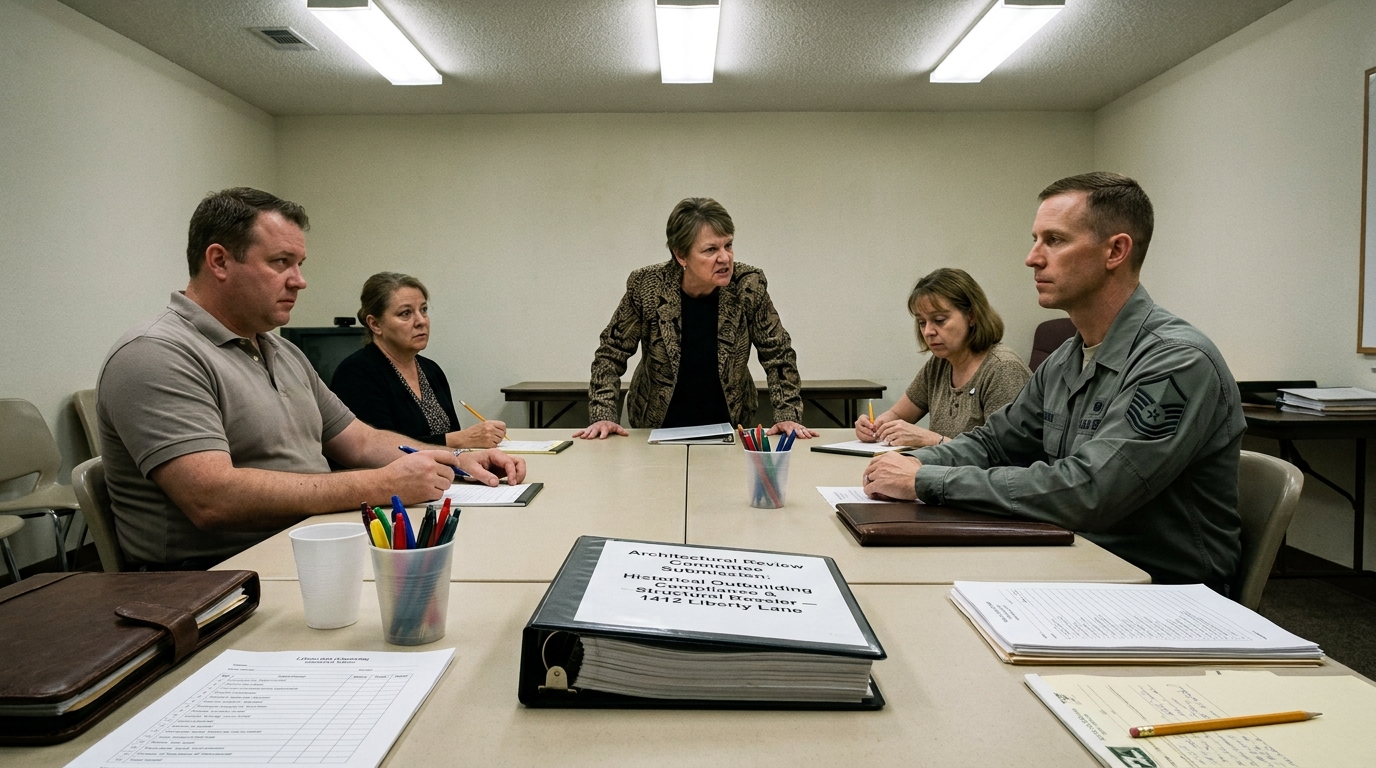
The conference room inside the Liberty Crossing community clubhouse smelled permanently of industrial lemon disinfectant and cheap copy-machine toner. It was a windowless, soul-crushing box designed to grind down dissent through sheer architectural monotony. A long laminate table stretched down the center, flanked by plastic chairs that groaned whenever anyone shifted their weight.
I sat at the far end of the table, my posture rigid, my forearms resting on the cool gray surface. Directly in front of me sat the three-inch binder, its black spine absorbing the harsh, flickering glare of the overhead fluorescent tubes.
At the opposite end of the table sat the committee. Karen Miller occupied the central chair like an enthroned magistrate, her pastel pink tracksuit replaced today by a sharp, aggressive blazer that screamed corporate bureaucracy. Flanking her were Brenda, whose nervous fingers kept picking at the seam of her notepad, and Gary, a pompous man whose polo shirt stretched tightly across his chest as he puffed himself up for the proceedings. Two other residents completed the panel, their expressions a mix of profound boredom and quiet dread.
Karen rapped a small wooden gavel against the laminate. The crack was sharp, entirely out of proportion to the size of the room.
“We’ll call this special architectural review session to order,” Karen announced, her voice dripping with artificial authority. Her gaze flicked past me, refusing to acknowledge the heavy black binder resting inches from my hands. “We have several minor community items on the agenda—mailbox color consistency, deck-stain approvals—and then we will address the ongoing zoning infraction at fourteen twelve Liberty Lane.”
For twenty excruciating minutes, they performed the theater of governance. They debated the precise hex code of acceptable brown paint for a neighbor’s back fence. They voted unanimously to fine a homeowner fifty dollars because a garbage bin had been left by the curb three hours past the Tuesday morning deadline. Every motion was executed with mechanical precision, a ritual designed to reinforce the board’s absolute control over the micro-details of suburban existence.
My pulse remained steady. In the Corps, I had learned that a hostile command structure always overplayed its hand when it felt cornered by procedure. They mistook routine for invulnerability.
Finally, Karen cleared her throat, her eyes narrowing as she turned her attention down the length of the table.
“Next item,” she said, her voice dropping into a register of practiced disdain. “The matter of the unauthorized auxiliary structure at fourteen twelve Liberty Lane. Mr. Caldwell submitted documentation earlier this week.”
Gary picked up a single sheet of paper from his folder—not my three-inch engineering dossier, but a standard checklist form—and cleared his throat nervously. “The committee has reviewed the situation,” he mumbled, staring firmly at his notes. “And while… ah… while paperwork was submitted, the structure remains a clear violation of aesthetic uniformity. It’s an old stone hole. It doesn’t match the vinyl siding profile of the neighborhood.”
He trailed off, clearly uncomfortable under the heavy silence that followed. He hadn’t opened the binder. None of them had.
Karen didn’t give him a chance to recover. She leaned forward, resting her palms on the table. “We don’t need to read a novel to know what we can see with our own eyes, Mr. Caldwell. This is a community of modern, well-maintained homes. A primitive stone cellar does not fit our visual standard. The committee’s position is unanimous and unchanged.”
I didn’t blink. I let the silence hang in the room, letting the friction of their bad faith grind against the record.
“Is it?” I asked, my voice cutting through the hum of the fluorescent lights with absolute, calm clarity. “Did the committee review the structural engineering report detailing the load-bearing integrity of the fieldstone foundation?”
Karen waved a dismissive hand, a sharp, sweeping motion. “We don’t review engineering reports for illegal dirt holes. The architectural review committee holds absolute authority over all property lines and exterior elevations under section seven of the association bylaws. Your application is denied.”
“Denied without review,” I repeated, making sure the words were slow, distinct, and heavy. “Just to be entirely clear for the record: the committee is officially rejecting a certified structural and municipal code compliance dossier without opening its cover.”
Gary shifted uncomfortably in his seat, his hand twitching toward a pen. A flicker of doubt crossed his face, a sudden realization that dismissing a formal engineering submission out of hand might leave a very sharp paper trail. But Karen shot him a look so cold it could have frozen groundwater.
“The decision is final, Mr. Caldwell,” Karen snapped, her voice rising in pitch. “You have fourteen days from today to submit a professional demolition contractor’s schedule, or the board will proceed with the previously arranged remediation order. Meeting adjourned.”
She brought the gavel down with a sharp, aggressive crack.
The committee members immediately began gathering their papers, eager to escape the suffocating tension of the room. They stood up, avoiding my eyes, shuffling their files into leather portfolios.
I didn’t move. I left the massive three-inch binder sitting squarely in the middle of the table, untouched.
As Karen swept past my chair toward the door, her blazer rustling stiffly, I spoke quietly to the empty space between us.
“Keep the binder, Karen,” I said, my eyes fixed straight ahead. “You’re going to need it for the deposition.”
She froze for half a second, her stride breaking, before she forced herself forward and stormed out of the room, the heavy door swinging shut behind her with a dull metallic thud. Gary and Brenda scuttled out in her wake like mice fleeing a collapsing barn.
I sat alone in the humming fluorescence for a long moment, feeling the steady, rhythmic thrum of my own pulse. The trap was fully baited. They had officially documented their own bad faith, locking themselves inside a cage of institutional arrogance.
I stood up, leaving the dossier on the table as an unexploded ordinance, and walked out into the afternoon air. The paper war was over. It was time to open the next front.
CHAPTER 4: THE ATTIC TRUNK AND THE 1978 FEDERAL CERTIFICATE
The heavy oak door of the 1920s farmhouse creaked open, admitting a slice of bright sunlight that cut through the dim interior hallway. I didn’t stop in the kitchen. I walked straight to the narrow, enclosed staircase tucked behind the pantry door, lifting the latch and stepping onto the unpainted wooden treads.
The stairs climbed steeply toward the upper reaches of the house. With every step, the air grew warmer, heavier, smelling intensely of dried cedar, ancient dust, and the baked roof timber of a century past. I reached the top and pulled the dangling porcelain light chain. A weak, yellow bulb flickered to life, casting long, fractured shadows across the rafters of the sprawling attic.
My grandfather had been a man who preserved things with the quiet, methodical dedication of a quartermaster. The attic wasn’t a junk room; it was an archive of survival. Neatly stacked wooden crates of winter tools, rows of old mason jars, and spare harness leather lined the perimeter walls.
I walked past a cedar chest containing my grandmother’s wedding dress, its fabric muted under a protective sheet, and headed straight for the far dark corner beneath the eaves. That was where my grandfather kept his personal files—trunks and metal footlockers that predated the suburban creep outside our wire fence.
Kneeling on the rough floorboards, I reached into the shadows and found the object I was looking for: a heavy black metal steamer trunk with solid brass fittings. Stencled in faded white paint across the lid was the name of my great-grandfather: Elias Caldwell.
The brass latches were stiff, crusted with a fine layer of oxidation. I worked my thumbs against them, the metal biting into my skin with sharp, cold friction until they popped open with a dry, metallic snap. I lifted the heavy lid. It groaned on its hinges, releasing a dense plume of trapped, ancient air that tasted faintly of dry paper and iron filings.
Beneath a top layer of moth-eaten wool blankets lay stacked ledgers bound in cracked leather, bundles of faded correspondence tied with brittle ribbon, and several cardboard boxes filled with yellowed documents.
I pulled a straight-backed wooden chair from beneath the eaves, dragged it over to the trunk, and sat down. Resting a halogen work lamp on a nearby crate, I angled its beam across my knees and began to sort through the papers one by one.
Hours bled past in absolute silence, measured only by the steady ticking of the old wall clock downstairs and the occasional rustle of dry leaves scraping against the attic shingles. I found farm logs from the 1880s detailing crop yields, cattle sales, and lumber purchases. I found tax receipts bearing stamps from an era when Virginia counties were vast, untamed stretches of agrarian flatland.
None of it offered the leverage I needed. These were just the quiet footprints of people who worked the land and died on it.
Near the bottom of the trunk, my fingers brushed against a thick manila folder buried beneath a stack of old seed catalogs. The label on the tab, written in my grandfather’s precise, angular cursive, bore three simple words: The Cellar.
My chest tightened slightly. I pulled the folder free and laid it flat across my knees.
Inside were handwritten notes detailing structural repairs made to the root cellar’s stone masonry back in the 1930s. But beneath those notes lay a series of letters exchanged between my grandfather and a man named Dr. Alistair Finch, a history professor at the University of Virginia, dated in the late 1970s.
I unfolded the top letter, the brittle paper crackling like dry autumn leaves under my fingertips. Professor Finch’s typed words were formal, laced with academic reverence. He spoke of local oral histories, church registries, and fugitive slave narratives compiled from state archives. According to the professor’s research, my great-great-grandfather—a staunch abolitionist in a volatile border region—had utilized the hidden, stone-lined root cellar as a clandestine sanctuary for freedom seekers moving north along a little-documented route.
The professor referred to it repeatedly in the correspondence as the Caldwell Station.
My breath caught in my throat. I turned to the next document in the folder. It was a thick, cream-colored cardstock certificate embossed with an official, heavy-inked seal of the United States Department of the Interior, National Park Service.
Across the top, elegant typography declared: This is to certify that the Caldwell Homestead Root Cellar has been entered on the National Register of Historic Places.
The date stamped at the bottom was October 12, 1978.
My grandfather had quietly worked with a university historian to secure federal historical protection for his dirt hole, filed the papers away in a black metal trunk, and never spoke a word of it to anyone. To him, it wasn’t a badge of honor; it was simply a truth that needed safeguarding.
I stared at the embossed seal under the harsh glare of the halogen lamp. The cold, heavy calm of a tactical commander settling over hostile ground locked into place across my shoulders.
Karen Miller and her board weren’t just attempting an act of petty neighborhood vandalism. Armed with this certificate, their planned concrete remediation order crossed the boundary from an administrative overreach into a federal felony.
I carefully closed the manila folder, tucked it beneath my arm, and stood up from the wooden chair. The attic shadows seemed to recede, replaced by the sharp, undeniable clarity of the operational terrain ahead. The trap wasn’t just set; it was anchored in federal stone.
CHAPTER 5: ASSEMBLING THE QUIET ALLIANCE ON THE BACK PORCH
The screen door of the farmhouse clicked shut behind me with a familiar, high-pitched twang as I stepped out onto the back porch. The sun was dipping below the tree line, casting long, bruised shadows of purple and deep amber across the rolling Virginia grass.
I didn’t wait for them to arrive. I walked over to the wooden table where two ceramic mugs sat waiting, filled them with fresh, dark coffee, and set them down alongside the manila folder. Five minutes later, the crunch of gravel announced our guests.
Arthur Abernathy, the retired high school history teacher who lived three doors down, walked up the porch steps first, his posture upright and military-adjacent despite his seventy years. Right behind him came Miguel and Maria Garcia, the young couple from the edge of the development whose children’s plastic slide had been targeted by Karen Miller’s compliance enforcers two months prior.
“Evening, Mark,” Arthur said, pulling out a wooden chair and lowering himself into it with a soft sigh of joint relief. “Your message sounded urgent. Has the board made a formal move?”
Miguel and Maria sat down side by side on the weathered bench, their expressions tight with guarded tension. Maria clutched her coffee mug as if seeking warmth against a sudden chill.
I remained standing for a moment, leaning against the porch railing, looking out toward the dark, quiet stone entrance of the root cellar fifty yards away. The iron latch caught the last glint of fading sunlight.
“They’ve made their move,” I said quietly, turning back to face them. “They voted to uphold the demolition order at today’s committee meeting. No review of the engineering reports. No consideration of the municipal exemptions. They want that cellar filled with concrete by the end of next week, and they’ve added a five-thousand-dollar special assessment to my records.”
Maria let out a sharp, bitter breath. “Typical. That’s exactly how she operated when she went after our slide. No dialogue, just an automated fine delivered by a teenager on a golf cart.”
“That’s not all,” I continued, my voice steady. I picked up the manila folder from the table, untied the cotton string, and slid out the stiff, cream-colored document bearing the National Park Service seal. I laid it flat across the center of the wooden table under the amber glow of the porch light. “They think they’re dealing with an unapproved outbuilding. They don’t know what they’re actually looking at.”
Arthur leaned forward instantly, his spectacles catching the light as his eyes scanned the text. He adjusted his glasses, reading the bold header, then dropped his gaze down to the date and the embossed federal seal. His breath hitched.
“My word, Mark,” Arthur whispered, his voice trembling slightly as his fingers hovered just above the heavy paper. “The National Register of Historic Places. Nineteen seventy-eight.”
Miguel leaned in, squinting at the page. “What does this mean?”
“It means,” Arthur said, looking up with a sudden, sharp glint in his eye, “that this isn’t just a root cellar. According to Professor Finch’s research files tucked right behind this certificate, this structure was a documented stop on the Underground Railroad. The Caldwell Station.”
A heavy, stunned silence settled over the porch. Maria stared at the document, her hands tightening around her coffee mug until her knuckles whitened. “An Underground Railroad station… right here in Liberty Crossing?”
“My great-great-grandfather built it to withstand more than just winter frost,” I said, leaning back against the railing. “And under Title 54 of the United States Code, willful destruction or alteration of a registered historic site is a federal felony. Not a civil infraction. A felony that carries personal liability for every individual board member who authorized the demolition.”
Miguel let out a slow, low whistle, shaking his head. “They’re walking into a buzzsaw and they don’t even know it.”
“They are,” I said. “But a legal trap isn’t enough. If we just serve them with federal statutes on the day the concrete truck arrives, they’ll cry foul, claim ignorance, and drag it out through months of expensive civil litigation while public opinion is twisted by the board’s PR machine. We need to shift the terrain before the truck rolls down this road.”
Arthur nodded firmly, tapping his finger against the edge of the table. “You’re entirely right, Mark. The board rules through manufactured consensus. They maintain power because individual homeowners are isolated, intimidated, and kept in the dark about their own rights.”
“That’s where the rest of the strategy comes in,” I said, looking at Maria and Miguel. “Karen’s power isn’t absolute. It’s fragile, built entirely on fear and a closed information loop. But when Miguel and I started talking to neighbors last week, the cracks in her foundation showed up everywhere.”
Maria looked up, a fierce, quiet resolve replacing the tension in her face. “Word is already spreading about the fines, Mark. People are sick of paying double-digit increases for landscaping contracts awarded to Karen’s own brother-in-law at Prestige Lawn Care. They’re tired of being treated like tenants on their own property.”
“Then we widen the breach,” I said, setting my coffee mug down on the wood. “Arthur, I need you to pull every historical record, map, and newspaper clipping from the county archives regarding the Caldwell Station. Make it bulletproof. Miguel, keep feeding the reform network online. When the time is right, we won’t just stop a concrete truck on my driveway—we’ll dismantle the entire regime from the inside out.”
Arthur reached out, his hand resting gently on the corner of the federal certificate. “Consider it done, Mark. History has a way of balancing the scales, provided someone is willing to hold the line.”
The porch grew darker as the last embers of twilight faded into night, but the air felt clear, crisp, and charged with an unyielding, methodical momentum. The logistics were locked. The alliance was forged.
CHAPTER 6: THE YELLOW CONCRETE TRUCK AND THE FEDERAL STANDOFF
The morning of the twenty-eighth arrived crisp and clear, the late spring sun casting long, sharp shadows across the gravel driveway of the homestead. I stood on the front porch, nursing a ceramic mug of black coffee, my boots planted firmly on the worn boards. My pulse was a steady, rhythmic thrum—the calm before an engagement.
At precisely nine o’clock, the air broke.
It started as a low, mechanical growl vibrating through the dry earth, swelling into the unmistakable groan of a heavy-duty diesel engine shifting down gears. A massive, canary-yellow concrete mixer from Apex Concrete Solutions lumbered around the corner, its massive steel drum rotating in a slow, relentless circle. It ground to a halt directly outside my property line, the air brakes hissing with the sharp authority of an angry animal.
Right behind it rolled a pristine white SUV with the gold emblem of the Meadows at Liberty Crossing affixed to the driver’s door.
The door pushed open, and Karen Miller stepped out. She wore a vibrant fuchsia power suit that seemed to vibrate with aggressive energy under the morning sun, her white sneakers pristine and untouched by the dirt. Flanking her on either side were Gary and Brenda, wearing the tight, nervous expressions of lieutenants braced for a skirmish they weren’t entirely sure how to win.
A handful of neighbors, drawn by the heavy machinery, began to drift out toward their front yards, watching from the safety of their manicured lawns. A short distance away, near the edge of the property line, Arthur Abernathy and Miguel Garcia stood side by side, silent, immovable pillars of observation.
The driver of the concrete truck—a burly man in a faded blue work shirt—hopped down from the cab. He wiped his hands on a rag, looked up at Karen, and then pointed a heavy work boot toward the old stone entrance of the root cellar fifty yards down the slope.
“Is this the spot, Mrs. Miller?” the driver called out, his voice carrying over the rumble of the rotating drum.
“That’s the one,” Karen snapped, her voice sharp and ringing with vindictive triumph. She swept her arm outward in a grand, theatrical gesture. “Strip the timber, unhinge the door, and fill that dirt hole right to the brim. Let’s get this community cleaned up once and for all.”
The driver nodded, unhooking a long metal chute from the side of the truck and dragging it toward the back assembly.
This was the point of no return.
I set my coffee mug down on the porch railing, picked up a thick, leather-bound folder resting beside it, and walked down the steps. I didn’t rush. Every step was deliberate, measured, the boots meeting the gravel with a dry crunch. I crossed the open yard and stopped right at the surveyed boundary marker of my property line, blocking the direct path of the unfolding metal chute.
“Morning, Karen,” I said, my voice low, steady, and entirely devoid of heat. “That’s as far as that truck goes.”
Karen froze, her face twisting into an expression of profound irritation. She marched forward, stopping a few feet short of the property line, keeping her immaculate white sneakers safely on the community side of the grass.
“Mr. Caldwell, you are obstructing a legally ordered remediation,” she shrieked, her face flushing a dark, mottled red that clashed violently with her fuchsia suit. “The association has paid for this service, and the contract is absolute. Step aside immediately, or I will have the deputies add criminal trespassing and interference to your list of violations.”
I didn’t blink. I turned my attention away from her and looked directly at the driver, who had paused with his hands resting on the chute clamp, sensing the sudden shift in atmospheric pressure.
“Sir,” I said, raising my voice just enough to cut through the idle roar of the truck’s engine, “I need to inform you of something important. The structure you’ve been contracted to destroy is not an unapproved outbuilding. It is a registered site on the National Register of Historic Places.”
The driver stopped entirely, his brow furrowing as he looked from me to Karen. “Historic? Nobody said anything about historic.”
“He’s lying!” Karen shrieked, stepping into my field of vision, her hands trembling with rage. “It’s an old dirt hole! He printed some fake paper off the internet! Don’t listen to him—do your job!”
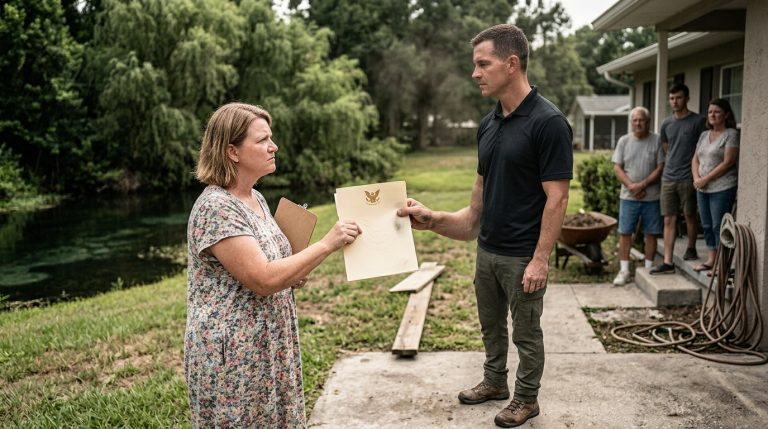
I unclipped the leather strap of the dossier I carried and opened it smoothly, letting the morning light fall across the stiff, cream-colored pages. I didn’t shove it in her face; I held it steady, exposing the embossed gold seal of the United States Department of the Interior and the clear, bold typography of the National Park Service registration dating back to October 1978.
“Under Title 54 of the United States Code,” I said, reading the text aloud with absolute, chilling clarity, “the willful destruction or structural alteration of a registered historic property is a federal felony. It carries individual criminal liability, prison sentences of up to five years, and heavy personal fines for every single person who authorizes, directs, or executes the demolition.”
The words dropped into the morning air like lead weights.
Gary turned instantly pale, staring at the embossed seal as if it were a live grenade. Brenda let out a small, terrified gasp, her hands flying to her mouth.
The concrete truck driver slowly backed away from the metal chute, holding his hands up palms-out. “Whoa. Whoa, lady. Federal felony? Prison? I pour concrete for foundations, I don’t sign up for federal penitentiary time. My rig stays right here.”
“You can’t leave!” Karen screamed, her voice cracking under the sudden collapse of her authority. “I am the president of this association! I command this project!”
“You command an illegal act,” a calm, weathered voice rang out from behind us.
We all turned. Stepping out from the shadow of the neighbor’s hedge were two county sheriff’s cruisers, their blue lights dark but their presence absolute. Senior Deputy Miller—no relation—stepped out of the lead cruiser, his thumbs hooked casually into his duty belt, his seasoned eyes scanning the chaotic tableau with profound, weary resignation.
“We got a call about a public disturbance,” the deputy said, his gaze settling squarely on Karen’s rigid, trembling form. “Mind explaining what’s happening to the National Register plaque you were about to bury in wet mix?”
Karen opened her mouth, but no sound came out. The absolute, unyielding wall of federal law had collided with her petty kingdom, and in the quiet morning light, her empire of beige vinyl and paper-thin authority finally shattered into dust.
CHAPTER 7: THE RECALL MEETING AT THE HIGH SCHOOL AUDITORIUM
The air inside the Liberty Crossing High School auditorium was thick with stale coffee, damp wool, and the unmistakable tension of a populace that had reached its breaking point. Rows of folding chairs filled the gymnasium floor, packed shoulder-to-shoulder with homeowners who had spent years swallowing petty fines, silent intimidation, and arbitrary rulebook tyranny.
I sat near the center aisle, my boots resting firmly against the scuffed linoleum floor. Around me, the low murmur of conversation sounded like a swarm of angry hornets. Up on the elevated stage, seated behind a long laminate table under the harsh glare of overhead stage lights, sat Karen Miller, Gary, and Brenda. They looked isolated, stranded on an island of their own making. The corporate representatives from the national property management firm sat awkwardly to their right, sweating through their cheap suits, fully aware that the ship was taking on water too fast to bail.
The double doors at the back of the auditorium swung shut with a heavy thud, and Arthur Abernathy stepped up to the center aisle microphone. The room quieted instantly, every eye locking onto him.
“This special meeting of the Meadows at Liberty Crossing Homeowners Association is now called to order,” Arthur said, his voice carrying with the steady, authoritative cadence of a man who had commanded classrooms for decades. “The sole item on our agenda this evening is the formal consideration and vote concerning the recall of the sitting board of directors.”
A ragged wave of scattered applause rippled through the rows, quickly swelling into a solid wall of approval.
Karen leaned into her desktop microphone, her face flushed, her fingers clawing nervously at the plastic casing. “This meeting is completely out of order!” she snapped, her voice cracking over the PA system. “An unauthorized assembly driven by disgruntled, rule-breaking elements does not supersede the bylaws! We have retained legal counsel, and anyone participating in this illegal mutiny will face immediate financial penalties and—”
“Quiet down, Karen,” a voice shouted from the back rows, sharp and unsparing.
The auditorium erupted into laughter and catcalls. The illusion of absolute authority, built on years of mailed notices and golf-cart patrols, had dissolved entirely under the sunlight of public exposure.
Miguel Garcia stepped up to the microphone next, holding a thick folder filled with printed financial spreadsheets. When he spoke, his voice was measured, factual, and devastatingly calm.
“We haven’t come here to shout,” Miguel said, looking directly up at the stage. “We’ve come to review the ledger. Over the past three years, this board has issued over four hundred individual citations, generating nearly eighty thousand dollars in discretionary fine revenue. Yet, during that exact same period, the exclusive landscaping contract for all common areas was awarded without bidding to Prestige Lawn Care—a company owned by Mrs. Miller’s immediate family—at rates nearly double market value.”
A collective murmur of outrage swept through the crowd. Necks craned toward the stage. Gary dropped his pen, his face draining of color, while Brenda shrank back into her plastic chair as if trying to melt through the upholstery.
For the next hour, homeowner after homeowner stepped up to the microphone. An elderly widow spoke of being forced to pay out-of-pocket to replace healthy azaleas because they weren’t on the approved color palette. A young father detailed how his children’s plastic toys left on the grass for ten minutes triggered a formal legal threat. The architecture of their control wasn’t about community standards; it was a closed, predatory loop designed to extract compliance and profit from fear.
Karen tried to interrupt twice more, waving a stack of papers and shouting accusations of slander, but Arthur simply muted her microphone from the master audio board on the wall. The silence that followed her cut-off mic was more brutal than any argument.
“We will now proceed to the written ballot,” Arthur announced, his voice steady. “Every household represented tonight has one vote. Please mark your ballots and drop them into the collection boxes held by our neighborhood volunteers.”
The voting took twenty minutes. It was conducted in absolute, orderly quiet—the quiet of an execution carried out by the book.
When the last paper box was sealed and carried up to the stage, the two corporate representatives hastily conferred with Karen, whispered urgently, and then stepped back. Arthur and a neutral auditor spent ten grueling minutes tallying the sheets under the glare of the stage lights.
Arthur finally stepped back up to the center mic, a single piece of paper in his hand. He looked out over the crowded auditorium, letting the silence build until you could hear the low hum of the ceiling vents.
“The results are certified,” Arthur said clearly. “Ninety-two percent of the participating membership has voted in favor of the resolution. The sitting board of directors—Karen Miller, Gary Peterson, and Brenda How—is hereby recalled, effective immediately.”
The roar that shook the gymnasium rafters was deafening. People stood up, clapping, cheering, and shaking hands across the folding chair rows.
Up on the stage, Karen sat frozen, staring out at the sea of faces that no longer feared her. Without a word, she grabbed her leather portfolio, stood up with jerky, mechanical movements, and marched off the stage through the side exit doors, her fuchsia blazer vanishing into the shadows. Gary and Brenda scrambled after her like rats deserting a sinking hull.
I remained seated in the center aisle, watching them go. The regime was broken. The quiet infrastructure of tyranny had been dismantled not with anger, but with the heavy, unyielding weight of truth, documentation, and a neighborhood standing shoulder to shoulder.
CHAPTER 8: THE GRANITE PLAQUE AND THE DUSTY FIELDSTONE PATH
The autumn air carried a sharp, clean bite, smelling of dry leaves, woodsmoke, and damp earth. Six months had passed since the night the high school auditorium emptied its anger into the cold night air, and the transformation across Liberty Crossing was visible in the way neighbors walked, talked, and looked at one another across property lines.
The legal fallout had struck with the clean, surgical precision of an engineered settlement. Apex Insurance, representing the HOA, had covered every dollar of my legal fees, while the individual defendants—Karen, Gary, and Brenda—were permanently barred from ever holding board office in any community managed by the national firm. Furthermore, a substantial portion of the financial settlement had been extracted directly from their personal accounts, a public and painful consequence that served as a permanent deterrent to administrative tyranny. The new interim board, led by Arthur Abernathy and Miguel Garcia, had wiped out the backlog of petty fines, canceled the predatory landscaping contracts, and rewritten the bylaws to strip away the vague, subjective clauses that had fueled years of fear.
On this crisp October afternoon, the entire neighborhood gathered on my lawn.
Children ran across the open grass, laughing and chasing one another without fear of a compliance citation. Neighbors stood in small, relaxed clusters, sharing coffee and conversation. Even a local color guard from the VFW post was present, standing at attention near the western boundary of the homestead.
I stood near the edge of the slope, looking down at the root cellar.
With the settlement funds, I had hired a master stonemason to construct a respectful, low-profile fieldstone path leading from the edge of my lawn directly down to the heavy timber door of the cellar. The stones matched the 1860s masonry precisely, fitted with the quiet, durable geometry my grandfather would have respected. Mounted on a solid block of dark Virginia granite beside the path was a heavy, cast-bronze plaque.
Arthur Abernathy stepped forward, clearing his throat gently, and tapped a microphone connected to a small portable amplifier. The feedback hummed softly before fading away.
“Friends, neighbors,” Arthur began, his voice carrying clearly across the quiet gathering. “We often think of a home as four walls, a roof, and a piece of paper recording a property line. But history reminds us that true ownership is stewardship. Today, we dedicate a permanent marker to the Caldwell Station—a safe harbor on the Underground Railroad, a sanctuary where ordinary people chose courage over compliance, and endurance over tyranny.”
A quiet, reverent hush fell over the crowd.
Arthur gestured toward me. “Mark, would you do the honors?”
I walked forward, stepping off the grass onto the newly laid fieldstone path. The stone was cool beneath the soles of my boots, solid and immovable. I reached out, my fingers resting against the dark, textured surface of the bronze plaque. With a smooth, deliberate motion, I pulled away the heavy canvas shroud, letting it drop to the earth.
The polished bronze caught the autumn sunlight, gleaming with the sharp, crisp lettering commissioned to tell the story of the site, the abolitionist work of the 1860s, and the federal recognition secured by my grandfather in 1978.
The crowd broke into a slow, sustained applause—not the frantic cheering of a political rally, but a deep, resonant validation of shared history and community survival.
After the speeches concluded and the mayor had shaken my hand, the crowd slowly dispersed to mill about the lawn, drinking cider and talking beneath the turning leaves.
Arthur walked up beside me, hands clasped behind his back, looking down at the bronze plaque and then over toward the heavy oak door of the root cellar.
“You know, Mark,” Arthur said quietly, a faint smile touching the corners of his mouth. “In a strange way, we all owe Karen Miller a debt of gratitude.”
I raised an eyebrow, turning my head slightly. “How do you figure that, Arthur?”
“Her absolute obsession with destroying a piece of history forced all of us to look down, find it, cherish it, and stand together to protect it,” Arthur said, clapping a warm hand firmly against my shoulder. “You didn’t just save a root cellar from a concrete truck. You forced a sleeping neighborhood to remember its own backbone.”
I looked back down at the fieldstone path, then toward the weathered timber and fieldstone of the cellar structure. The iron latch caught the afternoon light, gleaming softly against the dark wood.
The war of attrition was over. The logistics of the homestead were secure. The ground was quiet again, anchored not by rules and fines, but by memory, endurance, and the unyielding strength of stone.