The Calibration of Justice: How an Ex-Engineer Dismantled a Suburban Empire of Paper and Greed Through Cold, Methodical Warfare
CHAPTER 1: The Ultimatum at the Property Line
The words, thick with a syrupy, self-satisfied authority, hang in the humid afternoon air, seeming to curdle the very sunlight that falls across the backyard.
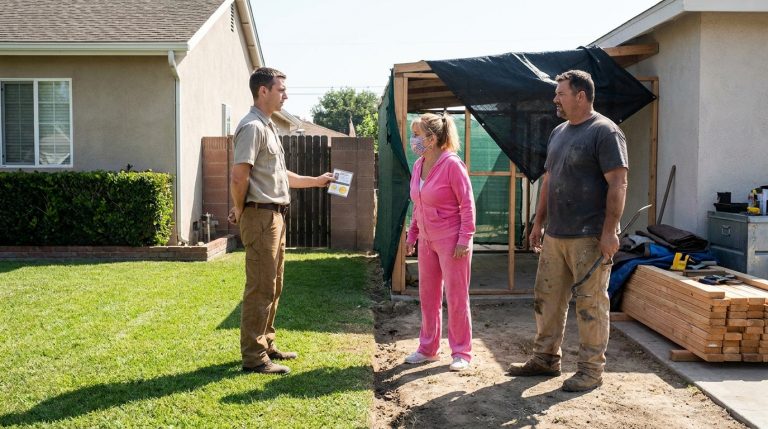
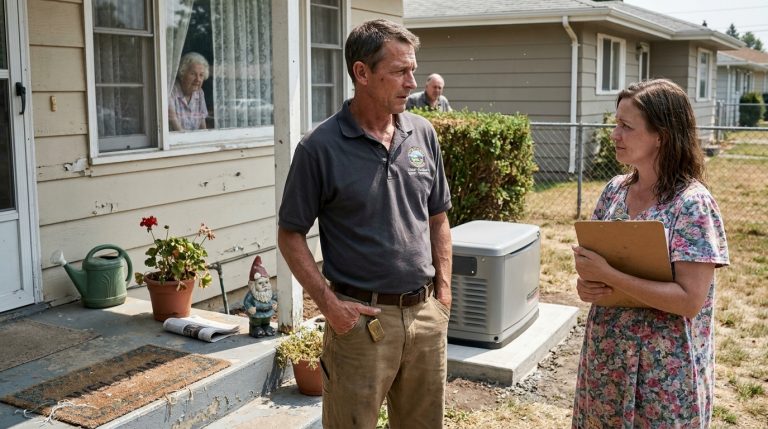
Mark turns slowly from the half-assembled frame of his greenhouse, his hand still clamping a torque wrench, and faces the source of the decree. Karen Miller stands at the edge of the property line, her arms crossed over a vast floral mumu, her face a mask of pinched indignation. Her two silent, golf-shirted board cronies flank her like gargoyles on a crumbling cathedral of suburban mediocrity. This property, this greenhouse—a sanctuary he is building for Elena—has just been labeled junk and sentenced to death with the casual tyranny of a board queen ordering an execution.
The shock is a cold spike in the gut, but twenty-five years in the Army Corps of Engineers teaches a man how to compartmentalize adrenaline and move directly to tactical analysis. Mark’s gaze flickers past Karen’s smug smirk to the structure behind him: the gleaming galvanized steel ribs, the stacks of polycarbonate panels waiting to be installed, the fresh concrete footings poured with absolute precision just last week.
“Abandoned?” Mark repeats, his voice dangerously low, stripped of all warmth. “Ma’am, I was working on it ten seconds before you started shouting. The materials were delivered yesterday. How exactly do you define abandoned?”
Karen sniffs, a sound like a leaky balloon yielding under pressure. “It’s an unfinished eyesore, and it’s been like this for weeks. It violates the aesthetic harmony of our community. The board has voted. The fine stands. Seventy-two hours.”
The sheer weaponized stupidity of it is breathtaking, a friction point that demands an immediate, calculated counter-move. But before Mark can formulate the exact parameters of his response, a sharp, metallic clatter echoes from the neighbor’s driveway across the lane—a car door slamming shut with heavy, deliberate finality, followed by the crunch of heavy boots on loose gravel that stops dead silent right at the edge of the cul-de-sac.
CHAPTER 2: The Blueprint of Resistance
The metallic echo dies away against the neat, identical siding of the Serenity Meadows houses, but the tension it leaves behind is thick enough to cut with a blade. Across the narrow lane, Tom—the young firefighter from two doors down—has just stepped out of his battered pickup truck, his heavy work boots crunching deliberately on the loose asphalt. He doesn’t look at Karen. His eyes lock onto Mark with a tight, knowing flick of solidarity before he turns and heads up his own walkway.
Karen notices the shift. Her pinched face tightens further, the floral mumu straining over her chest as she pivots slightly to track Tom’s movement. She thrives on absolute isolation, on making a target feel like they are standing entirely alone against an impenetrable wall of neighborhood consensus.
“You’re wasting your breath, Mr. Davis,” Karen snaps, dragging her attention back with a sharp jerk of her chin. Her two board cronies, Bob and Linda, shift uneasily behind her, their golf shirts sticking to their frames in the midday heat. “The board’s ruling is final. Seventy-two hours, or the county enforcement will be the least of your worries. We have ways of ensuring properties like yours are dealt with permanently.”
Mark doesn’t step forward. He doesn’t raise the torque wrench. He simply lets the silence stretch between them—a classic engineering tactic where the absence of sound forces the opponent to fill the void with their own growing paranoia. His mind races back to the structural stress charts of his old days in the Corps: every system has a breaking point, a precise threshold where internal pressure exceeds the tensile strength of the material. Karen’s authority is built entirely on paper-thin procedural bluffing, completely lacking deep structural integrity.
“Dealt with permanently,” Mark echoes quietly, his voice carrying a metallic edge that cuts cleanly through the humid air. “That’s an interesting phrase, Karen. Sounds like an operational directive. Tell me, does that directive come from your bylaws, or from the private maintenance contracts you hand out to your family?”
A microscopic twitch hits the corner of Karen’s left eye. It is the only sign, but to a trained observer, it is a glaring fracture in her facade. Bob shifts his weight, his sneakers scraping against the turf, while Linda clears her throat with a sudden, nervous rasp.
“What are you implying?” Karen spits out, her voice rising an octave, losing its syrupy composure. “The board operates with total transparency.”
“Transparency,” Mark says, his gaze dropping deliberately to the freshly poured concrete footings of the greenhouse, then rising slowly back to meet her eyes with unblinking precision. “We’ll see how transparent things look when the county pulls the complete file on your property set-backs and the architectural exemptions you claim to govern. Enjoy your afternoon, Karen. The clock is running—for both of us.”
Without waiting for a reply, Mark turns his back on her. The casual insult of dismissal hits harder than any shout. He walks methodically to the galvanized steel frame, sets the torque wrench down with a deliberate, metallic clink on the workbench, and heads inside the house, leaving Karen standing at the property line with her mouth half-open, suffocating on her own unspent authority.
Inside the cool, dim quiet of the hallway, Elena is standing by the living room window, her hands wrapped tightly around a warm ceramic mug. The soft light catches the slight strain around her eyes—the constant, invisible tax of her chronic pain, exacerbated by the sudden spike of neighborhood hostility outside.
“She didn’t like that,” Elena says softly, her voice a gentle contrast to the hard lines of Mark’s posture as he steps through the door.
“People who rely on theater never know how to handle absolute facts,” Mark replies, walking over to gently take the mug from her hands, his fingers brushing hers with a steady, grounding warmth. “She thinks this is a turf war over a greenhouse. She doesn’t realize we haven’t even laid the foundation yet.”
He moves past her toward the back office—the room that is about to become a war command center. On the desk sits the pristine, heavy binder of county zoning codes and state nonprofit regulations. Opening the cover, Mark picks up a red marker, uncaps it with a sharp click, and draws a clean, dark line through the first obstacle. The defense phase is over. It is time to map the ledger.
CHAPTER 3: Mapping the Enemy Ledger
The study is quiet except for the low, rhythmic hum of the small desktop fan pushing stale air across stacks of printed public documents. Mark does not look up when Elena’s soft footsteps pause in the doorway. He keeps his eyes fixed on the Secretary of State corporate printouts spread across his mahogany desk like an aerial survey of hostile terrain.
“You’ve been staring at those nonprofit filings for three hours,” Elena says quietly, her voice carrying a fragile note of concern as she leans against the doorframe.
“An organization doesn’t survive eight years of identical leadership without structural reinforcement,” Mark replies, his pen tracing a line from the Serenity Meadows HOA corporate registry down to a subsidiary business filing. “Karen didn’t build this system. She inherited the shell and weaponized the vagueness. But every corporation leaves a digital footprint, and nonprofits are legally required to lay bare their financial anatomy.”
He taps a corner of the paper with the back of his pen. The numbers don’t lie, but they require a cold, calibrated eye to interpret. For a decade, the landscaping line item has consumed nearly sixty percent of the community’s annual operational budget—an astronomical sum for a patch of suburban grass that looks perpetually malnourished.
Mark shifts his weight, the leather of his desk chair creaking in the silence. He pulls a fresh sheet of grid paper toward him and begins to map out the vendor registry cross-references he pulled earlier that morning. The registered agent for Greenscape Solutions LLC is listed under a residential address three miles outside city limits. A quick search of property records connects that address directly to Gary Miller—Karen’s brother-in-law.
It is a textbook conflict of interest executed with casual, arrogant impunity. Karen drafts the aesthetic bylaws, her board cronies rubber-stamp the expenditures, and the community’s treasury funnels thousands of dollars directly into her extended family’s bank accounts. They treated the neighborhood like an annuity, assuming no one would ever possess the patience or technical background to audit a decade of municipal filings.
“She thought she was operating above the law,” Mark murmurs, his pen scratching a steady, rhythmic line across the paper. “She didn’t realize she was just sitting on a compromised foundation.”
Elena steps fully into the room, walking over to place a hand lightly on his shoulder. Her fingers are cool, offering a grounded anchor against the rising tide of analytical calculation. “And if she fights back through official channels? What happens when the certified mail comes back denied?”
“Then we stop playing defense with letters,” Mark says, turning his head slightly to meet her gaze, his expression unyielding. “We build a coalition. A single voice complaining about a landscaping bill is easy for an HOA president to ignore as a disgruntled homeowner. But a systematic audit backed by multiple affected residents? That’s a structural failure she can’t patch over with a floral mumu.”
He closes the corporate registry binder with a sharp, definitive snap that breaks the heavy silence of the room. The paper trail is secured, but corporate malfeasance is only the first layer of the fortress. To truly crack her control, Mark knows he needs to understand how deep the neighborhood’s silence goes—starting across the lane with the people who have already been broken by her petty tyranny.
Rising from the desk, Mark walks toward the front window, his sharp eyes tracking the lengthening afternoon shadows falling across the asphalt. Across the street, Tom’s driveway is empty, the firefighter’s pickup truck presumably out on shift. But down the block, Mrs. Gable can be seen through the dappled sunlight, kneeling alone by her flower beds with a small hand trowel, moving with the careful, fragile precision of someone who has learned to tend her life around deeply buried scars.
The time for paperwork is coming to an end. The transition to the field requires direct human contact, and Mark knows that stepping off his property to speak with his neighbors will draw immediate, hostile attention from the house across the street. He reaches down, picks up his heavy-duty leather work gloves from the side table, and pulls them on one finger at a time, feeling the stiff, resistant grain tighten against his skin. The perimeter is set. It is time to test the fences.
CHAPTER 4: The Council of Light and Shadow
The gravel under Mark’s boots shifts with a sharp, dry crunch as he walks down the driveway, his gaze level and fixed on the perimeter. The afternoon sun beats down on the neat, identical lawns, casting long, sharp shadows across the manicured turf. Up the street, the upper-story windows of Karen Miller’s house catch the glare like polished glass—a silent, watching turret that overlooks the entire block.
Mark doesn’t look up. He knows the surveillance is there, woven into the architecture of a neighborhood designed to enforce conformity through constant visibility. Instead, he maintains a steady, measured pace, crossing the asphalt lane to the edge of Tom’s driveway.
The firefighter’s pickup truck is parked squarely in the center, its hood ticking softly as the engine cools down from the afternoon shift. Before Mark can raise a hand to knock on the open garage door, Tom steps out from the dim interior, wiping grease from his knuckles with a heavy shop rag. His jaw is tight, a permanent line of tension carved into a face that has spent too many years absorbing local grievances without an outlet.
“You’re making waves, Mark,” Tom says, his voice pitched low, carrying across the hood of the truck as he tosses the rag onto a workbench. “Word travels fast when the HOA president starts drafting certified warnings. Half the street thinks you’re out of your mind; the other half is locking their front doors hoping she doesn’t notice them breathing.”
“Conformity relies on isolation,” Mark replies, stopping a few feet short of the concrete apron. His voice is calm, stripped of any defensive heat. “Karen operates under the assumption that every household is an independent island fighting its own private fine. If you isolate the targets, they absorb the blows individually. But a structure only holds together under uniform pressure.”
Tom pauses, the shop rag dangling from his fingers. He looks past Mark’s shoulder, scanning the empty street before locking eyes with the older veteran. “You’re talking about more than a greenhouse dispute.”
“I’m talking about a structural audit,” Mark says smoothly, taking a slow step forward to bridge the gap. “The aesthetic harmony clause isn’t a legal standard; it’s a flexible wedge. Last year, she cited you a thousand dollars over a portable basketball hoop for your son. Two years ago, she forced Mrs. Gable to rip out a memorial Japanese maple because it didn’t fit her visual landscape.”
Tom’s grip on the rag tightens, his knuckles whitening against the dark fabric. The memory of his boy’s heartbreak over the basketball hoop flashes across his eyes—a raw, unhealed friction point. “She buried me in paperwork. Threatened a lien on the house. With a newborn at home, I couldn’t risk the legal fees to fight a board that writes its own rules.”
“Because she controls the ink,” Mark answers, his tone steady and unyielding. “And she funds her operations by treating the neighborhood treasury like a private family trust. The landscaping contract alone consumes sixty percent of the annual budget, funneled directly into a company owned by her brother-in-law.”
The silence that follows is heavy, charged with the sudden, sharp realization of systemic betrayal. Tom stares at him, the analytical weight of the revelation sinking in beneath the surface of his exhaustion.
“Her brother-in-law,” Tom repeats, the words tasting like ash. “All this time we thought the maintenance fees were going up because of inflation.”
“They’re going up to pay for a dynasty,” Mark says. “We don’t need to shout across the fence anymore. We need to pool our documentation. David, the corporate lawyer down on Elm Street, is already reviewing the state nonprofit filings. If we bring enough voices to the table, her paper wall collapses.”
Tom lets out a slow, heavy breath, his shoulders dropping an inch as the initial shock gives way to a cold, hard resolve. He looks down at his grease-stained hands, then up at Mark with a sharp, evaluating nod. “My garage is open on Saturday morning. Bring the paperwork.”
Mark gives a single, firm nod of agreement, turning his heel against the gravel to retrace his steps across the lane. The first pillar of the coalition is anchored. As he walks back toward his own property, the skeletal ribs of the unfinished greenhouse gleam coldly in the fading sunlight, no longer just a target for an HOA tyrant, but the central anchor point of a resistance that is about to dismantle the entire foundation.
CHAPTER 5: Reconnaissance at the Depths
The chain-link perimeter fence of the Serenity Meadows community pool stands cold and silent beneath the late afternoon sky, its galvanized wire catching the slant of the sun with sharp, industrial glints. Mark does not enter through the main gate; instead, he traces the outer boundary line, moving with the measured, low-impact stride of an engineer inspecting a contested perimeter.
Every detail of the installation speaks of deferred maintenance masked by glossy promotional brochures. The gate latch hangs slightly misaligned, its self-closing mechanism stripped of tension, failing to catch properly when swung shut. The depth markers painted on the concrete apron are faded to pale ghosts, peeling away from the weathered aggregate. But it is the heavy brick pump house tucked into the far corner that draws his complete focus.
A public pool of this scale is governed by a strict, unyielding grid of federal and state health statutes—most notably the Virginia Graeme Baker Pool and Spa Safety Act, which mandates rigorous compliance for anti-entrapment drain covers and chemical storage protocols. In municipal engineering, these aren’t mere suggestions; they are structural load-bearing laws. When an administrator cuts corners here, they aren’t just violating aesthetic guidelines—they are introducing catastrophic points of failure into a public system.
Mark stops at the edge of the pump house intake vent, the damp, chemical-laden smell of chlorine and muriatic acid drifting out on a warm puff of exhaust. The ventilation louvers are choked with dust and dead leaves, pointing to an utter neglect of environmental safety controls.
A shadow falls across the concrete as a heavy footstep crunches on the gravel behind him. Mark pivots smoothly, his body language shifting into defensive readiness before his eyes even register the figure. It is Tom, having cycled over on his mountain bike, pulling up alongside the fence with a tight, grim set to his jaw.
“You won’t find many friends looking through the fence here,” Tom says quietly, resting his hands on the handlebars. “Karen treats this pool like her personal crown jewel. Her board crony, Bob Jenkins, handles the maintenance contract through his own company, Crystal Clear Pool Services. Nobody questions it because nobody dares ask to see the chemical logs.”
“Because a closed loop doesn’t require oversight until the stress exceeds the material threshold,” Mark replies, his eyes scanning the rusted padlock securing the pump house door. “Bob sits on the board, votes on the maintenance budget, and writes checks directly to his own business. It’s a textbook conflict of interest wrapped in a rubber-stamped approval.”
Tom lets out a sharp, cynical breath, shaking his head. “We asked for the maintenance records last summer when the filtration system kept breaking down. Karen claimed the board had plenary authority to handle vendor selection without public disclosure.”
“Plenary authority ends where federal health mandates begin,” Mark says, his voice flat and absolute. “An HOA can invent whatever aesthetic bylaws it wants to harass homeowners over a greenhouse or a basketball hoop, but they cannot override state health codes or federal safety standards. If Bob’s company skipped the annual VGB drain compliance check, the liability doesn’t just rest on the board—it rests on every single signature that approved the contract.”
Mark pulls a small, pocket-sized notebook from his jacket, clicking a pen with a sharp snap, and records the exact date, time, and visible state of the gate latch and pump room ventilation. Every observation is a structural anchor point for the legal packet David is currently compiling.
“The formal demands are already in the mail,” Mark continues, his pen moving steadily across the paper. “When she stonewalls those requests—and people like Karen always double down rather than admit a flaw—she’ll provide the exact written evidence we need to escalate this from a local dispute to an official health department investigation.”
Tom watches him write, the tension in his shoulders easing into a hardened, tactical focus. “What do you need from me next, Mark?”
“Keep your kids away from the deep end this weekend,” Mark says quietly, closing the notebook with a crisp snap. “And be ready when the county health inspector answers the door.”
Mark turns away from the chain-link fence, his boots striking the pavement with steady, purposeful momentum. The perimeter has been mapped, the vulnerabilities identified, and the trap is fully rigged. The only thing left to do is wait for the enemy to pull the pin.
CHAPTER 6: The Chief Inspector Arrives
The heavy rumble of the Ford Explorer vibrates through the asphalt, cutting short any lingering thoughts of retreat. The vehicle doesn’t hesitate or slow down for the speed bumps; it moves with the absolute, unyielding purpose of a state mandate, cutting sharply into the small parking lot beside the community pool and blocking the entrance with calculated finality.
Mark doesn’t blink. He stops right at the boundary of his lawn, his hand resting casually against the side of his truck as he watches the driver’s side door swing open. A man in his forties steps out into the glaring afternoon sun, dressed in a crisp, dark county health uniform. His hair is cropped close in a military-style fade, and his expression carries the hardened, unreadable neutrality of an inspector who has seen every shortcut, every bribe, and every fatal omission a fraudulent manager can hide behind a fresh coat of paint. He is Chief Inspector Evans, exactly the kind of force multiplier Mark knew a bureaucratic structure could not ignore once the coordinates were accurately provided.
Across the lane, the scene at the pool deck is bustling with the casual, sun-drenched arrogance of a Friday afternoon before a three-day holiday weekend. Children splash in the shallow end, teenagers jostle each other near the diving board, and right at the center of it all, Karen Miller presides from a low-slung lounge chair beneath a massive canvas umbrella. Her floral mumu billows slightly in the warm breeze as she lifts a tall glass of iced tea, laughing effortlessly at something Bob Jenkins has just muttered from the adjacent chair.
They have no idea that the foundation beneath them has already cracked.
Inspector Evans doesn’t bother with polite neighborhood pleasantries. He marches straight through the manual gate—which swings open without catching on its broken latch—and strides directly onto the sun-bleached concrete of the pool deck. His boots strike the hard surface with sharp, echoing slaps that immediately cut through the ambient laughter and splashing.
“Are you the responsible party for this facility?” Evans asks, his voice carrying an acoustic authority that travels effortlessly across the entire enclosure. His eyes sweep the deck, cataloging every fading depth marker and rusted handrail in a single passing glance.
Karen freezes mid-sip, her hand hovering halfway to her mouth. Annoyance flares instantly across her pinched features as she lowers the glass with a sharp clink, struggling awkwardly to haul herself out of the low lounge chair. “I am the president of the homeowners association,” she snaps, her voice rising with defensive irritation. “Who do you think you are barging in here? We are fully compliant. Our facilities are maintained by certified professionals.” She gestures vaguely toward Bob, who shrinks back into his chair, suddenly intensely interested in the tile pattern beneath his sneakers.
“I am Chief Inspector Evans of the County Health and Safety Division,” the officer announces, pulling a heavy clipboard firmly against his chest. “And your certified professional has been operating a hazard zone.”
Without waiting for her permission, Evans turns on his heel and walks straight toward the brick pump house. He pulls a master key ring from his belt, finds the correct key on the first try, and throws the heavy door open wide. Even from across the asphalt, the harsh glare of the interior reveals the critical failure: stacks of heavy chlorine containers and carboys of muriatic acid jammed together in a tight, unventilated space, their caps leaking subtle, chemical wisps into the stagnant air.
“Class one critical violation,” Evans calls out, his voice sharp enough to draw gasps from the nearest parents pulling their kids from the water. “Improper storage of incompatible chemicals. One spark or a minor leak and this entire enclosure becomes a gas chamber.”
Karen scrambles forward, her face turning a blotchy, furious red as her veneer of absolute authority begins to shred under the weight of hard evidence. “This is harassment! We have documentation! This is because of that disgruntled neighbor—Mark Davis! He’s been filing malicious complaints!”
The admission hangs in the hot air, raw and defensive. Evans stops cold, turning slowly to face her with an expression carved from granite. “Ma’am, I don’t care about neighborhood disputes. I care about this.” He reaches into his breast pocket and pulls out a laminated information card featuring the smiling face of a young girl. “This is Virginia Graham Baker. She was seven years old when she was trapped and killed by a non-compliant drain cover just like the one installed in your deep end.”
Silence drops over the pool deck like a lead weight. The teenagers have stopped swimming entirely, clinging to the edge of the gutter in stunned stillness.
Evans doesn’t wait for her to recover. He walks straight to the edge of the deep end, kneels down on the damp concrete, and points a firm finger at the flat, outdated main drain grate at the bottom of the blue water—the exact hazard cited three years running and ignored by Karen’s bookkeeping shell game.
“Willful non-compliance,” Evans says, his pen scratching furiously against his violation pad as he writes out the formal closure order. “Failure to remediate critical safety hazards. The cumulative fines and penalties total eighty-five thousand dollars. This facility is closed indefinitely.”
Karen stares at the yellow slip of paper as Evans thrusts it toward her chest, her mouth opening and closing without sound. The kingdom built on paper bylaws and family maintenance contracts has just collided with an immovable wall of physical reality. Mark watches from the quiet boundary of his lawn, his face expressionless, knowing that the first phase of the wall has finally come down.
CHAPTER 7: The Tribunes of the Middle School Auditorium
The air inside the middle school auditorium is thick with the collective breathing of over two hundred homeowners who have crowded into every available row, filling the aisles and pressing against the back walls. The fluorescent overhead lights cast a harsh, clinical glare over the long folding table on the stage where Karen, Bob, and Linda sit. They look smaller here, stripped of their suburban turf, exposed beneath an institutional roof that does not bend to local bylaws or floral mumus.
Mark stands at the center podium, his hands resting flat against the cool laminate surface. He does not raise his voice, but the acoustic resonance of his steady, measured delivery carries cleanly to the furthest corners of the room. He does not open with anger; he opens with structure.
“For eight years,” Mark begins, his eyes sweeping across the sea of tense faces before locking onto the table on the stage, “we have operated under the assumption that our homeowner association was a protective governance body. We were told that rules were enforced for our collective harmony, that dues were managed with fiscal discipline, and that the board acted as an uncompromised trustee of our community investments.”
A low murmur ripples through the middle rows, carrying the sharp edge of collective realization.
Mark clicks a remote in his hand, bringing up the first financial slide on the projector screen behind the stage. The red-circled line item of the landscaping budget blazes against the white canvas, followed immediately by the Secretary of State registry printout bearing Gary Miller’s name.
“This is not governance,” Mark continues, his tone dropping into a cold, clinical cadence. “This is a closed loop of extraction. Over four hundred thousand dollars funneled through family-owned shell contracts for substandard work, while common areas deteriorated and legitimate community needs were ignored.”
Karen stiffens at the table, her face flushing a dark, mottled crimson. She tries to open her mouth, to cut him off with a familiar demand for order, but David—the corporate lawyer sitting prominently in the front row—slips a single sheet of state corporation code paper across the edge of the table, his eyes locking onto her with absolute legal finality. She shuts her mouth, her hands gripping the edge of the folding table until her knuckles turn white.
Mark does not pause. He advances the slide to the documentation pulled straight from the county health department—the explicit, unyielding violation reports detailing the non-compliant VGB drain cover, the improper chemical storage in the pump room, and the cumulative eighty-five thousand dollar safety penalty levied just days prior.
“This is where paper authority meets physical reality,” Mark says, his voice cutting through the heavy silence of the room. “An administrative loophole can protect a bad policy on paper, but it cannot stop chlorine gas from leaking or protect a child from a structural entrapment hazard. Karen Miller and her board did not just mismanage funds; they gambled with the physical safety of every family in Serenity Meadows.”
The silence breaks. A sudden, massive surge of sound erupts from the audience—not a chaotic riot, but a unified, thundering roar of repudiation. People stand up from their folding chairs, their voices overlapping in sharp demands for immediate removal.
Tom, standing near the side aisle, steps forward and raises his hand, calling for a motion of no confidence under the emergency bylaws. The procedural requirements are met instantly; over sixty percent of the registered homeowners raise their hands in a sea of synchronized defiance. When the call is made for votes against, only three hands remain down—Karen, Bob, and Linda, frozen in absolute isolation.
Mark steps away from the podium, his boots clicking rhythmically against the stage floor as he walks back to sit beside Elena in the front row. The vote is formalized, the corrupt board is stripped of its authority on the spot, and the interim administration is installed with unanimous resolve. The paper empire has finally collapsed under the weight of its own structural fractures.
CHAPTER 8: The Sanctuary Restored
The morning sun filters cleanly through the clear polycarbonate panels of the completed greenhouse, casting soft, dappled light across long rows of polished cedar benches. The air inside is heavy with moisture and the rich, earthy scent of damp bark and blossoming exotic life. There are no corporate filings here, no intimidating legal ledgers, and no threatening notices from a self-appointed board queen. There is only the quiet, rhythmic hum of the ventilation system and the steady, living breath of rare orchids thriving within a precisely calibrated environment.
Mark stands near the center bench, his hands resting on the smooth surface of the framework he had built piece by piece. Every bolt has been torqued to exact specifications; every structural rib stands rigid against the wind, proof against any external pressure.
Outside the clear panels, the neighborhood of Serenity Meadows moves in a different light. Down the block, Mrs. Gable can be seen tending to a freshly planted dogwood tree in her front yard, her movements unhurried, free of the quiet fear that once governed her mornings. Across the lane, children’s laughter echoes from a street where the community pool now operates under strict, transparent compliance, its safety audit fully settled and its hazards erased.
The legal fallout from the forensic audit had struck with the cold, impartial momentum of a wrecking ball. The district attorney’s office formally filed criminal charges for fraud and embezzlement against Karen Miller, her brother-in-law Gary, and Bob Jenkins. The systemic corruption that had shielded their actions for nearly a decade dissolved the moment the corporate veil was pierced by undeniable proof. Realizing that her paper empire had completely collapsed, Karen listed her house for sale within a fortnight. On the morning the moving truck pulled away, no one cheered or gloated; the neighborhood simply watched the departure with a quiet, collective sense of gravity, stepping forward into a future built on mutual trust rather than petty tyranny.
Elena steps softly into the greenhouse, her footsteps light against the rubber-matted floor. She pauses by the entrance, her hand brushing the delicate, vibrant petal of a deep purple cattleya orchid resting on the middle shelf. The lines of tension and chronic fatigue that had once weighed heavily around her eyes seem to have softened, smoothed away by the tranquil air of the sanctuary Mark built to protect her peace.
She turns her head, looking through the clear panels toward the houses beyond before meeting Mark’s gaze with a radiant, unbroken smile. “You actually finished it,” she whispers, her voice carrying a profound, quiet warmth. “You built a true sanctuary.”
Mark walks over to her, his hand sliding naturally into hers, the hard callus of his palm a physical reminder of the heavy labor and tactical precision it took to reach this moment. He looks down at her, then back out at the quiet, peaceful street where neighbors nod and wave across property lines without fear of arbitrary decrees.
“Every structure holds when you build it on the truth,” Mark replies softly.
He reaches into his jacket pocket and pulls out the old torque wrench—the heavy steel tool that had anchored his defense from the very first afternoon Karen issued her unlawful ultimatum. With deliberate, measured care, he walks over to the corner workbench where a minor adjustment on the misting frame’s intake valve is needed. He fits the wrench to the bolt, gives it a single, precise turn until it clicks into absolute alignment, and lays it down for good. The mission is complete. The foundation is secure.