The Architect of Silence and the Steel Network That Crushed Oakmont
CHAPTER 1: THE RUPTURE AT THE PERIMETER
The cheap pine framing groaned three seconds before it sheared. I didn’t drop the brass temperature sensor in my left hand. I thumbed the notched edge of David’s military compass in my pocket, feeling the notch bite into my skin until my heart rate settled back to forty-eight beats per minute.
“This unauthorized structure is coming down, Mr. Evans,” a voice rasped. It sounded like dry gravel dragged across corrugated tin. “Consider this your final official notice.”
I turned slowly. My right knee didn’t flex past forty degrees without a dull click, but I kept my weight centered over my heel.
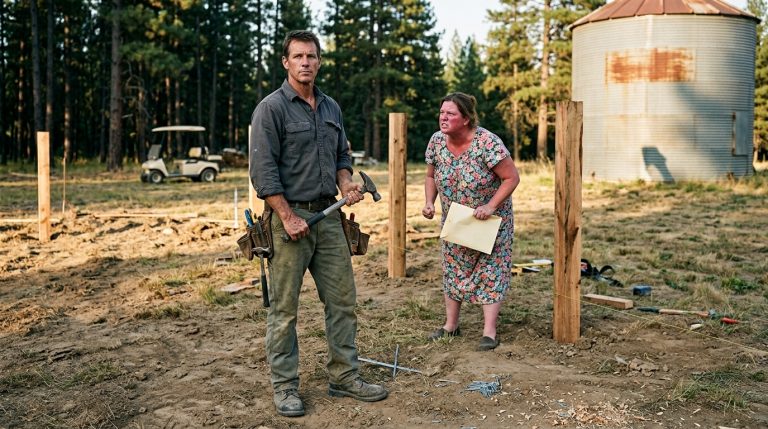
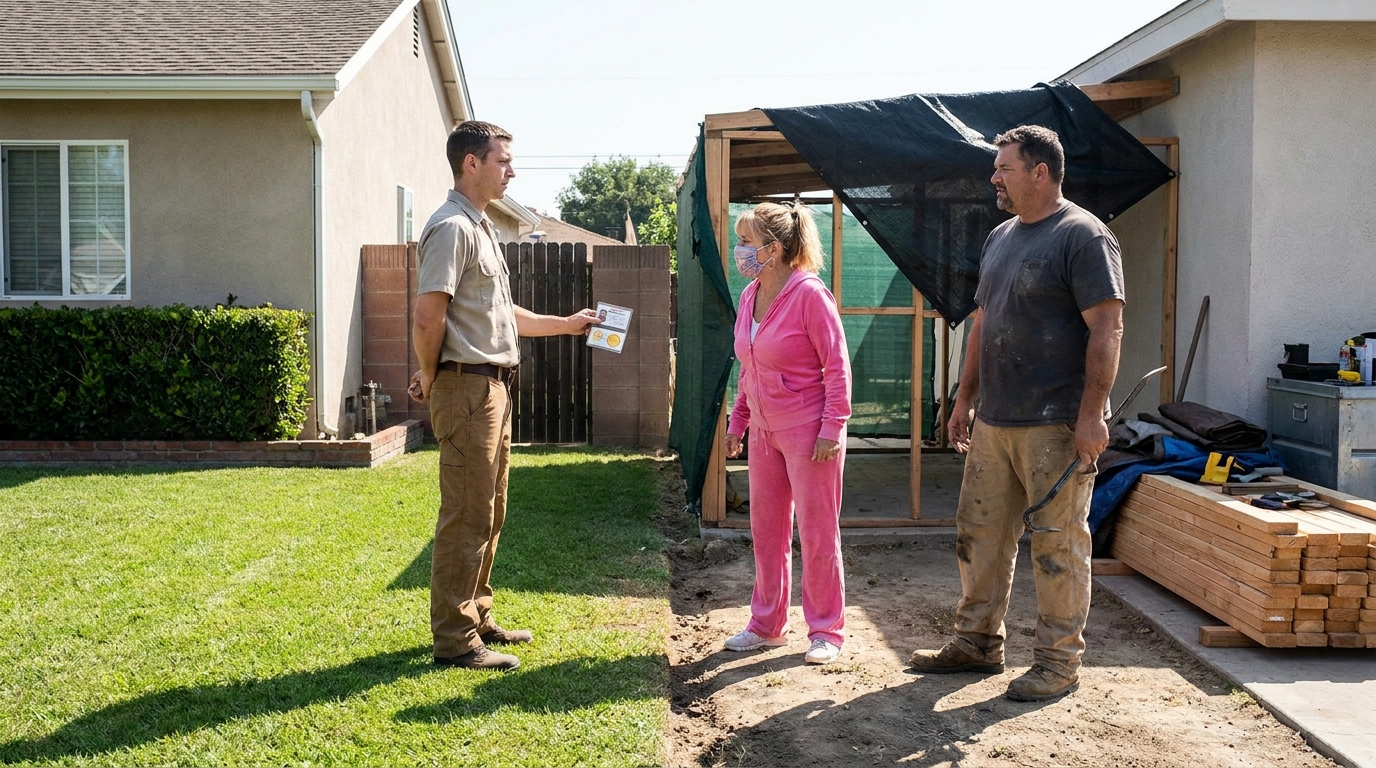
Karen Miller stood six feet past my property line. Her violently pink tracksuit strained across her chest, the synthetic fabric buzzing against the quiet morning heat. Beside her, a six-foot-two brute in grease-stained canvas pants held a twenty-four-inch crowbar. The steel claw was buried deep into the base of my thirty-foot green mesh shade barrier.
“Karen,” I said. My voice didn’t rise. “You are trespassing. Tell him to take the steel off my frame.”
“Section 7, paragraph 4 of the Oakmont Covenant,” she snapped. She waved a sheaf of stapled paper like a baton. “Temporary shade structures are strictly prohibited without prior design committee approval. I have the board authority right here.”
The brute didn’t wait for her to finish. He leaned his two-hundred-pound frame into the lever. The green mesh tore with a sound like ripping canvas.
Instantly, bright sunlight hit the shaded soil bed behind the frame.
I looked down. Three inches below the tear, the pale green leaves of six Skyleaf Verbena seedlings began to curl inward under the direct hundred-degree heat. The microclimate I had spent four weeks balancing—seventy percent humidity, dappled shade, wind barrier—was collapsing.
I pulled my phone from my belt. I didn’t scream. I didn’t move toward the man with the crowbar. I clicked the record button, keeping the lens level at eye height.
“State your full name for the record,” I said, holding the screen flat.
Karen blinked. The sneer on her mouth stalled for a fraction of a second. “What?”
“State your name. And state the name of the contractor you brought onto my deeded property.”
“I am Karen Miller, President of the Oakmont Estates Homeowners Association,” she said, puffing her chest until the pink fabric stretched tight. “And this is an authorized abatement action. You were warned, Evans.”
I panned the camera down. I got four clear seconds of her face, three seconds of the contractor’s unwashed boots, and a tight zoom on the splintered 2×4 frame where the metal claw had gouged the wood. Finally, I held the lens two inches from the curling, blackened tips of the Verbena seedlings.
“Video saved to cloud,” I said aloud. I tapped the screen once, sending the file straight to Dr. Thorne at the county conservation office and mirroring it to Sarah’s drive.
I put the phone back in my pocket and stepped forward. I stopped precisely eighteen inches from Karen’s shoulder. I didn’t touch her, but I occupied the space.
“You just committed three distinct violations, Karen,” I said softly. “Criminal trespass. Destruction of private property valued over five hundred dollars. And interference with an active county environmental restoration agreement under Ordinance 1138-B.”
Her jaw twitched. “Don’t quote fake laws at me. HOA bylaws supersede your little backyard hobby.”
“The HOA is a civil corporation registered in this state,” I said. My thumb pressed the compass notch harder. “The county is a government authority. You don’t supersede the county, Karen. You exist underneath it.”
I pulled a laminated card from my wallet and held it flat against her line of sight. The gold county seal caught the morning light.
“Every seedling exposed right now is cataloged under a state recovery protocol,” I said. “Every hour of labor is logged. The county council doesn’t send fine letters. They issue summonses.”
The contractor shifted his weight on his work boots. He looked from the laminated badge to the torn mesh, then down at his crowbar. “Lady,” he muttered, stepping back half a pace. “You said this was an abandoned shed frame.”
“Shut up, Donnie,” she hissed. But her eyes darted to my face, searching for a twitch, a raise in volume, anything that signaled a bluff.
She found nothing. Twelve years in the Army Corps taught me one fundamental truth: you don’t announce an artillery strike while the guns are still zeroing. You set the coordinates in silence.
“This isn’t over,” Karen spat. She turned on her heel, her sneakers dragging through my dry mulch as she marched toward the driveway. Donnie trailed two paces behind her, his crowbar hanging uselessly at his knee.
I didn’t watch them leave. I dropped to one knee, pulled a black shade tarp from my supply bin, and clamped it over the broken timber frame to cover the dying seedlings.
The wood was ruined. The plants were damaged. But as I tightened the plastic clamps, my hand remained completely steady. Karen thought she had just torn down an ugly fence. She had no idea she had just signed her name to the front of a federal evidence file.
CHAPTER 2: THE COUNTERNURSERY
The dirt beneath my knees held the midday heat like a slab of iron. Six catalog tags on the withered stems of the Skyleaf Verbena were already baking brittle under the black plastic tarp.
I didn’t reach for my phone to check if Dr. Thorne had replied to the video transmission. I knew the county’s bureaucratic response speed down to the minute: two hours to process the incident report, four hours to route it through legal, six before the first official query notice landed on a desk. That gave me an eight-hour operational window before Karen attempted a second sweep.
I stood up, my right knee popping once against the quiet hum of the suburban cul-de-sac.
Instead of repairing the splintered pine frame Donnie had crowbarred, I dragged the wreckage to the center of the yard. I took a handsaw from my work bench and cut the ruined 2x4s into precise twelve-inch segments, stacking them in a neat, square pile beside the fence line. Itemized destruction looks better in an evidence box when it’s stacked cleanly.
By three in the afternoon, a flatbed commercial supply truck idle-chugged up the driveway. The driver dropped a pallet of two-inch galvanized steel square tubing and four commercial-grade shade sails directly onto the concrete.
“You building a bunker?” the driver asked, spitting a seed into the dust.
“A climate control enclosure,” I said, handing him the signed receipt. “Permitted under county agricultural code.”
I worked straight through the afternoon glare without stopping for water until the first four steel posts were set thirty inches deep in concrete footings along the lot line. The steel didn’t flex when I braced it with my shoulder. It was heavy, industrial, and completely impervious to a hand-held crowbar.
As I tightened the final tension bolt on the high-density shade cloth, a shadow cut across the zinc-coated post.
It wasn’t Karen.
An elderly man in a faded canvas sun hat stood three feet back from the fresh concrete. He was leaning heavily on a carved oak cane, his pale eyes tracking the precision of my diagonal cross-braces.
“Two-inch tube steel,” he said, his voice dry as paper. “A bit heavy for petunias, isn’t it?”
“Skyleaf Verbena,” I replied, not breaking my rhythm as I torqued the nut with a fifteen-millimeter socket wrench. “County restoration project. I’m Mark Evans.”
“George Vance,” he said. He didn’t offer a hand, but his eyes locked onto the laminated county partner ID tucked into my shirt pocket. “I live three doors down. At number forty-two. I watched her little circus here this morning with that demolition thug.”
I set the wrench on the workbench. “You’re familiar with Donnie.”
“Donnie’s her brother-in-law,” George said flatly. “He runs a unregistered haulage firm out of his garage in Westford. She’s used him twice before. Last spring she paid him eighty dollars out of the community maintenance reserve to cut down Mrs. Higgins’ weeping willow because it dropped leaves across the sidewalk line.”
My thumb hit the notch on David’s compass inside my pocket. “Did she have a board vote for the willow?”
“Karen hasn’t held a quorum for a board vote since November 2015,” George said. A thin, predatory smile creased the skin around his mouth. “She relies on the fact that most people in Oakmont Estates work forty hours a week and value peace enough to write a fifty-dollar check to make a violation notice go away. She feeds on friction resistance.”
“I don’t pay friction fees,” I said.
“I know,” George replied. “That’s why I walked down here. I used to practice corporate litigation before my hips gave out. You’re setting a trap, Evans. But you’re building it out of steel when you should be building it out of paper.”
I pointed toward the newly strung mesh structure. Beneath the fresh canopy, the misting system I’d rigged to the spigot clicked on, spraying a fine, cool haze over the surviving plants.
“The county council is handling the environmental violation under Ordinance 1138-B,” I said. “Dr. Thorne is issuing a formal inquiry.”
George took two slow steps forward, his cane poking at a dry splinter from Donnie’s morning demolition. “Thorne is an academic. He moves at the speed of a glacier. If you want to strip that woman’s authority before she tries to lean your mortgage, you need her own ledger. The Oakmont Covenant gives every homeowner the absolute right to inspect the association’s physical books within ten days of a written demand.”
I looked at him carefully. “You have the wording?”
“I have the filing template saved on a flash drive,” George said. “And across the street, young Maria has every digital PDF Karen ever uploaded and tried to delete from the community portal. We’ve just been waiting for someone with enough iron in their spine to act as the named complainant.”
I picked up my clipboard, checking the digital hygrometer sensor inside the new steel frame. The humidity reading was rising—fifty-five percent, sixty, sixty-two. The surviving seedlings were straightening, their leaves drinking the suspended moisture.
“Bring the drive,” I said. “We start on the paper.”
CHAPTER 3: THE AUDIT TRAP
The flash drive settled on the grain of the oak table with a dull click.
I didn’t reach for it immediately. I sat with my forearms flat on the polished wood, watching a single water bead slide down the side of my mug. Across from me, George unbuttoned his wool cardigan and rested his oak cane against the chair leg.
“Ten business days,” George said, his thumb tapping his knee in a slow, metronomic beat. “Under state corporate statute 720, section thirty-one, that drive contains the formal statutory demand. Once served on the corporate secretary—which is Karen—she has exactly two hundred and forty hours to produce every physical ledger, invoice, and bank reconciliation statement for the last thirty-six months.”
“And if she ignores it?” I asked.
“Then we file an emergency petition for an order to compel in district court on day eleven,” George said softly. “Which carries mandatory attorney fee shifts. Her retainer attorney knows this. He’ll tell her to open the clubhouse doors.”
I picked up the flash drive. The plastic felt cold against my thumb. “Let’s print two physical hard copies. One for her door via certified mail, one served by hand.”
Three days later, the air inside the Oakmont Estates community clubhouse smelled like stagnant carpet cleaner and old cardboard.
The air conditioning unit in the window rattled every twelve seconds, vibrating the dust on six banker’s boxes stacked on a folding table. Behind the table sat Karen. Her eyes were rimmed with red, her pink tracksuit replaced by a dark blue nylon windbreaker that she kept zipped to her chin. To her left sat a man in a gray suit with a frayed silver tie—her legal counsel.
Stan Gable, our group’s retired accountant, pulled out a folding chair with a sharp metallic screech that echoed off the linoleum floor. He placed a high-speed document scanner on the table, plugged its power strip into the wall outlet, and set a green visor beside his legal pad.
“Two hours,” Karen’s lawyer said, checking a gold-plated watch. “My client is accommodating this inspection under protest. You will not remove any original documents from this room, and you will not mark them.”
“We don’t need to mark them,” Stan said flatly. He didn’t look up as he unbraced the scanner’s feeder tray. “We have digital optical character recognition.”
I stood two paces behind Stan’s shoulder, my hands resting behind my lower back in a parade-rest posture. My right knee throbbed with the drop in room pressure, but I kept my weight distributed evenly.
Maria sat to my left, her laptop open, its screen casting a blue glare over her fingers as she established a direct optical feed from Stan’s scanner.
The first box contained 2024 general vendor receipts. Stan’s hands moved with practiced, mechanical efficiency—slide invoice, feeds into scanner, drop into scanned bin, repeat. The whirring of the feed rollers filled the silence like a mechanical locust.
Twenty-two minutes in, Stan’s hand paused. He pulled a yellow carbon receipt from the feed tray and held it under the overhead fluorescent tube.
“Receipt number 4082,” Stan read aloud, his voice steady and dry. “Issued June 14th. Three hundred and forty-two dollars and sixteen cents to Big Lots General. Itemization: twelve cases of bottled water, four cases of paper towels, three boxes of heavy-duty garbage bags, and…” He squinted through his bifocals. “…two forty-pound bags of cat litter and three packages of hair dye.”
Karen’s hands tightened into fists inside her windbreaker pockets. “Office supplies for community cleanup events,” she snapped.
“You don’t wash the sidewalks with hair dye, Karen,” Maria murmured without looking up from her screen. “Tagging file as personal expenditure misappropriation.”
“That is a clerical error,” her lawyer interjected instantly, slapping a hand on the table. “A minor administrative mix-up. Move to the next folder.”
Stan didn’t argue. He dropped the carbon slip into the scanner tray, let the machine swallow it, and reached into the second box—the 2025 maintenance ledger.
Forty minutes remained on the lawyer’s watch when Stan pulled out a thick stapled invoice printed on cheap, NCR tractor-feed paper. The logo at the top was a crude vector drawing of a sledgehammer over a flatbed truck.
Donnie’s Demolition & General Hauling.
“Invoice 1104,” Stan read. “Dated May 17th of this year. Description: Emergency structural clearance and hazardous timber removal, Lot 72. Amount: Fifteen hundred dollars paid out of the emergency reserve fund. Authorized by K. Miller.”
My eyes moved from the paper to Karen’s face.
She didn’t look back at me. Her gaze was locked on the edge of the table, her bottom lip biting down on a dry flake of skin.
“Lot 72 is my property,” I said softly.
“The board authorized emergency abatement of a dangerous non-compliant structure,” Karen’s lawyer blurted, though his voice lacked the sharp edge it had twenty minutes ago. His thumb was nervously spinning his gold watch band.
“The board didn’t vote on May 17th,” Maria said, tapping her keyboard once. “I cross-referenced the official meeting minutes uploaded to the portal. The May 12th meeting adjourned without a quorum, and the June meeting minutes didn’t mention an emergency authorization. She signed the check herself to her brother-in-law.”
“That’s a civil corporate violation,” Stan noted, his pen making a clean, sharp mark on his legal pad. “It’s also self-dealing with corporate assets under state code 607.”
The lawyer turned his head three inches toward Karen. “Is Donnie your relative?” he whispered, his voice catching on the microphone of Maria’s recording rig.
Karen didn’t answer. A red flush rose from the collar of her windbreaker, creeping up her neck like a rash.
“We have what we need for the financial audit,” Stan said, switching off the scanner with a soft click. The sudden silence in the room was heavy, smelling of ozone and old dust.
I reached down, picked up the scanner, and packed it into its canvas case. I looked directly across the folding table at Karen. Her hands were shaking slightly inside her pockets—not from anger anymore, but from the realization that every piece of paper she had generated was turning into a physical bar in a cage she had built herself.
“You built your whole authority on the Oakmont Covenant, Karen,” I said, zipping the canvas bag shut. “You should have read the fine print.”
CHAPTER 4: THE DIGITAL LEAK
The grease pencil made a sharp squeak as I circled the entry for May 17th on the white enamel board.
Beside me, the cooling fan on Maria’s laptop spun up to a high-pitched whine. The screen lit her face in stark blue light as forty-two separate scanned PDF files hit eighty-nine percent on the batch upload bar.
“The site is live,” Maria whispered, her fingers hovering over the trackpad. “I registered the domain name under an anonymous trust. Oakmont Transparency Portal. Every resident with a registered email address in the community directory is getting an automated notification in three minutes.”
I didn’t turn around. I added one final bracket to the dry-erase board, linking the check paid to Donnie’s hauling firm directly to Karen’s personal signature on the HOA reserve bank account.
“Did you scrub the EXIF metadata on the video file?” I asked.
“Stripped down to the raw pixels,” she said. “No timestamps, no device IDs. Just thirty seconds of a crowbar tearing through a frame, a tight shot on Karen’s face, and thirty-seven cataloged stems of Skyleaf Verbena wilting under direct sun.”
The garage side-door creaked open six inches. George stepped inside, his oak cane tapping twice on the raw concrete floor. He pulled a thick manila folder from under his arm and laid it flat over my workbench, right next to a spare roll of shade cloth.
“Dr. Thorne just signed off on the county council’s formal assessment,” George said. His voice was low, carrying the gravelly texture of a retired litigator who knew the jury was about to enter the room. “The legal department finished calculating the statutory penalties under Ordinance 1138-B.”
I set the grease pencil in the tray. “What’s the figure?”
“Fifty thousand dollars,” George said.
Maria paused, her finger frozen half an inch above her keyboard. “Fifty thousand? The screen materials were only six hundred dollars.”
“It’s not a property damage claim,” George explained, tapping the county seal stamped on the top sheet. “Ordinance 1138-B is a environmental conservation protection mandate. The penalty structure calculates the total replacement cost of the nursery stock, the specialized labor for microclimate re-establishment, and a fixed statutory fine of one thousand dollars per damaged specimen. Thirty-seven plants died when the screen came down.”
“And the county is targeting the HOA?” I asked.
“No,” George said, a cold, sharp smile breaking across his face. “That’s the master stroke. Thorne’s legal team reviewed the audit records we pulled yesterday. Because Karen acted without a valid board quorum or documented vote, she exceeded her scope of corporate agency. The county attorney is piercing the corporate veil. They’re levying the full assessment against Karen Miller as an individual.”
My thumb pressed into the notch of David’s compass. I felt the sharp brass edge anchor my hand.
“She doesn’t have fifty thousand dollars in liquid cash,” I said.
“She has equity in her house,” George said flatly. “And if she doesn’t pay within thirty days of formal service, the county registers a priority lien against her deed. The same tool she’s been threatening to use on every neighbor with an unpainted mailbox for seven years.”
Ping.
Maria’s phone buzzed on the workbench, followed immediately by a second chime, then a third. A rapid cascade of notification alerts began stuttering from her laptop screen.
“Emails are hitting the neighborhood inboxes,” Maria said, scrolling through the live web analytics dashboard. “Forty visits in forty seconds. Sixty. Someone just shared the direct link to the cat litter receipts in the block group chat.”
I walked over to the open garage door and looked down the quiet asphalt of the cul-de-sac.
Three houses down, a porch light clicked on. Across the street, a living room curtain pulled back two inches, the glow of a tablet screen reflecting in the window glass.
Karen’s house at the end of the street remained dark, save for the blue flicker of a television in her second-story window. But even from fifty yards away, I could hear the faint, high-pitched ring of a landline phone starting to dial over and over again through the open window of her porch.
The quiet retreat was over. The paper network was locked, the numbers were set, and tomorrow night at seven o’clock, the entire neighborhood was meeting in the clubhouse.
“Pack the projector, Maria,” I said softly, stepping back into the shadow of the garage. “We have a presentation to give.”
CHAPTER 5: THE AMBUSH AT THE CLUBHOUSE
The clock above the double emergency doors clicked over to 7:00 PM.
Eighty people filled the rows of metal folding chairs. The room smelled of wet raincoats, stale coffee, and collective fury. People were holding printed pages from Maria’s website, the white paper glowing under the fluorescent fixtures.
Karen slammed the cracked wooden gavel once against the folding table. Crack.
“Order,” she barked. Her voice lacked its usual smooth resonance; it sounded dry, like paper scraping concrete. “This is the annual general meeting of the Oakmont Estates Homeowners Association. We will follow the published agenda strictly. No interruptions.”
She reached for her microphone, but her hand twitched, knocking a paperclip onto the floor. She didn’t bend to pick it up.
“First item,” Karen said, her chin jutting out. “The board treasurer report—”
“Point of order,” George called out from the third row. He stood up slowly, using both hands on his oak cane to anchor his hips. “Under Section 4 of the Oakmont Covenant, any homeowner may motion to amend the meeting agenda prior to the approval of financial statements.”
“Denied,” Karen snapped. “Sit down, Mr. Vance.”
“Second the motion,” Stan Gable shouted from the back wall.
“Seconded!” four more voices called out from different sides of the room.
Karen’s head snapped left, then right. Her two handpicked board members sat beside her, staring straight ahead at their nameplates, refusing to meet her eyes or touch their microphones.
“The membership has the floor, Karen,” I said, stepping out from the back aisle. I didn’t raise my voice, but the entire room went dead quiet as I pressed the side button on the wireless advancer.
The projector mounted on the ceiling hummed. A high-definition image flashed across the white pull-down screen behind Karen’s head.
It was the scanned copy of check number 4102. Fifteen hundred dollars, drawn on the Oakmont emergency reserve account, payable to Donnie’s Demolition. Signed by Karen Miller. Below it, Maria had highlighted the state corporate registry filing showing Donnie’s residential address matching Karen’s brother-in-law.
A low murmur rippled through the rows, turning into a sudden wave of sharp, audible gasps.
“That document is proprietary!” Karen screeched, standing up so fast her metal chair scraped six inches back into the drywall. “This meeting is adjourned! I am exercising presidential authority to dissolve—”
“You don’t have authority to dissolve a statutory assembly, Miss Miller,” a voice boomed from the back doors.
The double doors swung open, heavy rubber gaskets slapping against the steel frame.
Two men in uniform stepped inside. On the left stood a county sheriff’s deputy, his belt creaking with every deliberate step. On the right was Officer Miller from the county conservation department, wearing a crisp khaki uniform with a green state patch on his shoulder. He carried a yellow legal-sized envelope sealed with red tape.
The room parted like a split seam. Eighty residents turned in their seats as Officer Miller walked down the center aisle, his boots striking the linoleum with rhythmic, heavy thuds.
He stopped three feet from Karen’s table. He didn’t look at the crowd, the projector screen, or the gavel.
“Karen Miller?” Officer Miller asked, his tone level, devoid of drama.
Karen stayed frozen, her mouth open, her face draining of color until her skin matched her white cotton collar. “This is a private corporate meeting,” she whispered.
“I am serving you with a formal administrative notice of violation and penalty assessment from the county attorney’s office,” Officer Miller said. He slid the heavy yellow envelope across the table, knocking her cracked gavel aside.
“What is this?” she rasped.
“Pursuant to Ordinance 1138-B,” Officer Miller declared, his voice carrying into every corner of the silent room, “you have been individually cited for the deliberate destruction of protected nursery stock belonging to the Skyleaf Verbena recovery protocol on May 17th.”
Karen’s lawyer, sitting three seats down, buried his face in his hands.
“The county has completed its audit of the damaged site,” Officer Miller continued. “Because your actions were executed without corporate board authorization, the county has pierced the corporate shield. The statutory fine of fifty thousand dollars is assessed directly to you, individually.”
“Fifty…” Karen choked, her knees buckling. She collapsed back into her chair, her eyes staring blankly at the yellow envelope lying beside her nameplate. “Fifty thousand?”
“You have thirty days to remit payment or file an appeal with the district magistrate,” Officer Miller said. He turned on his heel and walked out, the deputy trailing two paces behind him.
I stood in the center aisle, watching the total silence hold for three full seconds before George raised his cane.
“I move for an immediate vote of no confidence,” George announced, his voice ringing crisp and clear through the room. “And the immediate removal of Karen Miller from the board.”
“Second!” fifty people shouted in unison.
Karen sat motionless under the glare of the projector screen, the yellow envelope resting on her lap, as eighty hands went up around her.
CHAPTER 6: THE QUIET GROUND
The vote didn’t take ten seconds.
When eighty hands remained lifted in the harsh light of the clubhouse, Karen didn’t reach for her gavel again. Her fingers twitched once against the yellow county envelope on her lap, sliding off the slick paper as if it burned her skin. She pulled her knees together, stood up without making eye contact with her attorney, and walked down the side aisle toward the back exit.
Her heels made a hollow, uneven clicking on the linoleum. No one moved to block her path. No one spoke. The room just held its breath until the heavy crash bar on the exit door clicked shut behind her.
By the time the sun hit the western fence line three months later, the quiet had returned to the cul-de-sac—not the tense, suffocating quiet of an occupation, but the still air of a workspace after the heavy machinery has rolled away.
I stood inside the steel frame of the greenhouse, my thumbs resting on the rough lip of a cedar propagation tray. The galvanized steel posts were cool under my palms, solid and anchored thirty inches deep into the earth. Outside the fine mesh window, a yellow moving truck backed down the asphalt drive of number seventy-eight, its reverse beeper sounding a steady, mechanical rhythm.
A cardboard box slid onto the truck’s hydraulic ramp, followed by a rolled-up synthetic rug. Karen was moving out.
The legal traps we had set with George and Stan had sprung with relentless, mechanical precision. When the county registered its tax lien under Ordinance 1138-B, her mortgage lender declared a technical covenant default. Combined with the civil suit filed by the newly elected HOA board under Susan to recover the twenty-two thousand dollars in misappropriated reserve funds, Karen had no leverage left. She settled every claim out of court, liquidating her equity to satisfy the county’s environmental assessment before the sheriff’s office could order a public auction on the courthouse steps.
George walked into the greenhouse, his oak cane crunching softly on the pea-gravel floor. He stopped beside the misting manifold, his eyes following the diesel moving truck as it pulled away from the curb.
“She tried filing for bankruptcy protection in federal court on Tuesday,” George said, his voice dry and calm. “The magistrate dismissed the discharge motion for the county debt under the intentional tort exception. Ordinance 1138-B stays on her personal ledger until every cent of the statutory fine is satisfied.”
I leaned over the tray, checking the soil moisture meter stuck into the center pot. The needle rested squarely in the green zone—eighty percent relative humidity.
“And the board?” I asked.
“Susan signed the revised Oakmont Covenant amendments yesterday,” George replied, a faint smile creasing the corner of his mouth. “Section 7, paragraph 4 is officially stricken. No shade restrictions, no play-set bans, no mailbox color registries. The community budget is audited quarterly by Stan, and Donnie’s hauling firm has been blacklisted across the entire township.”
I reached into my pocket and pulled out David’s military compass. The brass casing was dull, scratched from years of riding inside uniform pockets and tool belts, but the bevel turned smoothly under my thumb. I set it down on the cedar workbench next to a small brass screwdriver.
Using the edge of the blade, I tightened the loose hinge pin on the compass casing, turning the tiny steel screw until the top lid snapped shut with a clean, solid click. The play in the metal was gone.
“Dr. Thorne is coming up the driveway,” George noted, nodding toward the lane.
A white county parks pickup truck pulled up behind my fence. Dr. Thorne stepped out, holding a large acrylic transport cage covered with a dark mesh cloth. He unlatched the greenhouse door and stepped inside, the humid, scented air catching in his throat.
“Temperature is holding at seventy-one,” Dr. Thorne said, checking the wall gauge before setting the cage on the cedar table. “The county board approved the final release permit this morning, Mark. This is the first official brood.”
He lifted the dark cloth.
Inside the acrylic cage, three dozen silver-spotted azure butterflies rested on fresh cuttings of Skyleaf Verbena. Their wings were folded tight, showing the brilliant, iridescent silver scales along the undersides.
I reached down and unlatched the front screen door of the transport box.
For three seconds, nothing moved. Then, as a stray beam of afternoon sunlight cut through the overhead shade sail, the first butterfly uncoiled its slender legs, shifted its weight on the blue blossom, and took flight.
It lifted four inches into the mist, its wings flashing deep cobalt as it circled the galvanized steel ridge beam before drifting out through the open ventilation hatch toward the undeveloped county woods beyond my lot line. A second followed it, then four more, rising in a silent, fluttering cloud against the clear sky.
George stood beside me, leaning both hands on his cane, watching the blue wings disperse over the rooftops of Oakmont Estates.
“You built it, Evans,” George said quietly.
I picked up David’s compass from the workbench, slipped it back into my pocket, and closed the wooden latch on the greenhouse door.
“Yeah,” I said, looking out at the open woods. “We built it.”