Retired Military Engineer Uses Meticulous Rules to Dismantle Corrupt HOA President and Save Deployed Soldier’s Family
CHAPTER 1: THE ULTIMATUM AT CHESTNUT DRIVE
The phone receiver felt heavy in my palm. Sarah’s voice was shaking so hard she could barely articulate the words.
Thirty days to vacate. Over a green plastic turtle sandbox.
A cold, familiar burn settled deep in my gut. For twenty-five years as a US Army Corps of Engineers officer, I dealt with hostile logistics and impossible regulations. But this wasn’t a military theater. This was a suburban driveway.
I set the schematics for the commercial HVAC refit aside on my desk. The blue lines faded into the background as I pulled up the Oakmont Creek HOA covenants.
Karen Peterson thought she could terrorize a military wife whose husband was halfway across the world. She didn’t realize she had just declared war on a man who built his entire life on blueprints, chains of command, and cold, hard rules.
I dialed George, the retired postal worker next door, to get the lay of the land. His whispered warning confirmed my suspicions: Karen targeted the vulnerable because it was easy.
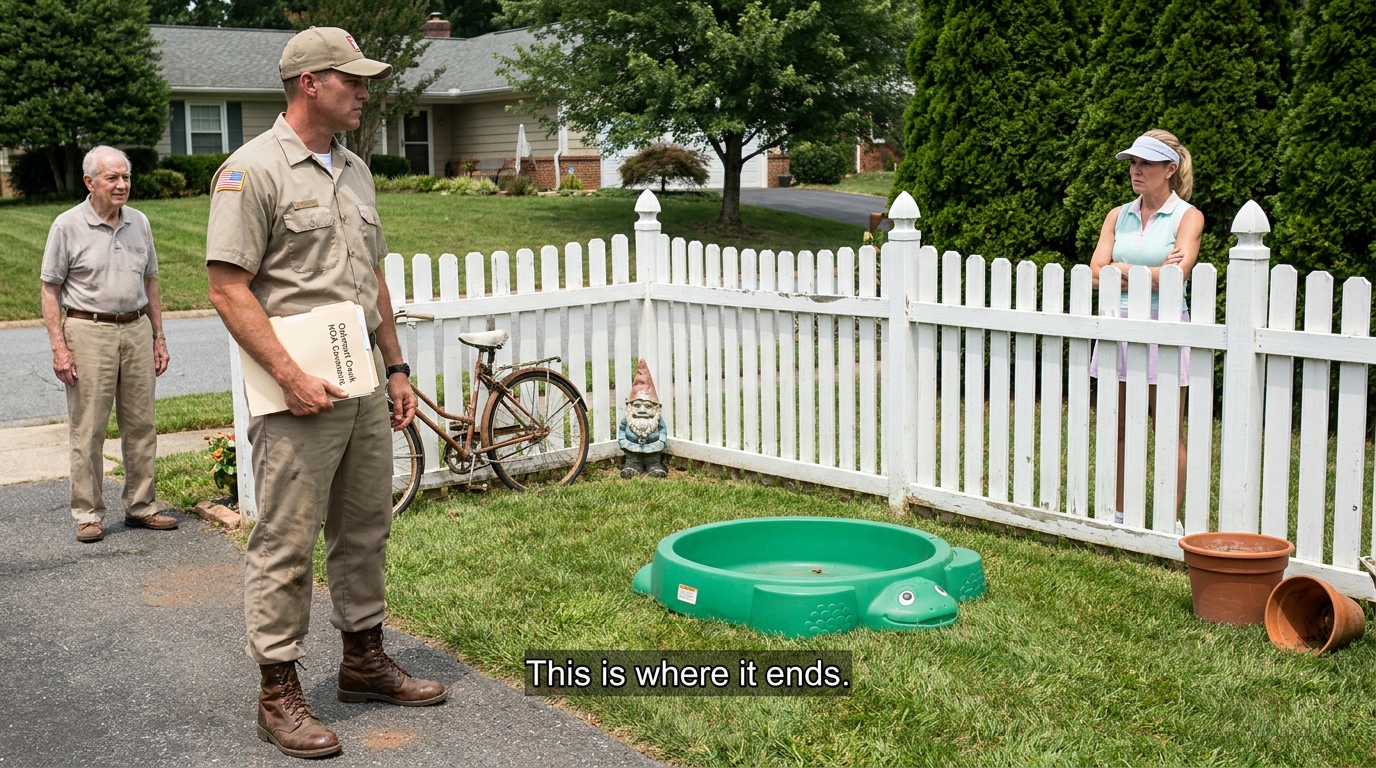
I drove over to Chestnut Drive immediately. The plastic turtle sat innocently in the corner of the yard, barely visible through the fence slats.
I took twelve photographs from every angle and walked up to Sarah’s door. The fear in her eyes was palpable, but I gave her a calm, solemn vow.
“You’re not going anywhere,” I told her. “Let me handle the paperwork.”
CHAPTER 2: DISSECTING THE CODE ON THE DINING ROOM TABLE
The kitchen table was buried under a chaotic patchwork of highlighted text. Red for Karen’s overreaches, blue for homeowner rights, and yellow for ambiguities.
For two days, I treated the Oakmont Creek bylaws like a flawed structural engineering blueprint. Every paragraph was a load-bearing wall holding up an illusion of absolute power.
My phone buzzed against the polished wood, displaying a fresh text from George next door.
She’s checking the perimeter again, Major. Just drove past Chestnut Drive twice.
I didn’t answer. Let her waste fuel burning circles around the block while I tracked down the operational flaws in her authority.
Article 4, Section 2 mentioned harmonious aesthetics, but it said nothing about portable plastic play structures. It required architectural review committee approval for permanent sheds, not twenty-pound toys.
She had weaponized a vague clause to justify harassment. That meant her entire enforcement framework was built on sand.
I picked up the red pen and drew a clean line straight through her claimed eviction powers. The bylaws explicitly stated the HOA could fine owners, but they had zero legal standing to interact with tenants or threaten evictions.
Her threats weren’t just administrative overreach. They were fraudulent intimidation tactics designed to terrify civilians who didn’t know their rights.
I printed out the relevant sections and placed them directly into a fresh folder labeled with her name.
The defense strategy was solid, but a good commander never wins a war purely by holding a defensive line. It was time to find out who else she had targeted in this neighborhood.
CHAPTER 3: BUILDING THE GRASSROOTS ALLIANCE
George traced his thumb over the handwritten list of names inside the notebook.
“This is just the tip of the iceberg, Major,” he muttered, keeping his voice low as a waitress walked past with a tray of clinking glassware.
“The Garcías spent three grand fighting her over a tomato patch before they packed up and sold at a loss.”
I tapped a finger against the laminate tabletop, calculating the structural weight of the pattern.
Karen wasn’t just running a neighborhood committee; she was operating a localized protection racket built on exhaustion and fear.
“We don’t need to shout from the rooftops,” I replied, sliding a fresh stack of legal printouts toward him. “We just need a room, a microphone, and the bylaws she thinks she’s above.”
By the following week, our clandestine list had grown to seven local families ready to testify.
We gathered in a drab community room a few towns over, far enough from Oakmont Creek to avoid neighborhood gossip.
Mrs. Albright sat near the back, her fingers nervously twisting the edge of a receipt book documenting years of unjust bicycle fines.
“She threatened to put a lien on my house over a toy left on the porch,” Mrs. Albright said, her voice shaking with years of suppressed fatigue.
“I was working two jobs. I just paid it to make her stop calling.”
“She won’t be calling anyone else after next month,” I told the room, laying out the multi-phase mobilization plan across the center table.
We weren’t just going to defend against her bullying tactics. We were going to bury her in formal grievances, demand complete financial transparency, and run George against her for the presidency.
The air in the room shifted from quiet despair to cold, focused resolve.
CHAPTER 4: THE FALL OF THE GAVEL AT THE ANNUAL MEETING
Karen stood at the front of the drab linoleum-floored clubhouse, basking in the glow of her own manufactured authority.
“Let’s move on to new business,” she announced, her voice flat and dismissive through the crackling portable microphone.
I stood up slowly from the back row, my heavy binder resting against my thigh.
“I have some new business,” my voice carried cleanly across the crowded room, forcing her head to snap up in sharp irritation.
Karen squinted, her face flushing a deep, angry red as she recognized me. “State your name and address for the record.”
“Mark Thorne, 124 Chestnut Drive.”
A low murmur rippled through the neighbors packed shoulder-to-shoulder in the folding chairs.
“I’d like to discuss the board’s pattern of unsubstantiated fines, homeowner harassment, and illegal violations of its own bylaws regarding mediation,” I said, stepping into the aisle.
“This is not the forum for personal grievances,” she snapped, striking the wooden block again. “Submit it in writing and sit down.”
“I have,” I replied, walking forward and placing a copy of the dossier directly onto the front table. “As have six other homeowners here tonight whose grievances you unlawfully dismissed.”
My allies began distributing the remaining copies through the rows, the rustle of pages filling the sudden, heavy silence.
As neighbors flipped through the sworn statements and financial flags, the collective mood in the room shifted from restless curiosity to cold, hard fury.
“What about the twenty thousand dollars for the lake fountain?” a man shouted from the front row. “The fountain’s been broken for three years!”
Karen stammered, her grip on the microphone slipping as the crowd erupted into open rebellion.
George stood up beside me, his voice cutting through the rising chaos. “I move for a vote of no confidence in the current board.”
“I second that motion,” another homeowner called out instantly.
Karen watched in stunned silence as the vote swept through the room by an overwhelming majority, stripping her of her title in less than ten minutes.
CHAPTER 5: THE FINAL LEVERAGE IN THE BACK OFFICE
David Chen, the regional manager, stared down at the open dossier, his face tightening with every turned page.
“She used her community position to launch a retaliatory strike against a military family’s housing,” David muttered, sliding the anonymous complaint across the metal surface.
“She targeted my tenants because she couldn’t touch me through the HOA,” I replied, keeping my voice level and cold.
“And she did it on company time, using store resources to manage her personal vendetta.”
The door swung open, and Karen stood in the frame, her arms crossed tightly over a cheap polyester blouse, her face a blotchy mask of defiance.
“This is a private matter,” she snapped, her voice trembling with impotent rage. “It has nothing to do with my job here.”
“You made it your employer’s problem when you exposed this franchise to legal liability,” I said, rising slowly from my chair.
“You spent months trying to foreclose on my property while walking onto my commercial plaza every single day to earn your paycheck.”
Karen’s jaw went slack, the color draining entirely from her cheeks as the final, terrible irony locked into place.
She had spent her entire afternoon trying to destroy a landlord, completely unaware she was just a tenant in his building.
David didn’t hesitate. “Karen, clean out your desk. Your employment is terminated effective immediately.”
She didn’t argue. She turned on her heel, her bravado completely shattered, leaving behind only the cold reality of a cardboard box and a closed door.
CHAPTER 6: THE DUST SETTLES ON OAKMONT CREEK
The neighborhood looked different through the windshield, brighter and uncluttered by the invisible weight of petty tyranny.
George was already holding morning meetings on his front lawn, coordinating the independent financial audit that finally exposed where every missing dollar had gone.
The audit didn’t just find sloppy bookkeeping; it uncovered years of systematic embezzlement disguised as administrative fees and phantom landscaping invoices.
A warrant followed shortly after, tracking Karen across state lines where she had fled to live with her sister, bringing her reign of fraudulent authority to a very public, metallic halt in handcuffs.
My tenant, Sergeant Miller, returned home from his deployment a few weeks later, greeting me with a firm handshake and quiet gratitude that needed no embellished words.
The green plastic turtle sandbox still sat untouched in the corner of the rental yard, serving as a silent monument to an overreach that collapsed entirely under its own ridiculous weight.
I sat on the patio of the newly opened family restaurant across town, letting the evening breeze drift across the parking lot.
Some conflicts require a courtroom, some require a community vote, and others just need a common-sense approach to dismantle a paper tiger.
The books were balanced, the property was secure, and the neighborhood had finally reclaimed its peace.