Federal Auditor Dismantles Corrupt HOA After Illegal Property Seizure Of Deceased Father’s Mountain Cabin
CHAPTER 1: THE PADLOCK NOTICE
The rain ran down my face, but I barely felt it. My boots stayed glued to the wet gravel of my father’s driveway.
That padlock mocked everything he had built with his own two hands. I shifted the heavy brass plumb bob inside my coat pocket, letting the cold metal ground my rising pulse.
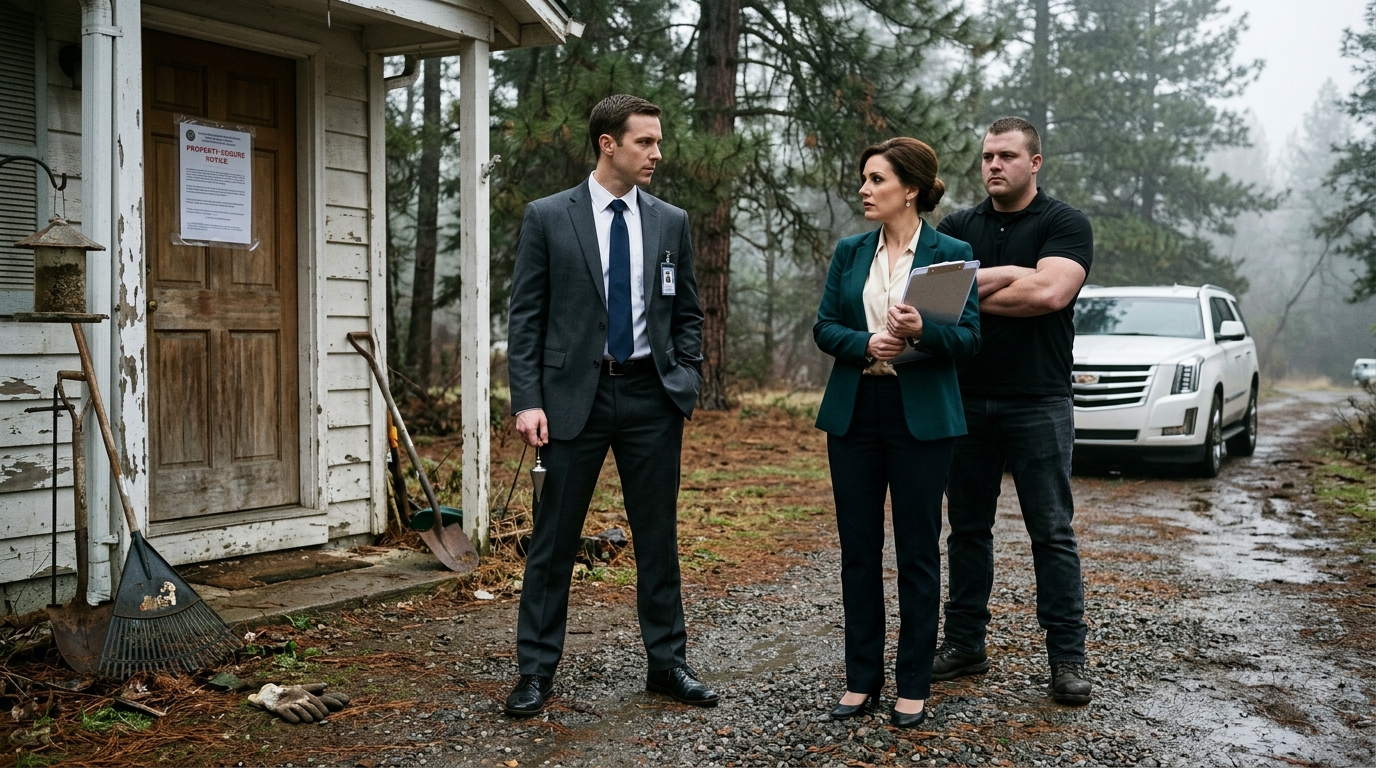
The laminated notice stapled to the chestnut wood glared back at me with bold, arrogant typography. Property seizure. Maintenance arrears. A total fabrication designed to bully an old man who had spent his final months in hospice.
I reached out and touched the edge of the laminated plastic. It was cheap, hastily printed, and reeked of small-town intimidation.
My father had surveyed this very ridgeline back in 1987 before a single one of these cookie-cutter houses existed. He knew every property line, every easement, and every trick a corrupt developer could pull.
The silence of the mountain morning broke with the crunch of heavy tires rolling up behind me. A white Cadillac Escalade nosed directly against my bumper, blocking me in with calculated insolence.
A sharp burst of heavy floral perfume cut through the damp pine air before the driver’s door even finished swinging open. Denise Keller stepped out onto the wet asphalt, clipboard clutched like a shield.
Behind her stood a thick-necked man in a black polo, his arms crossed over his chest like a bouncer guarding a cheap nightclub.
“Honey,” Denise said, tapping her clipboard with a manicured fingernail without sparing me a real glance. “This property has been reclaimed by the community.”
CHAPTER 2: THE ESCALADE CONFRONTATION
“You’re standing on community property,” Denise repeated, tapping the corner of her clipboard against her tailored blazer sleeve. “And your father’s estate owes four thousand eight hundred dollars in cumulative maintenance fees.”
The bouncer in the black polo shifted his weight from one boot to the other, his thick arms locked across his chest.
I didn’t step back. I let the cold brass weight of the tool inside my pocket anchor my feet against the wet gravel.
“There are no fees,” I said, my voice flat and carrying the dry, level tone of a federal compliance officer who had spent a decade tearing through corporate balance sheets. “My father paid his county assessments in full before he entered hospice.”
Denise offered a tight, patronizing smile that didn’t reach her eyes. “The HOA has its own ledger, Mr. Hollis. County records don’t govern private communities.”
She turned her back on me with practiced arrogance, signaling to her muscle-bound companion that the conversation was over.
The Escalade’s reverse lights flickered on, cutting through the misty rain with blinding white glare.
I didn’t move an inch. I stood directly behind my own sedan, blocking her maneuver while I watched the unrecorded tax stamps on her clipboard’s pocket folder catch the dull gray light.
Something didn’t add up. Private HOA fees didn’t double four times over a six-week bereavement window without a formal board quorum.
Denise rolled down her tinted passenger window, her face tightening with genuine annoyance. “Move your car, Hollis, or I’ll have it towed off the ridge by noon.”
“Try it,” I said, stepping closer to her driver-side glass. “Every tow order requires a certified municipal filing, and I happen to know the county recorder hasn’t logged a single lien against this parcel.”
Her expression flickered—just a microsecond of genuine panic before she masked it behind a cold glare.
She hit the gas pedal, spinning her rear tires in the wet gravel before wrenching the wheel and roaring down the mountain pass.
I watched the red tail-lights vanish around the sharp pine curve, leaving behind only the heavy smell of exhaust and wet dirt.
I pulled out my phone and dialed the direct internal extension for the state tax compliance database.
If Denise Keller wanted to play bureaucrat, I was about to show her what a real federal auditor looked like when he started digging through her books.
CHAPTER 3: THE FEDERAL AUDIT
The digital voice droned through the speaker, confirming that Ridgewood Pines community association was registered under a secondary shell corporation rather than standard municipal zoning codes.
I rolled the heavy brass plumb bob between my fingers, feeling the familiar, grounding weight of my father’s tools.
If Denise Keller wanted to play fast and loose with private property statutes, she had picked the wrong federal auditor to cross.
I pulled up the digital ledger files on my tablet, cross-referencing the assessment fees she had cited with state tax exemptions.
The numbers didn’t just disagree—they were entirely fictional constructs designed to manufactured sudden insolvency for aging homeowners.
A sudden crunch of tires on wet gravel echoed from the end of the drive, but it wasn’t the white Escalade this time.
A battered blue pickup truck idled near the tree line, its engine knocking softly in the damp mountain air.
An elderly man with a weathered canvas cap stepped out from the driver’s side, his shoulders hunched against the steady downpour.
It was Dennis, the retired county bridge inspector who lived three lots down and had known my father for four decades.
“You shouldn’t be poking around those books, Jamie,” Dennis called out, pulling his jacket tighter around his neck. “Denise has the county commissioners in her back pocket.”
“She has an inflated ledger,” I replied, stepping off the porch to meet him halfway across the gravel. “And I have direct access to federal housing compliance databases.”
Dennis wiped rain from his forehead, casting a nervous glance toward the empty road behind us.
“She took Marcus Webb’s basketball hoop last week over a manufactured fine,” Dennis said, his voice dropping to a harsh whisper. “And she’s already eyeing the corner lots for her brother-in-law’s landscaping crew.”
I felt my jaw tighten, the cold reality of the syndicate’s operational pattern clicking fully into place.
This wasn’t about maintenance fees or property values; it was an organized campaign of predatory extraction.
“She hasn’t filed a single legal lien with the county recorder,” I said, holding up my tablet screen for him to see. “Every single seizure notice she’s posted is legally void.”
Dennis stared at the unrecorded filing codes on the screen, his eyes widening in a mixture of shock and sudden, dangerous hope.
“If you can freeze their operational accounts through the federal registry,” Dennis muttered, leaning closer against the wind, “the whole house of cards collapses by Friday.”
CHAPTER 4: THE NEIGHBORS LEDGER
“She’s done it to half the ridge,” Dennis muttered, staring down at the itemized financial extraction logs displayed on my screen.
A sharp spike of old memory hit me—watching my father map these exact boundary lines in the freezing autumn of 1987, hammering wooden stakes deep into the earth to protect every family’s rightful acreage.
Now, a paper-pushing syndicate was using bogus code-enforcement fees to rip those very families off their land.
“They’re using manufactured maintenance debts as a weapon,” I said, sliding the tablet back into my jacket pocket. “If we pull records from the other thirty lots, the pattern becomes undeniable.”
Dennis shook his head slowly, his hands gripping the worn steering wheel of his truck as a bead of sweat rolled down his temple.
“People won’t talk to strangers, Jamie,” Dennis warned, shifting his truck into park with a heavy metallic clank. “They’re terrified of losing their homes just like your father’s cabin.”
“They won’t be talking to a stranger,” I replied, stepping closer to his window. “They’ll be talking to Earl Hollis’s son.”
Dennis let out a long, ragged sigh, his eyes scanning the empty neighborhood road before giving a curt, reluctant nod.
“Meet me behind Ruth Odum’s place in twenty minutes,” Dennis said, his voice dropping low. “She’s been paying three hundred dollars a month for phantom paving assessments she never voted on.”
The truck lurched forward, its tires spitting wet gravel as it sped down the winding mountain lane.
I stood alone in the mist, the heavy brass plumb bob pressing firmly against my ribs.
Denise Keller thought she owned this mountain because she controlled the paperwork.
She had no idea what happened when a federal auditor started connecting the dots family by family.
CHAPTER 5: THE RECORDED WHISPER
Ruth opened her side door only a crack, the chain lock holding fast while her anxious eyes scanned the shadows of the yard.
She looked smaller than she had last summer, her fingers nervously twisting the edge of a faded floral apron.
“Dennis said you were coming, Jamie,” she whispered, her voice trembling slightly against the sound of dripping eaves. “Please keep your voice down. Denise has eyes everywhere on this ridge.”
I pulled my hands free from my pockets and rested one palm flat against the weathered wood of her door frame, maintaining a calm, steady posture.
“I’m not here to cause trouble, Ruth,” I said, keeping my tone level and pragmatic. “I’m here to stop what’s happening to these properties.”
Ruth swallowed hard, her gaze darting toward the dark kitchen behind her before she reached into her apron pocket.
“They forced me to pay three hundred dollars every month for paving assessments,” she murmured, slipping a small, older-model digital recorder across the gap. “I found this in the community center box after the annual meeting. Someone left it running.”
I caught the device, its plastic casing still cold from the damp air.
“Press play,” Ruth whispered, her knuckles whitening against the door chain. “You need to hear how they talk about us when the doors are closed.”
I hit the playback button with my thumb.
The audio crackled with static before Denise Keller’s sharp, unmistakable voice cut through the background hum.
“Just triple the invoice line items for the older parcels,” the recording hissed. “If they can’t pay the assessment within thirty days, we trigger the seizure clause and flip the lot to my brother-in-law’s crew.”
The room fell dead silent except for the steady rhythm of rain hitting the tin roof.
I pocketed the recorder, the hard evidence of the syndicate’s operational core now resting securely against my ribs.
“Thank you, Ruth,” I said quietly. “Your part in this is done, and I’ll make sure those charges are wiped clean.”
Ruth let out a shaky breath and slowly unlatched the chain, stepping back into the warm light of her kitchen.
“Just finish it, Jamie,” she said, closing the door softly.
CHAPTER 6: THE AUDIT TRAP
I slid behind the steering wheel and immediately plugged the micro-recorder directly into my laptop’s primary data port.
A sharp error chime echoed through the cab as the association’s online banking portal attempted to sync with unverified municipal routing numbers.
“Let’s see how long your shell corporation lasts without liquid assets,” I muttered, fingers flying across the keyboard to initiate an official federal compliance freeze.
The system required a direct administrative override code—credentials that belonged exclusively to the primary registered agent on file.
I pulled up my father’s old surveyor ledgers from 1987, scanning the original incorporation filings for Ridgewood Pines.
There it was: Denise Keller’s husband listed as a secondary signatory, operating under a lapsed municipal license that had expired two decades prior.
I keyed in the compliance restriction code, locking every single operating account associated with the community syndicate in real-time.
A red warning banner flashed across my screen, indicating that all outgoing transactions, assessment collections, and property transfers were instantly suspended.
The phone on my dashboard buzzed violently against the plastic mount, displaying an unknown local caller ID ringing insistently.
I let it ring three times before swiping the screen to accept the connection, keeping my voice entirely flat and devoid of emotion.
“You’ve locked our community operating accounts,” Denise’s voice shrieked through the speaker, her polished composure completely shattering into raw panic. “You have thirty seconds to undo this federal hold before I have the county sheriff drag you off that ridge in handcuffs!”
“Try it,” I said, leaning back against the driver’s seat as I rolled the heavy brass plumb bob between my fingers. “Every transaction on that ledger is now under federal review, and your husband’s signature is on the fraudulent filings.”
The line clicked dead with an angry squeal of static.
I closed my laptop lid with a sharp thud, knowing the real storm was only seconds away.
CHAPTER 7: THE DESPERATE COUNTER
The passenger window rattled under a sudden, violent assault of heavy pounding.
Denise Keller stood outside in the pouring rain, her tailored blazer soaked through, her face twisted in a mask of unfiltered rage.
“Open this door right now, Hollis!” she screamed, her voice cracking over the sound of the storm as she hammered her manicured fists against the glass.
I didn’t blink. I reached into my coat pocket and gripped the heavy brass plumb bob, letting its unyielding weight ground my posture.
She threw open her own Escalade door parked inches from my bumper, sprinting around to block my path as I pushed my car door open.
“You don’t know who you’re dealing with!” Denise shrieked, pointing a trembling finger at my chest while her mascara ran down her cheeks in dark streaks. “My brother-in-law is pulling every municipal permit on this ridge by morning, and your father’s cabin will be bulldozed into gravel!”
She wasn’t surrendering. Cornered rats always bite twice as hard.
“Try it,” I said, stepping out into the cold downpour and towering over her with absolute, immovable calm. “Every single permit requires a valid operating account, and right now, your syndicate’s books are completely frozen by federal audit.”
Her breath hitched, her chest heaving as the raw realization of total financial ruin finally hit her arrogance.
“You can’t do this,” she whispered, her voice dropping into a desperate, frantic plea. “We built this community. We made the rules.”
“You broke the law,” I replied, my voice hard as iron.
She lunged forward, attempting to snatch my tablet case off the passenger seat, but I slammed the door shut in her face with a definitive, ringing crash.
CHAPTER 8: THE FINAL BOUNDARY
The federal compliance notification on my tablet flashed green, confirming that every single fraudulent account tied to the community association had been permanently seized and sequestered for formal state prosecution.
Denise stared at the screen over the hood of her Escalade, her breathing ragged and shallow as she realized every forged lien, inflated assessment, and illegal lockout order had evaporated under actual scrutiny.
“You can’t do this,” she stammered, her voice cracking into a hollow rasp. “My husband’s commission—the zoning board—they’ll invalidate every audit you filed.”
“They don’t have jurisdiction over federal housing fraud,” I replied, closing my tablet case with a sharp, echoing snap.
She turned and wrenched open her vehicle door, slamming herself inside before spinning her tires in the mud as she fled down the mountain lane for good.
I watched her red tail-lights disappear into the wet pine trees, leaving behind only the steady, rhythmic sound of falling rain.
I walked up the wooden steps of my father’s cabin and pulled the heavy brass key from my pocket.
The new padlock Denise had installed lay discarded on the wet porch boards, stripped of its authority by common sense and hard work.
I slid the key into the brass lock my father had fitted thirty-seven years ago, turning it with a smooth, familiar click.
The door swung open, welcoming me back into the scent of cedar, worn leather, and old spice.
I stepped inside, closing the heavy wooden door behind me and locking out the noise of the world.
I walked over to the kitchen counter, picked up my father’s heavy iron coffee kettle, and set it on the wood-burning stove to heat.
The view outside the window stretched across the Blue Ridge Mountains, quiet, immutable, and entirely unyielding.
I sat down at the wooden table, rolled the heavy brass plumb bob between my fingers one last time, and let out a long, steady breath.
The cabin was safe.
And the boundary lines were exactly where they belonged.