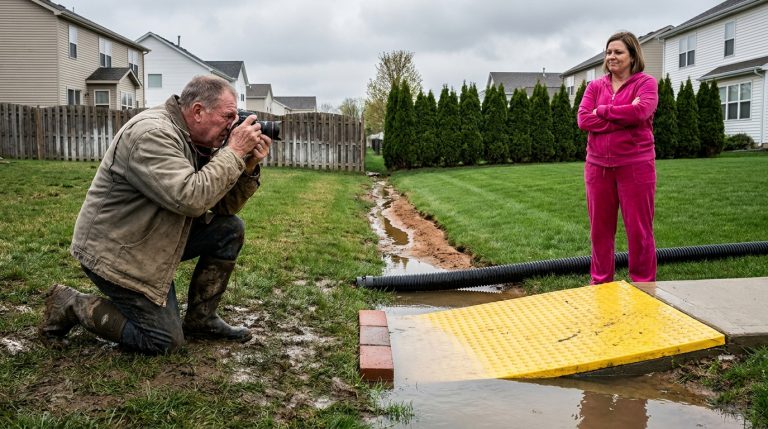
The Architect of Silence: A Cold Reconstruction of Truth in the Shadow of Oakwood Estates
CHAPTER 1: The Abomination
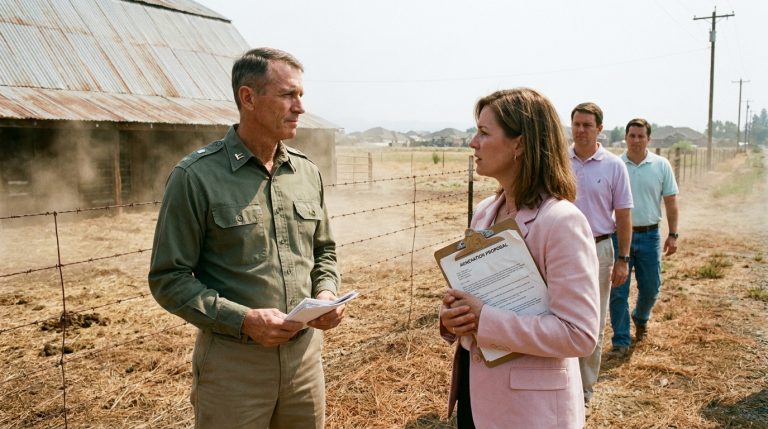
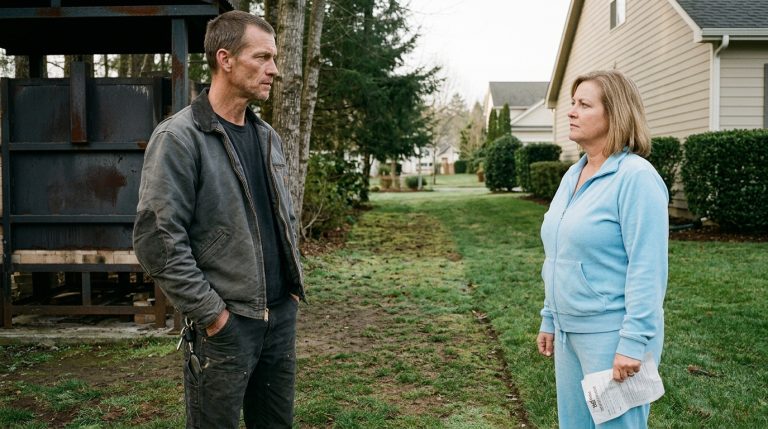
The air felt thin, sharp with the scent of impending rain and the metallic tang of the quarry stone. I didn’t move. My hands, calloused and thick with the grit of three months’ labor, rested at my sides, knuckles stiff from the morning chill. I watched the way she stood, the way she gripped that notice—her posture was all chest and chin, a drill sergeant who had never felt the kick of a rifle.
“The permits are in the county office, Ms. Miller,” I said, my voice low. It was a flat, stripped-back sound, the kind of tone that usually preceded a tactical assessment.
She scoffed, a quick, rattling sound. “County permits are irrelevant here. Oakwood Estates has standards. We have an Architectural Review Committee, and they have deemed your… construction… a severe violation of the community aesthetic.”
She reached out, tapping the laminated sheet against her palm. The sound was rhythmic, almost mocking. She wasn’t looking at the chimney. She was looking at the ground, at the space where the driveway ended and the property line blurred into the neighborhood’s manufactured perfection. I tracked the movement of her eyes, noting the way she scanned the perimeter. She was looking for a reaction, a flicker of panic, a sign of surrender.
“I haven’t received notice of a review,” I said, ignoring the sheet. “And I don’t recall an election for an ARC.”
The color flared in her cheeks, a bright, unnatural crimson. “My committee’s procedures are not up for debate with homeowners, Mr. Caldwell. You have until Friday. Do not make me involve the legal department.”
She turned on her heel, her movements abrupt and mechanical. The minivan’s door slid shut with a hollow, plastic thud. I stood in the silence of the driveway, the echo of her voice still hanging in the humid air like smoke. My eyes went back to the chimney—the granite, the riverstone, the way the light caught the jagged edges. It was solid. It was real.
I looked down at the gravel. A small, blue-tinted stone sat out of place near the foundation. I nudged it with the toe of my boot, watching it roll into a crack. A minor discrepancy. A detail out of alignment. Karen Miller was a professional of petty tyrannies, but she had made a calculation error. She had assumed that because I was quiet, I was defenseless. She hadn’t bothered to check the original property surveys, and she certainly hadn’t checked who had laid the stone for the entire development.
As the minivan pulled away, leaving a faint cloud of exhaust that stung my lungs, I noticed something else. The paper she had dropped—a copy of the notice—lay fluttering in the wind against the grass. I walked over and picked it up. The edges were perfectly straight, the print crisp, but there was a signature at the bottom. A florid, self-important squiggle. Underneath, a line of text that hadn’t been on the version she waved at me. It was a stamp, faded and barely visible.
Recommended Vendor: Miller’s Quality Contracting.
The realization hit me with the weight of a stone block, cold and precise. It wasn’t about the chimney. It wasn’t about the community aesthetic. I looked up at the house, the quiet windows reflecting the gray sky. There was a discrepancy in the ledger, a hidden architecture to her greed. And if she wanted a war over the rules, I would give her a lesson in how a foundation is truly laid.
CHAPTER 2: The Geometry of Defiance
The silence in the house was not an absence of sound; it was an presence, a physical weight that pressed against the windows and pooled in the corners of the dining room. I sat at the heavy oak table, the wood cool and unyielding beneath my forearms. The violation notice sat in front of me, its cream-colored surface catching the dull, filtered light of an overcast afternoon.
I didn’t reach for it. Not yet. Instead, I traced the grain of the wood, my calloused fingertip catching on a small knot near the edge. Memory, unbidden and sharp, cut through the quiet. Twenty years ago, on a desert base that felt a million miles from these manicured lawns, we were taught that the most dangerous enemy wasn’t the one with the loudest weapon; it was the one who controlled the logistics. Whoever controls the flow of resources controls the engagement. Karen Miller wasn’t just a neighbor in a floral suit; she was a gatekeeper for a revenue stream, and she had made the mistake of showing me her supply line.
The notice was a piece of theatre, a prop meant to intimidate. But the stamp at the bottom—Recommended Vendor: Miller’s Quality Contracting—was a tactical error. It was a crack in the façade. I stood up, the chair scraping sharply against the hardwood, a sound that seemed to snap the tension of the room. I walked to the kitchen, the floorboards groaning under my boots. I didn’t need to look at the chimney again to know it was solid. I had laid every stone. I knew the weight of the granite, the tensile strength of the mortar, and the precise angle of the flue. It was a structure built for eternity, and she was trying to judge it with a ruler made of paper.
I returned to the dining room, but this time I didn’t sit. I walked to the heavy three-inch binder that sat on the bookshelf—the mountain of paperwork that had been forced upon us when Sarah’s medical bills made our financial integration with the development a necessity. I pulled it down. The weight of it was significant, a dense collection of covenants, conditions, and restrictions. It was a manual of control, written by developers who viewed residents as line items.
I set the binder on the table, the thud echoing in the hallway. I opened it, the pages yellowed slightly at the edges. My reconnaissance began now. I wasn’t looking for excuses; I was looking for leverage. I needed to understand the terrain of this cul-de-sac kingdom.
For the next two hours, the world outside ceased to exist. I didn’t drink my coffee; it went cold, a dark, bitter pool in the ceramic mug. I cross-referenced the bylaws with the municipal permit copies I had kept in the back of the binder. I was searching for the specific language that defined “external modifications.” I highlighted sections, my pen moving with the same precision I used when checking a sight picture.
The weakness was there, buried in an addendum concerning “pre-existing structural integrity.” My home had been here for a decade before the McMansions arrived. It was an island, a piece of old earth that the developers had been forced to leave untouched. According to the bylaws, modifications to a pre-existing structure were governed by a specific set of rules, ones that Karen had conveniently omitted from her threatening letters.
The cold clarity that had settled in my chest began to sharpen. She was operating outside the spirit of the document, and, I suspected, outside its letter as well. I turned the page, my eyes narrowing. The Architectural Review Committee. I looked for the roster. The page was blank, save for a boilerplate declaration that the committee members were appointed by the board president.
I closed the binder, the snap of the cover sounding like the slide of a pistol going into battery. I had the start of a tactical assessment. She had bypassed the committee because she was the committee. She had no paper trail because she was using the HOA’s institutional power as a personal collection agency for her brother’s business.
I walked to the window. The sky was darkening, the threat of rain finally manifesting as a thin, gray mist that blurred the outline of the cookie-cutter houses across the street. A minivan, the color of weak tea, drifted slowly past the end of the driveway. It didn’t stop, but it slowed, the driver’s side window tinted too darkly to see inside.
I didn’t move away from the window. I let her see me standing there, a silhouette against the dim light of the dining room. I didn’t wave. I didn’t react. I simply watched, my hands folded behind my back, the embodiment of a patient, calculated presence. She was watching for fear, for a panicked attempt to cover my tracks. She wouldn’t find it.
I picked up the phone. I didn’t call a lawyer. I wasn’t ready for the noise of the legal system yet. I needed something more precise. I dialed a number I hadn’t used in three years, the rhythm of the digits etched into my muscle memory.
“Gunny,” I said when the line clicked open. There was no need for pleasantries.
“Jack,” the voice on the other end was a low, gravelly rasp, seasoned by age and a lifetime of hard intelligence work. “Don’t tell me you’ve finally found a fight worth having, you old dog.”
“I need eyes, Gunny,” I said, my gaze never leaving the spot where the minivan had disappeared. “Not a person. A business. I need the backend on an HOA president and her preferred contractor. I want the incorporation papers, the vendor lists, and the connection between the board and the money. And I need it done quiet. The kind of quiet that doesn’t trigger a back-trace.”
There was a pause on the line, the sound of a man considering the variables. “You’re playing a dangerous game, Jack. These HOA types, they don’t fight like infantry. They fight like lawyers.”
“I’m not looking for a firefight,” I replied, my voice as steady as the stones in the chimney. “I’m looking for the foundation. You show me where the concrete is soft, and I’ll handle the demolition.”
“Send me the names,” Gunny said, the tactical shift in his tone signaling the start of the engagement.
I hung up the phone and looked back at the chimney. The mist was beginning to cling to the granite, darkening the stone, making it look ancient and immovable. The war for Oakwood Estates hadn’t started with the fine; it had started the moment she thought she could tear down something that was never hers to judge. And now, the survey was complete. I knew where the lines were drawn, and I knew exactly what it would take to shift them.
CHAPTER 3: The Ghost in the Records
The phone felt heavy in my hand, still radiating the faint warmth of the call. Outside, the mist had curdled into a steady, persistent drizzle that tapped a rhythmic, uneven tempo against the windowpane. I looked at the desk—at the binder, the highlighted bylaws, the scrap of notebook paper where I’d jotted down the address of the HOA’s registered agent.
I didn’t wait for the rain to let up. I stood, my joints popping with a dull ache that reminded me of years spent in the mud and the grit of the Corps. I grabbed my canvas jacket from the coat rack—a garment stained with mortar dust and faded by the sun—and stepped out onto the porch. The air was frigid, cutting through the thin layers of my shirt, but it was a clean, sharp cold that cleared the fog from my head.
I walked down the driveway, my boots finding the familiar grip on the gravel. I wasn’t heading for my truck. I was heading for the mailbox at the end of the cul-de-sac. It was a mundane action, the sort of thing a retired man did to fill the empty hours of an afternoon, but I was treating it like a flank maneuver.
The Oakwood Estates mailbox center was a brutalist structure of brick and beige aluminum, an aesthetic eyesore that Karen Miller had once called “a triumph of uniform design.” As I reached it, I saw Eleanor Vance, my next-door neighbor, struggling with a stubborn lock on her box. She looked frail against the bulk of the brick structure, her hand trembling slightly as she turned the key.
“Let me, Eleanor,” I said, stepping into her space.
She jumped, a small, startled bird of a woman. “Oh, Jack. You frightened me. It’s this lock… it’s been sticking for weeks. Ever since the board changed the vendor for maintenance.”
I took the key from her, feeling the resistance in the tumbler. It wasn’t rust. It was cheap, poorly fitted hardware—the kind of cost-cutting measure that seemed to plague every corner of the development now. I jiggled the key, applying the precise, measured pressure that coaxed the mechanism into yielding. It slid open with a metallic click.
“They won’t fix it,” she whispered, leaning in closer as if the very air had ears. “I submitted a work order three times. Karen told me that if I wanted a premium lock, I’d have to pay the upgrade fee and use their authorized contractor.”
“Miller’s Quality Contracting?” I asked, though I already knew the answer.
She nodded, a shadow passing over her face. “Always them. It feels like every time something breaks in this neighborhood, they’re the ones waiting in the wings to profit from it. I just wanted my mail, Jack. I don’t understand why everything has to be a struggle.”
I didn’t answer immediately. I handed her the key, but my gaze lingered on the row of boxes. I scanned the names, the mundane labels of a neighborhood that was being slowly hollowed out from the inside. Then, I turned my attention to the ARC notice board—a glass-covered frame that was supposed to display the minutes and the committee roster. It was empty. A single, dusty thumb-tack clung to the felt backing, but the records were gone.
“How long has that been empty?” I asked.
“Since the last ‘annual’ meeting,” she said, her voice dropping. “Karen said the committee was going through a restructuring. That was six months ago.”
I thanked her and watched as she hurried back toward her house, her small umbrella a bright spot of red in the dreary gray. I didn’t head home. Instead, I walked to the edge of the development, where the manicured landscaping gave way to the dense, untamed thicket of the old quarry road.
This was the border of the property, the line where my jurisdiction ended and the developer’s fever dream began. I walked the perimeter, my eyes scanning the ground. I was looking for signs, for the physical trace of maintenance. What I found was neglect. Hidden behind a row of neatly trimmed hedges were piles of discarded construction materials, rusted metal scraps, and broken concrete—the debris of a company that didn’t care about the land, only the bottom line.
I stopped near a pile of shattered granite, the color of the stone familiar. I picked up a piece, turning it over in my hand. It was high-quality material, the same grade I had used for my chimney. It had been dumped here, left to sink into the mud, a testament to the sheer wastefulness of the operation.
My phone vibrated in my pocket. A text from Gunny. P.O. box confirmed. Brother’s name is Rick Peterson. Two bankruptcies, one pending civil suit in the next county. And you’re right about the records—the state office has zero filings for an ARC for this HOA. Not one. She’s running the committee out of her own pocket.
I stared at the screen, the cold rain slicking the glass. She wasn’t just breaking rules; she was operating a phantom structure. The ARC didn’t exist in the eyes of the law, which meant every fine she had levied, every demand she had issued, and every threat of a lien was legally unenforceable.
I looked back toward the cluster of houses—the beige, uniform structures that stood like tombstones in a graveyard of aesthetic compliance. Karen Miller thought she was the queen of the hill, but she had built her fortress on a foundation of sand. She was a ghost, a hollow authority that thrived only as long as people were too afraid to ask for the records.
I walked back toward my house, my pace quickening. The rain began to fall in earnest, the sky bruising to a deep, heavy purple. I needed to document this. I needed to translate the silence into evidence.
When I reached my porch, I stopped. A cream-colored envelope was pinned to my door, its edges damp and curling. I reached out, the paper tearing slightly as I pulled it free.
Final Notice: Compliance Failure. Failure to cease fireplace operations within 48 hours will result in the immediate filing of a lien against your property title. No further warnings will be issued.
I looked at the signature. It was the same florid, arrogant scrawl. I didn’t tear it up. I didn’t throw it in the mud. I walked inside, the warmth of the house rushing to meet me. I placed the notice on the dining table, right next to the binder.
The stakes had just shifted. She was trying to force a checkmate, pushing for a legal encumbrance that would bleed me dry. She was operating with the arrogance of someone who thought they had already won. She had no idea that I was just beginning to dismantle the board, piece by piece, stone by stone.
I sat down and reached for the pen. It was time to invite the neighbors to the conversation. If she wanted to play by the rules of the committee, then we would start by asking the committee to present its credentials. And I knew exactly who to call to ensure those questions were heard.
CHAPTER 4: The Architecture of Alliance
The dining room was dim, the overhead light casting long, skeletal shadows against the walls. I kept the pen moving, scratching names into the list. Arthur Kensington lived three streets over in a house that mirrored the rest—beige stucco, symmetrical windows—but there was an order to his lawn that suggested a mind that didn’t tolerate chaos. I checked the watch on my wrist. It was late, the kind of hour where the neighborhood felt like a stage set after the play had finished.
I grabbed my jacket and stepped out into the night. The rain had subsided to a thick, clinging mist that turned the streetlights into hazy, golden orbs. My boots hit the asphalt with a hollow, rhythmic thud. I wasn’t just walking; I was measuring the distance between my reality and the orchestrated illusion Karen Miller had imposed on Oakwood Estates.
Arthur’s house appeared out of the fog, its porch light burning with a stark, defiant brightness. I didn’t knock; I pressed the bell, the chime echoing deep within the house.
He opened the door before the final note faded, his face framed by the warm glow of his foyer. He was dressed in a silk robe, a pair of reading glasses perched on the edge of his nose. He looked at me, then at the manila folder tucked under my arm, and his expression shifted from surprise to an immediate, analytical focus.
“Mr. Caldwell,” he said, holding the door wider. “I assume this isn’t a social call. The hour is somewhat unconventional for neighbors, but for soldiers, I suppose the clock is irrelevant.”
“I have the documentation on the ARC,” I said, stepping into the warmth of the hallway.
He led me into his study, a room lined with leather-bound books that smelled of cedar and old paper. He gestured to a chair, his movements deliberate. I sat, placing the binder and the forged-looking notice from Karen on his desk. He didn’t look at the notice first. He looked at me, his eyes peering over the top of his glasses.
“You’re looking for a crack in the armor,” Arthur said, his voice a low, resonant baritone.
“I found the weakness,” I corrected, tapping the binder. “She’s not just bullying us, Arthur. She’s acting as a one-woman board. No minutes, no election, no committee. She’s operating a phantom administration.”
He leaned forward, pulling the binder toward him. He began to flip through the pages with the practiced speed of a man who had spent forty years reading contracts for a living. The room was silent, save for the rhythmic turning of pages and the distant, muffled sound of a car passing on the main road.
“If this is true,” he said finally, his voice devoid of emotion, “if she has indeed bypassed the corporate charter, she has violated her fiduciary duty. But more importantly, she has rendered every architectural decision she’s made for the last twenty-four months legally void.”
“Void,” I repeated, the word tasting like iron on my tongue.
“Completely,” he confirmed, looking up at me. “But you’re an engineer, Jack. You know as well as I do that you don’t build a house by removing one board. You have to remove the foundation. If we are going to do this, it cannot be a protest. It must be a dissolution.”
We spent the next two hours in a tactical rhythm that felt familiar, like a pre-mission brief in a darkened tent. We didn’t talk about anger; we talked about statutes, corporate bylaws, and the liability of the board. I showed him the invoice from Miller’s Quality Contracting. He looked at it, his face tightening, the color flushing into his cheeks.
“Nepotism,” he said, his voice sharp. “This isn’t just an HOA issue. This is fraud. If she’s directing community funds to her brother’s company without disclosure, she’s not just losing her presidency—she’s opening herself up to criminal charges.”
He stood up and walked to the window, staring out into the misty night. “I have a young man down the street, a software engineer named Mike. He’s been looking for a way to secure our communications. We need a digital space, Arthur. A way to share this without Karen’s spies getting wind of it.”
“You’re proposing a revolution,” Arthur said, turning back to me.
“I’m proposing a restoration,” I replied. “She made this a war. We’re just reclaiming the property.”
He smiled, a slow, thin line that didn’t reach his eyes. “I’ve spent my life navigating the corridors of corporate power, Jack. It’s a dirty, grey place where people trade their souls for the comfort of routine. But you? You’re a man who understands that things need to be solid. I’ll help you. Not because I want the presidency of the HOA, but because I find the incompetence of this current board offensive to the very concept of governance.”
He reached out and shook my hand. His grip was surprisingly firm, the hand of a man who still understood the weight of a commitment. As I left his house, the mist seemed to have thinned. The streets were quiet, the McMansions looming like silent monuments to a lifestyle that had traded character for convenience.
I looked up at the sky. The clouds were breaking, revealing a sliver of the moon. My house was a few blocks away, and as I walked, I realized that the silence of the neighborhood had changed. It was no longer a heavy, oppressive presence. It was a tension, the kind that exists before a storm. I had the documents. I had the alliance. Now, all I needed was to bring the rest of the neighborhood into the light. Karen Miller was about to find out that the people she treated as tenants were, in fact, the owners of the ground she stood on.
CHAPTER 5: The Weight of the Lien
I stepped back into the house, the light from the hallway spilling across the floorboards. The certified letter sat on the dining table, a stark, ivory rectangle that seemed to absorb the ambient light. I didn’t open it immediately. I knew the contents before my fingers touched the wax seal. Karen Miller was done with threats; she was moving to foreclosure.
I pulled out a chair, the wood dragging against the floor with a sound like a blade on stone. My hands were steady as I slid a letter opener beneath the flap. The paper was heavy, expensive stock, the kind that feels significant even when it is carrying poison. The letterhead was from a law firm downtown, a high-rise outfit that specialized in property litigation. It was formal, cold, and entirely devoid of human empathy.
Notice of Lien. Assessment of Violation Fees: $17,500. Property encumbrance initiated.
The total had tripled. She wasn’t just levying fines anymore; she was weaponizing the HOA’s bylaws to cloud my title. It was a classic move, the sort of bureaucratic bludgeon designed to force a surrender through financial attrition. She was betting that I would fold under the pressure of a looming foreclosure, that I would tear down the chimney just to stop the bleeding.
I stood up and walked to the window. Outside, the night was indifferent, the streetlights humming in the mist. I felt a cold, sharp spike of something that wasn’t quite anger—it was the clarity of a man who has finally identified the true nature of his enemy. She wasn’t just corrupt; she was reckless. By placing a lien on my property based on a fraudulent fine, she had moved from the domain of neighborhood politics into the arena of actionable torts.
I left the letter on the table and walked to the kitchen. My hands moved with a mechanical, practiced grace as I prepared the coffee. The act was a grounding exercise, a way to focus the adrenaline that was beginning to hum in my veins.
The house was quiet, but it was no longer the silence of solitude; it was the silence of a staging area. I had everything I needed: the forged documents, the evidence of nepotism, and now, the physical proof of her overreach. The lien was the mistake she would never recover from.
The phone on the counter buzzed, a sharp, jarring vibration against the granite. I didn’t look at the caller ID; I knew it was Arthur.
“I received it, Arthur,” I said, picking up the receiver.
“I suspected she would,” his voice was crisp, lacking the late-night warmth it had possessed hours earlier. “She’s desperate, Jack. She’s trying to consolidate her position before the annual meeting. She thinks if she clears you out of the way, the rest of the neighborhood will fall in line.”
“She’s given us the leverage,” I replied, staring at the kitchen sink, where the water glinted like polished steel under the light. “By clouding the title on a veteran’s home over a disputed architectural fine, she’s not just broken the bylaws. She’s committed slander of title.”
“It’s actionable,” Arthur said, the tone of his voice sharpening. “And it’s the piece we need to bring the media into this. A lien is public record, Jack. It’s no longer a private dispute. It’s a matter of public interest.”
“I have a contact,” I said, thinking of Brenda Walsh, the reporter I’d heard about in the county archives. “If we move fast, we can turn this lien into the centerpiece of the narrative.”
“Then do it,” Arthur replied. “I’ll handle the legal filings for the board’s removal. We need to be ready for the meeting. If we don’t have the majority by Thursday, we’re finished.”
“We’ll have the majority,” I said. My voice was calm, devoid of the doubt that usually plagued men in my position.
I hung up and walked back to the dining room. I sat down and picked up the lien notice. It felt different now, no longer a weight, but a tool. I pulled out a fresh sheet of paper and began to draft a response—not to Karen, but to the board. It was a formal, written notice of dispute, citing the invalidity of the architectural review committee and the explicit conflict of interest regarding the vendor.
I wrote until the small hours of the morning, my pen carving dark, decisive lines into the paper. I was constructing a response that was airtight, a document that would serve as the opening salvo in the final phase of this engagement.
As the first hint of gray light began to bleed into the sky, I set the pen down. My hands were stiff, the skin around my knuckles raw, but I felt a strange, lingering sense of peace. The chimney outside was still standing, a silent, granite sentinel in the early morning fog.
Karen Miller was about to find out that she had been playing a game of checkers, while I had been meticulously building a fortress. The lien was the catalyst for the end, the final, foolish gamble of a woman who had never learned how to build anything that could stand against the truth. I went to the window, the cold glass pressing against my forehead. The neighborhood looked the same, but I knew that by the time the sun fully crested the horizon, everything was about to change. I wasn’t just a neighbor anymore. I was the architect of her decline.
CHAPTER 6: The Eye of the Storm
The television station was a maze of gray corridors and buzzing fluorescent lights, a stark, antiseptic contrast to the quiet study where I had spent the last two days forging a path to this moment. Brenda Walsh met us near the main studio entrance. She was younger than I expected, with eyes that scanned the room with the efficiency of a scanner, constantly measuring, calculating, and categorizing. She wasn’t interested in the emotional weight of a stone chimney; she was interested in the collision of power and greed.
“Mr. Caldwell,” she said, her voice clipped, professional. “We have twenty minutes before the 5:00 news goes to air. I need the documents.”
I handed her the folder. It contained everything: the certified letters, the notice of violation, the corporate records Gunny had pulled, and, most importantly, the photograph of the original developer’s blueprint for the ‘Model B’ stone fireplace.
She opened the folder, her thumb flicking through the pages. When she stopped at the print of the original contract—my signature at the bottom, dated a decade prior—she slowed down. She looked at me, a brief flicker of genuine interest crossing her face. “You built these? All of them?”
“I built fifty-seven of them,” I said. “Every single one of the exterior stone accents in Oakwood Estates. I set the standard that she is now claiming I violated.”
She didn’t respond, but she tucked the blueprint under her arm, the action telling me more than a monologue could. We moved into the studio, a vast, cavernous room filled with hanging cables, heavy camera booms, and the soft, steady hum of the broadcast equipment. It was a space designed for fabrication, for the curated projection of a reality.
I sat in the chair, the bright, blinding lights forcing me to squint. It was a tactical disadvantage, being stripped of the ability to see the shadows, but I leaned into it. I needed them to see me. I needed them to see the man who had been threatened with the seizure of his home for the crime of fulfilling his own original design.
“We’re live in three,” a voice boomed from somewhere in the dark.
I felt a sudden, sharp memory of the old quarry road, the feeling of the heavy granite blocks beneath my hands, the way the mortar dried into a permanent, inflexible bond. The irony of it was suffocating. I had spent my life building things that endured, while Karen Miller spent hers trying to manipulate the perception of those things for a quick, illicit profit.
“Two. One.”
The camera lens, a cold, unblinking black eye, locked onto me. Brenda began, her voice modulated, perfectly pitched for maximum impact. “We are here with Jack Caldwell, a retired Marine and master stonemason, who finds himself at the center of a battle for his property rights—and the integrity of one of our city’s most exclusive neighborhoods.”
She leaned into the frame, her tone shifting to the investigative edge that made her name. “Mr. Caldwell, you’ve been issued a lien against your property, a move that could cost you your home. The HOA claims it’s for an ‘unauthorized’ modification. What do you say to that?”
I looked directly into the camera. I didn’t reach for the emotional pull of Sarah’s memory—not yet. I focused on the facts. “I built the stone features of Oakwood Estates. I have the contracts. I have the blueprints. The chimney they are threatening to tear down is an enhanced version of the exact architectural standard I was hired to set ten years ago.”
I paused, letting the statement hang in the air, a physical challenge. “They are not protecting community standards. They are protecting a monopoly on maintenance contracts. Every fine, every violation, every threat of foreclosure, leads back to one vendor: the president’s brother.”
I reached into the folder, pulled out the invoice for the $500 door-painting fine, and held it up. The camera operator zoomed in, the lens whirring with mechanical precision. “This is not an architectural review committee. This is a racket.”
The air in the studio felt thin, the temperature dropping as the weight of the evidence manifested. Brenda didn’t even look at the monitor; she stayed focused on me, her pen poised. She knew, as I did, that this wasn’t just a local news segment. This was the opening of a fissure in Karen’s authority.
As the segment continued, we laid it out—the lack of meeting minutes, the nonexistent committee, the financial trail between the board and Miller’s Quality Contracting. It was systematic, cold, and undeniably damaging. By the time the segment wrapped, I felt the familiar, grim exhaustion that comes after a high-stakes engagement.
I walked out of the studio, the lights of the lobby feeling muted and soft compared to the glare inside. Brenda walked with me to the door. She didn’t offer a platitude; she simply nodded. “That’s going to hit the community board in the morning, Mr. Caldwell. I’d advise you to stay close to your counsel.”
“I’m not going anywhere,” I said.
I stepped out into the night air. The city was far away, a distant sprawl of amber light, but here, in the quiet of the station’s parking lot, the wind carried the scent of rain and wet earth. My work here was done. The target had been designated, and the payload was set. The community meeting was in forty-eight hours, and by then, the information I had just exposed would be circulating through every mailbox, every smartphone, and every dinner table in Oakwood Estates.
Karen Miller thought she was untouchable. She was about to find out how quickly the air leaves a room when the truth finally kicks the door in. I walked to my truck, my movements measured, the cold weight of the lien notice still in my pocket, but for the first time in months, it didn’t feel like a threat. It felt like a receipt. I had paid the cost, and now, I was coming to collect.
CHAPTER 7: The Gavel and the Grit
The community center smelled of industrial cleaner and stale coffee, a scent that triggered a sharp, sensory echo of the VFW halls I’d haunted years ago. The room was packed. People stood three deep along the back wall, a murmuring mass of frustration that surged and receded with every rustle of paper. I moved through the crowd, my boots silent on the linoleum, scanning the faces. I saw Eleanor Vance, her posture stiff with nervous anticipation, and the Rodriguez family, clutching their young daughter’s hand.
I reached the podium. The long table at the front was occupied by the board, their faces a collection of masks. Karen Miller sat in the center, her floral suit a jarring, vibrant contrast to the drab wood of the dais. She didn’t look at me. She didn’t look at anyone. Her gaze was fixed on the gavel in front of her, her hand gripping the handle so tightly the knuckles were translucent white.
“The meeting will come to order,” she announced. Her voice didn’t crack, but it lacked its usual, imperious resonance. It was thin, frayed at the edges.
I stepped up to the microphone. The feedback shrieked, a high-pitched, metallic protest that silenced the room instantly. I didn’t open the folder yet. I let the silence stretch, forcing the room to acknowledge the weight of the air.
“We are here to review board conduct,” I said, my voice steady, stripped of all artifice. I didn’t need to shout. The acoustic design of the room carried the low frequency of my tone into every corner. “But before we move to the agenda, I have a question regarding the integrity of the architectural review committee.”
Karen’s head snapped up. Her eyes, usually cold and calculating, were wide, the pupils dilated with an encroaching panic. “That item is not on the agenda, Mr. Caldwell. You are out of order.”
“The committee is a required legal function of this corporation, Ms. Miller,” I replied, my voice gaining a harder edge. “If the committee does not exist, then the board has no authority to levy fines or place liens on property. Can you provide the current roster of the ARC members?”
The room surged, a sudden, collective movement of bodies that made the floorboards groan. I didn’t look at the crowd. I kept my eyes on Karen. She looked to her left, then to her right, seeking an ally who wasn’t there. The other board members were staring at their own laps, their shoulders hunched.
“I am the committee,” she snapped, the defiance returning in a jagged, desperate flash. “I have the authority to manage the aesthetic standards of this development as I see fit.”
“You are not the committee,” I said, opening the manila folder. I didn’t shout. I just held up the copy of the corporate charter. “The law requires a body of at least three elected officials. By operating as a solo authority, you have breached the corporate charter. You have essentially liquidated the ARC and replaced it with a private service contract—to your brother’s company.”
I laid the invoices on the table in front of her. They slid across the polished wood, coming to rest against her hand like a summons.
“This isn’t about standards,” I said, turning to address the room. “This is about the systematic extraction of wealth from every family in this building. Every time a door was painted the wrong shade, every time a garden was deemed ‘disruptive,’ a fee was generated. And every one of those fees was directed to Miller’s Quality Contracting.”
The roar that erupted from the room was not a cheer; it was a howl. It was the sound of a trapped animal finally realizing the cage door was open. People were on their feet, the chairs crashing backward against the floor, a chaotic symphony of realization and fury.
Karen struck the gavel. Crack. Crack. Crack. The sound was comically small against the volume of the crowd.
“Slander!” she shrieked, but her voice was swallowed by the noise. “These are lies! He’s a disgruntled tenant trying to avoid a legitimate fine!”
I waited for the wave of sound to crest. I wasn’t done. I reached into the folder one last time and pulled out the original development blueprints—the ones I had signed, the ones that held my legacy. I held them up, the crisp, technical lines visible even from the back of the room.
“I built these homes,” I said, my voice dropping, yet somehow audible over the din. “I built the standards you are using to terrorize us. And I tell you now, there is no violation. There is only a lie, built on the back of a community that trusted you to do right by them.”
Karen stood up, her face a mask of incandescent, pure-bred rage. She looked around the room, expecting the silent, obedient compliance she had commanded for years. She found only cold, hard stares. The board members were standing up now, but not to support her—they were retreating, distancing themselves from the center of the storm.
She turned back to me, her hand trembling as she reached for the gavel, but it slipped, clattering off the table and rolling toward the edge of the dais. She reached for it, but stopped, her gaze catching on the folder, then on the crowd, then back to me. For the first time, I saw the truth behind the arrogance: she was terrified, not of the law, not of the audit, but of the sudden, irrevocable collapse of the world she had constructed.
The gavel sat on the floor, a small, abandoned piece of wood in the middle of a room that was no longer hers to control. The silence that followed was heavy, expectant. The vote of no confidence was imminent, and I knew, as I looked at the faces of my neighbors, that there would be no debate. The restoration had begun.
CHAPTER 8: The Foundation
The aftermath of the meeting was not a celebration; it was a slow, atmospheric settling. The room began to empty, not with the chaotic roar of the previous hour, but with a murmuring, subdued gravity. People walked out into the cool night air as if emerging from a long, feverish dream. I stayed near the podium, watching. Karen Miller had vanished through the service exit, a figure shrunken and diminished, her exit marked by the hollow click of her heels against the tiles.
She would be gone by morning. The legal filings would follow, the audit would dismantle the architecture of her brother’s company, and the neighborhood would move forward. But for me, the victory was internal. It was in the way the air felt different—lighter, clearer—as if the very atmosphere of Oakwood Estates had been scrubbed clean.
I walked out to the parking lot, the asphalt slick with the damp residue of the evening. Arthur Kensington met me by my truck. He didn’t offer a handshake or a smile. He simply looked up at the moon, which was finally breaking free of the cloud cover.
“The board has accepted my nomination as interim president, Jack,” he said, his voice a low, gravelly note of satisfaction. “George is already pulling the digital records. By tomorrow, we’ll have the full scope of the financial bleed.”
“Good,” I said. “Make sure the records go to the DA. Don’t let it become an internal affair.”
He nodded, a sharp, decisive movement. “It won’t. The community is finished with secrecy.”
I drove home in silence. The streets were dark, the beige houses looking less like an artificial uniformity and more like a collection of homes—each one a different life, each one finally breathing without the weight of an invisible hand.
When I reached my driveway, I didn’t go inside immediately. I walked to the back of the house, to the fireplace. The mortar was dry, the stones settled into the earth with the permanence of a mountain range. I ran my hand over the rough granite, feeling the history in the stone—the history of the quarry, of Sarah’s sketches, and of the long, cold fight that had brought me to this moment.
I knelt, picking up a small chisel I had left on the ledge. There was a single, jagged chip near the base where the stone had been slightly marred during the construction—a flaw that had haunted me for weeks. It was a small thing, nearly invisible, but to an architect, it was a reminder of an imperfect start.
I tapped the chisel, once, twice. The sound was a sharp, musical clink against the stone. With a steady hand, I smoothed the edge, turning the imperfection into a clean, finished line. It was a small act, a quiet repair, but as the dust settled, the stone felt complete. The chimney wasn’t just a monument anymore; it was an anchor. It was the physical manifestation of the truth: that if you build with honest materials and clear intent, the structure will survive the storms of others’ ambition.
I went inside and built a fire. The wood caught quickly, the flame licking at the seasoned oak, sending a steady, vibrant warmth out into the room. I sat in my old armchair, the one Sarah used to love. The silence here was different now. It wasn’t the heavy, suffocating silence of grief; it was the quiet of a house that had been reclaimed.
I picked up the original blueprint of the Model B fireplace, the one that had served as the ultimate evidence of my integrity. I unfolded it on the table. It was fragile, yellowed, and marked with the wear of a decade, but it was the document that had leveled the playing field. I didn’t need it anymore. I took the paper, folded it neatly, and placed it on the mantle—a souvenir of the battle, not a necessary shield.
The fire settled into a steady, rhythmic glow, the light casting deep shadows against the stone of the hearth. I closed my eyes, the exhaustion finally pulling at my limbs, a heavy, earned fatigue. I had started this by wanting to honor a memory, and I ended it by securing a future for a place that had almost lost its soul.
The community of Oakwood Estates was awake now. They would have their gardens, their blue doors, and their disagreements, but they would have them on their own terms. I had done my part. The foundation was set. I listened to the crackle of the wood, the wind brushing against the glass, and for the first time in years, I didn’t feel the need to calculate the next move. I was home. The fire was warm, the stone was strong, and the night was finally, mercifully, at peace.