The Dusty Gray Line: How One Returning Soldier Unraveled a Suburban Empire Built on Stolen Dreams
CHAPTER 1: Midnight Arrival
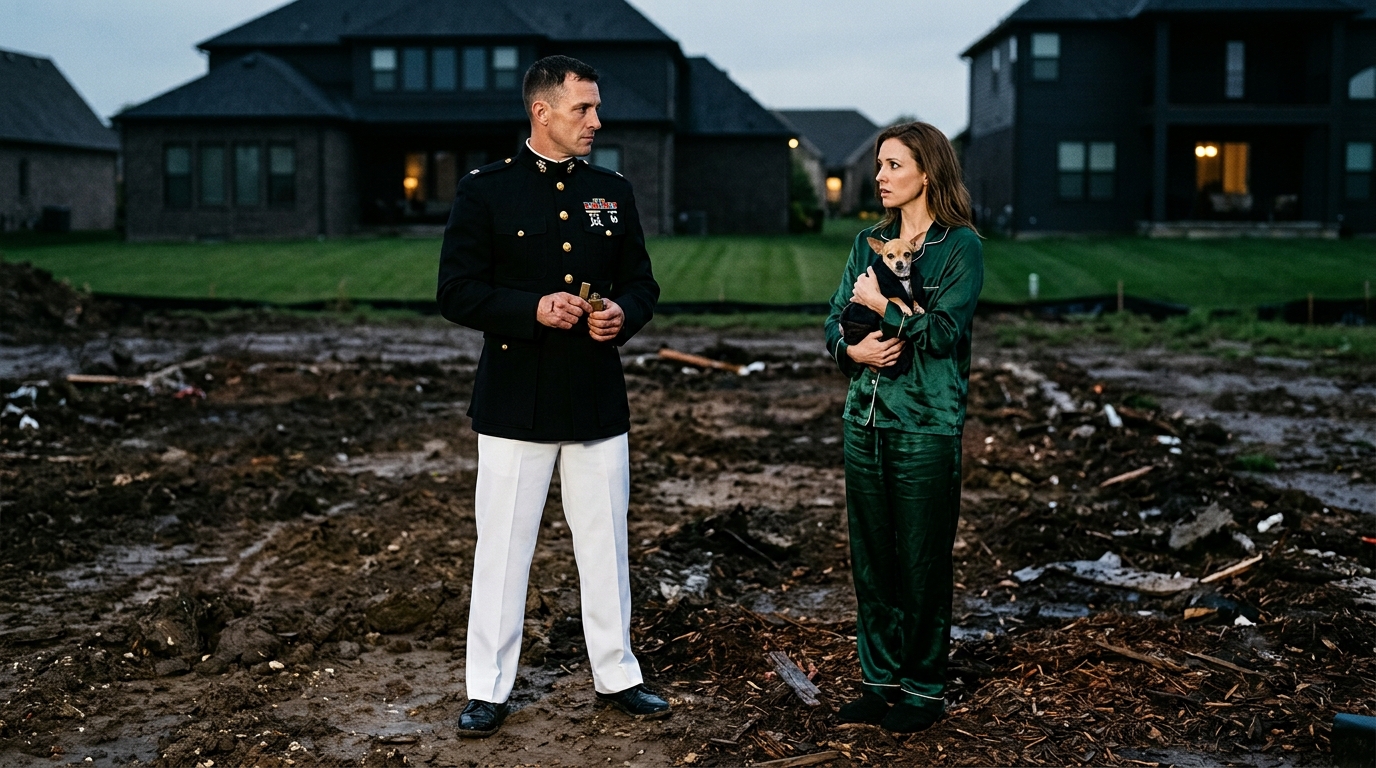
The metal of my boot crunched down on fresh, damp soil where my living room used to be, the scent of wet mulch hanging heavy in the 3:00 a.m. air.
I stood there in full dress blues, the sand from three continents still ground deep into the treads, staring at a smug little herb garden and a freshly driven for-sale sign.
My house was gone.
Flattened.
Click-clack.
The rhythmic, aggressive tap of designer heels cut through the quiet darkness of Willowbrook Estates.
Constance Blackwater strolled up the sidewalk wrapped in silk pajamas, her pocket-sized dog trembling like it wanted nothing to do with her.
She tilted her head, putting on a sickeningly sweet display of faux pity.
“Oh, honey, back early? Should have paid those dues. We reallocated it for the community’s benefit.”
I didn’t yell.
I didn’t let my heart hammer against my ribs.
I just rolled a heavy, unlit brass Zippo lighter between my scarred knuckles, feeling the familiar cold metal ground my focus.
“Funny thing about that, Constance,” I said, my voice steady and flat. “You just violated federal law, and the Service Member Civil Relief Act doesn’t give a damn about your community benefit.”
Her perfectly sculpted smirk froze solid, the color draining from her face as realization flickered in her eyes.
She had never had anyone look her in the eye and call her bluff without flinching.
CHAPTER 2: The Paper Trail
The kitchen of the cramped temporary apartment smelled faintly of old carpet and floor wax.
Marcus sat across from me, his thumb tracing the edge of a photocopied deed that should never have existed.
We had no digital proxies to save us now, no automated bank transfers to catch the falling knife.
The system had swallowed my digital paper trail whole while I was overseas.
Every single transaction had to be dragged out into the harsh fluorescent light of reality one crumpled paper slip at a time.
“She didn’t just miss a payment notification, Derek,” Marcus said, sliding a bank statement across the laminate. “Look at the routing numbers on these foreclosure fees.”
I didn’t answer right away.
I just pulled the heavy brass Zippo lighter from my pocket, letting the smooth metal roll back and forth across my knuckles.
The friction kept the cold spike of adrenaline right where it belonged.
“Same corporate entity,” I murmured, my eyes tracking the sequence of ink-stamped routing codes. “Every single house she seized went through the exact same shell company before landing in her landscaper’s hands.”
“For eight hundred and forty-seven dollars,” Marcus muttered, shaking his head. “They’re running a foreclosure mill disguised as community upkeep.”
It wasn’t a random administrative glitch.
It was an industrial-scale operation hidden behind pristine neighborhood rules.
Constance Blackwater had turned suburban compliance into an eviction machine, systematically stripping away the homes of deployed service members while they were halfway across the world.
I tossed the statement onto the pile, the dry paper rustling sharply against the table.
“We need more than bank slips,” I said, standing up so fast the wobbly table groaned. “The receipts prove the theft, but they don’t prove why she targeted my lot specifically.”
Marcus looked up, narrowing his eyes. “You think there’s a bigger footprint?”
“There’s only one way to find out,” I replied, grabbing my jacket. “Let’s go take a closer look at that herb garden.”
CHAPTER 3: The Municipal Fault Line
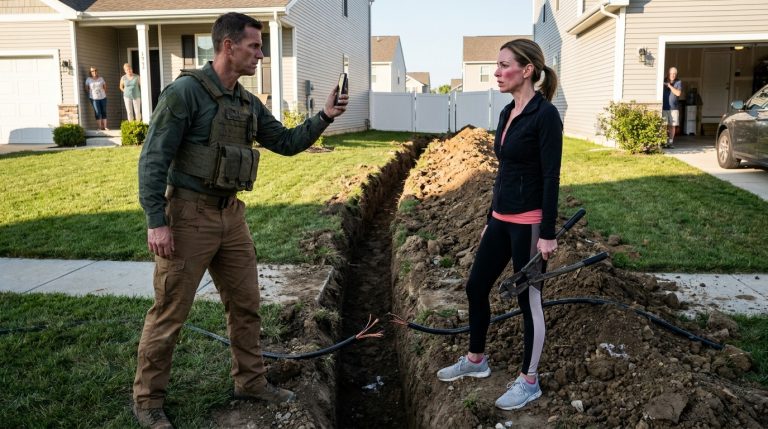
I knelt beside the neat rows of decorative boxwood, my fingers pressing into the wet soil until I felt the hard, synthetic edge of a buried PVC pipe.
It didn’t match any standard residential setup.
The diameter was thick enough to feed a commercial agricultural block, angling straight past my former property line toward the sprawling, multi-million-dollar waterfront lots at the edge of the cul-de-sac.
“Find something interesting?”
Marcus stood a few feet away, keeping watch near the sidewalk with his hands buried deep in his jacket pockets.
I traced the line of the pipe with my thumb, feeling the faint, rhythmic vibration of pressurized water humming beneath the dirt.
“She didn’t just reallocate my yard for community aesthetics,” I said, standing up and wiping the dark loam from my palms. “She tapped into the municipal main illegally to service the premium backyards down the block.”
Marcus let out a short, humorless breath, shaking his head. “That’s not just an HOA fine. That’s city code violation territory.”
“Exactly,” I replied, pulling out my phone. “Let’s see how much Constance’s precious property values love a municipal lien.”
I dialed the city utility inspector’s office, letting the mechanical ringing drone through the cold night air.
A tired voice picked up on the third ring.
“City utilities, department of code enforcement.”
“Morning,” I said, keeping my tone completely flat and even. “I’m calling to report an unpermitted commercial irrigation installation at Willowbrook Estates, corner lot. The lines are tied directly into residential mains without commercial meters.”
There was a brief pause on the other end, the sound of paper shuffling against a desk.
“Name and address?”
“Derek Thornfield,” I said, staring at the empty patch of ground where my living room wall used to stand. “And trust me, your inspectors are going to want to bring tape measures. It’s a ten-thousand-dollar violation before daily penalties even kick in.”
CHAPTER 4: The Manufactured Threat
Officer Davidson sat opposite me, his fingers drumming a slow, measured tattoo against a printed stack of paper complaint forms.
The top sheet bore Constance Blackwater’s immaculate, sharp-angled signature alongside a formal police statement accusing me of stalking, military reconnaissance, and aggressive late-night property monitoring.
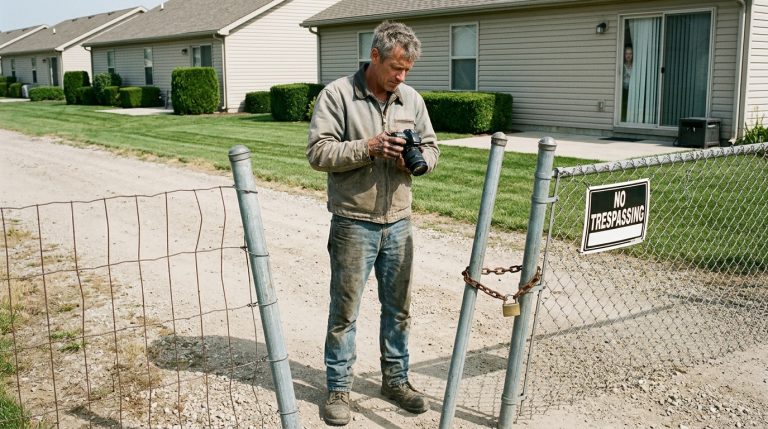
“She says you’ve been lingering around her perimeter in the dark,” Davidson said, his voice entirely neutral as he slid the document forward. “Making threatening gestures and taking photographs of her residence.”
I didn’t blink.
I reached slowly into my jacket pocket and pulled out my cracked smartphone, dropping it onto the cold steel between us.
“Every single photo on that device was taken from the public sidewalk,” I said, my voice dropping into a low, steady register. “And every single image documents unpermitted construction and municipal code violations on the lot she illegally seized from me.”
Davidson picked up the phone, swiping through the gallery of oversized irrigation lines and forged property transfer notices.
The steady drumming of his fingers stopped entirely.
“She filed this as an urgent community safety alert on the neighborhood portal this morning,” Davidson muttered, leaning back in his chair. “Claiming you’re an unstable combat veteran hunting down residents.”
“She’s painting the victim as the threat,” I replied, rolling the heavy brass Zippo lighter between my knuckles under the edge of the table. “Because the municipal lien on those commercial pipes just hit her desk.”
Davidson stared at the screen for a long, silent moment before standing up and grabbing the phone.
“Sit tight,” he said, heading toward the heavy glass door. “I need to make a quick call to base legal.”
CHAPTER 5: The Checkmate Meeting
Federal agents in windbreakers walked shoulder-to-shoulder into the room, spreading out quietly along the back walls.
Constance Blackwater sat at the head of the folding table, her gavel raised midway in the air as her perfectly manicured fingers froze over the wood.
She had scheduled this emergency session to push through an illegal foreclosure auction on another deployed service member’s family home before anyone could object.
“This meeting is out of order,” Constance snapped, her voice tightening as she slammed the gavel down anyway. “Federal observers have no jurisdiction over private community governance.”
Agent Torres stepped forward, sliding a thick manila folder onto the center of the table right beside Constance’s coffee mug.
“We aren’t here for community governance, Mrs. Blackwater,” Torres said, her tone devoid of warmth. “We’re here regarding organized civil rights violations and fraudulent property seizures totaling over two million dollars.”
Constance’s face flushed a deep, mottled crimson, her jaw tightening as she refused to back down an inch.
“That is a malicious fabrication by disgruntled agitators who refuse to follow basic property standards,” she hissed, standing up to loom over the table. “You have no right to disrupt this meeting.”
I rolled the heavy brass Zippo lighter between my knuckles, watching her scramble for leverage that no longer existed.
“Tell them about the waterfront sightlines, Constance,” I said, stepping forward out of the crowd. “Tell them why you really bulldozed my house.”
Her eyes darted toward me, wide with sudden, unadulterated fury.
“You should have stayed overseas,” she snarled, her mask finally slipping completely off. “None of this would be your problem if you just accepted your place.”
CHAPTER 6: The Final Ledger
Constance yanked her hands back, her designer blazer twisting awkwardly as she glared at the camera lenses surrounding her.
“This is an outrage!” she screamed, her voice cracking as federal agents guided her toward the rear door of an awaiting cruiser. “You cannot do this over a few missed community dues!”
“It’s not about dues, Mrs. Blackwater,” Agent Torres said, closing the cruiser door with a solid, definitive thud. “It’s about two point three million in stolen properties and twelve targeted military families.”
I watched the cruiser pull away down the quiet suburban street, the red taillights fading into the afternoon sun.
There was no dramatic speech left to give.
Just the quiet, grinding reality of a system finally correcting itself.
The shell companies were seized within forty-eight hours, and the deeds to every illegally auctioned home were restored directly to their rightful owners.
Six months later, I stood in the driveway of my fully rebuilt ranch style home.
The municipality had ripped out the illegal commercial irrigation lines, and where Constance’s smug herb garden once stood, a row of clean, quiet American flags fluttered in the afternoon breeze.
Marcus leaned against the porch railing, tossing a set of fresh mailbox keys across the concrete.
“Board election is tonight,” Marcus said, taking a sip from a paper cup of coffee. “Staff Sergeant Rodriguez is running unopposed for president.”
I caught the keys, the cold brass grounding my grip.
“Good,” I replied, looking out over the peaceful cul-de-sac where children were riding bikes without looking over their shoulders. “Let’s keep it that way.”