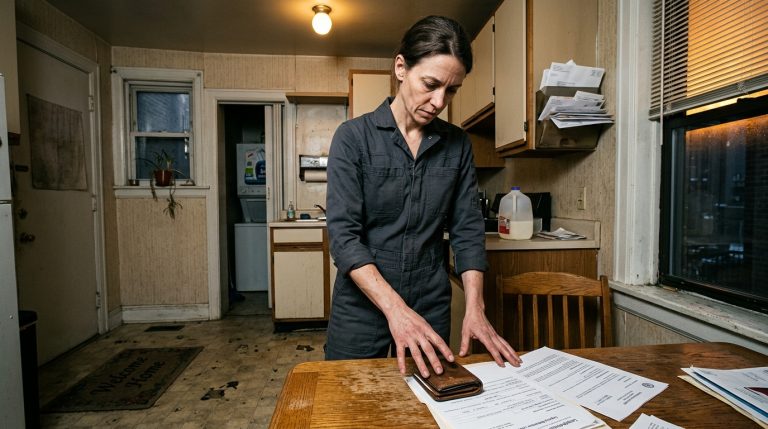
The Quiet Dirt Knows exactly Where the Fences Stand and It Never Forgets
CHAPTER 1: HEAVY INK
The sun hadn’t even cleared the eastern ridge line before the white sedan kicked up gravel at the cattle guard.
A young man in a stiff blue polo shirt walked toward the porch, holding a plastic clipboard like a shield against the wide, silent sky. He didn’t look at the timber joists or the heavy iron hinges on the door; he just stared at the yellow carbon slip in his fingers.
—Sign here— he said, his voice completely flat. —Certified. From Silver Creek Estates Management.—
I didn’t take the pen. I let my eyes trace the hard graphite edge of the carpenter’s pencil tucked behind my ear, then rolled it slowly between my thumb and index finger, feeling the flat wood grain anchor my hands.
—You’re forty miles out of your delivery circle, son— I said, keeping my voice down so it wouldn’t carry across the yard. —This is county dirt. No estates out here.—
He didn’t argue, just left the envelope on the top step and backed down the gravel walkway without looking back.
The paper felt ridiculously heavy when I picked it up, thick and formal with bold red letters stamped right across the seal. FINAL NOTICE: IMMEDIATE COMPLIANCE REQUIRED.
I leaned my back against the porch post, the morning wind pulling the scent of damp sagebrush across the pasture. The letter claimed three thousand dollars in delinquent community maintenance dues, citing an annexation agreement from a decade back that supposedly swallowed my forty acres whole.
It was an absolute lie, written with the kind of stiff, clinical confidence meant to make a working man doubt his own name. I looked out toward the western fence line where the old cedar posts stood exactly where they had for thirty years, gray and split by the winter frost but deeply rooted.
The telephone in my pocket vibrated against my hip, the screen lighting up with a private number before I even had the chance to break the envelope’s seal.
—Mr. Vance— a woman’s voice said the second I pressed the receiver to my ear, polished and sharp like glass left out in the sun. —This is Evelyn Reed, President of the Silver Creek Board. I assume you’ve received our delivery.—
I didn’t answer right away, just watched a lone red-tailed hawk circle low over the creek bed, its shadow cutting clean through the dry grass.
—You sent a piece of paper— I said, my voice dead and practical. —But paper doesn’t change where the county line stops, Ms. Reed.—
—The board has already reviewed the historical plats, Mr. Vance— she said, her tone shifting seamlessly into that rehearsed sweetness people use when they think they’re holding all the cards. —Everyone pays their share. We’re simply bringing the edge properties into alignment before the collection filings go to court on Friday.—
The absurdity of it hit my chest like a dull ache, but I just pressed the flat side of the carpenter’s pencil against my palm, letting the physical pinch keep my temper perfectly still.
—Then you’d better start digging for a signed covenant with my name on it— I said quietly. —Because until you find one, you’re just sending mail to a stranger.—
The line went completely dead before she could respond, leaving nothing but the sound of the wind through the kitchen screen.
CHAPTER 2: BLURRY RED
The plastic housing of the phone felt slick against my calloused palm, warmed by the rising morning heat. The dial tone cut out, replaced by a harsh, rhythmic buzzing that signaled the board president had pulled the plug on the conversation the second her authority was questioned.
I didn’t lower the device immediately. I kept it pressed to my ear, my eyes locked on the distant horizon where the county road met the dirt trail leading up to my gate. A bluebird flickered across the fence line, its sudden movement drawing my attention to the old iron latch on the cattle guard, which sat completely still.
The flat wood of the carpenter’s pencil dug into the meat of my thumb as I applied pressure, using the sharp physical bite to bleed off the sudden spike of heat in my chest.
A sharp ping rattled the metal casing of the phone. The screen flickered, displaying an incoming text message from the same unlisted number that had just filled my porch with empty threats.
Formal notice of non-compliance has been logged, the text read, the letters small and sterile on the glass screen. Fines accrue at one hundred dollars per day effective immediately. The board does not negotiate statutory community requirements with individual residents.
I let out a short, dry breath through my nose that didn’t sound like a laugh. The audacity wasn’t surprising, but the clinical speed of the delivery told me exactly what kind of game Evelyn Reed was playing. She wasn’t trying to prove a legal right; she was trying to establish a digital paper trail of intimidation before I could even figure out who held the keys to the town’s records.
The pocket knife in my front jeans pocket felt heavy as I pulled it out, flicking the small blade open with a clean, practiced click of my wrist.
I began to shave a thin sliver of cedar from the side of the pencil, the scent of fresh wood shavings cutting through the heavy smell of the dry dust beneath the porch stairs. Every stroke of the blade was deliberate, calculated to take exactly enough wood to expose the raw black lead beneath without breaking the point.
—You’re reaching across a line that isn’t yours, Evelyn— I muttered to the empty yard, my voice flat and completely devoid of the anger she was trying to provoke.
The telephone buzzed again, the screen lighting up with a PDF attachment labeled Silver Creek Estates Official Boundary Map – Revised.
I tapped the glass with a clean thumb, waiting three long seconds for the low-resolution image to render against the glare of the morning sun. The map was an absolute mess—a blurry, multi-generation copy of an old plat map that looked like it had been run through a faulty office scanner three times too many.
Right across the center of the image, an uneven, dark red shaded boundary line had been drawn, slicing through the natural creek bed and swallowing my forty acres whole. The edges of the red ink were jagged, completely lacking the precise geometric coordinates that any real county surveyor would place on a legal land document.
But it was the very bottom right corner of the document that made my thumb stop moving against the wood of the pencil.
Tucked neatly under the jagged red border was a small, perfectly crisp, high-resolution emblem of a development corporation that had gone completely bankrupt back in the winter of ninety-six. The logo was pristine, untouched by the artificial blur and digital noise that coated the rest of the map, standing out like a fresh oil stain on a dry concrete floor.
I closed the knife with a hard snap, the metal locking mechanism echoing against the cedar posts behind me.
The strategy was obvious now; they were using an old, dead developer’s template to fabricate a modern jurisdiction, betting that a weary land owner would look at the red ink and the legal jargon and simply write a check to avoid the headache.
A heavy cloud of dust began to rise from the county road two miles out, a small white speck moving slowly along the fence line toward my eastern boundary.
CHAPTER 3: THE BROKEN LINE
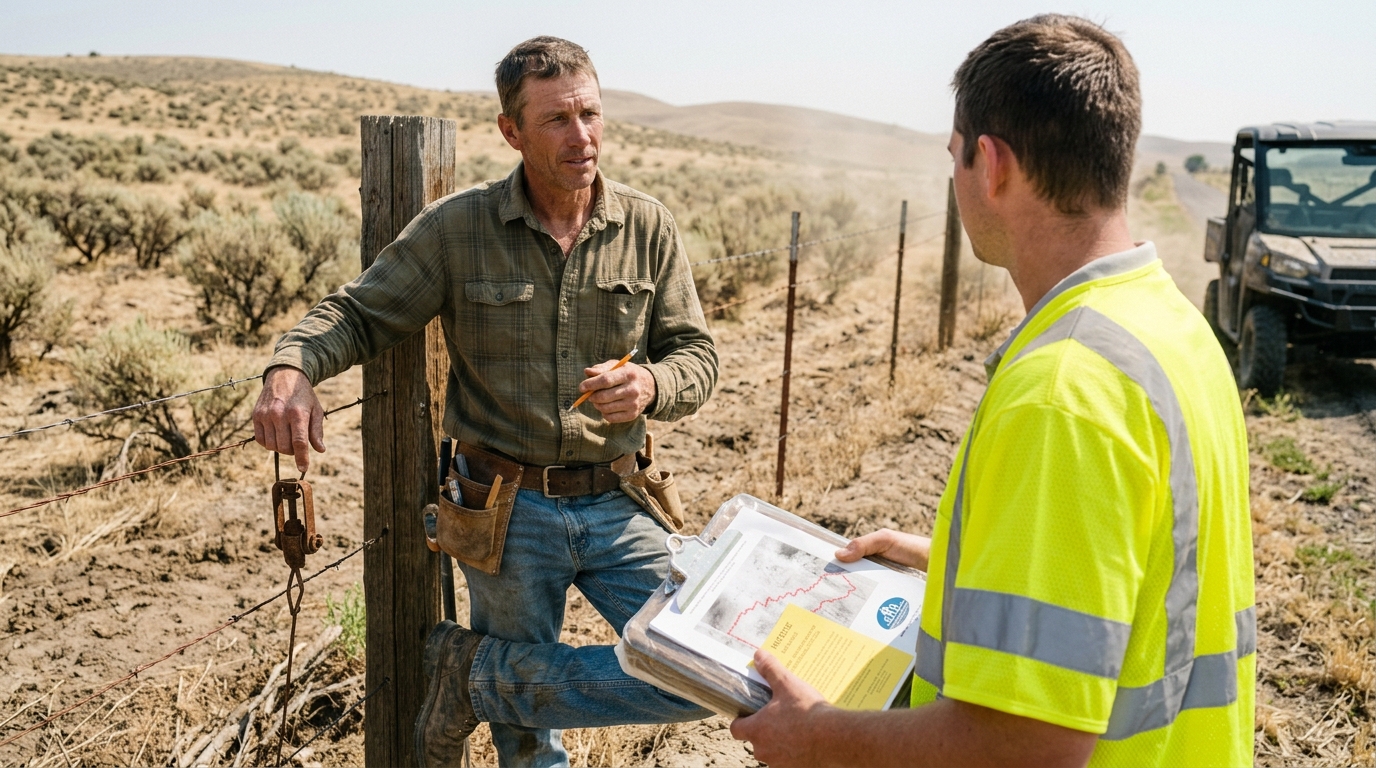
The vehicle didn’t pull into the approach. It hovered on the narrow shoulder of the public blacktop, the engine idling with a low, hydraulic whine that vibrated through the steel fence posts.
The front passenger window glided down about three inches, exposing the dark, reflective cylinder of a professional camera lens. A small, rhythmic click echoed across the drainage ditch—once, twice, then three times in rapid succession—capturing the alignment of my outbuildings against the open pasture.
I tightened my grip on the rusted wire tensioner, the rough orange flaking of the oxidized iron digging right into the meat of my palm.
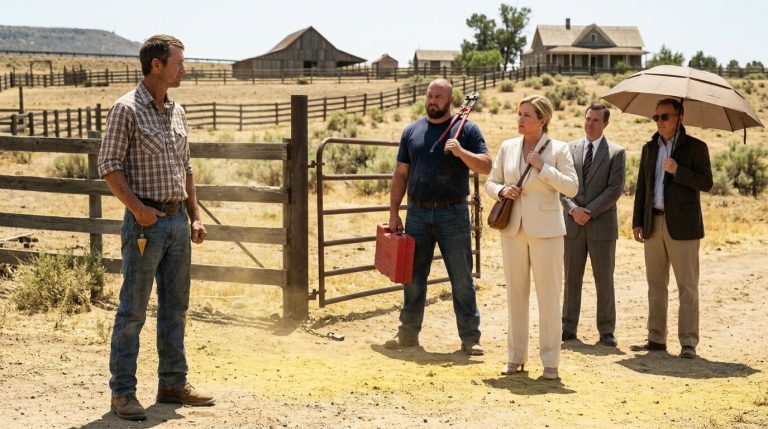
—You’re taking pictures of a private working lease— I called out, my voice flat, carrying across the gravel without rising an octave. —There’s nothing on this side of the post that belongs to town boards.—
The door clicked open, and a man stepped down into the dry ditch weeds, holding a thick clipboard wrapped in heavy clear plastic to keep the wind from catching the sheets. He wore a bright safety vest that looked brand new, the reflective silver stripes completely clean of dirt or grease, which instantly marked him as an office hire.
—Zoning and compliance check— he said, his posture tightening as he glanced at the heavy iron pin anchoring my gate to the timber post. —We’re documenting visible infrastructure violations for Silver Creek Estates under the expanded district guidelines.—
He raised a fresh sheet from his board, pointing toward a printed diagram that looked exactly like the low-resolution file Evelyn Reed had messaged to my phone.
I leaned my weight against the cedar post, my eyes tracking the paper in his hand rather than the camera lens still tracking my face from the front seat. From this distance, the lower margin of his document showed that same high-contrast developer emblem, perfectly distinct from the smudged red ink of the boundary lines.
—That paperwork has a dead developer’s stamp on the corner— I said, pointing the tip of my sharpened carpenter’s pencil toward the plastic wrap on his board. —That firm went into receivership thirty years ago, before those subdivisions even broke ground.—
His thumb twitched against the metal clip, a tiny bead of sweat breaking along his collar as the hot valley breeze swept between us. He didn’t answer the remark; he just pulled a yellow notice slip from the bottom of his stack and wedged it firmly into the gap between the wire fence and the cedar bark.
—The board operates on active title parameters— he muttered, stepping back toward the idling vehicle without looking me in the eye. —If you have an exception, you bring it to the community hall on Tuesday night.—
The heavy door slammed shut with a solid thud, and the white vehicle accelerated down the blacktop, leaving nothing but a thick plume of gray dust settling over my fresh fence line.
CHAPTER 4: THE BOARD TABLE
The room smelled faintly of burnt industrial coffee and decades of damp basement carpet.
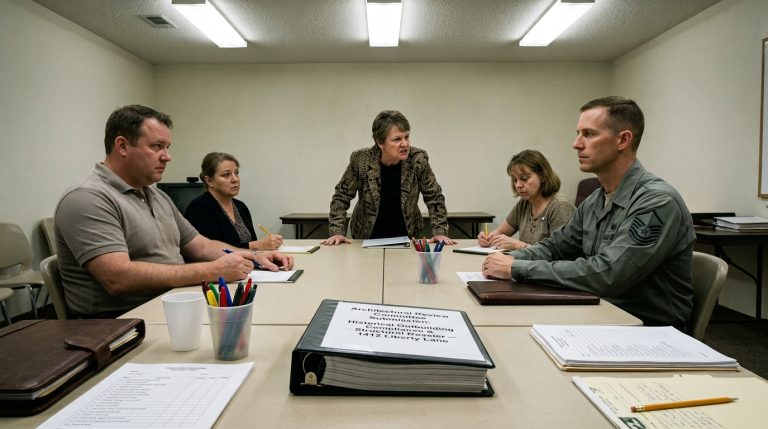
Evelyn Reed sat dead-center at the folding table, her silk blouse perfectly pressed, though a slight tremor in her hand rattled her silver pen against her water glass every time someone walked through the double doors. She didn’t look back toward the rear rows where the late arrivals were pulling additional metal seats from the storage rack.
I rolled the flat carpenter’s pencil between my fingers, letting the blunt wood edges anchor my posture against the hum of thirty people whispering into their collars.
—The board will come to order— Evelyn announced, her voice piping through a tiny desktop microphone that hissed with heavy static. —We have a standard agenda tonight, including the review of non-compliant perimeter tracts that refuse to pay their fair share for neighborhood infrastructure stability.—
She didn’t look at me, but her chin tilted up just enough to let everyone know exactly who she was targeting.
A heavy-set man in the third row, Dennis—her quiet husband who usually spent these meetings tracking budget spreadsheets in silence—shifted uncomfortably, his breathing heavy as he looked down at a stack of freshly photocopied site diagrams. He reached over and nudged the paper toward his wife, his knuckles turning a faint, pale white under the tension.
I didn’t wait for the floor to open. I stood up slowly, the metal legs of my chair scraping hard against the vinyl tile floor with a sharp, echoing screech that cut clean through the microphone’s hum.
—Let’s bypass the standard reading, Ms. Reed— I said, keeping my tone perfectly level, the pragmatic voice of a contractor who measures twice and skips the sales pitch. —You sent a truck to my gate to hang a trespass warning on fence lines that have been clear of town lines since the seventy-eight survey.—
Evelyn’s smile didn’t reach her eyes, her lips tightening into a thin line that showed the sudden strain of losing the room’s rhythm.
—Mr. Vance, this is a private association assembly— she snapped, her knuckles locking tight around her silver pen. —Non-members have no standing to disrupt community business. You are an uncooperative contractor trying to exploit common resources without paying the baseline fees.—
The room went dead silent, the absolute lack of movement letting the absurd weight of her entitlement sit right in the center of the floor.
—If I’m a non-member, you have no business mailing me fines— I said, taking two deliberate steps into the center aisle. —And if I am a member, you show this room the county recording number that links my dirt to your bank account.—
Evelyn opened her mouth to speak, but her eyes flicked to Dennis, whose hand was now flat over the unrecorded development map, completely blocking it from the public view.
CHAPTER 5: CHECKMATE TRAP
The paper rattled slightly in the dry, conditioned air of the hall as I held it high enough for the homeowners in the front rows to see the red ink.
—You layout a nice line, Evelyn, but you should’ve checked the ink on your master template— I said, my voice deadpan, cutting straight through the murmurs. —This logo in the corner belongs to a developer that went bust in ninety-six, long before your board ever took a single dime for lawn maintenance.—
Evelyn’s face hardened, a thin bead of sweat instantly breaking through her heavy foundation makeup as she leaned directly into the desktop microphone.
—That document is an internal administrative reference, Mr. Vance— she hissed, her knuckles turning white around her silver pen. —Our legal team has already certified our boundary extension, and a contractor with a low-tier county license has no standing to audit our structural archives.—
—Then let your attorney stand up and read the county filing number— I said, stepping closer to the front table until I could see the fine lines of panic around her eyes. —Because we both know there isn’t one. You didn’t annex this dirt; you lifted an old corporate draft to cover the fact that your community reserves are empty.—
Dennis, her quiet husband, let out a sharp, involuntary cough, his hands trembling so hard he dropped his yellow highlighter straight onto the table.
Evelyn didn’t back down; she slammed both palms flat against the wood, her chair sliding back with a loud screech as she glared down at me with pure defiance.
—This meeting is adjourned— she shouted, her voice cracking under the sudden weight of thirty neighbors leaning forward in their seats. —You will receive our final collection demand through formal enforcement channels tomorrow morning!—
CHAPTER 6: THE DUSTY TRUTH
The morning sun broke clean over the ridge, flooding the pasture with a sharp, clear light that stripped every shadow from the cedar posts. The driver didn’t speak, just shifted the sedan into reverse and backed away down the blacktop, leaving the quiet to settle right back into the dirt where it belonged.
I tore the top edge of the paper open, my thumb dry against the crisp linen stock.
Formal Dissolution of Claim, the letter stated, the text written in the precise, tight font of a high-tier defense firm rather than the board’s usual sloppy formatting. Silver Creek Estates hereby unreservedly withdraws all compliance assessments, late notices, and proposed enforcement actions regarding parcel forty-two. The board acknowledges total jurisdictional separation.
A final, desperate asymmetric counter-move had landed in the local weekly paper just the evening before—Evelyn Reed had printed a public notice claiming she was stepping down due to “uncooperative fringe elements compromising community safety.” She had tried to play the victim until the absolute end, attempting to warp her administrative overreach into a righteous crusade to protect her neighborhood.
But the bluff had dried up completely the moment the community members began checking their own underlying deeds, realizing the board had been shifting infrastructure funds into private development accounts.
I tucked the folded paper into my back pocket and walked back through the gate, the iron latch clicking shut with a heavy, definitive ring that echoed across the dry grass.
The carpenter’s pencil went right back into the small tool drawer in the barn, its flat cedar face worn down from a long week of holding the line. There were no victory speeches required out here, no grand announcements to the county, just the steady, exhausting maintenance of a boundary line that common sense had drawn long before the town boards existed.
I picked up the old iron grease gun from the workbench, walking slow toward the tractor axle to start the morning routine in the quiet air.
The cold metal felt solid against my palms, completely stripped of the artificial tension that had clogged the mailbox for the last month. The pastures stretched wide and level under the mounting blue sky, the dirt perfectly still, answering only to the season and the hard work it took to keep it clear.