The Steel Vault of Harmony Creek: A Tactical Counter-Strike Against Suburban Tyranny
CHAPTER 1: THE TACTICAL LINE
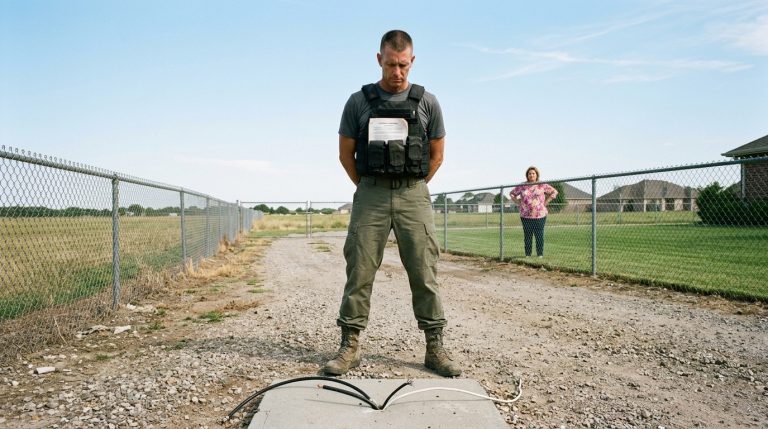
The floral print mumu moved across the property boundary like a signal flare against the muted cedar line.
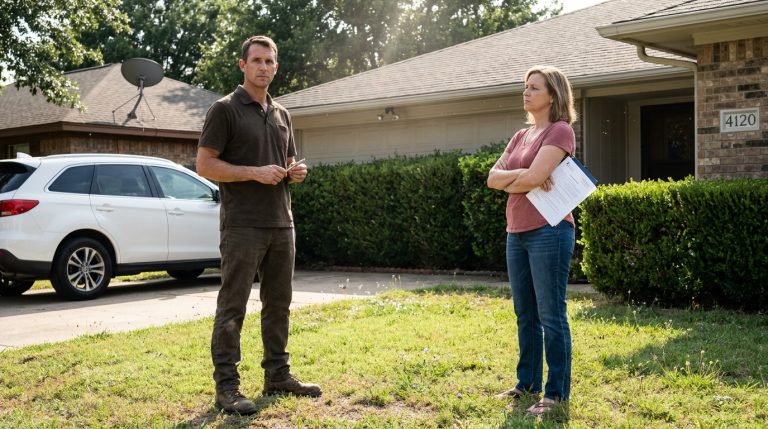
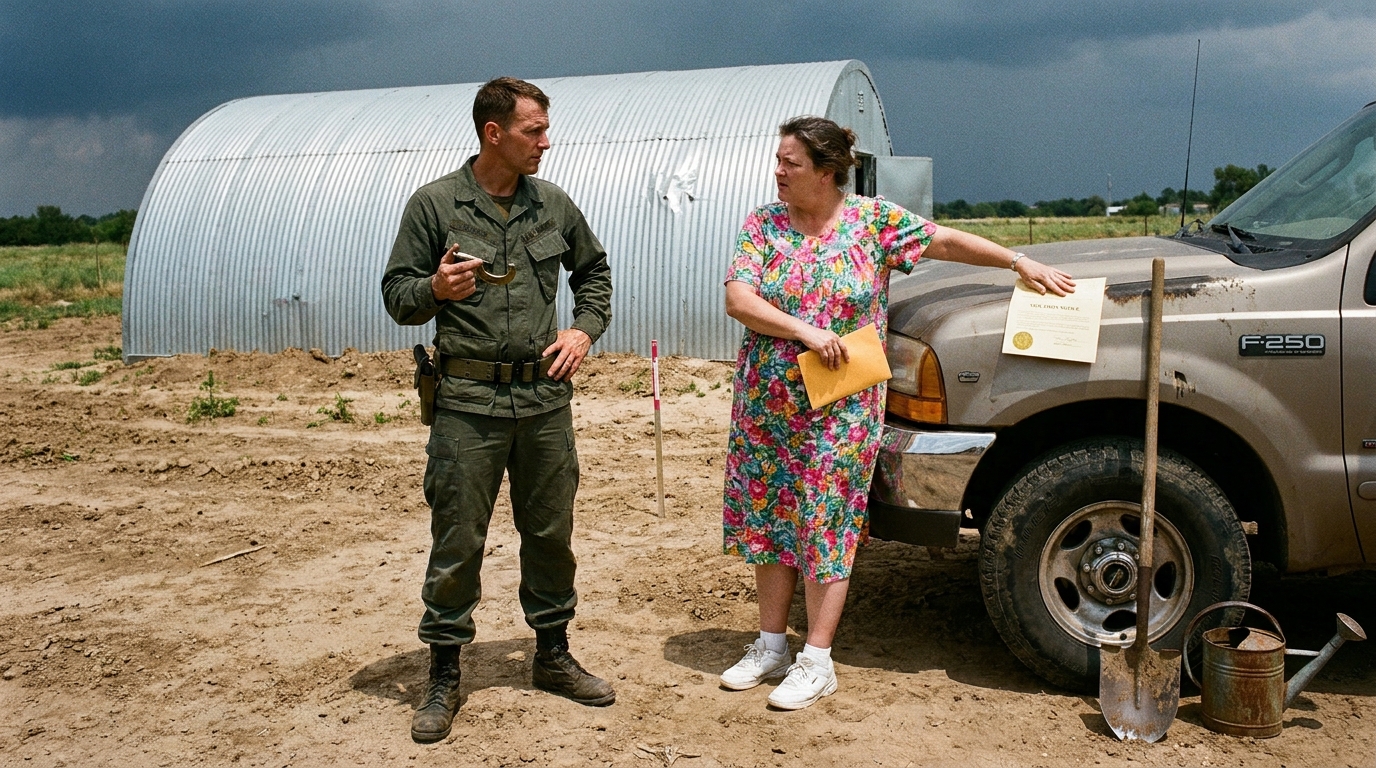
I stopped spinning the brass micrometer between my fingers. The edge of Karen Thompson’s orthopedic sneaker was precisely four inches past my surveyor’s pin. Four inches on a ten-acre agricultural plot meant nothing to a surveyor, but on a tactical grid, it was an insertion.
“That hideous metal tube has to go, Mr. Thorne,” she said. Her voice had the dry, screeching pitch of an ungreased pulley. “It’s an eyesore. A violation of Covenant 7.4, subsection B. It lowers the property value of this entire prestigious community.”
I didn’t step back. The twenty-two years of Combat Engineer discipline didn’t leave my spine just because I was wearing work boots instead of utility fatigue. I looked past her shoulder to the 25-foot corrugated dome gleaming in the noon light. Below that galvanized shell lay fifteen feet of reinforced concrete, blast-rated air scrubbers, and three-inch steel plate.
“It’s a FEMA-standard storm shelter,” I said. My voice stayed at a flat, low frequency. “Registered with the county.”
“Call it what you want.” She slapped a cream-colored envelope against the flat palm of her left hand. The paper made a sharp, dry pop. “It looks like a grain silo. It’s built of industrial scrap. You have fourteen days to begin removal or the daily fines commence.”
She extended the envelope across the invisible fence line. She didn’t drop it. She waited for me to reach for it, testing leverage.
I didn’t take the paper. I let her hand hover in the humid air until her shoulder twitched.
“My land isn’t part of the Meadows subdivision, Mrs. Thompson,” I said, thumbing the knurled adjustment screw on the brass micrometer. The metal was cool against my thumb, calibrated to a thousandth of an inch. “This parcel was zoned agricultural in 1994.”
“Was,” she said. A thin, thin smile cut across her mouth. “The annexation board finalized the jurisdictional expansion six months ago. The vote passed. You are in the Meadows now, Mr. Thorne. And the Meadows has standards.”
She dropped the envelope onto the hood of my parked tractor.
She turned on her heel, her sneakers tearing two small divots into the damp rye grass I’d planted in October. She marched toward her white golf cart parked on the asphalt shoulder, her clipboard tucked under her arm like a weapon.
I picked up the envelope. The paper was heavy, heavy stock—expensive cardstock bought with somebody else’s money. Inside, the printed ink was crisp: Violation Notice — Non-conforming Industrial Structure. Fine: $500/day. Compliance Fee: $250.
At the bottom of the page, beneath the gold-embossed HOA seal, a small file reference code was stamped in light gray ink: Ref: Vanguard Ledger – Sub-division 04.
I turned the paper over. There was no certified mail stamp. No tracking barcode. Just a hand-delivered notice dropped on a tractor hood by a woman who thought twenty-five feet of steel was an aesthetic insult.
I looked back at the silo entrance. The steel door was recessed behind six feet of poured foundation. I walked over, ran my knuckles along the cold, corrugated seam, and listened to the hollow, unyielding thud of forty tons of grounded concrete.
The wind blew off the western plain, carrying the faint, metallic scent of ozone from an approaching front.
Fourteen days.
I opened the heavy oak door to my workshop, walked past the tool racks, and laid the cream envelope flat on the workbench directly beside a fresh stack of county land deeds.
CHAPTER 2: THE KANGAROO COURT
The brass micrometer clicked shut against its anvil. Zero point zero zero zero. True zero.
I left the cream envelope resting beside the county land deeds on my oak workbench, grabbed my leather binder of blueprints, and drove the truck straight down the gravel access road toward the Meadows clubhouse.
A sudden deluge hit five minutes out—an unseasonable squall blowing off the western plains that turned the roadside ditches into churning brown gutters. Water sheeted across the windshield in thick, heavy curtains. By the time I pulled into the paved parking lot of the community clubhouse, the storm had shifted the ambient light into a murky, twilight gray.
Inside, the room smelled of synthetic floor wax and damp wool.
The HOA board sat behind a long folding table lined with fake wood veneer. Karen Thompson occupied the center chair like a judge presiding over a magistrate’s court, her floral mumu replaced by a razor-sharp navy blazer. To her right sat Gerald, a rail-thin man with wire-rimmed glasses who kept nervously aligning his pen with the edge of his notepad. To her left was a woman knitting furiously with grey yarn, and two other men whose sole function appeared to be breathing synchronously with Karen.
“Mr. Thorne,” Karen said, tapping her gavel once against a cork coaster. The sound was flat, deadened by the low acoustic ceiling. “You requested a hearing regarding Violation Notice 088. You have five minutes.”
I didn’t sit in the metal folding chair set up in the middle of the aisle. I walked directly to the table, opened the binder, and laid three full-size architectural sheets over her spread-out paperwork.
“These are the structural schematics,” I said. My voice carried cleanly over the persistent hum of the overhead fluorescent tubes. “Foundation depth is fifteen feet. Reinforcement is grade-60 rebar on six-inch centers. The superstructure above grade is an auxiliary entry hatch built from heavy-gauge corrugated steel. It is fully permitted under County Permit 409.”
Gerald glanced down at the blueprints. His thumb twitched against his notepad, tracing a printed line at the top of his financial ledger. I caught the header before he slid a blank folder over it: Thompson Landscaping — Escrow Deposit 409.
“The county,” Karen interrupted, her voice dropping an octave into pure ice, “does not govern our architectural harmony. The Meadows at Harmony Creek operates under private covenant. The structure you erected is an industrial anomaly. It degrades the neighborhood profile.”
“It’s a hurricane- and EF5-rated blast shelter,” I said. “Built to FEMA 361 standards. It holds forty people. In a corridor that saw three homes pulverized in Prairie Ridge last spring, it isn’t an anomaly. It’s life insurance.”
The knitting woman didn’t pause her needles. “Bylaws are bylaws, Mr. Thorne,” she hummed quietly to her yarn.
“Mr. Thorne,” Karen said, leaning forward. The gold-plated chain around her neck swung, catching the stark glare of the fluorescent lights. “Your passion project is noted. But if we grant an exemption for your metal tube, what follows? A mobile home in a driveway? A commercial ham radio tower? Aesthetics preserve property values. That is our primary obligation.”
“Your primary obligation,” I said, leaning over the table just enough to force her to look up, “is operating within the legal boundaries of the state. My land was annexed six months ago without certified mail notification to my address. That invalidates the jurisdictional vote.”
Gerald froze. His hand hovered over his pen, his knuckles turning chalk-white. He shot a frantic, sideways glance at Karen.
Karen didn’t flinch. Her expression hardened into a concrete slab. “Procedural matters are handled by our legal counsel, not in an open board hearing. The board has reviewed your submission. The blueprints are irrelevant. The county permits are irrelevant.”
She picked up her wooden gavel and struck the cork coaster hard enough to crack the dry wood underneath.
“Exemption denied,” she declared. “The daily fine of five hundred dollars remains active, effective midnight. Compliance enforcement fees will compound weekly until the structure is dismantled.”
She didn’t look at me again. She pulled the top folder from Gerald’s stack and began reading a canned update about spring lawn-aeration schedules.
I stood at the table for three seconds, letting the silence stretch until Gerald looked up again. When his eyes met mine, I picked up my blueprints, folded them with deliberate, crisp snaps, and tucked them under my arm.
“Five hundred a day,” I said quietly.
“Starting tonight,” Karen said without raising her eyes from her paper.
“Then I suggest Gerald opens a dedicated account,” I replied, my voice perfectly level. “Because every cent is going into escrow pending judicial review of the annexation logs. Starting tonight.”
I turned and walked down the center aisle. Behind me, the rhythmic click of the knitting needles hesitated, missed a beat, and then resumed its hollow, wooden cadence.
Outside, the rain had backed off into a fine, cold mist that hung in the glow of the parking lot lamps. I opened the door of my F-250, slid onto the worn leather bench seat, and watched the clubhouse window.
Inside, through the glass, I could see Gerald leaning close to Karen’s ear, his hand gesturing wildly toward the folder labeled Escrow Deposit 409. Karen pulled her chair back, grabbed his wrist, and forced his arm down onto the table.
I turned the ignition key. The diesel engine roared to life, vibrating through the steering column. I engaged the drive gear, backed out of the space, and headed home toward the war room.
CHAPTER 3: THE FORENSICS WAR
The steering wheel vibrated against my palms as the F-250 turned off the wet asphalt and onto the gravel driveway of my farm. Water sprayed into the wheel wells, a harsh rhythmic hiss that matched the steady sweep of the wipers.
Inside the workshop, the smell of sawdust, engine oil, and cold coffee took the edge off the night air. I flipped the main breaker switch. Four overhead fluorescent banks flickered, sputtered, and settled into a buzzing white glow over the long pine workbench.
Art Donovan was already sitting on a steel stool by the space heater, a thermos resting between his boots. He wore a faded flannel shirt, his knuckles thick with arthritis, but his blue eyes had the sharp, calculating focus of a man who’d spent thirty years dismantling corporate defense teams in federal court.
“How bad was it?” Art asked, unscrewing the cup from his thermos.
“Standard kangaroo operation,” I said, unzipping my canvas jacket and tossing my binder onto the table. “Karen ran the gavel. Gerald sweated through his collar. Exemption denied unanimously. Fines start at midnight—five hundred a day.”
Art didn’t flinch. He poured a stream of steaming black liquid into the cap. “Did you drop the escrow line?”
“Word for word,” I said. “Gerald almost choked on his pen. He was holding a ledger sheet with a header line for Thompson Landscaping tied directly to Escrow Deposit 409.”
Art set the cup down with a sharp clatter against the metal heater frame. “He held the page? You saw the vendor name?”
“Clear as day,” I said. “Along with a file tag labeled Vanguard Ledger.”
I walked over to the filing cabinet against the far wall, unlocked the bottom drawer, and pulled out the thick stack of papers I’d extracted from the county clerk’s public terminal three days ago. I spread them across the pine boards under the stark light: meeting minutes, regional zoning maps, and the five-year expenditure summaries for the Meadows at Harmony Creek HOA.
“If we’re going to break their jurisdiction, we don’t hit the silo,” Art said, pulling a pair of reading glasses from his breast pocket and resting them on the bridge of his nose. “The silo is the decoy. They want you fighting over covenants because on covenants, the board has home-field advantage. We hit the annexation itself.”
“The notification law,” I said.
“State Statute 42-A,” Art muttered, his thumb running down the edge of the printed county record. “Section 12. Annexation of agricultural land bordering a residential district requires certified mail delivery of the ballot notice to every registered title holder at least ninety days prior to the board vote. No exceptions. No bulk mail. No physical drop-offs.”
He pulled a magnifying glass from his coat pocket and leaned over the annexing resolution document.
I sat down across from him, pulled a pad of yellow legal paper closer, and uncapped a black ballpoint pen. For three hours, the only sounds in the workshop were the rain hammering on the tin roof, the hum of the overhead lights, and the dry scrape of paper turning.
We cross-referenced every date.
In May of last year, the HOA board logged a $4,200 expenditure under “Legal & Administrative Expansion.” Three weeks later, the annexation resolution was recorded as passed at a special executive session—signed by Karen Thompson and witnessed by Gerald.
“Look at the postal registry attached to the back of Exhibit C,” Art whispered, tapping the glass against the page.
I leaned in. The page was a low-resolution photocopy of a postal manifest.
“That’s not a certified mail receipt,” I said, spotting the discrepancy immediately. “There’s no twenty-digit tracking code. No green card return signatures. It’s a bulk-rate mail permit stamp from the regional distribution center.”
“They didn’t certify it,” Art said, a cold, dry smile tugging at the corner of his mouth. “They sent the notice via third-class bulk mail. Half of it probably went into the burn bin or got lost in the rural route stack. They intentionally bypassed certified delivery to keep you from getting the ballot in time to protest.”
“Which invalidates the annexation,” I said, the realization settling like an iron weight. “The entire expansion vote was legally void the second they dropped those letters in a bulk bin.”
“It gets worse for them,” Art said, shifting the stack of financial summaries to the center of the light. “Or better for us. Look at the vendor payouts for the beautification fund over the last thirty-six months.”
He ran a red highlighter down the column.
Thompson Landscaping and Design — $12,400.
Thompson Landscaping and Design — $18,900.
Thompson Landscaping and Design — $22,100.
Every major line item for groundskeeping, tree removal, and structural maintenance was awarded without a single competing bid listed in the board minutes.
“I pulled the Secretary of State’s corporate registry this morning before I came over,” Art said, sliding a printout across the table.
I looked at the registered agent line. Frank Thompson. 1402 Industrial Parkway.
“Frank Thompson,” I read aloud. “Karen’s brother-in-law.”
“She’s funneling association fees directly into her family’s business,” Art said smoothly. “The beautification fund isn’t a reserve. It’s a siphon. And your five-hundred-dollar-a-day fine isn’t about compliance—it’s capital to cover the deficit before the annual audit next month.”
I stared at the red lines on the yellow pad. The brass micrometer sat on the edge of the desk, reflecting the glare of the fluorescent bulbs.
“They forged the notification process to absorb my acreage,” I said, my voice dropping into a quiet, tactical focus. “Not for aesthetics. To expand their tax base and hide the shortfall.”
“Layer one is exposed, John,” Art said, sliding his glasses off and rubbing the bridge of his nose. “We have them dead on the annexation forgery. That’s our shield. But the financial fraud? That’s the sword.”
The sound of an engine outside cut through the rain. Headlights swept across the workshop window, illuminating the rain-streaked glass in harsh yellow beams.
I reached out, clicked the safety latch on my binder, and stood up.
Through the glass, I saw a dark SUV idle at the end of the driveway near the silo entrance. The driver didn’t get out. The vehicle sat there for twenty seconds, its high beams burning through the mist, illuminating the gleaming steel cylinder against the black sky, before slowly backing out onto the county road.
“They’re monitoring the site,” I said.
“Let them monitor,” Art said, stacking the dossier into a neat, square pile. “They think they’re building a legal fence around a farm. They don’t know we just found the key to the gate.”
CHAPTER 4: THE BROADCAST AMBUSH
The taillights of the dark SUV faded into the thick fog along the county road, leaving only the red glare reflected in the puddles outside my workshop window.
I didn’t give them three days to draft another violation letter. At 0945 Tuesday morning, the fog had burned off into a sharp, brittle autumn chill. A white county vehicle with official decals on the doors pulled off the asphalt and onto my driveway, followed closely by a Channel 8 news van.
Chief Miller stepped out of the county car, his olive-drab jacket zipped to the throat. He pulled his leather gloves tight over his knuckles, his gray eyes sweeping the twenty-five-foot corrugated steel shell rising from the excavation pit.
“John,” Miller said, his boots crunching on the wet limestone gravel. “You said you had a situation out here.”
“HOA claims it’s an unapproved industrial eye hazard,” I said, meeting him halfway between the driveway and the vault entry. “Five hundred dollars a day in non-compliance fines.”
Miller snorted, a plume of vapor rising in the clear air. “An eye hazard? This is three-eighths-inch corrugated steel anchored into poured footings. I’ve seen missile silos built with less concrete.”
Behind him, the news crew stepped onto the driveway. The reporter, Sarah Jenkins, adjusted her coat lapel while the cameraman hoisted a heavy shoulder-rig, the red tally light flashing twice as it locked focus on the shelter’s intake vents.
Before Miller could reach the blast door handle, the screech of small electric motors rattled across the gravel.
Karen Thompson’s white golf cart careened around the cedar hedge at maximum speed, its small tires tearing rubber off the edge of the asphalt. Gerald sat bolted upright in the passenger seat, clutching a thick leather-bound binder against his chest like a chest-plate.
Karen slammed the cart to a halt three feet from the county vehicle’s rear bumper. She surged out of the seat, her face flushed dark crimson under her pristine visor.
“This is private property!” Karen shouted, pointing a trembling, manicured finger directly at Chief Miller. “This inspection is unauthorized! The Meadows at Harmony Creek Board of Directors has issued a cease-and-desist regarding all non-compliant structures on parcel 04!”
The cameraman didn’t blink. He swung the heavy lens ninety degrees, capturing every inch of Karen’s posture, her trembling finger, and Gerald’s sweat-sheened forehead hovering behind her shoulder.
Chief Miller slowly turned. He stood six-foot-two in his work boots, his hands resting flat against his utility belt. He didn’t raise his voice. He didn’t step back.
“Ma’am,” Miller said, the tone flat enough to cut steel. “I am the Director of Emergency Management for this county. I am here at the invitation of the deed-holder to conduct a structural safety assessment of an auxiliary shelter. If you step across this property line again, I will have the deputy on duty cite you for obstructing a municipal official in the performance of his duties.”
Gerald paled. He pulled his binder back two inches. “Karen—” he whispered, his jaw twitching. “The camera. They’re recording.”
Karen looked directly into the black circle of the broadcast lens. Her lips pressed into a bloodless line. Her right thumb dug into the plastic edge of her clipboard, her knuckles white with tension. She opened her mouth to speak, caught the glint of the red tally light, and froze.
“We will settle this in court, Mr. Thorne,” she spat, her voice dropping into a harsh whisper. She turned, grabbed Gerald by his lapel, and dragged him back toward the golf cart. “Turn the cart around, Gerald. Now.”
I didn’t watch them retreat. I gripped the heavy T-handle of the vault door, disengaged the internal locking pins with a metallic clack, and swung the three-inch steel plate outward.
“After you, Chief,” I said.
Miller stepped down the reinforced concrete stairwell, the news crew trailing close behind. Inside the subterranean vault, the emergency lights hummed to life, illuminating the reinforced ribbing, the blast-rated air scrubbers, and the long stainless-steel benches bolted into the floor slab.
Jenkins held her microphone close to Miller’s chest. “Chief Miller, what is your official assessment of this facility?”
Miller ran his hand along the raw, unpainted weld of the structural framing. He knocked his knuckles against the steel plate—a dead, solid thud that echoed down the bunker chamber.
“In twenty-two years of civil engineering and disaster management,” Miller said directly into the lens, “I have never seen a private installation that meets this standard. This isn’t a violation, Miss Jenkins. This is an insurance policy for forty human lives. If every property owner in Tornado Alley built to this standard, my crews wouldn’t be digging families out of splintered pine every spring.”
Jenkins turned the microphone toward me. “Mr. Thorne, the HOA claims you are destroying their property values. What do you say to the board?”
I looked past her shoulder, directly at the optical glass of the camera. I pulled the brass micrometer from my pocket, turning it once between my fingers until the steel frame clicked shut.
“Safety isn’t an aesthetic choice,” I said quietly. “My door stays open. When the sky turns gray, I don’t care if you’re on the board or if you’re four hundred dollars behind on your lawn dues. You get inside.”
I saw Jenkins nod. The cameraman held the frame for five seconds of unbroken silence, capturing the cold steel walls, the emergency rations stacked along the perimeter, and the heavy locking pins waiting at the threshold.
By five o’clock that evening, the broadcast van was gone. But as the sun dipped behind the western ridge, the wind began to shift—a sudden, violent drop in pressure that rattled the tin flashing on my workshop roof.
I stepped outside and looked at the horizon. The clouds weren’t gray anymore. They were turning a bruised, sickly green.
CHAPTER 5: THE PRESSURE CHAMBER
The pressure drop hit like an physical slap against the inner ear.
The green hue on the horizon deepened into a muddy, bruised violet. Across the open ten acres, the leaves on the cottonwoods turned belly-up, locked in a eerie, dead stillness before the wind hit.
When it hit, it didn’t blow—it slammed. The tin flashing on my workshop roof shrieked, two galvanized sheets tearing loose with a noise like ripping canvas.
I pulled my radio from my belt. The weather channel was drowned out by continuous static punctuated by three long, high-pitched electronic bursts: TORNADO WARNING. EXTREME DANGER. TAKE SHELTER IMMEDIATELY.
I sprinted from the workshop across the gravel lot, my boots churning through loose stone. I hit the vault entrance, grabbed the locking handle, and threw the three-inch steel plate back until it caught on the exterior magnetic stop.
“Sarah!” I shouted toward the farmhouse.
She was already halfway across the yard, holding her jacket over her head against the first drops of rain—drops the size of quarters that stung like gravel. Behind her came the Millers, Jessica clutching her six-year-old son Leo against her neck while her husband carried two canvas duffel bags. Art Donovan was twenty paces back, moving with a steady, unhurried limp, his leather briefcase tucked tight under his left arm.
“Get down!” I barked, ushering them past the steel threshold. “Third bay on the left, pull the folding benches down!”
Headlights cut through the driving rain—a erratic zig-zag of yellow light bouncing across the access road. A blue sedan skidded sideways onto the gravel, its tires spinning uselessly before mounting the grass shoulder. Two more cars pulled in right behind it—neighbors from down the line, families who’d seen the Channel 8 broadcast four hours ago.
“Move! Down the stairs!” I directed, physically guiding them past the frame.
Thirty-four people filing down into the reinforced shaft in less than four minutes. Below us, the intake blowers roared to life as the automatic sensors picked up the grid power drop and kicked the auxiliary diesel generator into gear.
The sound from the north changed. It stopped sounding like wind and began sounding like a freight train hauling gravel through a iron tunnel.
I stood at the top of the stairwell, my hand on the steel edge of the hatch.
Across the hedge boundary, a silver luxury sedan lost traction on the mud, fishtailing across my driveway. It slammed into the fence line and stalled.
The door threw open. Karen Thompson stumbled out into the gale. Her visor was gone, her gray hair plastered across her face in wet, tangled strands. Her expensive tailored slacks were soaked black from the knees down. She took three desperate steps toward her front porch, but a sharp, deafening CRACK echoed above the roar of the wind.
The massive seventy-foot oak on her front lawn—the same oak listed on last month’s Thompson Landscaping emergency removal invoice—snapped clean at the trunk base. The heavy canopy slammed down directly over her front porch, splintering the overhang and burying her front door under three tons of crushed timber and stone.
Karen shrieked—a thin, terrified sound instantly swallowed by the gale. She whirled around, her eyes wide, wild, searching the flattened landscape for a single standing structure.
She saw me. She saw the open steel hatch gleaming under the emergency floodlight.
She ran. She didn’t march; she stumbled, her leather loafers slipping in the mud, her hands reaching out into the driving rain.
“John!” she screamed, her voice cracking as she hit the concrete apron of the shelter. “Please! The door is blocked! Let me in!”
I held the steel edge of the hatch. The wind whipped her wet hair across her eyes. Her fingers caught the lip of the steel frame, her knuckles raw and bleeding where she’d scraped them on her car door. The imperious HOA president, the woman who had levied daily fines on this very structure, was gone. In her place was a terrified human being staring down the throat of an EF4 wedge.
I didn’t say a word. I stepped back two paces and swung my arm inward, pointing down the concrete stairs.
She scrambled past me, tumbling down the first three steps before catching herself on the steel handrail. She collapsed onto the bottom landing, gasping for air, her wet clothes dripping onto the sealed concrete.
I grabbed the heavy internal T-handle, pulled the three-inch steel door flush against its rubber gasket, and threw the three locking pins home.
CLACK. CLACK. CLACK.
The deadbolts seated into the concrete frame.
Three seconds later, the world outside exploded.
The sound above us was a physical force—a suffocating, terrifying pressure that vibrated through the six-foot concrete foundation and into the soles of our boots. The forty-foot steel tube groaned under the shear stress, the corrugated ribs flexing, absorbing the kinetic energy of flying debris, upturned vehicles, and snapping trees slamming against the exposed dome above ground.
Inside, forty people sat in absolute silence under the amber glow of the emergency LEDs.
Karen sat alone on the lowest step, her knees pulled tight against her chest, her teeth chattering uncontrollably. She looked up slowly. Across the narrow aisle, Jessica Miller was wrapping a wool emergency blanket around her son’s shoulders, while Art Donovan sat calmly against the steel bulkhead, his briefcase resting across his knees.
Nobody spoke. Nobody pointed. The sheer, unyielding weight of forty tons of steel and concrete stood between them and annihilation, and every soul in the vault knew exactly who built it.
The vibration continued for ninety seconds—ninety seconds of deafening, grinding fury—before the heavy thrum began to ease, shifting back into the steady, rhythmic hum of the diesel generator scrubbing the air.
I checked the digital pressure gauge mounted by the hatch lock.
“Pressure is stable,” I said, my voice cutting cleanly through the quiet chamber. “We hold here ten minutes to let the tail end pass.”
Art looked up from his briefcase, met my eyes across the vault, and gave a single, slow nod.
CHAPTER 6: CHECKMATE AT THE GYMNASIUM
Ten minutes passed in absolute silence before I unlatched the heavy T-handle and threw the steel hatch outward.
The light that hit us was a pale, washed-out gray. Outside, the landscape was stripped bare: cedar fences flattened, power lines snapped across the mud, and Karen’s front porch crushed under the shattered seventy-foot oak. But every single one of the forty people who descended into the vault walked up those concrete stairs alive, uninjured, and silent.
Shadows lengthened across the debris over the days that followed, and four days of cleanup broke when thirty vehicles pulled into the high school gravel parking lot under the amber glow of the floodlights.
The emergency board meeting was convened in the high school gymnasium—the clubhouse roof having lost its south pitch to the storm. Over sixty residents sat on the wooden bleachers, their faces harsh under the buzzing white glare of the overhead gymnasium halides.
Karen Thompson sat at a folding table beneath the basketball hoop. Her navy blazer was gone, replaced by a plain gray cardigan. Her hands rested flat on a manila folder, her knuckles stiff, her eyes fixed entirely on the polished maple floorboards. Gerald sat two chairs down, his collar unbuttoned, his thumb nervously rubbing a raw blister on his right hand.
Art Donovan stepped up to the portable lectern. He didn’t bring a stack of speeches. He placed a single leather binder flat on the wood, opened it, and adjusted his reading glasses.
“This special session of the Meadows at Harmony Creek Homeowners Association is now in order,” Art said. His voice carried across the high ceiling, crisp and unhurried. “Under State Statute 42-A, Section 12, I am laying before this assembly the audit of the association’s jurisdictional records and beautification reserve.”
Karen’s head snapped up. Her hand twitched toward the folder on her table. “Mr. Donovan, this forum is restricted to storm recovery discussions—”
“The court reporter at the side table is actively logging these proceedings, Mrs. Thompson,” Art cut in smoothly, without raising his tone. “Sit down.”
Karen froze. Her jaw worked silently, her posture stiffening into a desperate, rigid line, but she did not stand.
Art flipped the first divider in his binder. “Item one: The annexation of parcel 04—Mr. Thorne’s ten-acre farm. On May 14th of last year, the board recorded a passed vote to incorporate agricultural land. However, postal manifest records from the regional distribution center confirm that ballot notifications were shipped using third-class bulk mail permits rather than legally mandated certified delivery.”
A low rustle rippled across the bleachers. Jessica Miller leaned forward from the third row, her arm around her husband’s shoulder.
“Because proper notification was deliberately bypassed,” Art continued, “the annexation of parcel 04 is legally void ab initio. The association possesses zero jurisdictional authority over Mr. Thorne’s land, making every non-compliance fine levied against his storm shelter an unlawful assessment.”
Gerald slumped back in his folding chair, his glasses slipping half an inch down his nose.
“Item two,” Art said, turning to the second tab. “The financial architecture. Over the past thirty-six months, the board levied over seventy thousand dollars in compliance penalties and maintenance assessments. These funds were directed into an account designated as Escrow Deposit 409, managed under an internal ledger titled the Vanguard Ledger.”
Karen’s fingers curled into tight fists against her cardigan, her nails digging into the knit fabric.
“Cross-referencing bank routing numbers with the Secretary of State’s corporate registry reveals that sixty-two percent of those reserves were paid directly out to a single vendor,” Art said, holding up a certified bank statement. “A vendor named Thompson Landscaping, registered to Frank Thompson. Invoices were submitted for emergency tree removal, seasonal plantings, and structural work—including an invoice for fifteen thousand dollars for work on an oak tree that sat five miles outside our residential boundary on private family land.”
The silence in the gymnasium turned suffocating.
Art looked up from his binder, his gaze locking directly onto Karen. “This was not a disagreement over architectural harmony or the color of a mailbox. This was a systematic conversion of community assets into private family accounts, protected by selective enforcement and forged administrative notices.”
Karen slammed her hands flat against the table and stood up. “I dedicated eight years to this community!” her voice shrieked, cracking against the high gymnasium rafters. “I maintained property values! I kept this neighborhood from falling apart!”
“You used association funds to prune your sister’s yard, Karen,” Jessica Miller called out from the bleachers, her voice loud and unwavering.
“Order,” Art said quietly, though he didn’t raise his gavel. He turned to the third page of his brief. “I move for an immediate floor vote on two measures. First: The total revocation of all fines, legal notices, and claims against John Thorne, with a formal public apology entered into the county record.”
“Seconded!” a dozen voices shouted simultaneously from the bleachers.
“All in favor?” Art asked.
Every hand on the bleachers went up. Not a single palm remained down.
Gerald looked at Karen, swallowed hard, and slowly raised his hand as well. Karen looked at him with pure, venomous shock, but Gerald kept his hand in the air, his shoulders collapsing in absolute defeat.
“Motion carries unanimously,” Art said. “Second motion: The immediate removal of the sitting board of directors, the appointment of an interim committee to oversee restitution, and the formal transfer of this financial dossier to the County District Attorney for criminal review.”
The vote passed in less than ten seconds.
Karen didn’t wait for the adjournment. She grabbed her leather folder, pushed her chair back so hard it clattered against the floorboards, and walked rapidly down the sidelines toward the exit doors. Her retreat was devoid of her former posture—her head down, her sneakers squeaking softly on the polyurethane gym floor, exiting alone into the autumn darkness.
Two hours later, the gymnasium was empty.
The fluorescent banks were powered down, leaving only the amber night-lights burning near the rafters. The cool midnight air drifted through the open double doors as I sat on the tailgate of my F-250 parked in the quiet lot.
I pulled the brass micrometer from my pocket. The knurled adjustment screw had picked up a speck of grit from the cleanup work near the silo.
I took a clean shop rag from my belt, unscrewed the spindle completely, and wiped the threads clean. I applied a single drop of machine oil to the fine steel spiral, worked it back into the frame, and turned the thimble until the measuring anvils met with a soft, precise click.
Zero point zero zero zero. Perfectly calibrated.
Art walked out of the gymnasium doors, his leather briefcase tucked under his arm. He walked over to the truck, leaned his shoulder against the tailgate, and looked up at the clear, dark sky.
“District attorney’s office accepted the dossier twenty minutes ago,” Art said, his voice quiet in the stillness of the night. “Restitution orders will clear your escrow account by Friday. The county emergency management office is mounting a permanent disaster resource plaque on the shelter’s entrance tomorrow morning.”
“Good,” I said, sliding the micrometer back into my shirt pocket and buttoning the flap.
“It’s over, John,” Art said softly, offering a thin, tired smile. “You kept the shelter. You kept the land.”
I looked across the gravel lot toward the horizon. Five hundred yards away, past the cedar tree line, the twenty-five-foot corrugated steel dome stood tall against the starlight—unscathed, solid, anchored six feet deep into the bedrock.
“The shelter was never the issue, Art,” I said, stepping off the tailgate and closing the bed liner with a solid, metallic latch. “It was just a matter of keeping the foundation secure.”