Standing Ground Against the Suburban Tyrant: How a Simple Satellite Dish Unraveled an HOA’s Corrupt Empire
CHAPTER 1: THE BLIGHT ON THE ROOF
The heavy linen of the violation notice crackled between my fingers.
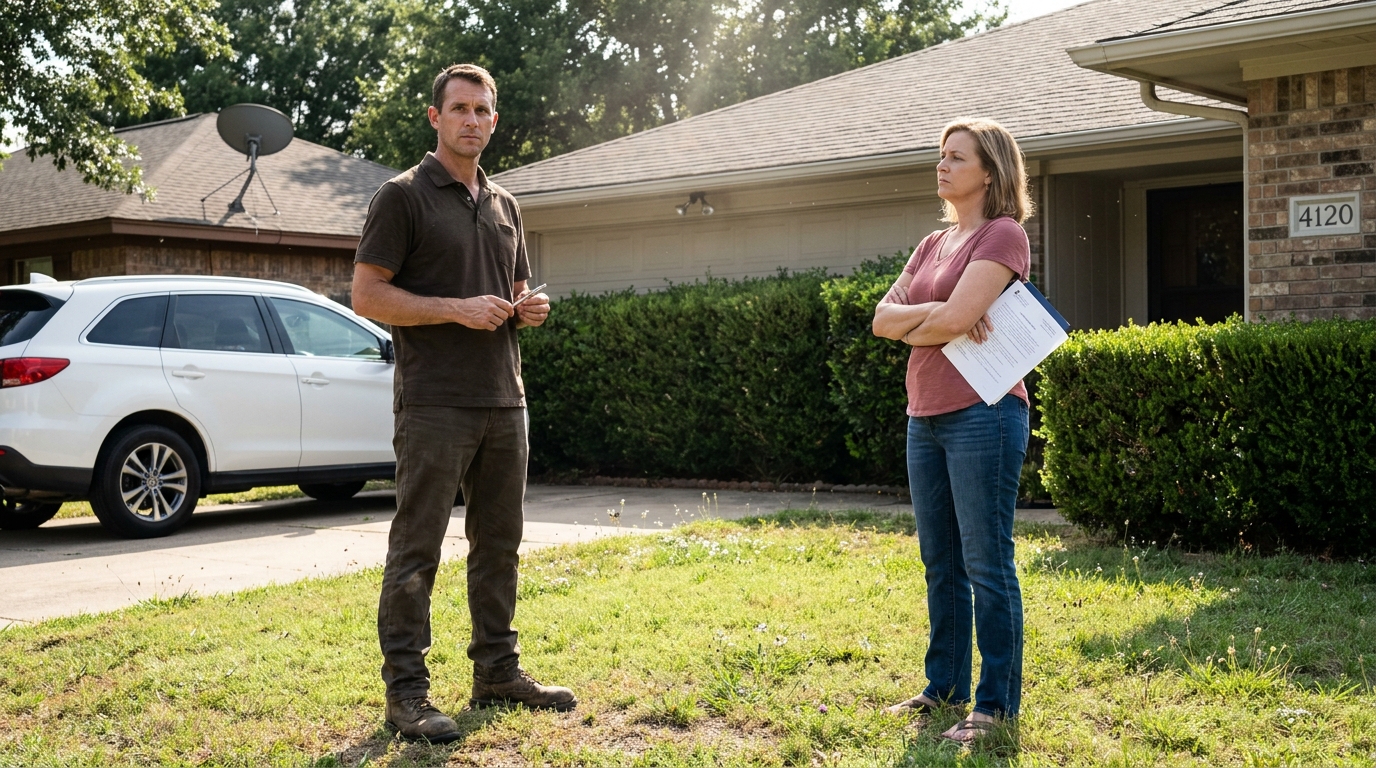
On the lawn before me stood Karen Vance, her arms locked across her chest in a rigid barrier of assumed authority.
Her gaze wasn’t on me; it was pinned to the side of my roof, locked onto the steel frame of my commercial-grade satellite dish.
“Seven days, Mr. Garrison,” she said, her voice dripping with the practiced condescension of a petty monarch. “That ugly thing comes down, or the fines begin.”
I didn’t blink. I rolled a heavy stainless-steel pen between my thumb and forefinger, feeling the cool metal ground the sudden spike of heat in my chest.
She called it an eyesore. It was actually a precision VSAT link, bolted down to withstand West Texas gales and engineered to pull a stable 100 megabits per second out of the dead air.
More importantly, it was the exact signal routing the community’s brand-new front guard shack relied on for its automated gates and security cameras.
The irony sat heavy in my throat like unswallowed gravel.
“It meets every structural requirement,” I said, keeping my voice flat and devoid of the anger biting at my ribs.
Karen sneered, her chin lifting with defensive arrogance. “The architectural committee decides what fits this community, not you.”
She turned on her heel and marched back toward her white SUV, leaving the humid stillness of the afternoon hanging thick between us.
I watched her tailgate clear the driveway before I turned and walked back inside the cool shadow of the house.
Sarah looked up from the kitchen island, her hand resting flat against the dark granite surface.
“She actually left the notice?” Sarah asked, her voice tight.
“She did,” I said, placing the heavy paper down beside a cold cup of coffee.
I didn’t yell. I didn’t pace.
Instead, I pulled the thick binder of community covenants off the shelf, dropped it onto the wood table, and picked up my highlighter.
CHAPTER 2: THE PAPERWORK TRENCH
I lined up the dates of Karen’s violation notices against the public meeting minutes downloaded from the county server.
The pattern didn’t look like community governance.
It looked like a ledger of targeted retaliation.
Every homeowner who had ever questioned a budget line item or challenged her authority at an open mic session suddenly found themselves holding a certified envelope within forty-eight hours.
Sarah stood behind my chair, her fingers resting lightly on the backrest.
“She’s not even trying to hide the timeline,” Sarah said, leaning down to track a highlighted line.
“She didn’t think anyone would look,” I said, rolling the heavy stainless-steel pen across the wood table.
I pulled out the architectural submission confirmation for my own satellite dish, printed five months prior with a digital timestamp and a read receipt.
The community bylaws stated quite clearly that lack of action within thirty days constituted tacit approval.
Karen had skipped that step entirely, choosing instead to lean on subjective aesthetic clauses that existed only in her head.
Checkmate number one was sitting right there in black and white.
I picked up the keyboard and drafted a clean, formal email to the entire board, copying the timestamped receipts and pasting the exact clause verbatim.
I didn’t threaten. I didn’t posture.
I simply laid out the administrative reality of her procedural failure, framed within a polite request for written confirmation that the violation notice had been rescinded.
Then I attached a secondary inquiry regarding the guard shack internet routing, framing my commercial VSAT setup as an active community support project.
The digital volley left my outbox with a soft chime.
Outside the window, the Texas heat shimmering off the asphalt felt heavy enough to choke an engine.
I didn’t wait for a reply.
I walked out the front door and down the sidewalk toward the Miller residence, my shoes crunching softly against the gravel edging.
Mrs. Miller opened the door before I could knock, her eyes red-rimmed and her shoulders bowed under the weight of an unearned humiliation.
“She was just here, Jack,” Eleanor whispered, her fingers clutching a crumpled tissue. “She’s making us dig up the rose bushes.”
CHAPTER 3: THE NEIGHBORHOOD COUNCIL
Arthur Miller stepped into the hallway behind his wife, his jaw set and his eyes carrying the steady glint of a retired union organizer who recognized a bad faith actor from fifty paces.
“She’s been bleeding us dry with those petty citations for three years,” Arthur said, his hand coming down flat on the doorframe. “And now we find out she’s playing judge, jury, and executioner with our dues.”
I pulled out the folder containing the copies of the Vance Services invoices and laid them across their kitchen table.
The numbers didn’t lie, and neither did the state registry linking the shell company straight to Karen’s husband.
Over the next forty-eight hours, I met discreetly with three other families who had suffered under the same selective enforcement machine.
Dr. Emily Chen brought her meticulous notes on parking citations, while the Rodriguezes brought receipts for fines levied over a stored basketball hoop.
When we finally gathered seven of us in my dining room on Tuesday evening, the air was thick with a slow-burning collective fury.
“She’s not just a bully,” Dr. Chen said, tapping a pen against her ledger. “She’s systematically engineering these violations to keep everyone too off-balance to look at the books.”
I slid the corporate registration papers across the wood grain.
“We don’t just fight the fines,” I said, my voice low and even. “We use her own procedural mandates to launch a full community recall.”
Arthur grinned, a sharp, hard expression that meant business.
“Draw up the petition,” he said. “We’ll have every signature we need before the week is out.”
CHAPTER 4: THE GUARD SHACK DARKNESS
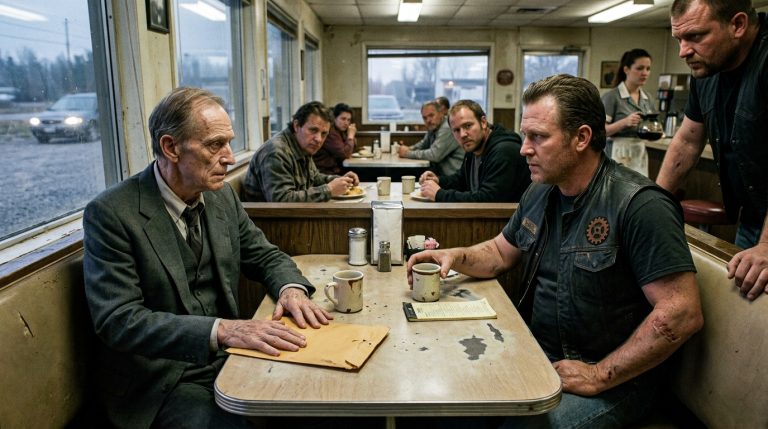
Dave Riley reviewed the compliance notice over a greasy diner table before giving the final nod.
“She thinks you’re backing down,” Dave said, tapping a pen against the legal pad. “Let her walk right into it.”
Ten days later, a generic utility van pulled up to the curb outside my house.
A hired handyman stepped out, holding a clipboard and looking up nervously at the west side of my roof line.
“Got an order from the HOA,” the man muttered, wiping sweat from his forehead. “Says I have to take down that satellite dish.”
“It’s right there,” I said, my voice entirely level. “Just mind the rose bed underneath.”
He climbed the ladder, pulled out a pair of heavy-duty cutters, and snapped the thick coaxial cable with a sharp pop.
The link went dead instantly.
Within five minutes, my phone rang with a frantic call from Steve, the community guard stationed at the front entrance.
“Jack, everything just went black,” Steve stammered over a chorus of honking car horns in the background. “The cameras are dead, the visitor logs are offline, and the main gate is stuck half open!”
“That sounds like a structural issue,” I replied, keeping my tone cool and helpful. “You should probably call Karen directly. She’s the one who ordered the equipment removed.”
I hung up, opened my email client, and hit send on the notification broadcast to all three hundred residents.
Attached was the timestamped work order signed by Karen’s own hand.
CHAPTER 5: THE TRIBUNAL AT THE AUDITORIUM
Over four hundred residents filled the rows, the murmur of collective outrage drowning out the hum of the overhead fluorescent lights.
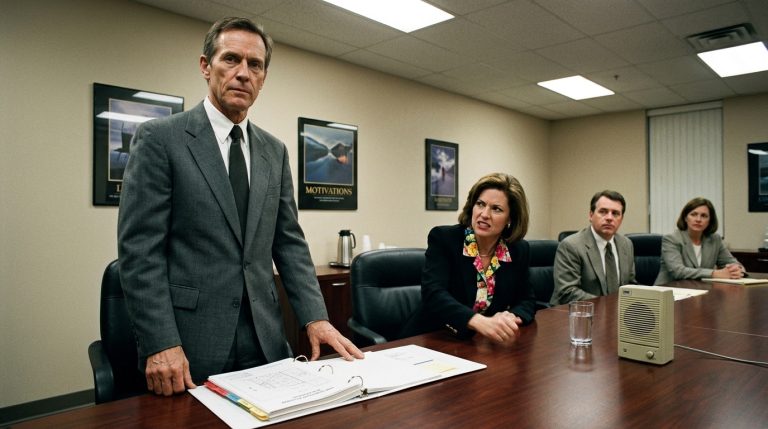
On the stage beneath them sat Karen Vance, her severe black blazer sharply contrasting with the pale, defensive set of her jaw.
Arthur Miller stepped up to the center microphone, his voice cutting through the noise with absolute, unyielding authority.
“We are not here tonight over a simple disagreement,” Arthur said, his hand gripping the metal stand. “We are here because our leadership chose to rule through intimidation and profit from our pockets.”
He handed the floor over to Dr. Emily Chen, who projected the financial audit onto the massive screen behind the stage.
The numbers didn’t leave room for debate.
Over forty thousand dollars funneled directly into Vance Services—a shell company owned by Karen’s own husband, built entirely on sub-threshold invoices designed to bypass board votes.
An audible gasp rolled through the auditorium like a physical wave.
Karen marched up to the podium, her face flushing a mottled, angry red as she slammed a stack of papers down.
“I have dedicated years to protecting property values!” she shrieked, her voice cracking under the weight of the exposed fraud. “You should all be grateful!”
The crowd erupted into a wall of boos and jeers, completely stripping away whatever illusion of authority she had left.
The neutral moderator raised his hand, stepped forward, and announced the final tally of the paper ballots.
“On the motion to recall President Karen Vance,” the moderator said into the microphone. “The vote is four hundred and twelve in favor, seven against.”
CHAPTER 6: THE DUSTY HORIZON
Karen Vance slipped out through a side exit, her husband trailing behind her in heavy silence, completely abandoned by the system they had manipulated for years.
No one called out. No one followed.
Her absolute authority had evaporated into the Texas air, leaving behind only the quiet accountability of a community that had finally reclaimed its voice.
Over the following weeks, the new interim board instituted strict financial transparency, audited past accounts, and secured a full settlement check recovering every stolen dollar.
The vague aesthetic bylaws were rewritten into clear, common-sense rules that protected property rights without feeding personal vendettas.
On a warm Saturday afternoon in late spring, the new normal settled comfortably over Oakidge Estates.
I stood by the barbecue grill outside the clubhouse, flipping a row of burgers as the heat rose off the steel grates.
Arthur Miller walked up beside me, tapping his bottled drink against the side of the metal frame with a contented grin.
“Look at that,” Arthur murmured, gesturing toward the green common area.
I looked over and saw Eleanor Miller showing off a photograph of her prize-winning rose bushes to the Rodriguez family, while Dr. Chen chatted easily with passing neighbors near the newly resurfaced tennis courts.
The front gate hummed smoothly in the distance, operating on a clean, professional contract backed by common sense and mutual respect.
My commercial satellite dish remained mounted quietly on the side of my roof, doing its job without fanfare or friction.
It was no longer an eyesore or a weapon; it was simply part of a quiet, functioning home.
I flipped a burger, listening to the satisfying hiss of the grease against the hot iron.
Peace had finally returned to the exurban fringe.