The Paper Fortress: A Veteran’s Gritty Stand for the Last Wild Acre in Oak Creek
CHAPTER 1: The First Violation
The silence of the field was usually absolute, a soft, vibrating hum of insect life that settled into your bones like a warm weight. Today, that silence was splintered. It felt jagged. I stood at the edge of the five acres, the dust of the driveway still settling on my boots, my eyes tracing the long, dark furrow where Karen’s shadow had stretched only minutes ago.
She had brought a clipboard, but she’d left behind a stench—a sterile, artificial perfume that fought against the honest, earthy musk of the milkweed. I walked out into the center of the patch, the purple cone flowers brushing against my knees like reaching hands. My hands were stained with the dark, rich compost I’d been working into the clay all afternoon. It was the only soil for miles that hadn’t been poisoned by suburban lawn chemicals, and just looking at the dark, healthy loam felt like looking at a safe room.
But the threat hung in the air, heavy as an oncoming storm. Paving it.
The words weren’t just an insult; they were a mechanical impossibility. You don’t pave a prayer. You don’t lay asphalt over a promise to a dead woman. My jaw ached, a residual tension from my days in the Corps, back when the problems were simpler: bridge structural integrity, road bearing capacity, the raw, ugly physics of war. This, however, was a different kind of engineering. This was about digging in, holding ground, and outlasting an enemy that used paper as a weapon.
I knelt, not to weed, but to feel the heartbeat of the land. My joints popped—a familiar, rusted complaint—but I ignored it. I pressed my palm flat against the dirt. It was cool, damp, and alive.
Somewhere in the distance, a screen door slammed—the sharp, unmistakable crack of a neighborhood sentinel marking my territory. I didn’t look up. I knew what they were doing. They were watching, waiting for the “weed patch” to be cleared so they could expand their parking, so they could normalize the street, so they could make everything look exactly like the bland, soulless strip malls that were slowly suffocating the county.
I stood up, wiping the grit onto my jeans. The anger was there—a white-hot coal in the center of my chest—but I did what I had done for thirty years. I packed it down. I converted the heat into fuel.
I turned back to the house, a modest ranch that felt more like a bunker now. I had less than seventy-two hours before the excavators arrived. Karen thought she had the authority of the HOA board behind her, the weight of the covenants, and the dismissive arrogance of a suburban tyrant. She didn’t know about the binder. She didn’t know that every inch of this dirt was charted, mapped, and legally tethered to the Department of Agriculture.
I reached the porch, the wood groaning under my boots. I stopped, catching my reflection in the window glass—gray hair, tired eyes, hands scarred by twenty years of hard labor. I didn’t look like a revolutionary. I looked like a retiree who’d forgotten to trim his lawn.
I stepped inside and locked the door behind me. The house was quiet, orderly, and smelled faintly of old paper and dried lavender—Sarah’s scent. I walked straight to the office. The black-spined binder was waiting on the desk, its edges worn, the brass rings clicking softly as I opened it.
I took a deep breath, the air in the room tasting of dust and cold, sharp intent. My phone vibrated on the desk. A notification from the neighborhood app. HOA Board Notice: Improvement project update. Monday, 8:00 AM.
I didn’t open the notification. I didn’t need to. I had the code. I had the regulations. I had the site plans. I sat down, pulled a fresh legal pad from the drawer, and began to write. The war wasn’t going to be won with shovels. It was going to be won with ink.
Then, I noticed it. A small, out-of-place detail on the window sill—a tiny, crushed piece of a blue flyer that hadn’t been there when I left for the garden. I hadn’t opened a window all day.
I stared at the scrap of paper, my pulse steadying into a rhythmic, calculated thrum. Someone had been at the house. And they hadn’t come to talk.
CHAPTER 2: The Paper Bunker
The scrap of blue flyer on the windowsill was a small, torn corner of an HOA neighborhood newsletter, the kind that usually advertised pet-grooming services or garage sales. But this one had been crumpled, deliberately shoved into the tight space between the frame and the sill. I didn’t touch it. I pulled a pair of nitrile gloves from my workbench drawer, the snap of the elastic sounding like a gunshot in the quiet room.
My heart wasn’t racing. It was doing something more precise: it was settling into a combat rhythm. I used a pair of long-nosed pliers to lift the paper. It was wet, likely from the humidity of the evening, and as I unfurled it under the desk lamp, I saw handwritten ink on the back—a series of numbers. 734-5B-21.
My property’s APN.
The cold knot in my gut tightened. This wasn’t an accident. This was a marker. A silent, psychological shot across the bow meant to tell me that my internal sanctuary—the one place I thought was off-limits—was visible to them. They were watching the house, not just the field.
I stood there, the pliers held steady, and let the memory wash over me. It was a phantom, an intrusive shift in my perception that felt like walking back into a command tent in the mud of a foreign theater. I could almost hear the low-frequency hum of a drone overhead, the smell of diesel fuel and dry, scorched earth. In the Army, when the enemy marked your position, it was never a random act. It was a prelude to a maneuver. You didn’t react in anger; you reacted by shifting your assets.
I turned back to the binder. The “Paper Bunker,” Sarah had called it. She had been the botanist, the one who saw the interconnected web of life, but she had understood my need for structure. She had helped me categorize these files, teaching me that if you have the right documentation, you don’t need a weapon to control a battlefield.
I spent the next two hours in a state of hyper-focused maintenance. I reorganized the tabs, grouping the USDA soil remediation reports behind the primary contract. I pulled the property survey maps, laying them out on the floor. I needed to know exactly where their proposed “guest parking” encroached on the easement. I took a red grease pencil and drew the line—a thick, jagged border that separated my private life from their corporate ambition.
Every move I made was calculated. My house was no longer just a home; it was a supply depot. I checked the batteries for the new security camera, confirming the cloud feed was active. I checked the backup hard drive, the hum of the cooling fan a steady, reassuring drone in the dark room.
I wasn’t just waiting for Monday morning. I was building a trap, layering the bureaucracy like sandbags.
My mind circled back to Karen. Her arrogance was a tactical weakness. She operated on the assumption that everyone else was as short-sighted as she was, that they only saw the surface-level issues—the aesthetics, the lawn height, the “unsightly” weeds. She couldn’t conceive of a world where someone would spend five years and thousands of hours of manual labor just to cultivate a native prairie. To her, it was a blank space, a resource to be harvested for a parking lot.
But there was something else. A flicker of doubt that nagged at the back of my mind. Why the blue flyer? Why the crude, handwritten APN on the back? It felt amateurish, beneath the slick, condescending veneer Karen presented to the world. It felt like someone else’s signature.
I looked at the map again. The proposed parking lot didn’t align with the community needs she’d cited. It was positioned strategically, right at the corner where the creek met the woods, the only spot on my five acres that actually had a stable, buildable grade.
It hit me with the force of a physical blow. This wasn’t about parking. It was about topography. If they paved that specific corner, they would establish a precedent for “infrastructure improvement” on that specific footprint. It was a foothold for a larger, structural change to the zoning.
I sat back, the chair groaning under the weight of my exhaustion. The grit of the soil still felt embedded in my skin, a reminder of the life I was fighting for. I had the documents. I had the USDA seal. But I realized now that the battle wasn’t just with the HOA president. It was with a ghost that was hiding in the footnotes of the community master plan.
I reached for my phone, scrolling through the contact list until I found the name I had been avoiding. Maria Diaz. Property law. Kicking institutional butt. I didn’t call. It was too late for that. Instead, I sent a brief, encrypted text.
The survey map shows a discrepancy in the HOA’s stated goal. It’s not a parking lot. They’re eyeing the drainage grade.
I hit send and waited. The house felt smaller, the walls pressing in. I went to the kitchen and poured a glass of water, watching the way the light from the streetlamp caught the dust in the air. I needed to stay sharp. I needed to stay invisible.
Karen wanted a fight over a weed patch? I would give her a war over the very foundation of her own bureaucracy. I walked to the front door, checked the deadbolt, and looked out into the night. The field was a dark, shifting sea of shadows, the fireflies beginning their evening dance.
They were still there. They were still alive.
I went back to the office, sat down, and opened the binder to the very first page. I started reading the HOA covenants again, searching for the specific language in the zoning preamble. I read until the words blurred, looking for the one sentence that would turn their own rules into a suicide pact for their plans.
My hands, once shaking with the anger of the confrontation earlier that afternoon, were now perfectly steady. I was a Corps engineer. I knew how to hold a line. And if they wanted to build on my ground, they were going to find out exactly how much weight this dirt could hold before the whole structure collapsed.
CHAPTER 3: The CounterStrike
I didn’t move for a long time. I just sat there, my hands still hovering over the keyboard, listening to the house breathe. My skin felt tight, a reaction to the sudden, sharp realization that my sanctuary had been violated. The scrap of paper wasn’t just a sign of presence; it was a psychological probe. They wanted to know if I was rattled. They wanted to see if the “old man with a weed patch” would scramble to protect his borders.
I stood up, the chair pushing back against the desk with a low, metallic groan, and walked to the door. I didn’t reach for the light switch. In the dark, the geography of my own home was a set of known variables. I moved through the hallway, my boots silent on the hardwood, and reached the front porch. The neighborhood was bathed in the dull, orange glow of the streetlights, Oak Creek Meadows looking like a stage set for a play that hadn’t quite started yet.
I went to the mailbox. I had four envelopes in my hand, their edges stiff with the official weight of certified mail. I’d spent the last hour refining the addresses. I wasn’t sending these to the HOA board as a collective; I was sending them to the individual directors—people like Arthur Pinter, people who had homes, families, and retirement accounts that were being used as collateral for Karen’s ego.
I walked to the end of the driveway. The night air was thick, carrying the smell of wet grass and the distant, metallic tang of the creek. My shadow stretched out before me, long and jagged under the streetlamp. As I reached the box, I heard a car turn the corner—a slow, deliberate roll. I didn’t hide. I stood right there, looking at the headlights as they cut through the dark. It was a white SUV, pristine and familiar, idling near the curb.
Karen.
She didn’t get out. She just sat there, the engine’s soft, rhythmic pulse the only sound in the street. She was watching me, waiting for me to react to the paper on my windowsill, waiting to see the fear. I didn’t give her the satisfaction. I opened the mailbox, slid the four heavy envelopes into the slot, and flagged it with a deliberate, slow motion.
The car didn’t move for another ten seconds, then slowly crept forward, rolling past my house. I caught a glimpse of her profile—the sharp, practiced tilt of her chin, the way her hands gripped the wheel like she was piloting a tank. She was performing for an audience of one, acting out the role of the neighborhood protector.
I turned and walked back to the house, the weight of the envelopes gone but the gravity of the situation doubling. The “Counter-Strike” wasn’t just the letters. It was the digital watch I had rigged to the perimeter of the field. I stopped by the workbench and picked up the tablet. The feed from the security camera was crisp, the infrared light casting the field in ghostly shades of white and gray.
I saw it then—a slight, unnatural movement near the east fence line. A silhouette. Not a stray dog or a deer. It was a figure, hunched, doing something with a measuring tape.
My eyes played tricks on me. For a second, the figure seemed to flicker, turning into a shadow I’d seen in a dozen different sites back in the service, a memory of a sapper planting a charge. I blinked, the image sharpening back into the mundane reality of a man in a windbreaker. It was likely an assistant from the excavation firm, doing a final survey, thinking they were alone.
I didn’t feel rage. I felt a cold, surgical curiosity. I grabbed my camera, the heavy lens cool and solid in my grip, and went out the back door. I moved through the tall grasses, the stalks whispering against my legs like dry, rustling paper. I wasn’t trying to confront them; I was trying to map their intent.
I reached a thicket of sumac near the property line and crouched. The air was cool, smelling of damp earth and the sharp, medicinal scent of crushed wild mint. The man was still there, his movements efficient and practiced. He wasn’t marking for parking. He was marking for drainage. He was checking the elevation of the soil, the way the water would flow if the surface were hardened.
He was confirming the grading for a commercial-grade runoff system.
The realization hit me with a hard, flat thud of clarity. Karen wasn’t just building a parking lot; she was preparing the site for a structural foundation. The “guest parking” was a decoy, a thin layer of asphalt to justify the grading, but the foundation work required for a large-scale structure was what she was really after. She was planning to hand this ground over to a developer, and they needed this specific acre, the only piece of the entire subdivision that sat above the hundred-year flood plain.
I snapped the photos, the shutter’s click soft but decisive. I waited until the man finished, packed his tape, and walked back toward the road. I let him go. Confrontation now was a waste of assets. I had the photographic proof of the grading survey, the document of the certified mail, and the cold knowledge of their endgame.
I stood up, the rustle of my jacket sounding like a warning in the stillness. I wasn’t just a veteran protecting a flower field anymore. I was an engineer defending a site against an illegal, calculated theft. I looked back at the house, the office window casting a single, steady rectangle of yellow light onto the lawn. It looked like a command center.
I walked back, my pace deliberate and rhythmic. I had a lot of work to do before Monday morning, and the clock was ticking, the seconds dropping away like lead weights.
CHAPTER 4: The Lawyers Gamble
I was still staring at the screen, the cursor blinking rhythmically like a heartbeat, when the inbox dinged. A single, aggressive notification. It was from Smith, Klein, and Abernathy—the HOA’s legal firm. I didn’t open it immediately. I let it sit there, a glowing white beacon in the dark room, while I went through a mental inventory of my current defenses.
My hands were steady, but the room felt colder now. I stood up and walked to the window. The house was settling, the wooden beams complaining under the weight of the night. Outside, the field was a black void, the fireflies long gone, the only movement the wind shifting through the tall prairie grass. They were out there, the markers, the invisible lines of encroachment that I had spent the last two days reinforcing with every piece of paper in my possession.
I turned back to the desk and clicked the email. It was short. Brutally, efficiently dismissive.
Regarding your recent communication and unsubstantiated claims: The Board of Directors of Oak Creek Meadows reiterates its plenary authority. Your attempt to obstruct the planned improvements will be met with immediate petition for a court injunction. Furthermore, be advised that any further contact with individual Board members will be construed as harassment and dealt with accordingly.
I read it twice. Then a third time. My eyes lingered on the phrasing: Plenary authority. It was the language of someone who didn’t just believe they were right, but someone who was being fed misinformation to believe they were untouchable. The lawyer wasn’t just defending a project; he was shielding a catastrophe.
I didn’t answer. I didn’t send a counter-threat. I did something much more pragmatic. I pulled the property tax records for the entire Oak Creek Meadows development. If there was a real-estate flip behind this—a hidden move to devalue the plots for corporate acquisition—the money trail had to exist somewhere. Property tax records weren’t just numbers; they were a roadmap of ownership and intent.
I spent the next three hours cross-referencing the lot numbers with the development history of the county. The room smelled of old coffee and ozone from the monitor. My eyes burned, a gritty, sharp pain that I ignored. I was looking for the silent partners, the entities that had purchased the empty lots back when the development first stalled five years ago.
And there it was. Apex Holdings. A shell company registered in a different state, holding the deeds to three of the adjacent plots—lots that had been perpetually “undeveloped” because of their proximity to the creek. The same lots that would benefit the most from the “guest parking” infrastructure I was fighting.
The lawyer’s gamble was clear now: he was betting I would panic. He was betting I would try to file a stop-work order on the parking lot, get bogged down in a civil suit, and bleed out my financial resources until I was forced to vacate. He wanted me to look like the erratic, litigious veteran who couldn’t accept community standards.
He didn’t realize that I wasn’t just fighting for the field. I was fighting for the truth of the development.
I stood up and paced the small office. The floorboards creaked—a familiar, rusted rhythm that reminded me of the old bridges I used to inspect. If the foundations were rotted, it didn’t matter how pretty the surface was. I needed to see Maria Diaz. I needed the leverage that only a formal petition could provide, but I couldn’t do it as an individual. I needed the backing of the homeowners who hadn’t been consulted.
I reached for the binder, the black spine cool against my fingertips. I turned to the back, to the section on community engagement. I had signatures—ten of them—from neighbors who had signed an informal petition back when Karen had first threatened the basketball hoops two years ago. It wasn’t legal tender, but it was a beginning.
I looked at the clock. 3:45 AM. The world was still, the suburban street outside a tomb of quiet. But the wheels were turning. I had the kickback connection, I had the corporate shell company, and I had a lawyer who loved kicking institutional butt.
The lawyer’s letter wasn’t a threat; it was a miscalculation. He had underestimated the amount of data a veteran with a Corps of Engineers background could mine from a public record. He thought I was a brick wall. He didn’t know I was the guy who knew exactly where the hairline cracks in his concrete were.
I sat back down and began drafting a response to the entire Board of Directors, carbon-copying it to the regional state conservation office and the County Planning Board. I didn’t mention the parking lot. I didn’t mention the “unsightly” weeds. I simply laid out the conflict of interest regarding Apex Holdings and the zoning violations inherent in the proposed grading.
It was a surgical strike. By the time the sun came up, I had the email ready. I didn’t hit send. I wanted to wait until the exact moment the excavators arrived on Monday morning. I wanted them to be on the site, to have their engines idling, to have their reputation on the line, before I dropped the hammer.
The silence of the room was suddenly broken by the low, distant rumble of a delivery truck passing by on the main road. The world was waking up. The threat was still out there, the “improvement project” still slated for 8:00 AM on Monday, but the playing field had shifted.
I leaned back, the friction of the chair against the carpet a grounding sensation. I felt the weight of the binder, the physical heft of five years of labor and three decades of discipline. They wanted a fight? I was ready. I’d spent my life building things that endured, and I was not about to let a group of people who couldn’t see past their own balance sheets tear down the only thing that mattered.
I closed my eyes for a moment, the image of the field—the monarch butterflies, the cone flowers, the way the light danced on the milkweed—burned into my retinas. Sarah’s dream wasn’t just a patch of dirt. It was a tactical, beautiful reality that had survived through sheer, stubborn persistence. And so would I.
I checked the tablet again. The perimeter was quiet. The survey markers were still there, small plastic flags fluttering in the early morning breeze like white surrender flags that refused to fall. I looked at the screen, the cursor still waiting for the command. I didn’t need to do anything more tonight. The trap was set, the triggers were primed, and the enemy was already walking into the killbox.
I stood up, walked to the hallway, and leaned against the wall, listening to the house settle. My body ached—the kind of deep, tactical exhaustion that comes after a long patrol—but my mind was clear, sharp as a piece of honed steel. Monday was coming. And when the sun hit that dirt, it was going to be a very, very different day than Karen expected.
CHAPTER 5: The Line in the Dust
I didn’t wait for the knocking. At 7:55 AM, I was already on the front porch, the morning air sharp and smelling faintly of dew and impending gasoline. The silence of the neighborhood had been shattered by the arrival of the flatbed truck, a hulking beast of yellow steel that shuddered to a halt at the edge of my drive. Its air brakes hissed—a long, drawn-out sound that felt like a challenge.
Behind me, the front door creaked. Dave Hastings stepped out, his Marine Corps cap pulled low, a professional-grade camcorder already braced against his shoulder. He didn’t say a word. He just moved to the edge of the porch, his posture radiating that specific, disciplined stillness I hadn’t seen since the base. He was my witness, my anchor.
Across the street, I saw the flash of movement. Karen’s white SUV had pulled into a gap between houses, positioned so she could watch the destruction of my field without having to be part of the mud and the noise. She was there, in her throne of leather and climate control, expecting me to break.
The truck driver climbed down from the cab. He was a thick-necked man in a flannel shirt, his face etched with the indifference of someone who had paved over a hundred driveways and never cared about what was underneath. He started unchaining the dozer, the metallic clatter of the links sounding like chains rattling in a cage.
I didn’t rush. I walked down the driveway, my boots hitting the asphalt with deliberate, heavy thuds. I carried only the laminated notice—the official USDA seal, the bold red letters screaming FEDERAL PROTECTION—and the binder, tucked under my arm like a shield.
“Morning,” I said, my voice steady, projecting just enough to be heard over the truck’s idling engine.
The driver glanced at me, his eyes flicking to Dave, who had the camera leveled directly at him. The driver paused, his hand hovering over a lever on the dozer’s transport rack. “You the owner?”
“I am,” I said. “And you’re about to commit a felony.”
I held out the laminated notice. He didn’t want to take it, but the look in Dave’s eyes—the unblinking, tactical focus of a man who’d seen enough chaos to know how to record it—made him hesitate. He reached out, his fingers brushing the plastic, and he took it. As he read, his expression shifted from bored indifference to a twitchy, nervous confusion.
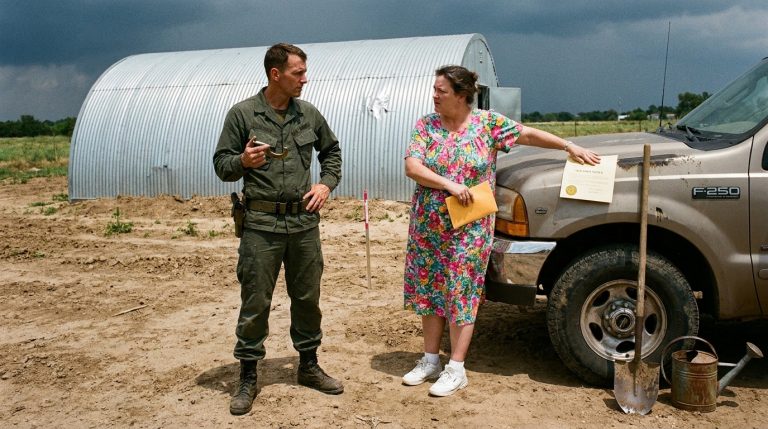
Frank, the owner of the excavation firm, walked over from his pickup. He was a man with a clipboard and a permanent scowl, but as he moved closer, I saw the flicker of doubt. He stopped, looking at the seal, then at me.
“This doesn’t mean anything,” Frank said, his voice trying to find its professional bark, though it wavered. “The HOA board signed the work order. I’ve got the permits for site clearing.”
“You’ve got a piece of paper from a homeowner’s group,” I said, my voice cold. “I’ve got a contract with the United States Department of Agriculture. If you drop a single track on that soil, I’m not calling the police. I’m calling the federal inspector. The fines start at six figures and move up to prison time. Read the footer.”
Frank’s eyes dropped to the bottom of the page. The red lettering—the explicit, legal threat—seemed to drain the color from his face. He looked at the field, the riot of life that was currently shivering in the morning breeze, and then he looked back at the street.
That was when the failure happened. I reached for my tablet to check the recording status, a secondary verification of the scene, but the screen flickered, went black, and then pulsed a bright, static-filled white. The humidity, or perhaps the magnetic interference from the heavy engine, had shorted the feed. My primary recording device was gone.
A flash of genuine, cold fear surged in my chest—not for me, but for the evidence. If the feed was corrupted, the burden of proof shifted. I felt the momentary instability, the ground seeming to tilt. But then I looked at Dave. His camcorder hadn’t skipped a beat. He was still rolling, his focus absolute.
I turned back to Frank, my mind working at a fever pitch. I had to maintain the illusion of total control. I didn’t let my expression waver.
“The feed is being backed up to a secure server,” I lied, my voice steady as stone. “Every second of this conversation is being logged by the USDA’s field office. If you turn that key, you’re not just breaking a contract. You’re becoming a federal case.”
Frank looked at the sky, then at the dozer, then at the empty house behind him. He didn’t want to be a federal case. He wanted to pave a parking lot and go home. He jerked his head at the driver, a quick, angry snap.
“Pack it up,” Frank spat. “We’re not doing this. I told the board I wasn’t going to get in the middle of a lawsuit, and I meant it.”
The driver didn’t argue. He hopped into the cab, the diesel engine revving as he began to reverse the dozer back onto the bed.
Across the street, I saw the SUV door fly open. Karen stepped out, her face a mask of incandescent, unadulterated rage. She didn’t look like a president of an association anymore. She looked like a cornered animal. She started across the street, her heels clicking aggressively on the pavement, but I didn’t wait for her. I turned my back on her, the ultimate act of defiance, and walked back toward my house.
The war had moved from the realm of paper and into the realm of raw, kinetic confrontation. The field was still standing. The bulldozers were retreating. But as I climbed the steps to my porch, I knew this wasn’t the end. The look on Karen’s face told me that if she couldn’t win with a dozer, she would find a way to destroy me another way.
I sat on the porch, my pulse finally beginning to settle, and watched the truck turn the corner. Dave kept the camera on them until they were out of sight, then lowered it, his face unreadable.
“They’ll be back, Jack,” Dave said, his voice a low, gravelly rasp. “Maybe not today. But they’ll be back.”
“Let them come,” I replied, feeling the heavy, grounded weight of the soil beneath the porch. “I’ve got plenty of paper left.”
CHAPTER 6: The Paper Shredder
I didn’t move from the porch for an hour. The morning sun climbed, sharpening the shadows of the oaks, but the chill in my blood—the cold, tactical awareness—remained. Dave had gone home to change, but his camcorder sat on my kitchen table, a silent witness to the retreat. I stood up, my knees stiff, and walked back into the office. It felt different now. The room was no longer just a workspace; it was a crime scene.
I pulled the HOA audit trail from the shelf. I had been sitting on these documents for three days, waiting for the right moment to cross-reference them with the Apex Holdings filing. The “shredder” was what Maria Diaz had called it—the moment the paper trail became an executioner.
I spread the bank statements across the desk. Pinter, the treasurer, had been sloppy. He’d kept records of every “consulting fee” paid out over the last eighteen months. I pulled the Apex filing, the shell company’s registration date, and the transfer of funds.
There it was. A six-figure transfer to a private account held in the name of a business entity called Oak Management, registered two weeks before the parking lot motion was introduced. I cross-referenced the signature on the Oak Management filing with the HOA board minutes.
Karen’s signature.
It wasn’t just a kickback; it was a complete, coordinated liquidation of the neighborhood’s assets for a private payout. The parking lot was never about utility. It was about clearing the title of those lots so Apex Holdings could take possession without the nuisance of “undeveloped” legal disputes. They were using the HOA to do their dirty work, to force a development change that would artificially boost the property value for Apex while bankrupting the homeowners with special assessments.
I felt a flash of V-1, the micro-mystery surfacing as I noticed a tiny, handwritten notation in the margin of a bank statement—a date, August 12th, marked in a frantic, hurried hand. That was two days from now. The day the “guest parking” was supposed to be finalized. They weren’t just paving a lot; they were hitting a deadline.
I picked up the phone. My hand felt steady, the grip firm. “Maria,” I said as soon as she answered, skipping any pleasantries. “I have the smoking gun. It’s not a parking lot. It’s an asset stripping scheme. Oak Management is Karen’s shell company. She’s selling the easement rights to Apex Holdings.”
There was a silence on the other end, long and deliberate. “Jack,” she said, her voice dropping into a register of sharp, focused professional alarm. “If this is true, this isn’t just a civil tort. This is wire fraud, embezzlement, and a massive criminal conspiracy. Do you have physical copies?”
“I have the originals,” I said. “And the digital logs.”
“Don’t send them,” she commanded. “I’m coming over. We need to secure these before the board realizes we’ve found the link. They’ll try to wipe the servers. Pinter is already looking for a way out, but Karen? She’ll burn the whole neighborhood down to save her own skin.”
I hung up, the silence of the office rushing back in. The air felt thin, metallic, the scent of dust and old paper now mixed with a sharp, ozone-like anxiety. I gathered the files into a single, stackable unit. I didn’t use a briefcase; I used a simple, beat-up cardboard box. It was nondescript, the kind of thing that would go unnoticed if I had to move fast.
I walked to the window. The street was quiet, but it felt like a trap. I saw a dark sedan, parked two houses down—not the Millers’, not Dave’s. It had been there for twenty minutes. My stomach tightened.
I wasn’t just observing the battlefield anymore; I was the target.
I returned to the desk and grabbed the hard drive. I popped the drive from the casing, the small, silver rectangle feeling like a heavy, dense secret in my palm. I went to the back door, checked the yard—empty, the tall grass swaying in a sluggish, lazy rhythm—and stepped out.
The heat was rising now, the sun beating down on the field. I walked to the old shed at the back of the property, the structure leaning against a patch of blackberry brambles, its wood rotting and gray. It was my backup. I had installed a floor safe under the workbench, disguised by a stack of old potting soil bags.
I opened the safe, placed the hard drive and the physical ledgers inside, and spun the dial. I didn’t trust the cloud anymore. In a war of paper and digital ghosts, physical possession was the only rule that mattered.
As I walked back to the house, the grass tickling my ankles, I saw a figure standing at the edge of the driveway. It was Karen. She wasn’t driving. She was walking, her movements stiff, her face devoid of the performative fury she’d worn on Monday. She looked small.
I stopped ten feet away. I didn’t say a word. I just waited, the weight of the binder still in my mind, the knowledge of the Oak Management scheme a weapon I held in reserve.
“You think you’re so clever, Jack,” she said, her voice sounding thin, like paper tearing. “You think you’ve won because you stopped a few trucks. But this place? It’s not a sanctuary. It’s a liability. And you’re just standing in the way of what’s coming.”
“What’s coming isn’t development, Karen,” I said, my voice quiet, cutting through the humid morning air. “What’s coming is an audit.”
She stared at me, the mask finally slipping. For a split second, I saw the genuine, raw panic in her eyes—the realization that I knew. Not just that I was a nuisance, but that I had pulled the thread that would unravel the entire, rotting tapestry she had woven.
She turned and walked away, her steps uneven, her posture broken. I watched her go, the feeling of victory replaced by a grim, hard-edged pragmatism. The fight was far from over. She wouldn’t just fold. She would fight until the bitter, ugly end. And I would be there to ensure she didn’t have a single place left to hide.
CHAPTER 7: The Town Hall Siege
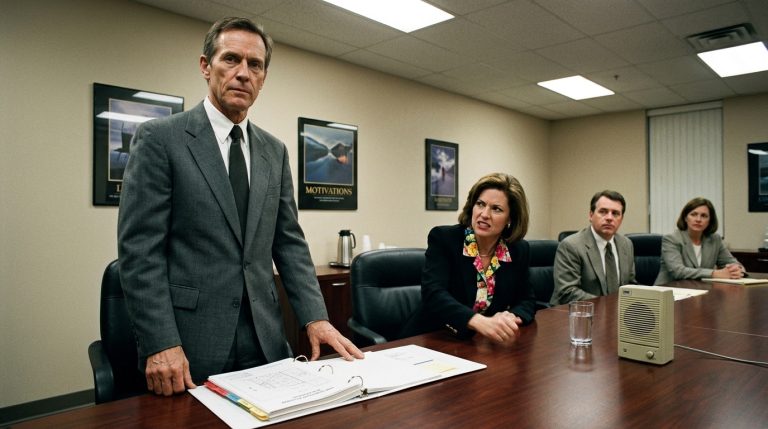
The community clubhouse was a humid, stifling box, the air thick with the smell of floor wax and the collective, low-frequency hum of three hundred angry people. I stood in the back row, my shoulder blades pressing against the cold, metal frame of a folding chair. Next to me, Maria Diaz held a leather-bound folio, her composure absolute. Across the room, Karen Peterson sat behind a long table, flanked by the remnants of her board. She looked like a general waiting for the final, inevitable artillery barrage.
The room erupted as Pinter, the treasurer, stood up to speak. His voice wasn’t loud, but it had the hollow, desperate quality of a man who’d already lost everything. He was dumping the evidence, throwing the emails and the bank statements onto the table like discarded shells. Every time a new document hit the surface, the room surged—a literal wave of noise and movement.
I didn’t watch Karen. I watched the room. I saw the Millers, their faces tight with a righteous, protective anger. I saw Dave Hastings, his arms crossed, his gaze fixed on Karen with the predatory focus of a soldier watching a target.
“This isn’t just about a parking lot!” Pinter shouted, his voice finally cracking. “She sold our easement rights to Apex Holdings! She used our dues to fund her own private kickback scheme!”
The silence that followed was visceral. It was the sudden, complete vacuum of a room where every single person realizes the scale of the betrayal. Karen’s face didn’t crumble; it hardened into a mask of pure, crystalline malice. She looked across the crowd, scanning for a defender, a way out, but there were no allies left. Her lawyer leaned in, whispering something in her ear, but she brushed him off with a violent, impatient gesture.
I stepped forward. The floorboards groaned—a familiar, rusted rhythm. I didn’t need to yell. I moved toward the table, the cardboard box heavy in my grip, its bottom edge cutting into my palms. I felt Sarah’s voice in my head, a phantom whisper of pragmatism, reminding me that the hardest part of building a bridge was ensuring the foundation wasn’t hollow.
I set the box down on the folding table with a dull, final thud.
“The parking lot was a decoy,” I said, my voice cutting through the remaining noise like a blade. “It was never about community amenities. It was about grading the land so a shell company could take possession of our property titles once the HOA was forced into bankruptcy by the fines.”
Karen stood up then, her movements jerky, erratic. She looked at me, and for a second, the mask vanished. She wasn’t a tyrant anymore. She was just a woman who had gambled everything on the assumption that no one would ever look close enough to see the cracks.
“You’re a liar, Jack,” she hissed. “You’re just a bitter, lonely man who couldn’t stand the idea of a little order.”
“I’m a man who builds things that last, Karen,” I replied. “And you’re a woman who built her empire on sand.”
The room surged again, but this time, it was a collective turn toward the table. The vice president, a woman who had been bullied by Karen for months, stood up and took the gavel. Her hands were shaking, but she held it tight.
“Karen Peterson,” she said, her voice rising to meet the moment, “you are hereby removed from your position, pending a full forensic audit and the arrival of local law enforcement.”
Karen didn’t argue. She didn’t bargain. She simply turned and walked away. She moved through the crowd like a ghost, the people parting as if she were carrying a contagion. As she reached the door, she stopped, looking back once, her eyes locking onto mine. There was no apology there. Just a cold, empty hatred—the look of someone who had lost the only thing that gave her life meaning.
I turned back to the room. The air felt different now. The tension hadn’t vanished, but it had shifted from the sharp, jagged edge of conflict to the heavy, grounding weight of accountability. The Town Hall wasn’t just a meeting anymore; it was a reclamation.
I looked at the box, the ledgers and bank statements still tucked inside, and felt a strange, quiet peace. The siege was over. The field was safe. Sarah’s dream wasn’t just a patch of weeds. It was the bedrock. And tonight, the neighborhood had finally realized that the real value of Oak Creek Meadows wasn’t in the asphalt or the property titles, but in the soil beneath our feet—the messy, untamed, resilient truth that we had spent the last week fighting to keep alive.
The room began to clear, a slow, steady stream of people moving toward the exits, their faces marked by a new, sober understanding. I stayed by the table, my hands finally letting go of the cardboard, feeling the sting of the grit in my palms. It was done. But the work of rebuilding—of mending the fences and restoring the trust—was only just beginning.
CHAPTER 8: The Settlement
The ink was dry. That was the first thing I noticed when I sat down at the table—the way the signature on the conservation easement caught the morning light, dark and permanent against the stark white of the legal paper. It wasn’t just a document; it was a physical barrier, a line of iron-clad reality that no future developer or power-hungry board could cross.
Maria sat across from me, her briefcase packed, her expression one of weary, professional satisfaction. The room felt different—emptier, perhaps, now that the chaos of the last week had been drained from the walls. “It’s done, Jack,” she said, her voice soft. “The county registrar has the original. The HOA has been officially served with the notice of permanent easement. The Apex Holdings contract has been voided due to the fraud investigation. It’s over.”
I nodded, the sensation of relief not a rush, but a slow, heavy settling in my chest. I looked out the kitchen window toward the field. The sunrise was beginning to touch the tops of the purple cone flowers, turning them into beacons of light against the deep, rich green of the prairie grass.
“What about Karen?” I asked.
“She’s gone,” Maria replied. “She didn’t wait for the audit. She cleared out her house on Friday night. Most of her accounts have been frozen by the investigators. Between the federal fines and the civil suit for damages, she won’t have enough left to buy a studio apartment in the city, let alone run another HOA.”
It felt like poetic justice—a cold, calculated accounting. She had sought to strip the community of its heart, and in the process, she had stripped herself of everything.
After Maria left, the silence of the house returned, but it was a different kind of quiet now. It was the silence of a structure that had been reinforced, the load-bearing walls finally carrying the weight they were meant to support. I went into the office and took the binder off the shelf—the “Paper Bunker.” It felt lighter in my hands. I placed it on the desk and opened it to the very last page, where I had kept Sarah’s original hand-drawn plans for the prairie.
They were still there, the ink slightly faded, the lines meticulous and beautiful. I picked up a small, weathered trowel from the desk—the one I had used to break the first layer of clay five years ago—and headed out the back door.
The field was waiting. It was different today. The air felt cleaner, sharper. I walked to the edge of the patch where the grading survey markers had been placed—the spot where the dozer had almost chewed through the earth. I spent an hour pulling out the last of the plastic flags, the snap and pop of them leaving the ground sounding like a final, retreating volley of small arms fire.
I knelt in the dirt, the familiar grit staining my palms, the earth cool and steady beneath me. I didn’t feel the need to rush. The rush was over. I dug a small hole near the base of a milkweed cluster and buried the last of the flags, then patted the soil down with the flat of my trowel. It was a small act of repair, a simple, tactile gesture of closing a wound.
I sat back on my heels, the field humming with the steady, golden drone of a thousand pollinators. I saw a monarch butterfly, its wings iridescent and fragile, land on a stalk of prairie clover. It didn’t hesitate. It just worked, searching for the nectar it needed to survive.
“We did it,” I whispered, the words hanging in the air, caught by the breeze.
The weight of the last few weeks began to lift, replaced by the deep, resonant peace of a task completed. The neighborhood wasn’t perfect. It was still a suburban development, still full of people who sometimes worried too much about the height of their grass, but the underlying rot had been cut away. The sense of community I had fought for wasn’t a static thing; it was a living, breathing process, one that required constant, careful stewardship.
I looked at my hands—stained with dark, rich soil, the scars from years of work standing out against the dirt. They were the hands of a man who had survived a war and come home to build something that would outlast the noise.
I went back to the porch and sat in the chair, watching the sun climb higher, the field glowing with the vibrant, messy, beautiful truth of a promise kept. The binder was inside, the legal battles were won, but the real work—the work of living, of watching things grow, of being part of something that actually mattered—was only just starting. And for the first time in a long time, I didn’t feel the need to calculate the next move, or verify the perimeter, or wait for the enemy to arrive.
I just sat there, listening to the hum of the field, and felt the earth, solid and unchanging, holding me up. It was a good day to be alive. It was a good day to watch the world grow.