A Hard-Earned Acre of Water, a Dead Man’s Lease, and the Quiet Collapse of Neighborhood Tyranny
CHAPTER 1: The First Notice
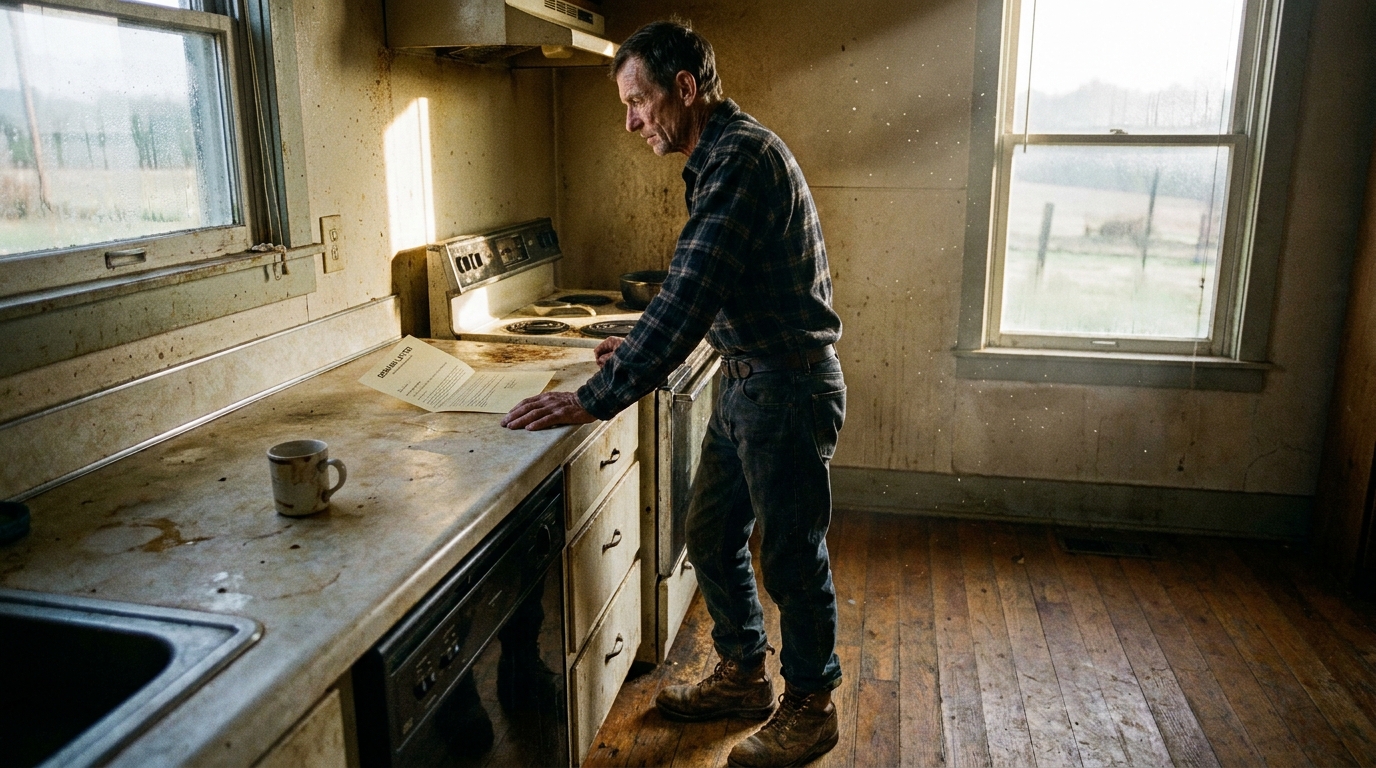
The kettle on the stove hissed, spitting a narrow plume of steam against the grease-stained wall behind it. I didn’t rush to turn it off. I kept my eyes fixed on the cream-colored envelope resting next to the deed.
My name was printed in sharp, mechanical block letters. No handwriting. No courtesy.
I picked up the envelope, slid my thumb beneath the flap, and pulled out the single sheet of heavy bond paper. Dolores Shrunk didn’t waste words when she thought she held the upper hand.
It laid out a demand for twelve hundred dollars as an annual community permit fee to maintain access to what she boldly called the Clearwater Pines municipal waters. Twelve hundred dollars to stand on dirt I bought and paid for with forty-seven thousand hard-earned dollars from an estate sale.
I walked over to the front window, the floorboards groaning slightly beneath my boots. Outside, the morning mist was still clinging to the dark, six-acre surface of Mill Lake.
Eleven boats bobbed lazily against the wooden docks at the edge of my property line. None of them belonged to me, and not a single owner had ever offered a handshake, let alone a dime, since I took title.
Dolores assumed a fresh face in the neighborhood meant an easy mark. She figured my silence while I unloaded my truck last week was a sign of weakness or ignorance.
I set the letter down on the counter and reached for my mug, letting the hot coffee burn my tongue just enough to ground me. Without a lawyer to lean on, every move had to be calculated down to the letter of the Virginia property code I spent nights studying under a flickering desk lamp.
I set the mug back down, walked out the front door, and headed straight down the pine-needle path toward the water.
CHAPTER 2: The Paper Trail
The county records office smelled like forty years of floor wax and wet wool.
I didn’t have an attorney to pull the files for me, so I sat at the scratched oak table with a stack of plat maps and tax assessments.
Dolores had filed three different preliminary site plans over the last decade, all listing the waterfront parcel as community common ground.
My finger traced the parcel lines on the 1994 survey map, noting how the original developer had carved out the six-acre lake as a separate tax parcel entirely distinct from the residential lots.
A crumpled county permit application caught my eye from the recycling bin beside the public copier, bearing an unauthorized signature scrawled in blue ballpoint over the HOA letterhead.
Someone had tried to push a dock expansion through the zoning board just four months before Harlon passed away, entirely without a deed or a signature from the rightful owner.
I folded the discarded form, slid it into my breast pocket, and walked out into the gray afternoon air.
CHAPTER 3: The Harriet File
Harriet pulled her wool cardigan tighter around her shoulders, her fingers trembling slightly against the ceramic mug of black coffee I had slid across the laminate.
—I found it stuffed in the back of Harlon’s desk drawer when I helped clean his workshop before the estate sale, —she said, her voice dropping to a harsh whisper.
I opened the folder, revealing a draft agreement from March 2019 bearing Harlon’s looping cursive and a formal lease proposal offering annual lake access to the Clearwater Pines association for thirty-six hundred dollars.
Stapled to the back was a certified mail receipt showing Dolores had signed for the delivery herself, tucking the proposal away into a filing cabinet while continuing to use the water for nothing.
—She knew it was private land the entire time, —I murmured, tracing the signature with the tip of my thumb.
Harriet stared down into her coffee, her jaw tightening as the full weight of the deception settled over the kitchen table.
—If the board finds out she ignored a valid lease just to play dictator, we’re all going to look like fools for trusting her, —she said, standing up abruptly from the wooden chair.
CHAPTER 4: The Public Exposure
I didn’t yell, and I didn’t make threats.
I printed out the exact property descriptions, the deed numbers, and a clean copy of Harlon’s 2019 lease proposal that Dolores had buried in her files.
Each envelope contained the raw documentation showing that the lake was privately owned and that the association had spent two decades taking water access for granted without a single legal right.
I sealed the final flap, the adhesive tasting of stale paste against my tongue, and carried the heavy bundle out to the roadside box.
Within forty-eight hours, the neighborhood group chat was burning through digital ink with frantic accusations and defensive denials.
Dolores posted a long, desperate message calling it malicious misinformation designed to divide a peaceful community, but she conspicuously avoided mentioning the lease.
She could spin whatever fairy tale she wanted on a computer screen, but paper trail facts have a stubborn way of cutting through noise.
The quiet rhythm of the subdivision had fractured, and the pressure was finally shifting directly onto the woman who built her entire authority on hollow ground.
CHAPTER 5: The Boardroom Collapse
The low murmur in the room snapped into a dead, heavy silence the second my boots hit the linoleum.
Dolores stood at the front folding table, her face flushed a mottled crimson above her beige blazer, tightly gripping a plastic gavel like a weapon. She didn’t wait for me to take a seat near the back wall.
—This man is attempting to destroy fifty years of community tradition with manipulated paperwork! —she announced, her voice shrill and vibrating with forced outrage, pointing the gavel directly at my chest.
She turned to the crowd, leaning over the table.
—He wants to lock your children out of the water, and he’s using fake documents to scare you into letting him steal what belongs to all of us.
I didn’t raise my voice, just pulled the original crumpled county permit application from my breast pocket, smoothing it out against the top of a plastic chair back.
—The only fake document here is the county zoning permit you forged three years ago, trying to build on a tax parcel you didn’t own with twenty-two thousand dollars of resident dues, —I said, letting the flat, unvarnished truth carry across the silent room.
The blood drained entirely from Dolores’s face, her grip on the gavel slipping just enough to let it clatter against the folding table.
She opened her mouth, closing it twice as she desperately searched the faces of her board members, but the quiet rustle of thirty neighbors unfolding the county tax records I had mailed them was the only sound left in the room.
CHAPTER 6: The New Shoreline
The pen felt cool and steady against my fingers as I signed the bottom line, wrapping up weeks of stubborn friction without a single lawyer to guide my hand.
The new board had stepped up immediately after Dolores packed her boxes, voting unanimously to formalize the arrangement under fair, common-sense terms.
They would pay three thousand dollars annually toward shared maintenance, and the lake would stay open for everyone who respected the property boundaries.
I rolled up the signed document and walked down the pine-needle path toward the water, the familiar morning mist hanging low over the dark surface.
Down at the shoreline, the old splintered boards were already gone, replaced by a solid, professional structure built by a local crew I hired with the first installment check.
Several neighborhood kids stood near the end of the new dock, casting their lines into the cold water just the way old Harlon would have wanted it.
I uncapped a thermos of black coffee, listening to the frogs quiet down as the sun cleared the tree line, leaving nothing behind but absolute, hard-earned peace.