The Surveyor’s Vengeance: A Meticulous Deconstruction of a Suburban Tyrant’s Engineered Empire
CHAPTER 1: The Empty Puncture
The morning air tasted like wet pine and the specific, metallic tang of cold earth. I stood perfectly still on the edge of the unincorporated island I’d fought for, my boots sinking slightly into the soft, dew-laden soil. My gaze was fixed on the space where, twelve hours ago, a fluorescent yellow survey marker had stood with the authority of the law.
Now, there was only the hole.
It was a clean, angry breach in the ground. Someone had not just plucked the marker; they had excavated it with deliberate, hateful precision. I looked down at the mud. The impress of a heavy-duty tool—a crowbar, judging by the leverage marks—was still visible, a fresh, crescent-shaped scar in the dirt.
I felt the familiar tightening in my chest, not the erratic pulse of panic, but the cold, rhythmic contraction of a professional identifying a tactical threat. This wasn’t the work of a curious neighbor or a local teenager. This was a targeted strike.
My eyes shifted toward the sprawling, beige expanse of Willow Creek Estates. The houses there sat in a row like silent, judgmental sentinels, their windows reflecting the pale, rising sun. A curtain in the house directly bordering my property twitched. Just once. A quick, sharp flick of fabric that confirmed the observer was watching.
Karen.
I knelt, ignoring the damp that began to seep through the knees of my jeans. I pulled my phone from my pocket and switched to the camera. I didn’t rush. I captured the empty hole, the discarded wooden lath lying three feet away like a severed limb, and the precise trajectory of the disturbance. I recorded the house in the background, a stationary piece of evidence that placed the suspect’s fortress in the frame.
The financial loss was a thousand dollars. That was the surface reality—the sting of the bill I’d paid Ben, the time he’d spent in the heat, the legal weight of the survey documents now sitting on my desk. But the deeper intrusion was the audacity. She had decided that the lines I had drawn—lines sanctioned by the county, by logic, and by engineering precision—were subordinate to her desire for aesthetic control.
A distant sound—the slide of a patio door—reached me through the stillness.
I didn’t turn around. I remained on my knees, observing the soil. My heartbeat was a steady, low-frequency hum in my ears. I saw her shadow fall across the boundary line, a long, distorted shape stretching toward my feet. I could feel her presence, the heat of her indignation radiating through the humid morning air. She wanted me to look up. She wanted me to protest, to beg, to scream—to lose the composure that had kept me alive in theaters of operation far more hostile than a suburban cul-de-sac.
I stood up slowly, tucking the phone away. I kept my face neutral, a mask of stone. I looked at the hole one last time, measuring it, cataloging the depth, and then I turned toward the treeline of my property. I had the photographic evidence. I had the coordinates stored in the digital record.
As I walked away, I heard a sharp, high-pitched voice shatter the morning quiet, slick with that venomous, practiced sweetness.
“Those little sticks don’t mean anything here, Mr. Hayes. I decide where your property ends and my community begins.”
I didn’t break stride. I didn’t offer the dignity of a reply. Instead, I reached into my pocket and touched the cold edge of my phone, knowing that her first victory was already being archived as her final, irreversible mistake. I had the coordinates, I had the proof, and I knew exactly who to call. The war hadn’t started today; it had been decided the moment she touched the iron.
CHAPTER 2: The Engineers Ledger
The silence that followed Karen’s retreat was not empty; it was pressurized. It hummed in the air, a physical weight that pressed against the back of my neck. I stood over the empty puncture in the earth for a long minute, watching the way the shadows of the morning sun began to crawl across the disturbed soil. The temptation to march across that lawn and demand she replace the marker was a physical urge, a knot of muscle and bone in my shoulders. I crushed it.
Impulse was for the undisciplined. It was a luxury for those who didn’t understand the physics of pressure.
I reached down and picked up the discarded wooden lath. It was light, pine-wood, snapping in my grip with a hollow, brittle sound. I tossed it onto the pile of debris near my truck. My phone buzzed in my pocket—a text from Ben. Saw the notification on the surveyor logs. Something’s wrong with the perimeter, Alex. Give me a call.
I walked toward the gravel path I’d laid, the sound of my boots crunching against the stone the only rhythm in the desolate morning. I dialed his number as I reached the driver’s side door of my truck. He answered on the first ring.
“She pulled them, didn’t she?” Ben’s voice was clipped, stripped of the usual brotherly warmth. There was only the professional, analytical detachment of a man who dealt in the absolute truth of degrees and minutes.
“Every one,” I said, leaning against the cold steel of the truck bed. “She walked out with a crowbar, acted like she was pruning a rosebush, and wrenched them out of the ground. She didn’t just move them, Ben. She tried to erase them.”
“She’s an idiot,” Ben muttered. The sound of rapid typing came through the line. “She doesn’t understand what she’s messing with. Those markers aren’t just plastic and rebar. They’re legal monuments. If I filed the record of survey, and I did, those points are attached to the county’s official plat map. She just committed a class C felony.”
“She’s not thinking about the law,” I said, looking back at the house that was still watching me. “She’s thinking about her own ego. She thinks her HOA rules override the state statutes. She thinks this is a game of who can shout the loudest.”
“Then we stop shouting,” Ben said, his voice hardening into the cadence of a project manager overseeing a site failure. “If she wants to play with the foundations, we’ll show her how a real structure is built. I’m driving down. Don’t touch anything else. Don’t go near her. I want you to document the exact state of the site. Photos, time-stamped, every corner. I need a clear trail of evidence that these were not just moved, but destroyed with malicious intent.”
“I’m already on it,” I replied.
“Good. And Alex? This is the last time she touches those markers. Next time we stake this out, it’s going to be in a way that requires a machine to move.”
I hung up and stood in the quiet of my two-acre island. The memory of a decade spent in the Army Corps of Engineers suddenly surfaced—the way we reinforced bridgeheads, the way we calculated load-bearing capacity to ensure that whatever we built would hold under any stress. This land was my bridgehead. The workshop I planned was my command center.
I looked at the house again. The curtain was still there, but now, a flicker of light shifted behind the glass. She wasn’t just watching; she was waiting for a reaction. She wanted me to escalate. She wanted a neighborly spat that she could resolve with a fine, a threat, a letter on pink paper.
She had no idea that I wasn’t a neighbor. I was a structural engineer.
I walked the perimeter of my land, my eyes trained on the ground, cataloging the subtle discrepancies in the soil. Where she had wrenched the rebar, she had left wide, jagged craters that wouldn’t heal for weeks. The lack of symmetry in her destruction was itself a data point. It was erratic, driven by passion, not precision.
I pulled out my notebook, the leather cover worn from years of use, and began to map the site. I wrote down the coordinates, the depth of the holes, the exact location of the discarded stakes. I didn’t write as a victim; I wrote as an auditor.
My mind began to drift toward the legal implications. If these were official monuments, then the destruction wasn’t a civil tort; it was a criminal act. I had the photographic proof. I had the witness in the house—the window was open, and I could hear the faint, high-pitched clatter of her working in her kitchen.
I sat on the tailgate of my truck and pulled out my laptop. I didn’t open social media or check the news. I opened the file for the county recorder’s office. I needed to see the original plat map for the area, to ensure the boundaries were as impenetrable as I remembered. I pulled up the digital survey documents.
There, in the bottom corner of the digital sheet, was the surveyor’s seal and the date of the last major assessment. It was an older survey, but it held. And it showed, with absolute, mathematical certainty, that my land was an island, unencumbered by the Willow Creek Estates’ bylaws.
A shadow fell over my laptop. I looked up. Karen was standing on the edge of her patio, holding a garden hose. She wasn’t spraying anything. She was just holding it, a coiled serpent of green rubber. She was looking at me, her face a mask of smug certainty, the lines around her mouth set in a permanent, tight-lipped grimace of disapproval.
She didn’t speak. She just stood there, waiting for me to react, to be intimidated, to show that the disruption of my plans had shaken me.
I didn’t give her the satisfaction. I turned my attention back to the screen, my fingers moving across the keys with steady, rhythmic purpose. I was building a different kind of structure now. It wasn’t a garage, not yet. It was an evidence file. Every line of data I pulled, every regulation I cross-referenced, was a brick in a wall I was building between her and the peace I had rightfully earned.
The wind picked up, rustling the pines. I breathed in the air, scenting the damp earth, and felt a strange, cold peace descend. She thought she was winning because she had moved a few pieces of metal. She had no idea she had just handed me the blueprints for her own defeat.
CHAPTER 3: Surveillance Calibration
The garden hose in Karen’s hand remained coiled, a silent, useless snake. She didn’t advance, and she didn’t retreat. She simply held her position on the edge of the patio, staring across the boundary line with a gaze that felt like a tactile weight against my skin. I didn’t look up again. I kept my eyes on the screen of my laptop, the reflection of the morning light dancing off the keyboard as I finished the final entry of the site map.
When I finally shut the lid, the soft click of the latch sounded unnaturally loud in the open air. I looked toward the patio. The space was empty. The glass door had slid shut, a seamless transition back into the beige sanctity of Willow Creek. She had vanished, but the pressure of her observation remained.
I stood up, the joints in my knees protesting the dampness of the ground, and turned to the back of my truck. Ben would be arriving within the hour. The instructions we had discussed on the phone were etched into my mind: document, fortify, record.
I began with the cameras. These weren’t the standard trail cams one might buy at a hardware store; these were rugged, low-profile units with infrared illuminators, designed for long-term deployment in hostile environments. I moved to the oak tree on the western edge of the property, the rough bark cool and damp under my palms. I climbed the first few feet, finding a natural notch where the foliage was thickest, and secured the first unit.
As I tightened the straps, I caught a glimpse of the digital display. The device was active. I adjusted the lens, angling it so that the entire span of the property line was captured in a wide-angle, monochrome sweep. It was then that I noticed it—a subtle distortion in the corner of the frame. I tapped the screen to zoom in. It was a secondary, motion-activated light sensor attached to a nearby fence post on her side of the line. It wasn’t just observing; it was a trigger. She was monitoring the very movement of the air.
I climbed down, my pulse steady. The realization didn’t produce fear; it produced a plan. If she wanted to watch, I would provide a performance that satisfied her—and hid the true nature of my work.
I spent the next forty minutes placing the other two units, one hidden within a tangle of overgrown honeysuckle that masked the northern corner, and a third clamped to the interior support of the gravel path’s gateway. Each was a silent eye, a digital witness that couldn’t be bribed, intimidated, or reasoned with.
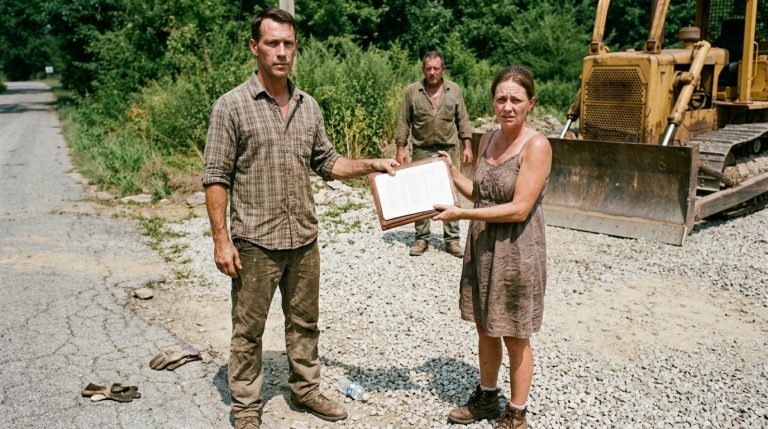
As I worked, the sound of a heavy engine turning into the gravel drive signaled Ben’s arrival. His Ford F-250 pulled in, the tires crunching with a deliberate, aggressive authority. He stepped out, his high-visibility vest bright against the desaturated palette of the dirt and trees. He wasn’t alone; Carlos was with him, carrying the total station tripod like a professional soldier carrying a rifle.
“Talk to me,” Ben said, his greeting devoid of pleasantries. He walked straight to the empty hole where the monument had been, his boots stopping inches from the crater.
“She stood there with a hose for ten minutes,” I said, pointing toward the patio. “She’s watching. Every move, every shift in the dirt.”
Ben didn’t look at the house. He looked at the hole. “Then let’s give her something to look at.” He signaled to Carlos, who began the setup. They moved with a choreographed efficiency, the tripod legs extending, the total station clicking into place with a sharp, mechanical finality.
“We’re not just staking it,” Ben said, his voice dropping to a low, tactical murmur. “We’re going to set these so deep and so fixed that she’ll need a backhoe to move them. And while we do it, we’re going to ensure the entire perimeter is mapped into a recorded file that’s physically impossible to contest.”
He handed me a set of heavy, steel-capped survey stakes. “Start here. Hammer them down every five feet. If she asks, you’re marking the path for a future fence. Which isn’t a lie, just not the whole truth.”
I took the mallet from the back of the truck. The weight of it was solid, balanced, and reassuring. I started the work. The thud, thud, thud of the mallet against the steel stakes became a rhythmic counterpoint to the distant hum of the morning commute. It was a grounding, physical task, a way to anchor my presence into the earth.
With every strike, I felt the tension of the last twenty-four hours dissipate, replaced by the cool, hard logic of the engineer. I was no longer just responding to a vandal; I was constructing a defensible position. Every stake was a commitment. Every inch of soil disturbed was a move in a game she didn’t know she was already losing.
As the sun climbed, the heat began to rise, shimmering off the gravel. I looked toward the house again. The blinds were fully drawn, a solid, impenetrable barrier against the light. She was still there, lurking in the shadows of her own construct. I gave the final stake a heavy, resounding blow, driving it flush with the dirt.
The line was set. It wasn’t just a boundary anymore; it was a tripwire.
I stood back, wiping sweat from my forehead with the back of my hand. Ben was checking the total station, the laser beam invisible but persistent, mapping the coordinates into the digital ether. Everything we were doing was being recorded, archived, and verified.
“How’s the signal?” I asked.
Ben tapped his tablet. “Locked. We have a redundant feed to the cloud server, and the hardware logs are encrypted. If she tries to move one of these, the system will trigger an instant alert to my phone and yours. And if she tries to destroy this lot, she’ll be providing the very evidence the state board needs to revoke her credibility.”
He looked at me, a sharp, knowing glint in his eye. “We’re ready, Alex. Let her come out. The stage is set.”
I looked at the line of steel stakes, their heads glinting in the sun like a row of teeth. The feeling of the morning—the anger, the frustration, the vulnerability—had vanished. In its place was something much colder, much more effective. I had my cameras, I had my surveyors, and I had my line. The queen of the cul-de-sac was about to find out that when you try to tear down a boundary, you’re actually just marking your own exit.
CHAPTER 4: The Midnight Breach
The shift in the sky was not gradual. One moment, the air was heavy with the heat of the day, and the next, the horizon collapsed into a deep, bruised purple. The first roll of thunder vibrated through the soles of my boots before the clouds actually opened, but when the rain did come, it was a deluge. It hit the ground with such violence that it turned the disturbed earth around our new monuments into a treacherous, shifting slurry.
“Move!” Ben shouted, his voice barely audible over the sudden roar of the storm. “We need to cover the survey gear and get the dash cam data secured before the mud swallows the signal!”
I didn’t hesitate. I sprinted toward the truck, the rain stinging my face like needles. My focus shifted from the tactical to the mechanical; the total station was a precision instrument, and the moisture was an enemy as dangerous as Karen. I watched Carlos scramble to pull the waterproof tarps over the equipment while Ben fumbled with the tablet, his fingers slick with water.
I reached the truck and grabbed the heavy-duty canvas covers from the bed, my muscles coiled with the effort of fighting the wind. As I turned, I saw it—the silhouette of a figure near the boundary, illuminated by a flash of lightning that turned the world into a stark, high-contrast photograph.
Karen.
She was out in the storm, her bulky frame hunched against the gale, wearing a poncho that whipped violently around her. In her hand, she held the long, iron crowbar. Even through the sheets of rain, I could see the frantic, singular focus in her movements. She wasn’t seeking shelter; she was seeking the monuments.
She had waited for the cover of the storm to do what she couldn’t do in the daylight.
“Ben!” I yelled, pointing toward the boundary line.
Ben didn’t look at me, but he looked where I was pointing. His jaw tightened. He didn’t stop covering the equipment, but he reached into his pocket and triggered the emergency alert on his phone. The notification sound was lost in the thunder, but the effect was immediate: the trail cameras we had hidden in the trees blinked to life, their infrared arrays cutting through the downpour like ghostly searchlights.
I left the cover in the bed of the truck and moved toward the fence line, my heart hammering a rhythm that matched the frantic pulse of the lightning. The ground was slick, treacherous, and I nearly lost my footing twice, the mud sucking at my boots like a living thing.
Karen had reached the first monument—the one I had driven flush with the ground only hours before. She jammed the crowbar into the softened, saturated earth. I could see the strain in her silhouette, the way she threw her full weight into the leverage. The steel pipe, anchored in concrete, resisted, and for a moment, the stalemate between her rage and my engineering was absolute.
I stopped at a distance of twenty feet. I didn’t need to get closer. The trail cameras were recording. The dash cam of the truck, parked at the perfect angle, was capturing every frantic, desperate heave of her body.
“Karen!” I shouted, the wind stealing the name from my lips before it could reach her. She didn’t turn. She was screaming something, a guttural, primal sound of frustration that was swallowed by the storm.
She repositioned, her feet sliding in the muck. She wasn’t just trying to move the marker; she was trying to destroy the evidence of her own loss. She was trying to reshape reality to fit the delusion of her authority, and the effort was tearing her apart. Her movements were jagged, uncoordinated, a frantic pantomime of power that looked nothing like the smug tyrant who had stood on her patio that morning.
I watched, holding my position. I felt a surge of cold, detached pity. She was a woman drowning, and she was fighting the tide with a piece of rusted iron.
“Let her do it,” Ben’s voice came from behind me, close now, as he moved up to my side. His voice was grim, devoid of any triumph. “Let her destroy it. We’ve got the full feed. The cameras are running, the sync is perfect. Every strike she makes, every groan, every piece of evidence she manages to break is a nail in her coffin.”
“She’s going to hurt herself,” I said, my voice barely above a whisper.
“She’s already hurting herself,” Ben replied. “She just doesn’t know it yet.”
We watched as she worked for five long, miserable minutes, wrestling with the steel pipe as the rain turned the site into a swamp. Finally, she managed to wrench the monument from the ground, the concrete base dragging a massive chunk of soil with it. She stood there, gasping for air, the monument held in her hands like a trophy, her poncho shredded by the wind. She looked at the hole, then at the other three monuments that stood firm, and then, for a brief, terrifying second, she turned toward where we stood.
She couldn’t see us in the dark and the rain, but she knew. She felt the weight of the surveillance. She stood there, shivering, the iron bar heavy in her grip, a silhouette of total, crushing defeat against the backdrop of the storm.
Then, she turned and stumbled back toward her house, dragging the ruined monument through the mud.
We remained in the rain for a long time after she disappeared, the storm beginning to taper off into a steady, rhythmic patter. The site was a mess—ruts, craters, and ruined earth everywhere. But the integrity of the survey was absolute.
“That was the decoy,” I said, looking at the empty hole.
“Yes,” Ben answered. “Now we wait for the fine.”
I walked back to the truck, my clothes heavy and sodden, the cold of the iron and the wet of the mud finally seeping into my skin. The storm had passed, leaving behind a silence that felt heavier than before. We hadn’t lost. We had gained the most valuable asset in the entire conflict: the physical, irrefutable documentation of her absolute refusal to accept the truth. The trap was no longer being set; it had been sprung.
CHAPTER 5: The Paper Blizzard
The envelope sat in my hand, its edges slightly curled from the damp, but the ink of the Willow Creek Estates logo was as sharp and accusing as ever. I stood by the driver’s side door of my truck, the morning light gray and listless after the violence of the night before. I didn’t open it immediately. I didn’t need to. I knew the weight of it, the specific, thin-paper feel of a threat delivered by someone who believed their authority was backed by a god-given right to govern.
I slid into the cab, the smell of wet leather and old coffee grounding me, and tore the seal.
The notice was typed in the same sterile, font-perfect bureaucratic jargon that had defined every interaction with Karen since this war began. My offenses were listed with a perverse level of detail: Unauthorized installation of non-compliant boundary markers. Failure to submit landscaping plans for aesthetic review. Creation of a visual nuisance adjacent to the community.
The fine was five hundred dollars. Then there was the daily penalty—one hundred dollars a day, retroactive to the date of the first monument installation. The total was climbing, a parasitic growth of numbers that seemed designed to drain not just my account, but my resolve.
I felt a sudden, sharp prick of irritation that I immediately labeled and suppressed. My mind raced, not with panic, but with a rapid, tactical assessment. This wasn’t just a fine; it was a paper trail. She was documenting a fictional conflict, weaving a narrative that would hold up in the petty, local court of an HOA board if I didn’t act to dismantle the premise of the entire document.
I stared at the fine amount, and for a flickering, unstable second, I saw it differently. I saw the HOA notices not as a nuisance, but as a deliberate, psychological bombardment. My vision felt slightly narrow, the edges of the dashboard blurring as I focused entirely on the stark black ink. I had to stop this. I had to find a way to make the numbers stop ticking. The sensation was fleeting—a flash of irrational, defensive urgency—but I caught it, anchored myself, and forced my breathing to even out.
I reached for the folder Ben had given me, the one containing the legal precedents and the records of the county archives. I needed to see if there was a loophole in the bylaws she was citing. I spent the next two hours in the cab of the truck, the rain dripping off the roof in a steady, monotonous rhythm, as I dissected the document.
Every claim she made had a specific, technical error. She cited bylaws that were intended for internal lot disputes, not for an unincorporated island that existed outside her jurisdiction. She was using a hammer to fix a watch, and she was doing it in a way that left her own corporate shield vulnerable.
I took out my phone and dialed David Fletcher’s office. I didn’t have to wait for him to answer; his voice came on, sharp and caffeinated.
“I have the new fine, David,” I said, skipping the pleasantries. “It’s aggressive. She’s accelerating the timeline.”
“Perfect,” David replied, and I could hear the smile in his voice. “Did she reference the board’s approval?”
“She did. Signed by her and two others.”
“Even better. That means she’s not acting as a lone wolf anymore; she’s binding the board to the fraud. Keep the notice, Alex. Don’t pay it, don’t write back, don’t acknowledge it in any way. If you give them a response, you give them a platform. We are going to let these accumulate until the pile is so high they won’t be able to climb over it when we go to court.”
“It’s getting difficult, David. The frequency is increasing. She’s trying to force a compliance reaction before the next meeting.”
“That’s exactly what she’s doing. She needs a win. If she can force you to pay, or force you to file for an appeal, she validates her own authority. If you stay silent, she’ll do something even more desperate.”
I hung up and looked out at the boundary line. The storm had left a mess of mud and mangled wood, but the monuments—the new, heavy-duty ones Ben had anchored in concrete—were still there, standing as silent, immutable points of truth in the chaos.
I started the engine. I needed to move. I needed to get out of this truck and do something physical. I drove toward the edge of town, the wipers slapping rhythmically against the glass, clearing the view of the landscape. I needed to see the community from a different angle, to understand the morale of the people who lived behind her walls.
I didn’t drive into Willow Creek. I drove to the perimeter, the public road that skirted the back edge of the neighborhood, and parked where I had a view of the backyards. From here, I could see them—the residents who were living their lives in the shadow of Karen’s arbitrary rules. I saw a man working in his garden, a woman hanging laundry, their movements cautious, checked, as if they were constantly glancing over their shoulders.
I took out my phone and began to record, not the line, but the atmosphere. I caught the way a neighbor looked at the street before taking a trash can out. It was a small, almost invisible detail, but it was a symptom. The fear was the real structure she had built, and that was the one thing that wasn’t on any survey map.
I had been focusing on the land, on the legal rights, on the engineering. But the real conflict wasn’t about the boundary at all. It was about the way she had managed to make people afraid of their own homes.
I turned the truck around, my mind already working on the next phase. If I wanted to dismantle her, I couldn’t just win a court case. I had to show the people behind those walls that the gatekeeper was nothing more than a woman with a crowbar and a failing bank account. I didn’t need to be the one to knock her down. I just needed to show everyone else that she was already on the ground.
CHAPTER 6: The Reconnaissance Walk
The asphalt of the public sidewalk beneath my boots felt like a different world from the damp, raw mud of my property. Here, in the heart of Willow Creek, everything was manicured into a state of unnatural perfection. It was quiet, but it was not the quiet of peace. It was the stifling, airless silence of a place held together by threat.
I walked with a deliberate pace, my hands in my pockets, the weight of the phone—and the digital dossier of Karen’s tyranny—a heavy, grounding presence against my thigh. My reconnaissance was no longer about the boundary; it was about the breach. I needed to see the faces behind the curtains.
As I passed the house of the Garcias, I slowed down. The yard was impeccable, the grass trimmed to the exact height dictated by the HOA manual, but the front door—a bland, sterile beige—seemed to drain the light from the entire facade. I didn’t knock. I simply stopped, turning my gaze toward the garden bed.
The door opened a crack, then wider, revealing Mr. Garcia. His face was etched with the same exhaustion I had seen in my own reflection after a long tour in a combat zone. He didn’t look angry; he looked defeated.
“Mr. Hayes,” he said, his voice a low, cautious vibration. He glanced left, then right, down the pristine street. “You shouldn’t be here. She’s… she’s watching. Her car is in the driveway, but she knows.”
“I’m not here to start a fight, Mr. Garcia,” I said, pitching my voice to be audible only to him. “I’m here to ask if you want to end one.”
The silence that followed was thick with decades of accumulated pressure. He looked at me, his eyes searching mine, and for a moment, I saw the fracture—the tiny, hairline crack in his submission. It was a mirror of my own internal state, a sudden, sharp, and intrusive memory of a logistics failure back in the desert, where a single missing supply chain had collapsed an entire unit’s morale. The feeling was identical: the weight of a system that wasn’t just broken, but rigged to fail.
“She told us we were lucky,” he whispered, a bitter edge entering his voice. “She told us that keeping the color beige was the price of our safety.”
“It’s not safety,” I said. “It’s a tax. And she’s the one collecting it.”
I didn’t say more. I reached into my pocket and handed him a folded piece of paper—not an HOA notice, but a simple list of names and contact numbers, a small, handwritten manifesto of the other residents I had spoken to. “You’re not alone, Mr. Garcia. The lines are drawn, and this time, the maps aren’t made by her.”
He took the paper, his fingers trembling slightly as he tucked it out of sight. The act was small, almost imperceptible, but it was a revolution in miniature. I moved on, my pace steady, maintaining the air of a man taking an evening walk.
By the time I reached the corner, the physical sensation of the walk had shifted. My skin felt prickled, sensitive to the air as if the neighborhood itself were an exposed nerve. I passed the house of George Miller, the retired Colonel. He was out on his porch, polishing a chrome fixture on his bike with the obsessive focus of a man who needed something tangible to control.
He looked up as I approached, his jaw setting into a hard, granite line. He didn’t look away. He stood, walked to the edge of his porch, and leaned against the railing.
“I hear she’s ramping up the paperwork,” he said, his voice a gravelly rumble.
“Daily fines,” I replied, stopping at the base of his steps. “And she’s dragging the board into it.”
“She’s desperate,” George said, his gaze drifting toward Karen’s house, which sat at the end of the block like a fortress of beige stucco. “I saw her dragging that pipe back in the dark. She’s not just a tyrant, Alex. She’s sinking. That Lexus in her driveway? It’s three years old, and I’ve seen the repo trucks circling the neighborhood for weeks. She’s not fining you to maintain the neighborhood. She’s fining you to pay the bank.”
The realization hit me with the force of a structural collapse. The financial embezzlement, the predatory rules, the obsession with “aesthetic review”—it wasn’t about the beauty of the community. It was about the liquidity of her own failing life. Layer 1 was the fine, but underneath it, the reality was a vacuum of absolute, personal bankruptcy.
“If she’s sinking,” I said, “then the whole board is on the boat with her.”
“Then we make sure they know how to swim,” George said. A grim, predatory smile touched his face. “I’ve got ten families ready to sign an affidavit regarding her harassment. Not just yours. Ours. The cumulative effect of her ‘leadership’ is enough to initiate a vote of no confidence. We don’t need a court to fire her, Alex. We need a clubhouse meeting and a quorum.”
“She’ll fight it. She’ll use every bylaw in the book to block the vote.”
“Let her,” George said. “Every time she blocks a vote, she violates the HOA’s own governing documents. We just need to give her enough rope. You provide the evidence of the harassment, and I’ll provide the votes.”
I walked back toward my property as the sky turned a deep, bruised indigo. My mind was no longer focused on the fence or the workshop. The reconnaissance was complete. I had seen the structure of her power, and I had identified the load-bearing failure. She wasn’t an untouchable queen; she was a debtor playing a shell game with the lives of her neighbors.
The air felt colder, sharper, as the evening chill set in. I looked at the dark silhouette of my land, the stakes I had driven into the earth standing like silent, watchful sentinels. The paper blizzard was still coming, the fines would still arrive, but they no longer felt like threats. They felt like the final, frantic gasps of a system that had already been dismantled. The stage for the public performance wasn’t just set; it was already being built, and the audience was waiting for the curtain to rise.
CHAPTER 7: Public Humiliation
The police cruisers didn’t arrive with sirens; they slipped into the cul-de-sac with the quiet, predatory grace of machines designed for containment. I stood near the boundary line, my hands shoved deep into my pockets to hide the slight, involuntary tremor of adrenaline. Beside me, Ben stood like a statue, his surveyor’s vest a high-visibility badge of professional legitimacy.
The neighborhood had stopped. The ambient noise of the morning—the distant hum of lawnmowers, the birds in the oaks—seemed to vanish, replaced by the rhythmic crunch of police tires on the gravel.
Karen was already in motion. She didn’t wait for them to exit the vehicles. She was moving with a frantic, uncoordinated energy, her purple sweatsuit a jarring, saturated splash of color against the desaturated grey of the street. She reached the lead cruiser before the door had even fully opened, her finger jabbed toward us, her face a blotchy, frantic map of indignation.
“They are trespassing! I told them to leave! I am the president of this association!”
The officer, Sergeant Miller, moved with a glacial, practiced patience. He held up a hand, effectively stalling her momentum. He didn’t look at her; he looked at the scene. He saw Ben, he saw the total station, and he saw the official signage we had placed hours ago.
I took a single step forward, not to speak, but to ensure I was in the frame of the dash cam that I knew was recording.
“Sergeant,” Ben said, his voice ringing out across the quiet street, perfectly calibrated to reach the ears of the neighbors peering from behind their curtains. “I am Benjamin Bennett, a state-licensed surveyor. We are operating on private property per our contract. The individual harassing us is not on HOA land, and she has repeatedly destroyed state-registered monuments.”
Karen’s face turned an ugly, mottled purple. “He’s lying! This is common area! It’s in the bylaws!”
The sergeant shifted his gaze to her, his expression turning to ice. “Ma’am, I need you to stay back. I’m speaking to this gentleman.”
The dynamic was shifting in real-time. I watched the faces in the nearby windows—George Miller standing tall on his porch, the Garcias huddled together behind their screen door—and I saw the collective realization dawning. The queen of the cul-de-sac was being treated like a disruptive civilian by the very power structure she relied on to maintain her regime.
“She has an admit-on-record for the destruction,” I added, my voice steady and quiet. “We have the footage of the night she used a crowbar to rip out the markers.”
Karen’s head snapped toward me, her eyes wild, the mask of the smug president finally, irrevocably slipping. She was trembling—not with rage, but with the dawning, terrifying awareness that her leverage was gone. She looked at the police, then back at us, then at the neighbors who were watching her descent in absolute, clinical silence.
“You don’t understand,” she stammered, her voice cracking. “They’re destroying the value of this neighborhood. They’re bringing in… they’re bringing in people who don’t follow the rules.”
“The rules you wrote?” Sergeant Miller asked, his voice deceptively soft. He gestured toward the stack of fine notices that Ben held in his hand, a physical stack of evidence that looked like a tower of bureaucratic corruption. “Is that what these are, ma’am? Rules, or something else?”
He took the folder from Ben, his thumb flipping through the pages of fraudulent fines with a steady, systematic rhythm. Each page turn was a death knell. The silence in the street became so absolute that I could hear the wind moving through the trees.
I looked at Karen. She was staring at the folder in the officer’s hand as if it were a weapon pointed at her chest. She looked small, diminished, the volume of her presence draining away into the asphalt. For the first time, I didn’t see a villain; I saw a woman whose entire identity was built on a foundation of sand, and the tide was finally coming in.
“We’re going to need you to step away from the property line, ma’am,” the sergeant said, his tone no longer conversational. “We have a report of a felony, and you are currently interfering with a professional land survey. If you do not move back, we are going to have to address this as a matter of criminal obstruction.”
She didn’t move. She stood there, her mouth opening and closing as she tried to find the words to reclaim her authority, but there were no words left. The language of the HOA—the fines, the threats, the passive-aggressive letters—had no power here.
She turned, her movements slow and mechanical, and walked back toward her house. She didn’t look at the neighbors. She didn’t look at the houses. She walked like a ghost haunting its own grave.
As she reached her porch, she paused, glancing back at us. It was a look of pure, unadulterated fear—not of the police, not of the law, but of the realization that she had been seen for exactly what she was.
The sergeant looked at me, a brief, sharp nod of acknowledgment. “We’ll take it from here, Mr. Hayes. Why don’t you and your crew finish your work?”
I felt the adrenaline begin to ebb, replaced by a cold, sharp clarity. The public performance had worked. The wall of fear that had defined Willow Creek was not just cracked; it was demolished. The neighbors were coming out of their houses now—George, the Garcias, others I had only spoken to in passing—and they weren’t looking at Karen. They were looking at the land, at the markers, at the reality of a boundary that no amount of ego could shift.
I picked up the mallet. The work wasn’t done, but the battle was.
CHAPTER 8: The Cool Down
The mallet felt different in my hand now. It wasn’t the weapon of a surveyor or the tool of an engineer under siege; it was just a piece of wood and iron, heavy with the weight of work done. I set it down on the workbench, the sound a dull, resonant thud against the scarred pine.
The workshop was quiet. Outside, the world of Willow Creek Estates was no longer a fortress of beige conformity, but a neighborhood, plain and simple. The Garcias were out in their yard, the buttery yellow of their front door catching the soft, gold light of the late afternoon. George was in his garage, the familiar scent of engine oil drifting on the breeze. There were no fines, no notices, no secret surveillance. Just the slow, steady hum of people living their lives without the specter of a predator in their midst.
The resolution had been as surgical as Ben’s total station. When the final audits of the HOA accounts were laid bare, they showed what George had suspected: the bank foreclosures, the mounting legal fees, the personal loans Karen had masked as “emergency landscaping fees.” She hadn’t been building a community; she had been trying to bridge the gap between her own ruin and the reality of her debt by cannibalizing the people she lived among.
I walked over to the 1969 Mustang, its body stripped and waiting. It had been sitting in storage for a decade, a monument to a life I hadn’t yet lived, but today, it was finally becoming a project. I ran a hand along the cool, dented fender. I had a long way to go before it was roadworthy, but for the first time in months, I wasn’t rushing.
The law had done its work. The civil settlement was finalized, and the criminal plea was filed. Karen was gone, the “For Sale” sign on her lawn a temporary, flickering reminder of a past that was already losing its definition.
I picked up a wrench, feeling the balance of it—a tool meant for construction, not confrontation. I began to tighten a bolt on the engine block, the motion slow and deliberate. It was a rhythmic, meditative task.
The garage door was wide open, letting in the fading light. From this vantage point, I could see the fence line—the one I had built post by post, panel by panel. It stood straight and true, marking the edge of my world. I didn’t need the cameras anymore. I didn’t need the legal threats or the tactical awareness of an engineer in a war zone. I just needed the space to build.
I heard footsteps on the gravel, a soft, measured tread. I didn’t reach for my phone. I didn’t check the perimeter. I stayed where I was, the wrench in my hand.
It was Mr. Garcia. He stood at the edge of the workshop’s threshold, hesitant, his hands clasped in front of him. He looked at the car, then at the workbench, then at me.
“It’s a beautiful thing,” he said, gesturing to the Mustang. “To see something broken being made whole again.”
I stood up, wiping the grease from my fingers with a shop rag. “It takes time, Mr. Garcia. More time than I ever thought.”
“But it’s worth the labor,” he replied. He looked out across the land, past the fence, to the quiet street beyond. “You’ve given us something back, Alex. You gave us our home.”
“I just drew a line,” I said, a faint, weary smile touching my lips.
“Sometimes,” he said, turning to look at me, “that is all that is required.”
He nodded, a gesture of quiet respect, and walked back toward his own house. I watched him go, the buttery yellow of his door a beacon in the dusk. I looked back at the car. The Mustang was a shell, but it was solid. It had potential. It was the future.
I felt a profound sense of settlement. The anger, the cold, calculating rage, the frantic need for vindication—they had all evaporated, leaving behind a clean, quiet workspace. I wasn’t fighting anymore. I was just working.
I reached out and touched the engine block one last time, the cold metal a final, grounding anchor. The horizon was turning a deep, steady twilight. Everything was right. The boundary was marked, the law was satisfied, and for the first time in a long time, the silence was just the sound of a cool, steady evening.
I was finally home.