The Weight of Water: How One Retired Mill Worker Fought a Corporate Giant Without Firing a Single Shot
CHAPTER 1: THE FIRST FLOOD
The coffee cup felt warm against my knuckles, the steam curling up past the kitchen windowpane. Outside, the sky hung heavy and bruised over the northern ridge where the old soybean field used to be.
Ten minutes ago, the storm hit hard, sheets of gray water driving sideways across my seven acres. Now it had passed, leaving behind the heavy, dripping silence of a rural morning.
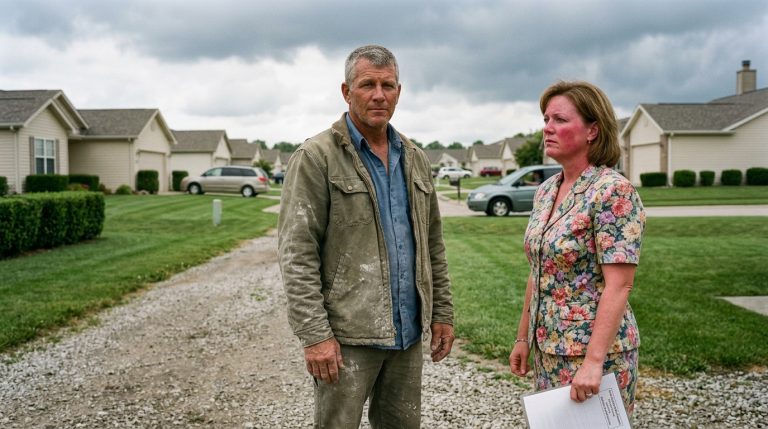
I set the mug on the counter and walked out to the back porch, my boots hitting the wooden planks with a familiar hollow thud. The split-rail fence I built twenty years ago cut a steady line across the damp grass, dividing my pasture from the sprawling asphalt of Harbor Point Commons.
My lower pasture wasn’t just wet. It was glazed over like someone had pulled a clear plastic tarp across the grass.
I stepped down off the porch, the mud sucking slightly at my boot heels as I walked toward the northern boundary. The grass near the property line wasn’t flattened; it was completely scoured away, leaving raw, dark earth exposed to the gray daylight.
Long, deliberate streaks of mud cut straight down the slope toward my leaning red shed. A cold knot tightened in my gut, steady and heavy.
I kept walking, the suction of the wet soil growing deeper with every step until I reached the fence line. There it was, poking out from beneath the manicured shrubbery of their multi-million-dollar parking lot.
A concrete drainage channel, clean and precise, feeding directly into a wide plastic pipe aimed square at my land. Water was still trickling out of it in a steady, unbothered stream, pooling lazily into my soil.
CHAPTER 2: THE GLASS DOOR
The gravel crunched hard under my tires as I pulled off the highway and into the sleek, manicured expanse of Harbor Point Commons.
Glass doors gleamed under the gray afternoon light, reflecting row upon row of empty parking spaces and a single, lonely shopping cart left stranded near a curb.
Inside, the air conditioning hit my face like a blast from a meat locker, smelling faintly of artificial pine and fresh carpet adhesive.
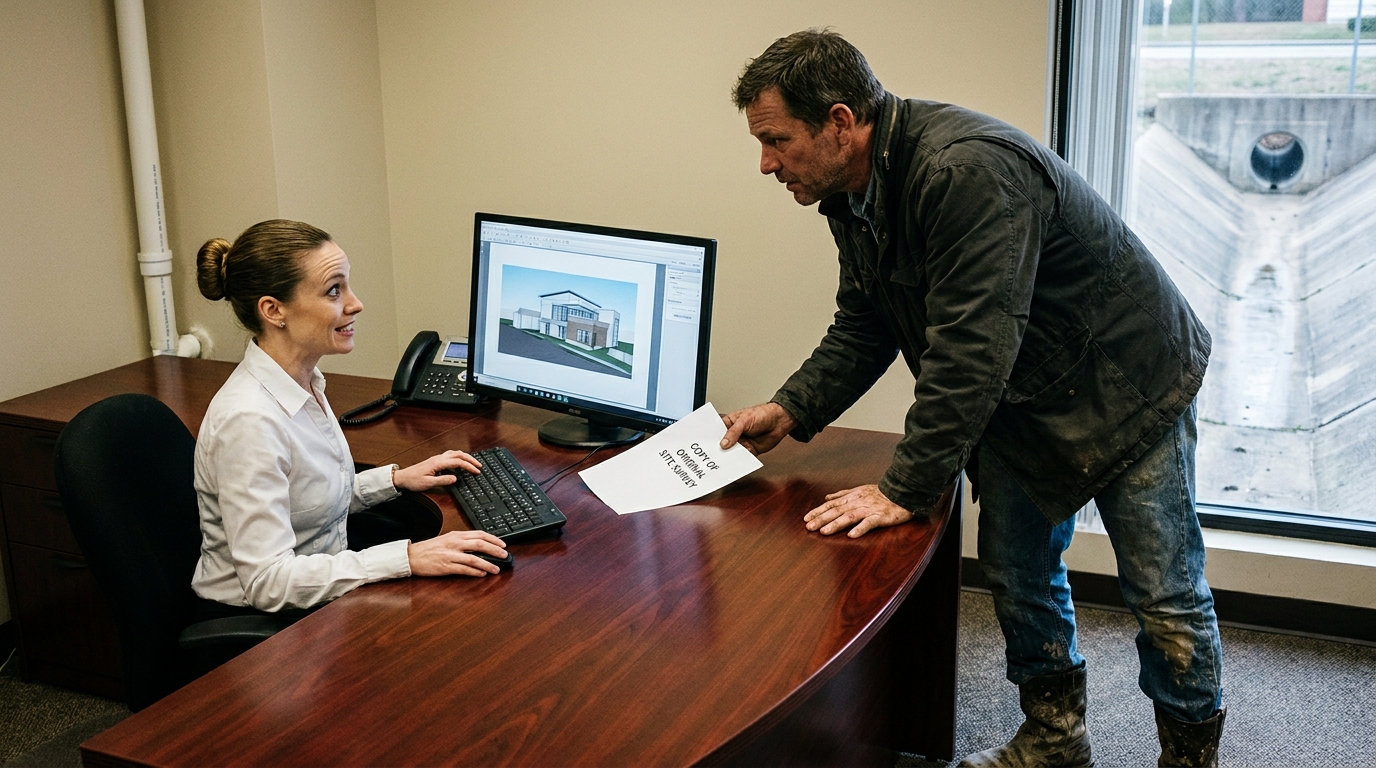
A receptionist sat behind a curved mahogany desk, her fingers flying across a keyboard while her eyes remained locked on a flat-screen monitor.
“Can I help you?” she asked without breaking rhythm, her voice pitched to the exact register of corporate patience.
“I think you already did,” I replied, resting my palms flat against the cold wood of the counter.
She paused, her fingers hovering an inch above the keys before she slowly looked up, her hair pulled into a tight knot that made her expression look perpetually surprised.
“Mr. Carter, right?” she asked, her smile thinning into a polite line as she recognized the name from my phone calls earlier that week.
“That’s right,” I said, leaning in just enough to close the physical distance between us. “The pipe you installed on your northern boundary is dumping thousands of gallons of runoff straight into my lower pasture.”
She let out a soft, practiced sigh and folded her hands neatly over the desk blotter.
“That’s just how drainage works, Mr. Carter,” she said smoothly. “Water naturally flows downhill.”
“Sure it does,” I said, keeping my voice flat and low. “Except it didn’t use to flow into a lake on my property before your contractors paved over seven acres of scrubland.”
Her eyes narrowed slightly, though her smile stayed glued in place like a cheap decal.
“The grading was engineered strictly according to county guidelines and approved stormwater management plans,” she replied, her tone dropping any pretense of warmth. “If you have an issue with the civil engineering, you’re welcome to file a formal complaint with the county.”
Translation: Not our problem.
I didn’t argue, didn’t raise my voice, and didn’t give her the satisfaction of a shouting match.
Instead, I reached into my coat pocket and slid a folded paper across the mahogany surface—a copy of the original site survey showing where two retention ponds were supposed to sit before mysteriously vanishing from the asphalt.
Her gaze dropped to the document for a fraction of a second before darting back to my eyes, a tiny twitch of hesitation flickering across her jawline.
“You might want to double-check those permits,” I said quietly, turning on my heel toward the glass doors.
CHAPTER 3: ENGINEER CONSULTING
The old Silverado pulled onto the shoulder of the county road, its suspension creaking as it settled into the tall grass.
Marcus Bell stepped out, hauling a heavy tripod and a laser level from the bed of his truck like he was carrying a briefcase to a meeting. He didn’t offer a handshake, just squinted across my fence line at the sprawling asphalt hill above us.
“You called about a water issue,” Marcus said, his voice as dry as cured timber as he adjusted the sight on his scope.
“They put a pipe in,” I said, pointing toward the concrete channel hugging the boundary. “Told me water just flows downhill.”
Marcus snorted softly, adjusting the brass dial on his equipment with calloused fingers.
He walked the property line with slow, deliberate steps, taking readings at the fence, the pipe, and the gouged mud of my lower pasture. Every time the laser dinged, he made a sharp mark in a small leather notebook.
“They changed the hydrology,” he said finally, straightening up and wiping a smear of red dirt from his forearm.
“Changed it how?”
“Increased the impermeable surface area,” Marcus said, tapping his boot against my sod. “Asphalt doesn’t drink water, Mr. Carter. That parking lot sheds runoff fast, and without retention ponds to slow it down, all that volume looks for the path of least resistance.”
He turned toward the commercial site, pointing his pencil at the fresh concrete plugs near the edge of their lot.
“There were supposed to be two retention basins built up there to hold the surge,” Marcus added, his eyes fixing on the exact spot where the pipe emerged. “If those ponds aren’t built, they aren’t in compliance.”
“Compliance,” I repeated, the word sitting heavy and cold in my chest.
“They bypassed the plan,” Marcus said flatly, clicking his pen shut. “It wasn’t an oversight. It was a choice.”
CHAPTER 4: THE COUNTER BASIN
The bucket of the excavator scraped against the dark topsoil, lifting a heavy load of earth and swinging it aside with a dull, grinding groan.
Louise stood near the trench line, wiping sweat from his forehead with the back of a calloused hand while he checked the grade stakes.
“You sure about this placement?” Louise asked, shouting over the diesel engine. “If we put it too close to the boundary, it’s going to catch everything they send down that pipe.”
“That’s the point,” I said, folding my arms against the damp morning chill.
We weren’t building a wall. Walls stand up to water until the pressure builds, and then they crack, letting gravity win the argument.
Instead, we were carving a wide, shallow agricultural basin right on my side of the fence, permitted and filed according to every rule in the county agricultural book.
The physics of it were simple. When the next storm hit, the runoff would pour through their corporate pipe, fill my basin to the brim, and then look for somewhere else to go.
With the basin hugging their boundary, the overflow wouldn’t dig deeper into my pasture; it would follow the natural upward contour right back toward their asphalt lot.
Louise cut the engine, the sudden silence ringing sharp in our ears as he wiped grease from a control lever.
“It’s going to back right up against their service docks,” Louise said, a slow, grim smile cutting across his face.
“Let’s hope it teaches them how water flows,” I replied.
CHAPTER 5: THE CORPORATE VISIT
The heavy rain came down sideways three nights later, drumming a relentless rhythm against the tin roof of my house.
I didn’t go out to the fence. I sat in the kitchen, watching the flashlight beam cut through the dark windowpane to catch the steady, churning sheet of brown water filling up the new basin.
The basin filled fast, swirling with mud and debris before hitting its lip and turning right back uphill toward the paved edge of Harbor Point Commons.
By morning, the sun broke through a pale sky, glinting off miles of wet asphalt as I drove my truck up the incline and parked near the service docks behind the grocery store.
Delivery trucks idled in a clumsy row, their drivers standing outside with hands jammed into their pockets, staring angrily at a shallow lake of standing water blocking the loading bay.
A sharp pair of leather shoes crunched on the gravel behind me, followed by the sound of an expensive suit jacket shifting in the morning wind.
“Mr. Carter,” Evan Whitmore said, his voice tight and controlled as he stepped around a muddy puddle to block my path.
“Mr. Whitmore,” I replied, keeping my hands loose in my pockets.
“We need to talk about the retention structure you installed along our common boundary,” he said, gesturing sharply toward the service docks where his delivery trucks were stalled. “It’s backing up water right into our commercial delivery zone.”
“It’s an agricultural water feature,” I said, my voice flat. “Fully permitted, fully compliant with county codes.”
“It’s disrupting our business,” Whitmore snapped, a bead of sweat breaking out near his temple despite the cool morning air. “We intended our initial configuration to be temporary during construction.”
“Construction finished six months ago,” I said, holding his gaze without blinking. “And your temporary pipe has been dumping thousands of gallons into my pasture ever since.”
He flushed dark, his fingers curling into tight fists at his sides as he realized his standard corporate deflections weren’t going to budge an inch.
“A rework of our parking lot drainage will cost hundreds of thousands of dollars,” Whitmore said, his voice rising in desperate frustration. “What will it take to make this go away?”
“I want the water handled where it lands,” I said quietly. “On your property.”
“We can offer a financial settlement,” he countered, his eyes narrowing as he threw his last card on the table. “Sign an easement, take the check, and let us manage the grade.”
I shook my head slowly, looking past him toward the empty space where two retention ponds should have been built on day one.
“The basin stays,” I said. “And any water past it is your problem.”
CHAPTER 6: THE RUSTED TRUTH
Heavy excavators rolled onto the northern ridge three weeks later, chewing up the manicured edges of the commercial lot without a single glossy rendering in sight.
Crews moved underground, dropping massive concrete retention units beneath the asphalt where those original blueprints said they should have been buried from the start.
The concrete channel at my boundary line fell silent.
When the next heavy storm rolled across the valley, I stood at the northern fence and watched the runoff pour into the newly constructed retention ponds up the hill.
The water stayed where it landed, swallowed safely by the underground basins instead of cutting a muddy scar through my pasture.
The pipe was capped, sealed permanently with a thick iron plate that put an end to shortcuts.
Dale wandered over that evening as the sun broke through the damp grass, holding a cold bottle in his hand and shaking his head.
“I’ll be damned,” Dale said, looking out over the dry pasture. “You actually pulled it off.”
“Didn’t pull anything,” I said, taking the bottle from him. “Just stopped letting it slide downhill.”
The grass took months to grow back green over the old scars, but the land remembered its shape.
Some folks thought I was too stubborn, that I should have taken the corporate check and let my property become a permanent solution for someone else’s balance sheet.
But sitting on the porch as the evening lights flickered on across the valley, I didn’t feel that knot in my stomach anymore.
Water follows the path of least resistance, and so do people.
Sometimes the only way to change the flow is to stop being the easy path.