The Stone Wall Verdict: How a Retired Engineer Dismantled an Overreaching HOA Empire With Simple, Unyielding Truth
CHAPTER 1: THE ULTIMATE SURRENDER OF REASON
The community clubhouse smelled of industrial carpet cleaner and stale municipal coffee.
Karen Miller adjusted the cheap plastic microphone, her smirk sharp enough to cut glass as she repeated the final ultimatum.
Thirty days.
That was the timeline she gave my family’s heritage wall, backed by a ten-thousand-dollar penalty for non-compliance.
Around us, twenty neighbors kept their eyes glued to their sneakers, too terrified of the HOA’s petty fines to offer a nod of support.
I didn’t yell, slam my fist, or threaten anyone across that folding table.
I simply stood up, tucked my notepad into my breast pocket, and walked out into the afternoon heat without a backward glance.
CHAPTER 2: THE ARCHIVE HUNT
The county records office was a quiet tomb compared to the shouting match at the clubhouse.
Rows of heavy steel filing cabinets stretched into the dim fluorescent hum, housing the legal DNA of the entire county.
I set my canvas bag on the scarred wooden table and pulled out a yellow legal pad.
The clerk didn’t look up from her crossword puzzle as I requested the 1919 foundational land grants and the subsequent Oakwood Preserve plat map filings from 1998.
For two straight days, I sat at that table, tracing ink lines drawn by men long since dead.
Every deed told a story of boundaries marked by stone walls, creeks, and iron pins rather than subdivision covenants.
My fingers brushed across the coarse vellum of the original survey maps, searching for the precise coordinates my grandfather had certified a century ago.
The Oakwood Preserve plat map sat beside it, clean, computer-generated, and aggressively modern.
As I laid the transparent county grid over the historical records, a subtle mathematical discrepancy jumped off the page.
The modern subdivision boundary didn’t just meet my property line; it swallowed a twenty-foot wide slice of it along the northern edge.
It wasn’t a random drafting error.
The numbers shifted precisely where the developer’s grading equipment had cleared the old timber line back in the late nineties.
I circled the discrepancy in red ink, my pen steady against the paper.
Karen Miller thought she was weaponizing the rules against an ordinary homeowner who would fold at the sight of a letterhead.
She had no idea she was trespassing on land that predated her entire neighborhood by generations.
I closed the 1998 plat book with a dull thud that echoed in the quiet archive aisle.
The paperwork didn’t lie, and neither did the math.
I packed the photocopies into my binder, zipped the bag, and walked out into the sharp afternoon light.

CHAPTER 3: THE BOARDROOM SHOWDOWN
Karen Miller looked down at the neatly tabbed pages with a practiced expression of bored dismissal.
She tapped a polished fingernail against the plastic tabletop, signaling her invisible backup.
A tinny speaker crackled to life in the center of the room, broadcasting the oily voice of their anonymous legal counsel.
The disembodied voice tried to pivot the argument toward re-engagement theory, claiming my home construction magically invalidated every historical document on the county record.
I didn’t raise my voice or reach for an attorney who wasn’t there.
I simply flipped to Article Four, Section Two of their very own founding charter.
The charter explicitly limited their authority to structures permitted after its filing date in nineteen-ninety-eight.
My great-grandfather’s stone wall predated their paperwork by seventy-six years.
The two bobblehead board members exchanged nervous glances, the artificial certainty draining from their faces.
Karen slammed her hand down on the table, her plastic smile cracking under the pressure of plain fact.
She leaned forward, her voice sharpening into a shrill command that the original demolition notice still stood on council advice.
I closed the binder with a slow, deliberate click of the brass corners.
They could hide behind an invisible phone speaker all they wanted, but words didn’t rewrite property law.
I picked up my paperwork and turned away from the table, leaving them to argue with an empty room.
CHAPTER 4: THE SURVEYORS FINDING
The cold morning dew soaked through the knees of my work trousers as I leaned closer to the excavation.
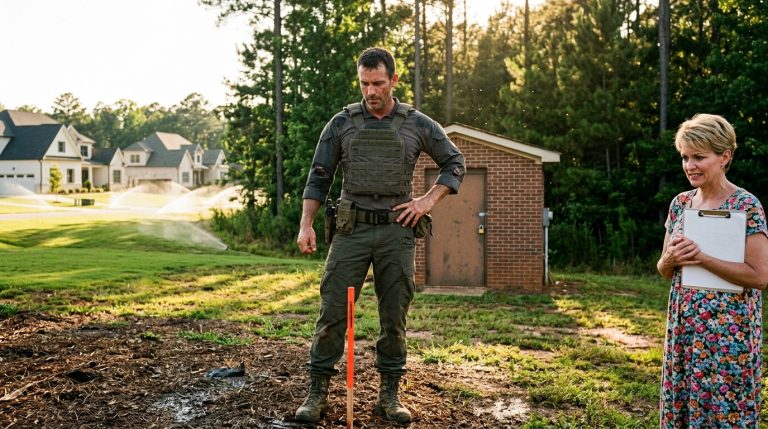
Gus brushed away a final clump of dark topsoil with his gloved thumb, revealing the pitted crown of an old iron rod.
— That’s your property pin, Mr. Caldwell — the veteran surveyor said, his breath pluming in the crisp air as he checked the digital readout on his GPS rover.
I didn’t answer right away.
I just stared at the rusted metal, letting the geography settle into my bones.
Ten feet away, the manicured brick foundation of the Oakwood Preserve community clubhouse loomed against the gray sky.
Gus stood up, wiping his palms on his thighs while looking back and forth between his data collector and the sprawling recreational facility.
— According to these coordinates, they didn’t just build near your line — he muttered, shaking his head. — They built right across it.
The realization hit with the weight of a sledgehammer, cold and absolute.
The clubhouse manager’s office, the visitors’ restrooms, the deep end of the swimming pool, and both tennis courts sat entirely on land deeded to my family a century ago.
Karen Miller had spent weeks threatening to demolish my grandfather’s stone wall over a technicality.
She had no clue she was standing on a multi-million-dollar land encroachment.
I pulled out my pocket notebook, steadying my hand against the cold metal casing of the survey equipment, and jotted down the exact GPS coordinates.
The battle lines had just shifted from a local zoning dispute to an immovable legal reality.
I stood up, brushed the grass from my knees, and locked eyes with Gus.
— Pack up the gear — I said quietly. — We have all the proof we need.
CHAPTER 5: THE FORMAL STRIKE
The kitchen was dead silent except for the scratch of ink against heavy cardstock.
I drafted the legal notification using plain, unyielding language, attaching certified copies of Gus’s GPS survey plats and the original 1920 property pins.
There were no threats, no emotional outbursts, and no requests for compromise.
Just a straightforward statement of fact: the Oakwood Preserve clubhouse, tennis courts, and pool facilities sat illegally across my family’s northern boundary line.
I slid the documents into a heavy manila envelope, sealed the flap, and drove straight back to the community clubhouse before evening office hours ended.
Karen Miller was sitting behind her desk, tapping her fingernails against a stack of colored violation slips when I pushed the glass door open.
She looked up, her expression hardening into an immediate mask of corporate hostility.
— You are not permitted in this administrative space without an appointment, Mr. Caldwell — she snapped, her voice carrying across the empty lobby. — And your demolition window for that stone eyesore is running out fast.
I didn’t blink or step back.
I walked straight across the polished tile floor and dropped the thick manila envelope squarely in the center of her desk papers.
— You wanted to talk about property boundaries and compliance, Karen — I said, my voice flat and even. — Read page four before you send out another fine.
She stared at the envelope, her upper lip twitching in a sudden, involuntary display of tension.
— What is this nonsense? — she demanded, her fingers hesitating above the paper.
— That’s the actual boundary survey — I replied, turning toward the exit. — You’re standing on my land.
CHAPTER 6: THE FINAL COLLAPSE
The heavy manila envelope had done its work before the sun even cleared the tree line.
Down the access road, three municipal utility trucks idled near the edge of the clubhouse parking lot, their amber hazard lights blinking in the pale dawn.
Karen Miller stood by the club entrance, clutching a clipboard against her chest while arguing frantically with a county inspector who pointed repeatedly at a folded plat map.
The multi-million-dollar recreational facility, complete with its tennis courts and pool pump house, was officially designated as an unauthorized structure on private family land.
There was no legal wizardry left to invent, no petty fine capable of overriding a century-old survey pin, and no lawyer willing to touch an indefensible land grab.
Karen’s desperate counter-move of threatening counter-suits had dissolved the moment the county auditor cross-referenced the global positioning coordinates.
The red tape she had weaponized against the neighborhood had finally wrapped around her own throat.
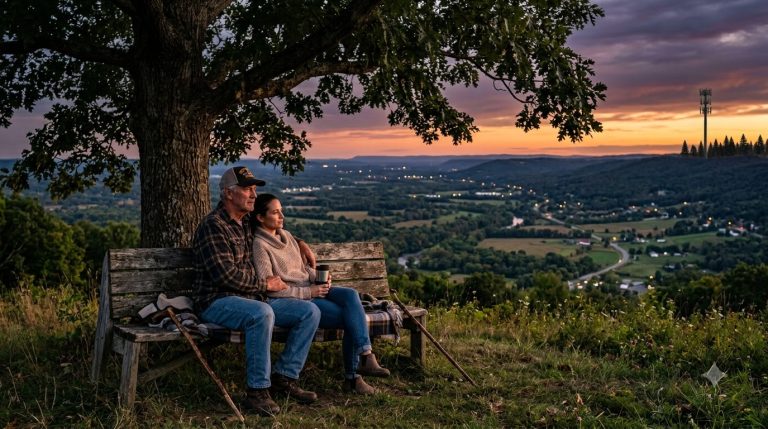
I took a slow sip of the coffee, letting the familiar warmth settle in my chest without a trace of anger left to burn.
The heritage wall stood untouched along the property line, mossy and secure in the morning quiet.
The rule of common sense had reclaimed the ground it never should have lost.
I set the empty mug down on the rustic wooden side table, the porch boards steady and silent beneath my boots.