The Price of a Fenced Line: A Story of Grounded Southern Dirt and Unbending Vindication
CHAPTER 1: THE INTRUDERS ARRIVE
The porcelain mug was warm against my calloused palm, the dark brew smelling of chicory and woodsmoke. Through the cracked kitchen window, the pre-dawn Georgia air carried the low, rhythmless hum of human voices where there should have been nothing but the early wind rustling through thirty acres of ripening stalks. I stepped onto the back porch, the floorboards groaning under my boots, and stopped dead.
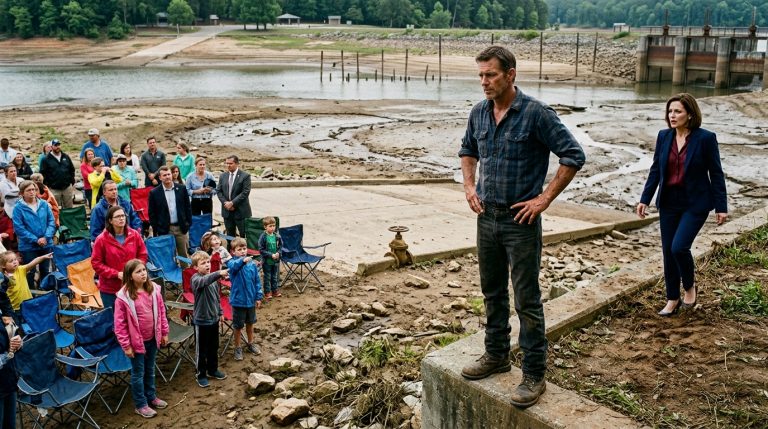
Thirty pastel-colored nylon domes sat glowing in the gray light, arranged in a neat, mocking semicircle right across my eastern boundary line. A folding stage made of raw plywood stood near the old tractor path, and a wooden sign painted with the words The Wholeness Collective: Nourish Your Dirt was already hammered into the loam. A woman in tight gray athletic gear was currently attempting to loop a purple silk scarf around the neck of my oldest nanny goat, who responded with a sharp, warning tilt of her horns. Near the hay bales, a man wearing a bright white golf visor was systematically lining up tiny glass bottles of lavender oil, his movements methodical and completely unbothered by the fact that he was standing on private agricultural property.
My thumb slipped into my pocket, finding the cold, scratched brass casing of my old Zippo. I didn’t strike it; I just rolled the rough wheel against my skin until the flint clicked against the wheel in a small, unseen rhythm.
The screen door banged shut behind me as I walked down the dirt incline toward the field. The red clay was damp beneath my soles, sticking to the welts of my work boots. The crowd didn’t scatter when my shadow hit the edge of the camp. Instead, a woman with a laminated clipboard tucked under her arm stepped out from the largest tent, her linen trousers trailing through the damp clover. She had a tight, practiced smile that didn’t reach her eyes, and she held that board like a shield.
“Oh, hello,” she said, her voice dripping with an artificial sweetness that made my teeth ache. “Are you the caretaker? We’re going to need you to move those cattle back toward the creek line. Their lowing is completely disrupting the morning alignment circle.”
I let my hand drop from the lighter in my pocket, my jaw tightening as I took in the sheer scale of the setup. “Name’s Hank. I don’t caretake this ground. I own it. My granddad cleared these pines, and my dad put down the lime to make this dirt grow. You’re past the posted wire by two hundred yards.”
Trish—according to the hand-scrawled nametag pinned to her linen top—gave a little, pitying sigh and tapped her pen against the plastic board. “Mr. Hank, we checked the regional maps online. This parcel is listed as an uncultivated conservation zone. We are simply enacting our right to reconnect. It’s a three-day restorative retreat for the community.”
“This is private farmland,” I said, keeping my voice down in the register I used when a heifer was about to kick. “The wire you climbed over to get here wasn’t put up to keep nature out. It was put up to keep the peace in. You’ve got three hours to pack these stakes and clear the lane.”
She smiled again, her fingers adjusting the strap of her clipboard. “We’ve already paid the county permit fees for the public access road, sir. We have a right to roam. Let’s not make this uncivil.”
Behind her, the music started—a tinny, synthetic drone from a battery-powered speaker that set the cows to shifting uncomfortably against the remaining fence line. The peace of the morning was dead, buried under nylon and arrogance.
CHAPTER 2: THE SEVERED LINE
The zinc coating on the wire was entirely gone where the metal had been twisted back and forth until it snapped. A bright yellow nylon hammock hummed in the morning breeze, tied between the ruptured fence post and a young pecan tree that my father had planted twenty years ago. The bark was already chafed raw down to the pale pulp.
Trish stood ten feet away on the packed dirt track, her clipboard held against her ribs like armor while Deputy Miller adjusted his duty belt, his boots sinking slightly into the soft margin of the ditch. He didn’t look at her; he looked at the three-pronged tear in his own uniform trousers from where he’d had to squeeze past a illegally parked micro-bus.
“Hank,” Miller said, his voice carrying the dry, gravelly rasp of a man who spent too much time breathing dust and listening to domestic disputes over property lines. “She’s got a paper from the county clerk’s website. Says it’s a gray area on the agricultural easement maps.”
—”It’s an agricultural tax exemption map, Miller,” I said, my thumb working the smooth brass wheel of the Zippo inside my pocket, clicking the cold metal lid against the casing once, twice, in the darkness of the denim. “Not a public invitation. My fence is down. That’s criminal trespass and property damage.”
Trish stepped forward, her expensive leather sandals crunching loudly on the gravel scatter. “Deputy, as I previously explained, the fence line itself constitutes an arbitrary restriction of natural migration. We are more than willing to compensate the caretaker for the three feet of rusted wire, but the festival collective requires the shade of these trees for our noon-day somatic release.”
Miller rubbed the bridge of his nose, his eyes drifting over the rows of tents where someone was currently trying to start a small, smokey fire using green pine boughs. “Look, Hank. Without a certified survey map right here in my hand, my hands are tied until Monday morning. If they think it’s public access, it takes a civil order to clear the whole lot out. I can tell them to keep the music down, but that’s about the size of it.”
The heat was already rising off the red clay, thick and heavy with the smell of unwashed linen and lavender oil. Trish gave a small, victorious nod, her pen making a sharp, aggressive checkmark on her sheet of paper before she turned her back on us, her linen shawl trailing through the weeds as she walked back toward her followers.
“You’re letting them stay the night,” I said, looking at the slack wire coiled in the grass like a dead water moccasin.
Miller spat into the ditch and turned back toward his cruiser. “Get your paperwork together, Hank. Until then, just don’t do anything that makes me have to come back out here with handcuffs.”
CHAPTER 3: THE HEAVY MIST
The threads clicked into place with a grinding screech, the scent of stale diesel and ancient manure rising from the iron belly of old Bessie. Earl stood by the rear assembly, a pair of cracked plastic safety goggles snapped tight against his temples, his teeth showing white against the smudge of grease on his jaw.
“She’s filled to the brim, Hank,” Earl whispered, tapping the side of the steel tank with a short piece of copper pipe. “The slurry from the lower lagoon has been sitting in the heat since June. It’s got a texture like warm gravy and an odor that’ll change a man’s political views.”
—”Just watch the pressure gauge, Earl,” I said, my boots slick on the dark concrete floor as I hauled myself into the high cab of the tractor. “Trish’s schedule says the drum circle starts at eleven-forty-five. They want to connect with the dirt, so we’re going to give them the purest part of it.”
The engine coughed once, a heavy, metallic rattle that shook the loose tin on the barn roof, before settling into a low, muffled thrum. We ran without lights, the front tires catching the ruts of the old logging path by touch alone, cutting wide around the boundary pines until the glowing cluster of pastel tents opened up through the leaves.
The valley was alive with the rhythmic, hollow thump-thump of hand drums, the sound bouncing off the limestone ridge while a projector threw large, shaky images of honeybees against the side of my hay barn. Trish was standing near the middle of the circle, her arms spread wide toward the fire pit, her voice carrying over the low chant of thirty people trying to find their souls on my sweet corn ground.
I eased the machine down the slope, the heavy green weight of Bessie pushing against the hitch, the tires sinking into the clover. Earl gave a sharp tap on the rear glass—the signal that the main gate valve was aligned.
“Let it loose,” I muttered into the dark cab.
The first blast hit the evening air with a wet, screaming hiss, a dark arc of fermented slurry cutting through the lantern light like a sudden storm.
The drums stopped instantly.
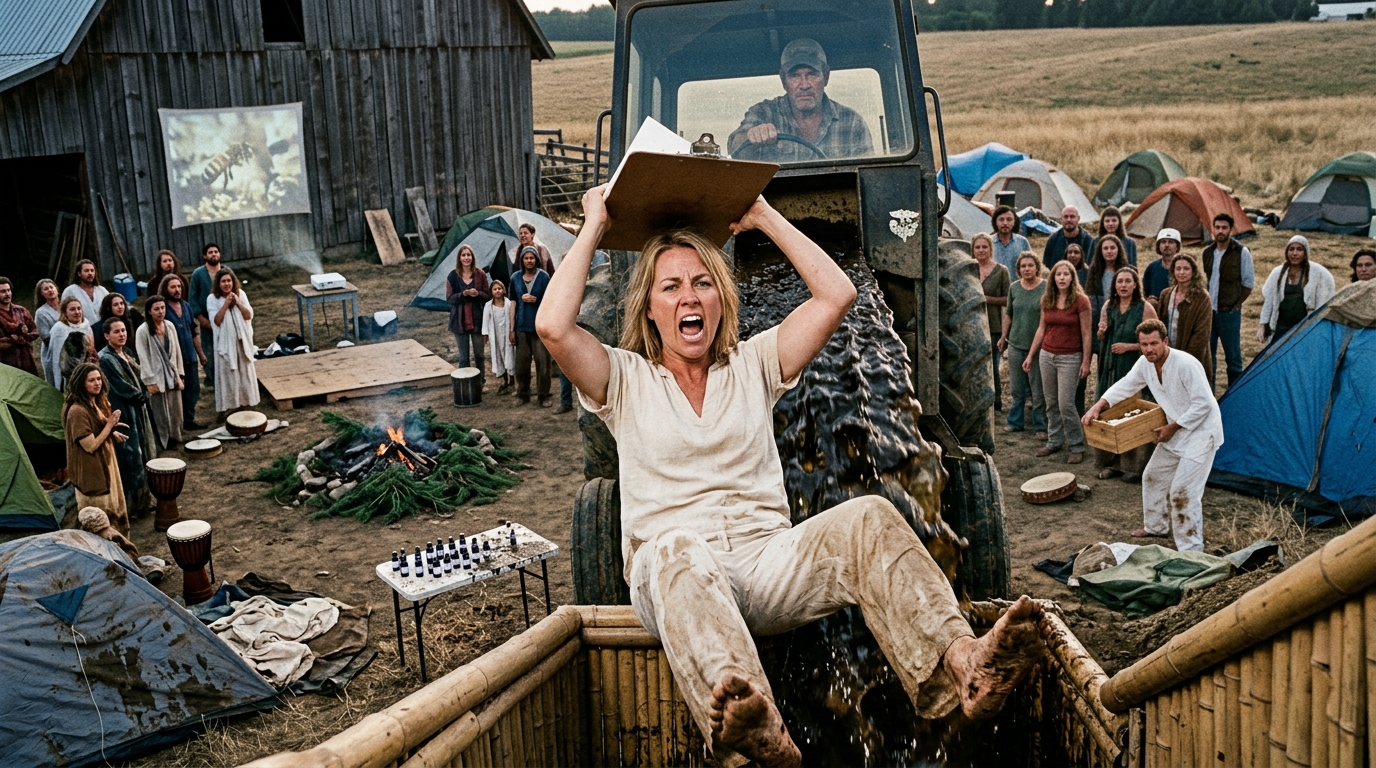
For one second, there was nothing but the heavy, dripping silence of forty thousand gallons of liquid manure raining down onto expensive nylon, linen robes, and organic snack bars. Then the screaming started—a high-pitched, desperate scramble as people slipped, flailed, and went down hard into the newly lubricated red clay.
A man in a white tunic tried to shield a wooden box of essential oils and skidded three feet on his chest, leaving a dark trench in the mud. Earl stood on the rear platform, his voice booming over the roar of the exhaust.
“Complimentary soil enrichment! All-natural skin treatment, folks!”
I turned the wheel hard, making a slow, steady sweep across the middle lane, painting the tents an even shade of dark Georgia brown. Trish came charging out of the mist, her clipboard held over her head like an umbrella, her face twisted into a mask of pure, unadulterated fury.
—”Stop this! This is biological warfare! I’ll have you in federal—”
The nozzle caught her mid-sentence, a fine, rich mist catching her square in the chest and knocking her off-balance until she tumbled backward, landing with a heavy, wet splash directly inside the open basin of their own bamboo compost toilet.
Earl gave her a slow, mocking salute as the tractor cleared the line, heading back toward the dark safety of the timber.
CHAPTER 4: THE PAPER TRAIL
The paper was thick, smelling faintly of vinegar and dry rot. A single green shaded bulb hung from a frayed cord above the metal table, casting long shadows across the columns of ink. Claude sat on a folding chair next to me, his heavy reading glasses slipping down his nose as he watched my hands turn the oversized pages.
The certified mail envelope Trish had sent sat open on the table, its pages filled with bold demands for emotional damages, civil rights violations, and compensation for twenty ruined tents. It didn’t look nearly as heavy now compared to the dead weight of forty years of county land mapping.
My finger stopped on a faded purple stamp marking the parcel boundary line of the northern creek creek section, right where the old logging road used to cut through the timber.
“Look right here, Claude,” I said, the brass Zippo clicking softly against the loose change in my left pocket as I shifted my weight on the concrete floor. “This isn’t the tax map Miller was looking at. This is the original plat allocation before the county rerouted the secondary highway.”
Claude leaned over, his dry breathing loud in the small basement room. He tracked the faded line with a blunt fingernail, pausing where the coordinates met a tiny hand-drawn square marked Structure 4B.
—”Hank,” Claude said, his voice dropping into that low, flat rumble he used when he found a leak in an insurance policy. “The vacation cottage Trish bought three years ago—the one with the fieldstone hearth and the wraparound deck—sits exactly thirty-four feet south of this margin.”
I looked closer at the crisp white line on the old blueprint overlay. A fresh, small pencil mark had been made right at the edge of the line, the graphite still gray and clean, completely out of place against the faded brown ink of forty years ago. Someone had been down here recently, looking at the exact same page, their thumb leaving a small smudge of lilac-scented hand cream on the edge of the paper.
“She knew,” I said, the cold truth settling into the small of my back like winter frost. “She didn’t miss the line by accident. She wanted this festival on my dirt so nobody would question where her stone patio actually sits.”
Claude stood up slowly, the iron legs of his chair scraping a harsh line across the floorboards. “Let’s get the county surveyor out out to the property at seven tomorrow morning, Hank. We aren’t fighting a lawsuit anymore. We’re moving a fence.”
CHAPTER 5: THE RECKONING OF THE BOUNDARY
The sledgehammer came down with a dull, heavy metallic ring, burying the surveyor’s spike straight through the expensive mortar joining two blue flagstones. Trish stood on the upper tier of the patio, her silk robe drawn tight around her waist, a thin layer of perspiration ruining the expensive foundation cream on her forehead as she watched the bright orange twine snap taut across her outdoor kitchen space.
“You have no authority to place stakes on my improvement zone,” she said, her chest heaving as she gripped the stone balustrade, her knuckles showing white. “The civil litigation is still pending before the magistrate. This is a malicious destruction of residential equity.”
—”This is a temporary agricultural partition, Trish,” I said, lifting the heavy iron digger and letting the sharp blades bite down into the turf six inches past her built-in wine cooler. “The county surveyor signed the corner plat three hours ago. Everything on this side of the line is my dirt, and I’m putting it to active agricultural use.”
Earl backed the rusty stock trailer down the gravel margin of her driveway, the tail-gate rattling open with a loud, deafening clang that set off three different car alarms down the cul-de-sac. Inside the steel mesh, twelve adolescent boer goats began bleating at the top of their lungs, their sharp hooves drumming against the wooden slats as the instructor from the local yoga collective unlatched the loading ramp.
Trish’s mouth twisted into a hard line, her eyes scanning the street for the deputy who wasn’t coming back out to help her. “You are leasing an residential-adjacent buffer zone for commercial livestock deployment? This violates the minimum setback covenants of the home owners association.”
—”My farm doesn’t answer to your committee, Trish,” I said, looping a thick strand of high-tensile wire around the new cedar post and pulling it tight with the fencing pliers until the wire hummed. “This is an un-zoned agricultural exemption block. You wanted people to connect with the ground, so I brought the neighborhood right to your back door.”
A goat leapt out of the trailer, its hooves clattering loudly across the flagstones before it began chewing vigorously on a potted hibiscus plant sitting next to her outdoor fireplace. Trish slammed her sliding glass door shut, the glass rattling inside the vinyl frame as she reached for her telephone, her face completely purple behind the tinted pane.
CHAPTER 6: THE FINAL DISMISSAL
The thick paper folder rattled as Judge Vance flattened it across his desk, his spectacles catching the harsh fluorescence of the county chamber. Trish sat two feet across the aisle from Claude and me, her knuckles white as she squeezed a damp paper tissue into a tight ball, her pristine navy suit looking stiff and out of place against the plain pine tables.
“Your Honor,” Trish began, her voice cracking slightly as she leaned toward the microphone, a desperate edge overriding her usual polished tone. “The defendant used heavy agricultural machinery to release bio-hazardous material directly onto our peaceful retreat, and subsequently erected a hazardous perimeter fence through my custom flagstone entertaining area. This is a clear case of target harassment.”
Judge Vance looked over the top of his lenses, his face as flat and unyielding as a granite headstone. He didn’t look at the photographs of ruined nylon tents she had spread out; he looked down at the certified surveyor’s plat Claude had placed on the timber rail.
—”Madam,” Judge Vance said, his gavel resting loosely near his right hand. “The documentation from the county administration shows that your custom flagstone area sits exactly thirty-four feet onto agricultural acreage that has belonged to the defendant’s family since 1946. Did you have written permission from Mr. Hank to clear that timber or lay those stone tiles?”
Trish swallowed hard, her mouth opening and closing twice in the quiet room before she pointed a trembling finger at the plat overlay. “The previous owner told me the easement was flexible. The festival was an educational effort to—”
—”The law isn’t flexible, Trish,” Claude said, shifting his posture on the oak bench without looking up from his yellow legal pad. “You brought thirty people over a wire fence to establish a public footprint on private dirt, purely to cloud the title before the county could enforce the true boundary line.”
The judge brought the gavel down with a sharp, echoing crack that cut through her final defense like a dry branch snapping in the woods.
“Case dismissed with prejudice,” Judge Vance stated, his pen slashing a dark ink line across the cover sheet. “Furthermore, this court notes the encroached structure must be cleared back past the orange stakes within thirty days, or the property owner has full authority to dismantle it at your expense. I suggest you consult a commercial real estate agent, ma’am, before this situation gets any more costly.”
Trish sat entirely frozen, the tissue tearing in her fingers as the reality of the boundary line finally settled onto her shoulders.
The heat of the late July sun was filtering through the high barn windows when I got back to the yard, the quiet hum of the Georgia afternoon filling the spaces between the stalls. Earl was already down by the tool shed, a clean rag in his hand as he wiped down the brass nozzles on the rear assembly of old Bessie, the green metal tank sitting clean and silent in the shadow of the pines.
I took the old brass Zippo out of my flannel pocket and set it down on the work bench, the metal cold and still under my palm. The sweet corn was rustling out in the eastern field, the wind moving through the stalks without a single pastel tent or microphone wire left to break the rows.