The Dry Shore Reckoning: How Common Sense and Iron-Willed Patience Brought Down a Corporate-Backed HOA Empire
CHAPTER 1: THE VALVE TURN
The morning air smelled of wet gravel and stagnant mud. I wrapped my fingers around the heavy brass handle of the gate valve and felt the familiar, grating resistance of rusted iron.
It was 6:07 a.m.. Down at the shoreline, the concrete pillars of the Ridge Rest HOA’s new park project stood stark against the grey morning light.
I didn’t need notes or ledgers to know what was coming. I simply leaned my shoulder into the iron and gave it a slow, deliberate half-turn.
A low shudder traveled up through the concrete foundation of the dam. Somewhere beneath the surface, thousands of gallons began their slow, calculated escape.
By 10:07 a.m., Vivian Marsh would be standing there with her ceremonial ribbon and her gleaming silver scissors. She would talk about community gifts and public spaces.
She wouldn’t be talking about the property lines etched into county deeds back when common sense still governed these parts. I watched the first ripples spread across the surface through my binoculars.
The water level didn’t drop in a dramatic flood; it pulled back with the quiet, stubborn persistence of a tide going out. It was a slow, silent subtraction that no amount of press releases could patch over.
Vivian thought she owned the horizon because she had a microphone and a stack of grant checks. She had spent two years ignoring every warning sign.
She assumed that a 1991 easement for walking paths and fishing meant she could pour concrete and build boat ramps. She didn’t understand the weight of a title deed.
My coffee grew cold on the porch table, but I didn’t touch it. I kept my eyes locked on the shoreline where the first dry patch of lake bed was beginning to show its cracked skin to the dawn.
The iron valve was locked in place now, holding the pressure steady. I let go of the handle and wiped my palm against my jeans, feeling the raw friction of the metal lingering on my skin.
Down at the lake, the first car doors were starting to slam in the distant parking lot. The crowd was gathering for a celebration built entirely on borrowed time.
CHAPTER 2: THE RIBBON CUTTING
The morning sun crested the ridge, casting a sharp, unforgiving light across the manicured lawns of the newly christened Ridge Rest Park.
Down by the water’s edge, a sea of folding chairs and brightly colored windbreakers had appeared like an artificial bloom.
Vivian Marsh stood front and center on the newly poured concrete stage, her tailored blazer immaculate against the rustic backdrop of the shore.
She held a pair of oversized, gold-plated ceremonial scissors aloft, smiling for the local news cameras and the cluster of thirty-odd smartphones pointed her way.
“For too long, this shoreline has been underutilized,” Vivian’s amplified voice echoed across the basin, sharp and dripping with practiced civic pride. “Today, we return it to the community where it belongs.”
A polite wave of applause rippled through the crowd of three hundred attendees. Families shifted in their seats, children chased a stray soccer ball near the edge of the newly paved walking path, and county officials nodded approvingly from the VIP row.
I kept the binoculars pressed to my eyes, adjusting the focus until I could make out the gold buttons on Vivian’s jacket.
Something else caught my eye just beyond the edge of the crowd—a subtle, out-of-place detail that didn’t belong in a grand opening celebration.
A cluster of heavy-duty drainage pipes, meant to sit two feet below the surface to feed the park’s decorative wading pond, stood completely exposed to the morning air, dripping wetly into dry dirt.
Nobody in the crowd was looking down. They were all staring up at the stage, caught up in the theater of civic accomplishment.
Vivian brought the golden blades down with a theatrical snap, slicing through the red ribbon as confetti cannons popped on either side of the stage.
The applause swelled louder, drowning out the faint, rhythmic metallic clanking echoing from the rusted dam gates miles upstream.
She lowered the scissors, her smile widening as she turned to accept a bouquet from the head of the HOA board.
She had no idea that the foundation beneath her grand achievement was already beginning to dry out.
CHAPTER 3: THE RECEDING TIDE
The murmur started small, like a dry leaf scraping across asphalt. A woman near the front row of folding chairs stopped clapping, her gaze dropping downward from Vivian Marsh’s triumphant smile on the stage.
She pointed a trembling finger toward the water’s edge.
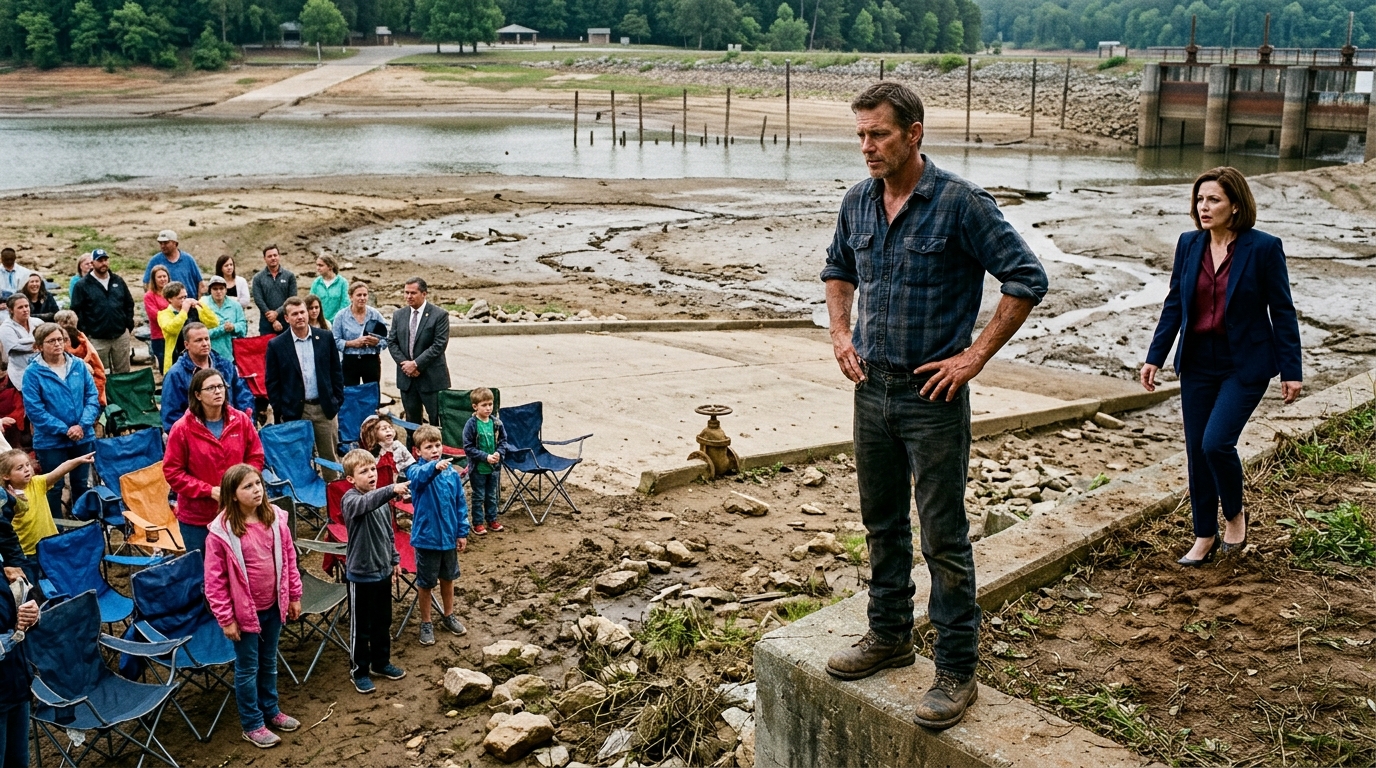
The lake wasn’t staying where it was supposed to. A pale strip of damp, cracked earth was widening between the lapping ripples and the freshly sodded grass of the park’s embankment.
“Look at the boat ramp,” a man nearby muttered, his voice cutting through the fading applause.
The concrete ramp, engineered to meet the water at a precise grade for easy launching, was suddenly sitting eighteen inches above the surface.
Water was pulling backward away from the pilings with an unnatural, hungry speed, leaving behind exposed stones and tangled weeds that had spent decades underwater.
Vivian didn’t notice at first. She was still shaking hands with the head of the HOA board, basking in the warmth of her own manufactured accomplishment.
The murmur in the crowd swelled into a sharp wave of bewildered chatter. Families stood up from their folding chairs, craning their necks toward the rapidly shrinking shoreline.
I lowered the binoculars and let out a slow, measured breath through my teeth. The physical reality of the land was finally speaking louder than any press release or ribbon-cutting ceremony.
A park built on a dry lake bed is just an expensive patch of mud waiting for an explanation.
Vivian finally turned away from the microphone, her smile faltering as she caught sight of the brown expanse opening up where the water should have been.
She took two sharp steps toward the edge of the embankment, her heels sinking uncomfortably into the soft, unmoored soil.
The murmurs stopped, replaced by an uneasy, heavy silence that hung thicker than the morning humidity.
CHAPTER 4: THE LEGAL DROP
The process server navigated the sea of folding chairs with the practiced stride of a man who had delivered bad news to people who thought they were untouchable.
He didn’t look at the dry earth or the sinking boat ramp. He kept his eyes locked on Vivian Marsh, who was still trying to calm the murmuring crowd from the wooden platform.
A thick, manila-bound document—a forty-seven-page verified complaint—rested heavy in his left hand.
“Excuse me, ma’am,” his voice carried clearly over the silent lawn, stripped of any professional pleasantry.
Vivian turned sharply, her forced smile vanishing into a tight, pale line of irritation. “This is a private community celebration. You need to leave immediately.”
“You’re Vivian Marsh,” he stated rather than asked, stepping directly onto the edge of the newly laid sod. “You’ve been served.”
He extended the heavy packet toward her chest.
Vivian stared down at the document as if it were a venomous snake, refusing to lift her hands from the sides of her tailored blazer.
“I don’t know what this nonsense is, but security will have you removed,” she snapped, her voice rising in a sharp, desperate pitch that echoed off the dry earth.
“It’s a complaint for willful encroachment, fraudulent grant acquisition, and easement violation,” the server replied, dropping the thick packet directly onto the wooden podium in front of her.
The papers landed with a dull, heavy thud that rattled the microphone.
Around them, the crowd pressed closer, cell phone cameras raised high to capture every twitch of panic on Vivian’s face.
She looked from the stack of legal papers down to the receding shoreline, where the water had now pulled back a full eighteen feet from the designed edge.
The mathematical reality of what she had built was collapsing in real-time under the weight of county deeds and common-sense property laws.
Her jaw tightened until the skin turned chalk-white, her eyes darting frantically toward the local news cameras recording her public unraveling.
CHAPTER 5: THE PUBLIC COLLAPSE
The local news anchor stared into the studio camera with a look of stunned disbelief, summarizing what had become the most viral local scandal of the year.
Footage from the grand opening played on a continuous loop—the cheering crowds, the golden scissors cutting the ribbon, and then the disastrous, immediate retreat of the water leaving behind cracked mud and stranded docks.
Online video views crossed three hundred and forty thousand within six hours, turning Ridge Rest HOA into a nationwide laughingstock.
Vivian Marsh refused to fold quietly into the background. Instead, her criminal defense attorney released a frantic statement claiming the community had been victimized by an “unforeseen natural anomaly” and sabotage.
She stood outside the county administration building later that afternoon, her hair slightly disheveled, doubling down on her claims before a battery of microphones.
“We followed every protocol required for community enrichment,” she snapped at a reporter who dared ask about the private property boundaries. “This project will not be derailed by malicious interference from disgruntled neighbors!”
Her defiance was absolute, a textbook display of an entrenched administrator refusing to acknowledge reality even as the ground slipped beneath her feet.
The Attorney General’s office didn’t buy the performance. State investigators immediately announced an emergency audit of the forty-five-thousand-dollar county grant allocated for the park’s construction.
The HOA board members went completely silent, blocking their phone lines and dodging emergency neighborhood meetings as angry homeowners demanded answers.
Vivian tried one last desperate maneuver, attempting to file an emergency injunction to force the water back into the basin by executive fiat.
The judge threw the motion out within ten minutes, citing the glaring absence of any valid deed ownership or legal easement for permanent structures.
The weight of unearned entitlement finally shattered against the cold, unyielding wall of property law.
CHAPTER 6: THE QUIET PORCH
The Sunday paper sat unread on the porch table, its headlines already moving on to the next political squabble.
Down at the lake bed, the water had found its natural resting point, leaving the HOA’s expensive boat ramp stranded high and dry like a concrete monument to human foolishness.
Vivian Marsh had cleared her desk by Friday evening, resigning quietly without a single parting statement to the community she had promised to modernize.
The state investigators were still combing through the grant paperwork, but that was bureaucracy’s problem, not mine.
I picked up the empty mug and walked it over to the kitchen sink, letting the cold tap water run over the ceramic until the surface lost its chill.
There were no crowds left outside, no news crews shouting questions, and no grand ribbons waiting to be cut.
Just the steady, unhurried rhythm of the lake returning to its own terms.
Property lines aren’t maintained by press releases or public charm; they are held by people willing to stand their ground when the noise gets too loud.
I turned off the faucet, dried my hands on a worn kitchen towel, and walked back out to the front porch.
The horizon was quiet, stretching out under the evening stars exactly as it always should have.