The Iron Lattice on the Ridge: How One Veteran Dismantled a Tyrant’s Empire With Cold Math and Federal Law
CHAPTER 1: THE FIRST NOTICE
The voice, sharp and grating as rusted metal, sliced through the tranquil afternoon air.
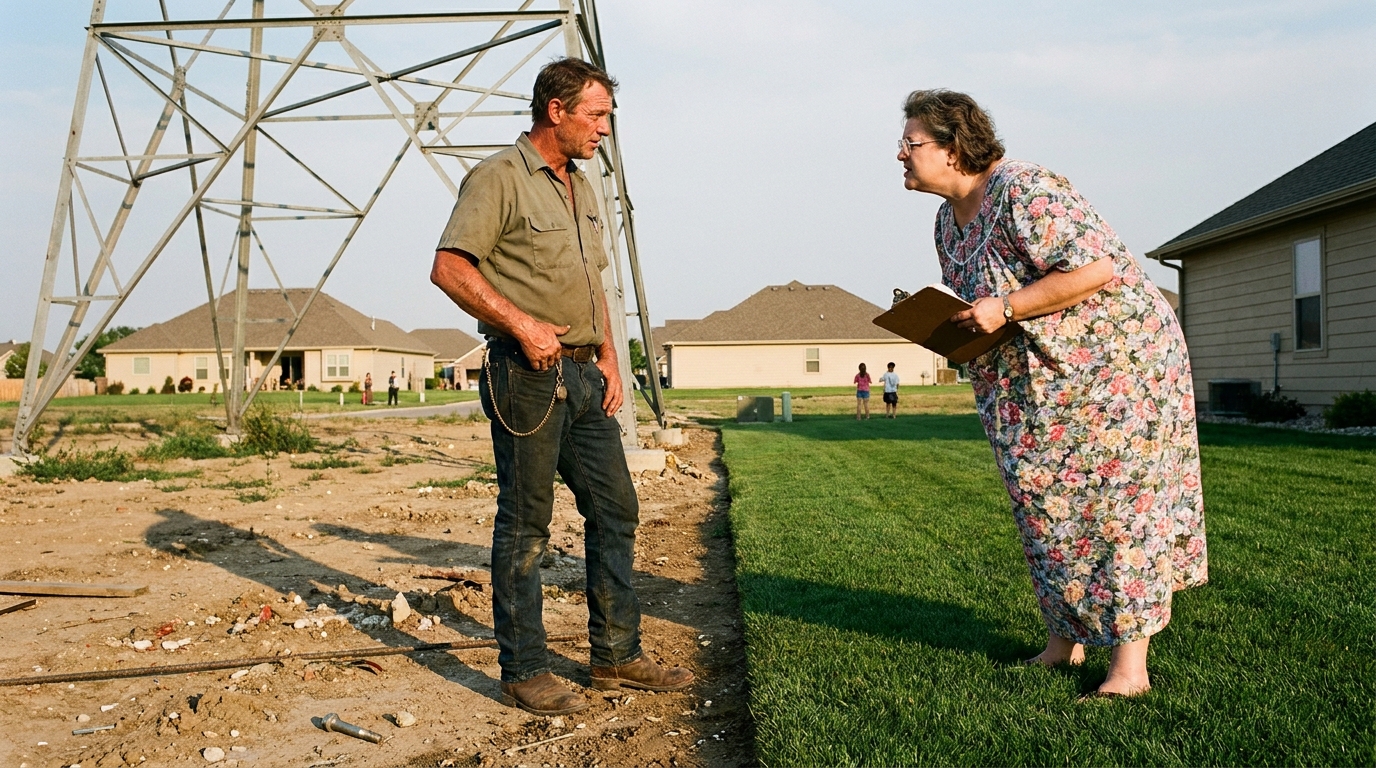
I turned from the base of my newly completed tower to see her standing there, a formidable silhouette against the setting sun.
Karen, the president of the Oak Ridge Homeowners Association, was planted just on her side of my property line, one foot tapping impatiently on the manicured turf of her domain.
She held a clipboard like a riot shield, a pen clutched in her other hand, as if it were a dagger ready to be plunged into the heart of my peace.
Her floral-print muumuu billowed around her plus-size frame, a garish flag of war in this quiet corner of the world.
Her eyes, magnified by thick glasses, scanned the 40-foot steel lattice structure behind me with a look of profound disgust, as if I had erected a monument to everything she despised.
The tower was my sanctuary, a place to watch the stars and escape the constant, low-grade static in my head—a vertical slice of solitude built with my own two hands on land that was strictly mine.
To her, it was a personal affront, a violation of the beige uniform conformity she worshipped.
The sheer audacity of the threat, the casual mention of a ten-thousand-dollar fine as if she were ordering a latte, sent a cold, familiar spike of adrenaline through my chest, the kind I hadn’t felt since my last tour.
This wasn’t a discussion about property values.
It was a power play, pure and simple.
“That illegal monstrosity comes down by Friday,” she snapped, her pen tapping the clipboard with rhythmic irritation. “Or I’m bringing in a crew and billing you for the demolition, plus the fine.”
I didn’t yell, and I didn’t take the bait.
Instead, my thumb instinctively found the heavy brass pocket watch in my denim pocket, rolling its cold, scarred casing back and forth against my palm to ground the sudden surge of heat in my throat.
For twenty years in the Air Force, maintaining satellite uplinks on desolate mountaintops, I learned that screaming at a broken signal path accomplishes nothing.
You isolate the variable, you check the schematics, and you hold your ground.
“You’re standing on private land, Karen,” I said, my voice flat and even, deliberately pitched beneath the register of her outrage.
She scoffed, a sharp expulsion of air that ruffled her collar.
“The entire ridge was annexed into Oak Ridge jurisdiction by town council vote last month. You’re bound by our covenants whether you signed them or not.”
She spun on her heel without waiting for an answer, her floral fabric snapping in the wind as she marched back down the slope toward the sea of identical beige houses.
I stood there in the lengthening shadows, listening to the heavy crunch of gravel fade into the distance.
The official violation notice would arrive in a couple of days, wrapped in three pages of dense legalese designed to induce panic.
I let go of the brass casing in my pocket and looked up at the steel lattice catching the last amber rays of sunlight.
She had brought a rulebook to a structural fight.
Now it was time to see what those pages actually said.
CHAPTER 2: THE PAPER TRAIL
Sarah stood by the sink, the steady hum of running water doing little to mask the tension tightening the room.
“She can’t be serious with a ten-thousand-dollar fine, Jack,” she said, her voice dropping into that quiet, worried register she used when she was trying not to alarm Lily in the next room. “It’s extortion on letterhead.”
I didn’t answer right away.
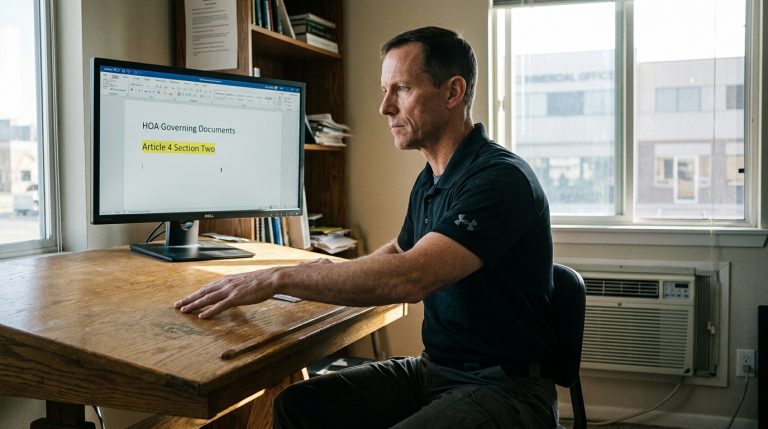
My thumb rubbed the worn brass casing of my pocket watch, feeling the fine knurling on the edge as my eyes tracked across page forty-two of the binder.
Karen had weaponized the community’s governing documents into a blunt instrument, assuming no one would spend the afternoon digging through the fine print.
“She’s counting on panic,” I said, finally lifting the heavy metal cover of the binder and flipping back to the supplementary addendums. “People see numbers like that and they write checks just to stop the noise.”
For the next three hours, I did what I used to do on remote command posts when a primary relay went dark.
I ignored the static, stripped away the emotional noise, and hunted for the specific line item where the system’s logic contradicted itself.
The kitchen grew dim as the afternoon sun dipped below the oak ridge, casting long, fractured shadows across the pages.
Every few minutes, the faint, high-frequency vibration hummed up through the floorboards from the concrete footing outside—a subtle, persistent pulse that reminded me why I had built the frame in the first place.
Then my finger stopped on a paragraph tucked deep inside Appendix C.
Clause 17.4b.
It was buried beneath three pages of standard landscaping restrictions and architectural aesthetic codes, drafted in the clumsy legalese of a cut-rate property lawyer years before the subdivision ever expanded.
“Look at this,” I said, sliding the binder across the wood toward Sarah.
She leaned down, her eyes scanning the dense text where the clause carved out an explicit exemption for pre-existing land parcels annexed into the development, shielding them from structural limitations on outbuildings unless a demonstrable, immediate safety hazard was proven.
My tower wasn’t a dwelling, and with its ten-ton concrete footing and professional engineering specs, it was structurally sounder than half the foundations in the valley.
Sarah let out a slow, measured breath, the tension in her shoulders dropping an inch.
“She skipped the due process,” Sarah murmured, tracing the margin with her finger. “The clause says any structural dispute requires a formal hearing before the Architectural Review Committee.”
“Which she completely bypassed in her rush to threaten demolition,” I replied, standing up and reaching for my notepad.
The paper trail was laid out, clean and unambiguous.
I sat back down, pulling a fresh sheet of paper toward me to draft the response.
I wasn’t going to yell, and I wasn’t going to beg.
I was going to cite their own rules right back down their throats, establishing a paper trail that would choke their petty bureaucrat routine before it even left the driveway.
CHAPTER 3: THE CELLULAR ANCHOR
The envelope containing the clause citations went out by certified mail before sunrise, leaving a paper trail that could not be casually dismissed or shredded behind closed doors.
Without an insider corporate backchannel to fast-track negotiations, I had to approach the cell provider through their standard commercial expansion portal, treating the corporate bureaucracy with the exact same patient persistence as the HOA.
Two weeks passed in a steady rhythm of radio silence, broken only by the low, continuous hum vibrating up from the tower’s massive concrete base.
Then came the email response from a regional site acquisition manager.
They weren’t interested in a personal favor; they were interested in a fifty-foot elevation advantage situated squarely in a notoriously stubborn valley dead zone.
By Tuesday afternoon, two commercial survey technicians parked their white utility truck at the base of my drive, uncoiling coaxial cables and setting up spectrum analyzers on the steel grating.
“Clean structure,” the senior technician muttered, clipping a meter onto the lattice leg. “Solid grounding, clear line of sight over the whole ridge. This solves a three-year coverage ticket for us.”
We spent two hours mapping power feeds, conduit paths, and commercial lease terms across my kitchen table.
The monthly site lease wasn’t a fortune, but it was enough to cover our property taxes twice over and fund whatever legal paperwork David Chen required to keep the board at bay.
The critical clause wasn’t the payout, however.
It was tucked into section nine of the standard commercial infrastructure agreement.
It explicitly classified the hardware mounted to the lattice as public utility equipment under commercial telecom guidelines, binding it to standard utility protections.
I signed the contract on the hood of my truck, handing the duplicate back to the technician just as a blue sedan slowed down near the end of my gravel drive.
Karen sat behind the steering wheel, her thick glasses magnified against the windshield as she stared at the commercial survey gear with unmistakable alarm.
She didn’t get out of the car.
She just sat there for ten long seconds, her fingers locked hard around the steering wheel before pressing down hard on the accelerator and kicking up a cloud of dust.
She thought she was dealing with a retired veteran with a lonely hobby.
She had no idea she had just walked into a commercial zoning trap she couldn’t fine, threaten, or bully away.
CHAPTER 4: THE COMMITTEE THEATER
The folding chairs in the community clubhouse scraped against the linoleum floor with a grating screech that set my teeth on edge.
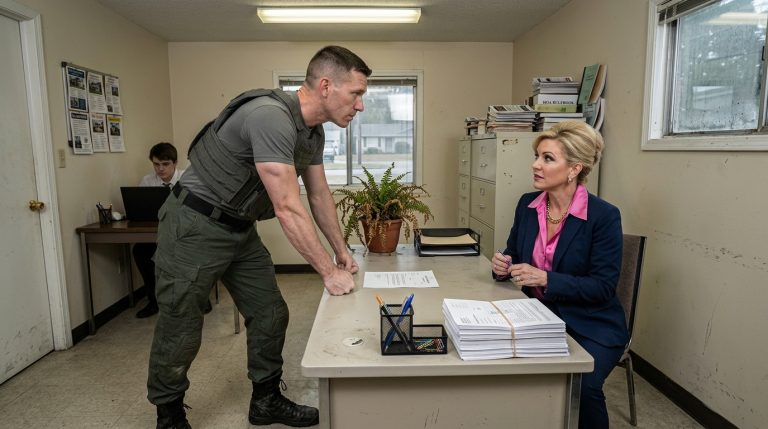
Karen sat at the head of the long folding table, her face flushed and her fingers gripping a stack of violation notices like playing cards she was desperate to shuffle.
The other four board members sat in stiff silence, avoiding eye contact with the crowded room of residents who had actually bothered to show up for a Tuesday night grievance hearing.
“Item number four,” Karen snapped, her voice cutting over the room murmur as she slapped a paper down. “Jack Rider, unauthorized turf accumulation—specifically, blades of grass exceeding the three-inch community height standard.”
I didn’t raise my voice.
I simply opened my black leather portfolio and placed a digital projector remote on the table, alongside a clear plastic bag containing a precisely clipped sample of turf.
“According to subsection seven of the structural bylaws,” I said, my tone flat and even as I clicked the remote, projecting a time-stamped, macro-lens photograph onto the pull-down screen behind her, “turf measurements require a standardized calibration against the soil grade, not an arbitrary glance from a passing vehicle.”
The image on the wall showed a microscopic breakdown of Kentucky bluegrass blades standing precisely at two point eight inches, measured beside a certified steel ruler.
A quiet murmur rippled through the rows of folding chairs.
Arthur, the retired accountant sitting to Karen’s left, leaned forward, adjusting his glasses to inspect the data on the screen before casting a sideways glance at the board president.
“That’s—that’s absurd,” Karen sputtered, her jaw tightening as her face flushed a deeper, dangerous shade of crimson. “The rule is clear! We don’t need a botany lecture to know an un-manicured lawn when we see one!”
“The rule requires objective verification, Madam President,” David Chen interjected smoothly from the aisle, his voice carrying the calm authority of a courtroom veteran. “Unless the board wishes to defend an arbitrary fine without physical evidence in a formal review.”
Karen’s hand trembled slightly as she reached for her glass of water, her fingers rapping a staccato rhythm against the plastic.
The other board members exchanged uneasy looks, the weight of the procedural trap settling over them like a wet blanket.
Arthur cleared his throat, lifting his voting paddle with a slow, deliberate motion.
“I move to dismiss the violation due to insufficient physical verification,” he said, looking straight at Karen.
Before she could bang her gavel in protest, two more paddles went up.
The vote was four to one, leaving Karen stranded in a lonely island of absolute authority that had just cracked down the middle.
CHAPTER 5: THE SEVERED LINE
Across the valley, the digital silence hit the neighborhood like a physical shockwave.
Inside the house, Sarah’s phone screen blinked out mid-text, while my own display dropped from solid five-bar 5G coverage to a flat, empty dead zone.
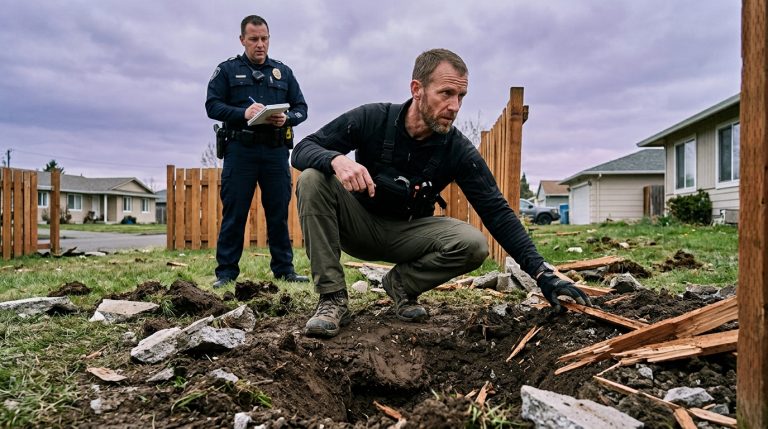
Out on the street, the steady rumble of a mini excavator idling near the common-area easement provided the answer before I even stepped off the front porch.
A young landscaping operator in a high-visibility vest sat in the driver’s seat, staring blankly at a freshly sliced orange cable protruding from a trench of dark, damp earth.
He had a formal work order clutched in his hand, bearing a signature that didn’t belong to a contractor or a utility worker.
It belonged to Karen Miller.
“I was just told to clear the drainage ditch,” the kid stammered, his fingers tightening nervously around the steering wheel as I walked up to the edge of the property line. “She said it was a routine community beautification project.”
“It’s a utility easement, son,” I said, my voice dropping into a flat, steady register as my thumb found the brass pocket watch casing in my pocket. “And that orange line is protected federal infrastructure.”
Before he could answer, his radio squawked to life with a sharp, frantic screech.
Karen’s voice blasted from the speaker, thin and shrill with panic and displaced rage.
“What do you mean the connection dropped? Fix it! Dig deeper if you have to, I authorized that trench!”
The operator yanked the radio off its mount, his face draining of color as he held the speaker out toward the empty air between us.
“Ma’am, we hit a main conduit,” he shouted back into the device. “We’re packing up right now. This is a federal line—we’re done.”
The line went dead with a harsh click.
Within minutes, the loading ramp slammed up against the side of the trailer, and the excavator rolled away down the gravel road, leaving behind a smoking trail of diesel fumes and a neighborhood completely cut off from the outside world.
Arthur and George appeared at the edge of my driveway a moment later, their expressions grim as they stared at the severed cable in the mud.
“She didn’t just target your tower this time,” Arthur said, adjusting his glasses with a trembling hand. “She just knocked out emergency connectivity for the whole ridge.”
“Which means she just crossed the line from a civil HOA dispute into federal liability,” I replied, letting go of the brass casing in my pocket.
The trap was fully sprung, and there was nowhere left for her to hide.
CHAPTER 6: THE FINAL COLLAPSE
Karen sat at the far end of the folding table, isolated by empty seats and a heavy, suffocating silence.
Her usual blustering confidence was gone, replaced by a pale, trembling stiffness as she gripped the edges of her floral muumuu.
Arthur stood at the center of the room, holding the emergency bylaws open to the page governing board accountability.
“We have received formal notice of intent from corporate legal counsel,” Arthur announced, his voice steady and unyielding in the quiet hall. “And a certified petition signed by over forty resident families.”
Karen tried to interrupt, her voice cracking with desperate defiance.
“The board cannot vote without my authorization! I am the president—this is a mutiny!”
“It’s a vote of no confidence, Karen,” Arthur replied, not even turning his head to look at her. “The motion carries unanimously, four to zero.”
She sat there stunned as the room around her remained silent, refusing to offer even a murmur of sympathy.
Within minutes, the old guard was stripped of every administrative title, and a new community committee was voted into immediate power.
The aftermath did not arrive with cheering crowds or cinematic speeches.
It arrived with quiet paperwork and the steady hum of repair crews splicing the severed fiber optic line down by the easement.
By the following week, the cell provider’s technicians had upgraded the equipment on my tower, restoring full connectivity across the valley while the neighborhood association rewrote its outdated bylaws to focus on common sense rather than petty enforcement.
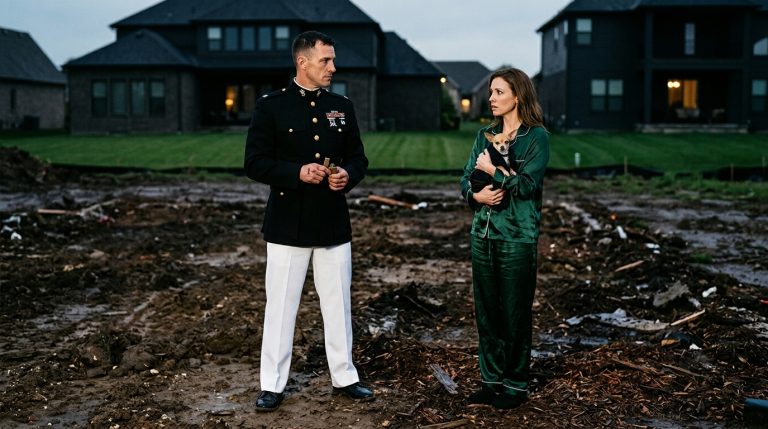
Karen’s house went on the market by the end of the month, sold quickly under the crushing weight of personal liability and unpaid legal fees.
Her moving truck pulled away down the gravel road on a crisp Tuesday morning, leaving behind a neighborhood that had finally learned how to breathe.
That evening, I climbed the metal steps of the tower for the first time since the ordeal ended, standing forty feet above the ground with my daughter Lily beside me.
The sky overhead was a deep, clear canvas of indigo stars, completely quiet except for the steady, rhythmic pulse of the small red warning light blinking into the dark.
I put my arm around her shoulder, feeling the solid, unmoving steel beneath my boots.
The noise in my head was gone, replaced by the quiet, living silence of a world set right.