The Rusted Gate of Harmony Creek Proves That Cold Paperwork and Quiet Persistence Crush Unchecked Arrogance
CHAPTER 1: THE CHAINED ACCESS
The heavy iron gate had stood anchored to those stone pillars for thirty years, but a fresh, rust-colored chain now wrapped through the bars.
I shifted my weight in the driver’s seat, the old vinyl upholstery creaking beneath me as I stared at the padlock.
The woman standing before me introduced herself with a syrupy, venomous smile, explaining that the road was now reserved exclusively for association members.
My fingers tightened around the scarred brass folding rule in my pocket, the metal cold against my palm as I measured the sheer absurdity of her demand.
“There is no other way to my land, Karen,” I said, keeping my voice flat and controlled through years of dealing with stubborn logistics.
She gave a dismissive shrug that rippled through her pink attire, telling me to take it up at the next quarterly meeting.
A shipment of custom black walnut was scheduled for my workshop tomorrow, and a three-month lockout meant immediate breach of contract.
I killed the diesel engine, letting the sudden silence settle over the gravel road as crickets began to chirp in the humid brush.
Without raising my voice, I pulled out my phone to dial a 24-hour commercial locksmith while fixing my gaze squarely on her triumphant expression.
Forty minutes later, the high-pitched whine of Gus’s angle grinder tore through the twilight, sending a brilliant shower of orange sparks against the iron bars.
The shackle snapped with a sharp crack, freeing the gate and leaving me with a four-hundred-dollar invoice and a pair of jagged iron souvenirs.
As I drove my truck past her sputtering disbelief, I knew this wasn’t a simple neighborhood disagreement.
It was a calculated siege against my livelihood, and my fuse was burning straight to the powder.
CHAPTER 2: THE MISSING DEED
The drawer glided open with a dry metallic hiss, exposing rows of manila folders that held six decades of my family’s history on this ten-acre plot.
I flipped through the rusted tabs, my thumb catching on the edge of a divider that should have held the foundational county-filed paperwork.
The section was empty.
Sarah stood in the doorway holding a mug of black coffee, her eyes tracing the tension in my shoulders.
“The original easement transfer from nineteen-eighty-eight,” I muttered, sliding the empty folder onto the scarred wooden desktop. “It’s gone.”
Without that specific signed document, our legal standing against the association rested entirely on circumstantial county index entries and fragmented oral testimony—a terrifying handicap given Karen’s aggressive posturing.
The absence of that paper wasn’t just an oversight; it felt like a deliberate administrative erasure.
I grabbed a flashlight and walked out to the workshop at the edge of the property, the damp night air chilling my skin through my shirt.
Deep inside a steel footlocker beneath a stack of old engineering blueprints, I found a secondary bundle of records tied with faded twine.
I sliced the twine with my pocketknife and pulled out a yellowed ledger from the initial development phase.
A single page was cleanly excised from the middle of the binding, leaving only ragged paper fibers clinging to the spine.
Someone had gone through these records before, removing the exact verification we needed to prove our perpetual right of way.
I stared at the mutilated binding while the distant hum of traffic on the county road echoed through the trees.
Karen wasn’t just relying on rude neighborhood politics; she had access to institutional archives that were slowly being sanitized to frame our land as landlocked.
My phone buzzed on the workbench with an email notification from the local zoning board regarding a sudden “unauthorized grade variance” on our access road.

CHAPTER 3: THE ESCALATING FINES
I scrolled down the digital notice demanding fifty dollars a day for non-compliant driveway stones.
The text was crisp, formal, and utterly detached from the reality of twenty years of gravel settling under country rains.
Karen had bypassed any sensible communication, using paper bureaucracy as a cudgel to bleed my resources dry while the missing easement papers left my legal defense standing on bare earth.
I printed the document out on heavy cardstock, listening to the sluggish whir of the office printer laboring against the late-night voltage drop.
Sarah stood by the kitchen window, watching the moonlight cut across the long gravel path.
“They’re trying to price us out of our own dirt,” she said, her voice tight with suppressed fatigue.
“They’re trying to force a reaction,” I replied, folding the fine notice into quarters and tucking it into my shirt pocket.
The next morning, the mailbox lid groaned open to reveal a second certified envelope bearing the association logo.
Inside was an itemized ledger of accumulated penalties totaling three hundred dollars for unapproved aggregate material.
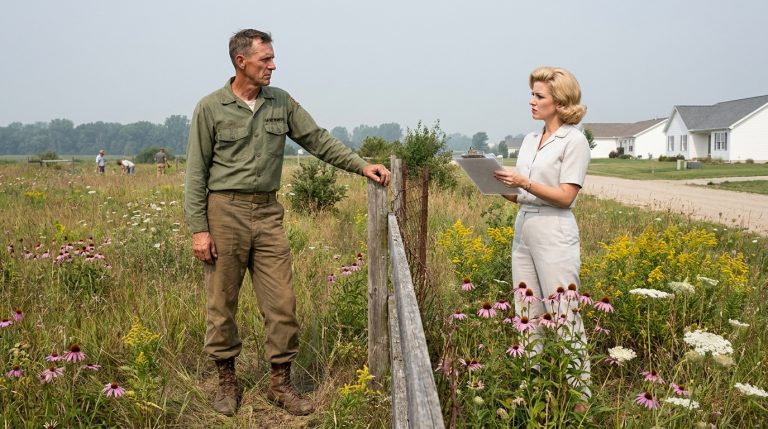
I didn’t call a lawyer this time; I simply walked down to the perimeter line where their manicured turf met my wild brush.
Karen was standing near her pristine hydrangea bushes, directing a landscaping crew with exaggerated hand gestures.
She caught sight of me approaching and crossed her arms over her pastel tracksuit, her mouth tightening into a thin line of calculated disdain.
“Private property, Mr. Rivera,” she called out before I reached the property marker, her voice carrying over the hum of a leaf blower. “Deliveries need to use the public drop-off outside the gates.”
“That fine notice won’t hold up in any court with a working calendar,” I said, stopping three feet short of her mulch bed.
She offered a cold, practiced smirk and turned her back to speak with the lead landscaper.
CHAPTER 4: THE SECRET RECORDINGS
Robert stood behind his screen door, his fingers twitching against the plastic casing of a small digital voice recorder.
He motioned me into the shadow of his patio overhang, keeping his eyes fixed on the stucco walls of Karen’s house across the lawn.
“She spends every afternoon out there on speakerphone,” Robert whispered, sliding a micro-SD card across the patio table. “Ever since the first lawsuit papers hit her door, she’s been bragging about how she plans to starve us out.”
I picked up the tiny black chip, feeling the rough plastic edge under my thumb.
Without the original paper deed from the county archives, these audio clips were the only structural leverage left to prove her malicious intent.
“Did she mention the board votes?” I asked, keeping my voice low and steady.
“She called the paperwork a joke—said they’d keep changing the locks until you sold the ten acres for pennies on the yard,” Robert replied, wiping his palms on his trousers.
I pocketed the card, knowing that exposing her conspiracy in open court would require walking right into a perjury trap.
Back in my home office, I plugged the chip into my laptop and watched the audio waveforms stack up on the screen in jagged blue lines.
The tinny sound of Karen’s voice filled the quiet room, laughing about fake fines and planned land seizures.
My phone buzzed on the desk with a message from Alan confirming our next legal filing.
CHAPTER 5: THE PERJURY TRAP
The mahogany table felt cold beneath my palms as Alan slid a yellow legal pad across the smooth surface.
Karen sat directly opposite us, her pastel blazer looking aggressively stiff under the fluorescent lights while her retained attorney whispered advice into her ear.
“Ms. Smith, was it your decision alone to alter the security perimeter on August first?” Alan asked, his voice steady and devoid of inflection.
“The board voted unanimously to secure our community against unauthorized traffic,” she snapped, smoothing her lapels with a nervous twitch of her fingers.
Without the physical easement deed to wave in her face, Alan relied entirely on the trap we had laid using Robert’s audio files.
He leaned forward, resting his forearms on the table as he questioned her about legal counsel reviews that never happened.
“And your attorney explicitly advised you that association rules supersede county property deeds?” Alan pressed softly.
“Our legal counsel confirmed our authority,” she lied without blinking, her gaze locking onto mine with defiant triumph.
Her lawyer closed his folder with a sharp snap, realizing too late that she had just walked straight into a documented perjury charge under oath.
Alan didn’t blink or raise his voice; he simply set his pen down and requested the court reporter read back her exact words.
CHAPTER 6: THE FINAL COLLAPSE
The double doors swung open, and the entire room went dead silent as we walked down the central aisle.
Karen stood behind the podium at the front, her chest heaving underneath her pastel blazer as she tried to shout down the gathering homeowners.
“This meeting is adjourned—you have no right to be here!” she shrieked, her voice cracking with frantic desperation.
Without the safety net of the board or her fabricated minutes, she lunged toward the exit, attempting a desperate counter-move by claiming the association was being victimized by an outside stalker.
Arthur, the newly elected board leader, banged his gavel against the wooden table with a sharp, echoing crack that cut through her hysteria.
“Sit down, Karen, or we call the sheriff to escort you off the premises,” Arthur said flatly, his voice carrying absolute authority.
I stepped forward and laid the certified court judgment across the podium, letting her see the sixty-thousand-dollar personal liability total staring back at her.
She stared at the numbers in stunned disbelief, her hands trembling as the harsh reality of her own reckless overreach finally crashed down upon her.
The neighborhood watched in cold silence, refusing to offer a single word of comfort to the tyrant who had tried to bankrupt them all.
Two weeks later, a neon-bright for-sale sign was hammered into her obsessively manicured front lawn while a moving truck idled in her driveway.
I stood on my back porch sipping coffee, watching the automated security gate glide open smoothly for a delivery van without a single obstruction in sight.
The ten acres of family land stretched out in quiet peace before me, fully secured not by lost paper deeds, but by common sense and relentless perseverance.