The Conduit of Ruin: A Retired Marine’s Calculated Dismantling of a Suburban Tyrant’s Power Empire
CHAPTER 1: The Severed Artery
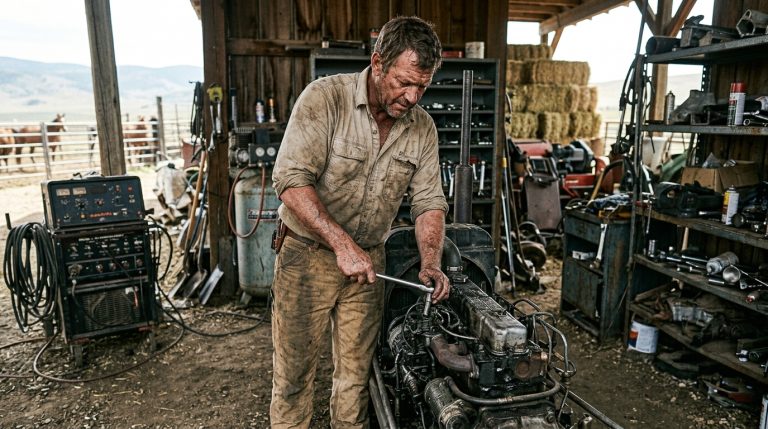
The silence of the workshop was the first thing to hit me—not the quiet of a resting space, but the hollow, dead-end absence of current. My industrial lathe sat motionless, a five-thousand-pound paperweight. Outside, the driveway was a landscape of jagged grass and upturned earth.
“This unsightly cable was violating common area aesthetics, Mr. Miller.”
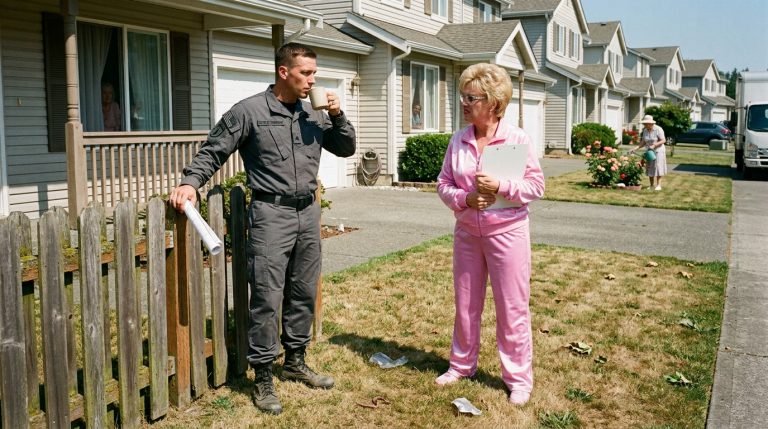
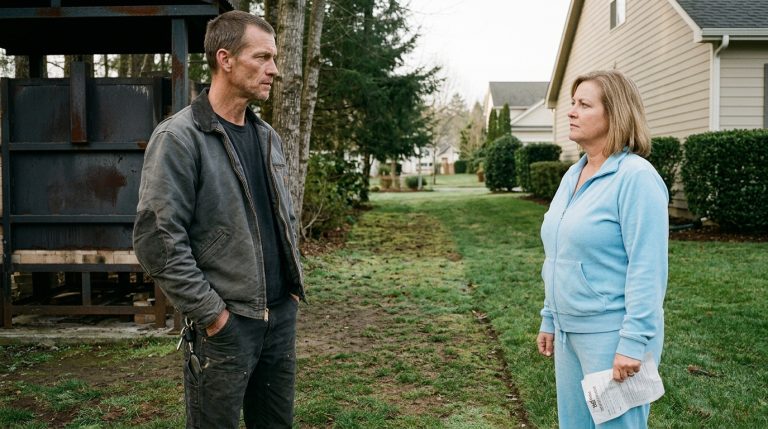
Karen’s voice didn’t carry the weight of a neighbor; it carried the thin, brittle authority of someone who had never been told “no.” She stood in the strip of grass between the properties, her stature magnified by the sheer, unbridled arrogance etched into her features. She looked like a queen surveying a ruined province. In her right hand, the bolt cutters—industrial, heavy, and stained with the black rubber of my line’s casing. In her left, she held the ends of my three-phase, 200-amp service like a trophy of some savage, internal war.
I didn’t scream. I didn’t reach for her. My pulse, trained for two decades to remain steady beneath the chaotic thunder of combat, didn’t spike. Instead, it slowed. My environment sharpened. I wasn’t in a manicured subdivision of Oak Creek Estates anymore; I was back on the periphery of a patrol, assessing a blown wire in a kill zone.
“Step away from the trench, Karen.” My voice was a low, flattened blade.
She tilted her head, her smile tight and self-satisfied. “I have enforced the community standards, Frank. You should have hired an approved contractor. This aerial monstrosity was a blight.”
She was blind to the physics of her own situation. She stood in the damp, freshly turned soil, oblivious to the fact that her plastic-coated handles were the only thing separating her from a lethal grounding path. I shifted my weight, my boots firm on the concrete, and pulled my phone from my pocket with a fluid, rhythmic motion.
“You have no idea what you’ve just done,” I said, my gaze locked on the copper sinews visible through the split black casing.
“I know exactly what I’ve done,” she snapped, the condescension finally hardening into something sharp. “I’ve protected this neighborhood from your… factory.”
I didn’t answer. I hit record. The lens of my phone panned deliberately—from her smug, flushed face down to the industrial tool, then across the lawn to the dark, silent mouth of my workshop. Every frame was an affidavit. I wasn’t just observing the crime; I was cataloging the ammunition I would use to burn her regime to the ground.
She wasn’t looking at a neighbor. She was looking at a combat engineer who had spent twenty years building infrastructure in the fire, and she had just handed me the one piece of leverage I needed to bury her. The air felt heavy, charged with the ozone of a disaster waiting for the circuit to close. I saw the tremor in her hand then—not from remorse, but from the sudden, creeping realization that the silence from the workshop wasn’t just a win. It was a witness.
CHAPTER 2: The Emergency Crew and the Evidence of Intent
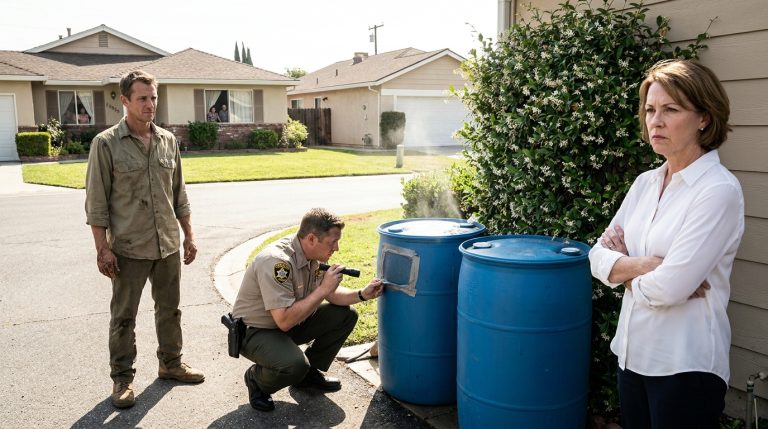
The heavy, white utility truck rumbled up the street, its amber strobes pulsing against the quiet, manicured hedges of Oak Creek Estates like a rhythmic, artificial heart. Karen didn’t move. She stood rigid, her eyes flicking between the approaching vehicle and the dark, yawning threshold of my workshop. The smirk that had defined her face moments ago had begun to curdle, replaced by a frantic, nervous tension that she clearly hadn’t expected to encounter.
I didn’t take my eyes off her. I stood my ground, my phone still clutched in my hand, the screen recording the scene. The distance between us felt like a no-man’s land, fraught with the tension of a wire ready to snap.
“Sir, is the line live? Is anyone injured?”
The operator’s voice crackled through my phone, urgent and professional. I adjusted my posture, turning slightly so the camera could capture both the open trench and the way Karen was now instinctively pulling her hands behind her back.
“The line should be considered live until your crew confirms otherwise,” I said, my voice cutting through the growing mechanical roar of the truck’s engine. “The individual who cut it is unharmed through sheer dumb luck, but she is currently standing in damp soil next to an open trench with an exposed, high-amperage conductor. I need your people here now.”
I could see the realization finally registering on her face. The words ‘high-amperage’ and ‘dumb luck’ seemed to strip away the last of her self-importance. She looked down at the bright yellow bolt cutters she had dropped into the dirt, then back at me, her mouth working silently. The authority she wielded via her three-ring binder was irrelevant here. Physics didn’t care about HOA bylaws, and for the first time, she seemed to understand that the rules she had enforced on everyone else were completely powerless against the consequences of her own actions.
She dropped the severed ends of the cable as if they had suddenly begun to sear her skin. The heavy black casing hit the grass with a dull, final thud.
I disconnected the call and transitioned directly to 911. My narrative was already hardening, the facts stacking up like bricks in a wall I was building around her. “I need to report a felony destruction of property in progress at 120 Oak Drive,” I told the dispatcher, my voice clipped, echoing the cadence of a radio check. “The suspect is the HOA president, Karen Peterson. She has intentionally severed a buried main power line. The damage is in excess of ten thousand dollars, and she has created an extreme public safety hazard.”
Karen took a step back, her face turning a sickly, mottled shade of pale. “You’re calling the police on me? I am the authority here! I was upholding the bylaws!” She was unraveling, the screech in her voice losing its edge, replaced by the frantic, thin sound of a cornered animal.
“The authority to commit a felony, Karen? I don’t think that’s in your little binder of rules,” I said, my voice as flat and unyielding as the concrete under my feet. I panned the camera again, focusing on the dark, lifeless workshop. The loss of power wasn’t just an inconvenience; it was the lifeblood of my business, the very reason I had bought this house. She had reached into the life I was building and severed the artery, thinking she was merely pruning a hedge.
The first wail of a siren joined the amber pulse of the utility truck, a piercing, high-frequency sound that shattered the suburban calm. Neighbors, those who had kept their heads down for months, were now appearing in their driveways, phones raised, watching the collapse of the neighborhood’s self-proclaimed queen.
I watched her through the lens. She wasn’t looking at me anymore; she was looking at the street, at the flashing lights, at the shifting shadows of the neighbors she had terrorized. The weight of her own delusion was collapsing, and I realized then that the destruction of my cable was just the initial tremor. The real damage—the kind that would leave a permanent scar—was just beginning to manifest in her eyes. I had the footage. I had the scene. And more importantly, I had the discipline to ensure that once the police arrived, she wouldn’t be leaving with anything other than a pair of steel cuffs.
CHAPTER 3: The Paper War
I stood in the entryway, the air inside the house still holding the quiet hum of normalcy, a stark contrast to the tactical chaos I had just vacated on the lawn. The envelope was heavy, the paper thick, cream-colored cardstock that screamed of manufactured authority. I didn’t need to open it to know what was inside. Karen Peterson was a creature of predictable habits; when her physical tantrums failed, she retreated to the only battlefield she truly understood: the bureaucratic maze of the Homeowners Association.
I carried the envelope to my desk, my movements precise. I didn’t rip it open. I used a utility knife to slice the seal, keeping the edges clean. Inside, the violation notice was printed in crisp, laser-jet black ink. It cited the diesel generator I’d rented, the one currently chugging away in the dark, silent space of my workshop. It was a formal demand for immediate removal, coupled with a hundred-dollar-a-day fine.
The smell of the paper—a dry, sterile odor—triggered a flicker of memory. Years ago, in the dust of Fallujah, we’d found blueprints in a reinforced bunker, maps of municipal infrastructure that had been diverted for insurgent use. They had been drawn with the same kind of obsessive, rigid adherence to “correctness” that Karen’s letter displayed. Back then, we dismantled the threat with controlled detonations. Now, I was going to dismantle it with a three-ring binder.
I pulled the thick, imposing volume of the HOA covenants from my shelf. It was the same binder she had handed me when I moved in, a document I had initially dismissed as the hobby horse of a bored retiree. Now, I treated it like a technical manual for a complex weapons system. I spent the next three hours mapping the subsections, cross-referencing the fine structures against the state’s property codes and the original 1978 deed history I’d pulled from the county records weeks ago.
The silence of the house was broken only by the steady, distant thrum of the generator—the pulse of my business, still alive. Every time the floorboards creaked, my mind instinctively checked the perimeter. It wasn’t paranoia; it was habit. I had learned early on that the most dangerous threats weren’t the ones that came at you with bolt cutters; they were the ones that waited for you to blink on a technicality.
I drafted my response not as a neighbor, but as a combat engineer completing a project report. I cited the specific paragraph of the bylaws she had referenced, then I meticulously disassembled her argument. I framed the generator not as an industrial violation, but as a necessary, temporary mitigation measure to prevent financial ruin—damages for which, I noted with clinical precision, she was already criminally liable for causing. I included a copy of the police incident report number, a quote for the electrical repairs, and a demand for a formal board hearing.
My wife, Sarah, appeared in the doorway, her presence soft, a grounded anchor to the life I was fighting for. She watched me for a moment, her eyes tracing the stacks of documents. “You’re really going to war with her, aren’t you?”
“I’m not going to war, Sarah,” I said, not looking up from the page. “I’m auditing her failure.”
I walked to the kitchen and made a cup of black coffee, the steam rising in the dim, evening light. The house felt smaller tonight, the walls pressing in. I knew that the violation notice was only the beginning. Karen wasn’t just a nuisance; she was a symptom of a larger, systemic decay. The more I read through the fine print of the HOA binder, the more I noticed the language. It was crafted not to manage a community, but to gatekeep it.
I sat back down at the desk and signed the letter with a firm, steady hand. I would send it certified, return receipt requested. Every piece of paper I sent was a thread in the net I was casting. I was clogging their system, forcing them to acknowledge the legitimacy of my presence. Each violation notice she sent was just another brick I could add to the wall of evidence I was building. By the time the sun came up, I had already mapped out the next four responses. I wasn’t waiting for her move; I was dictating the tempo. I could feel the cold, sharp edges of the paper under my fingertips, the texture of the only weapon that really mattered in this suburban theater of operations.
CHAPTER 4: The Hum of Resistance
The workshop air was dense with the scent of ozone and stale machine oil—a familiar, grounding atmosphere that stood in direct opposition to the antiseptic, rule-bound silence of the HOA’s correspondence. I had pushed the massive fabrication table to the center of the room, positioning it under the stark, focused glare of the work lamps. Upon it, I had laid out the binders—an expanding archive of Karen’s campaign against the neighborhood.
The first to arrive was Tom, a man whose apprehension was evident in the way he kept glancing at the windows, expecting to see Karen’s floral muumuu emerging from the shadows. He was followed closely by Dave, the Air Force vet, whose movements retained a military efficiency that gave me a grim sense of relief. Last was Mrs. Gable, clutching a tin of chocolate chip cookies as if they were a tactical asset.
I waited until they were settled, the generator outside providing a rhythmic, metallic heartbeat to our gathering.
“This,” I said, my finger tracing the spine of the thickest binder, “is the archive of everything she’s thrown at me in the last two weeks. And this,” I indicated the second, equally bloated binder, “is the rebuttal.”
Dave leaned in, his eyes scanning the neatly organized tabs. He let out a low, appreciative whistle. “You’ve turned the bureaucracy against itself. It’s a classic insurgent tactic—jam the gears until the machine stalls.”
“That’s the goal,” I agreed, my tone stripped of any ego. “But defense won’t win this. She’s built a fiefdom. Every violation notice, every fine, every ‘correction’ she’s issued hasn’t just been about control—it’s been about a pattern.”
I opened the binder to a section I’d been mapping for the last forty-eight hours. I had laid out a timeline of fines and violations issued across the subdivision over the past eighteen months. “Look at the addresses,” I instructed, pointing to the grid I’d sketched. “Notice a trend?”
Mrs. Gable squinted at the map. “It’s all the same side of the creek. The new families. The ones who haven’t been here as long.”
“Exactly,” I said. “She isn’t governing. She’s selecting. She identifies anyone who lacks the time, the resources, or the knowledge to push back, and she drains them until they’re compliant or they leave.”
I handed a document to Tom. It was a copy of the HOA’s own internal guidelines, with specific sections highlighted in red. “The bylaws grant us the right to inspect every financial record, every contract, every board minute. She’s been ignoring this because she knows that as long as it’s buried in the ‘executive session’ designation, she’s untouchable.”
Tom looked up, his brow furrowed. “What do we do? If we just show up and ask, she’ll laugh at us.”
“We don’t ask,” I said, a cold resolve settling into my chest. “We demand. In writing. We serve them with a formal, certified letter citing the exact articles of the bylaws. When they refuse—and they will—they’re in breach of the association contract. That breach is the leverage we need to escalate this to an attorney who doesn’t answer to her.”
The room quieted. The generator seemed to grow louder, filling the silence with its steady, unceasing mechanical labor. They weren’t looking at me as a neighbor anymore; they were looking at the mechanics of a survival strategy.
“I’ve been checking the county plat maps,” Dave said, his voice lowering. “If she’s acting outside the board’s recorded minutes, she’s breaking the law, not just the bylaws.”
“That’s the friction point,” I replied. “She thinks she’s fighting individuals, but she’s been fighting the community. We just need to aggregate our evidence. Every violation notice, every baseless fine, every photo of an ‘approved’ yard vs. an ‘unapproved’ one—we need to catalog it all.”
Mrs. Gable set the cookies on the table, the metallic clatter of the tin echoing against the steel. “She ruined my late husband’s roses,” she said softly, but the tremor in her voice had vanished, replaced by a crystalline hardness. “What do you need me to do, Frank?”
“I need you to remember every date, every encounter, and every cent you’ve paid in fines,” I said. “We’re not going to shout. We’re going to be so organized, so thoroughly documented, that they won’t have a choice but to open the books.”
I stood there, watching them—a veteran, a father, and a widow, all united by a common antagonist. The workshop felt different now; it wasn’t just a site for metal fabrication, but a foundry for a different kind of project. We were moving past the point of individual skirmishes. We were preparing for a siege. The hum of the generator felt like a promise: we were powered, we were prepared, and for the first time, Karen Peterson’s absolute rule was showing the first, jagged cracks of fatigue.
CHAPTER 5: The Legal Nuclear Option
The transition from the gritty, oil-stained environment of my workshop to the sterile, high-altitude office of Evelyn Reed felt like stepping into a different world. Outside, the city was a sprawling, blurred motion of traffic and concrete; inside, the silence was heavy, expensive, and absolute. Ms. Reed sat behind a desk that looked more like a slab of obsidian than mahogany, her eyes focused on the binders I’d laid out like a roadmap of the HOA’s slow-motion collapse.
She didn’t speak for a long time. She simply flipped through the pages, her expression a mask of clinical detachment. She studied the photos of the severed cable, traced the log of petty violation notices, and scrutinized the certified mail receipts with the intensity of an interrogator. When she finally looked up, the predatory glint in her eyes was unmistakable.
“Mr. Miller,” she said, her voice dropping into a register that made the ambient silence feel heavier. “You’ve done eighty percent of my work for me. This isn’t just an HOA dispute. This is a manual for how to systematically dismantle an organization from the inside out.”
“It’s about survival,” I said, my voice steady, reflecting the same cold precision I’d used to build my fabrication business.
“Survival is the baseline,” she countered, leaning back. “But what we have here is something else. You have a documented history of targeted, malicious harassment. You have the destruction of your primary business infrastructure. And if I’m reading these bylaws and meeting minutes correctly, you have a board that has effectively weaponized its governance power.”
A flicker of movement at the door caught my attention—a junior associate stepping in with an urgent, apologetic look. “Ms. Reed, the firm’s partner on the zoning matter just pulled out of the afternoon briefing. It’s a conflict of interest, they’re claiming. We have to recalibrate the filing strategy by the hour.”
Reed didn’t even blink, her focus never leaving the binders. “Push the briefing to the evening. We don’t adjust our strategy; we sharpen it. Tell them we’ll file without their oversight.”
The associate retreated instantly. It was a small, sharp detour—a butterfly effect in the massive machinery of her practice—but it didn’t slow her down. She turned back to me, her attention singular. “She cut your power line, so I am,” she repeated, the words rolling off her tongue with a sense of grim satisfaction. “That is the pivot. Most HOA cases are about fences and paint. This is an act of willful, criminal destruction. We don’t just sue the Association; we pierce the corporate veil. We go after the individuals. Karen Peterson. Her bank accounts. Her assets. Her husband’s practice.”
I felt the shift. It was the same sensation I got when a structural weld finally took hold—the moment the metal ceased to be two separate pieces and became one single, stronger entity. “What does that mean, practically?”
“It means we file for a temporary restraining order and a massive civil suit for damages,” she said, pulling a legal pad toward her and beginning to write with rapid, aggressive strokes. “The lawsuit will act as a physical barrier. It will stop their ‘violation’ notices in their tracks. We’ll sue for the repair costs, the lost business income, and punitive damages. When this lands on her doorstep, the game changes. She won’t be the one fining you; she’ll be the one trying to figure out how to pay for her own defense.”
She looked at me, her gaze piercing. “But be warned: this is the legal nuclear option. Once this is filed, there is no ‘neighborly’ resolution. You aren’t just cleaning up the neighborhood; you’re executing an organization.”
I thought of the workshop, the silence of the lathe, the smell of dust settling on tools that should have been humming. “I’m not looking for neighborly. I’m looking for finality.”
“Good,” she said, closing the binder with a sharp, echoing slap. “Because that’s exactly what you’re going to get.”
I left the office with the draft of the complaint in my hand, the weight of the document in my pocket feeling surprisingly heavy. The city air felt cooler, thinner, as I walked toward the elevator. The legal machinery had been set in motion, and there was no reversing the gears now. Every step I took was a calculated advance toward the collapse of the world Karen had built, and for the first time, I could see the end of the war, a sharp, clear line on the horizon where the consequences of her greed would finally meet the weight of the law.
CHAPTER 6: The Rosetta Stone of Corruption
The delivery of the banker’s boxes was a tactical inundation. Twelve of them, stacked in a towering column of cardboard and tape in the middle of my shop floor, looming like a fortification I was now required to besiege. Each box was sealed with reinforced packing tape, and as I dragged the first one onto the fabrication table, the sheer physical weight of the disclosure was palpable. This was their “document dump”—a deliberate attempt to bury us under a mountain of mundane invoices, bank statements, and meeting minutes, hoping we would lose our way in the noise.
They had underestimated the nature of the people I had gathered.
Arthur, our forensic accountant, pulled up a chair to the table, his eyes already tracing the rows of entries on a ledger sheet like a navigator reading a star map. “They think volume is a defense,” he muttered, his voice quiet. “They don’t realize that every transaction, no matter how small, leaves a footprint.”
I grabbed the heavy-duty box cutter from my belt—the same tool I’d used to maintain the fabrication equipment that Karen had tried to destroy—and sliced through the tape. The scent that wafted out was pure, stale paper—the smell of trapped air and long-held secrets.
For three nights, the workshop didn’t sleep. The hum of the generator was the only constant, a mechanical rhythm that seemed to sync with the scratching of Arthur’s pens and the rustle of scanned pages. Tom and Dave were working the peripherals, cross-referencing vendor lists against property records. I was on the hunt for intent.
I reached the final box, a nondescript container tucked under a layer of utility bills. It contained a folder mislabeled “Drafts.” I flipped it open, and the breath caught in my throat. It wasn’t a draft. It was the raw, handwritten log of the HOA’s “executive sessions.”
I pulled a single sheet toward the lamp, the glare highlighting the uneven, frantic handwriting. It was dated six months prior. Miller, 120 Oak, excessive noise from workshop. Need to find violation to pressure him, check property lines. The ink was smudged, a testament to the haste of its recording. Beside it, another note, this one concerning Mrs. Gable: Roses are an eyesore, increase fines until she removes them.
The paper was brittle between my fingers, a physical manifestation of a systematic, malicious conspiracy. The cold, clinical logic of the notes made my skin crawl. This wasn’t governance; it was a targeted campaign of attrition.
I kept digging. I found a separate folder, buried deep, labeled Drainage Assessment 2024. I laid the contents out on the steel table. There was the invoice for the common area improvements, but beneath it lay a geological survey map and a rezoning application—a request to reclassify two acres of protected green space into low-density residential. My heart hammered against my ribs as I pulled my own laminated survey map from my desk and laid it over the rezoning plot.
The geometry was undeniable. The access road for the proposed development cut straight through the 10-foot utility easement on my property—the very corridor where my three-phase power line was buried. The “aesthetically unapproved” cable wasn’t just a nuisance; it was the primary obstacle to a multi-million dollar real estate transaction.
I looked at the notes again, the connection locking into place with the sickening precision of a falling guillotine blade. She hadn’t just been harassing me; she had been clearing a path for a developer who was holding a check with six zeros on it. The bolt cutters hadn’t been an act of a neighborhood busybody. They had been a calculated surgical strike.
“Frank,” Arthur said, not looking up from his ledger. “Look at the landscaping invoices for Prestige Greenscapes. They aren’t just overcharged. They’re identical to the payments being made out to an LLC owned by a shell company in the Cayman Islands.”
I didn’t answer. I just stared at the map. The workshop, once a sanctuary of creation, felt different—as if the shadows in the corners were watching, the equipment humming with a warning. I had found the heart of the machine. The embezzlement was the fuel, but this rezoning deal was the engine. We didn’t just have evidence of tyranny; we had the proof of a massive, coordinated fraud that went far beyond the boundaries of Oak Creek Estates.
The light from the lamps felt harsh, exposing the reality of what we had uncovered. Karen wasn’t just an antagonist; she was the architect of a rot that had been festering beneath the surface of the entire subdivision for years. I reached for my phone, my fingers steady, and began to document the files, each click of the camera a step closer to dismantling the entire structure. The air in the workshop was cold now, the metallic chill of the steel table seeping into my skin, but I didn’t feel it. I was too focused on the dark, clear path that lay ahead.
CHAPTER 7: The Collapse of Authority
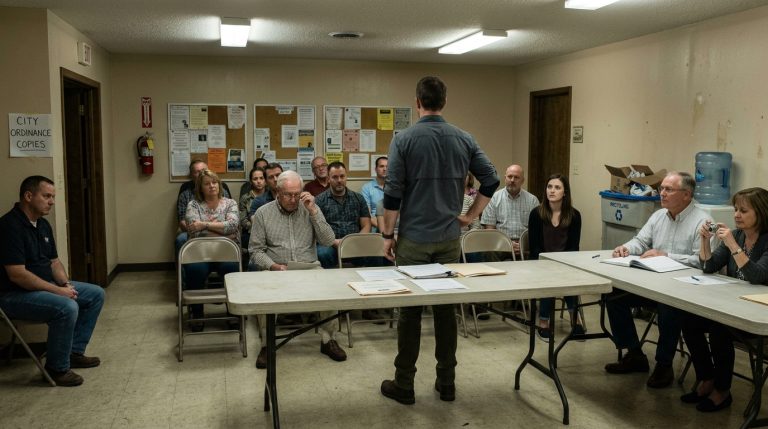
The elementary school cafeteria smelled of floor wax and stale air—a mundane, non-threatening environment that felt utterly incongruous with the fire I was about to ignite. Close to a hundred neighbors filled the plastic chairs, a sea of faces ranging from confused to outright hostile. At the front, sitting at a long, folding table, were Karen, Carol, and Patricia. They looked like royalty presiding over an unruly court, though Karen’s posture was stiff, her hands clutching a gavel that she hadn’t yet dared to strike.
Beside them, their lawyer—a man whose suit cost more than my first lathe—fidgeted with a stack of papers, his eyes darting toward the back of the room where Ms. Reed stood, a silent, immovable monolith of legal threat.
I approached the podium. The microphone feedback whistled, a sharp, piercing note that made the front row wince. I ignored it, planting my feet. My internal compass was locked. I had the documents. I had the map. I had the truth.
“Good evening,” I said, my voice cutting through the ambient murmur. It was flat, devoid of the passion I’d felt in the workshop, but packed with the weight of the evidence I’d spent weeks accumulating. “My name is Frank Miller. Many of you know me as the neighbor whose power line was severed by our board president.”
A collective murmur rippled through the room. Karen opened her mouth to protest, but I didn’t give her the oxygen. I clicked the remote. The projector flickered, throwing a massive, high-definition image of the utility easement map onto the screen behind me.
“This is not about an unsightly cable,” I stated, the red line of the easement glowing on the wall. “This is about an obstacle to a million-dollar transaction.”
I moved through the slides with the rhythmic, calculated pace of a briefing. I didn’t frame it as a story; I presented it as a structural failure. I showed the landscaping invoices side-by-side with the social media photos of the board members at family gatherings. The reaction was visceral—a low, grinding sound of collective realization. When Arthur stood up to walk them through the financial charts, the room didn’t just listen; it began to turn.
Then, I hit the final slide. The developer’s letter. The rezoning request. The access road cutting through the very heart of the community’s green space.
“She wasn’t protecting your property values,” I said, my voice steady as I looked directly at Karen. Her face was a ruin of mottled, panicked white, her hands trembling so violently that the gavel she was holding slipped, clattering against the metal table. “She was selling your assets for a secret payday. She cut my power because it was the only thing standing between her and a developer’s bribe.”
The cafeteria exploded. It wasn’t a roar; it was a physical shift in the room, a sudden, violent surge of collective anger that pushed back against the folding table. People were standing, their faces contorted with betrayal. Karen’s lawyer jumped up, his face pale, but Ms. Reed merely stepped forward from the back of the room, her presence effectively muting his protest before he could utter a word.
Karen tried to speak, her voice reaching a frantic, shrill register that was instantly devoured by the cacophony. She was no longer a president; she was an obstruction in the path of a tidal wave. I stood back, my hands resting on the podium, watching the structure of her authority dissolve in real-time. The faces in the crowd weren’t looking at her as an authority anymore; they were looking at her as a thief.
The chaos was loud, discordant, and entirely deserved. It was the sound of a community recognizing its own theft. Karen reached for the gavel again, a final, pathetic gesture of control, but her hand stopped mid-air. She looked at me, her eyes finally meeting mine, and I saw the absolute, shattering realization that there was no procedure, no bylaw, and no lawyer that could patch the hole she had torn in the community’s trust. The floor wasn’t just shaking; it was falling out from under her, and she was, for the first time, realizing she had nowhere left to fall.
CHAPTER 8: The Price of Order
The cafeteria was a vacuum of sound. The only movement came from the fringes—neighbors shifting in their chairs, whispers circulating like smoke. Karen sat at the table, her face now completely devoid of color, her gaze fixed on the floor where her gavel had fallen. She looked smaller, stripped of the floral muumuu of her perceived authority, replaced by the crushing reality of the situation.
As the vote concluded—a landslide against her and her board—the doors to the side corridor swung open. Detective Russo stepped through, his presence clinical and deliberate. He didn’t rush. He didn’t need to. He walked directly to the table, his footsteps clicking against the linoleum with the finality of a closing door.
“Karen Peterson,” he said, his voice flat, cutting through the stagnant air. “You have been formally indicted on counts of felony criminal damage and reckless endangerment. The Grand Jury has spoken.”
Karen didn’t argue. She didn’t screech. She simply stood, her movements sluggish, like a woman waking from a fever dream. The metallic click of the handcuffs was the only response required. It was a sharp, biting sound that seemed to slice through the lingering tension, signaling the end of the insurrection and the beginning of the legal accounting.
As the officers led her out, she passed within feet of me. I didn’t gloat; I simply watched, noting the tremor in her hands. She was a woman who had lived her life in the margins of bylaws, believing that if she wrote the rules, she was exempt from the consequences. She was wrong.
The aftermath was a slow, deliberate restoration of order. We held a secondary vote to elect the interim board—myself, Dave, and Arthur—and for the first time in years, the room didn’t feel like a pressure cooker. It felt like a foundation. We didn’t talk about punishment; we talked about maintenance. We discussed the budget, the contracts, the physical repair of the common spaces.
The following weeks were a process of surgical removal. We terminated the fraudulent contracts, opened the financial books to the entire community, and worked with the new landscaping company to restore the green space Karen had tried to sell. The rezoning application was formally withdrawn, the parcel of land in the back of the subdivision designated as “Liberty Park.”
I spent my evenings back in the workshop, but the atmosphere was different. The silence was no longer heavy or charged with threat; it was the quiet of productive labor. My lathe hummed, the industrial rhythm steady and true. I spent three nights on a special project, cutting intricate roses from stainless steel scrap. When they were finished, I took them next door to Mrs. Gable. She accepted them with a quiet grace, her hands tracing the metallic petals—a permanent, unyielding memento of the resilience she had shown when it mattered most.
The financial restitution arrived in pieces. The court judgment against Karen was extensive, encompassing my lost income, legal fees, and the physical repairs to the power line. She had lost her house, her reputation, and her ability to influence the community she had tried to possess.
One Saturday, a year later, I watched a moving truck depart from her former driveway. A young family with three small children moved in the next week. They immediately installed a brightly colored plastic slide in the backyard—a non-compliant, vibrant, chaotic joy that would have once been a violation. Now, it was just the sound of a neighborhood finally breathing.
I walked out to my front lawn, the grass perfectly manicured, the evening light soft and golden across the street. The air smelled of cut grass and damp earth. I reached down and touched the ground where the trench had been, the earth now reclaimed and firm. The damage had been repaired, the scars hidden beneath the natural growth of the community.
I headed back to the workshop, the door left propped open to the cool night. I had started this with a mission to protect my own, but I’d ended it by helping to build something that was, in its own way, stronger than before. I picked up a piece of steel, the metal cold and expectant in my grip. There was work to do, projects to build, and for the first time in a long time, the only thing that mattered was the steady, controlled friction of the work itself. The war was over, the ledger was balanced, and the peace I had fought for had finally settled in, quiet and permanent.